


Adena culture

Encyclopedia
Pre-Columbian
The pre-Columbian era incorporates all period subdivisions in the history and prehistory of the Americas before the appearance of significant European influences on the American continents, spanning the time of the original settlement in the Upper Paleolithic period to European colonization during...
Native American
Native Americans in the United States
Native Americans in the United States are the indigenous peoples in North America within the boundaries of the present-day continental United States, parts of Alaska, and the island state of Hawaii. They are composed of numerous, distinct tribes, states, and ethnic groups, many of which survive as...
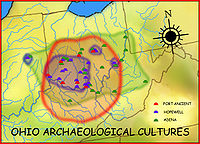
culture that existed from 1000 to 200 BC, in a time known as the early Woodland Period
Woodland period
The Woodland period of North American pre-Columbian cultures was from roughly 1000 BCE to 1000 CE in the eastern part of North America. The term "Woodland Period" was introduced in the 1930s as a generic header for prehistoric sites falling between the Archaic hunter-gatherers and the...
. The Adena culture refers to what were probably a number of related Native American societies sharing a burial complex and ceremonial system. The Adena lived in a variety of locations, including: Ohio
Ohio
Ohio is a Midwestern state in the United States. The 34th largest state by area in the U.S.,it is the 7th‑most populous with over 11.5 million residents, containing several major American cities and seven metropolitan areas with populations of 500,000 or more.The state's capital is Columbus...
, Indiana
Indiana
Indiana is a US state, admitted to the United States as the 19th on December 11, 1816. It is located in the Midwestern United States and Great Lakes Region. With 6,483,802 residents, the state is ranked 15th in population and 16th in population density. Indiana is ranked 38th in land area and is...
, West Virginia
West Virginia
West Virginia is a state in the Appalachian and Southeastern regions of the United States, bordered by Virginia to the southeast, Kentucky to the southwest, Ohio to the northwest, Pennsylvania to the northeast and Maryland to the east...
, Kentucky
Kentucky
The Commonwealth of Kentucky is a state located in the East Central United States of America. As classified by the United States Census Bureau, Kentucky is a Southern state, more specifically in the East South Central region. Kentucky is one of four U.S. states constituted as a commonwealth...
, and parts of Pennsylvania
Pennsylvania
The Commonwealth of Pennsylvania is a U.S. state that is located in the Northeastern and Mid-Atlantic regions of the United States. The state borders Delaware and Maryland to the south, West Virginia to the southwest, Ohio to the west, New York and Ontario, Canada, to the north, and New Jersey to...
and New York
New York
New York is a state in the Northeastern region of the United States. It is the nation's third most populous state. New York is bordered by New Jersey and Pennsylvania to the south, and by Connecticut, Massachusetts and Vermont to the east...
.
Importance
Adena sites are concentrated in a relatively small area - maybe 300 sites in the central Ohio Valley, with perhaps another 200 scattered throughout IndianaIndiana
Indiana is a US state, admitted to the United States as the 19th on December 11, 1816. It is located in the Midwestern United States and Great Lakes Region. With 6,483,802 residents, the state is ranked 15th in population and 16th in population density. Indiana is ranked 38th in land area and is...
, Kentucky
Kentucky
The Commonwealth of Kentucky is a state located in the East Central United States of America. As classified by the United States Census Bureau, Kentucky is a Southern state, more specifically in the East South Central region. Kentucky is one of four U.S. states constituted as a commonwealth...
, West Virginia
West Virginia
West Virginia is a state in the Appalachian and Southeastern regions of the United States, bordered by Virginia to the southeast, Kentucky to the southwest, Ohio to the northwest, Pennsylvania to the northeast and Maryland to the east...
and Pennsylvania
Pennsylvania
The Commonwealth of Pennsylvania is a U.S. state that is located in the Northeastern and Mid-Atlantic regions of the United States. The state borders Delaware and Maryland to the south, West Virginia to the southwest, Ohio to the west, New York and Ontario, Canada, to the north, and New Jersey to...
, although they may once have numbered in the thousands. The importance of the Adena complex comes from its considerable influence on other contemporary and succeeding cultures. The Adena culture is seen as the precursor to the traditions of the Hopewell culture
Hopewell culture
The Hopewell tradition is the term used to describe common aspects of the Native American culture that flourished along rivers in the northeastern and midwestern United States from 200 BCE to 500 CE. The Hopewell tradition was not a single culture or society, but a widely dispersed set of related...
, which are sometimes thought as an elaboration, or zenith, of Adena traditions.
The Adena were notable for their agricultural practices, pottery, artistic works and extensive trading network, which supplied them with a variety of raw materials, ranging from copper from the Great Lakes to shells from the Gulf Coast.
The Adena culture was named for the large mound on Thomas Worthington's early 19th-century estate called "Adena", in Chillicothe, Ohio
Chillicothe, Ohio
Chillicothe is a city in and the county seat of Ross County, Ohio, United States.Chillicothe was the first and third capital of Ohio and is located in southern Ohio along the Scioto River. The name comes from the Shawnee name Chalahgawtha, meaning "principal town", as it was a major settlement of...
.
Mounds
Lasting traces of Adena culture are still seen in their substantial earthworksEarthworks (archaeology)
In archaeology, earthwork is a general term to describe artificial changes in land level. Earthworks are often known colloquially as 'lumps and bumps'. Earthworks can themselves be archaeological features or they can show features beneath the surface...
. Once Adena mounds numbered in the hundreds, but only a number of Adena earthen monuments still survive today. These mound
Mound
A mound is a general term for an artificial heaped pile of earth, gravel, sand, rocks, or debris. The most common use is in reference to natural earthen formation such as hills and mountains, particularly if they appear artificial. The term may also be applied to any rounded area of topographically...
s generally ranged in size from 20 feet (6.1 m) to 300 feet (91.4 m) in diameter and served as burial structures, ceremonial sites, historical markers and possibly gathering places. These mounds were built using hundreds of thousands of baskets full of specially selected and graded earth. According to archaeological investigations, Adena mounds were usually built as part of burial ritual, in which the earth of the mound was piled immediately atop a burned mortuary building. These mortuary buildings were intended to keep and maintain the dead until their final burial was performed. Before the construction of the mounds, some utilitarian and grave goods would be placed on the floor of the structure, which was burned with the goods and honored dead within. The mound would then be constructed, and often a new mortuary structure would be placed atop the new mound. After a series of repetitions, mound/mortuary/mound/mortuary, a quite prominent earthwork would remain. In the later Adena period, circular ridges of unknown function were sometimes constructed around the burial mounds. Adena mounds stood in isolation from domestic living areas.
List of Mounds
| Site | Image | Description |
|---|---|---|
| Adena Mound (Ross County, Ohio) Adena Mound (Ross County, Ohio) Adena Mound, the type site for the Adena culture of prehistoric mound builders, is a registered historic structure, on the grounds of the Adena Mansion for which it is named, near Chillicothe, Ohio, listed in the National Register on June 5, 1975.... |
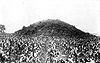 |
Adena Mound, the type site Type site In archaeology a type site is a site that is considered the model of a particular archaeological culture... for the culture, a registered historic structure near Chillicothe, Ohio Chillicothe, Ohio Chillicothe is a city in and the county seat of Ross County, Ohio, United States.Chillicothe was the first and third capital of Ohio and is located in southern Ohio along the Scioto River. The name comes from the Shawnee name Chalahgawtha, meaning "principal town", as it was a major settlement of... |
| Biggs Site Biggs Site The Biggs Site , also known as the Portsmouth Earthworks Group C, is an Adena culture archaeological site located near South Shore in Greenup County, Kentucky. Group C was originally a large series of concentric circular embankments and ditches surrounding a central conical burial mound... |
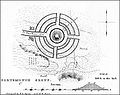 |
The site, located in Greenup County, Kentucky Greenup County, Kentucky Greenup County is a county located in the U.S. state of Kentucky. It was formed in 1804. As of 2000, the population was 36,891. Its county seat is Greenup. The county is named in honor of Christopher Greenup.... , is a conical abide surrounded by a series of circular ditches and embankments. It is connected to the Portsmouth Earthworks Portsmouth Earthworks The Portsmouth Earthworks are a large prehistoric mound complex constructed by the Ohio Hopewell culture mound builder indigenous peoples of eastern North America... directly across the Ohio River Ohio River The Ohio River is the largest tributary, by volume, of the Mississippi River. At the confluence, the Ohio is even bigger than the Mississippi and, thus, is hydrologically the main stream of the whole river system, including the Allegheny River further upstream... in Portsmouth, Ohio Portsmouth, Ohio Portsmouth is a city in the U.S. state of Ohio and the county seat of Scioto County. The municipality is located on the northern banks of the Ohio River and east of the Scioto River in Southern Ohio. The population was 20,226 at the 2010 census.-Foundation:... . |
| Criel Mound Criel Mound The Criel Mound is a Native American burial mound located in South Charleston, West Virginia, USA. The mound was built by the Adena culture, probably around 250-150 BC, and lay equidistant between two “sacred circles”, earthwork enclosures each in diameter. It was originally high and in... |
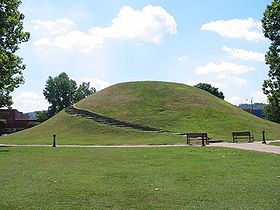 |
A 35 feet (10.7 m) high and 175 feet (53.3 m)-diameter conical mound, is the second largest of its type in West Virginia West Virginia West Virginia is a state in the Appalachian and Southeastern regions of the United States, bordered by Virginia to the southeast, Kentucky to the southwest, Ohio to the northwest, Pennsylvania to the northeast and Maryland to the east... . It is located in South Charleston, West Virginia South Charleston, West Virginia South Charleston is a city in Kanawha County, West Virginia, U.S. The population was 13,450 at the 2010 census. South Charleston was established in 1906, but not incorporated until 1919 by special charter enacted by the West Virginia Legislature... . P. W. Norris of the Smithsonian Institution Smithsonian Institution The Smithsonian Institution is an educational and research institute and associated museum complex, administered and funded by the government of the United States and by funds from its endowment, contributions, and profits from its retail operations, concessions, licensing activities, and magazines... oversaw the excavation. His team discovered numerous skeletons along with weapons and jewelry. |
| Enon Mound | Ohio's second largest conical Cone (geometry) A cone is an n-dimensional geometric shape that tapers smoothly from a base to a point called the apex or vertex. Formally, it is the solid figure formed by the locus of all straight line segments that join the apex to the base... burial mound, it is believed to have been built by the Adena. |
|
| Grave Creek Mound Grave Creek Mound At high and in diameter, the Grave Creek Mound is one of the largest conical type burial mounds in the United States. The builders of the site moved more than 60,000 tons of dirt to create it. It is located in Moundsville, West Virginia near the banks of the Ohio River. The first recorded... |
 |
At 69 feet (21 m) high and 295 feet (89.9 m) in diameter, is the largest conical-type burial mound in the United States. It is located in Moundsville, West Virginia Moundsville, West Virginia Moundsville is a city in Marshall County, West Virginia, along the Ohio River. It is part of the Wheeling Metropolitan Statistical Area. The population was 9,998 at the 2000 census. It is the county seat of Marshall County. The city was named for the Grave Creek Mound. Moundsville was settled in... . In 1838, much of the archaeological evidence in this mound was destroyed when several non-archaeologists tunneled into the mound. |
| Miamisburg Mound |  |
Once serving as an ancient burial site, the Mound is the most recognizable landmark in Miamisburg. It is the largest conical burial mound in Ohio Ohio Ohio is a Midwestern state in the United States. The 34th largest state by area in the U.S.,it is the 7th‑most populous with over 11.5 million residents, containing several major American cities and seven metropolitan areas with populations of 500,000 or more.The state's capital is Columbus... , and remains virtually intact. Located in a city park at 900 Mound Avenue, it is an Ohio historical site and serves as a popular attraction and picnic destination for area families. Visitors can climb to the top of the mound, via stone-masonry steps. |
| Wolf Plains Wolf Plains The Wolf Plains Group is a Late Adena culture group of 30 earthworks including 22 conical mounds and nine circular enclosures. The Plains, originally known as Wolf's Plains, located a few miles to the northwest of Athens, is a relatively flat terrace in an area of hilly terrain in southeastern... Group |
A Late Adena group of 30 earthworks including 22 conical mounds and nine circular enclosures. located a few miles to the northwest of Athens, Ohio Athens, Ohio Athens is the largest city in, and the county seat of, Athens County, Ohio, United States. It is located along the Hocking River in the southeastern part of Ohio. A historic college town, Athens is home to Ohio University and is the principal city of the Athens, Ohio Micropolitan Statistical Area. ... , |
|
Shamanism
Although the mounds are beautiful artistic achievements themselves, Adena artists created smaller, more personal pieces of art. Art motifs that became important to many later Native Americans began with the Adena. Motifs such as the weeping eye and cross and circle design, became mainstays in many succeeding cultures. Many pieces of art seemed to revolve around shamanicShamanism
Shamanism is an anthropological term referencing a range of beliefs and practices regarding communication with the spiritual world. To quote Eliade: "A first definition of this complex phenomenon, and perhaps the least hazardous, will be: shamanism = technique of ecstasy." Shamanism encompasses the...
practices, and the transformation of humans into animals—particularly birds, wolves, bears and deer—and back to human form. This may indicate a belief that the practice imparted the animals' qualities to the wearer or holder of the objects. Deer antlers, both real and constructed of copper, wolf, deer and mountain lion jawbones, and many other objects were fashioned into costumes, necklaces and other forms of regalia by the Adena. Distinctive tubular smoking pipes, with either flattened or blocked-end mouthpieces, suggest the offering of smoke to the spirits. The objective of pipe smoking may have been altered states of consciousness, achieved through the use of the hallucinogenic plant Nicotiana rustica
Nicotiana rustica
Nicotiana rustica, known in South America as Mapacho and in Vietnam as Thuoc Lao , is a plant in the Solanaceae family. It is a very potent variety of tobacco. The high concentration of nicotine in its leaves makes it useful for creating organic pesticides.Rustica is also used for entheogenic...
. All told, Adena was a manifestation of a broad regional increase in the number and kind of artifacts devoted to spiritual needs.
Stone tablets
The Adena also carved small stone tablets, usually 4 or 5 inches by 3 or 4 inches by .5 inches thick. On one or both flat sides were gracefully composed stylized zoomorphs or curvilinear geometric designs in deep relief. Paint has been found on some Adena tablets, leading archaeologists to propose that these stone tablets were probably used to stamp designs on cloth or animal hides, or onto their own bodies. Its possible they were used to outline designs for tattooTattoo
A tattoo is made by inserting indelible ink into the dermis layer of the skin to change the pigment. Tattoos on humans are a type of body modification, and tattoos on other animals are most commonly used for identification purposes...
ing.
Pottery
Unlike in other cultures, Adena potteryNative American pottery
Native American pottery is an art form with at least a 7500-year history in the Americas. Pottery is fired ceramics with clay as a component. Ceramics are used for utilitarian cooking vessels, serving and storage vessels, pipes, funerary urns, censers, musical instruments, ceremonial items, masks,...
was not buried with the dead or the remains of the cremated, as were other artifacts. Usually tempered with grit or crushed limestone, it was largely plain, cord-marked or fabric marked, although one type bore a nested-diamond design incised into its surface. The vessel shapes were sub-conoidal or flat-bottomed jars, sometimes with small foot-like supports.
Settlement patterns
The large and elaborate mound sites served a nearby scattering of people. The population was dispersed in small settlements of one to two structures. A typical house was built in a circle form from 15 to 45 feet in diameter. The walls were made of paired posts tilted outward, joined to other wood to form a cone shaped roof. The roof was then covered with bark and the walls may have been bark and/or wickerwork.Food sources
Their subsistence was acquired through foraging and the cultivation of native plants.- Hunted deer, elk, black bear, woodchuck, beaver, porcupine, turkey, trumpeter swan, ruffed grouse
- Gathered several edible seed grasses and nuts.
- Cultivated pumpkinPumpkinA pumpkin is a gourd-like squash of the genus Cucurbita and the family Cucurbitaceae . It commonly refers to cultivars of any one of the species Cucurbita pepo, Cucurbita mixta, Cucurbita maxima, and Cucurbita moschata, and is native to North America...
, squash, sunflowerSunflowerSunflower is an annual plant native to the Americas. It possesses a large inflorescence . The sunflower got its name from its huge, fiery blooms, whose shape and image is often used to depict the sun. The sunflower has a rough, hairy stem, broad, coarsely toothed, rough leaves and circular heads...
, and goosefootChenopodiumChenopodium is a genus of about 150 species of perennial or annual herbaceous flowering plants known as the goosefoots, which occur almost anywhere in the world. It is placed in the family Amaranthaceae in the APG II system; older classifications separate it and its relatives as Chenopodiaceae, but...
.
Tools
The Adena ground stone tools and axes. Somewhat rougher slab-like stones with chipped edges were probably used as hoes. Bone and antler were used in small tools but even more prominently in ornamental objects such as beads, combs, and worked animal-jaw gorgetGorget
A gorget originally was a steel or leather collar designed to protect the throat. It was a feature of older types of armour and intended to protect against swords and other non-projectile weapons...
s or paraphernalia. Spoons, beads and other implements were made from the marine conch
Conch
A conch is a common name which is applied to a number of different species of medium-sized to large sea snails or their shells, generally those which are large and have a high spire and a siphonal canal....
. A few copper axes have been found, but otherwise the metal was hammered into ornamental forms, such as bracelets, rings, beads, and reel-shaped pendants.
See also
- Hopewell tradition
External links
- Ohio Memory
- Ohio Historical Society's Archaeology Page
- The Adena Culture, Virtual First Ohioans