

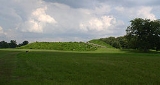
Angel Mounds

Encyclopedia
Angel Mounds State Historic Site is located on the Ohio River
in Vanderburgh
and Warrick
Counties eight miles (13 km) southeast of Evansville
and just upriver of the confluence of the Green
and Ohio rivers. Administered by the Indiana Department of Natural Resources
, Division of Indiana State Museum
s and Historic Sites, it is one of 16 state museums and historic sites. In 1964 this major complex of earthworks
was designated a National Historic Landmark
because of its significance. It is named after the Angel family who in the early 19th century owned the property on which it is located along the Ohio River
.
, who settled near the rivers and used them for travel and trade.
Beginning after 1000, people of the Mississippian culture
built a town at this site, covering 100 acre (0.404686 km²) and situated on a large, terraced mound near the river. Today, Angel Mounds State Historic Site is nationally recognized as one of the best-preserved prehistoric
Native American sites in the United States. It was given National Historic Landmark status as part of this recognition. This site is the most northeastern of the Mississippian culture
. Continuing excavations reveal new elements of the complex society.
From 1100 to 1450, people of the Middle Mississippian culture
built and lived in a town on this site. They were known for building characteristic earthwork mounds, with shapes including platform, conical and ridgetop (as seen at Cahokia
.) Angel Mounds was a chiefdom
(the base of the chief
) and the regional center of a large residential and agricultural community that extended for several miles around. They built a major earthwork, working with a variety of soils to create a stable mass. The platform mound held their central community. They traded with other chiefdoms and peoples along the Ohio and Mississippi
rivers. This settlement was the largest-known town of its time in Indiana. Scholars estimate its population at several thousand.
The town might have contained as many as 1000 residents in its heyday. Distinctive pottery here and in other satellite communities in this section of the Ohio River valley define the Angel phase. Archaeologists infer that the smaller communities were politically subordinate to the main site.
The people engaged in hunting and farming on the rich bottom lands of the Ohio River
. In addition to the mounds they built for ceremonial and cosmological purposes, they constructed a defensive 12 feet (3.7 m)-high stockade
made of wattle and daub
, and punctuated with bastions.
 The Mississippian people deserted the site long before Europe
an contact. No one knows why the civilization declined, but scholars have speculated that an extended regional drought reduced the maize surpluses that had enabled the concentration of population. In addition, the people may have overhunted, as well as reducing forests by their consumption of wood for the stockade and houses. Archaeologists theorize that with the collapse of the chiefdom by 1450, many of the Angel people had relocated downriver to the confluence of the Ohio and Wabash River
s. A new Late Mississippian cultural group subsequently emerged and are known as the Caborn-Welborn culture.
Groups of Shawnee
, Miami, and other tribes moved into this area about 1650 CE, after the Mississippians abandoned the town at Angel Mounds. Later, European-American settlers farmed the land. Much like the Native Americans, they were lured by the rich soil and temperate growing season. One of the families to settle in southwestern Indiana was headed by Mathias Angel. He had a farmstead on the site of Angel Mounds from 1852 until his death in 1899. His brothers owned adjacent farms, and the land remained in the Angel family until 1938. Angel Mounds State Historic Site is named after this family.
In 1938, the Indiana Historical Society purchased 480 acres of the Angel family property to protect the historically valuable site. Eli Lilly donated the money for the purchase. In 1946, the Historical Society gave the property to the State of Indiana, and in 1965 gave excavation rights to Indiana University. The original purchase was augmented by Elda Clayton Herts' donation of 20 acres containing an early Woodland mound.
WPA workers under the direction of Glenn A. Black began scientific excavations in the 1930s, and Indiana University has continued archaeological research there since 1945.
Preservation and archaeology
excavations at Angel Mounds State Historic Site offer a glimpse into this highly developed culture. For 60 years, this living museum has told the story of a major pre-contact Native American culture on the Ohio River.
Archaeological work at Angel Mounds is conducted by the Glenn A. Black Laboratory of Archaeology, Indiana University
. This institution was named after Glenn Albert Black
, the archaeologist who conducted most of the excavations at Angel Mounds. He brought the site to national attention. His two-volume study (1967) of the site remains the definitive work.
It was declared a National Historic Landmark
in 1964.
In May 2006, researchers discovered a probable pottery-making workshop at the site. This discovery revealed the artistic skills of the indigenous people who inhabited the area. Found during the season's excavation were pottery tools and masses of prepared, slightly fired clay awaiting shaping into bowls, jars or figures.
found this location by the Ohio River ideal for agricultural purposes, as annual spring floods replenished the nutrients in the soil and allowed cultivation of maize. The fertile soil enabled production of surplus crops, which the Mississippian people used for trade and to support a large enough population to develop artisan and craft specialties. The town became the center of a regional chiefdom.
The people planned and constructed the town on the third terrace of an earthen mound, above the area flooded on a regular basis, yet close to the fields. A slough
surrounds the town on three sides, making it a virtual island, with the river on the fourth side. When the site was first settled, the slough was deeper and the people kept it clear of brush and trees. The community sits atop a terrace looking south across a narrow channel toward Three Mile Island (Kentucky
). The chute and island, which existed during the time Angel Mounds was inhabited, created a quiet backwater suitable for using canoes, collecting water, and bathing. Until near the end of the 19th century, the Ohio River was clear and potable.
 Archaeological excavation revealed that the town was surrounded by a stockade, with the Ohio River
acting as a barrier on the south side. A gateway was placed to the east, about a fourth of the way around from where the eastern flank of the stockade meets the river. A second barrier, a type of picket fence, was set 14 feet (4.3 m) outside the stockade. It was designed to slow the attackers as they came into range.
In 1972 the park reconstructed part of the stockade, based on archeological evidence. It stands 12’ high and is made of wooden posts set four feet into a narrow trench. The posts are covered with wattle and daub
, a loose weaving of sticks covered with a mud-and-grass plaster. They also reconstructed the defensive bastions, built every 10 to 11 feet (3.4 m) and projecting 11 to 12 feet (3.7 m) from the wall. The original people planned the bastions at distances which defenders could cover with arrows or lances, thus protecting the walls from a direct attack.
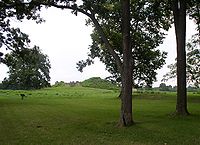 Central Mound
Mound A, also called the central mound
, is the highest in the complex. It contains two levels, with a conical mound in the southeast corner. The base mound is 644 feet (196.3 m) long and 415 feet (126.5 m) wide. Villagers carried 67,785 cubic yards of dirt in baskets from the chute along the south side of the village to create the mound. The lower terrace is 100 feet (30.5 m) by 100 feet (30.5 m) and is located on the south side of the mound. The upper terrace is 28 feet (8.5 m) above the surrounding area and is larger than the lower terrace.
The state constructed a modern stairway ascending the mound to protect it from erosion of pedestrian traffic. Archeological evidence suggests there may have been a log stairway in prehistoric times.
Based on reports from early European explorers in the southeastern United States, this mound was likely the residence of the hereditary chief of the town and the surrounding communities. The regional center had associated settlements and hamlets within a 70 miles (112.7 km) radius of Angel Mounds.
valley in Illinois
, Kentucky, and Indiana, the Mississippian-culture towns of Kincaid
, Wickliffe
, Tolu
, and Angel Mounds have been grouped together into a "Kincaid Focus" set, due to similarities in pottery assemblages and site plans. Most striking are the comparisons between the Kincaid and Angel sites, which include analogous site plans, stylistic similarities in artifacts, and geographic proximity. These connections have led some scholars to hypothesize that the builders and residents were of the same society.
The 300-400 year span in which these types of artifacts and sites are found is called the “Angel Phase
”. It is broken up into three subphases:
Rare painted and incised sherds of Mississippian culture pottery
have been found at all four sites, ranging from less than one percent near Kincaid to about three or four percent of the assemblage at Wickliffe. Some common pottery styles found in these sites include: Angel Negative Painted, Kincaid Negative Painted, and Matthews Incised. This pottery is shell-tempered and ranges from the smoothed surface and coarser temper of Mississippi Ware to the more polished surface and finer temper of Bell Ware.
Ohio River
The Ohio River is the largest tributary, by volume, of the Mississippi River. At the confluence, the Ohio is even bigger than the Mississippi and, thus, is hydrologically the main stream of the whole river system, including the Allegheny River further upstream...
in Vanderburgh
Vanderburgh County, Indiana
As of the census of 2000, there were 171,922 people, 70,623 households, and 44,421 families residing in the county. The population density was 733 people per square mile . There were 76,300 housing units at an average density of 325 per square mile...
and Warrick
Warrick County, Indiana
As of the census of 2000, there were 52,383 people, 19,438 households, and 15,181 families residing in the county. The population density was 136 people per square mile . There were 20,546 housing units at an average density of 54 per square mile...
Counties eight miles (13 km) southeast of Evansville
Evansville, Indiana
Evansville is the third-largest city in the U.S. state of Indiana and the largest city in Southern Indiana. As of the 2010 census, the city had a total population of 117,429. It is the county seat of Vanderburgh County and the regional hub for both Southwestern Indiana and the...
and just upriver of the confluence of the Green
Green River (Kentucky)
The Green River is a tributary of the Ohio River that rises in Lincoln County in south-central Kentucky. Tributaries of the Green River include the Barren River, the Nolin River, the Pond River and the Rough River...
and Ohio rivers. Administered by the Indiana Department of Natural Resources
Indiana Department of Natural Resources
The Indiana Department of Natural Resources is the agency of the U.S. state of Indiana charged with maintaining natural areas such as state parks, state forests, recreation areas, etc...
, Division of Indiana State Museum
Museum
A museum is an institution that cares for a collection of artifacts and other objects of scientific, artistic, cultural, or historical importance and makes them available for public viewing through exhibits that may be permanent or temporary. Most large museums are located in major cities...
s and Historic Sites, it is one of 16 state museums and historic sites. In 1964 this major complex of earthworks
Earthworks (archaeology)
In archaeology, earthwork is a general term to describe artificial changes in land level. Earthworks are often known colloquially as 'lumps and bumps'. Earthworks can themselves be archaeological features or they can show features beneath the surface...
was designated a National Historic Landmark
National Historic Landmark
A National Historic Landmark is a building, site, structure, object, or district, that is officially recognized by the United States government for its historical significance...
because of its significance. It is named after the Angel family who in the early 19th century owned the property on which it is located along the Ohio River
Ohio River
The Ohio River is the largest tributary, by volume, of the Mississippi River. At the confluence, the Ohio is even bigger than the Mississippi and, thus, is hydrologically the main stream of the whole river system, including the Allegheny River further upstream...
.
History
For thousands of years, southwestern Indiana was home to Native AmericansNative Americans in the United States
Native Americans in the United States are the indigenous peoples in North America within the boundaries of the present-day continental United States, parts of Alaska, and the island state of Hawaii. They are composed of numerous, distinct tribes, states, and ethnic groups, many of which survive as...
, who settled near the rivers and used them for travel and trade.
Beginning after 1000, people of the Mississippian culture
Mississippian culture
The Mississippian culture was a mound-building Native American culture that flourished in what is now the Midwestern, Eastern, and Southeastern United States from approximately 800 CE to 1500 CE, varying regionally....
built a town at this site, covering 100 acre (0.404686 km²) and situated on a large, terraced mound near the river. Today, Angel Mounds State Historic Site is nationally recognized as one of the best-preserved prehistoric
Prehistory
Prehistory is the span of time before recorded history. Prehistory can refer to the period of human existence before the availability of those written records with which recorded history begins. More broadly, it refers to all the time preceding human existence and the invention of writing...
Native American sites in the United States. It was given National Historic Landmark status as part of this recognition. This site is the most northeastern of the Mississippian culture
Mississippian culture
The Mississippian culture was a mound-building Native American culture that flourished in what is now the Midwestern, Eastern, and Southeastern United States from approximately 800 CE to 1500 CE, varying regionally....
. Continuing excavations reveal new elements of the complex society.
From 1100 to 1450, people of the Middle Mississippian culture
Mississippian culture
The Mississippian culture was a mound-building Native American culture that flourished in what is now the Midwestern, Eastern, and Southeastern United States from approximately 800 CE to 1500 CE, varying regionally....
built and lived in a town on this site. They were known for building characteristic earthwork mounds, with shapes including platform, conical and ridgetop (as seen at Cahokia
Cahokia
Cahokia Mounds State Historic Site is the area of an ancient indigenous city located in the American Bottom floodplain, between East Saint Louis and Collinsville in south-western Illinois, across the Mississippi River from St. Louis, Missouri. The site included 120 human-built earthwork mounds...
.) Angel Mounds was a chiefdom
Chiefdom
A chiefdom is a political economy that organizes regional populations through a hierarchy of the chief.In anthropological theory, one model of human social development rooted in ideas of cultural evolution describes a chiefdom as a form of social organization more complex than a tribe or a band...
(the base of the chief
Tribal chief
A tribal chief is the leader of a tribal society or chiefdom. Tribal societies with social stratification under a single leader emerged in the Neolithic period out of earlier tribal structures with little stratification, and they remained prevalent throughout the Iron Age.In the case of ...
) and the regional center of a large residential and agricultural community that extended for several miles around. They built a major earthwork, working with a variety of soils to create a stable mass. The platform mound held their central community. They traded with other chiefdoms and peoples along the Ohio and Mississippi
Mississippi River
The Mississippi River is the largest river system in North America. Flowing entirely in the United States, this river rises in western Minnesota and meanders slowly southwards for to the Mississippi River Delta at the Gulf of Mexico. With its many tributaries, the Mississippi's watershed drains...
rivers. This settlement was the largest-known town of its time in Indiana. Scholars estimate its population at several thousand.
The town might have contained as many as 1000 residents in its heyday. Distinctive pottery here and in other satellite communities in this section of the Ohio River valley define the Angel phase. Archaeologists infer that the smaller communities were politically subordinate to the main site.
The people engaged in hunting and farming on the rich bottom lands of the Ohio River
Ohio River
The Ohio River is the largest tributary, by volume, of the Mississippi River. At the confluence, the Ohio is even bigger than the Mississippi and, thus, is hydrologically the main stream of the whole river system, including the Allegheny River further upstream...
. In addition to the mounds they built for ceremonial and cosmological purposes, they constructed a defensive 12 feet (3.7 m)-high stockade
Stockade
A stockade is an enclosure of palisades and tall walls made of logs placed side by side vertically with the tops sharpened to provide security.-Stockade as a security fence:...
made of wattle and daub
Wattle and daub
Wattle and daub is a composite building material used for making walls, in which a woven lattice of wooden strips called wattle is daubed with a sticky material usually made of some combination of wet soil, clay, sand, animal dung and straw...
, and punctuated with bastions.
Europe
Europe is, by convention, one of the world's seven continents. Comprising the westernmost peninsula of Eurasia, Europe is generally 'divided' from Asia to its east by the watershed divides of the Ural and Caucasus Mountains, the Ural River, the Caspian and Black Seas, and the waterways connecting...
an contact. No one knows why the civilization declined, but scholars have speculated that an extended regional drought reduced the maize surpluses that had enabled the concentration of population. In addition, the people may have overhunted, as well as reducing forests by their consumption of wood for the stockade and houses. Archaeologists theorize that with the collapse of the chiefdom by 1450, many of the Angel people had relocated downriver to the confluence of the Ohio and Wabash River
Wabash River
The Wabash River is a river in the Midwestern United States that flows southwest from northwest Ohio near Fort Recovery across northern Indiana to southern Illinois, where it forms the Illinois-Indiana border before draining into the Ohio River, of which it is the largest northern tributary...
s. A new Late Mississippian cultural group subsequently emerged and are known as the Caborn-Welborn culture.
Groups of Shawnee
Shawnee
The Shawnee, Shaawanwaki, Shaawanooki and Shaawanowi lenaweeki, are an Algonquian-speaking people native to North America. Historically they inhabited the areas of Ohio, Virginia, West Virginia, Western Maryland, Kentucky, Indiana, and Pennsylvania...
, Miami, and other tribes moved into this area about 1650 CE, after the Mississippians abandoned the town at Angel Mounds. Later, European-American settlers farmed the land. Much like the Native Americans, they were lured by the rich soil and temperate growing season. One of the families to settle in southwestern Indiana was headed by Mathias Angel. He had a farmstead on the site of Angel Mounds from 1852 until his death in 1899. His brothers owned adjacent farms, and the land remained in the Angel family until 1938. Angel Mounds State Historic Site is named after this family.
In 1938, the Indiana Historical Society purchased 480 acres of the Angel family property to protect the historically valuable site. Eli Lilly donated the money for the purchase. In 1946, the Historical Society gave the property to the State of Indiana, and in 1965 gave excavation rights to Indiana University. The original purchase was augmented by Elda Clayton Herts' donation of 20 acres containing an early Woodland mound.
WPA workers under the direction of Glenn A. Black began scientific excavations in the 1930s, and Indiana University has continued archaeological research there since 1945.
Preservation and archaeology
Archaeology
Archaeology, or archeology , is the study of human society, primarily through the recovery and analysis of the material culture and environmental data that they have left behind, which includes artifacts, architecture, biofacts and cultural landscapes...
excavations at Angel Mounds State Historic Site offer a glimpse into this highly developed culture. For 60 years, this living museum has told the story of a major pre-contact Native American culture on the Ohio River.
Archaeological work at Angel Mounds is conducted by the Glenn A. Black Laboratory of Archaeology, Indiana University
Indiana University Bloomington
Indiana University Bloomington is a public research university located in Bloomington, Indiana, in the United States. IU Bloomington is the flagship campus of the Indiana University system. Being the flagship campus, IU Bloomington is often referred to simply as IU or Indiana...
. This institution was named after Glenn Albert Black
Glenn Albert Black
Glenn Albert Black was an influential archaeologist of the United States who was the first professional to study Indiana prehistoric sites. He was born 18 August 1900 in Indianapolis, Indiana and died 2 September 1964....
, the archaeologist who conducted most of the excavations at Angel Mounds. He brought the site to national attention. His two-volume study (1967) of the site remains the definitive work.
It was declared a National Historic Landmark
National Historic Landmark
A National Historic Landmark is a building, site, structure, object, or district, that is officially recognized by the United States government for its historical significance...
in 1964.
In May 2006, researchers discovered a probable pottery-making workshop at the site. This discovery revealed the artistic skills of the indigenous people who inhabited the area. Found during the season's excavation were pottery tools and masses of prepared, slightly fired clay awaiting shaping into bowls, jars or figures.
Setting
The Mississippian farmersMississippian culture
The Mississippian culture was a mound-building Native American culture that flourished in what is now the Midwestern, Eastern, and Southeastern United States from approximately 800 CE to 1500 CE, varying regionally....
found this location by the Ohio River ideal for agricultural purposes, as annual spring floods replenished the nutrients in the soil and allowed cultivation of maize. The fertile soil enabled production of surplus crops, which the Mississippian people used for trade and to support a large enough population to develop artisan and craft specialties. The town became the center of a regional chiefdom.
The people planned and constructed the town on the third terrace of an earthen mound, above the area flooded on a regular basis, yet close to the fields. A slough
Slough
Slough is a borough and unitary authority within the ceremonial county of Royal Berkshire, England. The town straddles the A4 Bath Road and the Great Western Main Line, west of central London...
surrounds the town on three sides, making it a virtual island, with the river on the fourth side. When the site was first settled, the slough was deeper and the people kept it clear of brush and trees. The community sits atop a terrace looking south across a narrow channel toward Three Mile Island (Kentucky
Kentucky
The Commonwealth of Kentucky is a state located in the East Central United States of America. As classified by the United States Census Bureau, Kentucky is a Southern state, more specifically in the East South Central region. Kentucky is one of four U.S. states constituted as a commonwealth...
). The chute and island, which existed during the time Angel Mounds was inhabited, created a quiet backwater suitable for using canoes, collecting water, and bathing. Until near the end of the 19th century, the Ohio River was clear and potable.
Stockade
Ohio River
The Ohio River is the largest tributary, by volume, of the Mississippi River. At the confluence, the Ohio is even bigger than the Mississippi and, thus, is hydrologically the main stream of the whole river system, including the Allegheny River further upstream...
acting as a barrier on the south side. A gateway was placed to the east, about a fourth of the way around from where the eastern flank of the stockade meets the river. A second barrier, a type of picket fence, was set 14 feet (4.3 m) outside the stockade. It was designed to slow the attackers as they came into range.
In 1972 the park reconstructed part of the stockade, based on archeological evidence. It stands 12’ high and is made of wooden posts set four feet into a narrow trench. The posts are covered with wattle and daub
Wattle and daub
Wattle and daub is a composite building material used for making walls, in which a woven lattice of wooden strips called wattle is daubed with a sticky material usually made of some combination of wet soil, clay, sand, animal dung and straw...
, a loose weaving of sticks covered with a mud-and-grass plaster. They also reconstructed the defensive bastions, built every 10 to 11 feet (3.4 m) and projecting 11 to 12 feet (3.7 m) from the wall. The original people planned the bastions at distances which defenders could cover with arrows or lances, thus protecting the walls from a direct attack.
Mounds
Mound A, also called the central mound
Platform mound
A platform mound is any earthwork or mound intended to support a structure or activity.-Eastern North America:The indigenous peoples of North America built substructure mounds for well over a thousand years starting in the Archaic period and continuing through the Woodland period...
, is the highest in the complex. It contains two levels, with a conical mound in the southeast corner. The base mound is 644 feet (196.3 m) long and 415 feet (126.5 m) wide. Villagers carried 67,785 cubic yards of dirt in baskets from the chute along the south side of the village to create the mound. The lower terrace is 100 feet (30.5 m) by 100 feet (30.5 m) and is located on the south side of the mound. The upper terrace is 28 feet (8.5 m) above the surrounding area and is larger than the lower terrace.
The state constructed a modern stairway ascending the mound to protect it from erosion of pedestrian traffic. Archeological evidence suggests there may have been a log stairway in prehistoric times.
Based on reports from early European explorers in the southeastern United States, this mound was likely the residence of the hereditary chief of the town and the surrounding communities. The regional center had associated settlements and hamlets within a 70 miles (112.7 km) radius of Angel Mounds.
Kincaid Focus
In the lower Ohio RiverOhio River
The Ohio River is the largest tributary, by volume, of the Mississippi River. At the confluence, the Ohio is even bigger than the Mississippi and, thus, is hydrologically the main stream of the whole river system, including the Allegheny River further upstream...
valley in Illinois
Illinois
Illinois is the fifth-most populous state of the United States of America, and is often noted for being a microcosm of the entire country. With Chicago in the northeast, small industrial cities and great agricultural productivity in central and northern Illinois, and natural resources like coal,...
, Kentucky, and Indiana, the Mississippian-culture towns of Kincaid
Kincaid Mounds State Historic Site
The Kincaid Mounds Historic Site, circa 1050-1400 CE, was among the largest prehistoric Mississippian culture chiefdom centers, located at the southern tip of present day U.S. state of Illinois...
, Wickliffe
Wickliffe Mounds
Wickliffe Mounds is a prehistoric, Mississippian culture archaeological site located in Ballard County, Kentucky, just outside the town of Wickliffe, about three miles from the confluence of the Ohio and Mississippi rivers. Archaeology investigations have linked the site with others along the Ohio...
, Tolu
Tolu Site
The Tolu Site is a prehistoric archeological site of the Mississippian culture near the unincorporated community of Tolu, Crittenden County, Kentucky, United States. It was built and occupied between 1200-1450 CE. No carbon dating has been performed at the site, but analysis of pottery styles...
, and Angel Mounds have been grouped together into a "Kincaid Focus" set, due to similarities in pottery assemblages and site plans. Most striking are the comparisons between the Kincaid and Angel sites, which include analogous site plans, stylistic similarities in artifacts, and geographic proximity. These connections have led some scholars to hypothesize that the builders and residents were of the same society.
The 300-400 year span in which these types of artifacts and sites are found is called the “Angel Phase
Angel Phase
The Angel Phase describes a 300-400-year cultural manifestation of the Mississippian culture of the central portions of the United States of America, as defined in the discipline of archaeology. Angel Phase archaeological sites date from c...
”. It is broken up into three subphases:
| Subphases | Dates |
|---|---|
| Jonathan Creek | 1000 - 1100/1200 |
| Angelly | 1200 - 1300 |
| Tinsley Hill | 1300 - 1450 |
Rare painted and incised sherds of Mississippian culture pottery
Mississippian culture pottery
Mississippian culture pottery is the ceramic tradition of the Mississippian culture found as artifacts in archaeological sites in the American Midwest and Southeast. It is often characterized by the adoption and use of riverine shell-tempering agents in the clay paste. Shell tempering is one of...
have been found at all four sites, ranging from less than one percent near Kincaid to about three or four percent of the assemblage at Wickliffe. Some common pottery styles found in these sites include: Angel Negative Painted, Kincaid Negative Painted, and Matthews Incised. This pottery is shell-tempered and ranges from the smoothed surface and coarser temper of Mississippi Ware to the more polished surface and finer temper of Bell Ware.
See also
- Angel PhaseAngel PhaseThe Angel Phase describes a 300-400-year cultural manifestation of the Mississippian culture of the central portions of the United States of America, as defined in the discipline of archaeology. Angel Phase archaeological sites date from c...
- Mississippian cultureMississippian cultureThe Mississippian culture was a mound-building Native American culture that flourished in what is now the Midwestern, Eastern, and Southeastern United States from approximately 800 CE to 1500 CE, varying regionally....
- Caborn-Welborn culture
- Southeastern Ceremonial ComplexSoutheastern Ceremonial ComplexThe Southeastern Ceremonial Complex is the name given to the regional stylistic similarity of artifacts, iconography, ceremonies, and mythology of the Mississippian culture that coincided with their adoption of maize agriculture and chiefdom-level complex social organization from...
- Mississippian stone statuaryMississippian stone statuaryThe Mississippian stone statuary are artifacts of polished stone in the shape of human figurines made by members of the Mississippian culture and found in archaeological sites in the American Midwest and Southeast...
- List of Mississippian sites
External links
- Angel Mounds website
- Friends of Angel Mounds
- Kincaid Mounds Website
- "Angel Mounds Hiking and Biking ", Southern Indiana Trails