

K-League

Encyclopedia
The Korea Professional Football League (K-League) is South Korea
's only fully professional association football league. At the top of the South Korean football league system
, it is the country's highest and most prestigious level of football competition currently contested by 16 clubs.
, POSCO Dolphins
, Daewoo Royals, Kookmin Bank FC
. Hallelujah FC won the inaugural title, finishing one point ahead of Daewoo FC to lift the crown.
In 1998, Korea's football league was reformed and renamed the K-League. Since its creation, the league has expanded from an initial 5 to 15 clubs. Of the 5 inaugural clubs, only Yukong Kokkiri
, POSCO Dolphins
, and Daewoo Royals remain in the K-League; Kookmin Bank FC
dropped out of the league at the end of 1984, and Hallelujah FC followed the season after.
Below the level of the K-League there is the National League, a closed semi-professional/amateur league with fifteen clubs, established in 2003. The third level of football in Korea is the Challengers League.
There is, at present, no official system of promotion and relegation between any of the three leagues. However, beginning in 2006, the champions of the National League had been eligible for promotion to the K-League provided they had met certain criteria. Goyang Kookmin Bank and Ulsan Mipo Dockyard, National League champions in 2006 and 2007 respectively, both rejected the opportunity to move up to the K-League. After back-to-back K-League promotion refusals, the National League committee decided to discontinue the conditional promotion system prior to the 2008 season.
The sixteen member clubs play each other twice in the regular season giving a total of 30 matches. The top six sides at the end of the regular season will enter the championship playoffs, which decide final standings of the season among the six. In the first two matches, the third-placed team will face the sixth-placed team and the fourth-placed team will face the fifth-placed team, with the two winners then playing off for the right to face the second-placed team. The winner of that match will then progress to the two-legged championship playoff final where the first-placed side lie in wait, with the overall winner of the home and away series being crowned champions for 2009.
The K-League champions, runner-up and third place gain entry to the AFC Champions League
the following season, with the exception of Sangmu, due to their unique status as an army team, and therefore non-professional.
A number of the member clubs are owned by major Korean Chaebols
, and the club names reflect that fact. Clubs have adopted local city names in an effort to integrate themselves more with the local communities; for example, Daewoo evolved over the years into Daewoo Royals, Busan Daewoo Royals, Busan I'cons and latterly Busan I'Park.
Following the 2002 FIFA World Cup
, leaders of the K-League had hoped to transfer South Korea’s passion for its National Team to the domestic league. However, the K-League continued to flounder. Although a number of K-League clubs have relocated in the past, the Lucky Goldstar (LG) corporation caused a huge controversy at the end of 2003 when they made the decision to uproot their Anyang LG Cheetahs
from the Seoul
satellite city of Anyang and move into the empty Seoul World Cup stadium
, becoming FC Seoul
. Then following the 2005 season SK announced it was moving the Bucheon SK
FC to the island of Jeju
, where they became Jeju United
.
In the 2009 season, Gangwon FC
(Head Coach: Choi Sun-Ho, former Ulsan Hyundai Mipo Chosun head coach) joined the K-League as it's 15th member club. As such, the K-League had one or more club in every Korean Province
(Capital
, Gyeongsang
, Jeolla
, Jeonnam
, Chungcheong
, Gangwon
, Jeju
) in Korea.
This is the first time in domestic Korean professional sports history that there has been at least two clubs in each Korean province.
On April 5, 2010, Gwangju
City has announced a plan to establish a football club by end of 2010 & to join the league from the 2011 season. On October 12, 2010, the club was approved to join the league as 16th member club.
On October 5, 2011, the league announced a plan to introduce a relegation system from 2012 season. A number of teams of the league will decreased to 12 teams from 2013 season. 4 teams will be relegated to next level league based on the standing of 2012 season. And, the league introduce a split system like Scottish Premier League
from 2012 season.
The following 16 clubs will compete in the K-League during the 2011 season.
The roll-call of champions is as follows (present-date names included where teams have changed names previously):
[1] Yokong renamed to SK Energy
[2] GS Group
is separated from LG Group
[3] Hanil Bank is merged by Woori Bank
Note : Kokkiri means elephant, Horang-i means tiger, Hwangso means bull, Chunma means pegasus, Bulsajo means phoenix.
[1] K-League officially began city franchise policy in 1990, But Pohang Stleeers began in 1988 and Busan I'Park began in 1989.
[2] Actually Bucheon SK held all home matches at Mokdong Stadium
in Seoul until 2000. Because Bucheon Stadium
was under construction.
At the inception of the K-League in 1983, only two Brazilian players made rosters. At the time, rules allowed each club to have three foreign players and that the three could also play simultaneously in a game. From the 1996 season, each team had five foreign players among whom three could play in a game at the same time. Moreover,
from the 2000 season to the 2002 season, the limit on foreign players was expanded seven but only three could play in a game at the same time. The limit was lower to five in 2003, four in 2005, and three in 2007. From the 2009 season, the number of foreign players went back up to four per team, including a slot for a player from AFC
countries.
In the 1985 season, Piyapong Pue-on
of Thailand
led foreign players in the league in scoring and assists. Other leading players were Rade Bogdanović
, who had 10 goals and 10 assists in the 1996 season. Valeri Sarychev
, the K-League's most famous foreign goalkeeper, played in 320 league games from 1992 to 2004. He was eventually naturalized as a Korean citizen and given the Korean name Shin Eui-Son which means God's hand because of his stellar play.
In the 1990s, the trend was for the K-League to get foreign players from Eastern Europe like Rade Bogdanović
, Radivoje Manic, Saša Drakulić
and Denis Laktionov. From 2000, Brazilians became the K-League's priority such as Tavares
, Mota
, Nádson
, Adilson
and Edu. Since 2009, players from AFC
have been fairly popular especially those from Australia
, China PR, Japan
and Uzbekistan
.
Notable Foreign Players
Africa Michel Pensée
Jean-Kasongo Banza
Derek Asamoah
Cheick Oumar Dabo
Victor Shaka
Asia Ahmad Elrich Saša Ognenovski
Li Weifeng
Feng Xiaoting
Abbas Obeid Jassim
Masakiyo Maezono
Naohiro Takahara
Kazuyuki Toda
Valeri Sarychev
Piyapong Pue-on
Server Djeparov
Alexander Geynrikh
Timur Kapadze
Europe Jasmin Agić
Mato Neretljak
Jasenko Sabitović Dževad Turković
Dalian Atkinson
Chris Marsden
Frank Lieberam
Paulo Rink
Slavčo Georgievski
Stevica Ristić
Ion Testemitanu
Dejan Damjanović
Dženan Radončić
Kiki Musampa
Ricardo Esteves
Ricardo Nascimento
Europe (cont.) Pavel Badea
Adrian Neaga
Cosmin Olăroiu
Gabriel Popescu
Sergey Burdin
Denis Laktionov Andrei Solomatin
Rade Bogdanović
Saša Drakulić
Ognjen Koroman
Radivoje Manic Dragan Mladenović
Alpay Özalan
Ceyhun Eriş
Vitaliy Parakhnevych Volodymyr Savchenko
South America Rubén Bernuncio
Carlos Esteban Frontini
Juan Arce Andrezinho
Dodô
Edmilson
Edu Gonçalves Eninho
Grafite
Itamar
Leandro Machado
Léomar Leiria
Magno Alves
Mota
Nádson
Renaldo
Sandro Cardoso
South America (cont.) Mauricio Molina
Carmelo Valencia
Juan Estiven Vélez
José Ortigoza
Roberto Luzardo
North America, Central America & Caribbean Jeaustin Campos
South Korea
The Republic of Korea , , is a sovereign state in East Asia, located on the southern portion of the Korean Peninsula. It is neighbored by the People's Republic of China to the west, Japan to the east, North Korea to the north, and the East China Sea and Republic of China to the south...
's only fully professional association football league. At the top of the South Korean football league system
Korea Republic football league system
The South Korean football league system contains three unconnected leagues for Korean football clubs. The Korean system is different from many other national league systems, in the sense that there is no official direct route for movement between any of the three divisions.The highest level of...
, it is the country's highest and most prestigious level of football competition currently contested by 16 clubs.
Establishment
The K-League was founded in 1983 as the Korean Super League, with five member clubs. The initial five clubs were Hallelujah FC, Yukong KokkiriJeju United FC
Jeju United Football Club is a South Korean professional football club. The club is based in Seogwipo, Jeju of South Korea.-History:...
, POSCO Dolphins
Pohang Steelers
Pohang Steelers are a South Korean professional football club based in Pohang, Gyeongsangbuk-do. They were originally called POSCO, after the Pohang Iron and Steel Company that owned it...
, Daewoo Royals, Kookmin Bank FC
Kookmin Bank FC
Kookmin Bank FC is a South Korean football club based in the Seoul satellite city of Goyang. It currently plays in the National League, the second tier of Korean football.- K-League Membership :...
. Hallelujah FC won the inaugural title, finishing one point ahead of Daewoo FC to lift the crown.
In 1998, Korea's football league was reformed and renamed the K-League. Since its creation, the league has expanded from an initial 5 to 15 clubs. Of the 5 inaugural clubs, only Yukong Kokkiri
Jeju United FC
Jeju United Football Club is a South Korean professional football club. The club is based in Seogwipo, Jeju of South Korea.-History:...
, POSCO Dolphins
Pohang Steelers
Pohang Steelers are a South Korean professional football club based in Pohang, Gyeongsangbuk-do. They were originally called POSCO, after the Pohang Iron and Steel Company that owned it...
, and Daewoo Royals remain in the K-League; Kookmin Bank FC
Kookmin Bank FC
Kookmin Bank FC is a South Korean football club based in the Seoul satellite city of Goyang. It currently plays in the National League, the second tier of Korean football.- K-League Membership :...
dropped out of the league at the end of 1984, and Hallelujah FC followed the season after.
Structure
At present the K-League is the only professional league in Korea. It contains sixteen member clubs.Below the level of the K-League there is the National League, a closed semi-professional/amateur league with fifteen clubs, established in 2003. The third level of football in Korea is the Challengers League.
There is, at present, no official system of promotion and relegation between any of the three leagues. However, beginning in 2006, the champions of the National League had been eligible for promotion to the K-League provided they had met certain criteria. Goyang Kookmin Bank and Ulsan Mipo Dockyard, National League champions in 2006 and 2007 respectively, both rejected the opportunity to move up to the K-League. After back-to-back K-League promotion refusals, the National League committee decided to discontinue the conditional promotion system prior to the 2008 season.
League summary
The K-League season typically begins around March/April and runs to late November each year. The number of games, clubs and the systems used have varied through the years, but for 2009 the league will operate with a full stage regular season followed by a top six championship playoff system.The sixteen member clubs play each other twice in the regular season giving a total of 30 matches. The top six sides at the end of the regular season will enter the championship playoffs, which decide final standings of the season among the six. In the first two matches, the third-placed team will face the sixth-placed team and the fourth-placed team will face the fifth-placed team, with the two winners then playing off for the right to face the second-placed team. The winner of that match will then progress to the two-legged championship playoff final where the first-placed side lie in wait, with the overall winner of the home and away series being crowned champions for 2009.
The K-League champions, runner-up and third place gain entry to the AFC Champions League
AFC Champions League
The AFC Champions League is the premier Asian club football competition hosted annually by Asian Football Confederation . The tournament is contested among the top thirty-two clubs from the top 10 Asian leagues, two of which must qualify through the playoffs...
the following season, with the exception of Sangmu, due to their unique status as an army team, and therefore non-professional.
A number of the member clubs are owned by major Korean Chaebols
Chaebol
Chaebol refers to a South Korean form of business conglomerate. They are global multinationals owning numerous international enterprises. The term is often used in a context similar to that of the English word "conglomerate"...
, and the club names reflect that fact. Clubs have adopted local city names in an effort to integrate themselves more with the local communities; for example, Daewoo evolved over the years into Daewoo Royals, Busan Daewoo Royals, Busan I'cons and latterly Busan I'Park.
Following the 2002 FIFA World Cup
2002 FIFA World Cup
The 2002 FIFA World Cup was the 17th staging of the FIFA World Cup, held in South Korea and Japan from 31 May to 30 June. It was also the first World Cup held in Asia, and the last in which the golden goal rule was implemented. Brazil won the tournament for a record fifth time, beating Germany 2–0...
, leaders of the K-League had hoped to transfer South Korea’s passion for its National Team to the domestic league. However, the K-League continued to flounder. Although a number of K-League clubs have relocated in the past, the Lucky Goldstar (LG) corporation caused a huge controversy at the end of 2003 when they made the decision to uproot their Anyang LG Cheetahs
Anyang LG Cheetahs
Anyang LG Cheetahs was a South Korean football club located in Anyang, Gyeonggi. It was owned and managed by GS Sports, a subsidiary of GS Group. The club was considered a powerhouse in the K-League...
from the Seoul
Seoul
Seoul , officially the Seoul Special City, is the capital and largest metropolis of South Korea. A megacity with a population of over 10 million, it is the largest city proper in the OECD developed world...
satellite city of Anyang and move into the empty Seoul World Cup stadium
Seoul World Cup Stadium
The Seoul World Cup Stadium, also known as Sangam Stadium, is located in Seongsan, Mapo-gu, Seoul, South Korea. It was built for the 2002 FIFA World Cup and opened in 2001. It was designed to represent the image of a traditional Korean kite...
, becoming FC Seoul
FC Seoul
FC Seoul is a South Korean professional football club based in Seoul, South Korea, that plays in the K-League. It is currently owned by GS Sports, a subsidiary of GS Group....
. Then following the 2005 season SK announced it was moving the Bucheon SK
Bucheon SK
Bucheon SK was the former name of South Korean football club Jeju United, which was based in Bucheon from 1995 to 2005, prior to its relocation to Jeju at the start of the 2006 season.-History:...
FC to the island of Jeju
Jeju-do
Jeju-do is the only special autonomous province of South Korea, situated on and coterminous with the country's largest island. Jeju-do lies in the Korea Strait, southwest of Jeollanam-do Province, of which it was a part before it became a separate province in 1946...
, where they became Jeju United
Jeju United FC
Jeju United Football Club is a South Korean professional football club. The club is based in Seogwipo, Jeju of South Korea.-History:...
.
In the 2009 season, Gangwon FC
Gangwon FC
Gangwon FC is a South Korean football club. Based in Gangwon Province of South Korea, Gangwon FC joined the K-League as its 15th club for the 2009 season.- Foundation :...
(Head Coach: Choi Sun-Ho, former Ulsan Hyundai Mipo Chosun head coach) joined the K-League as it's 15th member club. As such, the K-League had one or more club in every Korean Province
Provinces of Korea
This article describes the historical development of Korea's provinces . For detailed information on current administrative divisions, please see Administrative divisions of North Korea and Administrative divisions of South Korea....
(Capital
Seoul National Capital Area
The Seoul National Capital Area is a region located in the north-west of South Korea. It is generally referred to as Sudogwon in Korean, and contains three different administrative districts; Seoul, Incheon and Gyeonggi-do....
, Gyeongsang
Gyeongsang
Gyeongsang was one of the eight provinces of Korea during the Joseon Dynasty. Gyeongsang was located in the southeast of Korea....
, Jeolla
Jeolla
Jeolla was a province in southwestern Korea, one of the historical Eight Provinces of Korea during the Joseon Dynasty. It consisted of the modern South Korean provinces of North Jeolla, South Jeolla and the Special City of Gwangju as well as Jeju Island...
, Jeonnam
Jeollanam-do
Jeollanam-do is a province in the southwest of South Korea. The province was formed in 1896 from the southern half of the former Jeolla province, remained a province of Korea until the country's division in 1945, then became part of South Korea...
, Chungcheong
Chungcheong
Chungcheong was one of the eight provinces of Korea during the Joseon Dynasty. Chungcheong was located in the southwest of Korea...
, Gangwon
Gangwon-do (South Korea)
Gangwon-do is a province of South Korea, with its capital at Chuncheon. Before the division of Korea in 1945, Gangwon and its North Korean neighbour Kangwŏn formed a single province.-History:...
, Jeju
Jeju-do
Jeju-do is the only special autonomous province of South Korea, situated on and coterminous with the country's largest island. Jeju-do lies in the Korea Strait, southwest of Jeollanam-do Province, of which it was a part before it became a separate province in 1946...
) in Korea.
This is the first time in domestic Korean professional sports history that there has been at least two clubs in each Korean province.
On April 5, 2010, Gwangju
Gwangju
Gwangju is the sixth largest city in South Korea. It is a designated metropolitan city under the direct control of the central government's Home Minister...
City has announced a plan to establish a football club by end of 2010 & to join the league from the 2011 season. On October 12, 2010, the club was approved to join the league as 16th member club.
On October 5, 2011, the league announced a plan to introduce a relegation system from 2012 season. A number of teams of the league will decreased to 12 teams from 2013 season. 4 teams will be relegated to next level league based on the standing of 2012 season. And, the league introduce a split system like Scottish Premier League
Scottish Premier League
The Scottish Premier League , also known as the SPL , is a professional league competition for association football clubs in Scotland...
from 2012 season.
Participating Clubs (2011)
As of 2011 Season, K-League Clubs by ProvinceProvinces of Korea
This article describes the historical development of Korea's provinces . For detailed information on current administrative divisions, please see Administrative divisions of North Korea and Administrative divisions of South Korea....
| Province Provinces of Korea This article describes the historical development of Korea's provinces . For detailed information on current administrative divisions, please see Administrative divisions of North Korea and Administrative divisions of South Korea.... (Population) |
City / Area (Population) | Clubs |
|---|---|---|
| Capital Seoul National Capital Area The Seoul National Capital Area is a region located in the north-west of South Korea. It is generally referred to as Sudogwon in Korean, and contains three different administrative districts; Seoul, Incheon and Gyeonggi-do.... Region (24,200,705) |
Seoul Seoul Seoul , officially the Seoul Special City, is the capital and largest metropolis of South Korea. A megacity with a population of over 10 million, it is the largest city proper in the OECD developed world... (10,207,304) |
FC Seoul FC Seoul FC Seoul is a South Korean professional football club based in Seoul, South Korea, that plays in the K-League. It is currently owned by GS Sports, a subsidiary of GS Group.... |
| Incheon Incheon The Incheon Metropolitan City is located in northwestern South Korea. The city was home to just 4,700 people when Jemulpo port was built in 1883. Today 2.76 million people live in the city, making it Korea’s third most populous city after Seoul and Busan Metropolitan City... (2,693,123) |
Incheon United | |
| Suwon Suwon Suwon is the provincial capital of Gyeonggi-do, South Korea. A major city of over a million inhabitants, Suwon lies approximately south of Seoul. It is traditionally known as "The City of Filial Piety".... (1,068,033) |
Suwon Samsung Bluewings Suwon Samsung Bluewings Suwon Samsung Bluewings is a South Korean football club based in the city of Suwon, South Korea, that plays in the K-League. Founded in December 1995, they have become one of Asian football's most famous clubs with a host of domestic and continental honours... |
|
| Seongnam Seongnam Seongnam is the second largest city in South Korea's Gyeonggi province after Suwon and the 9th largest city in the country, with a population of nearly 1 million... (941,889) |
Seongnam Ilhwa Chunma Seongnam Ilhwa Chunma Seongnam Ilhwa Chunma is a South Korean professional football club, based in Seongnam, South Korea, that plays in the K-League... |
|
| Gyeongsang Gyeongsang Gyeongsang was one of the eight provinces of Korea during the Joseon Dynasty. Gyeongsang was located in the southeast of Korea.... Region (13,056,617) |
Busan Busan Busan , formerly spelled Pusan is South Korea's second largest metropolis after Seoul, with a population of around 3.6 million. The Metropolitan area population is 4,399,515 as of 2010. It is the largest port city in South Korea and the fifth largest port in the world... (3,562,642) |
Busan I'Park |
| Daegu Daegu Daegu , also known as Taegu, and officially the Daegu Metropolitan City, is a city in South Korea, the fourth largest after Seoul, Busan, and Incheon, and the third largest metropolitan area in the country with over 2.5 million residents. The city is the capital and principal city of the... (2,493,192) |
Daegu FC Daegu FC Daegu Football Club, commonly referred to as Daegu FC , is a South Korean professional football club based in Daegu. The club was founded as a community team at the end of 2002, and the club made their K-League debut in 2003. Historically, Daegu have always placed in the lower reaches of the... |
|
| Ulsan Ulsan Ulsan , officially the Ulsan Metropolitan City, is South Korea's seventh largest metropolis with a population of over 1.1 million. It is located in the south-east of the country, neighboring Busan to the south and facing Gyeongju to the north and the Sea of Japan to the east.Ulsan is the... (1,112,579) |
Ulsan Hyundai | |
| Gyeongnam (3,224,676) | Gyeongnam FC Gyeongnam FC Gyeongnam FC is a South Korean football club. Based in Changwon, the capital city of Gyeongsangnam-do, Gyeongnam FC joined the K-League as its 14th club for the 2006 season and was founded in 2005.-2006 season:... |
|
| Pohang Pohang Pohang is a city in North Gyeongsang Province, South Korea, and a main seaport in the Daegu-Gyeongbuk region. The built-up area of Pohang is located on the alluvium of the mouth of the Hyeongsan River... (508,382) |
Pohang Steelers Pohang Steelers Pohang Steelers are a South Korean professional football club based in Pohang, Gyeongsangbuk-do. They were originally called POSCO, after the Pohang Iron and Steel Company that owned it... |
|
| Sangju Sangju Sangju is a city in North Gyeongsang Province, South Korea. Although Sangju is rather rural, it is very old and was once a key city. Along with Gyeongju, it gives rise to half of the name of the Gyeongsang provinces... (105,398) |
Sangju Sangmu Phoenix | |
| Jeolla Jeolla Jeolla was a province in southwestern Korea, one of the historical Eight Provinces of Korea during the Joseon Dynasty. It consisted of the modern South Korean provinces of North Jeolla, South Jeolla and the Special City of Gwangju as well as Jeju Island... Region (5,757,649) |
Gwangju Gwangju Gwangju is the sixth largest city in South Korea. It is a designated metropolitan city under the direct control of the central government's Home Minister... (1,423,519) |
Gwangju FC Gwangju FC Gwangju FC is a South Korean football club. Based in Gwangju of South Korea, Gwangju FC joined the K-League as its 16th club for the 2011 season.-Squad for 2011 season:... |
| Jeonnam Jeollanam-do Jeollanam-do is a province in the southwest of South Korea. The province was formed in 1896 from the southern half of the former Jeolla province, remained a province of Korea until the country's division in 1945, then became part of South Korea... (1,918,310) |
Chunnam Dragons Chunnam Dragons Chunnam Dragons is a football club founded in 1995 in the Korean city of Gwangyang, which joined the K-League for the 1995 season at the same time as Jeonbuk Hyundai Motors, their Jeolla province rivals.-History:... |
|
| Jeonbuk(1,855,171) | Jeonbuk Hyundai Motors Jeonbuk Hyundai Motors Jeonbuk Hyundai Motors are a professional football club based in Jeonju, Jeonbuk, South Korea. They won their first K-League title in 2009. Prior to this, the club won the AFC Champions League title in 2006, becoming the first club from East Asia to win the tournament since the AFC Champions... |
|
| Chungcheong Chungcheong Chungcheong was one of the eight provinces of Korea during the Joseon Dynasty. Chungcheong was located in the southwest of Korea... Region (5,020,305) |
Daejeon Daejeon Daejeon is South Korea's fifth largest metropolis and the provincial capital of Chungnam. Located in the center of the country, Daejeon had a population of over 1.5 million in 2010. It is at the crossroads of Gyeongbu railway, Honam railway, Gyeongbu Expressway, and Honam Expressway. Within the... (1,481,516) |
Daejeon Citizen Daejeon Citizen Daejeon Citizen Football Club is a South Korean professional football team, currently playing in the K-League.Daejeon Citizen Football Club are famous for being the first community-club in Korea. Daejeon first entered the K-League for the 1997 season, finishing 7th out of the 10 teams... |
| Gangwon Gangwon-do (South Korea) Gangwon-do is a province of South Korea, with its capital at Chuncheon. Before the division of Korea in 1945, Gangwon and its North Korean neighbour Kangwŏn formed a single province.-History:... Region (1,507,799) |
Gangwon Gangwon-do (South Korea) Gangwon-do is a province of South Korea, with its capital at Chuncheon. Before the division of Korea in 1945, Gangwon and its North Korean neighbour Kangwŏn formed a single province.-History:... (1,507,799) |
Gangwon FC Gangwon FC Gangwon FC is a South Korean football club. Based in Gangwon Province of South Korea, Gangwon FC joined the K-League as its 15th club for the 2009 season.- Foundation :... |
| Jeju Jeju-do Jeju-do is the only special autonomous province of South Korea, situated on and coterminous with the country's largest island. Jeju-do lies in the Korea Strait, southwest of Jeollanam-do Province, of which it was a part before it became a separate province in 1946... Region (560,649) |
Jeju Jeju-do Jeju-do is the only special autonomous province of South Korea, situated on and coterminous with the country's largest island. Jeju-do lies in the Korea Strait, southwest of Jeollanam-do Province, of which it was a part before it became a separate province in 1946... (560,649) |
Jeju United Jeju United FC Jeju United Football Club is a South Korean professional football club. The club is based in Seogwipo, Jeju of South Korea.-History:... |
- * Population - 2009 census
The following 16 clubs will compete in the K-League during the 2011 season.
- K-League's principle of official statistics is that final club succeeds to predecessor club's history & records.
- K-League Official Club Profiles Page
| Club | City / Area | Manager | Joined | Owner(s) / Sponsor(s) |
|---|---|---|---|---|
| Busan Busan Busan , formerly spelled Pusan is South Korea's second largest metropolis after Seoul, with a population of around 3.6 million. The Metropolitan area population is 4,399,515 as of 2010. It is the largest port city in South Korea and the fifth largest port in the world... |
 Ahn Ik-Soo Ahn Ik-SooAhn Ik-Soo An Ik-Soo is retired football player and manager.He played in K-League side Ilhwa Chunma and Pohang Steelers in South Korea.Ahn was manager of South Korea women's national football team.... |
|
Owner : I'Park Sports in Hyundai Development Group Hyundai Development Hyundai Development is a South Korean company involved mainly in civil and architectural engineering. The company was established in 1976 as a part of Hyundai Group, but no longer is a part of it. It is headed by chairman Chung Mong Gyu, the eldest son of Chung Se Yung, co-founder of Hyundai... |
|
| Jeonnam Jeollanam-do Jeollanam-do is a province in the southwest of South Korea. The province was formed in 1896 from the southern half of the former Jeolla province, remained a province of Korea until the country's division in 1945, then became part of South Korea... |
Jung Hae-Seong Jung Hae-Seong Jung Hae-Seong is a South Korean football manager, who currentlay manages Chunnam Dragons.- Club career statistics :- Coach & Manager Career :* 1990 : Lucky-Goldstar Hwangso Trainer* 1991-1993 : LG Cheetahs Coach* 1994 : LG Cheetahs Scouter... |
|
Owner : Gwangyang Steelworks in POSCO POSCO POSCO is a multinational steel-making company headquartered in Pohang, South Korea. It is the world's third-largest steelmaker by market value and the most profitable Asia-based steelmaker.... |
|
| Daegu Daegu Daegu , also known as Taegu, and officially the Daegu Metropolitan City, is a city in South Korea, the fourth largest after Seoul, Busan, and Incheon, and the third largest metropolitan area in the country with over 2.5 million residents. The city is the capital and principal city of the... |
Lee Young-Jin Lee Young-Jin Lee Young-Jin is a South Korea football manager and former player.He played only one club LG Cheetahs that predecessor of FC Seoul. He capped 186 games and scored 10 goals/23 assists in League, and 34 games and scored 1 goal/5 assists in Cup... |
|
Owners : Government of Daegu Daegu Daegu , also known as Taegu, and officially the Daegu Metropolitan City, is a city in South Korea, the fourth largest after Seoul, Busan, and Incheon, and the third largest metropolitan area in the country with over 2.5 million residents. The city is the capital and principal city of the... , Citizen Stockholder Sponsors : Doosan Group, Daegu Bank |
|
| Daejeon Daejeon Daejeon is South Korea's fifth largest metropolis and the provincial capital of Chungnam. Located in the center of the country, Daejeon had a population of over 1.5 million in 2010. It is at the crossroads of Gyeongbu railway, Honam railway, Gyeongbu Expressway, and Honam Expressway. Within the... |
Wang Sun-Jae Wang Sun-Jae Wang Sun-Jae is a South Korean former footballer who plays as a forward. He is a current manager who most recently coached Daejeon Citizen.In 1983, He was top scorer of Korean League 1983 and Hanil Bank won the trophy.... |
|
Owners : Government of Daejeon Daejeon Daejeon is South Korea's fifth largest metropolis and the provincial capital of Chungnam. Located in the center of the country, Daejeon had a population of over 1.5 million in 2010. It is at the crossroads of Gyeongbu railway, Honam railway, Gyeongbu Expressway, and Honam Expressway. Within the... , Citizen Stockholder Sponsors : Kyeryong Construction Co.,Ltd, Hanwha Group Hanwha Hanwha Group is one of the largest business conglomerate in South Korea. Founded in 1952 as Korea Explosives Inc. , the group has grown into a large multi-profile business conglomerate, with diversified holdings stretching from explosives, their original business, to retail to financial... |
|
| Gangwon Gangwon-do (South Korea) Gangwon-do is a province of South Korea, with its capital at Chuncheon. Before the division of Korea in 1945, Gangwon and its North Korean neighbour Kangwŏn formed a single province.-History:... |
Choi Soon-Ho |
|
Owners : Government of Gangwon-do Gangwon-do (South Korea) Gangwon-do is a province of South Korea, with its capital at Chuncheon. Before the division of Korea in 1945, Gangwon and its North Korean neighbour Kangwŏn formed a single province.-History:... , Citizen Stockholder Sponsors : High1 Resort, Nonghyup Nonghyup The National Agricultural Cooperative Federation is a federation of agricultural cooperatives in South Korea.It delivers supply, processing, marketing, and banking services through more than 4000 branches... |
|
| Gwangju Gwangju Gwangju is the sixth largest city in South Korea. It is a designated metropolitan city under the direct control of the central government's Home Minister... |
Choi Man-Hee Choi Man-Hee Choi Man Hee is a former South Korean football player and coach. He is the current manager of Gwangju FC.He was started his coaching career with Namgang High School since 1987. He managed many teams, In 2010, Gwangju FC was joined in the K-League and he was appointed 1st manager of Gwangju... |
2011 K-League The 2011 edition of the K-League is the twenty-ninth since its establishment in 1983. The 2011 season is known as Hyundai Oilbank K-League 2011 due to the competition's sponsorship by Hyundai Oilbank... - |
Owners : Government of Gwangju Gwangju Gwangju is the sixth largest city in South Korea. It is a designated metropolitan city under the direct control of the central government's Home Minister... , Citizen Stockholder Sponsors : |
|
| Gyeongnam Gyeongsangnam-do Gyeongsangnam-do is a province in the southeast of South Korea. The provincial capital is located at Changwon. It contains the major metropolitan center and port of Busan. Located there is UNESCO World Heritage Site Haeinsa, a Buddhist temple that houses the Tripitaka Koreana and attracts many... |
Choi Jin-Han Choi Jin-Han Choi Jin-Han is a South Korean football manager who manages for Gyeongnam FC.-Player: Lucky-Goldstar Hwangso* K-League Winners : 1985, 1990* K-League Runners-up : 1986, 1989* Korean National Football Championship Winners : 1988-Manager:... |
|
Owners : Government of Gyeongsangnam-do Gyeongsangnam-do Gyeongsangnam-do is a province in the southeast of South Korea. The provincial capital is located at Changwon. It contains the major metropolitan center and port of Busan. Located there is UNESCO World Heritage Site Haeinsa, a Buddhist temple that houses the Tripitaka Koreana and attracts many... , Citizen Stockholder Sponsors : STX Corporation STX Corporation STX Corporation is a South Korean holding company engaged in the provision of trading services. Headquartered in Gyeongsangnamdo, South Korea, the company operates its business through two divisions: trade and ship maintenance. Its trade business division provides shipping and energy materials,... , Gyeongnam Bank |
|
| Incheon Incheon The Incheon Metropolitan City is located in northwestern South Korea. The city was home to just 4,700 people when Jemulpo port was built in 1883. Today 2.76 million people live in the city, making it Korea’s third most populous city after Seoul and Busan Metropolitan City... |
Huh Jung-Moo Huh Jung-Moo Huh Jung-Moo is a former Korean football player and currently manages Incheon United.-Football career:Huh played for PSV Eindhoven and Hyundai Horang-i as midfielder... |
|
Owners : Government of Incheon Incheon The Incheon Metropolitan City is located in northwestern South Korea. The city was home to just 4,700 people when Jemulpo port was built in 1883. Today 2.76 million people live in the city, making it Korea’s third most populous city after Seoul and Busan Metropolitan City... , Citizen Stockholder Sponsors : Daewoo E&C, Shinhan Bank Shinhan Bank Shinhan Bank , is a bank, headquartered in Seoul, Korea. Historically it was the first bank in Korea, established under the name Hanseong Bank in 1897. The bank was reestablished in 1982. It is part of the Shinhan Financial Group, along with Jeju Bank... , GM Korea |
|
| Jeju Jeju-do Jeju-do is the only special autonomous province of South Korea, situated on and coterminous with the country's largest island. Jeju-do lies in the Korea Strait, southwest of Jeollanam-do Province, of which it was a part before it became a separate province in 1946... |
Park Kyung-Hoon Park Kyung-Hoon Park Kyung-Hoon is a South Korean football manager and former defender for POSCO Atoms, currently managing Jeju United FC. He played for the POSCO Atoms throughout his entire career.He was awarded the Most Valuable Player of K-League in 1988... |
|
Owner : SK Energy in SK Group SK Group SK Group is the third largest conglomerate in South Korea. The SK Group is composed of 92 subsidiary and affiliate companies that share the SK brand and culture.... |
|
| Jeonbuk Jeollabuk-do Jeollabuk-do is a province in the southwest of South Korea. The province was formed in 1896 from the northern half of the former Jeolla province, and remained a province of Korea until the country's division in 1945, then became part of South Korea... |
Choi Kang-Hee Choi Kang-hee Choi Kang-hee is a South Korean actress and radio DJ.Choi made her film debut in the 1998 horror Whispering Corridors, and in 2006 she starred in the low budget My Scary Girl, a surprise hit for which she earned a Best Actress nomination at the 27th Blue Dragon Film Awards.In addition to her... |
|
Owner : Hyundai Motor Company Hyundai Motor Company Hyundai Motor Company is a Korean multinational automaker based in Seoul, South Korea which, along with Kia, comprises the Hyundai Kia Automotive Group, the world's fourth largest automaker as of 2009. As of 2011, it is the world's fastest growing automaker for two years running... in Hyundai Motor Group |
|
| Pohang Pohang Pohang is a city in North Gyeongsang Province, South Korea, and a main seaport in the Daegu-Gyeongbuk region. The built-up area of Pohang is located on the alluvium of the mouth of the Hyeongsan River... , Gyeongbuk |
Hwang Sun-Hong Hwang Sun-Hong Hwang Sun-Hong or Hwang Seon-Hong is a South Korean football manager and former player, currently managing Pohang Steelers- Biography :During most of the last 2 decades Hwang was regarded as a Korean scoring sensation... |
|
Owner : Pohang Steelworks in POSCO POSCO POSCO is a multinational steel-making company headquartered in Pohang, South Korea. It is the world's third-largest steelmaker by market value and the most profitable Asia-based steelmaker.... |
|
| Sangju Sangju Sangju is a city in North Gyeongsang Province, South Korea. Although Sangju is rather rural, it is very old and was once a key city. Along with Gyeongju, it gives rise to half of the name of the Gyeongsang provinces... , Gyeongbuk |
Lee Soo-Chul Lee Soo-Chul Lee Soo-Chul was a South Korean footballer and football manager.He played for Ulsan Hundai FC as a forward, and was manager of Sangju Sangmu Phoenix at the time of his death.Soon-Chul was found dead on October 18, 2011, in an apparent suicide. He was 45.... |
|
Owners : Government of Sangju Sangju Sangju is a city in North Gyeongsang Province, South Korea. Although Sangju is rather rural, it is very old and was once a key city. Along with Gyeongju, it gives rise to half of the name of the Gyeongsang provinces... , Ministry of National Defence Sponsors : |
|
| Seongnam Seongnam Seongnam is the second largest city in South Korea's Gyeonggi province after Suwon and the 9th largest city in the country, with a population of nearly 1 million... , Gyeonggi |
Shin Tae-Yong |
|
Owner : Ilhwa in Tongil Group Unification Church The Unification Church is a new religious movement founded by Korean religious leader Sun Myung Moon. In 1954, the Unification Church was formally and legally established in Seoul, South Korea, as The Holy Spirit Association for the Unification of World Christianity . In 1994, Moon gave the church... |
|
| Seoul Seoul Seoul , officially the Seoul Special City, is the capital and largest metropolis of South Korea. A megacity with a population of over 10 million, it is the largest city proper in the OECD developed world... |
Choi Yong-Soo Choi Yong-Soo Choi Yong-Soo is a former professional footballer and current coach. He spent his professional career playing for Korea and Japan and was regarded as a prolific striker in both countries, known for his hard-nose aggressiveness and work rate.Choi has played in 1996 Summer Olympics and also... |
|
Owner : GS Sports in GS Group GS Group GS Group is a Korean conglomerate. GS comprises GS Holdings and subsidiaries & affiliates including GS Caltex, GS Retail, GS Shop, GS EPS, GS Global, GS Sports and GS E&C among others. The asset size is at 31.1 trillion KRW as the end of 2007 placing GS at the 6th largest in Korea excluding the... |
|
| Suwon Suwon Suwon is the provincial capital of Gyeonggi-do, South Korea. A major city of over a million inhabitants, Suwon lies approximately south of Seoul. It is traditionally known as "The City of Filial Piety".... , Gyeonggi |
Yoon Sung-Hyo Yoon Sung-Hyo Yoon Sung-Hyo is a South Korean football manager and former player, currently managing Suwon Samsung Bluewings-External links:*... |
|
Owner : Samsung Electronics Samsung Electronics Samsung Electronics is a South Korean multinational electronics and information technology company headquartered in Samsung Town, Seoul... in Samsung Group Samsung Group The Samsung Group is a South Korean multinational conglomerate corporation headquartered in Samsung Town, Seoul, South Korea... |
|
| Ulsan Ulsan Ulsan , officially the Ulsan Metropolitan City, is South Korea's seventh largest metropolis with a population of over 1.1 million. It is located in the south-east of the country, neighboring Busan to the south and facing Gyeongju to the north and the Sea of Japan to the east.Ulsan is the... |
Kim Ho-Gon Kim Ho-Gon Kim Ho-Gon is a South Korean football manager and former football player. He is managing director of the Korea Football Association.From December 2008, Kim has been managing Ulsan Hyundai Horang-i. His first season managing the club is the 2009 season.-References:* *... |
|
Owner : Hyundai Heavy Industries Hyundai Heavy Industries Hyundai Heavy Industries Co., Ltd. is the world's largest shipbuilding company, headquartered in Ulsan, South Korea. The company is a subsidiary of Hyundai Heavy Industries Group... in Hyundai Heavy Industries Group Hyundai Heavy Industries Group The Hyundai Heavy Industries Group refers to the group of affiliated companies interconnected by complex shareholding arrangements, with Hyundai Heavy Industries regarded as de facto representative of the Group.- Subsidiaries :* Hyundai Heavy Industries... |
Stadiums (2011)
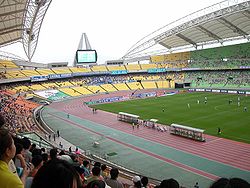
Primary venues used in the K-League:| Busan I'Park | Chunnam Dragons Chunnam Dragons Chunnam Dragons is a football club founded in 1995 in the Korean city of Gwangyang, which joined the K-League for the 1995 season at the same time as Jeonbuk Hyundai Motors, their Jeolla province rivals.-History:... |
Daegu FC Daegu FC Daegu Football Club, commonly referred to as Daegu FC , is a South Korean professional football club based in Daegu. The club was founded as a community team at the end of 2002, and the club made their K-League debut in 2003. Historically, Daegu have always placed in the lower reaches of the... |
Daejeon Citizen Daejeon Citizen Daejeon Citizen Football Club is a South Korean professional football team, currently playing in the K-League.Daejeon Citizen Football Club are famous for being the first community-club in Korea. Daejeon first entered the K-League for the 1997 season, finishing 7th out of the 10 teams... |
|---|---|---|---|
| Busan Asiad Stadium Busan Asiad Stadium The Busan Asiad Stadium or Asiad Main Stadium is a stadium in Busan, Republic of Korea, that was built for the 2002 Asian Games and was also used for matches in the 2002 Football World Cup. It has a capacity of 53,864... |
Gwangyang Football Stadium | Daegu Stadium | Daejeon World Cup Stadium Daejeon World Cup Stadium Daejeon World Cup Stadium, nicknamed "Purple Arena", is a football stadium in the South Korean city of Daejeon. It was used to host some matches of the 2002 World Cup .... |
| Capacity: 53,769 | Capacity: 13,496 | Capacity: 66,422 | Capacity: 40,535 |
 |
|||
| Gangwon FC Gangwon FC Gangwon FC is a South Korean football club. Based in Gangwon Province of South Korea, Gangwon FC joined the K-League as its 15th club for the 2009 season.- Foundation :... |
Gwangju FC Gwangju FC Gwangju FC is a South Korean football club. Based in Gwangju of South Korea, Gwangju FC joined the K-League as its 16th club for the 2011 season.-Squad for 2011 season:... |
Gyeongnam FC Gyeongnam FC Gyeongnam FC is a South Korean football club. Based in Changwon, the capital city of Gyeongsangnam-do, Gyeongnam FC joined the K-League as its 14th club for the 2006 season and was founded in 2005.-2006 season:... |
Incheon United Incheon United Incheon United is a professional Korean football team currently playing in the K-League. The team's home town is Incheon, the third biggest city in the country, and the team's home stadium is the Incheon Munhak Stadium, one of the ten venues built in Korea for the 2002 FIFA World... |
| Gangneung Stadium Gangneung Stadium Gangneung Stadium is a multi-purpose stadium in Gangneung, South Korea. It is currently used mostly for football matches. The stadium has a capacity of 30,000 people and was opened in 1980. It is home ground of Gangneung City FC and Gangwon FC from 2009.... |
Gwangju World Cup Stadium | Changwon Football Center Changwon Football Center Changwon Football Center is a Football-specific stadium and training ground in Changwon, South Korea. It is currently used mostly for football matches. The stadium holds 15,500 people. It was built in 2009... |
Incheon Munhak Stadium Incheon Munhak Stadium Incheon Munhak Stadium is a football stadium in the South Korean city of Incheon. The stadium's capacity is 50,256. It is the home stadium of the football club Incheon United F.C..Incheon Munhak Stadium, initially named Incheon World Cup Stadium, hosted some matches in the 2002 World Cup... |
| Capacity: 22,333 | Capacity: 40,245 | Capacity: 15,116 | Capacity: 49.084 |
| Jeju United Jeju United FC Jeju United Football Club is a South Korean professional football club. The club is based in Seogwipo, Jeju of South Korea.-History:... |
Jeonbuk Hyundai Motors Jeonbuk Hyundai Motors Jeonbuk Hyundai Motors are a professional football club based in Jeonju, Jeonbuk, South Korea. They won their first K-League title in 2009. Prior to this, the club won the AFC Champions League title in 2006, becoming the first club from East Asia to win the tournament since the AFC Champions... |
Pohang Steelers Pohang Steelers Pohang Steelers are a South Korean professional football club based in Pohang, Gyeongsangbuk-do. They were originally called POSCO, after the Pohang Iron and Steel Company that owned it... |
Sangju Sangmu Phoenix |
| Jeju World Cup Stadium Jeju World Cup Stadium Jeju World Cup Stadium is a football stadium with a 42,256-person capacity that is located in the city of Seogwipo on the small South Korean island province of Jeju-do... |
Jeonju World Cup Stadium Jeonju World Cup Stadium Jeonju World Cup Stadium, nicknamed "Fort Jeonju", is a football stadium in the South Korean city of Jeonju. It is the home of Jeonbuk Hyundai Motors. The stadium's capacity is 43,348. The final of 2011 AFC Champions League was held at this stadium.... |
Pohang Steel Yard | Sangju Civic Stadium |
| Capacity: 35,657 | Capacity: 42,477 | Capacity: 18,960 | Capacity: 15,042 |
| Seongnam Ilhwa Chunma Seongnam Ilhwa Chunma Seongnam Ilhwa Chunma is a South Korean professional football club, based in Seongnam, South Korea, that plays in the K-League... |
FC Seoul FC Seoul FC Seoul is a South Korean professional football club based in Seoul, South Korea, that plays in the K-League. It is currently owned by GS Sports, a subsidiary of GS Group.... |
Suwon Samsung Bluewings Suwon Samsung Bluewings Suwon Samsung Bluewings is a South Korean football club based in the city of Suwon, South Korea, that plays in the K-League. Founded in December 1995, they have become one of Asian football's most famous clubs with a host of domestic and continental honours... |
Ulsan Hyundai |
| Tancheon Sports Complex Tancheon Sports Complex Seongnam Tancheon Sports Complex is a multi-purpose stadium in Seongnam, South Korea. Its name was Seongnam 2 Sports Complex but changed to Tancheon Sports Complex in 2006, naming after the stream, named Tancheon, beside the stadium... |
Seoul World Cup Stadium Seoul World Cup Stadium The Seoul World Cup Stadium, also known as Sangam Stadium, is located in Seongsan, Mapo-gu, Seoul, South Korea. It was built for the 2002 FIFA World Cup and opened in 2001. It was designed to represent the image of a traditional Korean kite... |
Suwon World Cup Stadium Suwon World Cup Stadium The Suwon World Cup Stadium, which seats 43,288, in the Korean city of Suwon, has been home to K-League football side Suwon Samsung Bluewings since 2001.- International Matches :The stadium is famous for hosting several international matches... |
Ulsan Munsu Football Stadium |
| Capacity: 16,146 | Capacity: 66,806 | Capacity: 43,959 | Capacity: 44,474 |
 |
K-League Champions
Seongnam Ilhwa Chunma are the most successful team in terms of championship victories, having lifted the title on no less than seven occasions.The roll-call of champions is as follows (present-date names included where teams have changed names previously):
- K-League's principle of official statistics is that final club succeeds to predecessor club's history & records.
Titles By Season
1983-1999
|
2000—present
|
Titles By Club
| Club | Champions | Runners-Up | Winning Seasons | Runners-Up Seasons |
|---|---|---|---|---|
| Seongnam Ilhwa Chunma Seongnam Ilhwa Chunma Seongnam Ilhwa Chunma is a South Korean professional football club, based in Seongnam, South Korea, that plays in the K-League... |
1993, 1994, 1995, 2001, 2002, 2003, 2006 | 1992, 2007, 2009 | ||
| FC Seoul FC Seoul FC Seoul is a South Korean professional football club based in Seoul, South Korea, that plays in the K-League. It is currently owned by GS Sports, a subsidiary of GS Group.... |
1985, 1990, 2000, 2010 2010 K-League The 2010 edition of the K-League is the twenty-eighth since its establishment in 1983. The 2010 season is known as Sonata K-League 2010 due to the competition's sponsorship by Hyundai Motor Company. Jeonbuk Hyundai Motors is the defending champions, having won their first title. The season began on... |
1986, 1989, 1993, 2001, 2008 | ||
| Pohang Steelers Pohang Steelers Pohang Steelers are a South Korean professional football club based in Pohang, Gyeongsangbuk-do. They were originally called POSCO, after the Pohang Iron and Steel Company that owned it... |
1986, 1988, 1992, 2007 | 1985, 1987, 1995, 2004 | ||
| Busan I'Park | 1984, 1987, 1991, 1997 | 1983, 1990, 1999 | ||
| Suwon Samsung Bluewings Suwon Samsung Bluewings Suwon Samsung Bluewings is a South Korean football club based in the city of Suwon, South Korea, that plays in the K-League. Founded in December 1995, they have become one of Asian football's most famous clubs with a host of domestic and continental honours... |
1998, 1999, 2004, 2008 | 1996, 2006 | ||
| Ulsan Hyundai | 1996, 2005 | 1988, 1991, 1998, 2002, 2003 | ||
| Jeju United Jeju United FC Jeju United Football Club is a South Korean professional football club. The club is based in Seogwipo, Jeju of South Korea.-History:... |
1989 | 1984, 1994, 2000, 2010 2010 K-League The 2010 edition of the K-League is the twenty-eighth since its establishment in 1983. The 2010 season is known as Sonata K-League 2010 due to the competition's sponsorship by Hyundai Motor Company. Jeonbuk Hyundai Motors is the defending champions, having won their first title. The season began on... |
||
| Hallelujah FC | 1983 | |||
| Jeonbuk Hyundai Motors Jeonbuk Hyundai Motors Jeonbuk Hyundai Motors are a professional football club based in Jeonju, Jeonbuk, South Korea. They won their first K-League title in 2009. Prior to this, the club won the AFC Champions League title in 2006, becoming the first club from East Asia to win the tournament since the AFC Champions... |
2009 | |||
| Chunnam Dragons Chunnam Dragons Chunnam Dragons is a football club founded in 1995 in the Korean city of Gwangyang, which joined the K-League for the 1995 season at the same time as Jeonbuk Hyundai Motors, their Jeolla province rivals.-History:... |
1997 | |||
| Incheon United | 2005 |
Titles By City / Area
- Since 1987 season : K-League introduced home and away matches system in 1987.
City / Area Titles Clubs Seoul SeoulSeoul , officially the Seoul Special City, is the capital and largest metropolis of South Korea. A megacity with a population of over 10 million, it is the largest city proper in the OECD developed world...5 Lucky-Goldstar Hwangso FC SeoulFC Seoul is a South Korean professional football club based in Seoul, South Korea, that plays in the K-League. It is currently owned by GS Sports, a subsidiary of GS Group....
(1990), FC SeoulFC SeoulFC Seoul is a South Korean professional football club based in Seoul, South Korea, that plays in the K-League. It is currently owned by GS Sports, a subsidiary of GS Group....
(20102010 K-LeagueThe 2010 edition of the K-League is the twenty-eighth since its establishment in 1983. The 2010 season is known as Sonata K-League 2010 due to the competition's sponsorship by Hyundai Motor Company. Jeonbuk Hyundai Motors is the defending champions, having won their first title. The season began on...
)Ilhwa Chunma Seongnam Ilhwa ChunmaSeongnam Ilhwa Chunma is a South Korean professional football club, based in Seongnam, South Korea, that plays in the K-League...
(1993, 1994, 1995)Suwon SuwonSuwon is the provincial capital of Gyeonggi-do, South Korea. A major city of over a million inhabitants, Suwon lies approximately south of Seoul. It is traditionally known as "The City of Filial Piety"....4 Suwon Samsung Bluewings Suwon Samsung BluewingsSuwon Samsung Bluewings is a South Korean football club based in the city of Suwon, South Korea, that plays in the K-League. Founded in December 1995, they have become one of Asian football's most famous clubs with a host of domestic and continental honours...
(1998, 1999, 2004, 2008)Seongnam SeongnamSeongnam is the second largest city in South Korea's Gyeonggi province after Suwon and the 9th largest city in the country, with a population of nearly 1 million...4 Seongnam Ilhwa Chunma Seongnam Ilhwa ChunmaSeongnam Ilhwa Chunma is a South Korean professional football club, based in Seongnam, South Korea, that plays in the K-League...
(2001, 2002, 2003, 2006)Pohang PohangPohang is a city in North Gyeongsang Province, South Korea, and a main seaport in the Daegu-Gyeongbuk region. The built-up area of Pohang is located on the alluvium of the mouth of the Hyeongsan River...3 POSCO Atoms Pohang SteelersPohang Steelers are a South Korean professional football club based in Pohang, Gyeongsangbuk-do. They were originally called POSCO, after the Pohang Iron and Steel Company that owned it...
(1988, 1992), Pohang SteelersPohang SteelersPohang Steelers are a South Korean professional football club based in Pohang, Gyeongsangbuk-do. They were originally called POSCO, after the Pohang Iron and Steel Company that owned it...
(2007)Busan BusanBusan , formerly spelled Pusan is South Korea's second largest metropolis after Seoul, with a population of around 3.6 million. The Metropolitan area population is 4,399,515 as of 2010. It is the largest port city in South Korea and the fifth largest port in the world...2 Daewoo Royals (1991), Busan Daewoo Royals Busan Daewoo RoyalsPusan Daewoo Royals was the former name of South Korean football club Busan I'Park, which was based in Busan from 1983 to 1999.- History :The Pusan Daewoo Royals football club was found in 1983 in the city of Busan by the Daewoo corporation....
(1997)Ulsan UlsanUlsan , officially the Ulsan Metropolitan City, is South Korea's seventh largest metropolis with a population of over 1.1 million. It is located in the south-east of the country, neighboring Busan to the south and facing Gyeongju to the north and the Sea of Japan to the east.Ulsan is the...2 Ulsan Hyundai Horangi (1996, 2005) Anyang AnyangAnyang is a prefecture-level city in Henan province, People's Republic of China. The northernmost city in Henan, Anyang borders Puyang to the east, Hebi and Xinxiang to the south, and the provinces of Shanxi and Hebei to its west and north respectively....1 Anyang LG Cheetahs Anyang LG CheetahsAnyang LG Cheetahs was a South Korean football club located in Anyang, Gyeonggi. It was owned and managed by GS Sports, a subsidiary of GS Group. The club was considered a powerhouse in the K-League...
(2000)Busan BusanBusan , formerly spelled Pusan is South Korea's second largest metropolis after Seoul, with a population of around 3.6 million. The Metropolitan area population is 4,399,515 as of 2010. It is the largest port city in South Korea and the fifth largest port in the world...
+Gyeongnam1 Daewoo Royals (1987) Incheon IncheonThe Incheon Metropolitan City is located in northwestern South Korea. The city was home to just 4,700 people when Jemulpo port was built in 1883. Today 2.76 million people live in the city, making it Korea’s third most populous city after Seoul and Busan Metropolitan City...
+Gyeonggi1 Yukong Kokkiri Jeju United FCJeju United Football Club is a South Korean professional football club. The club is based in Seogwipo, Jeju of South Korea.-History:...
(1989)Jeonbuk 1 Jeonbuk Hyundai Motors Jeonbuk Hyundai MotorsJeonbuk Hyundai Motors are a professional football club based in Jeonju, Jeonbuk, South Korea. They won their first K-League title in 2009. Prior to this, the club won the AFC Champions League title in 2006, becoming the first club from East Asia to win the tournament since the AFC Champions...
(2009)
Titles By Province
- Since 1987 season : K-League introduced home and away matches system in 1987.
Province Provinces of KoreaThis article describes the historical development of Korea's provinces . For detailed information on current administrative divisions, please see Administrative divisions of North Korea and Administrative divisions of South Korea....Titles City / Area Clubs Capital Seoul National Capital AreaThe Seoul National Capital Area is a region located in the north-west of South Korea. It is generally referred to as Sudogwon in Korean, and contains three different administrative districts; Seoul, Incheon and Gyeonggi-do....
Region15 (5) Seoul SeoulSeoul , officially the Seoul Special City, is the capital and largest metropolis of South Korea. A megacity with a population of over 10 million, it is the largest city proper in the OECD developed world...Lucky-Goldstar Hwangso FC SeoulFC Seoul is a South Korean professional football club based in Seoul, South Korea, that plays in the K-League. It is currently owned by GS Sports, a subsidiary of GS Group....
(1990), FC SeoulFC SeoulFC Seoul is a South Korean professional football club based in Seoul, South Korea, that plays in the K-League. It is currently owned by GS Sports, a subsidiary of GS Group....
(20102010 K-LeagueThe 2010 edition of the K-League is the twenty-eighth since its establishment in 1983. The 2010 season is known as Sonata K-League 2010 due to the competition's sponsorship by Hyundai Motor Company. Jeonbuk Hyundai Motors is the defending champions, having won their first title. The season began on...
)Ilhwa Chunma Seongnam Ilhwa ChunmaSeongnam Ilhwa Chunma is a South Korean professional football club, based in Seongnam, South Korea, that plays in the K-League...
(1993, 1994, 1995)(4) Suwon SuwonSuwon is the provincial capital of Gyeonggi-do, South Korea. A major city of over a million inhabitants, Suwon lies approximately south of Seoul. It is traditionally known as "The City of Filial Piety"....Suwon Samsung Bluewings Suwon Samsung BluewingsSuwon Samsung Bluewings is a South Korean football club based in the city of Suwon, South Korea, that plays in the K-League. Founded in December 1995, they have become one of Asian football's most famous clubs with a host of domestic and continental honours...
(1998, 1999, 2004, 2008)(4) Seongnam SeongnamSeongnam is the second largest city in South Korea's Gyeonggi province after Suwon and the 9th largest city in the country, with a population of nearly 1 million...Seongnam Ilhwa Chunma Seongnam Ilhwa ChunmaSeongnam Ilhwa Chunma is a South Korean professional football club, based in Seongnam, South Korea, that plays in the K-League...
(2001, 2002, 2003, 2006)(1) Anyang AnyangAnyang is a prefecture-level city in Henan province, People's Republic of China. The northernmost city in Henan, Anyang borders Puyang to the east, Hebi and Xinxiang to the south, and the provinces of Shanxi and Hebei to its west and north respectively....Anyang LG Cheetahs Anyang LG CheetahsAnyang LG Cheetahs was a South Korean football club located in Anyang, Gyeonggi. It was owned and managed by GS Sports, a subsidiary of GS Group. The club was considered a powerhouse in the K-League...
(2000)(1) Incheon IncheonThe Incheon Metropolitan City is located in northwestern South Korea. The city was home to just 4,700 people when Jemulpo port was built in 1883. Today 2.76 million people live in the city, making it Korea’s third most populous city after Seoul and Busan Metropolitan City...
+GyeonggiYukong Kokkiri Jeju United FCJeju United Football Club is a South Korean professional football club. The club is based in Seogwipo, Jeju of South Korea.-History:...
(1989)Gyeongsang GyeongsangGyeongsang was one of the eight provinces of Korea during the Joseon Dynasty. Gyeongsang was located in the southeast of Korea....
Region8 (3) Pohang PohangPohang is a city in North Gyeongsang Province, South Korea, and a main seaport in the Daegu-Gyeongbuk region. The built-up area of Pohang is located on the alluvium of the mouth of the Hyeongsan River...POSCO Atoms Pohang SteelersPohang Steelers are a South Korean professional football club based in Pohang, Gyeongsangbuk-do. They were originally called POSCO, after the Pohang Iron and Steel Company that owned it...
(1988, 1992), Pohang SteelersPohang SteelersPohang Steelers are a South Korean professional football club based in Pohang, Gyeongsangbuk-do. They were originally called POSCO, after the Pohang Iron and Steel Company that owned it...
(2007)(2) Busan BusanBusan , formerly spelled Pusan is South Korea's second largest metropolis after Seoul, with a population of around 3.6 million. The Metropolitan area population is 4,399,515 as of 2010. It is the largest port city in South Korea and the fifth largest port in the world...Daewoo Royals (1991), Busan Daewoo Royals Busan Daewoo RoyalsPusan Daewoo Royals was the former name of South Korean football club Busan I'Park, which was based in Busan from 1983 to 1999.- History :The Pusan Daewoo Royals football club was found in 1983 in the city of Busan by the Daewoo corporation....
(1997)(2) Ulsan UlsanUlsan , officially the Ulsan Metropolitan City, is South Korea's seventh largest metropolis with a population of over 1.1 million. It is located in the south-east of the country, neighboring Busan to the south and facing Gyeongju to the north and the Sea of Japan to the east.Ulsan is the...Ulsan Hyundai Horangi (1996, 2005) (1) Busan BusanBusan , formerly spelled Pusan is South Korea's second largest metropolis after Seoul, with a population of around 3.6 million. The Metropolitan area population is 4,399,515 as of 2010. It is the largest port city in South Korea and the fifth largest port in the world...
+GyeongnamDaewoo Royals (1987) Jeolla JeollaJeolla was a province in southwestern Korea, one of the historical Eight Provinces of Korea during the Joseon Dynasty. It consisted of the modern South Korean provinces of North Jeolla, South Jeolla and the Special City of Gwangju as well as Jeju Island...
Region1 (1) Jeonbuk Jeonbuk Hyundai Motors Jeonbuk Hyundai MotorsJeonbuk Hyundai Motors are a professional football club based in Jeonju, Jeonbuk, South Korea. They won their first K-League title in 2009. Prior to this, the club won the AFC Champions League title in 2006, becoming the first club from East Asia to win the tournament since the AFC Champions...
(2009)Chungcheong ChungcheongChungcheong was one of the eight provinces of Korea during the Joseon Dynasty. Chungcheong was located in the southwest of Korea...
Region0 Gangwon Gangwon-do (South Korea)Gangwon-do is a province of South Korea, with its capital at Chuncheon. Before the division of Korea in 1945, Gangwon and its North Korean neighbour Kangwŏn formed a single province.-History:...
Region0 Jeju Jeju-doJeju-do is the only special autonomous province of South Korea, situated on and coterminous with the country's largest island. Jeju-do lies in the Korea Strait, southwest of Jeollanam-do Province, of which it was a part before it became a separate province in 1946...
Region0
- *Kokkiri means elephant, Hwangso means bull, Horang-i means tiger, Chunma means pegasus
Title Sponsors
| Start | End | Name |
|---|---|---|
| 1983 | 1993 | None |
| 1994 | 1995 | Hite Hite Hite Brewery Company Limited is a South Korean brewery company headquartered in Yeongdeungpo-gu, Seoul. Its main products are beer, rice wine, and mineral water. The company was established as Chosun Breweries in 1933... |
| 1996 | 1997 | Rapido Samsung C&T Corporation Samsung C&T Corporation , established in 1938, is the origin of Samsung Group and currently consists of Engineering & Construction Group and Trading & Investment Group... |
| 1998 | - | Hyundai Hyundai Hyundai ) is a global conglomerate company, part of the Korean chaebol, that was founded in South Korea by one of the most famous businessmen in Korean history: Chung Ju-yung... |
| 1999 | - | Buy Korea |
| 2000 | - | Samsung DigiTall Samsung Electronics Samsung Electronics is a South Korean multinational electronics and information technology company headquartered in Samsung Town, Seoul... |
| 2001 | - | Posco POSCO POSCO is a multinational steel-making company headquartered in Pohang, South Korea. It is the world's third-largest steelmaker by market value and the most profitable Asia-based steelmaker.... |
| 2002 | 2008 | Samsung Hauzen Samsung Electronics Samsung Electronics is a South Korean multinational electronics and information technology company headquartered in Samsung Town, Seoul... |
| 2009 | - | None |
| 2010 2010 K-League The 2010 edition of the K-League is the twenty-eighth since its establishment in 1983. The 2010 season is known as Sonata K-League 2010 due to the competition's sponsorship by Hyundai Motor Company. Jeonbuk Hyundai Motors is the defending champions, having won their first title. The season began on... |
- | Hyundai Motor Company Hyundai Motor Company Hyundai Motor Company is a Korean multinational automaker based in Seoul, South Korea which, along with Kia, comprises the Hyundai Kia Automotive Group, the world's fourth largest automaker as of 2009. As of 2011, it is the world's fastest growing automaker for two years running... Sonata Hyundai Sonata The Hyundai Sonata is a mid-size car/full-size car manufactured and marketed globally by Hyundai Motor Company. From the sixth generation onwards, it is known as the i45 in the Australian, Singaporean and New Zealand markets... |
| 2011 2011 K-League The 2011 edition of the K-League is the twenty-ninth since its establishment in 1983. The 2011 season is known as Hyundai Oilbank K-League 2011 due to the competition's sponsorship by Hyundai Oilbank... |
- | Hyundai Oilbank |
All-time K-League Clubs
There have been a total of 19 member clubs in the history of the K-League - those clubs are listed below with their current names (where applicable):- K-League's principle of official statistics is that final club succeeds to predecessor club's history & records.
| Club (Duration) | Owner(s) | Sponsor(s) | Note |
|---|---|---|---|
| POSCO Dolphins Pohang Steelers Pohang Steelers are a South Korean professional football club based in Pohang, Gyeongsangbuk-do. They were originally called POSCO, after the Pohang Iron and Steel Company that owned it... (1983-1984) POSCO Atoms Pohang Steelers Pohang Steelers are a South Korean professional football club based in Pohang, Gyeongsangbuk-do. They were originally called POSCO, after the Pohang Iron and Steel Company that owned it... (1985–1994) Pohang Atoms Pohang Steelers Pohang Steelers are a South Korean professional football club based in Pohang, Gyeongsangbuk-do. They were originally called POSCO, after the Pohang Iron and Steel Company that owned it... (1995–1996) Pohang Steelers Pohang Steelers Pohang Steelers are a South Korean professional football club based in Pohang, Gyeongsangbuk-do. They were originally called POSCO, after the Pohang Iron and Steel Company that owned it... (1997–present) |
Pohang Steelworks in POSCO POSCO POSCO is a multinational steel-making company headquartered in Pohang, South Korea. It is the world's third-largest steelmaker by market value and the most profitable Asia-based steelmaker.... |
Founded as a Semi-Professional FC on April 1973 Transferred into a Professional FC on February 1984 |
|
| Hallelujah FC (1983–1985) | defunct Shindongah Group | Inauguration Date - 20 December 1980 | |
| Yukong Kokkiri Jeju United FC Jeju United Football Club is a South Korean professional football club. The club is based in Seogwipo, Jeju of South Korea.-History:... (1983–1995) Bucheon Yukong Jeju United FC Jeju United Football Club is a South Korean professional football club. The club is based in Seogwipo, Jeju of South Korea.-History:... (1996–1997.09.30) Bucheon SK Jeju United FC Jeju United Football Club is a South Korean professional football club. The club is based in Seogwipo, Jeju of South Korea.-History:... (1997.10.01–2005) Jeju United Jeju United FC Jeju United Football Club is a South Korean professional football club. The club is based in Seogwipo, Jeju of South Korea.-History:... (2006–present) |
SK Energy[1] in SK Group SK Group SK Group is the third largest conglomerate in South Korea. The SK Group is composed of 92 subsidiary and affiliate companies that share the SK brand and culture.... |
Inauguration Date - 17 December 1982 | |
| Daewoo Royals (1983–1995) Busan Daewoo Royals (1996–1999) Busan I'cons (2000–2004) Busan I'Park (2005–present) |
defunct Daewoo Group Daewoo Daewoo or the Daewoo Group was a major South Korean chaebol . It was founded on 22 March 1967 as Daewoo Industrial and was dismantled by the Korean government in 1999... (1983–1999) I'Park Sports in Hyundai Development Group Hyundai Development Hyundai Development is a South Korean company involved mainly in civil and architectural engineering. The company was established in 1976 as a part of Hyundai Group, but no longer is a part of it. It is headed by chairman Chung Mong Gyu, the eldest son of Chung Se Yung, co-founder of Hyundai... (2000–present) |
Founded as a Semi-Professional FC in 1979 Refounded as a Professional FC Inauguration Date - 3 December 1983 |
|
| Kookmin Bank FC Kookmin Bank FC Kookmin Bank FC is a South Korean football club based in the Seoul satellite city of Goyang. It currently plays in the National League, the second tier of Korean football.- K-League Membership :... (1983–1984) |
Kookmin Bank Kookmin Bank KB Kookmin Bank or KB is the largest bank by both asset value and market capitalization in South Korea.The bank is led by Kang Chung-Won who previously worked for Seoulbank and oversaw its sale to competitor Hana Bank before moving to Kookmin.Kookmin intended to take over Korea Exchange Bank, a... |
Played as a Semi-Professional FC | |
| Hyundai Horangi (1984–1995) Ulsan Hyundai Horangi (1996–2008) Ulsan Hyundai (2008–present) |
Hyundai Motor Company Hyundai Motor Company Hyundai Motor Company is a Korean multinational automaker based in Seoul, South Korea which, along with Kia, comprises the Hyundai Kia Automotive Group, the world's fourth largest automaker as of 2009. As of 2011, it is the world's fastest growing automaker for two years running... in Hyundai Motor Group (1984–1997) Hyundai Heavy Industries Hyundai Heavy Industries Hyundai Heavy Industries Co., Ltd. is the world's largest shipbuilding company, headquartered in Ulsan, South Korea. The company is a subsidiary of Hyundai Heavy Industries Group... in Hyundai Heavy Industries Group Hyundai Heavy Industries Group The Hyundai Heavy Industries Group refers to the group of affiliated companies interconnected by complex shareholding arrangements, with Hyundai Heavy Industries regarded as de facto representative of the Group.- Subsidiaries :* Hyundai Heavy Industries... (1998–present) |
Inauguration Date - 6 December 1983 | |
| Lucky-Goldstar Hwangso FC Seoul FC Seoul is a South Korean professional football club based in Seoul, South Korea, that plays in the K-League. It is currently owned by GS Sports, a subsidiary of GS Group.... (1984–1990) LG Cheetahs FC Seoul FC Seoul is a South Korean professional football club based in Seoul, South Korea, that plays in the K-League. It is currently owned by GS Sports, a subsidiary of GS Group.... (1991–1995) Anyang LG Cheetahs FC Seoul FC Seoul is a South Korean professional football club based in Seoul, South Korea, that plays in the K-League. It is currently owned by GS Sports, a subsidiary of GS Group.... (1996–2003) FC Seoul FC Seoul FC Seoul is a South Korean professional football club based in Seoul, South Korea, that plays in the K-League. It is currently owned by GS Sports, a subsidiary of GS Group.... (2004–present) |
LG Group LG Group LG Corp. is the second-largest South Korean conglomerate company following Samsung, and it is headquartered in the LG Twin Towers in Yeouido-dong, Yeongdeungpo-gu, Seoul. LG produces electronics, chemicals, and telecommunications products and operates subsidiaries like LG Electronics, LG Display,... (1984–2004) GS Sports in GS Group GS Group GS Group is a Korean conglomerate. GS comprises GS Holdings and subsidiaries & affiliates including GS Caltex, GS Retail, GS Shop, GS EPS, GS Global, GS Sports and GS E&C among others. The asset size is at 31.1 trillion KRW as the end of 2007 placing GS at the 6th largest in Korea excluding the... [2] (2004~present) |
Inauguration Date - 22 December 1983 | |
| Hanil Bank FC (1984–1986) | Hanil Bank[3] | Played as a Semi-Professional FC | |
| Sangmu FC (1985) | Ministry of National Defence | Played as a Semi-Professional FC | |
| Ilhwa Chunma Seongnam Ilhwa Chunma Seongnam Ilhwa Chunma is a South Korean professional football club, based in Seongnam, South Korea, that plays in the K-League... (1989–1995) Cheonan Ilhwa Chunma Seongnam Ilhwa Chunma Seongnam Ilhwa Chunma is a South Korean professional football club, based in Seongnam, South Korea, that plays in the K-League... (1996–1999) Seongnam Ilhwa Chunma Seongnam Ilhwa Chunma Seongnam Ilhwa Chunma is a South Korean professional football club, based in Seongnam, South Korea, that plays in the K-League... (2000–present) |
Ilhwa in Tongil Group Unification Church The Unification Church is a new religious movement founded by Korean religious leader Sun Myung Moon. In 1954, the Unification Church was formally and legally established in Seoul, South Korea, as The Holy Spirit Association for the Unification of World Christianity . In 1994, Moon gave the church... |
Inauguration Date - 18 March 1989 | |
| Jeonbuk Buffalo (1994) | Bobaesoju (1994) | Inauguration Date - 1993 Dissolution Date - 1994 |
|
| Jeonbuk Dinos Jeonbuk Hyundai Motors Jeonbuk Hyundai Motors are a professional football club based in Jeonju, Jeonbuk, South Korea. They won their first K-League title in 2009. Prior to this, the club won the AFC Champions League title in 2006, becoming the first club from East Asia to win the tournament since the AFC Champions... (1995–1996) Jeonbuk Hyundai Dinos Jeonbuk Hyundai Motors Jeonbuk Hyundai Motors are a professional football club based in Jeonju, Jeonbuk, South Korea. They won their first K-League title in 2009. Prior to this, the club won the AFC Champions League title in 2006, becoming the first club from East Asia to win the tournament since the AFC Champions... (1997–1999) Jeonbuk Hyundai Motors Jeonbuk Hyundai Motors Jeonbuk Hyundai Motors are a professional football club based in Jeonju, Jeonbuk, South Korea. They won their first K-League title in 2009. Prior to this, the club won the AFC Champions League title in 2006, becoming the first club from East Asia to win the tournament since the AFC Champions... (2000–present) |
Consortium of Hyunyang & Hyundai Motor Company Hyundai Motor Company Hyundai Motor Company is a Korean multinational automaker based in Seoul, South Korea which, along with Kia, comprises the Hyundai Kia Automotive Group, the world's fourth largest automaker as of 2009. As of 2011, it is the world's fastest growing automaker for two years running... in Hyundai Motor Group and (1995–1998) Hyundai Motor Company Hyundai Motor Company Hyundai Motor Company is a Korean multinational automaker based in Seoul, South Korea which, along with Kia, comprises the Hyundai Kia Automotive Group, the world's fourth largest automaker as of 2009. As of 2011, it is the world's fastest growing automaker for two years running... in Hyundai Motor Group (1999–present) |
Inauguration Date - 12 December 1994 | |
| Chunnam Dragons Chunnam Dragons Chunnam Dragons is a football club founded in 1995 in the Korean city of Gwangyang, which joined the K-League for the 1995 season at the same time as Jeonbuk Hyundai Motors, their Jeolla province rivals.-History:... (1995–present) |
Gwangyang Steelworks in POSCO POSCO POSCO is a multinational steel-making company headquartered in Pohang, South Korea. It is the world's third-largest steelmaker by market value and the most profitable Asia-based steelmaker.... |
Inauguration Date - 16 December 1994 | |
| Suwon Samsung Bluewings Suwon Samsung Bluewings Suwon Samsung Bluewings is a South Korean football club based in the city of Suwon, South Korea, that plays in the K-League. Founded in December 1995, they have become one of Asian football's most famous clubs with a host of domestic and continental honours... (1996–present) |
Samsung Electronics Samsung Electronics Samsung Electronics is a South Korean multinational electronics and information technology company headquartered in Samsung Town, Seoul... in Samsung Group Samsung Group The Samsung Group is a South Korean multinational conglomerate corporation headquartered in Samsung Town, Seoul, South Korea... |
Inauguration Date - 15 December 1995 | |
| Daejeon Citizen Daejeon Citizen Daejeon Citizen Football Club is a South Korean professional football team, currently playing in the K-League.Daejeon Citizen Football Club are famous for being the first community-club in Korea. Daejeon first entered the K-League for the 1997 season, finishing 7th out of the 10 teams... (1997–present) |
Government of Daejeon Daejeon Daejeon is South Korea's fifth largest metropolis and the provincial capital of Chungnam. Located in the center of the country, Daejeon had a population of over 1.5 million in 2010. It is at the crossroads of Gyeongbu railway, Honam railway, Gyeongbu Expressway, and Honam Expressway. Within the... Citizen Stockholder |
Kyeryong Construction Hanwha Group Hanwha Hanwha Group is one of the largest business conglomerate in South Korea. Founded in 1952 as Korea Explosives Inc. , the group has grown into a large multi-profile business conglomerate, with diversified holdings stretching from explosives, their original business, to retail to financial... |
Inauguration Date - 12 March 1997 |
| Daegu FC Daegu FC Daegu Football Club, commonly referred to as Daegu FC , is a South Korean professional football club based in Daegu. The club was founded as a community team at the end of 2002, and the club made their K-League debut in 2003. Historically, Daegu have always placed in the lower reaches of the... (2003–present) |
Government of Daegu Daegu Daegu , also known as Taegu, and officially the Daegu Metropolitan City, is a city in South Korea, the fourth largest after Seoul, Busan, and Incheon, and the third largest metropolitan area in the country with over 2.5 million residents. The city is the capital and principal city of the... Citizen Stockholder |
Doosan Group Daegu Bank |
Inauguration Date - 19 March 2003 |
| Gwangju Sangmu Bulsajo (2003–2007) Gwangju Sangmu FC (2008–2010) Sangju Sangmu Phoenix (2011–present) |
Ministry of National Defence | ||
| Incheon United (2004–present) | Government of Incheon Incheon The Incheon Metropolitan City is located in northwestern South Korea. The city was home to just 4,700 people when Jemulpo port was built in 1883. Today 2.76 million people live in the city, making it Korea’s third most populous city after Seoul and Busan Metropolitan City... Citizen Stockholder |
Daewoo E&C Shinhan Bank Shinhan Bank Shinhan Bank , is a bank, headquartered in Seoul, Korea. Historically it was the first bank in Korea, established under the name Hanseong Bank in 1897. The bank was reestablished in 1982. It is part of the Shinhan Financial Group, along with Jeju Bank... GM Daewoo GM Daewoo GM Korea Company is South Korea's second largest automobile manufacturer and is a division of the General Motors Company. GM Korea's roots go back to the former Daewoo which was split from its parent company, Daewoo Group, in 2001... |
Inauguration Date - 1 March 2004 |
| Gyeongnam FC Gyeongnam FC Gyeongnam FC is a South Korean football club. Based in Changwon, the capital city of Gyeongsangnam-do, Gyeongnam FC joined the K-League as its 14th club for the 2006 season and was founded in 2005.-2006 season:... (2006–present) |
Government of Gyeongsangnam-do Gyeongsangnam-do Gyeongsangnam-do is a province in the southeast of South Korea. The provincial capital is located at Changwon. It contains the major metropolitan center and port of Busan. Located there is UNESCO World Heritage Site Haeinsa, a Buddhist temple that houses the Tripitaka Koreana and attracts many... Citizen Stockholder |
STX Corporation STX Corporation STX Corporation is a South Korean holding company engaged in the provision of trading services. Headquartered in Gyeongsangnamdo, South Korea, the company operates its business through two divisions: trade and ship maintenance. Its trade business division provides shipping and energy materials,... Gyeongnam Bank |
Inauguration Date - 17 January 2006 |
| Gangwon FC Gangwon FC Gangwon FC is a South Korean football club. Based in Gangwon Province of South Korea, Gangwon FC joined the K-League as its 15th club for the 2009 season.- Foundation :... (2009–present) |
Government of Gangwon-do Gangwon-do (South Korea) Gangwon-do is a province of South Korea, with its capital at Chuncheon. Before the division of Korea in 1945, Gangwon and its North Korean neighbour Kangwŏn formed a single province.-History:... Citizen Stockholder |
High1 Resort Nong Hyup |
Inauguration Date - 18 December 2008 |
| Gwangju FC Gwangju FC Gwangju FC is a South Korean football club. Based in Gwangju of South Korea, Gwangju FC joined the K-League as its 16th club for the 2011 season.-Squad for 2011 season:... (2011–present) |
Government of Gwangju Gwangju Gwangju is the sixth largest city in South Korea. It is a designated metropolitan city under the direct control of the central government's Home Minister... Citizen Stockholder |
Gwangju Bank | Inauguration Date - 16 December 2010 |
[1] Yokong renamed to SK Energy
[2] GS Group
GS Group
GS Group is a Korean conglomerate. GS comprises GS Holdings and subsidiaries & affiliates including GS Caltex, GS Retail, GS Shop, GS EPS, GS Global, GS Sports and GS E&C among others. The asset size is at 31.1 trillion KRW as the end of 2007 placing GS at the 6th largest in Korea excluding the...
is separated from LG Group
LG Group
LG Corp. is the second-largest South Korean conglomerate company following Samsung, and it is headquartered in the LG Twin Towers in Yeouido-dong, Yeongdeungpo-gu, Seoul. LG produces electronics, chemicals, and telecommunications products and operates subsidiaries like LG Electronics, LG Display,...
[3] Hanil Bank is merged by Woori Bank
Woori Bank
Woori Bank is a bank headquartered in Seoul, Korea. The bank changed its name in 2002, and includes the former Commercial Bank of Korea, Hanil Bank, and Peace Bank. It was known from 1999 through 2002 as Hanvit Bank...
Note : Kokkiri means elephant, Horang-i means tiger, Hwangso means bull, Chunma means pegasus, Bulsajo means phoenix.
Franchise relocations in K-League
- Not Franchised Period (1983–1986) : K-League Clubs had franchise but clubs played the all game of round at one stadium.
- Franchised Period (1987–present) : K-League introduced home and away matches system in 1987.
- Clubs which are not listed in the table don't have franchise relocations.
| Club | Original City / Area (Joined Year) |
Not Franchised Period 1983-1986 |
Franchised Period 1987–present |
|---|---|---|---|
| Pohang Steelers Pohang Steelers Pohang Steelers are a South Korean professional football club based in Pohang, Gyeongsangbuk-do. They were originally called POSCO, after the Pohang Iron and Steel Company that owned it... |
Daegu Daegu Daegu , also known as Taegu, and officially the Daegu Metropolitan City, is a city in South Korea, the fourth largest after Seoul, Busan, and Incheon, and the third largest metropolitan area in the country with over 2.5 million residents. The city is the capital and principal city of the... +Gyeongbuk (1983) |
N/A | Pohang Pohang Pohang is a city in North Gyeongsang Province, South Korea, and a main seaport in the Daegu-Gyeongbuk region. The built-up area of Pohang is located on the alluvium of the mouth of the Hyeongsan River... (1990 / 1988[1]-present) |
| Jeju United Jeju United FC Jeju United Football Club is a South Korean professional football club. The club is based in Seogwipo, Jeju of South Korea.-History:... |
Seoul Seoul Seoul , officially the Seoul Special City, is the capital and largest metropolis of South Korea. A megacity with a population of over 10 million, it is the largest city proper in the OECD developed world... +Incheon Incheon The Incheon Metropolitan City is located in northwestern South Korea. The city was home to just 4,700 people when Jemulpo port was built in 1883. Today 2.76 million people live in the city, making it Korea’s third most populous city after Seoul and Busan Metropolitan City... +Gyeonggi (1983) |
Seoul Seoul Seoul , officially the Seoul Special City, is the capital and largest metropolis of South Korea. A megacity with a population of over 10 million, it is the largest city proper in the OECD developed world... (1984) |
Incheon Incheon The Incheon Metropolitan City is located in northwestern South Korea. The city was home to just 4,700 people when Jemulpo port was built in 1883. Today 2.76 million people live in the city, making it Korea’s third most populous city after Seoul and Busan Metropolitan City... +Gyeonggi (1987) ▶ Seoul Seoul Seoul , officially the Seoul Special City, is the capital and largest metropolis of South Korea. A megacity with a population of over 10 million, it is the largest city proper in the OECD developed world... (1991) ▶ Bucheon Bucheon Bucheon is a city in Gyeonggi Province, South Korea. It is sandwiched between Incheon and Seoul. Manufacturing operations are located in the city.Bucheon promotes itself as the cultural centre of the Seoul Metropolitan Area... / Mok-dong Mok-dong Mok-dong is a dong, neighbourhood of Yangcheon-gu in Seoul, South Korea.It is famous for its education and good schools, including Yang-Chung High school where Phillip Kim, or Dong yeon Kim goes to, and which has more than 100 years of history. For this reason, it is home to many upper class... , Seoul Seoul Seoul , officially the Seoul Special City, is the capital and largest metropolis of South Korea. A megacity with a population of over 10 million, it is the largest city proper in the OECD developed world... (1996)[2] ▶ Bucheon Bucheon Bucheon is a city in Gyeonggi Province, South Korea. It is sandwiched between Incheon and Seoul. Manufacturing operations are located in the city.Bucheon promotes itself as the cultural centre of the Seoul Metropolitan Area... (2001) ▶ Jeju Jeju-do Jeju-do is the only special autonomous province of South Korea, situated on and coterminous with the country's largest island. Jeju-do lies in the Korea Strait, southwest of Jeollanam-do Province, of which it was a part before it became a separate province in 1946... (2006–present) |
| Busan I'Park | Busan Busan Busan , formerly spelled Pusan is South Korea's second largest metropolis after Seoul, with a population of around 3.6 million. The Metropolitan area population is 4,399,515 as of 2010. It is the largest port city in South Korea and the fifth largest port in the world... +Gyeongnam (1983) |
N/A | Busan Busan Busan , formerly spelled Pusan is South Korea's second largest metropolis after Seoul, with a population of around 3.6 million. The Metropolitan area population is 4,399,515 as of 2010. It is the largest port city in South Korea and the fifth largest port in the world... (1990 / 1989[1]-present) |
| Ulsan Hyundai | Incheon Incheon The Incheon Metropolitan City is located in northwestern South Korea. The city was home to just 4,700 people when Jemulpo port was built in 1883. Today 2.76 million people live in the city, making it Korea’s third most populous city after Seoul and Busan Metropolitan City... +Gyeonggi (1984) |
Incheon Incheon The Incheon Metropolitan City is located in northwestern South Korea. The city was home to just 4,700 people when Jemulpo port was built in 1883. Today 2.76 million people live in the city, making it Korea’s third most populous city after Seoul and Busan Metropolitan City... +Gyeonggi+Gangwon Gangwon-do (South Korea) Gangwon-do is a province of South Korea, with its capital at Chuncheon. Before the division of Korea in 1945, Gangwon and its North Korean neighbour Kangwŏn formed a single province.-History:... (1986) |
Gangwon Gangwon-do (South Korea) Gangwon-do is a province of South Korea, with its capital at Chuncheon. Before the division of Korea in 1945, Gangwon and its North Korean neighbour Kangwŏn formed a single province.-History:... (1987) ▶ Ulsan Ulsan Ulsan , officially the Ulsan Metropolitan City, is South Korea's seventh largest metropolis with a population of over 1.1 million. It is located in the south-east of the country, neighboring Busan to the south and facing Gyeongju to the north and the Sea of Japan to the east.Ulsan is the... (1990–present) |
| FC Seoul FC Seoul FC Seoul is a South Korean professional football club based in Seoul, South Korea, that plays in the K-League. It is currently owned by GS Sports, a subsidiary of GS Group.... |
Chungcheong Chungcheong Chungcheong was one of the eight provinces of Korea during the Joseon Dynasty. Chungcheong was located in the southwest of Korea... (1984) |
N/A | Chungcheong Chungcheong Chungcheong was one of the eight provinces of Korea during the Joseon Dynasty. Chungcheong was located in the southwest of Korea... (1987) ▶ Seoul Seoul Seoul , officially the Seoul Special City, is the capital and largest metropolis of South Korea. A megacity with a population of over 10 million, it is the largest city proper in the OECD developed world... (1990) ▶ Anyang Anyang Anyang is a prefecture-level city in Henan province, People's Republic of China. The northernmost city in Henan, Anyang borders Puyang to the east, Hebi and Xinxiang to the south, and the provinces of Shanxi and Hebei to its west and north respectively.... (1996) ▶ Seoul Seoul Seoul , officially the Seoul Special City, is the capital and largest metropolis of South Korea. A megacity with a population of over 10 million, it is the largest city proper in the OECD developed world... (2004–present) |
| Seongnam Ilhwa Chunma Seongnam Ilhwa Chunma Seongnam Ilhwa Chunma is a South Korean professional football club, based in Seongnam, South Korea, that plays in the K-League... |
Seoul Seoul Seoul , officially the Seoul Special City, is the capital and largest metropolis of South Korea. A megacity with a population of over 10 million, it is the largest city proper in the OECD developed world... (1989) |
N/A | Cheonan Cheonan Cheonan is a city located in the northeast corner of South Chungcheong, a province of South Korea, and is 83.6 km south of the capital, Seoul... (1996) ▶ Seongnam Seongnam Seongnam is the second largest city in South Korea's Gyeonggi province after Suwon and the 9th largest city in the country, with a population of nearly 1 million... (2000–present) |
| Sangju Sangmu Phoenix | Gwangju Gwangju Gwangju is the sixth largest city in South Korea. It is a designated metropolitan city under the direct control of the central government's Home Minister... (2003) |
N/A | Gwangju Gwangju Gwangju is the sixth largest city in South Korea. It is a designated metropolitan city under the direct control of the central government's Home Minister... (2003) ▶ Sangju Sangju Sangju is a city in North Gyeongsang Province, South Korea. Although Sangju is rather rural, it is very old and was once a key city. Along with Gyeongju, it gives rise to half of the name of the Gyeongsang provinces... (2011–present) |
[1] K-League officially began city franchise policy in 1990, But Pohang Stleeers began in 1988 and Busan I'Park began in 1989.
[2] Actually Bucheon SK held all home matches at Mokdong Stadium
Mokdong Stadium
Mokdong Stadium is a Sports complex located in Mok-dong, Yangcheon-gu, Seoul. It has a multi-purpose stadium with a capacity of 30,000, a baseball stadium, and an Artificial ice rink. It was opened on October 31, 1989...
in Seoul until 2000. Because Bucheon Stadium
Bucheon Stadium
Bucheon Stadium is a multi-purpose stadium in Bucheon, South Korea. It is currently used mostly for football matches. The stadium has 34,545 seats and opened in 2001.-External links:*...
was under construction.
K-League Awards
- K-League MVP Award
- K-League Top Scorer AwardK-League Top Scorer AwardThe K-League Top Scorer Award has been awarded since the 1983 season to K-League regular season and K-League Cup leading scorer.-K-League Regular Season Winners:- K-League Cup Winners :- R-League Winners:-References:* * - See also:...
- K-League Top Assistor Award
- K-League Rookie of the Year Award
- K-League Manager of the Year AwardK-League Manager of the Year AwardThe K-League Manager of the Year Award is a football award for coaches in K-League. The award is given to the coach deemed the most valuable coach in the league each season.-Winners:- See also:* K-League MVP Award* K-League Players' Player of the Year...
- K-League Best XIK-League Best XIThe K-League Best XI is an acknowledgement of the best eleven players in the league in a given season for K-League-Winners:- See also:* K-League MVP Award* K-League Players' Player of the Year* K-League Top Scorer Award* K-League Top Assistor Award...
- K-League 'FAN'tastic PlayerK-League 'FAN'tastic PlayerThe K-League 'FAN'tastic Player is an annual award given to the player who is judged to have been the best of the year in South Korea. The word 'Fan'tastic means that a fanstasic player is chosen by fans...
- K-League Players' Player of the YearK-League Players' Player of the YearThe K-League Players' Player of the Year is an annual award given to the player who is adjudged to have been the best of the year in South Korea...
Scorers
Following list is all-time top scorers in the K-League. Goals are including league and league cup goals.| Rank | Player | Goals |
|---|---|---|
| 1 | South Korea Woo Sung-Yong |
116 |
| 2 | South Korea Lee Dong-Gook Lee Dong-Gook Lee Dong-Gook is a South Korean football striker, who plays for Jeonbuk Hyundai Motors in K-League.-Early career:Lee started playing football for Pohang Steelers, where due to his outstanding performance in his first season, he managed to make his debut for the South Korean national team making... |
115 |
| 3 | South Korea Kim Do-Hoon |
114 |
| 4 | South Korea Kim Hyun-Seok |
110 |
| 5 |  Serbia Saša Drakulić Serbia Saša DrakulićSaša Drakulic Saša Drakulić is a retired Serbian footballer. The striker went to South Korea in 1995 and during his eight seasons in the K-League made a name for himself as one of the most successful imports ever in the league.-In Asia:In 1995 he joined the Korean side Busan Daewoo Royals, scoring eight goals... |
104 |
| 6 | South Korea Kim Eun-Jung Kim Eun-Jung Kim Eun-Jung is a South Korean footballer who plays as a striker for Gangwon FC in K-League.He played in the South Korea national team at 2004 AFC Asian Cup in China.He is member of 30-30 Club since 3 May 2008 at K-League.... |
103 |
| 7 | South Korea Yoon Sang-Chul Yoon Sang-Chul Yoon Sang-Chul is a South Korea football former player.He played only one club Lucky-Goldstar Hwangso that predecessor of FC Seoul.He was famous for first 100 goal scorer in K-League... |
101 |
| 8 | South Korea Shin Tae-Yong |
99 |
| 9 |  Montenegro Dejan Damjanović Montenegro Dejan DamjanovićDejan Damjanovic Dejan Damjanović is an international Montenegrin football forward, who plays for FC Seoul in the South Korean K-League.- Early life :Damjanović was born in the town of Mostar, SFR Yugoslavia on 27 July 1981.... |
90 |
| 10 | South Korea Roh Sang-Rae |
76 |
| (Italics denotes players still playing professional football, Bold denotes players still playing in the K-League). |
||
Appearances
Following list is all-time most appearances in the K-League. Appearances are including league and league cup.| Rank | Player | Appearances |
|---|---|---|
| 1 | South Korea Kim Byung-Ji Kim Byung-Ji Kim Byung-Ji is a football goalkeeper for Gyeongnam FC in the K-League in South Korea. He is known for dyeing his hair in different colors. He is also renowned for his erratic play; once having manoeuvered the length of the field and successfully scoring a goal during a K-league match... |
568 |
| 2 | South Korea Kim Gi-Dong Kim Gi-Dong Kim Gi-Dong is a Korean footballer currently playing for Pohang Steelers in the K-League. His position is central midfielder.In 1991, he debuted as a professional player with Pohang Steelers right after his graduation from high school, which was quite unusual then... |
501 |
| 3 | South Korea Choi Eun-Sung Choi Eun-Sung Choi Eun-Sung is a South Korean football player who currently plays for Daejeon Citizen.He has spent his entire professional career at Daejeon.... |
464 |
| 4 | South Korea Woo Sung-Yong |
439 |
| 5 | South Korea Kim Sang-Sik Kim Sang-Sik Kim Sang-Sik is a South Korean football player, who currently plays for the K-League side Jeonbuk Hyundai Motors.he played for the South Korea national team as a centre back.- Club career statistics :... |
409 |
| 6 | South Korea Shin Tae-Yong |
401 |
| 7 | South Korea Kim Hyun-Soo Kim Hyun-Soo (born March 1973) Kim Hyun-Soo is a South Korean former footballer who played as a center back. He is currently manager of Daegu FC U-18 team. He started club career with Busan Daewoo Royals.... |
383 |
| 8 | South Korea Lee Woon-Jae Lee Woon-Jae Lee Woon-Jae is a South Korean football goalkeeper, who plays for Chunnam Dragons in the South Korean K-League. He was part of Korea's 1994, 2002, 2006 and 2010 World Cup campaigns... |
377 |
| 9 | South Korea Kim Hyun-Seok |
371 |
| 10 | South Korea Kim Han-Yoon Kim Han-Yoon Kim Han-Yoon is a South Korean footballer currently playing for Busan I'Park. His previous clubs include FC Seoul, Bucheon SK and Pohang Steelers. He came out of retirement to sign as playing coach for Busan I'Park in April 2011, making his debut on 20th April 2011, and scoring in a 2-1 win for... |
366 |
| (Italics denotes players still playing professional football, Bold denotes players still playing in the K-League). |
||
Foreign Players
| Season | Squad | Play in match | Note |
|---|---|---|---|
| 1983–1993 | 2 | 2 | |
| 1994 | 3 | 2 | If three players chosen to in one club, three foreign players can play. |
| 1995 | 3 | 3 | |
| 1996–2000 | 5 | 3 | From 1997 season, foreign goalkeepers were restricted in play the match. * 1997 season : Two-third of all matches * 1998 season : one-third of all matches * From 1999 season : foreign goalkeepers were restricted in K-League |
| 2001–2002 | 7 | 3 | Temporary operation due to support the World Cup 2002 FIFA World Cup The 2002 FIFA World Cup was the 17th staging of the FIFA World Cup, held in South Korea and Japan from 31 May to 30 June. It was also the first World Cup held in Asia, and the last in which the golden goal rule was implemented. Brazil won the tournament for a record fifth time, beating Germany 2–0... |
| 2003–2004 | 5 | 3 | |
| 2005 | 4 | 3 | |
| 2006–2008 | 3 | 3 | |
| 2009– | 3+1 | 3+1 | '+1' is Asian quota. |
At the inception of the K-League in 1983, only two Brazilian players made rosters. At the time, rules allowed each club to have three foreign players and that the three could also play simultaneously in a game. From the 1996 season, each team had five foreign players among whom three could play in a game at the same time. Moreover,
from the 2000 season to the 2002 season, the limit on foreign players was expanded seven but only three could play in a game at the same time. The limit was lower to five in 2003, four in 2005, and three in 2007. From the 2009 season, the number of foreign players went back up to four per team, including a slot for a player from AFC
Asian Football Confederation
The Asian Football Confederation is the governing body of association football in Asia. It has 46 member countries, mostly located on the Asian continent. However, due to the disputed boundary of Europe and Asia, nations such as Russia and Turkey which are located mostly in geographic Asia are...
countries.
In the 1985 season, Piyapong Pue-on
Piyapong Pue-On
Piyapong Pue-on is a retired Thai football player. He is the most well-known football player in Thailand, and as such, he is considered the national football hero. He played as striker for Thailand national football team. He is also the top scorer of the Thai National Team. He also played for FC...
of Thailand
Thailand
Thailand , officially the Kingdom of Thailand , formerly known as Siam , is a country located at the centre of the Indochina peninsula and Southeast Asia. It is bordered to the north by Burma and Laos, to the east by Laos and Cambodia, to the south by the Gulf of Thailand and Malaysia, and to the...
led foreign players in the league in scoring and assists. Other leading players were Rade Bogdanović
Rade Bogdanovic
Rade Bogdanović is a Bosnian Serb football manager and former player.-Yugoslavia:...
, who had 10 goals and 10 assists in the 1996 season. Valeri Sarychev
Valeri Sarychev
Valeri Sarychev was a Russian-Tajikistan-South Korean footballer who played as a goalkeeper. His Korean name is Shin Eui-Son which means God's hand, because he has extremely good ability in goalkeeping in K-League.He became a naturalized Korean in 2000...
, the K-League's most famous foreign goalkeeper, played in 320 league games from 1992 to 2004. He was eventually naturalized as a Korean citizen and given the Korean name Shin Eui-Son which means God's hand because of his stellar play.
In the 1990s, the trend was for the K-League to get foreign players from Eastern Europe like Rade Bogdanović
Rade Bogdanovic
Rade Bogdanović is a Bosnian Serb football manager and former player.-Yugoslavia:...
, Radivoje Manic, Saša Drakulić
Saša Drakulic
Saša Drakulić is a retired Serbian footballer. The striker went to South Korea in 1995 and during his eight seasons in the K-League made a name for himself as one of the most successful imports ever in the league.-In Asia:In 1995 he joined the Korean side Busan Daewoo Royals, scoring eight goals...
and Denis Laktionov. From 2000, Brazilians became the K-League's priority such as Tavares
André Luiz Tavares
Andrezinho, real name André Luiz Tavares, mostly called Tavares in Korea , is a Brazilian footballer who plays as an Attacking midfielder for Internacional. His previous clubs are Flamengo, Pohang Steelers and Nova Iguaçu...
, Mota
João Soares da Mota Neto
João Soares da Mota Neto , also known as Mota, is a Brazilian football striker, who plays for Pohang Steelers since 2010.-Career:...
, Nádson
Nadson Rodrigues de Souza
Nádson Rodrigues de Souza, usually known as Nádson is a Brazilian football player who currently plays for América Futebol Clube .- Career :...
, Adilson
Adilson dos Santos
Adilson dos Santos, shortly Adi or Adilson is a Brazilian footballer, who plays as a left-back for South Korean K-League side FC Seoul.-Club career:...
and Edu. Since 2009, players from AFC
Asian Football Confederation
The Asian Football Confederation is the governing body of association football in Asia. It has 46 member countries, mostly located on the Asian continent. However, due to the disputed boundary of Europe and Asia, nations such as Russia and Turkey which are located mostly in geographic Asia are...
have been fairly popular especially those from Australia
Australia
Australia , officially the Commonwealth of Australia, is a country in the Southern Hemisphere comprising the mainland of the Australian continent, the island of Tasmania, and numerous smaller islands in the Indian and Pacific Oceans. It is the world's sixth-largest country by total area...
, China PR, Japan
Japan
Japan is an island nation in East Asia. Located in the Pacific Ocean, it lies to the east of the Sea of Japan, China, North Korea, South Korea and Russia, stretching from the Sea of Okhotsk in the north to the East China Sea and Taiwan in the south...
and Uzbekistan
Uzbekistan
Uzbekistan , officially the Republic of Uzbekistan is a doubly landlocked country in Central Asia and one of the six independent Turkic states. It shares borders with Kazakhstan to the west and to the north, Kyrgyzstan and Tajikistan to the east, and Afghanistan and Turkmenistan to the south....
.
Notable Foreign Players
Africa Michel Pensée
Michel Penseé
Michel Pensée Billong is a former Cameroonian footballer who played as a defender. He enjoyed a geographically varied career which took in spells with teams in his native Cameroon, Mexico, South Korea, Portugal, Russia, Japan and England...
Jean-Kasongo Banza
Jean-Kasongo Banza
Jean-Kasongo Banza is a retired professional football player from the DR Congo who played in DR Congo for AS Vita Club, in Turkey for Gençlerbirliği, in South Korea for Chunnam Dragons and Cheonan Ilhwa Chunma, in Tunisia for CS Sfaxien and Olympique Béja, and in Germany for VfL Wolfsburg and MSV...
Derek Asamoah
Derek Asamoah
Derek Asamoah is a Ghanaian professional footballer, who currently plays as a forward for K-League club Pohang Steelers in South Korea and the Ghana national team.Asamoah is a forward, known for his pace and dribbling ability...
Cheick Oumar Dabo
Cheick Oumar Dabo
Cheick Oumar Dabo is a Malian football player, who plays for Alahly Benghazi.-Bucheon SK:Dabo joined Bucheon SK in 2002. One of very few Africans playing in South Korea, Dabo earned a spot in the K-League All-Stars Soccer in 2002 and 2003, scoring in both games. He was selected for the team in...
Victor Shaka
Victor Shaka
Victor Shaakaa is a Nigerian footballer who plays as a forward. His previous club is include Trabzonspor, Happy Valley AA in Hong Kong, FC Seoul , Ulsan Hyundai Horangi and Busan I'Cons of the South Korean K-League- Club career :*1995-1997 Nigerdock*1997 Trabzonspor*1997-1999 Anyang LG...
Asia Ahmad Elrich Saša Ognenovski
Sasa Ognenovski
Saša Ognenovski is an Australian football player who currently plays as a central defender for Seongnam Ilhwa Chunma and the Australia national team. Since moving to South Korea, Ognenovski's success has rapidly risen. In 2010, he was named Asian Footballer of the Year, won a position in the...
Li Weifeng
Li Weifeng
Li Weifeng is a Chinese football defender who currently plays for Tianjin Teda. He has represented the Chinese national football team over 100 times. He also played in the 1997 FIFA World Youth Championship....
Feng Xiaoting
Feng Xiaoting
Feng Xiaoting is a Chinese international footballer. He currently plays as Center back for Guangzhou Evergrande in the Chinese Super League.-Sichuan Guancheng:...
Abbas Obeid Jassim
Abbas Obeid
Abbas Obeid Jassim , born 1979 in Iraq, is an Iraqi football player. He played for FC Seoul and Pohang Steelers of the South Korean K-League, then known as Anyang LG Cheetahs and Pohang Atoms...
Masakiyo Maezono
Masakiyo Maezono
is a retired Japanese football player. and Beach Soccer player.-Career:Maezono was a member of the Japanese Squad at the 1996 Summer Olympics and the 1996 AFC Asian Cup. He played Starting with Yokohama Flügels afterSantos, Goiás. in Brazil...
Naohiro Takahara
Naohiro Takahara
is a Japanese footballer. He currently plays for J. League Division 1 side Shimizu S-Pulse as a strikerTakahara was born in Mishima, Shizuoka. He has previously played for Júbilo Iwata in Japan, Boca Juniors in Argentina, Hamburger SV and Eintracht Frankfurt in Germany.On December 3, 2006, he...
Kazuyuki Toda
Kazuyuki Toda
is a Japanese football player who has recently played for J. League Division 2 side Thespa Kusatsu.He played in 1997 FIFA World Youth Championship, 2000 Olympic football tournament and the 2002 FIFA World Cup for Japan....
Valeri Sarychev
Valeri Sarychev
Valeri Sarychev was a Russian-Tajikistan-South Korean footballer who played as a goalkeeper. His Korean name is Shin Eui-Son which means God's hand, because he has extremely good ability in goalkeeping in K-League.He became a naturalized Korean in 2000...
Piyapong Pue-on
Piyapong Pue-On
Piyapong Pue-on is a retired Thai football player. He is the most well-known football player in Thailand, and as such, he is considered the national football hero. He played as striker for Thailand national football team. He is also the top scorer of the Thai National Team. He also played for FC...
Server Djeparov
Server Djeparov
Server Djeparov is an Uzbekistani professional football midfielder who currently plays for Al-Shabab. He has won the Asian Footballer of the Year awards twice, first in 2008 and the other in 2011.-Early life:He was born on 3 October 1982 in Chirchiq, Uzbek SSR...
Alexander Geynrikh
Alexander Geynrikh
Alexander Geynrikh is a Russian-Uzbek professional footballer forward who plays for Suwon Bluewings and the Uzbekistan national team. He is of partial German descent.-Career:...
Timur Kapadze
Timur Kapadze
Timur Kapadze is an Uzbekistani professional football midfielder of Georgian descent who currently plays for K-League side Incheon United.-International career:...
Europe Jasmin Agić
Jasmin Agic
Jasmin Agić is a Croatian football midfielder, currently unattached. He made his debut for the Croatia national football team on 10 March 1999 against Greece, coming on as a 61st-minute substitute for Goran Jurić. He went on to be capped a total of 14 times for his country.-External links:* at the...
Mato Neretljak
Mato Neretljak
Mato Neretljak is a Croatian footballer who plays as a defender. He plays for South Korean club Suwon Bluewings.-Career:...
Jasenko Sabitović Dževad Turković
Dževad Turković
Dževad Turković is a former Croatian football player. He capped 6 times for Croatia. He was champion of the Prva HNL in 1993, 1996 and 1997.- Club career :*1989-1996 Dinamo Zagreb*1996-2001 Busan I'cons...
Dalian Atkinson
Dalian Atkinson
Dalian Robert Atkinson is an English former footballer who played as a striker in the Football League and Premier League for Ipswich Town, Sheffield Wednesday, Aston Villa and Manchester City, in La Liga for Real Sociedad, in Ligue 1 for Metz, in the Turkish Super League for Fenerbahçe, in Saudi...
Chris Marsden
Chris Marsden
Christopher "Chris" Marsden is an English former footballer who played in the Football League and Premier League for Sheffield United, Huddersfield Town, Coventry City, Wolverhampton Wanderers, Notts County, Stockport County, Birmingham City, Southampton and Sheffield Wednesday, and in the Korean...
Frank Lieberam
Frank Lieberam
Frank Lieberam is a former footballer and manager. He started his senior playing career at DDR-Oberliga side 1. FC Magdeburg in 1982. In 1985 he left for BSG Stahl Riesa where he spent only one season, before moving on to SG Dynamo Dresden in 1986...
Paulo Rink
Paulo Rink
Paulo Roberto Rink , is a Brazilian-born German football centre forward, who retired in 2007.Rink began his career playing for Atlético Paranaense. After a solid career with the club, he negotiated with Bayer 04 Leverkusen, and was transferred for US$6M, the highest transfer fee paid for an...
Slavčo Georgievski
Slavco Georgievski
Slavčo Georgievski is a footballer from Macedonia, currently playing for Neftchi Baku as a Midfielder. He also plays for the Macedonia national football team.- Career :...
Stevica Ristić
Stevica Ristic
Stevica Ristić is a Macedonian football striker of Serbian origin, who plays for South Korean outfit Suwon Samsung Bluewings and the Macedonia national football team. He took Macedonian citizenship to be eligible for the national team.-Football career:...
Ion Testemitanu
Ion Testemitanu
Ion Testimitanu is a Moldovan footballer.He played 4 games in UEFA Euro 2008 qualifying.He is featured in Tony Hawks' book, Playing The Moldovans At Tennis, where he lost to the author 11-4.-References:* *...
Dejan Damjanović
Dejan Damjanovic
Dejan Damjanović is an international Montenegrin football forward, who plays for FC Seoul in the South Korean K-League.- Early life :Damjanović was born in the town of Mostar, SFR Yugoslavia on 27 July 1981....
Dženan Radončić
Dženan Radoncic
Dženan Radončić is a Montenegrin football player playing for K-League side Seongnam Ilhwa Chunma in South Korea....
Kiki Musampa
Kiki Musampa
Kizito "Kiki" Musampa is a former Congolese-born but Dutch-nationalised footballer who earned over 25 caps representing the Netherlands at the U20 and U21 level.-Ajax & Bordeaux:...
Ricardo Esteves
Ricardo Esteves
Ricardo Felipe dos Santos Esteves is a Portuguese footballer. On the right side of the pitch, he can play as either a defender or midfielder.-Football career:After arriving at S.L...
Ricardo Nascimento
Ricardo Nascimento
Ricardo Nuno Queirós Nascimento is a retired Portuguese footballer who played as an attacking midfielder.-Football career:...
Europe (cont.) Pavel Badea
Pavel Badea
Pavel Badea is a Romanian footballer who played as a midfielder.-Playing career:Badea began his professional football career with FC Universitatea Craiova, making his league debut in 1984. He left Romania to play for FC Lausanne-Sport of Switzerland in the summer of 1992, later moving to Korea...
Adrian Neaga
Adrian Neaga
Adrian Constantin Neaga is a Romanian football player. He is a forward.-Early career:* Neaga's career started once he signed his first professional contract with Argeş Piteşti in 1997...
Cosmin Olăroiu
Cosmin Olaroiu
Aurelian Cosmin Olăroiu is a former Romanian football player and football manager.-Club career:As a player, Olăroiu's best-known clubs he played for are Universitatea Craiova and Naţional Bucureşti. However, he also played with success in K-League for Suwon Samsung Bluewings and helped the team to...
Gabriel Popescu
Gabriel Popescu
Gabriel Popescu is a Romanian former footballer.Popescu went on to represent the Romanian national team 21 times and scored four goals, he was also capped 37 times for the U-21 side...
Sergey Burdin
Sergey Burdin
Sergey Nikolaevich Burdin is a retired Russian football player. His previous club was including Russian club CSKA Moscow, Chernomorets Novorossiysk, Gazovik-Gazprom Izhevsk and South Korean club Bucheon SK, Seongnam Ilhwa Chunma.-External links:*...
Denis Laktionov Andrei Solomatin
Andrei Solomatin
Andrei Yuryevich Solomatin is a retired Russian football player.He played mostly for Lokomotiv Moskva and CSKA Moskva.He played for Russia national football team and was a participant at the 2002 FIFA World Cup.-Honours:...
Rade Bogdanović
Rade Bogdanovic
Rade Bogdanović is a Bosnian Serb football manager and former player.-Yugoslavia:...
Saša Drakulić
Saša Drakulic
Saša Drakulić is a retired Serbian footballer. The striker went to South Korea in 1995 and during his eight seasons in the K-League made a name for himself as one of the most successful imports ever in the league.-In Asia:In 1995 he joined the Korean side Busan Daewoo Royals, scoring eight goals...
Ognjen Koroman
Ognjen Koroman
Ognjen Koroman is a Serbian international footballer. He plays for Krylia Sovetov Samara-Career:...
Radivoje Manic Dragan Mladenović
Dragan Mladenovic
Dragan Mladenović , , is a professional footballer.Mladenović, an international for Serbia and Montenegro , joined Rangers from Serbian champions Red Star Belgrade for £1m in August 2004. He made his Rangers debut in a UEFA Champions League qualifier against CSKA Moscow...
Alpay Özalan
Alpay Özalan
Alpay Fehmi Özalan is a former Turkish footballer.Alpay is currently a member of the management committee of Siirtspor.-Playing style:...
Ceyhun Eriş
Ceyhun Eris
Ceyhun Eriş is a Turkish professional footballer who currently plays as an attacking midfielder for Denizlispor in the 1. Lig.-Club career:...
Vitaliy Parakhnevych Volodymyr Savchenko
South America Rubén Bernuncio
Rubén Bernuncio
Rubén Bernuncio was an Argentine football striker who played for several clubs in Argentina, including San Lorenzo and Textil Mandiyú...
Carlos Esteban Frontini
Carlos Esteban Frontini
Carlos Esteban Frontini , or simply Frontini, is an Argentine football striker, who plays for Ipatinga in the Série C.Frontini also has the Brazilian nationality.- Club career :...
Juan Arce Andrezinho
André Luiz Tavares
Andrezinho, real name André Luiz Tavares, mostly called Tavares in Korea , is a Brazilian footballer who plays as an Attacking midfielder for Internacional. His previous clubs are Flamengo, Pohang Steelers and Nova Iguaçu...
Dodô
Dodô
Ricardo Lucas, known as Dodô , is a Brazilian footballer who played striker.-Career:Dodô has played for several clubs in Brazil, including São Paulo, Santos, Botafogo and Fluminense...
Edmilson
Edmilson Dias de Lucena
Edmilson Dias de Lucena , simply Edmilson, is a retired Brazilian footballer who played as a forward.-Football career:...
Edu Gonçalves Eninho
Eninho
Enio Oliveira Junior shortly Eninho is a Brazilian footballer who currently plays for South Korean club Jeonbuk Hyundai Motors in the K-League.- Club career :*1999-2000 Mogi Mirim...
Grafite
Grafite
Edinaldo Batista Libânio , commonly known as Grafite is a Brazilian footballer who plays for UAE Football League club Al-Ahli Dubai....
Itamar
Itamar Batista Da Silva
Itamar Batista da Silva, also known as "il bove", is a Brazilian football player. His previous clubs include Jaguares de Chiapas, Seongnam Ilhwa Chunma, Suwon Samsung Bluewings, Pohang Steelers, Chunnam Dragons and Tigres UANL...
Leandro Machado
Leandro Machado
For the Brazilian water polo player with the same name see Leandro Ruiz MachadoLeandro Machado , is a former Brazilian footballer who played as a striker....
Léomar Leiria
Léomar Leiria
Léomar Leiria is a retired Brazilian footballer.-Honours:*Campeonato Brasileiro Série B in 1995 with Clube Atlético Paranaense*Campeonato Pernambucano in 1997, 1998, 1999, 2000 with Sport Club do Recife...
Magno Alves
Magno Alves
Magno Alves de Araújo is a Brazilian football player, currently associated with Atlético Mineiro.- Career :...
Mota
João Soares da Mota Neto
João Soares da Mota Neto , also known as Mota, is a Brazilian football striker, who plays for Pohang Steelers since 2010.-Career:...
Nádson
Nadson Rodrigues de Souza
Nádson Rodrigues de Souza, usually known as Nádson is a Brazilian football player who currently plays for América Futebol Clube .- Career :...
Renaldo
Renaldo Lopes da Cruz
Renaldo Lopes da Cruz, simply Renaldo , is a Brazilian footballer who plays for Vilavelhense Futebol Clube as a forward.-Football career:...
Sandro Cardoso
Sandro Cardoso dos Santos
Sandro Cardoso dos Santos , simply known as Sandro is a Brazilian footballer who plays as a role of forward.He was a member of U-19 Brazil national football team and a top scorer of 2001 season K-league....
South America (cont.) Mauricio Molina
Mauricio Molina
Mauricio Alejandro Molina Uribe, nicknamed Mao is a Colombian football midfielder, who currently plays for FC Seoul in the K-League.-Career:...
Carmelo Valencia
Carmelo Valencia
Carmelo Valencia is a Colombian soccer player who currently plays for Ulsan Hyundai in the K-League...
Juan Estiven Vélez
Julián Estiven Vélez
Juan Estiven Vélez Upegui is a Colombian footballer who plays for Ulsan Hyundai in the K-League.He can play as a left back defender or defensive midfielder...
José Ortigoza
José Ortigoza
José María Ortigoza Ortiz, is a Paraguayan football striker. He currently plays for Cruzeiro of Brazilian Série A, on loan from Sol de América.-Club:Ortigoza started his career with the Paraguayan club Sol de América...
Roberto Luzardo
Roberto Luzardo
Roberto Arsenio Luzardo Correa, commonly Arsenio Luzardo is Uruguayan football player. He is now retired. His previous club is including Club Nacional de Football, Spanish football club Recreativo de Huelva and FC Seoul of the South Korean K-League, then known as LG Cheetahs.-Player: Uruguay...
North America, Central America & Caribbean Jeaustin Campos
Jeaustin Campos
Jeaustin Campos Madriz is a Costa Rican football player and coach. He was one of the most famous Costa Rican soccer midfielders during the 1990s and played most of his career with Deportivo Saprissa, where he won four national championships and two CONCACAF Champions Cup, in 1993 and 1995...
See also
- K-League ChampionshipK-League ChampionshipK-League have adotpted both Single season format and play offs format. K-League Championship is official name of K-League playoffs since 2009.-Split Season + Final:-Single Season + Top 4 Playoffs + Final:-Split Season + Top 4 Playoffs + Final:...
- K-League CupK-League CupThe K-League Cup or Korean League Cup is a Korean professional football competition.The origin competition is the Professional Football Championship.This tournament played in 1986 can be seen as a forerunner of this competition....
- R-League
- High School Club Challenge League
- Korean National Youth Football League
- Korean FA CupKorean FA CupThe Korean FA Cup is a national cup knockout competition involving K-League, National League, and various amateur and university-level clubs which is held by KFA....
- Korean Super CupKorean Super CupThe Super Cup was a traditional curtain-raiser to the Korean football season since its inception in 1999. Played between the K-League champions and Korean FA Cup holders, Jeonbuk Hyundai Motors are the only non-champions to have lifted the Super Cup trophy....
- AFC Champions LeagueAFC Champions LeagueThe AFC Champions League is the premier Asian club football competition hosted annually by Asian Football Confederation . The tournament is contested among the top thirty-two clubs from the top 10 Asian leagues, two of which must qualify through the playoffs...
- Korean National League
- Challengers League
- U-League
- K-League All-Stars SoccerK-League All-Stars SoccerThe K-League All-Stars Game is an annual exhibition match organised by the Korea Professional Football League . Inaugural match was started at 1991.-1991:* Blue: Yukong Kokkiri, Lucky-Goldstar Hwangso, Daewoo Royals...
- Korean football league systemKorea Republic football league systemThe South Korean football league system contains three unconnected leagues for Korean football clubs. The Korean system is different from many other national league systems, in the sense that there is no official direct route for movement between any of the three divisions.The highest level of...
- List of football clubs in South Korea
- List of foreign K-League players