

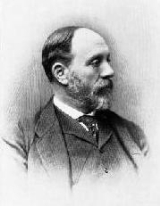
John Wolfe-Barry

Encyclopedia
Sir John Wolfe-Barry was an English civil engineer
of the late 19th and early 20th century. His most famous project was the construction of Tower Bridge
over the River Thames in London
.
Sir Charles Barry
, added "Wolfe" to his inherited name in 1898. He was educated at Glenalmond
and King's College London
, and was a pupil of civil engineer Sir John Hawkshaw
, as was Henry Marc Brunel, son of the great Isambard Kingdom Brunel
. Barry and Hawkshaw worked on railway bridge crossings across the Thames, among other projects (Brunel pursued his own business from 1871, but in 1878 went into partnership with Barry). Barry began his own practice in 1867, and carried out more work for the railways.
Horace Jones first proposed a low-level bascule
bridge. An Act of Parliament allowing the Corporation of the City of London
to build it was passed in 1885. Jones was appointed architect, and knighted, but died the same year. Wolfe-Barry, already well-established with experience of bridges across the Thames, then took control.
in 1896, knighted in 1897, and served on several Royal Commissions), Wolfe-Barry played a prominent role in the development of industry standardisation, urging the ICE's Council to form a committee to focus on standards for iron and steel sections.
Two members each from the ICE, the Institution of Mechanical Engineers
, the Institution of Naval Architects
and the Iron and Steel Institute first met on 26 April 1901. With the Institution of Electrical Engineers
who joining the following year, these bodies were the founder institutions of what is today the British Standards Institution or BSI.
.
He was chairman of Cable and Wireless from 1900 to 1917.
In 1902 Wolfe-Barry joined the consulting firm Robert White & Partners, and it was renamed Wolfe-Barry, Robert White & Partners (later, 1946, Sir Bruce White, Wolfe Barry and Partners – now part of London-based consultancy Hyder Consultants
).
Wolfe-Barry died in January 1918 and was buried in Brookwood Cemetery
near Woking
in Surrey
.
Civil engineer
A civil engineer is a person who practices civil engineering; the application of planning, designing, constructing, maintaining, and operating infrastructures while protecting the public and environmental health, as well as improving existing infrastructures that have been neglected.Originally, a...
of the late 19th and early 20th century. His most famous project was the construction of Tower Bridge
Tower Bridge
Tower Bridge is a combined bascule and suspension bridge in London, England, over the River Thames. It is close to the Tower of London, from which it takes its name...
over the River Thames in London
London
London is the capital city of :England and the :United Kingdom, the largest metropolitan area in the United Kingdom, and the largest urban zone in the European Union by most measures. Located on the River Thames, London has been a major settlement for two millennia, its history going back to its...
.
Early career
Wolfe-Barry, the youngest son of architectArchitect
An architect is a person trained in the planning, design and oversight of the construction of buildings. To practice architecture means to offer or render services in connection with the design and construction of a building, or group of buildings and the space within the site surrounding the...
Sir Charles Barry
Charles Barry
Sir Charles Barry FRS was an English architect, best known for his role in the rebuilding of the Palace of Westminster in London during the mid-19th century, but also responsible for numerous other buildings and gardens.- Background and training :Born on 23 May 1795 in Bridge Street, Westminster...
, added "Wolfe" to his inherited name in 1898. He was educated at Glenalmond
Glenalmond College
Glenalmond College is a co-educational independent boarding school in Perth and Kinross, Scotland, for children aged between 12 and 18 years. It is situated on the River Almond near the village of Methven, about west of the city of Perth. The school's motto is Floreat Glenalmond...
and King's College London
King's College London
King's College London is a public research university located in London, United Kingdom and a constituent college of the federal University of London. King's has a claim to being the third oldest university in England, having been founded by King George IV and the Duke of Wellington in 1829, and...
, and was a pupil of civil engineer Sir John Hawkshaw
John Hawkshaw
Sir John Hawkshaw , was an English civil engineer.-Early life:He was born in Leeds, Yorkshire and was educated at Leeds Grammar School...
, as was Henry Marc Brunel, son of the great Isambard Kingdom Brunel
Isambard Kingdom Brunel
Isambard Kingdom Brunel, FRS , was a British civil engineer who built bridges and dockyards including the construction of the first major British railway, the Great Western Railway; a series of steamships, including the first propeller-driven transatlantic steamship; and numerous important bridges...
. Barry and Hawkshaw worked on railway bridge crossings across the Thames, among other projects (Brunel pursued his own business from 1871, but in 1878 went into partnership with Barry). Barry began his own practice in 1867, and carried out more work for the railways.
Tower Bridge
However, it was Tower Bridge that really made Wolfe-Barry's name. In 1878, architectArchitect
An architect is a person trained in the planning, design and oversight of the construction of buildings. To practice architecture means to offer or render services in connection with the design and construction of a building, or group of buildings and the space within the site surrounding the...
Horace Jones first proposed a low-level bascule
Bascule
Bascule may refer to:* A Bascule bridge, a moveable bridge with a counterweight that continuously balances the span, or "leaf," throughout the entire upward swing in providing clearance for boat traffic...
bridge. An Act of Parliament allowing the Corporation of the City of London
City of London
The City of London is a small area within Greater London, England. It is the historic core of London around which the modern conurbation grew and has held city status since time immemorial. The City’s boundaries have remained almost unchanged since the Middle Ages, and it is now only a tiny part of...
to build it was passed in 1885. Jones was appointed architect, and knighted, but died the same year. Wolfe-Barry, already well-established with experience of bridges across the Thames, then took control.
Other projects
His other projects included:- Cannon Street Railway BridgeCannon Street Railway BridgeCannon Street Railway Bridge is a bridge in central London, crossing the River Thames. Downstream, the next bridge is London Bridge, and upstream Southwark Bridge. It carries trains over the river to Cannon Street station on the north bank...
(aka the Alexandra Bridge) (1866) - Blackfriars Railway BridgeBlackfriars Railway BridgeBlackfriars Railway Bridge is a railway bridge crossing the River Thames in London, between Blackfriars Bridge and the Millennium Bridge.There have been two structures with the name. The first bridge was opened in 1864 and was designed by Joseph Cubitt for the London, Chatham and Dover Railway...
(aka St Paul's Bridge), London (1886) - docks at BarryBarry, WalesBarry is a town and community in the Vale of Glamorgan in Wales. Located along the northern coast of the Bristol Channel less than south-southwest of Cardiff, the capital city of Wales, Barry is a seaside resort, with attractions including several beaches and the Barry Island Pleasure Park...
near CardiffCardiffCardiff is the capital, largest city and most populous county of Wales and the 10th largest city in the United Kingdom. The city is Wales' chief commercial centre, the base for most national cultural and sporting institutions, the Welsh national media, and the seat of the National Assembly for...
, south WalesWalesWales is a country that is part of the United Kingdom and the island of Great Britain, bordered by England to its east and the Atlantic Ocean and Irish Sea to its west. It has a population of three million, and a total area of 20,779 km²... - District LineDistrict LineThe District line is a line of the London Underground, coloured green on the Tube map. It is a "sub-surface" line, running through the central area in shallow cut-and-cover tunnels. It is the busiest of the sub-surface lines. Out of the 60 stations served, 25 are underground...
of the London UndergroundLondon UndergroundThe London Underground is a rapid transit system serving a large part of Greater London and some parts of Buckinghamshire, Hertfordshire and Essex in England...
(with Sir John Hawkshaw) - pumping stations on the Regent's CanalRegent's CanalRegent's Canal is a canal across an area just north of central London, England. It provides a link from the Paddington arm of the Grand Union Canal, just north-west of Paddington Basin in the west, to the Limehouse Basin and the River Thames in east London....
, north London - Kew BridgeKew BridgeKew Bridge is a bridge in London over the River Thames. The present bridge was designed by John Wolfe-Barry and opened in 1903 by King Edward VII. The bridge was givenGrade II listed structure protection in 1983.- Location :...
, west London (1903) - expansion of Greenland DockGreenland DockGreenland Dock is the oldest of London's riverside wet docks, located in Rotherhithe in the area of the city now known as Docklands. It used to be part of the Surrey Commercial Docks, most of which have by now been filled in...
, Surrey Docks (now Surrey QuaysSurrey QuaysSurrey Quays is a name given to a largely residential area of Rotherhithe in south-east London, occupied until 1970 by the Surrey Commercial Docks...
), south-east London (1904)
Industry standardisation
A recognised industry leader (he was elected President of the Institution of Civil EngineersInstitution of Civil Engineers
Founded on 2 January 1818, the Institution of Civil Engineers is an independent professional association, based in central London, representing civil engineering. Like its early membership, the majority of its current members are British engineers, but it also has members in more than 150...
in 1896, knighted in 1897, and served on several Royal Commissions), Wolfe-Barry played a prominent role in the development of industry standardisation, urging the ICE's Council to form a committee to focus on standards for iron and steel sections.
Two members each from the ICE, the Institution of Mechanical Engineers
Institution of Mechanical Engineers
The Institution of Mechanical Engineers is the British engineering society based in central London, representing mechanical engineering. It is licensed by the Engineering Council UK to assess candidates for inclusion on ECUK's Register of professional Engineers...
, the Institution of Naval Architects
Royal Institution of Naval Architects
The Royal Institution of Naval Architects is an international organisation representing naval architects. It is an international professional institution whose members are involved world-wide at all levels in the design, construction, repair and operation of ships, boats and marine...
and the Iron and Steel Institute first met on 26 April 1901. With the Institution of Electrical Engineers
Institution of Electrical Engineers
The Institution of Electrical Engineers was a British professional organisation of electronics, electrical, manufacturing, and Information Technology professionals, especially electrical engineers. The I.E.E...
who joining the following year, these bodies were the founder institutions of what is today the British Standards Institution or BSI.
Late career
He was a member of the Smeatonian Society of Civil EngineersSmeatonian Society of Civil Engineers
The Smeatonian Society of Civil Engineers was founded in 1771, and was originally known as the Society of Civil Engineers, being renamed following its founder's death...
.
He was chairman of Cable and Wireless from 1900 to 1917.
In 1902 Wolfe-Barry joined the consulting firm Robert White & Partners, and it was renamed Wolfe-Barry, Robert White & Partners (later, 1946, Sir Bruce White, Wolfe Barry and Partners – now part of London-based consultancy Hyder Consultants
Hyder Consulting
Hyder Consulting is a multi-national advisory and design consultancy with particular specialisation in the transport, property, utilities and environmental sectors. The firm employs approximately 4,200 people across the UK, Europe, Germany, Middle East, Asia and Australia and has been listed on the...
).
Wolfe-Barry died in January 1918 and was buried in Brookwood Cemetery
Brookwood Cemetery
Brookwood Cemetery is a burial ground in Brookwood, Surrey, England. It is the largest cemetery in the United Kingdom and one of the largest in western Europe.-History:...
near Woking
Woking
Woking is a large town and civil parish that shares its name with the surrounding local government district, located in the west of Surrey, UK. It is part of the Greater London Urban Area and the London commuter belt, with frequent trains and a journey time of 24 minutes to Waterloo station....
in Surrey
Surrey
Surrey is a county in the South East of England and is one of the Home Counties. The county borders Greater London, Kent, East Sussex, West Sussex, Hampshire and Berkshire. The historic county town is Guildford. Surrey County Council sits at Kingston upon Thames, although this has been part of...
.
External links
- John Wolfe-Barry's Gravesite This article on his father contains a paragraph describing John Wolfe-Barry's career.
- Sir John Wolfe-Barry, biography at the Tower Bridge Restoration website