

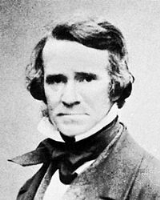
John Hawkshaw

Encyclopedia
Sir John Hawkshaw was an English
civil engineer
.
, Yorkshire
and was educated at Leeds Grammar School
. Before he was 21 he had been engaged for six or seven years in railway engineering and the construction of roads in his native county, and in the year of his majority he obtained an appointment as engineer to the Bolivar Mining Association in Venezuela
. But the climate there was more than his health could stand, and in 1834 he was obliged to return to England.
at the Liverpool
docks, and subsequently was made engineer in charge of the railway and navigation works of the Manchester, Bolton and Bury Canal Company
. In 1845 he became chief engineer to the Manchester and Leeds Railway
, and in 1847 to its successor, the Lancashire and Yorkshire Railway
for which he constructed a large number of branch lines. One such was Manchester and Southport line
Surveyed by his associate Clement Wilks
and as well as the Lancashire and Yorkshire Railway
near Heckmondwike. In 1850 he removed to London
and began to practise as a consulting engineer, at first alone, but subsequently in partnership with Harrison Hayter
. In that capacity his work was of an extremely varied nature, embracing almost every branch of engineering.
He retained his connection with the Lancashire & Yorkshire Company until his retirement from professional work in 1888, and was consulted on all the important engineering points that affected it in that long period. In London he was responsible for the Charing Cross
and Cannon Street
railways, together with the two bridges which carried them over the Thames
; he was engineer of the East London railway, which passes under the Thames through Sir Marc Brunel
's well-known tunnel
; and jointly with Sir J Wolfe-Barry
he constructed the section of the Underground railway which completed the inner circle between the Aldgate
and Mansion House stations.
In addition, many railway works claimed his attention in all parts of the world--Germany
, Russia
, India
, Mauritius
, etc. One noteworthy point in his railway practice was his advocacy, in opposition to Robert Stephenson
, of steeper gradients than had previously been thought desirable or possible, and so far back as 1838 he expressed decided disapproval of the maintenance of the broad gauge on the Great Western
, because of the troubles he foresaw it would lead to in connection with future railway extension, and because he objected in general to breaks of gauge in the lines of a country.
The construction of canal
s was another branch of engineering in which he was actively engaged. In 1862 he became engineer of the Amsterdam
ship-canal, and in the succeeding year he may fairly be said to have been the saviour of the Suez Canal
. About that time the scheme was in very bad odour, and the khedive determined to get the opinion of an English engineer as to its practicability, having made up his mind to stop the works if that opinion was unfavourable. Hawkshaw was chosen to make the inquiry, and it was because his report was entirely favourable that Ferdinand de Lesseps
was able to say at the opening ceremony that to him he owed the canal.
As a member of the International Congress which considered the construction of an inter-ocean canal across central America
, he thought best of the Nicaragua
route, and privately he regarded the Panama scheme
as impracticable at a reasonable cost, although publicly he expressed no opinion on the matter and left the Congress without voting. Sir John Hawkshaw also had a wide experience in constructing harbours (e.g. Holyhead
) and docks (e.g. Penarth
, the Albert Dock at Hull
, and South Dock (formerly the City Canal
) of the West India Docks
in London), in river-engineering, in drainage and sewerage, in water-supply, etc.
He was engineer, with Sir James Brunlees
, of the original Channel Tunnel
Company from 1872, but many years previously he had investigated for himself the question of a tunnel under the Strait of Dover
from an engineering point of view, and had come to a belief in its feasibility, so far as that could be determined from borings and surveys. Subsequently, however, he became convinced that the tunnel would not be to the advantage of Great Britain
, and thereafter would have nothing to do with the project. He was also consulting engineer to the Severn Tunnel
, which, from its magnitude and the difficulties encountered in its construction, was one of the most notable engineering undertakings of the 19th century. Following the inundation of the tunnel working in 1879, he employed Thomas A. Walker
as lead contractor to complete the work.
He also designed the famous Puerto Madero, the port of Buenos Aires
, which started its construction in 1885 and was finished in 1898.
He served as president of the Institution of Civil Engineers
between December 1861 and December 1863.
He was knighted in 1873.
He died in London on 2 June 1891. His son, John Clarke Hawkshaw
was born in 1841 and was also a civil engineer.
England
England is a country that is part of the United Kingdom. It shares land borders with Scotland to the north and Wales to the west; the Irish Sea is to the north west, the Celtic Sea to the south west, with the North Sea to the east and the English Channel to the south separating it from continental...
civil engineer
Civil engineer
A civil engineer is a person who practices civil engineering; the application of planning, designing, constructing, maintaining, and operating infrastructures while protecting the public and environmental health, as well as improving existing infrastructures that have been neglected.Originally, a...
.
Early life
He was born in LeedsLeeds
Leeds is a city and metropolitan borough in West Yorkshire, England. In 2001 Leeds' main urban subdivision had a population of 443,247, while the entire city has a population of 798,800 , making it the 30th-most populous city in the European Union.Leeds is the cultural, financial and commercial...
, Yorkshire
Yorkshire
Yorkshire is a historic county of northern England and the largest in the United Kingdom. Because of its great size in comparison to other English counties, functions have been increasingly undertaken over time by its subdivisions, which have also been subject to periodic reform...
and was educated at Leeds Grammar School
Leeds Grammar School
Leeds Grammar School was an independent school in Leeds established in 1552. In August 2005 it merged with Leeds Girls' High School to form The Grammar School at Leeds. The two schools physically united in September 2008....
. Before he was 21 he had been engaged for six or seven years in railway engineering and the construction of roads in his native county, and in the year of his majority he obtained an appointment as engineer to the Bolivar Mining Association in Venezuela
Venezuela
Venezuela , officially called the Bolivarian Republic of Venezuela , is a tropical country on the northern coast of South America. It borders Colombia to the west, Guyana to the east, and Brazil to the south...
. But the climate there was more than his health could stand, and in 1834 he was obliged to return to England.
Career
He soon obtained employment under Jesse HartleyJesse Hartley
Jesse Hartley was Civil Engineer and Superintendent of the Concerns of the Dock Estate in Liverpool, England between 1824 and 1860.-Hartley's career:...
at the Liverpool
Liverpool
Liverpool is a city and metropolitan borough of Merseyside, England, along the eastern side of the Mersey Estuary. It was founded as a borough in 1207 and was granted city status in 1880...
docks, and subsequently was made engineer in charge of the railway and navigation works of the Manchester, Bolton and Bury Canal Company
Manchester, Bolton and Bury Canal
The Manchester Bolton & Bury Canal is a disused canal in Greater Manchester, England, built to link Bolton and Bury with Manchester. The canal, when fully opened, was 15 miles 1 furlong long. It was accessed via a junction with the River Irwell in Salford...
. In 1845 he became chief engineer to the Manchester and Leeds Railway
Manchester and Leeds Railway
The Manchester and Leeds Railway was a railway company in the United Kingdom which opened in 1839, connecting Manchester with Leeds via the North Midland Railway which it joined at Normanton....
, and in 1847 to its successor, the Lancashire and Yorkshire Railway
Lancashire and Yorkshire Railway
The Lancashire and Yorkshire Railway was a major British railway company before the 1923 Grouping. It was incorporated in 1847 from an amalgamation of several existing railways...
for which he constructed a large number of branch lines. One such was Manchester and Southport line
Manchester and Southport Railway
The Manchester and Southport Railway in England opened on 9 April 1855. It merged with the Lancashire and Yorkshire Railway in January 1885. The line eventually formed part of the Lancashire and Yorkshire Railway, 59.5 km Liverpool to Manchester route via a junction with the Liverpool and Bury...
Surveyed by his associate Clement Wilks
Clement Wilks
Clement Wilks was a notable Civil Engineer and Architect in colonial Victoria, Australia.-Early days:Clement Wilks was born at Peckham Rye, Surrey, 15 February 1819, the youngest son of the Rev. Mark Wilks, of Paris...
and as well as the Lancashire and Yorkshire Railway
Lancashire and Yorkshire Railway
The Lancashire and Yorkshire Railway was a major British railway company before the 1923 Grouping. It was incorporated in 1847 from an amalgamation of several existing railways...
near Heckmondwike. In 1850 he removed to London
London
London is the capital city of :England and the :United Kingdom, the largest metropolitan area in the United Kingdom, and the largest urban zone in the European Union by most measures. Located on the River Thames, London has been a major settlement for two millennia, its history going back to its...
and began to practise as a consulting engineer, at first alone, but subsequently in partnership with Harrison Hayter
Harrison Hayter
Harrison Hayter was a British engineer, participating in many significant railway construction projects in Britain and many harbour and dock constructions worldwide....
. In that capacity his work was of an extremely varied nature, embracing almost every branch of engineering.
He retained his connection with the Lancashire & Yorkshire Company until his retirement from professional work in 1888, and was consulted on all the important engineering points that affected it in that long period. In London he was responsible for the Charing Cross
Charing Cross railway station
Charing Cross railway station, also known as London Charing Cross, is a central London railway terminus in the City of Westminster, England. It is one of 18 stations managed by Network Rail, and trains serving it are operated by Southeastern...
and Cannon Street
Cannon Street station
Cannon Street station, also known as London Cannon Street, is a central London railway terminus and London Underground complex in the City of London, England. It is built on the site of the medieval Steelyard, the trading base in England of the Hanseatic League...
railways, together with the two bridges which carried them over the Thames
River Thames
The River Thames flows through southern England. It is the longest river entirely in England and the second longest in the United Kingdom. While it is best known because its lower reaches flow through central London, the river flows alongside several other towns and cities, including Oxford,...
; he was engineer of the East London railway, which passes under the Thames through Sir Marc Brunel
Marc Isambard Brunel
Sir Marc Isambard Brunel, FRS FRSE was a French-born engineer who settled in England. He preferred the name Isambard, but is generally known to history as Marc to avoid confusion with his more famous son Isambard Kingdom Brunel...
's well-known tunnel
Thames Tunnel
The Thames Tunnel is an underwater tunnel, built beneath the River Thames in London, United Kingdom, connecting Rotherhithe and Wapping. It measures 35 feet wide by 20 feet high and is 1,300 feet long, running at a depth of 75 feet below the river's surface...
; and jointly with Sir J Wolfe-Barry
John Wolfe-Barry
Sir John Wolfe-Barry was an English civil engineer of the late 19th and early 20th century. His most famous project was the construction of Tower Bridge over the River Thames in London.-Early career:...
he constructed the section of the Underground railway which completed the inner circle between the Aldgate
Aldgate tube station
Aldgate tube station is a London Underground station located at Aldgate in the City of London.The station is on the Circle Line between Tower Hill and Liverpool Street. It is also the eastern terminus of the Metropolitan Line...
and Mansion House stations.
In addition, many railway works claimed his attention in all parts of the world--Germany
Germany
Germany , officially the Federal Republic of Germany , is a federal parliamentary republic in Europe. The country consists of 16 states while the capital and largest city is Berlin. Germany covers an area of 357,021 km2 and has a largely temperate seasonal climate...
, Russia
Russia
Russia or , officially known as both Russia and the Russian Federation , is a country in northern Eurasia. It is a federal semi-presidential republic, comprising 83 federal subjects...
, India
India
India , officially the Republic of India , is a country in South Asia. It is the seventh-largest country by geographical area, the second-most populous country with over 1.2 billion people, and the most populous democracy in the world...
, Mauritius
Mauritius
Mauritius , officially the Republic of Mauritius is an island nation off the southeast coast of the African continent in the southwest Indian Ocean, about east of Madagascar...
, etc. One noteworthy point in his railway practice was his advocacy, in opposition to Robert Stephenson
Robert Stephenson
Robert Stephenson FRS was an English civil engineer. He was the only son of George Stephenson, the famed locomotive builder and railway engineer; many of the achievements popularly credited to his father were actually the joint efforts of father and son.-Early life :He was born on the 16th of...
, of steeper gradients than had previously been thought desirable or possible, and so far back as 1838 he expressed decided disapproval of the maintenance of the broad gauge on the Great Western
Great Western Railway
The Great Western Railway was a British railway company that linked London with the south-west and west of England and most of Wales. It was founded in 1833, received its enabling Act of Parliament in 1835 and ran its first trains in 1838...
, because of the troubles he foresaw it would lead to in connection with future railway extension, and because he objected in general to breaks of gauge in the lines of a country.
The construction of canal
Canal
Canals are man-made channels for water. There are two types of canal:#Waterways: navigable transportation canals used for carrying ships and boats shipping goods and conveying people, further subdivided into two kinds:...
s was another branch of engineering in which he was actively engaged. In 1862 he became engineer of the Amsterdam
Amsterdam
Amsterdam is the largest city and the capital of the Netherlands. The current position of Amsterdam as capital city of the Kingdom of the Netherlands is governed by the constitution of August 24, 1815 and its successors. Amsterdam has a population of 783,364 within city limits, an urban population...
ship-canal, and in the succeeding year he may fairly be said to have been the saviour of the Suez Canal
Suez Canal
The Suez Canal , also known by the nickname "The Highway to India", is an artificial sea-level waterway in Egypt, connecting the Mediterranean Sea and the Red Sea. Opened in November 1869 after 10 years of construction work, it allows water transportation between Europe and Asia without navigation...
. About that time the scheme was in very bad odour, and the khedive determined to get the opinion of an English engineer as to its practicability, having made up his mind to stop the works if that opinion was unfavourable. Hawkshaw was chosen to make the inquiry, and it was because his report was entirely favourable that Ferdinand de Lesseps
Ferdinand de Lesseps
Ferdinand Marie, Vicomte de Lesseps, GCSI was the French developer of the Suez Canal, which joined the Mediterranean and Red Seas in 1869, and substantially reduced sailing distances and times between the West and the East.He attempted to repeat this success with an effort to build a sea-level...
was able to say at the opening ceremony that to him he owed the canal.
As a member of the International Congress which considered the construction of an inter-ocean canal across central America
Central America
Central America is the central geographic region of the Americas. It is the southernmost, isthmian portion of the North American continent, which connects with South America on the southeast. When considered part of the unified continental model, it is considered a subcontinent...
, he thought best of the Nicaragua
Nicaragua
Nicaragua is the largest country in the Central American American isthmus, bordered by Honduras to the north and Costa Rica to the south. The country is situated between 11 and 14 degrees north of the Equator in the Northern Hemisphere, which places it entirely within the tropics. The Pacific Ocean...
route, and privately he regarded the Panama scheme
Panama Canal
The Panama Canal is a ship canal in Panama that joins the Atlantic Ocean and the Pacific Ocean and is a key conduit for international maritime trade. Built from 1904 to 1914, the canal has seen annual traffic rise from about 1,000 ships early on to 14,702 vessels measuring a total of 309.6...
as impracticable at a reasonable cost, although publicly he expressed no opinion on the matter and left the Congress without voting. Sir John Hawkshaw also had a wide experience in constructing harbours (e.g. Holyhead
Holyhead
Holyhead is the largest town in the county of Anglesey in the North Wales. It is also a major port adjacent to the Irish Sea serving Ireland....
) and docks (e.g. Penarth
Penarth
Penarth is a town and seaside resort in the Vale of Glamorgan , Wales, 5.2 miles south west from the city centre of the Welsh capital city of Cardiff and lying on the north shore of the Severn Estuary at the southern end of Cardiff Bay...
, the Albert Dock at Hull
Kingston upon Hull
Kingston upon Hull , usually referred to as Hull, is a city and unitary authority area in the ceremonial county of the East Riding of Yorkshire, England. It stands on the River Hull at its junction with the Humber estuary, 25 miles inland from the North Sea. Hull has a resident population of...
, and South Dock (formerly the City Canal
City Canal
The City Canal was a short, and short-lived, canal excavated across the Isle of Dogs in east London, linking two reaches of the River Thames. Today, it has been almost completely reconstructed to form the South Dock of the West India Docks.-History:...
) of the West India Docks
West India Docks
The West India Docks are a series of three docks on the Isle of Dogs in London, the first of which opened in 1802. The docks closed to commercial traffic in 1980 and the Canary Wharf development was built on the site.-History:...
in London), in river-engineering, in drainage and sewerage, in water-supply, etc.
He was engineer, with Sir James Brunlees
James Brunlees
Sir James Brunlees was a Scottish civil engineer. He was born in Kelso in the Scottish Borders in 1816.In 1850, Brunlees worked on the Londonderry and Coleraine Railway...
, of the original Channel Tunnel
Channel Tunnel
The Channel Tunnel is a undersea rail tunnel linking Folkestone, Kent in the United Kingdom with Coquelles, Pas-de-Calais near Calais in northern France beneath the English Channel at the Strait of Dover. At its lowest point, it is deep...
Company from 1872, but many years previously he had investigated for himself the question of a tunnel under the Strait of Dover
Strait of Dover
The Strait of Dover or Dover Strait is the strait at the narrowest part of the English Channel. The shortest distance across the strait is from the South Foreland, 6 kilometres northeast of Dover in the county of Kent, England, to Cap Gris Nez, a cape near to Calais in the French of...
from an engineering point of view, and had come to a belief in its feasibility, so far as that could be determined from borings and surveys. Subsequently, however, he became convinced that the tunnel would not be to the advantage of Great Britain
Great Britain
Great Britain or Britain is an island situated to the northwest of Continental Europe. It is the ninth largest island in the world, and the largest European island, as well as the largest of the British Isles...
, and thereafter would have nothing to do with the project. He was also consulting engineer to the Severn Tunnel
Severn Tunnel
The Severn Tunnel is a railway tunnel in the United Kingdom, linking South Gloucestershire in the west of England to Monmouthshire in south Wales under the estuary of the River Severn....
, which, from its magnitude and the difficulties encountered in its construction, was one of the most notable engineering undertakings of the 19th century. Following the inundation of the tunnel working in 1879, he employed Thomas A. Walker
Thomas A. Walker
Thomas Andrew Walker was an English civil engineering contractor.Walker was born at Brewood in Staffordshire. He was educated at King's College London...
as lead contractor to complete the work.
He also designed the famous Puerto Madero, the port of Buenos Aires
Buenos Aires
Buenos Aires is the capital and largest city of Argentina, and the second-largest metropolitan area in South America, after São Paulo. It is located on the western shore of the estuary of the Río de la Plata, on the southeastern coast of the South American continent...
, which started its construction in 1885 and was finished in 1898.
Honours and Awards
He was elected a Fellow of the Royal Society in June 1855.He served as president of the Institution of Civil Engineers
Institution of Civil Engineers
Founded on 2 January 1818, the Institution of Civil Engineers is an independent professional association, based in central London, representing civil engineering. Like its early membership, the majority of its current members are British engineers, but it also has members in more than 150...
between December 1861 and December 1863.
He was knighted in 1873.
He died in London on 2 June 1891. His son, John Clarke Hawkshaw
John Clarke Hawkshaw
John Clarke Hawkshaw was a British civil engineer.Hawkshaw was born in Manchester, England in 1841 and was the son of civil engineer Sir John Hawkshaw and Lady Ann Hawkshaw...
was born in 1841 and was also a civil engineer.