


Johann de Kalb

Encyclopedia
Johann von Robais, Baron de Kalb (June 19, 1721 – August 19, 1780), born Johann Kalb, was a German
soldier who served as a major general
in the Continental Army
during the American Revolutionary War
.
, now a part of Erlangen
, in present-day Bavaria
, the son of Johann Leonhard Kalb and Margarethe Seitz. He learned French, English, and the social skills to get a substantial military commission in the Loewendal German Regiment of the French Army
(where he served as Jean de Kalb). He served with distinguished honor throughout the War of Austrian Succession
in Flanders
. During the Seven Years' War
, he was promoted to lieutenant colonel
and made assistant quartermaster general in the Army of the Upper Rhine, a division created by the disbanding of the Loewendal Regiment. He won the Order of Military Merit
in 1763, and was elevated to the nobility with the title of baron.
In 1764, he resigned from the army and married Anna Elizabeth Emilie van Robais, an heiress to a fortune from cloth manufacturing.
In 1768, he traveled to America
on a covert mission to determine the level of discontent amongst colonists by de Choiseul
, on behalf of France
. During the trip, he gained a respect for the colonists and their "spirit of independence".
, and joined the Continental Army. He was disappointed and angry to learn, at first that he would not be made a major general, but after Lafayette's influence, was appointed on September 5, 1777, while he was on the road to leave for France.
He was at Valley Forge
for most of the 1777–78 winter, and commanded a division
of Patterson's and Learned
's Brigades. He wrote letters of introduction for John Adams to the French court.
De Kalb wrote:
 He was assigned the command of a division of Maryland and Delaware troops, and was ordered south as reinforcements. During the British southern campaign, he was disappointed to learn that Horatio Gates
had been appointed to command instead of him. At the Battle of Camden
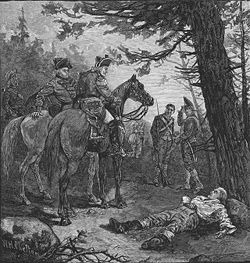
on August 16, 1780, de Kalb's horse was shot from under him, causing him to tumble to the ground. Before he could get up, he was shot three times and bayonet
ted repeatedly by British soldiers. His friend and aide, the Chevalier du Buysson, was seriously wounded blocking additional blows with his own body.
It is reported that Cornwallis supervised as De Kalb's wounds were dressed by his own surgeons in Camden, South Carolina
. De Kalb replied to a British officer, "I thank you sir for your generous sympathy, but I die the death I always prayed for: the death of a soldier fighting for the rights of man." He died three days later and was buried in Camden.
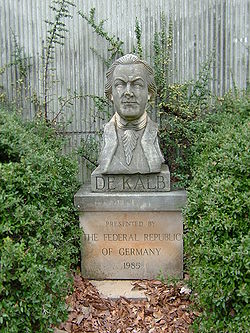 He was greatly revered by his contemporaries. Several towns, counties and streets in the U.S. are named DeKalb
after him, in Alabama
, Georgia
, Illinois
, Indiana
, New York
, Tennessee and Texas. Streets include the DeKalb Avenue
in Brooklyn
, New York City
and others. His portrait was painted posthumously by Charles Willson Peale
. In 1886, a monument to Baron de Kalb was erected on the grounds of the Maryland state house
to honor his contributions to the revolution.
Germans
The Germans are a Germanic ethnic group native to Central Europe. The English term Germans has referred to the German-speaking population of the Holy Roman Empire since the Late Middle Ages....
soldier who served as a major general
Major General
Major general or major-general is a military rank used in many countries. It is derived from the older rank of sergeant major general. A major general is a high-ranking officer, normally subordinate to the rank of lieutenant general and senior to the ranks of brigadier and brigadier general...
in the Continental Army
Continental Army
The Continental Army was formed after the outbreak of the American Revolutionary War by the colonies that became the United States of America. Established by a resolution of the Continental Congress on June 14, 1775, it was created to coordinate the military efforts of the Thirteen Colonies in...
during the American Revolutionary War
American Revolutionary War
The American Revolutionary War , the American War of Independence, or simply the Revolutionary War, began as a war between the Kingdom of Great Britain and thirteen British colonies in North America, and ended in a global war between several European great powers.The war was the result of the...
.
Early life
Kalb was born in HüttendorfHuttendorf
Huttendorf is a commune in the Bas-Rhin department in Alsace in north-eastern France.-Geography:Agriculture, including livestock rearing, plays an important part in the village economy.-History:...
, now a part of Erlangen
Erlangen
Erlangen is a Middle Franconian city in Bavaria, Germany. It is located at the confluence of the river Regnitz and its large tributary, the Untere Schwabach.Erlangen has more than 100,000 inhabitants....
, in present-day Bavaria
Bavaria
Bavaria, formally the Free State of Bavaria is a state of Germany, located in the southeast of Germany. With an area of , it is the largest state by area, forming almost 20% of the total land area of Germany...
, the son of Johann Leonhard Kalb and Margarethe Seitz. He learned French, English, and the social skills to get a substantial military commission in the Loewendal German Regiment of the French Army
Military of France
The French Armed Forces encompass the French Army, the French Navy, the French Air Force and the National Gendarmerie. The President of the Republic heads the armed forces, with the title "chef des armées" . The President is the supreme authority for military matters and is the sole official who...
(where he served as Jean de Kalb). He served with distinguished honor throughout the War of Austrian Succession
War of the Austrian Succession
The War of the Austrian Succession – including King George's War in North America, the Anglo-Spanish War of Jenkins' Ear, and two of the three Silesian wars – involved most of the powers of Europe over the question of Maria Theresa's succession to the realms of the House of Habsburg.The...
in Flanders
Flanders
Flanders is the community of the Flemings but also one of the institutions in Belgium, and a geographical region located in parts of present-day Belgium, France and the Netherlands. "Flanders" can also refer to the northern part of Belgium that contains Brussels, Bruges, Ghent and Antwerp...
. During the Seven Years' War
Seven Years' War
The Seven Years' War was a global military war between 1756 and 1763, involving most of the great powers of the time and affecting Europe, North America, Central America, the West African coast, India, and the Philippines...
, he was promoted to lieutenant colonel
Lieutenant colonel
Lieutenant colonel is a rank of commissioned officer in the armies and most marine forces and some air forces of the world, typically ranking above a major and below a colonel. The rank of lieutenant colonel is often shortened to simply "colonel" in conversation and in unofficial correspondence...
and made assistant quartermaster general in the Army of the Upper Rhine, a division created by the disbanding of the Loewendal Regiment. He won the Order of Military Merit
Order of Military Merit
Order of Military Merit may refer to:* Order of Military Merit , National Order "For Military Merit"* Order of Military Merit * German States:** Military Merit Order ** Military Merit Order...
in 1763, and was elevated to the nobility with the title of baron.
In 1764, he resigned from the army and married Anna Elizabeth Emilie van Robais, an heiress to a fortune from cloth manufacturing.
In 1768, he traveled to America
United States
The United States of America is a federal constitutional republic comprising fifty states and a federal district...
on a covert mission to determine the level of discontent amongst colonists by de Choiseul
Étienne François, duc de Choiseul
Étienne-François, comte de Stainville, duc de Choiseul was a French military officer, diplomat and statesman. Between 1758 and 1761, and 1766 and 1770, he was Foreign Minister of France and had a strong influence on France's global strategy throughout the period...
, on behalf of France
France
The French Republic , The French Republic , The French Republic , (commonly known as France , is a unitary semi-presidential republic in Western Europe with several overseas territories and islands located on other continents and in the Indian, Pacific, and Atlantic oceans. Metropolitan France...
. During the trip, he gained a respect for the colonists and their "spirit of independence".
American Revolutionary War
In 1777, he returned again with his protégé, the Marquis de LafayetteGilbert du Motier, marquis de La Fayette
Marie-Joseph Paul Yves Roch Gilbert du Motier, Marquis de La Fayette , often known as simply Lafayette, was a French aristocrat and military officer born in Chavaniac, in the province of Auvergne in south central France...
, and joined the Continental Army. He was disappointed and angry to learn, at first that he would not be made a major general, but after Lafayette's influence, was appointed on September 5, 1777, while he was on the road to leave for France.
He was at Valley Forge
Valley Forge
Valley Forge in Pennsylvania was the site of the military camp of the American Continental Army over the winter of 1777–1778 in the American Revolutionary War.-History:...
for most of the 1777–78 winter, and commanded a division
Division (military)
A division is a large military unit or formation usually consisting of between 10,000 and 20,000 soldiers. In most armies, a division is composed of several regiments or brigades, and in turn several divisions typically make up a corps...
of Patterson's and Learned
Ebenezer Learned
Ebenezer Learned was a brigadier general in the American Continental Army during the Revolutionary War.-Early life and career:...
's Brigades. He wrote letters of introduction for John Adams to the French court.
De Kalb wrote:
On the whole, I have annoyances to bear, of which you can hardly form a conception. One of them is the mutual jealousy of almost all the French officers, particularly against those of higher rank than the rest. These people think of nothing but their incessant intrigues and backbitings. They hate each other like the bitterest enemies, and endeavor to injure each other wherever an opportunity offers. I have given up their society, and very seldom see them. La Fayette is the sole exception; I always meet him with the same cordiality and the same pleasure. He is an excellent young man, and we are good friends.... La Fayette is much liked, he is on the best of terms with Washington.
Horatio Gates
Horatio Lloyd Gates was a retired British soldier who served as an American general during the Revolutionary War. He took credit for the American victory at the Battle of Saratoga – Benedict Arnold, who led the attack, was finally forced from the field when he was shot in the leg – and...
had been appointed to command instead of him. At the Battle of Camden
Battle of Camden
The Battle of Camden was a major victory for the British in the Southern theater of the American Revolutionary War...
on August 16, 1780, de Kalb's horse was shot from under him, causing him to tumble to the ground. Before he could get up, he was shot three times and bayonet
Bayonet
A bayonet is a knife, dagger, sword, or spike-shaped weapon designed to fit in, on, over or underneath the muzzle of a rifle, musket or similar weapon, effectively turning the gun into a spear...
ted repeatedly by British soldiers. His friend and aide, the Chevalier du Buysson, was seriously wounded blocking additional blows with his own body.
It is reported that Cornwallis supervised as De Kalb's wounds were dressed by his own surgeons in Camden, South Carolina
Camden, South Carolina
Camden is the fourth oldest city in the U.S. state of South Carolina and is also the county seat of Kershaw County, South Carolina, United States. The population was an estimated 7,103 in 2009...
. De Kalb replied to a British officer, "I thank you sir for your generous sympathy, but I die the death I always prayed for: the death of a soldier fighting for the rights of man." He died three days later and was buried in Camden.
Legacy
DeKalb
-Locations:* Municipalities in the United States:** DeKalb, Illinois, the largest city in the United States named DeKalb***DeKalb High School in that city** De Kalb, Mississippi ** De Kalb, Missouri...
after him, in Alabama
DeKalb County, Alabama
As of the 2010 Census DeKalb County had a population of 71,109. The median age was 37.5. The racial and ethnic makeup of the population was 81.6% non-Hispanic white, 1.5% African American, 1.4% Native American, 0.3% Asian, 0.2% Pacific Islander , 9.9% from some other race, 2.2% reporting two or...
, Georgia
DeKalb County, Georgia
DeKalb County is a county located in the U.S. state of Georgia. The population of the county was 691,893 at the 2010 census. Its county seat is the city of Decatur. It is bordered to the west by Fulton County and contains roughly 10% of the city of Atlanta...
, Illinois
DeKalb County, Illinois
DeKalb County is a county located in the U.S. state of Illinois. According to the 2010 census, it has a population of 105,160, which is an increase of 18.2% from 88,969 in 2000. Its county seat is Sycamore. DeKalb County is part of the Chicago metropolitan statistical area.-History:DeKalb County...
, Indiana
DeKalb County, Indiana
DeKalb County is a county located in the U.S. state of Indiana. Named for Revolutionary War hero Johann, Baron de Kalb , the county was created by the Indiana legislature in 1835 and organized in 1837. As of 2010, the population was 42,223...
, New York
De Kalb, New York
De Kalb is a town in St. Lawrence County, New York, USA. The population was 2,213 at the 2000 census. The town is named after American general Baron de Kalb, a German officer serving under George Washington....
, Tennessee and Texas. Streets include the DeKalb Avenue
DeKalb Avenue
DeKalb Avenue is a street in the New York City boroughs of Brooklyn and Queens, with the majority of its length in Brooklyn. It runs from Woodward Avenue in Ridgewood, Queens to Fulton Street in Downtown Brooklyn...
in Brooklyn
Brooklyn
Brooklyn is the most populous of New York City's five boroughs, with nearly 2.6 million residents, and the second-largest in area. Since 1896, Brooklyn has had the same boundaries as Kings County, which is now the most populous county in New York State and the second-most densely populated...
, New York City
New York City
New York is the most populous city in the United States and the center of the New York Metropolitan Area, one of the most populous metropolitan areas in the world. New York exerts a significant impact upon global commerce, finance, media, art, fashion, research, technology, education, and...
and others. His portrait was painted posthumously by Charles Willson Peale
Charles Willson Peale
Charles Willson Peale was an American painter, soldier and naturalist. He is best remembered for his portrait paintings of leading figures of the American Revolution, as well as establishing one of the first museums....
. In 1886, a monument to Baron de Kalb was erected on the grounds of the Maryland state house
Maryland State House
The Maryland State House is located in Annapolis and is the oldest state capitol in continuous legislative use, dating to 1772. It houses the Maryland General Assembly and offices of the Governor and Lieutenant Governor. The capitol has the distinction of being topped by the largest wooden dome in...
to honor his contributions to the revolution.