

Valley Forge

Encyclopedia

Pennsylvania
The Commonwealth of Pennsylvania is a U.S. state that is located in the Northeastern and Mid-Atlantic regions of the United States. The state borders Delaware and Maryland to the south, West Virginia to the southwest, Ohio to the west, New York and Ontario, Canada, to the north, and New Jersey to...
was the site of the military camp
Military camp
A military camp or bivouac is a semi-permanent facility for the lodging of an army. Camps are erected when a military force travels away from a major installation or fort during training or operations, and often have the form of large campsites. In the Roman era the military camp had highly...
of the American
United States
The United States of America is a federal constitutional republic comprising fifty states and a federal district...
Continental Army
Continental Army
The Continental Army was formed after the outbreak of the American Revolutionary War by the colonies that became the United States of America. Established by a resolution of the Continental Congress on June 14, 1775, it was created to coordinate the military efforts of the Thirteen Colonies in...
over the winter of 1777–1778 in the American Revolutionary War
American Revolutionary War
The American Revolutionary War , the American War of Independence, or simply the Revolutionary War, began as a war between the Kingdom of Great Britain and thirteen British colonies in North America, and ended in a global war between several European great powers.The war was the result of the...
.
History
George Washington
George Washington was the dominant military and political leader of the new United States of America from 1775 to 1799. He led the American victory over Great Britain in the American Revolutionary War as commander-in-chief of the Continental Army from 1775 to 1783, and presided over the writing of...
sought quarters for his men. Washington and his troops had just fought what was to be the last major engagement of 1777 at the Battle of White Marsh
Battle of White Marsh
The Battle of White Marsh or Battle of Edge Hill was a battle of the Philadelphia campaign of the American Revolutionary War fought December 5–8, 1777, in the area surrounding Whitemarsh Township, Pennsylvania...
(or Edge Hill). He devised to pull his troops from their present encampment in the White Marsh area (now Fort Washington State Park
Fort Washington State Park
Fort Washington State Park is a Pennsylvania state park in Springfield and Whitemarsh Townships, Montgomery County, Pennsylvania in the United States. The park is noted for the springtime flowering of dogwood trees, and is popular with families for picnics and hiking...
) and move to a more secure location for the coming winter.
Though several locations were proposed, he selected Valley Forge, Pennsylvania
Valley Forge, Pennsylvania
The Village of Valley Forge is an unincorporated settlement located on the west side of Valley Forge National Historical Park at the confluence of Valley Creek and the Schuylkill River in Pennsylvania, United States. The remaining village is in Schuylkill Township of Chester County, but once...
, 25 miles (40.2 km) northwest of Philadelphia. It proved to be an excellent choice.
Named for an iron
Iron
Iron is a chemical element with the symbol Fe and atomic number 26. It is a metal in the first transition series. It is the most common element forming the planet Earth as a whole, forming much of Earth's outer and inner core. It is the fourth most common element in the Earth's crust...
forge
Forge
A forge is a hearth used for forging. The term "forge" can also refer to the workplace of a smith or a blacksmith, although the term smithy is then more commonly used.The basic smithy contains a forge, also known as a hearth, for heating metals...
on Valley Creek, the area was close enough to the British to keep their raiding and foraging parties out of the interior of Pennsylvania, yet far enough away to halt the threat of British surprise attacks. The high ground of Mount Joy and the adjoining elevated ground of Mount Misery combined with the Schuylkill River
Schuylkill River
The Schuylkill River is a river in Pennsylvania. It is a designated Pennsylvania Scenic River.The river is about long. Its watershed of about lies entirely within the state of Pennsylvania. The source of its eastern branch is in the Appalachian Mountains at Tuscarora Springs, near Tamaqua in...
to the north, made the area easily defensible.
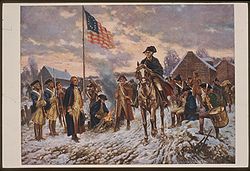
On December 19, 1777, when Washington's poorly fed, ill-equipped army, weary from long marches, staggered into Valley Forge, winds blew as the 12,000 Continentals prepared for winter's fury. Only about 1/3 of them had shoes, and many of their feet were leaving bloody footprints from the marching. Grounds for brigade
Brigade
A brigade is a major tactical military formation that is typically composed of two to five battalions, plus supporting elements depending on the era and nationality of a given army and could be perceived as an enlarged/reinforced regiment...
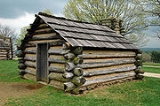
encampments were selected, and defense lines were planned and begun. Though construction of more than a thousand huts provided shelter, it did little to offset the critical shortages that continually plagued the army.
The men were under cover within six weeks. The first properly constructed hut appeared in three days. One other hut, which required 80 logs, and whose timber had to be collected from miles away, went up in one week with the use of only one axe. These huts provided sufficient protection from the moderately cold, but mainly wet and damp conditions of the mild, but typical Pennsylvania winter of 1777–1778. Snow was limited, and small in amounts. Alternating freezing and melting of snow and ice made it impossible to keep dry and allowed for disease to fester.
Soldiers received irregular supplies of meat and bread, some getting their only nourishment from "fire cake," a tasteless mixture of flour and water. However, due to the talents of Baker General Christopher Ludwig, the men at Valley Forge more often than not received fresh baked bread, about one pound daily. So severe were conditions at times that Washington despaired "that unless some great and capital change suddenly takes place ... this Army must inevitably ... Starve, dissolve, or disperse, in order to obtain subsistence in the best manner they can." Animals fared no better. General Henry Knox
Henry Knox
Henry Knox was a military officer of the Continental Army and later the United States Army, and also served as the first United States Secretary of War....
, Washington's Chief of Artillery, wrote that hundreds of horses either starved to death or died of exhaustion.
Clothing, too, was wholly inadequate. Many wounded soldiers from previous battles died from exposure. Long marches had destroyed shoes. Blankets were scarce. Tattered garments were seldom replaced. At one point these shortages caused nearly 4,000 men to be listed as unfit for duty.
Undernourished and poorly clothed, living in crowded, damp quarters, the army was ravaged by sickness and disease. Typhoid, jaundice
Jaundice
Jaundice is a yellowish pigmentation of the skin, the conjunctival membranes over the sclerae , and other mucous membranes caused by hyperbilirubinemia . This hyperbilirubinemia subsequently causes increased levels of bilirubin in the extracellular fluid...
, dysentery
Dysentery
Dysentery is an inflammatory disorder of the intestine, especially of the colon, that results in severe diarrhea containing mucus and/or blood in the faeces with fever and abdominal pain. If left untreated, dysentery can be fatal.There are differences between dysentery and normal bloody diarrhoea...
, and pneumonia
Pneumonia
Pneumonia is an inflammatory condition of the lung—especially affecting the microscopic air sacs —associated with fever, chest symptoms, and a lack of air space on a chest X-ray. Pneumonia is typically caused by an infection but there are a number of other causes...
were among the many diseases that killed 2,500 men that winter. Although Washington repeatedly petitioned for relief, the Continental Congress
Continental Congress
The Continental Congress was a convention of delegates called together from the Thirteen Colonies that became the governing body of the United States during the American Revolution....
was unable to provide it, and the soldiers continued to suffer. Women, relatives of enlisted men, alleviated some of the suffering by providing valuable services such as laundry and nursing that the army desperately needed.
Upgrading military efficiency, morale, and discipline were as vital to the army's well-being as was its source of supply. The army had been handicapped in battle because unit training was administered from a variety of field manuals, making coordinated battle movements awkward and difficult. The soldiers were trained, but not uniformly. The task of developing and carrying out an effective training program fell to Baron Friedrich von Steuben. This skilled Prussian
Kingdom of Prussia
The Kingdom of Prussia was a German kingdom from 1701 to 1918. Until the defeat of Germany in World War I, it comprised almost two-thirds of the area of the German Empire...
drill master, recently arrived from Europe, tirelessly drilled the soldiers.
A group of people called Regimental Camp Followers also helped increase the morale of the soldiers and provided necessary support to the men. Camp Followers at Valley Forge consisted of the families, wives, children, mothers, and sisters of the soldiers.
These camp followers often served as laundresses, cleaning and mending the uniforms of the soldiers. Washington understood a soldier would die quickly from disease if his uniform was dirty and threadbare. These women and children also provided the emotional support to a soldier, allowing them to remain at camp and continue on training and soldiering during the winter months. These women gained half the rations of soldiers, half the wages of a soldier as well as a half pension after the war—if they had done enough work. Children would receive quarter rations if enough work was done.
Women were relegated to the back of the column when marching and were forbidden to ride on wagons. Camp followers faced the issues of disease along with the soldiers. While excellent scavengers, some women lost their lives on the battlefield trying to obtain goods from wounded or dead soldiers. At Valley Forge women averaged 1 to every 44 men, adding up to around 500 women.
Soon word of the British departure from Philadelphia brought a frenzied activity to the ranks of the Continental Army. On June 19, 1778, six months after its arrival, the army marched away from Valley Forge in pursuit of the British, who were moving toward New York
New York
New York is a state in the Northeastern region of the United States. It is the nation's third most populous state. New York is bordered by New Jersey and Pennsylvania to the south, and by Connecticut, Massachusetts and Vermont to the east...
. The war would last for another five years, but Washington and his men had won a decisive victory.
Baron (Freiherr) Friedrich Wilhelm von Steuben
Von Steuben was a onetime member of the elite General Staff of Frederick the Great, King of Prussia. No longer in the Prussian ArmyPrussian Army
The Royal Prussian Army was the army of the Kingdom of Prussia. It was vital to the development of Brandenburg-Prussia as a European power.The Prussian Army had its roots in the meager mercenary forces of Brandenburg during the Thirty Years' War...
, indeed without employment of any kind, von Steuben offered his military skills to the patriot cause.
When he arrived at Valley Forge from France
France
The French Republic , The French Republic , The French Republic , (commonly known as France , is a unitary semi-presidential republic in Western Europe with several overseas territories and islands located on other continents and in the Indian, Pacific, and Atlantic oceans. Metropolitan France...
on February 23, 1778, he was armed with a letter of introduction from Benjamin Franklin
Benjamin Franklin
Dr. Benjamin Franklin was one of the Founding Fathers of the United States. A noted polymath, Franklin was a leading author, printer, political theorist, politician, postmaster, scientist, musician, inventor, satirist, civic activist, statesman, and diplomat...
. Washington saw great promise in the Prussian and almost immediately assigned him the duties of Acting Inspector General with the task of developing and carrying out an effective training program. He was a drill instructor, he was full of energy, and he taught the soldiers how to fire their guns faster.
Numerous obstacles threatened success. No standard American training manuals existed, and von Steuben himself spoke little English
English language
English is a West Germanic language that arose in the Anglo-Saxon kingdoms of England and spread into what was to become south-east Scotland under the influence of the Anglian medieval kingdom of Northumbria...
. Undaunted, he drafted his own manual in French
French language
French is a Romance language spoken as a first language in France, the Romandy region in Switzerland, Wallonia and Brussels in Belgium, Monaco, the regions of Quebec and Acadia in Canada, and by various communities elsewhere. Second-language speakers of French are distributed throughout many parts...
. His aides often worked late into the night, translating his work into English. The translations were, in turn, copied and passed to the individual regiments and companies that carried out the prescribed drill (or military parade) the following day.
Von Steuben shocked many American officers by breaking tradition to work directly with the men. One officer wrote of von Steuben's "peculiar grace" as he took "under his direction a squad of men in the capacity of drill sergeant." From dawn to dusk his familiar voice was heard in camp above the sounds of marching men and shouted commands. Soon companies, regiments, and then brigades moved smartly from line to column, column to line; loaded muskets with precision; and drove imaginary redcoats from the field by skillful charges with the bayonet.
When the Continental Army paraded on May 6, 1778, to celebrate the French alliance
Treaty of Alliance (1778)
The Treaty of Alliance, also called The Treaty of Alliance with France, was a defensive alliance between France and the United States of America, formed in the midst of the American Revolutionary War, which promised military support in case of attack by British forces indefinitely into the future...
with America, von Steuben received the honor of organizing the day's activities. On that day the Grand Parade became a showplace for the united American army. Cannons boomed in salute. Thousands of muskets fired the ceremonial "feu de joie
Feu de joie
A feu de joie is a rifle salute, described as a "running fire of guns", on occasions of public rejoicing of nation and/or ruling dynasty. It can also mean a bonfire lit in a public place as a token of joy....
," a running fire that passed up and down the double ranks of infantrymen. Cheers echoed across the fields. The good drilling order and imposing appearance that the troops presented during the Alliance Day ceremonies demonstrated their remarkable progress in improving their abilities as a unified, fighting force capable of standing up to the British Army
British Army
The British Army is the land warfare branch of Her Majesty's Armed Forces in the United Kingdom. It came into being with the unification of the Kingdom of England and Scotland into the Kingdom of Great Britain in 1707. The new British Army incorporated Regiments that had already existed in England...
.
Washington, with von Steuben's aid, had made an army of the Continental troops. With their French allies, the Americans could now proceed with the war, which would rage on for many years.
Valley Forge Park
The site of the encampment became a PennsylvaniaPennsylvania
The Commonwealth of Pennsylvania is a U.S. state that is located in the Northeastern and Mid-Atlantic regions of the United States. The state borders Delaware and Maryland to the south, West Virginia to the southwest, Ohio to the west, New York and Ontario, Canada, to the north, and New Jersey to...
state park
State park
State parks are parks or other protected areas managed at the federated state level within those nations which use "state" as a political subdivision. State parks are typically established by a state to preserve a location on account of its natural beauty, historic interest, or recreational...
in 1893 and, on the 4th of July, 1976
United States Bicentennial
The United States Bicentennial was a series of celebrations and observances during the mid-1970s that paid tribute to the historical events leading up to the creation of the United States as an independent republic...
, it became Valley Forge National Historical Park
Valley Forge National Historical Park
Valley Forge National Historical Park is the site where the Continental Army spent the winter of 1777–1778 near Valley Forge, Pennsylvania, during the American Revolutionary War. The National Historical Park preserves the site and interprets the history of the Valley Forge encampment. ...
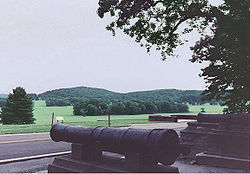
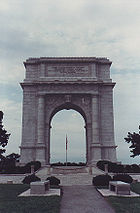
. The modern park features historical and recreated buildings and structures; memorials; and a newly renovated visitor center, which shows a short film and has several exhibits.
A chapel was built in 1903 as a memorial to Washington. An adjoining carillon
Carillon
A carillon is a musical instrument that is typically housed in a free-standing bell tower, or the belfry of a church or other municipal building. The instrument consists of at least 23 cast bronze, cup-shaped bells, which are played serially to play a melody, or sounded together to play a chord...
of 58 bells represents all U.S. states and territories. It resides in a tower built by the Daughters of the American Revolution
Daughters of the American Revolution
The Daughters of the American Revolution is a lineage-based membership organization for women who are descended from a person involved in United States' independence....
.
Other park amenities include walking and bicycle trails. The park supports around 1,000 deer which can be seen grazing in the wide-open fields.
See also
- Bodo OttoBodo OttoDr. Bodo Otto was a Senior Surgeon of the Continental Army during the American Revolution. He was one of the early settlers of Philadelphia, Pennsylvania, emigrating from Germany in 1755....
- Postage stamps and postal history of the United States#Two Cent Red Sesquicentennial issues of 1926–1932 (for a series of commemorative-stampCommemorative stampA commemorative stamp is a postage stamp, often issued on a significant date such as an anniversary, to honor or commemorate a place, event or person. The subject of the commemorative stamp is usually spelled out in print, unlike definitive stamps which normally depict the subject along with the...
issues honoring the 150th anniversaries of various battles of the American Revolution) - Upper Merion Township, Montgomery County, Pennsylvania
- Valley Forge PilgrimageValley Forge PilgrimageThe Valley Forge Pilgrimage and Encampment is the oldest annual Scouting event in the World. It was first held on February 22, 1913 , and has been held every year since. The event is hosted by the Cradle of Liberty Council and commemorates the soldiers of the Continental Army who braved the winter...