


Jan Swammerdam

Encyclopedia
Jan Swammerdam was a Dutch
biologist and microscopist. His work on insects demonstrated that the various phases during the life of an insect—egg
, larva
, pupa
, and adult—are different forms of the same animal. As part of his anatomical research, he carried out experiments on muscle contraction
. In 1658, he was the first to observe and describe red blood cell
s. He was one of the first people to use the microscope
in dissections, and his techniques remained useful for hundreds of years.
, and an amateur collector of minerals, coins, fossils, and insects from around the world. His mother died in 1661. The same year, when he was 24, Swammerdam entered the University of Leiden to study medicine. After qualifying as a candidate in medicine in 1663, he left for France, spending time in Issy, Saumur
and Paris with Melchisédech Thévenot
. He returned to Leiden in September 1665, and earned his M.D. on February 22, 1667.
Once he left university, he spent much of his time pursuing his interest in insects. This choice caused a rift between Swammerdam and his father, who thought his son should practice medicine. The relationship between the two deteriorated; Swammerdam's father cut off his financial support for Swammerdam's entomological studies. As a result, Swammerdam was forced, at least occasionally, to practice medicine in order to finance his own research.
From 1667 through 1674, Swammerdam continued his research and published three books. In 1675, he came under the influence of the Flemish
mystic
, Antoinette Bourignon
, renounced his work, and decided to devote the remainder of his life to spiritual matters. Niels Stensen, a gifted anatomist, and once his co-student, invited him to work for the Duke of Tuscany, but Swammerdam refused. There is evidence, however, that he did not completely give up his scientific studies. The papers, which he wished to be published posthumously, appear to have been revised during the last two years of his life. He died at age 43 of malaria. In 1737–1738, a half century after his death, Herman Boerhaave
translated Swammerdam's papers into Latin and published them under the title Biblia naturae (Book of Nature).
No authentic portrait of Jan Swammerdam is extant nowadays. The portrait shown in the header is derived from the painting The Anatomy Lesson of Dr Tulp by Rembrandt and represents the leading Amsterdam physician Hartman Hartmanzoon (1591–1659).
. According to this classical paradigm, insects were so insignificant they weren't worthy of the types of investigations done on fish
, reptiles, and mammals. Much of Swammerdam's entomological work was done to show that the difference between insects and the "higher" animals was one of degree, not kind. Swammerdam is credited with the enhancement of the study of biology due to his work dissecting insects and studying them under microscopes.
Swammerdam's principal interest in this area was demonstrating that insects develop in the same gradual manner as other animals. He wanted to dispel the seventeenth-century notion of metamorphosis
—the idea that different life stages of an insect (e.g. caterpillar
and butterfly
) represent different individuals or a sudden change from one type of animal to another. He garnered evidence against this claim from his dissections. By examining larvae, he identified underdeveloped adult features in pre-adult animals. For example, he noticed that the wings of dragonflies and mayflies exist prior to their final molt
. Swammerdam used these observations to bolster his case for epigenesis
in his 1669 publication, Historia Insectorum Generalis (The Natural History of Insects). This work also included many descriptions of insect anatomy. It was here that Swammerdam revealed that the "king" bee has ovaries. Biblia natura published posthumously in 1737, carried the first confirmation that the queen bee is the sole mother of the colony. Despite five intense years of beekeeping
, the mode of honey bee reproduction escaped him as he wrote, "I do not believe the male bees actually copulate with the females."
In addition to his research on metamorphosis, Swammerdam's entomological work stands out because he was among the first people to study insects in a systematized fashion (i.e., careful dissection, comparison of different species, and use of the microscope). His anatomical and behavioral descriptions of bees, wasps, ants, dragonflies, snails, worm
s, and butterflies were major contributions to the nascent field of entomology
in the late seventeenth century.
Besides Historia, he published Miraculum naturae sive uteri muliebris fabrica in 1672 and Ephemeri vita, in 1674. The latter was a study of the mayfly, written at a time when he was becoming increasingly involved in spiritual matters. The work contains long passages on the glory of the creator. His Bybel der Natuure was a collection of his papers and drawings.
 Swammerdam was not a pioneer in the study of anatomy as he was in study of insects, but he nonetheless made important contributions. His use of, and experiments with, frog muscle preparations played a key role in the development of our current understanding of nerve
–muscle
function. The experiments introduced a new method of studying nerves, the frog nerve-muscle preparation, which was still used centuries later.
In one experiment, Swammerdam removed the heart of a frog and observed that touching certain areas of the brain caused certain muscles to contract. For Swammerdam, this was evidence that the brain, not the circulatory system
, was responsible for muscle contraction
.
Swammerdam played a key role in the debunking of the balloonist theory
, the idea that 'moving spirits' are responsible for muscle contractions. The idea, supported by the Greek physician Galen
, held that nerves were hollow and the movement of spirits through them propelled muscle motion. René Descartes
furthered the idea by basing it on a model of hydraulics
, suggesting that the spirits were analogous to fluids or gasses and calling them 'animal spirits'. In the model, which Descartes used to explain reflex
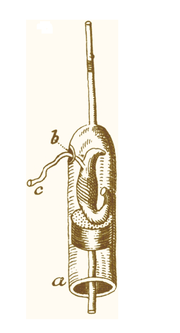
es, the spirits would flow from the ventricles of the brain, through the nerves, and to the muscles to animate the latter. According to this hypothesis, muscles would grow larger when they contract because of the animal spirits flowing into them. To test this idea, Swammerdam placed severed frog thigh muscle in an airtight syringe with a small amount of water in the tip. He could thus determine whether there was a change in the volume of the muscle when it contracted by observing a change in the level of the water (image at right). When Swammerdam caused the muscle to contract by irritating the nerve, the water level did not rise but rather was lowered by a minute amount; this showed that no air or fluid could be flowing into the muscle. Swammerdam did not believe the results of his own experiment, suggesting that they were the result of artifact. However, he concluded in his book The Book of Nature II that "motion or irritation of the nerve alone is necessary to produce muscular motion". This idea that nerve stimulation led to movement had important implications for neuroscience
by putting forward the idea that behavior is based on stimuli.
Swammerdam also discovered valves in the lymphatic system, which were later dubbed Swammerdam valves.
was significant, many current histories remember him as much for his methods and skill with microscopes as for his discoveries. He developed new techniques for examining, preserving, and dissecting specimens, including wax injection to make viewing blood vessels easier.
and spontaneous generation
because they represented randomness and haphazardness that was not possible in a world regulated by God.
His ultimate departure from the scientific scene in 1675 can also be attributed to his religiosity. Perhaps due to the influence of Antoinette Bourignon
, Swammerdam came to believe that his scientific work was no longer in the service of God. He thought he was conducting investigations into the natural world merely to satisfy his own curiosity. As a result, he subjected himself to the tutelage of Bourignon and, for the most part, renounced scientific study.
Netherlands
The Netherlands is a constituent country of the Kingdom of the Netherlands, located mainly in North-West Europe and with several islands in the Caribbean. Mainland Netherlands borders the North Sea to the north and west, Belgium to the south, and Germany to the east, and shares maritime borders...
biologist and microscopist. His work on insects demonstrated that the various phases during the life of an insect—egg
Egg (biology)
An egg is an organic vessel in which an embryo first begins to develop. In most birds, reptiles, insects, molluscs, fish, and monotremes, an egg is the zygote, resulting from fertilization of the ovum, which is expelled from the body and permitted to develop outside the body until the developing...
, larva
Larva
A larva is a distinct juvenile form many animals undergo before metamorphosis into adults. Animals with indirect development such as insects, amphibians, or cnidarians typically have a larval phase of their life cycle...
, pupa
Pupa
A pupa is the life stage of some insects undergoing transformation. The pupal stage is found only in holometabolous insects, those that undergo a complete metamorphosis, going through four life stages; embryo, larva, pupa and imago...
, and adult—are different forms of the same animal. As part of his anatomical research, he carried out experiments on muscle contraction
Muscle contraction
Muscle fiber generates tension through the action of actin and myosin cross-bridge cycling. While under tension, the muscle may lengthen, shorten, or remain the same...
. In 1658, he was the first to observe and describe red blood cell
Red blood cell
Red blood cells are the most common type of blood cell and the vertebrate organism's principal means of delivering oxygen to the body tissues via the blood flow through the circulatory system...
s. He was one of the first people to use the microscope
Microscope
A microscope is an instrument used to see objects that are too small for the naked eye. The science of investigating small objects using such an instrument is called microscopy...
in dissections, and his techniques remained useful for hundreds of years.
Biography
Swammerdam was born in Amsterdam. His father was an apothecaryApothecary
Apothecary is a historical name for a medical professional who formulates and dispenses materia medica to physicians, surgeons and patients — a role now served by a pharmacist and some caregivers....
, and an amateur collector of minerals, coins, fossils, and insects from around the world. His mother died in 1661. The same year, when he was 24, Swammerdam entered the University of Leiden to study medicine. After qualifying as a candidate in medicine in 1663, he left for France, spending time in Issy, Saumur
Saumur
Saumur is a commune in the Maine-et-Loire department in western France.The historic town is located between the Loire and Thouet rivers, and is surrounded by the vineyards of Saumur itself, Chinon, Bourgueil, Coteaux du Layon, etc...
and Paris with Melchisédech Thévenot
Melchisédech Thévenot
Melchisédech Thévenot was a French author, scientist, traveler, cartographer, orientalist, inventor, and diplomat...
. He returned to Leiden in September 1665, and earned his M.D. on February 22, 1667.
Once he left university, he spent much of his time pursuing his interest in insects. This choice caused a rift between Swammerdam and his father, who thought his son should practice medicine. The relationship between the two deteriorated; Swammerdam's father cut off his financial support for Swammerdam's entomological studies. As a result, Swammerdam was forced, at least occasionally, to practice medicine in order to finance his own research.
From 1667 through 1674, Swammerdam continued his research and published three books. In 1675, he came under the influence of the Flemish
Flemish people
The Flemings or Flemish are the Dutch-speaking inhabitants of Belgium, where they are mostly found in the northern region of Flanders. They are one of two principal cultural-linguistic groups in Belgium, the other being the French-speaking Walloons...
mystic
Mysticism
Mysticism is the knowledge of, and especially the personal experience of, states of consciousness, i.e. levels of being, beyond normal human perception, including experience and even communion with a supreme being.-Classical origins:...
, Antoinette Bourignon
Antoinette Bourignon
Antoinette Bourignon de la Porte was a Flemish mystic. From an early age she was under the influence of religion, which took in course of time a mystical turn.-Biography:...
, renounced his work, and decided to devote the remainder of his life to spiritual matters. Niels Stensen, a gifted anatomist, and once his co-student, invited him to work for the Duke of Tuscany, but Swammerdam refused. There is evidence, however, that he did not completely give up his scientific studies. The papers, which he wished to be published posthumously, appear to have been revised during the last two years of his life. He died at age 43 of malaria. In 1737–1738, a half century after his death, Herman Boerhaave
Herman Boerhaave
Herman Boerhaave was a Dutch botanist, humanist and physician of European fame. He is regarded as the founder of clinical teaching and of the modern academic hospital. His main achievement was to demonstrate the relation of symptoms to lesions...
translated Swammerdam's papers into Latin and published them under the title Biblia naturae (Book of Nature).
No authentic portrait of Jan Swammerdam is extant nowadays. The portrait shown in the header is derived from the painting The Anatomy Lesson of Dr Tulp by Rembrandt and represents the leading Amsterdam physician Hartman Hartmanzoon (1591–1659).
Research on Insects
Knowledge of insects in the 17th century was to a great extent inherited from AristotleAristotle
Aristotle was a Greek philosopher and polymath, a student of Plato and teacher of Alexander the Great. His writings cover many subjects, including physics, metaphysics, poetry, theater, music, logic, rhetoric, linguistics, politics, government, ethics, biology, and zoology...
. According to this classical paradigm, insects were so insignificant they weren't worthy of the types of investigations done on fish
Fish
Fish are a paraphyletic group of organisms that consist of all gill-bearing aquatic vertebrate animals that lack limbs with digits. Included in this definition are the living hagfish, lampreys, and cartilaginous and bony fish, as well as various extinct related groups...
, reptiles, and mammals. Much of Swammerdam's entomological work was done to show that the difference between insects and the "higher" animals was one of degree, not kind. Swammerdam is credited with the enhancement of the study of biology due to his work dissecting insects and studying them under microscopes.
Swammerdam's principal interest in this area was demonstrating that insects develop in the same gradual manner as other animals. He wanted to dispel the seventeenth-century notion of metamorphosis
Metamorphosis
Metamorphosis is a biological process by which an animal physically develops after birth or hatching, involving a conspicuous and relatively abrupt change in the animal's body structure through cell growth and differentiation...
—the idea that different life stages of an insect (e.g. caterpillar
Caterpillar
Caterpillars are the larval form of members of the order Lepidoptera . They are mostly herbivorous in food habit, although some species are insectivorous. Caterpillars are voracious feeders and many of them are considered to be pests in agriculture...
and butterfly
Butterfly
A butterfly is a mainly day-flying insect of the order Lepidoptera, which includes the butterflies and moths. Like other holometabolous insects, the butterfly's life cycle consists of four parts: egg, larva, pupa and adult. Most species are diurnal. Butterflies have large, often brightly coloured...
) represent different individuals or a sudden change from one type of animal to another. He garnered evidence against this claim from his dissections. By examining larvae, he identified underdeveloped adult features in pre-adult animals. For example, he noticed that the wings of dragonflies and mayflies exist prior to their final molt
Ecdysis
Ecdysis is the moulting of the cuticula in many invertebrates. This process of moulting is the defining feature of the clade Ecdysozoa, comprising the arthropods, nematodes, velvet worms, horsehair worms, rotifers, tardigrades and Cephalorhyncha...
. Swammerdam used these observations to bolster his case for epigenesis
Epigenesis
Epigenesis may refer to:* Epigenesis , describes morphogenesis and development of an organism* By analogy, a philosophical and theological concept, part of the concept of spiritual evolution* The Epigenesis, a 2010 album by Melechesh...
in his 1669 publication, Historia Insectorum Generalis (The Natural History of Insects). This work also included many descriptions of insect anatomy. It was here that Swammerdam revealed that the "king" bee has ovaries. Biblia natura published posthumously in 1737, carried the first confirmation that the queen bee is the sole mother of the colony. Despite five intense years of beekeeping
Beekeeping
Beekeeping is the maintenance of honey bee colonies, commonly in hives, by humans. A beekeeper keeps bees in order to collect honey and other products of the hive , to pollinate crops, or to produce bees for sale to other beekeepers...
, the mode of honey bee reproduction escaped him as he wrote, "I do not believe the male bees actually copulate with the females."
In addition to his research on metamorphosis, Swammerdam's entomological work stands out because he was among the first people to study insects in a systematized fashion (i.e., careful dissection, comparison of different species, and use of the microscope). His anatomical and behavioral descriptions of bees, wasps, ants, dragonflies, snails, worm
Worm
The term worm refers to an obsolete taxon used by Carolus Linnaeus and Jean-Baptiste Lamarck for all non-arthropod invertebrate animals, and stems from the Old English word wyrm. Currently it is used to describe many different distantly-related animals that typically have a long cylindrical...
s, and butterflies were major contributions to the nascent field of entomology
Entomology
Entomology is the scientific study of insects, a branch of arthropodology...
in the late seventeenth century.
Besides Historia, he published Miraculum naturae sive uteri muliebris fabrica in 1672 and Ephemeri vita, in 1674. The latter was a study of the mayfly, written at a time when he was becoming increasingly involved in spiritual matters. The work contains long passages on the glory of the creator. His Bybel der Natuure was a collection of his papers and drawings.
Research on Anatomy
Nerve
A peripheral nerve, or simply nerve, is an enclosed, cable-like bundle of peripheral axons . A nerve provides a common pathway for the electrochemical nerve impulses that are transmitted along each of the axons. Nerves are found only in the peripheral nervous system...
–muscle
Muscle
Muscle is a contractile tissue of animals and is derived from the mesodermal layer of embryonic germ cells. Muscle cells contain contractile filaments that move past each other and change the size of the cell. They are classified as skeletal, cardiac, or smooth muscles. Their function is to...
function. The experiments introduced a new method of studying nerves, the frog nerve-muscle preparation, which was still used centuries later.
In one experiment, Swammerdam removed the heart of a frog and observed that touching certain areas of the brain caused certain muscles to contract. For Swammerdam, this was evidence that the brain, not the circulatory system
Circulatory system
The circulatory system is an organ system that passes nutrients , gases, hormones, blood cells, etc...
, was responsible for muscle contraction
Muscle contraction
Muscle fiber generates tension through the action of actin and myosin cross-bridge cycling. While under tension, the muscle may lengthen, shorten, or remain the same...
.
Swammerdam played a key role in the debunking of the balloonist theory
Balloonist theory
Balloonist theory was a theory in early neuroscience that attempted to explain muscle movement by asserting that muscles contract by inflating with air or fluid. The Greek physician Galen believed that muscles contracted due to a fluid flowing into them, and for 1500 years afterward, it was...
, the idea that 'moving spirits' are responsible for muscle contractions. The idea, supported by the Greek physician Galen
Galen
Aelius Galenus or Claudius Galenus , better known as Galen of Pergamon , was a prominent Roman physician, surgeon and philosopher...
, held that nerves were hollow and the movement of spirits through them propelled muscle motion. René Descartes
René Descartes
René Descartes ; was a French philosopher and writer who spent most of his adult life in the Dutch Republic. He has been dubbed the 'Father of Modern Philosophy', and much subsequent Western philosophy is a response to his writings, which are studied closely to this day...
furthered the idea by basing it on a model of hydraulics
Hydraulics
Hydraulics is a topic in applied science and engineering dealing with the mechanical properties of liquids. Fluid mechanics provides the theoretical foundation for hydraulics, which focuses on the engineering uses of fluid properties. In fluid power, hydraulics is used for the generation, control,...
, suggesting that the spirits were analogous to fluids or gasses and calling them 'animal spirits'. In the model, which Descartes used to explain reflex
Reflex
A reflex action, also known as a reflex, is an involuntary and nearly instantaneous movement in response to a stimulus. A true reflex is a behavior which is mediated via the reflex arc; this does not apply to casual uses of the term 'reflex'.-See also:...
es, the spirits would flow from the ventricles of the brain, through the nerves, and to the muscles to animate the latter. According to this hypothesis, muscles would grow larger when they contract because of the animal spirits flowing into them. To test this idea, Swammerdam placed severed frog thigh muscle in an airtight syringe with a small amount of water in the tip. He could thus determine whether there was a change in the volume of the muscle when it contracted by observing a change in the level of the water (image at right). When Swammerdam caused the muscle to contract by irritating the nerve, the water level did not rise but rather was lowered by a minute amount; this showed that no air or fluid could be flowing into the muscle. Swammerdam did not believe the results of his own experiment, suggesting that they were the result of artifact. However, he concluded in his book The Book of Nature II that "motion or irritation of the nerve alone is necessary to produce muscular motion". This idea that nerve stimulation led to movement had important implications for neuroscience
Neuroscience
Neuroscience is the scientific study of the nervous system. Traditionally, neuroscience has been seen as a branch of biology. However, it is currently an interdisciplinary science that collaborates with other fields such as chemistry, computer science, engineering, linguistics, mathematics,...
by putting forward the idea that behavior is based on stimuli.
Swammerdam also discovered valves in the lymphatic system, which were later dubbed Swammerdam valves.
Contributions to Methodology
Though Swammerdam's work on insects and anatomyAnatomy
Anatomy is a branch of biology and medicine that is the consideration of the structure of living things. It is a general term that includes human anatomy, animal anatomy , and plant anatomy...
was significant, many current histories remember him as much for his methods and skill with microscopes as for his discoveries. He developed new techniques for examining, preserving, and dissecting specimens, including wax injection to make viewing blood vessels easier.
Spirituality
Swammerdam's scientific work was deeply influenced by his religious views. For him, studying the Earth's creatures revealed the greatness of God; scientific pursuits were pious activities. His spiritual views not only motivated his work, but also affected his ideas about the natural world. For example, he rejected metamorphosisMetamorphosis
Metamorphosis is a biological process by which an animal physically develops after birth or hatching, involving a conspicuous and relatively abrupt change in the animal's body structure through cell growth and differentiation...
and spontaneous generation
Spontaneous generation
Spontaneous generation or Equivocal generation is an obsolete principle regarding the origin of life from inanimate matter, which held that this process was a commonplace and everyday occurrence, as distinguished from univocal generation, or reproduction from parent...
because they represented randomness and haphazardness that was not possible in a world regulated by God.
His ultimate departure from the scientific scene in 1675 can also be attributed to his religiosity. Perhaps due to the influence of Antoinette Bourignon
Antoinette Bourignon
Antoinette Bourignon de la Porte was a Flemish mystic. From an early age she was under the influence of religion, which took in course of time a mystical turn.-Biography:...
, Swammerdam came to believe that his scientific work was no longer in the service of God. He thought he was conducting investigations into the natural world merely to satisfy his own curiosity. As a result, he subjected himself to the tutelage of Bourignon and, for the most part, renounced scientific study.
Further reading
- Jorink, Eric. "'Outside God there is Nothing': Swammerdam, Spinoza, and the Janus-Face of the Early Dutch Enlightenment." The Early Enlightenment in the Dutch Republic, 1650–1750: Selected Papers of a Conference, Held at the Herzog August Bibliothek Wolfenbüttel, 22–23 March 2001. Ed. Wiep Van Bunge. Leiden, The Netherlands: Brill Academic Publishers, 2003. 81–108.
- Fearing, Franklin. "Jan Swammerdam: A Study in the History of Comparative and Physiological Psychology of the 17th Century." The American Journal of Psychology 41.3 (1929): 442–455
- Ruestow, Edward G. The Microscope in the Dutch Republic: The Shaping of Discovery. New York: Cambridge University Press, 1996.
- Ruestow, Edward G. "Piety and the defense of natural order: Swammerdam on generation." Religion Science and Worldview: Essays in Honor of Richard S. Westfall. Eds. Margaret Osler and Paul Lawrence Farber. New York: Cambridge University Press, 1985. 217–241.