

Collecting

Encyclopedia
The hobby
of collecting includes seeking, locating, acquiring, organizing, cataloging, displaying, storing, and maintaining whatever items are of interest to the individual collector. Some collectors are generalists, accumulating merchandise, or stamps from all countries of the world. Others focus on a subtopic within their area of interest, perhaps 19th century postage stamp
s, milk bottle
labels from Sussex, or Mongolian harnesses and tack.
The items collectors collect may be antique, or simply collectible
. Antiques are collectible items at least 100 years old; collectibles are less than antique, and may even be new. Collectors and dealers may use the word vintage to describe older collectibles. Most collectibles are man-made commercial items, but some private collectors collect natural objects such as birds' eggs, butterflies, rocks, and seashells. Items which were once everyday objects may now be collectible since almost all those once produced have been destroyed or discarded called Ephemera
. Some collectors collect only in childhood while others continue to do so throughout their lives and usually modify their aims later in life. Philately
, phillumeny, and deltiology
(collecting postage stamps, matchboxes and postcards) are examples of forms of collecting which can be undertaken at minimal expense.
collected books from all over the known world at the Library of Alexandria
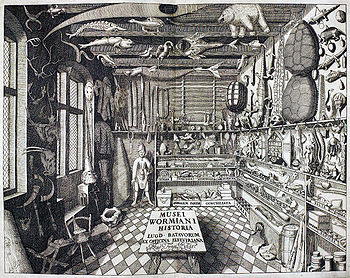
. The Medici family, in Renaissance Florence, made the first effort to collect art by private patronage, this way artists could be free for the first time from the money given by the Church and Kings; this citizenship tradition continues today with the work of private art collectors. Many of the world's popular museums—from the Metropolitan in New York City to the Thyssen in Madrid or the Franz Mayer in Mexico City—have collections formed by the generous collectors that donated them to be seen by the general public. The collecting hobby is a modern descendant of the "cabinet of curiosities" which was common among scholars with the means and opportunities to acquire unusual items from the 16th century onwards. Planned collecting of ephemeral publications goes back at least to George Thomason
in the reign of Charles I and Samuel Pepys
in that of Charles II. Collecting engravings and other prints by those whose means did not allow them to buy original works of art also goes back many centuries. The progress in 18th-century Paris of collecting both works of art and of curiosité, dimly echoed in the English curios, and the origins in Paris, Amsterdam and London of the modern art market have been increasingly well documented and studied since the mid-19th century. The involvement of larger numbers of people in collecting activities comes with the prosperity and increased leisure for some in the later 19th century in industrial countries. That is when collecting such items as antique china, furniture and decorative items from oriental countries becomes established.
s, the time frame is less stringent-—25 years or so being considered enough time to make a car a "classic" if not an antique. Traditionally in the area of furniture, the 1830s was regarded as the limit for antique furniture. However Victorian, Arts and Crafts, and some types of 20th century furniture can all be regarded as collectible.
In general, then, items of significance, beauty, values or interest that are "too young" to be considered antiques, fall into the realm of collectibles. But not all collectibles are limited editions, and many of them have been around for decades: for example, the popular turn-of-the-century posters, Art Deco
and Art Nouveau
items, Carnival and Depression era glass, etc. In addition, there exists the "contemporary collectibles" category, featuring items like plates
, figurine
s, bells
, graphics
, steins
, and doll
s.
Many collectors enjoy making a plan for their collections, combining education, stimulation and experimentation to develop a personal collecting style; and even those who reject the notion of "planned collecting" can refine their "selection skills" with some background information on the methods of collecting.
lighted villages.
A collector may find and join a local club for people who collect plates or other limited edition items. Collector publications frequently list the location, date and time of club meetings as a service to new collectors. Collectors who have already narrowed their collecting horizons to the creations of a particular producer may want to join a club that focuses on this producer's work. A potential collector may wish to chat with collectors with similar interests in specialized forums via the Internet. Fellow collectors are usually very happy to share information with new collectors; this includes information about where they have been successful in acquiring their collectibles, where they have struggled and what they are looking for. Collectors' forums allow for an open exchange of information, sometimes with experts available to answer questions and offer guidance. In addition, several web-sites specializing exclusively in the selling and trading of collectibles have been launched in recent years to help collectors manage their items as well as compare, connect, and trade directly with others.
Learning from retailers and direct marketers is considered a great way to gain an education in collecting. Collectors may establish a relationship with a retailer that specializes in limited editions. Those on direct mail literature mailing lists can learn a great deal from the support that many dealers supply.
When it comes to insuring a collection, the first step is generally to check one's present homeowner or renter's policy to find out how extensive coverage may be in the case of fire, burglary, or other risk. Some policies carry a fairly high maximum payment for items such as collectibles, while others offer very little of this type of protection. Compare the amount of coverage available with the value of the collection. If the homeowner’s policy is deemed inadequate, collectors have the option of contacting insurance companies that offer special policies for collectibles. It is essential as well that one determines how the value of items would be assessed by an insurance company: on replacement value, purchase price, or some type of "depreciated value."
A collector is most likely to obtain the best price for additional coverage or riders on a collection if they work with an insurance agent who already does business with them. Approaching an agent with a request for coverage just on a collection—unless it is extensive and valuable—is not likely to kindle a great deal of enthusiasm on their part. Other collectors might be a good source of information on insurance protection.
Caring for a collection requires two main tasks: security and cleaning/maintenance. Display valuables out of reach of children and pets, and in environments where heat, humidity, and sunlight are controlled. Avoid fire hazards, and make sure there are sufficient smoke detectors in good working order. Collectors with extensive holdings may want to consider an alarm system with sensors and electric eye
equipment — especially if they live in a crime-heavy area or if the home is well known as one that contains many valuables.
In terms of maintenance and cleaning of collectibles, the proper advice depends upon the medium and the delicacy of the item involved. Many firms supply Care and Handling sheets with their products, and these should be kept for future reference. Collectors can call or write to the Customer Service Department of the manufacturer of an item if they are in doubt as to how to care for it. In general, it is considered good advice to keep hand-painted items out of direct sunlight to avoid fading. Hand-painted items of terracotta, pewter
, and some other materials should not be handled any more than necessary, to avoid smudges or chipping. Never put a collectible plate or other item in the dishwasher — most are not dishwasher safe. Porcelain
collector plates may be carefully washed by hand with a mild soap
, and spray-rinsed. Most porcelain figurines may be lightly dusted or spray-washed and rinsed with mild soap and a gentle spray of water. Do not immerse figurines in water. To avoid problems with dust and dirt, many collectors favor frames and display cases with protective glass, especially for valuable or intricate items.
. Once a collectible is purchased, most of the costs associated with the retail price (i.e. advertising, production cost, shipping cost, etc.) must be deducted from the retail cost to determine the object’s immediate value on the secondary market, thus, retail cost is not equivalent to secondary market resale value. Depending on several different factors, individuals, auctioneers, and secondary retailers may sell a collectible for more, the same, or less than what they originally paid for it. These factors include, but are not limited to, condition, age, supply, and demand.
The 1960s through the early 1990s were major years for the manufacturing of contemporary collectibles. While some individuals purchased contemporary collectibles to enjoy and use, many purchased them as investments. Speculative secondary markets developed for many of these pieces. Because so many people bought for investment purposes, duplicates are common. And although many collectibles were labeled as "limited editions," the actual number of items produced was very large. The result of this is that there is very little demand for many (but not all) items produced during this time period, which means their secondary market values are often low.
There is no secondary market for an item unless someone is willing to buy it, and an object's value is whatever the buyer is willing to pay for it. Industry leaders believe that the secondary market is important for several reasons: primarily to allow experienced collectors to upgrade their collections, to stimulate the market and encourage new collectors, and to provide a means for monetary appreciation. To upgrade a collection, a collector may wish to dispose of things they no longer enjoy to produce the capital to buy other things. To stimulate the market, collectors may obtain some good quality pieces that have been traded in the past. They have an opportunity to learn the history of the hobby by owning some of the items that have been favorites in the past. Another reason is to make money, by selling an item with appreciated value.
A price guide is a resource such as a book or website that lists typical selling prices. The first price guide was the Stanley Gibbons catalogue issued in November 1865.
, collector forums and collector mailing lists.
Finding retired editions has become much more convenient with the advent of Internet auctions and trading. It has never been easier to track down a retired piece, and to reach out to dozens of dealers using e-mail
or their website
s. Most retailers tend to focus on one or two specific lines. Their activity in acquiring inventory adds liquidity to the market, and their sales of retired pieces are important to establishing a trend in value that is more consistent than random sales between individuals that may not be meaningfully documented.
The public and dealers alike use Internet auction websites to buy and sell collectibles. The thrill of "winning" an auction, and the convenience of shopping from home have contributed to a shift in volume from in-store sales of retired pieces to auction/mail order sales through such auction sites.
When buying expensive retired pieces, an escrow account for funds transfer may decrease the buyer's chance of losing their money. A form of fraud on the buy side involves swapping a defective piece for a good one bought via auction
. In this case, the buyer, who may have a repaired piece, or a slightly defective one, buys a mint condition
piece from the edition via auction and ships the defective one to the seller, demanding a refund on the auction. Sellers should record item numbers and other details about the piece before shipping so the seller has the facts they need to avoid this
. Examples include bird-watching; transportation, e.g. train spotting, aircraft spotting
, metrophiles, bus spotting
, see also I-Spy
; and visiting continents, countries, states, counties
, and national parks.
Hobby
A hobby is a regular activity or interest that is undertaken for pleasure, typically done during one's leisure time.- Etymology :A hobby horse is a wooden or wickerwork toy made to be ridden just like a real horse...
of collecting includes seeking, locating, acquiring, organizing, cataloging, displaying, storing, and maintaining whatever items are of interest to the individual collector. Some collectors are generalists, accumulating merchandise, or stamps from all countries of the world. Others focus on a subtopic within their area of interest, perhaps 19th century postage stamp
Postage stamp
A postage stamp is a small piece of paper that is purchased and displayed on an item of mail as evidence of payment of postage. Typically, stamps are made from special paper, with a national designation and denomination on the face, and a gum adhesive on the reverse side...
s, milk bottle
Milk bottle
Milk bottles are bottles used for milk. They may be reusable glass bottles used mainly for doorstep delivery of fresh milk by milkmen. Customers are expected to rinse the empty bottles and leave on the doorstep for collection...
labels from Sussex, or Mongolian harnesses and tack.
The items collectors collect may be antique, or simply collectible
Collectible
A collectable or collectible is any object regarded as being of value or interest to a collector . There are numerous types of collectables and terms to denote those types. An antique is a collectable that is old...
. Antiques are collectible items at least 100 years old; collectibles are less than antique, and may even be new. Collectors and dealers may use the word vintage to describe older collectibles. Most collectibles are man-made commercial items, but some private collectors collect natural objects such as birds' eggs, butterflies, rocks, and seashells. Items which were once everyday objects may now be collectible since almost all those once produced have been destroyed or discarded called Ephemera
Ephemera
Ephemera are transitory written and printed matter not intended to be retained or preserved. The word derives from the Greek, meaning things lasting no more than a day. Some collectible ephemera are advertising trade cards, airsickness bags, bookmarks, catalogues, greeting cards, letters,...
. Some collectors collect only in childhood while others continue to do so throughout their lives and usually modify their aims later in life. Philately
Philately
Philately is the study of stamps and postal history and other related items. Philately involves more than just stamp collecting, which does not necessarily involve the study of stamps. It is possible to be a philatelist without owning any stamps...
, phillumeny, and deltiology
Deltiology
Deltiology is the study and collection of postcards. Professor Randall Rhoades of Ashland, Ohio, coined a word in 1945 that became the accepted description of the study of picture postcards. It took about 20 years for the name to appear in the dictionary the first time...
(collecting postage stamps, matchboxes and postcards) are examples of forms of collecting which can be undertaken at minimal expense.
History
Collecting is a practice with a very old cultural history. The Egyptian Ptolemaic dynastyPtolemaic dynasty
The Ptolemaic dynasty, was a Macedonian Greek royal family which ruled the Ptolemaic Empire in Egypt during the Hellenistic period. Their rule lasted for 275 years, from 305 BC to 30 BC...
collected books from all over the known world at the Library of Alexandria
Library of Alexandria
The Royal Library of Alexandria, or Ancient Library of Alexandria, in Alexandria, Egypt, was the largest and most significant great library of the ancient world. It flourished under the patronage of the Ptolemaic dynasty and functioned as a major center of scholarship from its construction in the...
. The Medici family, in Renaissance Florence, made the first effort to collect art by private patronage, this way artists could be free for the first time from the money given by the Church and Kings; this citizenship tradition continues today with the work of private art collectors. Many of the world's popular museums—from the Metropolitan in New York City to the Thyssen in Madrid or the Franz Mayer in Mexico City—have collections formed by the generous collectors that donated them to be seen by the general public. The collecting hobby is a modern descendant of the "cabinet of curiosities" which was common among scholars with the means and opportunities to acquire unusual items from the 16th century onwards. Planned collecting of ephemeral publications goes back at least to George Thomason
George Thomason
George Thomason was an English book collector. He is famous for assembling a collection of more than 22,000 books and pamphlets published during the time of the English Civil War and the interregnum...
in the reign of Charles I and Samuel Pepys
Samuel Pepys
Samuel Pepys FRS, MP, JP, was an English naval administrator and Member of Parliament who is now most famous for the diary he kept for a decade while still a relatively young man...
in that of Charles II. Collecting engravings and other prints by those whose means did not allow them to buy original works of art also goes back many centuries. The progress in 18th-century Paris of collecting both works of art and of curiosité, dimly echoed in the English curios, and the origins in Paris, Amsterdam and London of the modern art market have been increasingly well documented and studied since the mid-19th century. The involvement of larger numbers of people in collecting activities comes with the prosperity and increased leisure for some in the later 19th century in industrial countries. That is when collecting such items as antique china, furniture and decorative items from oriental countries becomes established.
Beginning a collection
Some novice collectors start purchasing items that appeal to them, and then slowly work at acquiring knowledge about how to build a collection. Others (more cautious or studious types) want to develop some background in the field before starting to buy items. The term antique generally refers to items made over 100 years ago. In some fields, such as antique carAntique car
In the United States, an antique car is generally defined as a car over 45 years of age, this being the definition used by the Antique Automobile Club of America. However, the legal definition for the purpose of antique vehicle registration varies widely. The antique car era includes the veteran...
s, the time frame is less stringent-—25 years or so being considered enough time to make a car a "classic" if not an antique. Traditionally in the area of furniture, the 1830s was regarded as the limit for antique furniture. However Victorian, Arts and Crafts, and some types of 20th century furniture can all be regarded as collectible.
In general, then, items of significance, beauty, values or interest that are "too young" to be considered antiques, fall into the realm of collectibles. But not all collectibles are limited editions, and many of them have been around for decades: for example, the popular turn-of-the-century posters, Art Deco
Art Deco
Art deco , or deco, is an eclectic artistic and design style that began in Paris in the 1920s and flourished internationally throughout the 1930s, into the World War II era. The style influenced all areas of design, including architecture and interior design, industrial design, fashion and...
and Art Nouveau
Art Nouveau
Art Nouveau is an international philosophy and style of art, architecture and applied art—especially the decorative arts—that were most popular during 1890–1910. The name "Art Nouveau" is French for "new art"...
items, Carnival and Depression era glass, etc. In addition, there exists the "contemporary collectibles" category, featuring items like plates
Plate (dishware)
A plate is a broad, concave, but mainly flat vessel on which food can be served. A plate can also be used for ceremonial or decorative purposes.-Materials:...
, figurine
Figurine
A figurine is a statuette that represents a human, deity or animal. Figurines may be realistic or iconic, depending on the skill and intention of the creator. The earliest were made of stone or clay...
s, bells
Bell (instrument)
A bell is a simple sound-making device. The bell is a percussion instrument and an idiophone. Its form is usually a hollow, cup-shaped object, which resonates upon being struck...
, graphics
Graphics
Graphics are visual presentations on some surface, such as a wall, canvas, computer screen, paper, or stone to brand, inform, illustrate, or entertain. Examples are photographs, drawings, Line Art, graphs, diagrams, typography, numbers, symbols, geometric designs, maps, engineering drawings,or...
, steins
Beer stein
Beer stein , or simply stein, is an English neologism for either traditional beer mugs made out of stoneware, or specifically ornamental beer mugs that are usually sold as souvenirs or collectibles...
, and doll
Doll
A doll is a model of a human being, often used as a toy for children. Dolls have traditionally been used in magic and religious rituals throughout the world, and traditional dolls made of materials like clay and wood are found in the Americas, Asia, Africa and Europe. The earliest documented dolls...
s.
Many collectors enjoy making a plan for their collections, combining education, stimulation and experimentation to develop a personal collecting style; and even those who reject the notion of "planned collecting" can refine their "selection skills" with some background information on the methods of collecting.
Strategies
Collectors' magazines are one of the most popular means to learn more about the field. Attending conventions and collectibles shows is another way for a collector to familiarize him or herself with the possibilities. These shows will often include seminars on a variety of subjects such as artists, companies, decorating with collectibles or how to insure a collection. For example, the NCC (National Council of 56 Clubs) has individual member clubs that host regional gatherings each year for collectors of Department 56Department 56
Department 56 is a manufacturer of holiday collectibles, ornaments and giftware, known for their lit Christmas village collections and their Snowbabies collection. It is owned by Enesco.-History:...
lighted villages.
A collector may find and join a local club for people who collect plates or other limited edition items. Collector publications frequently list the location, date and time of club meetings as a service to new collectors. Collectors who have already narrowed their collecting horizons to the creations of a particular producer may want to join a club that focuses on this producer's work. A potential collector may wish to chat with collectors with similar interests in specialized forums via the Internet. Fellow collectors are usually very happy to share information with new collectors; this includes information about where they have been successful in acquiring their collectibles, where they have struggled and what they are looking for. Collectors' forums allow for an open exchange of information, sometimes with experts available to answer questions and offer guidance. In addition, several web-sites specializing exclusively in the selling and trading of collectibles have been launched in recent years to help collectors manage their items as well as compare, connect, and trade directly with others.
Learning from retailers and direct marketers is considered a great way to gain an education in collecting. Collectors may establish a relationship with a retailer that specializes in limited editions. Those on direct mail literature mailing lists can learn a great deal from the support that many dealers supply.
Types of limited editions
- Limited by announced quantity, with each item numbered
- Limited by announced quantity, with items not numbered
- Limited by announced firing period, numbered or not numbered
- Limited by year of issue, restricting the quantity to the number produced during the year of issue
- Limited by an announced time period that may be more or less than one year
Cataloging, insurance, and maintenance
Collectibles experts tend to agree that a collector should begin keeping a record as soon as they start collecting, of all details of purchase and price. Without this information, prospective buyers and insurance appraisers may not take the collector's word. It is also recommended to take a photograph or video of each item or groups of items where each may be easily identified. Records can be made in a format suitable for the collector, from a simple spiral notebook to a computer software program designed for collectibles. In addition to the information the collector records, it’s a good idea to keep all written material and certificates that came with the collectibles-—receipts, flyers and stories, care and handling instructions, etc. They will help to document a collection for resale or replacement in the future. At least one website now exists where collectors can permanently register their collections in an online database with a photograph and description of each item. The collector can affix an inconspicuous identifying tag or seal that is virtually impossible to counterfeit. Having such a record of the collection stored separately is good insurance in case of a disaster such as fire and is an aid to law enforcement in thwarting thieves.When it comes to insuring a collection, the first step is generally to check one's present homeowner or renter's policy to find out how extensive coverage may be in the case of fire, burglary, or other risk. Some policies carry a fairly high maximum payment for items such as collectibles, while others offer very little of this type of protection. Compare the amount of coverage available with the value of the collection. If the homeowner’s policy is deemed inadequate, collectors have the option of contacting insurance companies that offer special policies for collectibles. It is essential as well that one determines how the value of items would be assessed by an insurance company: on replacement value, purchase price, or some type of "depreciated value."
A collector is most likely to obtain the best price for additional coverage or riders on a collection if they work with an insurance agent who already does business with them. Approaching an agent with a request for coverage just on a collection—unless it is extensive and valuable—is not likely to kindle a great deal of enthusiasm on their part. Other collectors might be a good source of information on insurance protection.
Caring for a collection requires two main tasks: security and cleaning/maintenance. Display valuables out of reach of children and pets, and in environments where heat, humidity, and sunlight are controlled. Avoid fire hazards, and make sure there are sufficient smoke detectors in good working order. Collectors with extensive holdings may want to consider an alarm system with sensors and electric eye
Electric eye
An electric eye is a photodetector used for detecting obstruction of a light beam. An example is the door safety system used on garage door openers that use a light transmitter and receiver at the bottom of the door to prevent closing if there is any obstruction in the way that breaks the light...
equipment — especially if they live in a crime-heavy area or if the home is well known as one that contains many valuables.
In terms of maintenance and cleaning of collectibles, the proper advice depends upon the medium and the delicacy of the item involved. Many firms supply Care and Handling sheets with their products, and these should be kept for future reference. Collectors can call or write to the Customer Service Department of the manufacturer of an item if they are in doubt as to how to care for it. In general, it is considered good advice to keep hand-painted items out of direct sunlight to avoid fading. Hand-painted items of terracotta, pewter
Pewter
Pewter is a malleable metal alloy, traditionally 85–99% tin, with the remainder consisting of copper, antimony, bismuth and lead. Copper and antimony act as hardeners while lead is common in the lower grades of pewter, which have a bluish tint. It has a low melting point, around 170–230 °C ,...
, and some other materials should not be handled any more than necessary, to avoid smudges or chipping. Never put a collectible plate or other item in the dishwasher — most are not dishwasher safe. Porcelain
Porcelain
Porcelain is a ceramic material made by heating raw materials, generally including clay in the form of kaolin, in a kiln to temperatures between and...
collector plates may be carefully washed by hand with a mild soap
Soap
In chemistry, soap is a salt of a fatty acid.IUPAC. "" Compendium of Chemical Terminology, 2nd ed. . Compiled by A. D. McNaught and A. Wilkinson. Blackwell Scientific Publications, Oxford . XML on-line corrected version: created by M. Nic, J. Jirat, B. Kosata; updates compiled by A. Jenkins. ISBN...
, and spray-rinsed. Most porcelain figurines may be lightly dusted or spray-washed and rinsed with mild soap and a gentle spray of water. Do not immerse figurines in water. To avoid problems with dust and dirt, many collectors favor frames and display cases with protective glass, especially for valuable or intricate items.
Secondary market
The retail price of a collectible is valid only at the moment it was purchased. Once the collectible comes into the buyer’s possession, its value is linked to what is called the secondary marketSecondary market
The page applies to the finanical term; For the merchandising concept, see Aftermarket .The secondary market, also called aftermarket, is the financial market where previously issued securities and financial instruments such as stock, bonds, options, and futures are bought and sold....
. Once a collectible is purchased, most of the costs associated with the retail price (i.e. advertising, production cost, shipping cost, etc.) must be deducted from the retail cost to determine the object’s immediate value on the secondary market, thus, retail cost is not equivalent to secondary market resale value. Depending on several different factors, individuals, auctioneers, and secondary retailers may sell a collectible for more, the same, or less than what they originally paid for it. These factors include, but are not limited to, condition, age, supply, and demand.
The 1960s through the early 1990s were major years for the manufacturing of contemporary collectibles. While some individuals purchased contemporary collectibles to enjoy and use, many purchased them as investments. Speculative secondary markets developed for many of these pieces. Because so many people bought for investment purposes, duplicates are common. And although many collectibles were labeled as "limited editions," the actual number of items produced was very large. The result of this is that there is very little demand for many (but not all) items produced during this time period, which means their secondary market values are often low.
There is no secondary market for an item unless someone is willing to buy it, and an object's value is whatever the buyer is willing to pay for it. Industry leaders believe that the secondary market is important for several reasons: primarily to allow experienced collectors to upgrade their collections, to stimulate the market and encourage new collectors, and to provide a means for monetary appreciation. To upgrade a collection, a collector may wish to dispose of things they no longer enjoy to produce the capital to buy other things. To stimulate the market, collectors may obtain some good quality pieces that have been traded in the past. They have an opportunity to learn the history of the hobby by owning some of the items that have been favorites in the past. Another reason is to make money, by selling an item with appreciated value.
A price guide is a resource such as a book or website that lists typical selling prices. The first price guide was the Stanley Gibbons catalogue issued in November 1865.
On the Internet
The Internet offers many resources to any collector: personal sites presenting one's collection, online collectible catalogs, dealer/shops websites displaying their merchandise, Internet trading platforms, collector clubs, autograph clubAutograph club
Autograph clubs were developed for both the collectors and dealer to obtain knowledge in the hobby of autograph collecting known as philography.Autograph collecting may have started in the 16th century when Germans...
, collector forums and collector mailing lists.
Finding retired editions has become much more convenient with the advent of Internet auctions and trading. It has never been easier to track down a retired piece, and to reach out to dozens of dealers using e-mail
E-mail
Electronic mail, commonly known as email or e-mail, is a method of exchanging digital messages from an author to one or more recipients. Modern email operates across the Internet or other computer networks. Some early email systems required that the author and the recipient both be online at the...
or their website
Website
A website, also written as Web site, web site, or simply site, is a collection of related web pages containing images, videos or other digital assets. A website is hosted on at least one web server, accessible via a network such as the Internet or a private local area network through an Internet...
s. Most retailers tend to focus on one or two specific lines. Their activity in acquiring inventory adds liquidity to the market, and their sales of retired pieces are important to establishing a trend in value that is more consistent than random sales between individuals that may not be meaningfully documented.
The public and dealers alike use Internet auction websites to buy and sell collectibles. The thrill of "winning" an auction, and the convenience of shopping from home have contributed to a shift in volume from in-store sales of retired pieces to auction/mail order sales through such auction sites.
When buying expensive retired pieces, an escrow account for funds transfer may decrease the buyer's chance of losing their money. A form of fraud on the buy side involves swapping a defective piece for a good one bought via auction
Auction
An auction is a process of buying and selling goods or services by offering them up for bid, taking bids, and then selling the item to the highest bidder...
. In this case, the buyer, who may have a repaired piece, or a slightly defective one, buys a mint condition
Mint condition
Mint condition is an expression used in the description of pre-owned goods. Originally, the phrase comes from the way collectors describe the condition of coins. As the name given to a coin factory is a "mint", then mint condition is the condition a coin is in as it leaves the mint...
piece from the edition via auction and ships the defective one to the seller, demanding a refund on the auction. Sellers should record item numbers and other details about the piece before shipping so the seller has the facts they need to avoid this
Intangibles
An alternative to collecting physical objects is collecting experiences of some kind, through observation or photographyPhotography
Photography is the art, science and practice of creating durable images by recording light or other electromagnetic radiation, either electronically by means of an image sensor or chemically by means of a light-sensitive material such as photographic film...
. Examples include bird-watching; transportation, e.g. train spotting, aircraft spotting
Aircraft spotting
Aircraft spotting or plane spotting is the observation and logging of the registration numbers of aircraft: gliders, powered aircraft, balloons, airships, helicopters, and microlights....
, metrophiles, bus spotting
Bus spotting
Bus spotting is a pastime in which one seeks to see all buses in a particular fleet or those produced by a particular manufacturer. A person who engages in these activities is known as a bus spotter, bus fan , bus nut or bus enthusiast...
, see also I-Spy
I-Spy
The I-SPY books are spotters' guides written for British children, and particularly successful in the 1950s and 1960s in their original form and again when relaunched by Michelin in 2009 after a seven year gap in publishing....
; and visiting continents, countries, states, counties
County collecting
County collecting is keeping track of the counties and other major census divisions one has visited in the United States. Many county collectors try to go for blackout, to visit every county unit in the United States...
, and national parks.
Notable collectors
- Forrest J AckermanForrest J AckermanForrest J Ackerman was an American collector of science fiction books and movie memorabilia and a science fiction fan...
- James Allen (collector)James Allen (collector)James Allen is an American antique collector, known in particular for his collection of 145 photographs of lynchings in America, published in 2000 with Jon Lewis as Without Sanctuary: Lynching Photography in America...
- Raleigh DeGeer AmyxRaleigh DeGeer AmyxRaleigh DeGeer Amyx is an American collector of Presidential, Americana, military, sports, NASA, and Olympic artifacts, including gold, silver, and bronze winners medals presented to athletes.-Early life, education:...
- Miss Frank E. ButtolphMiss Frank E. ButtolphMiss Frank E. Buttolph was an American collector known for initiating the Miss Frank E. Buttolph American Menu Collection, 1851-1930 at New York Public Library in 1899.- Miss Frank E. Buttolph American Menu Collection, 1851-1930 :...
- John Gardner CoolidgeJohn Gardner CoolidgeJohn Gardner Coolidge was an American collector, diplomat, author, and nephew of Isabella Stewart Gardner.Coolidge was born and died in Boston, and served as U.S. Minister to Nicaragua in 1908. His summer home, The Stevens-Coolidge Place, is now a nonprofit museum.-External links:...
- Doc Corbin DartDoc Corbin DartDoc Corbin Dart is an alternative musician from the United States. He was lead singer, founder, and lyricist of the Lansing, Michigan 1980s punk rock band The Crucifucks...
- Barry HalperBarry HalperBarry Halper was an extensive collector of baseball memorabilia who had been a limited partner owning about 1% of the New York Yankees...
- Donald Kaufman (collector)Donald Kaufman (collector)Donald Lewis Kaufman was an American toy collector amassing millions of dollars worth of antique items in his country home in western Massachusetts.-Early life:...
- Princess Lida of Thurn and TaxisPrincess Lida of Thurn and TaxisLida, Princess Victor of Thurn and Taxis , also referred to as Princess Lida of Thurn and Taxis, was an American millionairess, socialite, and the wife of Prince Victor of Thurn and Taxis...
- Cordelia MendozaCordelia MendozaCordelia Mendoza is an antiques expert, volunteer, San Diego retailer, and author. Her volunteer work began at age 13 when she and her twin sister, Cathleen Scott, were named and represented the San Diego County Heart Association for a year as the Heart Fund Twins, after Mendoza successfully...
- Harvey H. NiningerHarvey H. NiningerHarvey Harlow Nininger , American meteorite collector, self-taught meteoriticist and educator, revived interest in the scientific study of meteorites in the 1930s, and assembled the largest personal collection of meteorites up to that time. He founded the American Meteorite Museum, which was first...
See also
- List of popular collectibles
- AntiquitiesAntiquitiesAntiquities, nearly always used in the plural in this sense, is a term for objects from Antiquity, especially the civilizations of the Mediterranean: the Classical antiquity of Greece and Rome, Ancient Egypt and the other Ancient Near Eastern cultures...
- Collectable
- HoardingHoardingHoarding or caching is a general term for a behavior that leads people or animals to accumulate food or other items in anticipation of future need or scarcity.-Animal behavior:...
and Compulsive hoardingCompulsive hoardingCompulsive hoarding is the acquisition of possessions in excess of socially normative amounts, even if the items are worthless, hazardous, or unsanitary... - Memorabilia
- SouvenirSouvenirA souvenir , memento, keepsake or token of remembrance is an object a person acquires for the memories the owner associates with it. The term souvenir brings to mind the mass-produced kitsch that is the main commodity of souvenir and gift shops in many tourist traps around the world...
- Autograph clubAutograph clubAutograph clubs were developed for both the collectors and dealer to obtain knowledge in the hobby of autograph collecting known as philography.Autograph collecting may have started in the 16th century when Germans...
- Obi stripObi stripAn is a strip of paper looped around a book or other product. This extends the term obi used for Japanese clothing; it is written with the same kanji. It is also referred to as a , or more narrowly as .-For books:...
External links
- Journal of the History of Collections
- Center for the History of Collecting in America
- The Association of Cultural Economics
- "Amass Appeal" Essay by Richard Rubin, AARP Magazine, March/April 2008.