


Interdigital webbing

Encyclopedia
Interdigital webbing is the presence of membranes of skin between the digit
s. Normally in mammal
s, webbing is present in the embryo
but resorbed later in development, but in various mammal species it occasionally persists in adulthood. In humans, it can be found in those suffering from LEOPARD syndrome
and from Aarskog-Scott syndrome
.
Webbing between the digits of the hindfoot is also present in several mammals that spend part of their time in the water. Webbing accommodates movement in the water.
Interdigital webbing is not to be confused with syndactyly
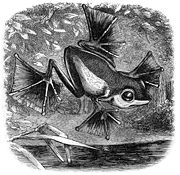
, which is a fusing of digits and occurs rarely in humans. Syndactyly specifically affecting feet occurs in birds (such as duck
s), amphibians (such as frog
s), and mammals (such as the kangaroo
).
 In oryzomyines
, a mainly South American rodent
group, the Marsh Rice Rat
, Pseudoryzomys simplex, and Sigmodontomys alfari all have small webs, which do not extend to the end of the proximal phalanges, whereas Amphinectomys savamis, Lundomys molitor and the members of the genera Holochilus
and Nectomys
have more expansive webbing, which extends beyond the proximal phalanges. Webbing apparently developed several times in oryzomyines and may also have been lost in some groups. Most ichthyomyines
, an exclusively semiaquatic South and Central American rodent group, have small webbing, but members of the genus Rheomys
have more expansive webs. Webbing is also present in the Australasian semiaquatic hydromyines (subfamily Murinae
) of the genera Baiyankamys, Hydromys
, and Crossomys; in the latter, it is most well-developed. The Africa
n semiaquatic rodents Colomys goslingi and Nilopegamys plumbeus, also members of the Murinae
, lack interdigital webbing. Webbing is present in the hind feet of the Coypu
(Myocastor coypus) of South America, which is currently classified in its own family.
s, the members of the genera Chimarrogale of southeastern Asia and Neomys
of western Eurasia have interdigital webbing, as does the American Water Shrew
(Sorex palustris) of North America, but it is more well-developed in Nectogale elegans of montane Asia. Webbing is also present in the Pyrenean Desman
(Galemys pyrenaicus).
family, which occurs in Africa and mainly on Madagascar
, includes several semiaquatic forms, and the small otter-shrews (Micropotamogale
) and the aptly named Web-footed Tenrec
(Limnogale mergulus) have developed interdigital webbing.
(Chironectes minimus) of South America is the only opossum with interdigital webbing.
ns have interdigital webbing, including the Greater Grison
(Galictis vittata), the Colombian Weasel
(Mustela felipei), the Amazon Weasel (Mustela africana), and the Mink
(Neovison vison).
All otter
s have interdigital webbing, in the fore or hind limbs or both, to aid in aquatic propulsion. In sea otters, the webbing is covered with hair, at a density of 3300 hairs per square centimeter.
s, ancestral whale
s, suggest that these animals had interdigital webbing, a development hypothesized to lead to the fluke, spurred by FGF8
, a Fibroblast growth factor
.
Digit
Digit may refer to:* Digit , one of several most distal parts of a limb—fingers, thumbs, and toes on hands and feet* Numerical digit, as used in mathematics or computer science* Hexadecimal, representing a four-bit number...
s. Normally in mammal
Mammal
Mammals are members of a class of air-breathing vertebrate animals characterised by the possession of endothermy, hair, three middle ear bones, and mammary glands functional in mothers with young...
s, webbing is present in the embryo
Embryo
An embryo is a multicellular diploid eukaryote in its earliest stage of development, from the time of first cell division until birth, hatching, or germination...
but resorbed later in development, but in various mammal species it occasionally persists in adulthood. In humans, it can be found in those suffering from LEOPARD syndrome
Leopard syndrome
LEOPARD syndrome - is part of a group called Ras/MAPK pathway syndromes - is a rare autosomal dominant, multisystem disease caused by a...
and from Aarskog-Scott syndrome
Aarskog-Scott syndrome
Aarskog–Scott syndrome is an inherited disease characterized by short stature, facial abnormalities, skeletal and genital anomalies.The Aarskog–Scott syndrome is also known as the Aarskog syndrome, faciodigitogenital syndrome, shawl scrotum syndrome and faciogenital dysplasia.-Signs and...
.
Webbing between the digits of the hindfoot is also present in several mammals that spend part of their time in the water. Webbing accommodates movement in the water.
Interdigital webbing is not to be confused with syndactyly
Syndactyly
Syndactyly is a condition wherein two or more digits are fused together. It occurs normally in some mammals, such as the siamang and kangaroo, but is an unusual condition in humans.-Classification:...
, which is a fusing of digits and occurs rarely in humans. Syndactyly specifically affecting feet occurs in birds (such as duck
Duck
Duck is the common name for a large number of species in the Anatidae family of birds, which also includes swans and geese. The ducks are divided among several subfamilies in the Anatidae family; they do not represent a monophyletic group but a form taxon, since swans and geese are not considered...
s), amphibians (such as frog
Frog
Frogs are amphibians in the order Anura , formerly referred to as Salientia . Most frogs are characterized by a short body, webbed digits , protruding eyes and the absence of a tail...
s), and mammals (such as the kangaroo
Kangaroo
A kangaroo is a marsupial from the family Macropodidae . In common use the term is used to describe the largest species from this family, especially those of the genus Macropus, Red Kangaroo, Antilopine Kangaroo, Eastern Grey Kangaroo and Western Grey Kangaroo. Kangaroos are endemic to the country...
).
Rodents
Oryzomyini
Oryzomyini is a tribe of rodents in the subfamily Sigmodontinae of family Cricetidae. It includes about 120 species in about thirty genera, distributed from the eastern United States to the southernmost parts of South America, including many offshore islands...
, a mainly South American rodent
Rodent
Rodentia is an order of mammals also known as rodents, characterised by two continuously growing incisors in the upper and lower jaws which must be kept short by gnawing....
group, the Marsh Rice Rat
Marsh Rice Rat
The marsh rice rat is a semiaquatic North American rodent in the family Cricetidae. It is found mostly in the eastern and southern United States, from New Jersey and Kansas south to Florida and northeasternmost Tamaulipas, Mexico; its range previously extended further west and north, where it may...
, Pseudoryzomys simplex, and Sigmodontomys alfari all have small webs, which do not extend to the end of the proximal phalanges, whereas Amphinectomys savamis, Lundomys molitor and the members of the genera Holochilus
Holochilus
Holochilus is a genus of semiaquatic rodents in the tribe Oryzomyini of family Cricetidae, sometimes called marsh rats. It contains three living species, Holochilus brasiliensis, Holochilus chacarius, and Holochilus sciureus, which are widely distributed in South America east of the Andes, and a...
and Nectomys
Nectomys
Nectomys is a genus of rodent in the tribe Oryzomyini of family Cricetidae. It is closely related to Amphinectomys and was formerly considered congeneric with Sigmodontomys...
have more expansive webbing, which extends beyond the proximal phalanges. Webbing apparently developed several times in oryzomyines and may also have been lost in some groups. Most ichthyomyines
Ichthyomyini
Ichthyomyini is a tribe of New World rats and mice in the subfamily Sigmodontinae. The species within this tribe share the characteristic of all being fish-eating rodents.*Anotomys - Ecuadorian Fish-eating Rat*Chibchanomys - Chibchan Water Mouse...
, an exclusively semiaquatic South and Central American rodent group, have small webbing, but members of the genus Rheomys
Rheomys
Rheomys is a genus of semiaquatic rodents in the family Cricetidae.It contains the following species:* Mexican Water Mouse * Goldman's Water Mouse * Thomas's Water Mouse...
have more expansive webs. Webbing is also present in the Australasian semiaquatic hydromyines (subfamily Murinae
Murinae
The Old World rats and mice, part of the subfamily Murinae in the family Muridae, comprise at least 519 species. This subfamily is larger than all mammal families except the Cricetidae and Muridae, and is larger than all mammal orders except the bats and the remainder of the...
) of the genera Baiyankamys, Hydromys
Hydromys
Hydromys is a genus of rodents in the subfamily Murinae.- List of species :Genus Hydromys - water rats*Rakali, Hydromys chrysogaster E...
, and Crossomys; in the latter, it is most well-developed. The Africa
Africa
Africa is the world's second largest and second most populous continent, after Asia. At about 30.2 million km² including adjacent islands, it covers 6% of the Earth's total surface area and 20.4% of the total land area...
n semiaquatic rodents Colomys goslingi and Nilopegamys plumbeus, also members of the Murinae
Murinae
The Old World rats and mice, part of the subfamily Murinae in the family Muridae, comprise at least 519 species. This subfamily is larger than all mammal families except the Cricetidae and Muridae, and is larger than all mammal orders except the bats and the remainder of the...
, lack interdigital webbing. Webbing is present in the hind feet of the Coypu
Coypu
The coypu , , also known as the river rat, and nutria, is a large, herbivorous, semiaquatic rodent and the only member of the family Myocastoridae. Originally native to subtropical and temperate South America, it has since been introduced to North America, Europe, Asia, and Africa, primarily by...
(Myocastor coypus) of South America, which is currently classified in its own family.
Soricomorphs
Among shrewShrew
A shrew or shrew mouse is a small molelike mammal classified in the order Soricomorpha. True shrews are also not to be confused with West Indies shrews, treeshrews, otter shrews, or elephant shrews, which belong to different families or orders.Although its external appearance is generally that of...
s, the members of the genera Chimarrogale of southeastern Asia and Neomys
Neomys
The genus Neomys is a group of three Eurasian water shrews from the subfamily Soricinae of the family Soricidae. These shrews are found in most of Europe, and parts of Northern Asia as well as Turkey and Iran...
of western Eurasia have interdigital webbing, as does the American Water Shrew
American Water Shrew
The American Water Shrew or Northern Water Shrew, is a large North American shrew found in aquatic habitats. Some sources include the Glacier Bay Water Shrew, S. alaskanus, within this species....
(Sorex palustris) of North America, but it is more well-developed in Nectogale elegans of montane Asia. Webbing is also present in the Pyrenean Desman
Pyrenean Desman
The Pyrenean Desman is a small semi-aquatic mammal that lives in the Pyrenees to the Iberian peninsula. The Pyrenean Desman is in the monotypic genus Galemys. The Pyrenean Desman lives in mountain streams....
(Galemys pyrenaicus).
Tenrecs
The tenrecTenrecidae
Tenrecidae is a family of mammals found on Madagascar and parts of Africa. Tenrecs are widely diverse, resembling hedgehogs, shrews, opossums, mice and even otters, as a result of convergent evolution. They occupy aquatic, arboreal, terrestrial and fossorial environments...
family, which occurs in Africa and mainly on Madagascar
Madagascar
The Republic of Madagascar is an island country located in the Indian Ocean off the southeastern coast of Africa...
, includes several semiaquatic forms, and the small otter-shrews (Micropotamogale
Micropotamogale
Micropotamogale is a genus of small, otter-like tenrecs native to riverine habitats of West African rainforests. They feed on aquatic animals and insects they can find and capture.Two species are recognized:...
) and the aptly named Web-footed Tenrec
Web-footed Tenrec
The Web-footed Tenrec, Otter Shrew, or Aquatic Tenrec is the only known semiaquatic Malagasy tenrec , and is found in eastern Madagascar, especially in and around Ranomafana National Park. It grows to between 25 and 39 cm, and was once thought to be extinct...
(Limnogale mergulus) have developed interdigital webbing.
Opossums
The Water OpossumWater Opossum
The water opossum , also locally known as the yapok, is a marsupial of the family Didelphidae. It is the only member of its genus, Chironectes...
(Chironectes minimus) of South America is the only opossum with interdigital webbing.
Carnivorans
Several carnivoraCarnivora
The diverse order Carnivora |Latin]] carō "flesh", + vorāre "to devour") includes over 260 species of placental mammals. Its members are formally referred to as carnivorans, while the word "carnivore" can refer to any meat-eating animal...
ns have interdigital webbing, including the Greater Grison
Greater Grison
The greater grison, Galictis vittata, is an animal belonging to the ferret family Mustelidae from Central and South America, from southern Mexico to Brazil and Bolivia, living in savannas and rainforests, usually seen near rivers and streams....
(Galictis vittata), the Colombian Weasel
Colombian Weasel
Colombian weasel , also known as Don Felipe's weasel, is a very rare species of weasel only known with certainty from the departments of Huila and Cauca in Colombia and nearby northern Ecuador...
(Mustela felipei), the Amazon Weasel (Mustela africana), and the Mink
Mink
There are two living species referred to as "mink": the European Mink and the American Mink. The extinct Sea Mink is related to the American Mink, but was much larger. All three species are dark-colored, semi-aquatic, carnivorous mammals of the family Mustelidae, which also includes the weasels and...
(Neovison vison).
All otter
Otter
The Otters are twelve species of semi-aquatic mammals which feed on fish and shellfish, and also other invertebrates, amphibians, birds and small mammals....
s have interdigital webbing, in the fore or hind limbs or both, to aid in aquatic propulsion. In sea otters, the webbing is covered with hair, at a density of 3300 hairs per square centimeter.
Whales
Pits present on the sides of fossil proximal phalanges of pakicetidPakicetid
Pakicetids or Pakicetidae are a carnivorous mammal family of the suborder Archaeoceti which lived during the Early Eocene to Middle Eocene in Pakistan and existed for approximately ....
s, ancestral whale
Whale
Whale is the common name for various marine mammals of the order Cetacea. The term whale sometimes refers to all cetaceans, but more often it excludes dolphins and porpoises, which belong to suborder Odontoceti . This suborder also includes the sperm whale, killer whale, pilot whale, and beluga...
s, suggest that these animals had interdigital webbing, a development hypothesized to lead to the fluke, spurred by FGF8
FGF8
Fibroblast growth factor 8 is a protein that in humans is encoded by the FGF8 gene.-External links:*...
, a Fibroblast growth factor
Fibroblast growth factor
Fibroblast growth factors, or FGFs, are a family of growth factors involved in angiogenesis, wound healing, and embryonic development. The FGFs are heparin-binding proteins and interactions with cell-surface associated heparan sulfate proteoglycans have been shown to be essential for FGF signal...
.
Literature cited
- Braun, J.K. and Díaz, M.M. 1999. Key to the native mammals of Catamarca Province, Argentina. Occasional papers of the Oklahoma Museum of Natural History 4:1–16.
- Cooper, L.N., and J.G.M. Thewissen. 2009 The role of FGF-8 in the origin of interdigital webbing in cetaceans. Presentation, Society of Integrative and Comparative Biology, Boston, Massachusetts.
- Fish, Frank E. Biomechanical Perspective on the Origin of Cetacean Flukes. J. G. M. Thewissen, ed. The emergence of whales: evolutionary patterns in the origin of Cetacea. Springer, 1998. ISBN 9780306458538. 303-24.
- Rumbaugh, D.M. and Chiarelli, A.B. 1972. Evolution, ecology, behavior, and captive maintenance. S. Karger, 263 pp. ISBN 9783805513623
- Tate, G.H.H. 1951. The rodents of Australia and New Guinea. Bulletin of the American Museum of Natural History 97:187–430.
- Voss, R.S. 1988. Systematics and ecology of ichthyomyine rodents (Muroidea) : patterns of morphological evolution in a small adaptive radiation. Bulletin of the American Museum of Natural History 188:260–493.
- Voss, R.S. and Jansa, S.A. 2009. Phylogenetic relationships and classification of didelphid marsupials, an extant radiation of New World metatherian mammals. Bulletin of the American Museum of Natural History 322:1–177.
- Weksler, M. 2006. Phylogenetic relationships of oryzomyine rodents (Muroidea: Sigmodontinae): separate and combined analyses of morphological and molecular data. Bulletin of the American Museum of Natural History 296:1–149.