


Interceptor body armor

Encyclopedia
United States Army
The United States Army is the main branch of the United States Armed Forces responsible for land-based military operations. It is the largest and oldest established branch of the U.S. military, and is one of seven U.S. uniformed services...
's primary bulletproof vest
Bulletproof vest
A ballistic vest, bulletproof vest or bullet-resistant vest is an item of personal armor that helps absorb the impact from firearm-fired projectiles and shrapnel from explosions, and is worn on the torso...
. The Interceptor design replaced the older fragmentation
Fragmentation (weaponry)
Fragmentation is the process by which the casing of an artillery shell, bomb, grenade, etc. is shattered by the detonating high explosive filling. The correct technical terminology for these casing pieces is fragments , although shards or splinters can be used for non-preformed fragments...
protective Personnel Armor System for Ground Troops
Personnel Armor System for Ground Troops
Personnel Armor System for Ground Troops, sometimes abbreviated to PASGT, was a combat helmet and ballistic vest used by the American military from the mid 1980s until 2005, when the system was succeeded by the Lightweight Helmet, Modular Integrated Communications Helmet, and Interceptor body...
(PASGT) body armor system, introduced in the early 1980s. Materials for the Interceptor vest were developed by DARPA in the 1990s, and a contract for production was awarded to DHB Industries' Point Blank Body Armor, Inc., by the U.S. Army Soldier Systems Center.
As of early 2010, the Interceptor Body Armor system (IBA) currently employs two main variants, the original Outer Tactical Vest (OTV), used with the Small Arms Protective Insert (SAPI) ballistic plates series; and the newer Improved Outer Tactical Vest
Improved Outer Tactical Vest
The Improved Outer Tactical Vest, or IOTV, is an enhanced version of, and a replacement for, the older Outer Tactical Vest variant of the Interceptor body armor, as fielded by the United States Army...
, (IOTV), used with the Enhanced Small Arms Protective Inserts (ESAPIs) ballistic plate series.
The original Interceptor OTV variant was re-designed, improved, and enhanced with the introduction of the Improved Outer Tactical Vest body armor for the Army (which began to be issued to ground combat units in late 2007). After initially using the OTV as their body armor system, the Marine Corps
United States Marine Corps
The United States Marine Corps is a branch of the United States Armed Forces responsible for providing power projection from the sea, using the mobility of the United States Navy to deliver combined-arms task forces rapidly. It is one of seven uniformed services of the United States...
developed a completely new armor system, the Modular Tactical Vest
Modular Tactical Vest
The Modular Tactical Vest or is a bulletproof vest originally adopted by the United States Marine Corps in 2006. The MTV was designed as a solution to shortcomings in the current, decade-old interceptor body armor and was selected after a rigorous proposal and examination process by the Marine...
, which is currently their primary body armor system. Some United States Navy ground force personnel (such as the Seabees and Corpsmen) use the Modular Tactical Vest. Other Navy personnel on Individual Augmentee assignments use the Army's body armor systems.
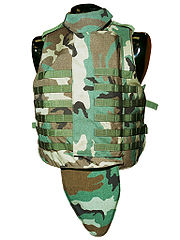
The original Interceptor OTV variant first began to be issued to U.S. Army ground combat units in the early 2000s, and the first OTV carriers were first produced in the M81 Woodland
M81 Woodland
Woodland pattern is the name of the default camouflage pattern issued to United States soldiers, Marines, airmen, and sailors from 1981, with the issue of the M81 Battle Dress Uniform until nearly the present day...
camouflage pattern (One initial contractor for the early OTVs was Point Blank, Inc). The Woodland camouflage pattern was then superseded by the 3-color Desert pattern, followed by the Universal Camouflage Pattern
Universal Camouflage Pattern
The Universal Camouflage Pattern , also referred to as ACUPAT or Digital Camouflage is the military camouflage pattern currently in use in the United States Army's Army Combat Uniform. The pattern was chosen after several laboratory and field tests that occurred from 2003 to 2004...
. Troops deployed in Operation Enduring Freedom are issued equipment in MultiCam
MultiCam
MultiCam is a single camouflage pattern designed to help the wearer hide in varied environments, seasons, elevations, and light conditions. It is a 7-color, multi-environment camouflage pattern developed by Crye Associates in conjunction with U.S. Army Soldier Systems Center...
. Other OTV carrier camouflage variants included the USMC's Coyote Brown color shade, and some solid color shade variants, such as black, green, and white.
Technical details
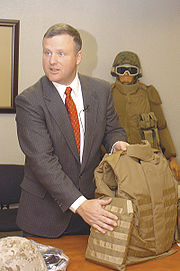
The Interceptor body armor system consists of an Outer Tactical Vest (OTV) and two Small Arms Protective Insert (SAPI) ballistic plates.The OTV features a carrier shell, and three main ballistic panel inserts (left and right side panels, and a rear back panel), which are made with a finely woven Kevlar
Kevlar
Kevlar is the registered trademark for a para-aramid synthetic fiber, related to other aramids such as Nomex and Technora. Developed at DuPont in 1965, this high strength material was first commercially used in the early 1970s as a replacement for steel in racing tires...
KM2 fiber. These two parts of the vest are both bullet and heat resistant. The vest was tested to stop a 9 mm 124 grain full metal jacket bullet
Full metal jacket bullet
A full metal jacket is a bullet consisting of a soft core encased in a shell of harder metal, such as gilding metal, cupronickel or less commonly a steel alloy. This shell can extend around all of the bullet, or often just the front and sides with the rear left as exposed lead...
at 1,400 ft/s (426 m/s) with minimal deformation and has a V-50 of roughly 1,525 ft/s (465 m/s). This means that the bullet has to be traveling faster than 1,525 ft/s for it to have more than a 50% chance of breaking through the soft armor panel.
These soft ballistic panels are produced in five different sizes (S-XXL), which are installed into their respective pocket on the OTV carrier shell.
To increase overall protection, separate accessories can be added to the OTV, such as the collar device, the groin protector, deltoid and auxiliary protectors, and side plate carriers.
The Interceptor cannot, however, be called a Level III-A vest as military standard does not require protection against heavy .44 Magnum
.44 Magnum
The .44 Remington Magnum, or simply .44 Magnum, is a large-bore cartridge originally designed for revolvers. After introduction, it was quickly adopted for carbines and rifles...
ammunition. However, both Level III-A vests and Interceptor do protect from much lighter 9mm threats in identical tests. The vest will stop other, slower-moving fragments and has removable neck, throat, shoulder and groin protection.
Two small-arms protective insert
Small-arms protective insert
The Small Arms Protective Insert is a ceramic plate fielded by the US military. It was first used in the Interceptor body armor, a ballistic vest. It is now also used in the Improved Outer Tactical Vest as well as the Modular Tactical Vest, in addition to commercially available "plate carriers"...
s may also be added to the front and back of the vest, with each plate designed to stop up to three hits from 7.62x51mm NATO M80 ball ammunition, with a muzzle velocity
Muzzle velocity
Muzzle velocity is the speed a projectile has at the moment it leaves the muzzle of the gun. Muzzle velocities range from approximately to in black powder muskets , to more than in modern rifles with high-performance cartridges such as the .220 Swift and .204 Ruger, all the way to for tank guns...
of 2,750 feet per second (838 m/s). The plates are the most technically advanced body armor fielded by the U.S. military, and are constructed of boron carbide
Boron carbide
Boron carbide is an extremely hard boron–carbon ceramic material used in tank armor, bulletproof vests, and numerous industrial applications...
ceramic
Ceramic
A ceramic is an inorganic, nonmetallic solid prepared by the action of heat and subsequent cooling. Ceramic materials may have a crystalline or partly crystalline structure, or may be amorphous...
with a Spectra/Dyneema shield backing that breaks down projectile
Projectile
A projectile is any object projected into space by the exertion of a force. Although a thrown baseball is technically a projectile too, the term more commonly refers to a weapon....
s and halts their momentum
Momentum
In classical mechanics, linear momentum or translational momentum is the product of the mass and velocity of an object...
.
The Interceptor armor also has a PALS webbing grid on the front of the vest which accommodate the same type of pockets used in the Modular Lightweight Load-carrying Equipment (MOLLE
MOLLE (military)
MOLLE |female name]]) is an acronym for MOdular Lightweight Load-carrying Equipment. It is used to define the current generation of load-bearing equipment and rucksacks utilized by the United States armed forces, especially the United States Army, and its use is also growing in the British Army in...
) backpack/carry vest system. This allows a soldier to tailor-fit his MOLLE and body armor system. While not specifically designed for it, the loops can also easily attach All-purpose Lightweight Individual Carrying Equipment (ALICE
All-purpose Lightweight Individual Carrying Equipment
The All-Purpose Lightweight Individual Carrying Equipment, or ALICE system, was adopted as United States Army Standard A on 17 January 1973 to replace the M-1956 Load-Carrying Equipment [LCE] and M-1967 Modernized Load-Carrying Equipment [MLCE]. ALICE gear is still in some limited use in the US...
)-based equipment, MOLLE's predecessor, as well as many pieces of civilian-made tactical gear, and also features a large handle on the back just below the collar which can be used to drag a wounded person to safety in an emergency. The Interceptor vest comes in various camouflage
Camouflage
Camouflage is a method of concealment that allows an otherwise visible animal, military vehicle, or other object to remain unnoticed, by blending with its environment. Examples include a leopard's spotted coat, the battledress of a modern soldier and a leaf-mimic butterfly...
patterns, including M81 Woodland
M81 Woodland
Woodland pattern is the name of the default camouflage pattern issued to United States soldiers, Marines, airmen, and sailors from 1981, with the issue of the M81 Battle Dress Uniform until nearly the present day...
, three-color desert, and the Army Combat Uniform
Army Combat Uniform
The Army Combat Uniform is the current combat uniform worn by the United States Army. It is the successor to the Battle Dress Uniform and Desert Camouflage Uniform worn during the 1980s and 1990s. It features a number of design changes, as well as a different camouflage pattern from its...
's Universal Camouflage Pattern
Universal Camouflage Pattern
The Universal Camouflage Pattern , also referred to as ACUPAT or Digital Camouflage is the military camouflage pattern currently in use in the United States Army's Army Combat Uniform. The pattern was chosen after several laboratory and field tests that occurred from 2003 to 2004...
, Coyote Brown, and black, the latter being used by Police SWAT
SWAT
A SWAT team is an elite tactical unit in various national law enforcement departments. They are trained to perform high-risk operations that fall outside of the abilities of regular officers...
units.
Originally the Interceptor Body Armor System weighs 16.4 pounds (7.4 kg), with the vest weighing 8.4 pounds (3.8 kg), and two plate inserts weighing four pounds (1.8 kg) each. This is lighter than the previous body armor fielded in Somalia
Somalia
Somalia , officially the Somali Republic and formerly known as the Somali Democratic Republic under Socialist rule, is a country located in the Horn of Africa. Since the outbreak of the Somali Civil War in 1991 there has been no central government control over most of the country's territory...
which weighed 25.1 pounds (11.4 kg).
Due to the increased dangers of improvised explosive device
Improvised explosive device
An improvised explosive device , also known as a roadside bomb, is a homemade bomb constructed and deployed in ways other than in conventional military action...
s, a newer version of the vital plates and components have been developed. The Enhanced Small Arms Protective Inserts (ESAPIs) and Enhanced Side Ballistic Inserts (ESBIs) have become available, along with the Deltoid and Axilliary Protectors (DAPs). These new systems are becoming the standard for forward deployed troops. The E-SAPI plates offer increased protection from 7.62mm armor piercing ammunition. The ESBIs is an attachable MOLLE ballistic panel with a pouch for a 8x6 side-SAPI, for protection of the side of the torso/under the arm. DAPs consists of two ambidextrous modular components, the Deltoid (upper arm) Protector and the Axillary (under arm) Protector, and provide for additional protection from fragmentary and projectiles to the upper arm and underarm areas. With the Interceptor body armor, E-SAPI plates (10.9 pounds), ESBIs (7.75 pounds), DAPs (5.03 pounds) and with the neck, throat and groin protectors installed the armor is significantly heavier at 33.1 pounds (15 kg).
Body armor is always a compromise: mobility and comfort (and thus speed and stamina) are inevitably sacrificed to some degree when greater protection is achieved. This is a point of contention in the U.S. armed forces, with some favoring less armor in order to maintain mobility and others wanting as much protection as is practical. The debate is especially valid in the Iraq war, when comparing lightly equipped insurgents with U.S. troops routinely burdened with upwards of 100 lbs. of weapons, ammunition, armor, food, water, and other assorted equipment. Many troops have complained that under such conditions, they are simply unable to pursue their guerrilla opponents. Troops who primarily ride in vehicles generally want the highest practical level of protection from IED's and ambushes, while dismounted infantry often make the case that impaired mobility can prove just as fatal as inadequate armor.
Controversy
George W. Bush
George Walker Bush is an American politician who served as the 43rd President of the United States, from 2001 to 2009. Before that, he was the 46th Governor of Texas, having served from 1995 to 2000....
’s $87 billion package that Congress approved for ongoing operations in Afghanistan and Iraq, $300 million has been earmarked for body armor, including the ceramic plates, which currently cost about $500 each. A complete Interceptor system costs $1,585.
On May 4, 2005 the United States Marine Corps
United States Marine Corps
The United States Marine Corps is a branch of the United States Armed Forces responsible for providing power projection from the sea, using the mobility of the United States Navy to deliver combined-arms task forces rapidly. It is one of seven uniformed services of the United States...
recalled 5,277 Interceptor combat vests made by DHB's Point Blank unit after news reports about the vests' inability to stop 9 mm bullets. In November, 2005, the Marine Corps ordered 10,342 Interceptor Outer Tactical Vests pulled from the operating forces after media reports indicated some samples tested by the manufacturer and by the Army's Aberdeen Proving Ground
Aberdeen Proving Ground
Aberdeen Proving Ground is a United States Army facility located near Aberdeen, Maryland, . Part of the facility is a census-designated place , which had a population of 3,116 at the 2000 census.- History :...
in Maryland failed to fully comply with ballistics standards. In 2005, the DoD under severe pressure from Congress, authorized a one-time $1,000 reimbursement to soldiers who had purchased civilian body armor and other gear but in 2006 they gave orders not to wear anything but military issued body armor fearing inadequate armor could be purchased.
A recent Marine Corps forensic study obtained by DefenseWatch slams the Interceptor OTV body armor system, claiming "as many as 42% of the Marine casualties who died from isolated torso injuries could have been prevented with improved protection in the areas surrounding the plated areas of the vest. Nearly 23% might have benefited from protection along the mid-axillary line of the lateral chest. Another 15% died from impacts through the unprotected shoulder and upper arm," the report says. Side armor has been sent to Iraq in increasing amounts, but many troops don't want to wear it because it adds 10 lb to the 16 lb vest and they say the added weight could decrease mobility and get them killed in certain combat scenarios.
On May 10, 2006, the Army announced it was holding an open competition for companies to design an entire new generation of body armor "to improve on and replace" the Interceptor. The Army said it wanted ideas from companies by May 31. Congressional investigators reportedly reviewed the Pentagon
The Pentagon
The Pentagon is the headquarters of the United States Department of Defense, located in Arlington County, Virginia. As a symbol of the U.S. military, "the Pentagon" is often used metonymically to refer to the Department of Defense rather than the building itself.Designed by the American architect...
's entire body armor program, including the Interceptor vest. Investigators expressed concern that the vests might not be adequate to protect troops.
Improved Version Replacement
Aside from replacing the SAPI vital plates with the improved E-SAPI plates, the vests have also been redesigned. The Army has transitioned to the Improved Outer Tactical VestImproved Outer Tactical Vest
The Improved Outer Tactical Vest, or IOTV, is an enhanced version of, and a replacement for, the older Outer Tactical Vest variant of the Interceptor body armor, as fielded by the United States Army...
, or "IOTV".
On September 25, 2006, the Marine Corps announced that Protective Products International won a contract for 60,000 new Modular Tactical Vest
Modular Tactical Vest
The Modular Tactical Vest or is a bulletproof vest originally adopted by the United States Marine Corps in 2006. The MTV was designed as a solution to shortcomings in the current, decade-old interceptor body armor and was selected after a rigorous proposal and examination process by the Marine...
s (MTV) to replace the Interceptor OTV vests. The MTV provides greater coverage, superior weight distribution, and additional features such as a quick-release system.
Units were issued to deploying troops for use in Afghanistan and Iraq, while the Interceptor will continue to be issued to garrison and training post troops for some time to come. The MTV has received top ratings by many US Marines; although a few Marines have complained about minor elements of it and an updated version will soon be released which deals with these elements.
See also
- Improved Outer Tactical VestImproved Outer Tactical VestThe Improved Outer Tactical Vest, or IOTV, is an enhanced version of, and a replacement for, the older Outer Tactical Vest variant of the Interceptor body armor, as fielded by the United States Army...
(IOTV) - Modular Tactical VestModular Tactical VestThe Modular Tactical Vest or is a bulletproof vest originally adopted by the United States Marine Corps in 2006. The MTV was designed as a solution to shortcomings in the current, decade-old interceptor body armor and was selected after a rigorous proposal and examination process by the Marine...
(MTV) - Personnel Armor System for Ground TroopsPersonnel Armor System for Ground TroopsPersonnel Armor System for Ground Troops, sometimes abbreviated to PASGT, was a combat helmet and ballistic vest used by the American military from the mid 1980s until 2005, when the system was succeeded by the Lightweight Helmet, Modular Integrated Communications Helmet, and Interceptor body...
(PASGT) - PRU-70PRU-70The PRU-70/P22P-18 is an Armored Survival Vest that is intended for aircrews. It will be fielded in 3 sizes and was designed in house by Navair's Human Systems Division...