


Small-arms protective insert

Encyclopedia
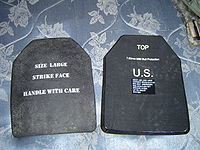
Ceramic plate
Ceramic plates are commonly used as inserts in soft ballistic vests. Most ceramic plates used in body armor provide National Institute of Justice Type III protection, allowing them to stop rifle bullets. Ceramic plates are a form of composite armor...
fielded by the US military
Military of the United States
The United States Armed Forces are the military forces of the United States. They consist of the Army, Navy, Marine Corps, Air Force, and Coast Guard.The United States has a strong tradition of civilian control of the military...
. It was first used in the Interceptor body armor
Interceptor body armor
Interceptor Body Armor is the United States Army's primary bulletproof vest. The Interceptor design replaced the older fragmentation protective Personnel Armor System for Ground Troops body armor system, introduced in the early 1980s...
, a ballistic vest. It is now also used in the Improved Outer Tactical Vest
Improved Outer Tactical Vest
The Improved Outer Tactical Vest, or IOTV, is an enhanced version of, and a replacement for, the older Outer Tactical Vest variant of the Interceptor body armor, as fielded by the United States Army...
as well as the Modular Tactical Vest
Modular Tactical Vest
The Modular Tactical Vest or is a bulletproof vest originally adopted by the United States Marine Corps in 2006. The MTV was designed as a solution to shortcomings in the current, decade-old interceptor body armor and was selected after a rigorous proposal and examination process by the Marine...
, in addition to commercially available "plate carriers". The kevlar
Kevlar
Kevlar is the registered trademark for a para-aramid synthetic fiber, related to other aramids such as Nomex and Technora. Developed at DuPont in 1965, this high strength material was first commercially used in the early 1970s as a replacement for steel in racing tires...
Interceptor vest itself is designed to stop projectiles up to and including 9x19mm Parabellum submachine gun
Submachine gun
A submachine gun is an automatic carbine, designed to fire pistol cartridges. It combines the automatic fire of a machine gun with the cartridge of a pistol. The submachine gun was invented during World War I , but the apex of its use was during World War II when millions of the weapon type were...
rounds, in addition to fragmentation. To protect against higher velocity rifle
Rifle
A rifle is a firearm designed to be fired from the shoulder, with a barrel that has a helical groove or pattern of grooves cut into the barrel walls. The raised areas of the rifling are called "lands," which make contact with the projectile , imparting spin around an axis corresponding to the...
rounds, SAPI plates are needed.
ESAPI
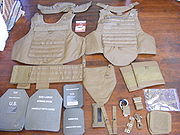
Military of the United States
The United States Armed Forces are the military forces of the United States. They consist of the Army, Navy, Marine Corps, Air Force, and Coast Guard.The United States has a strong tradition of civilian control of the military...
began replacing the standard Small Arms Protective Insert plates with the Enhanced Small Arms Protective Insert (ESAPI).
An ESAPI provides protection from .30-06 M2 Armor-piercing rounds with a steel or tungsten penetrator, but costs about $600 per plate, 50% more than SAPI plates. They are produced by Ceradyne
Ceradyne
Ceradyne, Incorporated, is a Costa Mesa, California, USA, manufacturer of ceramics products traded on the NASDAQ Stock Market.In addition to producing ceramic components for industrial processes such as silicon foundries and ceramic fuel pellets for nuclear reactors, Ceradyne researches and...
, BAE Systems
BAE Systems
BAE Systems plc is a British multinational defence, security and aerospace company headquartered in London, United Kingdom, that has global interests, particularly in North America through its subsidiary BAE Systems Inc. BAE is among the world's largest military contractors; in 2009 it was the...
, and ArmorWorks Enterprises.
XSAPI
A call for a next generation plate, to stop even greater velocity threats than the ESAPI plate has been issued by the US ArmyUnited States Army
The United States Army is the main branch of the United States Armed Forces responsible for land-based military operations. It is the largest and oldest established branch of the U.S. military, and is one of seven U.S. uniformed services...
. They have specifically allowed scalar or flexible systems, and are also calling for greater coverage, with less than a pound of additional weight.
Materials and capabilities
The standard plate for the Interceptor body armor is made of boron carbideBoron carbide
Boron carbide is an extremely hard boron–carbon ceramic material used in tank armor, bulletproof vests, and numerous industrial applications...
or silicon carbide
Silicon carbide
Silicon carbide , also known as carborundum, is a compound of silicon and carbon with chemical formula SiC. It occurs in nature as the extremely rare mineral moissanite. Silicon carbide powder has been mass-produced since 1893 for use as an abrasive...
ceramic
Ceramic
A ceramic is an inorganic, nonmetallic solid prepared by the action of heat and subsequent cooling. Ceramic materials may have a crystalline or partly crystalline structure, or may be amorphous...
.New ESAPI plates are also made of boron carbide
Boron carbide
Boron carbide is an extremely hard boron–carbon ceramic material used in tank armor, bulletproof vests, and numerous industrial applications...
. The standard plates are not given an NIJ rating, as they are tested in accordance with specific protocols for the military and not the NIJ's testing. Military testing calls for survivability of three hits from the round marked on the plate - for standard SAPI, of a caliber
Caliber
In guns including firearms, caliber or calibre is the approximate internal diameter of the barrel in relation to the diameter of the projectile used in it....
up to 7.62x51mm NATO M80 ball and of a muzzle velocity
Muzzle velocity
Muzzle velocity is the speed a projectile has at the moment it leaves the muzzle of the gun. Muzzle velocities range from approximately to in black powder muskets , to more than in modern rifles with high-performance cartridges such as the .220 Swift and .204 Ruger, all the way to for tank guns...
up to 2,750 ft/s (840 m/s). For ESAPI, a .30cal M2 AP (.30-06 black-tip armor-piercing) cartridge. This performance is only assured when backed by the soft armor of the OTV (or any soft armor which meets military requirements for protection. The ceramic plate is backed with a shield made of Spectra, a material up to 40% stronger than Kevlar
Kevlar
Kevlar is the registered trademark for a para-aramid synthetic fiber, related to other aramids such as Nomex and Technora. Developed at DuPont in 1965, this high strength material was first commercially used in the early 1970s as a replacement for steel in racing tires...
., to trap any fragments of either plate or projectile and prevent them from injuring the wearer.
Sizes and weights
SAPI plates meant for body armor come in front and back plates which are identical, and smaller side plates. The front and back plates come in five sizes. Their dimensions are the following:Front and back SAPI plates:
- Extra Small - 1.27 kg (2.8 lb) | 184 x 292 mm (7¼ x 11½ in)
- Small - 1.59 kg (3.5 lb) | 222 x 298 mm (8¾ x 11¾ in)
- Medium - 1.82 kg (4.0 lb) | 241 x 318 mm (9½ x 12½ in)
- Large - 2.09 kg (4.6 lb) | 260 x 337 mm (10⅛ x 13¼ in)
- Extra Large 2.40 kg (5.3 lb) | 280 x 356 mm (11 x 14 in)
ESAPI plates are the same size but slightly greater in weight.
- Extra Small - 1.70 kg (3.75 lb)
- Small - 2.08 kg (4.60 lb)
- Medium - 2.50 kg (5.50 lb)
- Large - 2.85 kg (6.30 lb)
- Extra Large - 3.25 kg (7.20 lb)
Torso side plates are as follows:
- 1 kg (2.3 lb) | 150 x 200 mm (6 x 8 )
Physics
The mechanism of effect lies in absorbing and dissipating the projectile's kinetic energyKinetic energy
The kinetic energy of an object is the energy which it possesses due to its motion.It is defined as the work needed to accelerate a body of a given mass from rest to its stated velocity. Having gained this energy during its acceleration, the body maintains this kinetic energy unless its speed changes...
in local shattering of the ceramic plate and blunting the bullet material on the hard ceramic. The Spectra backing then spreads the energy of the impact to larger area and stops the fragments, preventing injury to the wearer.
The same principle is used for the ceramic tiles used for the armored cockpits of some military airplanes, and the anti-spallation
Spallation
In general, spallation is a process in which fragments of material are ejected from a body due to impact or stress. In the context of impact mechanics it describes ejection or vaporization of material from a target during impact by a projectile...
liners used in modern armored personnel carriers.