


Universal Camouflage Pattern

Encyclopedia
Military camouflage
Military camouflage is one of many means of deceiving an enemy. In practice, it is the application of colour and materials to battledress and military equipment to conceal them from visual observation. The French slang word camouflage came into common English usage during World War I when the...
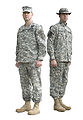
pattern currently in use in the United States Army
United States Army
The United States Army is the main branch of the United States Armed Forces responsible for land-based military operations. It is the largest and oldest established branch of the U.S. military, and is one of seven U.S. uniformed services...
's Army Combat Uniform
Army Combat Uniform
The Army Combat Uniform is the current combat uniform worn by the United States Army. It is the successor to the Battle Dress Uniform and Desert Camouflage Uniform worn during the 1980s and 1990s. It features a number of design changes, as well as a different camouflage pattern from its...
. The pattern was chosen after several laboratory and field tests that occurred from 2003 to 2004. Its digital pattern is a modification of the United States Marine Corps
United States Marine Corps
The United States Marine Corps is a branch of the United States Armed Forces responsible for providing power projection from the sea, using the mobility of the United States Navy to deliver combined-arms task forces rapidly. It is one of seven uniformed services of the United States...
' MARPAT
MARPAT
MARPAT is a digital camouflage pattern in use with the United States Marine Corps, introduced with the Marine Corps Combat Utility Uniform , which replaced the Camouflage Utility Uniform. The pattern is formed by a number of small rectangular pixels of color...
camouflage and research into Dual Texture (Dual-Tex) Camouflage conducted in the 1970s.
Initial patterns and colors
Three patterns were developed, called All Over Brush, Track, and Shadow/Line. For each pattern, there were four color combinations, which corresponded to a specific type of terrain, however, all four patterns used tanTan (color)
Tan is a pale whiteish, tawny shade of white. The name is derived from tannum used in the tanning of leather.The first recorded use of tan as a shade name in English was in the year 1590....
as their base color. The three remaining colors were green
Green
Green is a color, the perception of which is evoked by light having a spectrum dominated by energy with a wavelength of roughly 520–570 nanometres. In the subtractive color system, it is not a primary color, but is created out of a mixture of yellow and blue, or yellow and cyan; it is considered...
, brown
Brown
Brown is a color term, denoting a range of composite colors produced by a mixture of orange, red, rose, or yellow with black or gray. The term is from Old English brún, in origin for any dusky or dark shade of color....
, and black
Black
Black is the color of objects that do not emit or reflect light in any part of the visible spectrum; they absorb all such frequencies of light...
for the Woodland pattern, dark tan, khaki
Khaki
This article is about the fabric. For the color, see Khaki . Kaki, another name for the persimmon, is often misspelled "Khaki".Khaki is a type of fabric or the color of such fabric...
, and brown for the Desert pattern, light gray, medium gray, and black for the Urban pattern, and dark tan, light gray, and brown for the Desert/Urban pattern.
Test sites
There were a total of fifteen evaluations, which took place at Fort BenningFort Benning
Fort Benning is a United States Army post located southeast of the city of Columbus in Muscogee and Chattahoochee counties in Georgia and Russell County, Alabama...
, Fort Polk
Fort Polk
Fort Polk is a United States Army installation located in Vernon Parish, approximately 7 miles east of Leesville, Louisiana and 20 miles north of DeRidder, Louisiana....
, Fort Irwin, Fort Lewis
Fort Lewis
Joint Base Lewis-McChord is a United States military facility located south-southwest of Tacoma, Washington. The facility is under the jurisdiction of the United States Army Joint Base Garrison, Joint Base Lewis-McChord....
, and Yakima, WA. The camouflage patterns were then rated on their blending, brightness, contrast, and detection by US Army soldiers, during the daytime, and also at night using night vision devices.
Elimination of patterns
Following testing, the Shadow Line pattern was eliminated entirely, along with the urban and desert/urban patterns of All Over Brush. All four of the Track patterns were accepted along with All Over Brush's woodland and desert patterns.Phase II & III
The patterns were then modified and tested alongside a newly introduced "Contractor-Developed Mod" pattern, MultiCamMultiCam
MultiCam is a single camouflage pattern designed to help the wearer hide in varied environments, seasons, elevations, and light conditions. It is a 7-color, multi-environment camouflage pattern developed by Crye Associates in conjunction with U.S. Army Soldier Systems Center...
. Near Infrared testing determined that black, medium gray, and medium tan were the only colors that gave acceptable performance.
Phase IV (System Level)
All four remaining patterns, desert Brush, MultiCam, Woodland Track, and Urban Track were then tested alongside each other in urban, woodland, and desert environments.Results
The desert Brush design received the best overall mean daytime visual rating. Contractor developed pattern received highest rating in woodland environments, but low ratings in desert and urban environments. Urban Track was generally the 3rd or 4th worst performer at each site, but was the best performer in nighttime environments. Infrared testing showed negligible differences in the performance of the four patterns. Natick rated the patterns from best to worst as: Desert Brush, Woodland Track Mod, Contractor-Developed Mod, and Urban Track.Color selection
The color scheme of the Army Combat Uniform is composed of a gray (officially named Urban gray 501), tan (Desert sand 500) and sage green (Foliage green 502) digital pattern. The pattern is noticeable for its elimination of the color black. Justification for the ommission of black was that black is a colour not commonly found in nature. Pure black, when viewed through night vision gogglesNight vision goggles
A night vision device is an optical instrument that allows images to be produced in levels of light approaching total darkness. They are most often used by the military and law enforcement agencies, but are available to civilian users...
, appears excessively dark and creates an undesirable high-contrast image.
Controversy
Natick Soldier Center
The U.S. Army Natick Soldier Research, Development and Engineering Center — also known as the U.S. Army Natick Soldier Center , or simply as Natick Labs — is an element of the United States Army Research, Development, and Engineering Command , headquartered at Aberdeen Proving Ground, Maryland,...
's testing was unexplained. The US Army's public explanation of UCP's origin has been shown to be incorrect, as visual comparisons of pattern samples have shown the UCP to be simply a re-coloured version of the US Marines MARPAT scheme, which in turn was based on the earlier Canadian CADPAT camouflage pattern.
The omission of black in the colour palette has been the subject of much debate. The US Army's reasoning that it is not a colour commonly found in nature did not stop it from adopting an artificial pixellated design. Square pixels are also not found in nature. Black is generally perceived in camouflage schemes as shadow and a degree of black, or an alternative dark colour (e.g brown in desert patterns), invariably enhances a pattern's disruptive effect.
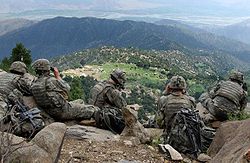
Soldiers have reported that the pattern is marginally effective in an urban or desert environment, and wholly ineffective in most others, particularly jungle and tropical terrain. As the U.S. Army is currently involved in the Middle East
Middle East
The Middle East is a region that encompasses Western Asia and Northern Africa. It is often used as a synonym for Near East, in opposition to Far East...
, the uniform may have been biased towards the current operating environments.
If passed by the Senate, House of Representatives Bill 2346 would require the Department of Defense to "take immediate action to provide combat uniforms to personnel deployed to Afghanistan with a camouflage pattern that is suited to the environment of Afghanistan.” The Army is currently evaluating alternative camouflage patterns to determine if this is a necessary action. In recent tests conducted by the U.S. Army's Natick Soldier Center, results indicated that three other patterns did significantly better than UCP in desert and woodland environments.
The US Army has been unable to say why UCP was adopted over better performing patterns.
See also
- U.S. Army trial patterns
- MARPATMARPATMARPAT is a digital camouflage pattern in use with the United States Marine Corps, introduced with the Marine Corps Combat Utility Uniform , which replaced the Camouflage Utility Uniform. The pattern is formed by a number of small rectangular pixels of color...
- CADPATCADPATCanadian Disruptive Pattern is the computer-generated digital camouflage pattern currently used by the Canadian Forces . CADPAT is designed to reduce the likelihood of detection by night vision devices. The basic uniform consists of a wide brim combat hat, helmet cover, shirt, jacket, trousers,...
- MultiCamMultiCamMultiCam is a single camouflage pattern designed to help the wearer hide in varied environments, seasons, elevations, and light conditions. It is a 7-color, multi-environment camouflage pattern developed by Crye Associates in conjunction with U.S. Army Soldier Systems Center...
- List of camouflage patterns