

IND 63rd Street Line

Encyclopedia
Rapid transit
A rapid transit, underground, subway, elevated railway, metro or metropolitan railway system is an electric passenger railway in an urban area with a high capacity and frequency, and grade separation from other traffic. Rapid transit systems are typically located either in underground tunnels or on...
line of the IND
Independent Subway System
The Independent Subway System , formerly known as the Independent City-Owned Subway System or the Independent City-Owned Rapid Transit Railroad, was a rapid transit rail system in New York City that is now part of the New York City Subway...
division of the New York City Subway
New York City Subway
The New York City Subway is a rapid transit system owned by the City of New York and leased to the New York City Transit Authority, a subsidiary agency of the Metropolitan Transportation Authority and also known as MTA New York City Transit...
system. It runs from the IND Sixth Avenue Line
IND Sixth Avenue Line
The Sixth Avenue Line is a rapid transit line of the B Division of the New York City Subway in the United States. It runs mainly under Sixth Avenue in Manhattan, and continues south through the Rutgers Street Tunnel to Brooklyn...
at 57th Street
57th Street (IND Sixth Avenue Line)
57th Street is a station on the IND Sixth Avenue Line of the New York City Subway. Located at the intersection of 57th Street and Sixth Avenue in Manhattan, it is served by the F train at all times...
east under 63rd Street and the East River
East River
The East River is a tidal strait in New York City. It connects Upper New York Bay on its south end to Long Island Sound on its north end. It separates Long Island from the island of Manhattan and the Bronx on the North American mainland...
through the 63rd Street Tunnel to the IND Queens Boulevard Line
IND Queens Boulevard Line
The Queens Boulevard Line is a fully underground line of the B Division of the New York City Subway in Manhattan and Queens, New York City, United States. The line provides crosstown service across Manhattan under 53rd Street and east through Queens to Jamaica...
in Queens
Queens
Queens is the easternmost of the five boroughs of New York City. The largest borough in area and the second-largest in population, it is coextensive with Queens County, an administrative division of New York state, in the United States....
. Crossover tracks connect it to the BMT 63rd Street Line
BMT 63rd Street Line
The BMT 63rd Street Line is a rapid transit line of the BMT division of the New York City Subway system. This short line connects the express tracks of the BMT Broadway Line from 57th Street – Seventh Avenue to Lexington Avenue – 63rd Street, where it stub-ends...
railroad south
Railroad directions
Railroad directions are used to describe train directions on railroad systems. The terms used may be derived from such sources as compass directions, altitude directions, or other directions...
(compass
Compass
A compass is a navigational instrument that shows directions in a frame of reference that is stationary relative to the surface of the earth. The frame of reference defines the four cardinal directions – north, south, east, and west. Intermediate directions are also defined...
west) of the Lexington Avenue station.
Extent and service
New York City Subway chaining
New York City Subway chaining is a method to precisely specify locations along the New York City Subway lines. It measures distances from a fixed point, called chaining zero, following the twists and turns of the railroad line, so that the distance described is understood to be the "railroad...
route "T" (T1 and T2).
The IND 63rd Street Line and BMT 63rd Street Line share only one point of contact, west of Lexington Avenue, where diamond crossovers allow northbound and southbound trains of either line to crossover to the other line. At Lexington Avenue, a double-decked station will allow cross-platform interchange
Cross-platform interchange
A cross-platform interchange is a type of interchange between different lines in a metro system. The term originates with the London Underground; such layouts exist in other networks but are not commonly so named...
between the two lines when future service is up and running on the long planned Second Avenue Subway
Second Avenue Subway
The Second Avenue Subway is a planned rapid transit subway line, part of the New York City Subway system. Phase I, consisting of two miles of tunnel and three stations, is currently under construction underneath Second Avenue in the borough of Manhattan.A plan for more than 75 years, the Second...
line, which will use the BMT 63rd Street Line as a connection for service downtown along the BMT Broadway Line
BMT Broadway Line
The BMT Broadway Line is a rapid transit line of the B Division of the New York City Subway in Manhattan, New York City, United States. , it is served by three services, all colored yellow: the on the express tracks and the on the local tracks...
. This double-decked arrangement is reversed from the arrangement at Queensboro Plaza
Queensboro Plaza (New York City Subway)
Queensboro Plaza is an elevated New York City Subway station over Queens Plaza in Long Island City, at the east end of the Queensboro Bridge, with Queens Boulevard running east from the plaza. It stands over the south side of the roadway, but formerly spanned the whole plaza...
. Trains to Queens (and later Upper Manhattan) use the lower level and trains to downtown Manhattan the upper level. Currently the BMT tracks are behind a wall on the platforms on each level, which will be removed when the tracks are put into active service.
The 63rd Street Line uses the 63rd Street Tunnel to cross the East River. The 63rd Street Tunnel is a two-level tunnel under the East River, which hosts the 63rd Street Line on its upper level. The lower level, currently without service, is reserved for the Long Island Rail Road
Long Island Rail Road
The Long Island Rail Road or LIRR is a commuter rail system serving the length of Long Island, New York. It is the busiest commuter railroad in North America, serving about 81.5 million passengers each year. Established in 1834 and having operated continuously since then, it is the oldest US...
's new East Side Access
East Side Access
East Side Access is a public works project being undertaken by the Metropolitan Transportation Authority in New York City, designed to bring the Long Island Rail Road into a new East Side station to be built below and incorporated into Grand Central Terminal in Manhattan...
service to Grand Central Terminal
Grand Central Terminal
Grand Central Terminal —often incorrectly called Grand Central Station, or shortened to simply Grand Central—is a terminal station at 42nd Street and Park Avenue in Midtown Manhattan in New York City, United States...
, which is expected to commence operations in 2015.
Early plans
In February 1963, the Transit Authority proposed a two-track East River subway tunnel under 76th Street with unspecified connections to the rest of the transit network, at a cost of $139 million. In a May 2, 1963 report, the proposed site of the tunnel was switched to 59th Street. On May 24, Mayor WagnerRobert F. Wagner, Jr.
Robert Ferdinand Wagner II, usually known as Robert F. Wagner, Jr. served three terms as the mayor of New York City, from 1954 through 1965.-Biography:...
suggested that a tunnel around 61st Street "be built with all deliberate speed." On October 17, 1963, the Board of Estimate
New York City Board of Estimate
The New York City Board of Estimate was a governmental body in New York City, responsible for budget and land-use decisions. Under the charter of the newly amalgamated City of Greater New York the Board of Estimate and Apportionment was composed of eight ex officio members: the Mayor of New York...
approved a new East River tunnel sited at 64th Street, noting that it would cost $30 million and take seven years to build. The 64th Street site was said to be $5.3 million less expensive, "because of easier grades and smaller curves."
The lack of specificity about how the tunnel would be used was criticized at an early date. In December 1964, the Citizens Budget Committee said that the project (now shifted to a 63rd Street site) was "leading nowhere-to-nowhere." The Committee went on to propose three connections that were eventually adopted (to the BMT Broadway Line
BMT Broadway Line
The BMT Broadway Line is a rapid transit line of the B Division of the New York City Subway in Manhattan, New York City, United States. , it is served by three services, all colored yellow: the on the express tracks and the on the local tracks...
and IND Sixth Avenue Line
IND Sixth Avenue Line
The Sixth Avenue Line is a rapid transit line of the B Division of the New York City Subway in the United States. It runs mainly under Sixth Avenue in Manhattan, and continues south through the Rutgers Street Tunnel to Brooklyn...
, both at 57th Street, to the IND Queens Boulevard Line
IND Queens Boulevard Line
The Queens Boulevard Line is a fully underground line of the B Division of the New York City Subway in Manhattan and Queens, New York City, United States. The line provides crosstown service across Manhattan under 53rd Street and east through Queens to Jamaica...
at Queens Plaza), and one that wasn't (to the IRT Lexington Avenue Line
IRT Lexington Avenue Line
The Lexington Avenue Line is one of the lines of the IRT division of the New York City Subway, stretching from Downtown Brooklyn or Lower Manhattan north to 125th Street in East Harlem. The portion in Lower and Midtown Manhattan was part of the first subway line in New York...
).
The Board of Estimate approved the revised 63rd Street route on January 14, 1965, at a budget of $28.1 million and a four-year timetable, with the connections to the rest of the transit network awaiting a study that was then scheduled for completion in mid-1966. The Times noted that "A variety of possible connections...are under study," including possible new lines under Madison and Second Avenues. The Transit Authority's chairman, Joseph E. O'Grady, said that the tunnel and the subway connections would eventually be completed at about the same time, "since construction of the tunnel takes at least a year longer than the connections."
In November 1967, voters approved a $2.5 billion transportation bond issue, and in early 1968 officials provided detailed plans for how it would be used. Among many other projects, the proposal included:
- The bi-level 63rd Street tunnel for both subway and Long Island Rail Road service
- A new subway line for northeastern Queens along the Long Island Expressway right-of-way
- A new subway line for southeastern Queens diverging from the IND Queens Boulevard line at Hillside Avenue, running along the LIRR Atlantic Branch right-of-way
- A super-express bypass for the IND Queens Boulevard Line running along the LIRR mainline between Queens Boulevard and Forest Hills
This proposal, with some modifications, received approval from the Board of Estimate on September 21, 1968.
Construction
Construction on the 63rd Street Line began on November 25, 1969, with tunneling westward in Queens, as well as in both directions under Welfare Island (now called Roosevelt IslandRoosevelt Island
Roosevelt Island, known as Welfare Island from 1921 to 1973, and before that Blackwell's Island, is a narrow island in the East River of New York City. It lies between the island of Manhattan to its west and the borough of Queens to its east...
). The double-deck, 3,140-foot tunnel under the East River was holed through on October 10, 1972. The East River tunnel was completed in 1973, and outfitting for the new lines that were to run through it was to begin in early 1974. Work on the segment of the line that ran under Central Park was started in 1971 and was completed in 1973. Construction on the section between 5th Avenue and Park Avenue began in August 1974.
On March 20, 1975, New York mayor Abraham Beame
Abraham Beame
Abraham David "Abe" Beame was mayor of New York City from 1974 to 1977. As such, he presided over the city during the fiscal crisis of the mid-1970s, during which the city was almost forced to declare bankruptcy....
announced significant cutbacks to the plan. Construction of the Southeastern Queens extension was "delayed to 1981," and the Long Island Rail Road extension through the lower level of the 63rd Street tunnel was "indefinite[ly] shelved." However, it was still anticipated that the Queens Boulevard super-express and the Archer Avenue Line up to Parsons/Archer would still be completed. (The Second Avenue Subway had been dropped the previous December.) The Queens project, although curtailed, was given priority because it was "more advanced in construction."
By the summer of 1976, the Transit Authority would announce that "it will take an extra five or six years—until 1987 or 1988—to complete the new Manhattan–Queens trunk subway line from Central Park to Jamaica via the new 63rd Street tunnel." The main cause of the delay was the 5.8-mile "super express," although it was expected that the three new Archer Avenue line stations could be ready sooner. As an interim measure, the authority proposed a new station at Northern Boulevard, adjacent to the Queens Plaza, possibly opened by 1983 or 1984.
The Manhattan portion of the line was completed in 1976. The Times noted:
- Underneath Central Park lie two eerily quiet sets of tracks. They have advanced equipment — welded tracks, fluorescent lighting and rubber-based pads under the rail — that have not yet been installed on most of the system's 230 operating miles.
- These tunnels were finished in 1976. This year, the contractor will tear down his two-story office in Central Park, remove the fence near Fifth Avenue and restore foliage and the bird house he damaged, at a cost of $300,000.
- By 1981, five years after completion of the tunnel, the Transit Authority expects to put it to use; its brand new quiet tracks will be used as a storage yard for out-of-service trains.
The unused tunnel
In May 1978, the Times noted, "What started out a few years ago as 40 miles of new subway routes to serve the long-suffering residents of Queens has been whittled down to 15 miles, is years behind schedule, and will cost more than twice as much as originally estimated....The line costs $100,000 a foot, will be very short and will serve only a modest number of riders." The article now noted that the Queens super-express had been deferred "to 1988 at the earliest," and the only sections in progress were the 63rd Street Line to Northern Boulevard, and "a small piece along Archer Avenue." The 63rd Street Line's opening date was projected for 1985. The plan depended on the idea that Queens Boulevard riders would be willing to exit the subway at Queens Plaza and walk a city block to a new station at Northern Boulevard to continue their trip. The transit authority projected that this transfer would draw 11,000 passengers a day.By October 1980, officials considered stopping both projects and spending the money on maintaining the existing system. By now, the Archer Avenue project was projected for completion in 1984, and the 63rd Street line in 1985. The Times noted that the lower level of the 63rd Street tunnel was still under construction, even though "officials knew that the tunnel would never be used." Richard Ravitch, the MTA chairman, said that to stop the work was impossible or so costly as to make it impractical subsequent to the construction of the subway portion." It "had to be finished — largely for structural reasons — to support the subway tunnel above." It was described as a "tunnel to nowhere."
In the spring of 1983, the MTA took a fresh look at the tunnel, considering every possibility between leaving it as-is (with its terminus in Long Island City), to the original 1960s plan, the cost of which was now estimated at $1 billion. Without some kind of connection to the rest of the Queens subway network, the line was expected to attract just 220 passengers per hour during the morning rush.
The plan eventually adopted was the least expensive (other than doing nothing) — to connect the tunnel to the tracks of the IND Queens Boulevard Line, at a cost of $222 million, and a timetable of at least eight years. It was estimated that the project would attract 16,500 passengers per hour. The MTA board approved this plan on December 14, 1984. The section of the line up to Long Island City was projected to open by the end of 1985.
By June 1985, the project was delayed again:
- The 63d Street subway tunnel, which has been under construction for 14 years and was scheduled to open later this year, has serious flaws and will not open on time, transit officials said yesterday.
- Some parts of the tunnel, which links Manhattan and Queens, are flooded with six feet of water, officials said. In other areas, girders are rusting and electrical equipment has corroded.
- The officials would not predict publicly when the $600 million structure might be opened or how much the repairs would cost.
Two contractors were hired to assess the structural integrity of the tunnel, and the delay was estimated at two years. In August 1985, the federal government—at the instigation of Senator Alphonse D'Amato—suspended funding on both the 63rd Street and Archer Avenue projects—over "concerns with the construction management practices." The two projects had cost $1 billion between them, of which the federal government had provided $530 million for 63rd Street and $295 million for Archer Avenue.
Opening
By 1987, the MTA's contractors had concluded that the tunnel was structurally sound, although federal funding had not yet been released. On February 6, 1987, the MTA approved a new plan to have the tunnel open by October 1989. The agency also proposed a $550 million, 1,500-foot connector to both the express and local tracks of the IND Queens Boulevard Line. Under the plan, the Queens Boulevard Line would be "reverse-signaled," which would accommodate Manhattan-bound trains on three out of the line's four tracks in the morning rush, and the opposite for the evening rush. This part of the plan was not projected to begin before the 1990s.In June 1987, the federal government completed its own review of the project. "A little light appeared at the end of the Metropolitan Transportation Authority's 63d Street "tunnel to nowhere" last week," the Times reported, as the government's own inspector found the tunnel sound, and released the final installment of $60 million for both the 63rd Street and Archer Avenue projects.
The first train to use the extension was the "rail polisher train", a non-revenue move that occurred on August 1, 1989.
A month shy of twenty years after construction began, the line went into service on October 29, 1989, after an expenditure of $898 million, with new stations at Lexington Avenue, Roosevelt Island, and 21st Street at 41st Avenue in Queens. The line was served by trains on weekdays and trains on weekends. The 1,500-foot connector to the Queens Boulevard Line had not yet started construction.
Connection to the Queens Boulevard line
Planning for the connection to the IND Queens Boulevard LineIND Queens Boulevard Line
The Queens Boulevard Line is a fully underground line of the B Division of the New York City Subway in Manhattan and Queens, New York City, United States. The line provides crosstown service across Manhattan under 53rd Street and east through Queens to Jamaica...
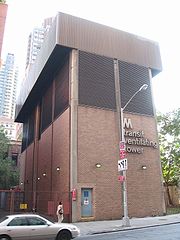
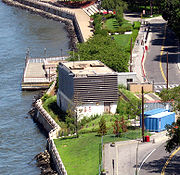
began in 1992; construction began in July 1994. The remaining section from 21st Street to the Queens Boulevard Line cost $645 million. In January 2001, the 63rd Street Connector was opened for construction reroutes. The Connector came into regular use on December 16, 2001 with the rerouting of F service at all times to 63rd Street. The construction project also extended the lower level LIRR tunnel and involved a number of other elements, including the integration of ventilation plants, lowering a sewer siphon 50 feet, rehabilitation of elements of the existing line, mitigating ground water, diverting trains which continued to run through the project area and widening of the entry point to the Queens Boulevard Line to six tracks. This new tunnel connection allowed rerouting the Queens Boulevard Line trains via the 63rd Street Tunnel, which increased capacity on the heavily-travelled Queens Boulevard Line.
Station listing
| Station | Services | Opened | Transfers and notes | |
|---|---|---|---|---|
| Line begins as a split from the IND Queens Boulevard Line IND Queens Boulevard Line The Queens Boulevard Line is a fully underground line of the B Division of the New York City Subway in Manhattan and Queens, New York City, United States. The line provides crosstown service across Manhattan under 53rd Street and east through Queens to Jamaica... |
||||
| 21st Street – Queensbridge | October 29, 1989 | |||
| Roosevelt Island Roosevelt Island (IND 63rd Street Line) Roosevelt Island is a station on the IND 63rd Street Line of the New York City Subway. Located on Roosevelt Island in the East River, between Manhattan and Queens, it is served by the F train at all times. The station opened in 1989 in conjunction with the partial completion of the 63rd Street... |
October 29, 1989 | |||
| Lexington Avenue – 63rd Street | October 29, 1989 | MetroCard transfer to IRT Lexington Avenue Line IRT Lexington Avenue Line The Lexington Avenue Line is one of the lines of the IRT division of the New York City Subway, stretching from Downtown Brooklyn or Lower Manhattan north to 125th Street in East Harlem. The portion in Lower and Midtown Manhattan was part of the first subway line in New York... at 59th Street MetroCard transfer to BMT Broadway Line BMT Broadway Line The BMT Broadway Line is a rapid transit line of the B Division of the New York City Subway in Manhattan, New York City, United States. , it is served by three services, all colored yellow: the on the express tracks and the on the local tracks... at Lexington Avenue / 59th Street |
||
| connecting tracks to BMT 63rd Street Line BMT 63rd Street Line The BMT 63rd Street Line is a rapid transit line of the BMT division of the New York City Subway system. This short line connects the express tracks of the BMT Broadway Line from 57th Street – Seventh Avenue to Lexington Avenue – 63rd Street, where it stub-ends... (No regular service) |
||||
| Merge with IND Sixth Avenue Line IND Sixth Avenue Line The Sixth Avenue Line is a rapid transit line of the B Division of the New York City Subway in the United States. It runs mainly under Sixth Avenue in Manhattan, and continues south through the Rutgers Street Tunnel to Brooklyn... |
||||