
Grand Central Terminal (
GCT)—often incorrectly called
Grand Central Station, or shortened to simply
Grand Central—is a terminal station at
42nd Street42nd Street is a major crosstown street in the New York City borough of Manhattan, known for its theaters, especially near the intersection with Broadway at Times Square. It is also the name of the region of the theater district near that intersection...
and
Park AvenuePark Avenue is a wide boulevard that carries north and southbound traffic in New York City borough of Manhattan. Through most of its length, it runs parallel to Madison Avenue to the west and Lexington Avenue to the east....
in
Midtown ManhattanMidtown Manhattan, or simply Midtown, is an area of Manhattan, New York City home to world-famous commercial zones such as Rockefeller Center, Broadway, and Times Square...
in
New York CityNew York is the most populous city in the United States and the center of the New York Metropolitan Area, one of the most populous metropolitan areas in the world. New York exerts a significant impact upon global commerce, finance, media, art, fashion, research, technology, education, and...
,
United StatesThe United States of America is a federal constitutional republic comprising fifty states and a federal district...
. Built by and named for the
New York Central RailroadThe New York Central Railroad , known simply as the New York Central in its publicity, was a railroad operating in the Northeastern United States...
in the heyday of American long-distance passenger trains, it is the largest train station in the world by number of
platformsA railway platform is a section of pathway, alongside rail tracks at a train station, metro station or tram stop, at which passengers may board or alight from trains or trams. Almost all stations for rail transport have some form of platforms, with larger stations having multiple platforms...
: 44, with 67 tracks along them. They are on two levels, both below ground, with 41 tracks on the upper level and 26 on the lower, though the total number of tracks along platforms and in rail yards exceeds 100. When the
Long Island Rail RoadThe Long Island Rail Road or LIRR is a commuter rail system serving the length of Long Island, New York. It is the busiest commuter railroad in North America, serving about 81.5 million passengers each year. Established in 1834 and having operated continuously since then, it is the oldest US...
's new station opens in 2016 (see
East Side AccessEast Side Access is a public works project being undertaken by the Metropolitan Transportation Authority in New York City, designed to bring the Long Island Rail Road into a new East Side station to be built below and incorporated into Grand Central Terminal in Manhattan...
), Grand Central will offer a total of 75 tracks and 48 platforms. The terminal covers an area of 48 acres (19 ha).
The terminal serves commuters traveling on the
Metro-North RailroadThe Metro-North Commuter Railroad , trading as MTA Metro-North Railroad, or, more commonly, Metro-North, is a suburban commuter rail service that is run and managed by the Metropolitan Transportation Authority , an authority of New York State. It is the busiest commuter railroad in the United...
to
WestchesterWestchester County is a county located in the U.S. state of New York. Westchester covers an area of and has a population of 949,113 according to the 2010 Census, residing in 45 municipalities...
,
PutnamPutnam County is a county located in the U.S. state of New York, in the lower Hudson River Valley. Putnam county formed in 1812, when it detached from Dutchess County. , the population was 99,710. It is part of the New York Metropolitan Area. The county seat is the hamlet of Carmel...
, and
DutchessDutchess County is a county located in the U.S. state of New York, in the state's Mid-Hudson Region of the Hudson Valley. The 2010 census lists the population as 297,488...
counties in
New York StateNew York is a state in the Northeastern region of the United States. It is the nation's third most populous state. New York is bordered by New Jersey and Pennsylvania to the south, and by Connecticut, Massachusetts and Vermont to the east...
, and
FairfieldFairfield County is a county located in the southwestern corner of the U.S. state of Connecticut. The county population is 916,829 according to the 2010 Census. There are currently 1,465 people per square mile in the county. It is the most populous county in the State of Connecticut and contains...
and
New HavenNew Haven County is a county located in the south central part of the U.S. state of Connecticut. As of the 2010 Census, the county population is 862,477 making it the third most populated county in Connecticut. There are 1,340 people per square mile...
counties in
ConnecticutConnecticut is a state in the New England region of the northeastern United States. It is bordered by Rhode Island to the east, Massachusetts to the north, and the state of New York to the west and the south .Connecticut is named for the Connecticut River, the major U.S. river that approximately...
. The terminal used to be served by
AmtrakThe National Railroad Passenger Corporation, doing business as Amtrak , is a government-owned corporation that was organized on May 1, 1971, to provide intercity passenger train service in the United States. "Amtrak" is a portmanteau of the words "America" and "track". It is headquartered at Union...
, but in 1991 their trains moved to nearby
Pennsylvania StationPennsylvania Station—commonly known as Penn Station—is the major intercity train station and a major commuter rail hub in New York City. It is one of the busiest rail stations in the world, and a hub for inbound and outbound railroad traffic in New York City. The New York City Subway system also...
as a result of the completion of the Empire Connection.
Although the terminal has been properly called "Grand Central Terminal" since 1913, many people continue to refer to it as "Grand Central Station." "Grand Central Station" is the name of the nearby post office, as well as the name of a previous rail station on the site, and it is also used to refer to a New York City subway station at the same location.
Layout
The tracks are numbered according to their location in the
terminal buildingA station building, also known as a head house, is the main building of a passenger train station. It is typically used principally to provide services to passengers.A station building is not to be confused with the station itself...
rather than the trains' destinations, because all of the trains terminate at Grand Central. 31 upper level tracks are in revenue service, numbered 11 to 42 east to west. Tracks 22 and 31 were removed in the late 1990s to build
concourseA concourse is a place where pathways or roads meet, such as in a hotel, a convention center, a railway station, an airport terminal, a hall, or other space.-Examples:Examples of concourses include:* Meeting halls* Universities* Railway stations...
s for Grand Central North, track 12 was removed to expand the platform between tracks 11 and 13, and track 14 is only used for loading a garbage train. The lower level has 26 tracks, numbered 100 to 126, east to west, though only tracks 102–112, and 114–116 are currently used for passenger service. This makes it easy for passengers to quickly locate where their train is departing from, and this eliminates much of the confusion in attempting to locate specific trains in an immense terminal. Often, local and off-peak trains depart from the lower level while
expressExpress trains are a form of rail service. Express trains make only a small number of stops, instead of stopping at every single station...
, super-express, and peak trains depart from the main concourse. Odd numbered tracks are usually on the east side (right side facing north) of the platform; even numbered tracks on the west.
The public timetables for April 3, 2011 show 286 weekday departures: 74 Hudson, 101 Harlem and 111 New Haven Line.
Besides platforms, Grand Central has restaurants, such as the
Oyster BarThe Oyster Bar, officially the Grand Central Oyster Bar & Restaurant, is a restaurant located on the lower level of Grand Central Terminal in New York City. It opened along with the terminal itself in 1913 and has been in business ever since, although it closed briefly for renovations following a...
and various fast food outlets surrounding the Dining Concourse on the level below the Main Concourse, as well as delis, bakeries, newsstands, a gourmet and fresh food market, an annex of the
New York Transit MuseumThe New York Transit Museum is a museum which displays historical artifacts of the New York City Subway, bus, commuter rail, and bridge and tunnel systems; it is located in a decommissioned Court Street subway station in the Brooklyn Heights neighborhood of New York City...
, and more than forty retail stores. Grand Central generally contains only private outlets and small franchises. There are no chain outlets in the complex, except for a
StarbucksStarbucks Corporation is an international coffee and coffeehouse chain based in Seattle, Washington. Starbucks is the largest coffeehouse company in the world, with 17,009 stores in 55 countries, including over 11,000 in the United States, over 1,000 in Canada, over 700 in the United Kingdom, and...
coffee shop and a
Rite AidRite Aid is a drugstore chain in the United States and a Fortune 500 company headquartered in East Pennsboro Township, Pennsylvania, near Camp Hill. Rite Aid is the largest drugstore chain on the East Coast and the third largest drugstore chain in the U.S....
pharmacy. Other chain stores anticipated to open in the future include an Apple Store and
Shake ShackShake Shack is a restaurant chain serving hamburgers, hot dogs, french fries, milkshakes and similar foods. There are currently eleven restaurants within the chain, six in New York City. There are two more locations opening soon: one in Grand Central Terminal, and one in Downtown Brooklyn.The...
.
A "secret" sub-basement known as M42 lies under the Terminal, containing the AC to DC converters used to supply DC
traction currentA railway electrification system supplies electrical energy to railway locomotives and multiple units as well as trams so that they can operate without having an on-board prime mover. There are several different electrification systems in use throughout the world...
to the Terminal. The exact location of M42 is a closely guarded secret and does not appear on maps, though it has been shown on television, most notably, the History Channel program
Cities of the UnderworldCities of the Underworld was an American documentary television series that premiered on March 2, 2007 on History. The program explored the subterranean environment and culture beneath various civilizations...
and also a
National GeographicThe National Geographic Society , headquartered in Washington, D.C. in the United States, is one of the largest non-profit scientific and educational institutions in the world. Its interests include geography, archaeology and natural science, the promotion of environmental and historical...
special. The original
rotary converterA rotary converter is a type of electrical machine which acts as a mechanical rectifier or inverter. It was used to convert AC to DC or DC to AC power before the advent of chemical or solid state power rectification...
s were not removed in the late 20th century when solid state ones took over their job, and they remain as a historical record. During
World War IIWorld War II, or the Second World War , was a global conflict lasting from 1939 to 1945, involving most of the world's nations—including all of the great powers—eventually forming two opposing military alliances: the Allies and the Axis...
, this was one of the most guarded facilities because its sabotage would have greatly impaired troop movement on the Eastern Seaboard. Despite it being a secret,
Adolf HitlerAdolf Hitler was an Austrian-born German politician and the leader of the National Socialist German Workers Party , commonly referred to as the Nazi Party). He was Chancellor of Germany from 1933 to 1945, and head of state from 1934 to 1945...
was aware of this facility and sent two spies to sabotage it. The spies were arrested by the FBI before they could strike. It is said that any unauthorized person entering the facility during the war risked being shot on sight: the rotary converters used at the time could have easily been crippled by a bucket of sand.
From 1924 through 1944, the attic of the east wing contained a 7000 square feet (650.3 m²) art school and gallery space called the
Grand Central School of ArtThe Grand Central School of Art was an American art school in New York City, founded in 1923 by the painters Edmund Greacen, Walter Leighton Clark and John Singer Sargent. The school was established and run by the Grand Central Art Galleries, an artists' cooperative founded by Sargent, Greacen,...
.
Main Concourse
The Main
ConcourseA concourse is a place where pathways or roads meet, such as in a hotel, a convention center, a railway station, an airport terminal, a hall, or other space.-Examples:Examples of concourses include:* Meeting halls* Universities* Railway stations...
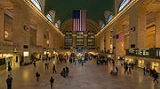
is the center of Grand Central. The space is cavernous – 275 ft (83.8 m) long, 120 ft (36.6 m) wide and 125 ft (38.1 m) high – and usually filled with bustling crowds. The ticket booths are located in the Concourse, although many now stand unused or repurposed since the introduction of ticket vending machines. The large
American flagThe national flag of the United States of America consists of thirteen equal horizontal stripes of red alternating with white, with a blue rectangle in the canton bearing fifty small, white, five-pointed stars arranged in nine offset horizontal rows of six stars alternating with rows...
was hung in Grand Central Terminal a few days after the September 11 attacks on the
World Trade CenterThe original World Trade Center was a complex with seven buildings featuring landmark twin towers in Lower Manhattan, New York City, United States. The complex opened on April 4, 1973, and was destroyed in 2001 during the September 11 attacks. The site is currently being rebuilt with five new...
. The main information booth is in the center of the concourse. This is a perennial meeting place, and the four-faced clock on top of the information booth is perhaps the most recognizable icon of Grand Central. Each of the four clock faces is made from
opalOpal is an amorphous form of silica related to quartz, a mineraloid form, not a mineral. 3% to 21% of the total weight is water, but the content is usually between 6% to 10%. It is deposited at a relatively low temperature and may occur in the fissures of almost any kind of rock, being most...
, and both
Sotheby'sSotheby's is the world's fourth oldest auction house in continuous operation.-History:The oldest auction house in operation is the Stockholms Auktionsverk founded in 1674, the second oldest is Göteborgs Auktionsverk founded in 1681 and third oldest being founded in 1731, all Swedish...
and
Christie'sChristie's is an art business and a fine arts auction house.- History :The official company literature states that founder James Christie conducted the first sale in London, England, on 5 December 1766, and the earliest auction catalogue the company retains is from December 1766...
have estimated the value to be between
$The United States dollar , also referred to as the American dollar, is the official currency of the United States of America. It is divided into 100 smaller units called cents or pennies....
10 million and
$The United States dollar , also referred to as the American dollar, is the official currency of the United States of America. It is divided into 100 smaller units called cents or pennies....
20 million. Within the marble and brass pagoda lies a "secret" door that conceals a spiral staircase leading to the lower level information booth.
Outside the station, the clock in front of the Grand Central facade facing 42nd Street contains the world's largest example of
TiffanyLouis Comfort Tiffany was an American artist and designer who worked in the decorative arts and is best known for his work in stained glass. He is the American artist most associated with the Art Nouveau and Aesthetic movements...
glass and is surrounded by sculptures carved by the John Donnelly Company of
MinervaMinerva was the Roman goddess whom Romans from the 2nd century BC onwards equated with the Greek goddess Athena. She was the virgin goddess of poetry, medicine, wisdom, commerce, weaving, crafts, magic...
,
HerculesHercules is the Roman name for Greek demigod Heracles, son of Zeus , and the mortal Alcmene...
, and
MercuryMercury was a messenger who wore winged sandals, and a god of trade, the son of Maia Maiestas and Jupiter in Roman mythology. His name is related to the Latin word merx , mercari , and merces...
and designed by
FrenchThe French Republic , The French Republic , The French Republic , (commonly known as France , is a unitary semi-presidential republic in Western Europe with several overseas territories and islands located on other continents and in the Indian, Pacific, and Atlantic oceans. Metropolitan France...
sculptor
Jules-Felix CoutanJules-Felix Coutan was a French sculptor and educator.- Life :As a student at the Ecole des Beaux-Arts, Coutan was awarded the Prix de Rome in 1872; after his return to Paris he executed the fountain group France Bearing the Torch of Civilization for the Exposition Universelle , one of the two...
. At the time of its unveiling (1914) this trio was considered to be the largest sculptural group in the world. It was 48 feet (14.6 m) high, the clock in the center having a circumference of 13 feet (4 m).
The upper level tracks are reached from the Main Concourse or from various hallways and passages branching off from it. On the east side of the Main Concourse is a cluster of food purveyor shops called Grand Central Market.
Ceiling
In autumn 1998, a 12-year restoration of Grand Central revealed the original luster of the Main Concourse's elaborately decorated astronomical ceiling.
The original ceiling, conceived in 1912 by Warren and
Paul César HelleuPaul César Helleu was a French artist best known for his portraits of many of the most famous and beautiful women of his time including the Duchess of Marlborough, the Countess of Greffulhe, the Marchesa Casati and Belle da Costa Greene.-Biography:He was born in Vannes, Brittany, France...
, was eventually replaced in the late 1930s to correct falling plaster.
This new ceiling was obscured by decades of what people thought was
coalCoal is a combustible black or brownish-black sedimentary rock usually occurring in rock strata in layers or veins called coal beds or coal seams. The harder forms, such as anthracite coal, can be regarded as metamorphic rock because of later exposure to elevated temperature and pressure...
and diesel smoke. Spectroscopic examination revealed that it was mostly
tarTar is modified pitch produced primarily from the wood and roots of pine by destructive distillation under pyrolysis. Production and trade in tar was a major contributor in the economies of Northern Europe and Colonial America. Its main use was in preserving wooden vessels against rot. The largest...
and
nicotineNicotine is an alkaloid found in the nightshade family of plants that constitutes approximately 0.6–3.0% of the dry weight of tobacco, with biosynthesis taking place in the roots and accumulation occurring in the leaves...
from
tobaccoTobacco is an agricultural product processed from the leaves of plants in the genus Nicotiana. It can be consumed, used as a pesticide and, in the form of nicotine tartrate, used in some medicines...
smoke. A single dark patch remains above the Michael Jordan Steakhouse, left untouched by renovators to remind visitors of the grime that once covered the ceiling.
There are two peculiarities to this ceiling: the sky is backwards, and the stars are slightly displaced. One explanation is that the constellations are backwards because the ceiling is based on a medieval manuscript that visualized the sky as it would look to God from outside the
celestial sphereIn astronomy and navigation, the celestial sphere is an imaginary sphere of arbitrarily large radius, concentric with the Earth and rotating upon the same axis. All objects in the sky can be thought of as projected upon the celestial sphere. Projected upward from Earth's equator and poles are the...
. According to this explanation, since the celestial sphere is an abstraction (stars are not all at equal distances from Earth), this view does not correspond to the actual view from anywhere in the universe. The stars are displaced because the manuscript showed a (reflected) view of the sky in the
Middle AgesThe Middle Ages is a periodization of European history from the 5th century to the 15th century. The Middle Ages follows the fall of the Western Roman Empire in 476 and precedes the Early Modern Era. It is the middle period of a three-period division of Western history: Classic, Medieval and Modern...
, and since then the stars shifted due to precession of the equinoxes. Most people, however, simply think that the image was reversed by accident. The ceiling was deliberately painted in reverse by the artist Giovanni Smeraldi.
When the
Vanderbilt familyThe Vanderbilt family is an American family of Dutch origin prominent during the Gilded Age. It started off with the shipping and railroad empires of Cornelius Vanderbilt, and expanded into various other areas of industry and philanthropy...
learned the ceiling was painted backwards, they maintained that the ceiling reflected
GodGod is the English name given to a singular being in theistic and deistic religions who is either the sole deity in monotheism, or a single deity in polytheism....
's view of the sky.
There is a small dark circle in the midst of the stars right above the image of
PiscesPisces is a constellation of the zodiac. Its name is the Latin plural for fish, and its symbol is . It lies between Aquarius to the west and Aries to the east...
. In a 1957 attempt to counteract feelings of insecurity spawned by the
SovietThe Soviet Union , officially the Union of Soviet Socialist Republics , was a constitutionally socialist state that existed in Eurasia between 1922 and 1991....
launch of Sputnik, Grand Central's Main Concourse played host to an American
Redstone missileThe PGM-11 Redstone was the first large American ballistic missile. A short-range surface-to-surface rocket, it was in active service with the U.S. Army in West Germany from June 1958 to June 1964 as part of NATO's Cold War defense of Western Europe...
. With no other way to erect the missile, the hole was cut so the rocket could be lifted into place. Historical Preservation dictated that this hole remain (as opposed to being repaired) as a testament to the many uses of the Terminal over the years.
Dining Concourse and lower level tracks
The Dining Concourse is below the Main Concourse. It contains many fast food outlets and restaurants, including the
Oyster BarThe Oyster Bar, officially the Grand Central Oyster Bar & Restaurant, is a restaurant located on the lower level of Grand Central Terminal in New York City. It opened along with the terminal itself in 1913 and has been in business ever since, although it closed briefly for renovations following a...
with its
Guastavino tileGuastavino tile is the "Tile Arch System" patented in the US in 1885 by Valencian architect and builder Rafael Guastavino...
vaults, surrounding central seating and lounge areas and provides access to the lower level tracks. The two levels are connected by numerous stairs, ramps, and escalators.
Vanderbilt Hall and Campbell Apartment
Vanderbilt Hall, named for the
Vanderbilt familyThe Vanderbilt family is an American family of Dutch origin prominent during the Gilded Age. It started off with the shipping and railroad empires of Cornelius Vanderbilt, and expanded into various other areas of industry and philanthropy...
who built and owned the station, is just off the Main Concourse. Formerly the main waiting room for the terminal, it is now used and rented out for various events. The
Campbell ApartmentThe Campbell Apartment is a public bar and cocktail lounge located in a corner of Grand Central Terminal in New York City. It faces Vanderbilt Avenue. Contrary to its name, the space was never an apartment, but was once the office of American financier John W...
is an elegantly restored cocktail lounge, located just south of the 43rd Street/Vanderbilt Avenue entrance, that attracts a mix of commuters and tourists. It was at one time the office of 1920s tycoon
John W. CampbellJohn Williams Campbell was a millionaire American financier. Campbell succeeded his father in a management role at Credit Clearing House. He kept an office at Grand Central Terminal in New York City...
and replicates the galleried hall of a 13th-century Florentine palace.
Solari display board
The original display board was an
electromechanicalIn engineering, electromechanics combines the sciences of electromagnetism, of electrical engineering and mechanics. Mechanical engineering in this context refers to the larger discipline which includes chemical engineering, and other related disciplines. Electrical engineering in this context...
display that displayed times and track numbers of arriving and departing trains. It contained rows of flip panels that displayed train information. It became a New York institution, as its many displays would flap simultaneously to reflect changes in train schedules, an indicator of just how busy Grand Central was. A small example of this type of device hangs in the
Museum of Modern ArtThe Museum of Modern Art is an art museum in Midtown Manhattan in New York City, on 53rd Street, between Fifth and Sixth Avenues. It has been important in developing and collecting modernist art, and is often identified as the most influential museum of modern art in the world...
as an example of outstanding industrial design.
The flap-board destination sign was replaced with high resolution mosaic LCDs modules manufactured by
Solari Udine of Italy, the maker of the original flap boards for train stations and airports. Similar modules are now also used on the trains, both on the sides to display the destination, and on the interior to display the time, next station, calling points, and other passenger information.
Subway station
The subway platforms at Grand Central are reached from the Main Concourse. Built by the
Interborough Rapid Transit CompanyThe Interborough Rapid Transit Company was the private operator of the original underground New York City Subway line that opened in 1904, as well as earlier elevated railways and additional rapid transit lines in New York City. The IRT was purchased by the City in June 1940...
(IRT) rather than the
New York Central RailroadThe New York Central Railroad , known simply as the New York Central in its publicity, was a railroad operating in the Northeastern United States...
, the subway areas of the station lack the majesty that is present throughout most of the rest of Grand Central, although they are in similar condition to its track levels. The shuttle platforms were originally an express stop on the
original IRT subwayThe first regularly operated subway in New York City was built by the city and leased to the Interborough Rapid Transit Company for operation under Contracts 1 and 2. Until 1918, when the new "H" system that is still operated - with separate East Side and West Side lines - was placed in service, it...
, opened in 1904. Once the
IRT Lexington Avenue LineThe Lexington Avenue Line is one of the lines of the IRT division of the New York City Subway, stretching from Downtown Brooklyn or Lower Manhattan north to 125th Street in East Harlem. The portion in Lower and Midtown Manhattan was part of the first subway line in New York...
was extended uptown in 1918, the original tracks were converted to shuttle use. One track remains connected to the downtown Lexington Avenue local track but the connection is not in revenue service. A fire in the 1960s destroyed much of the shuttle station, which has been rebuilt. The only signs of the fire damage are truncated steel beams visible above the platforms.
Grand Central North
Grand Central North, opened on August 18, 1999, provides access to Grand Central from 45th Street,
47th Street47th Street is an east-west running street between First Avenue and the West Side Highway in the borough of Manhattan in New York City. Traffic runs one way along the street, from east to west, starting at the United Nations Headquarters....
, and 48th Street. It is connected to the Main Concourse through two long hallways, the Northwest Passage (1,000 feet long) and Northeast Passage (1,200 feet long), which run parallel to the tracks on the upper level. Entrances are at the northeast corner of East 47th Street and
Madison AvenueMadison Avenue is a north-south avenue in the borough of Manhattan in New York City, United States, that carries northbound one-way traffic. It runs from Madison Square to the Madison Avenue Bridge at 138th Street. In doing so, it passes through Midtown, the Upper East Side , Spanish Harlem, and...
(Northwest Passage), northeast corner of East 48th Street and
Park AvenuePark Avenue is a wide boulevard that carries north and southbound traffic in New York City borough of Manhattan. Through most of its length, it runs parallel to Madison Avenue to the west and Lexington Avenue to the east....
(Northeast Passage), and on the east and west sides of 230 Park Avenue (
Helmsley BuildingThe Helmsley Building is a 35-story located at 230 Park Avenue in New York City. Before the erection of the Pan Am Building, now the MetLife Building, this building stood out over the city's second most prestigious avenue as it was the tallest structure in the great "Terminal City" complex around...
) between 45th and 46th Streets. A fifth entrance is scheduled to open in early 2012 on the south side of 47th Street between Park and Lexington Avenues.. The 47th Street passage provides access to the upper level tracks and the 45th Street passage provides access to the lower level tracks. Elevator access is available to the 47th Street (upper level) passage from street level on the north side of E. 47th Street, between Madison and Vanderbilt Avenues. There is no elevator access to the actual train platforms from Grand Central North; handicapped access is provided through the main terminal.
Near the north end of the passages, there is an Arts for Transit mosaic installation by Ellen Driscoll, an artist from
BrooklynBrooklyn is the most populous of New York City's five boroughs, with nearly 2.6 million residents, and the second-largest in area. Since 1896, Brooklyn has had the same boundaries as Kings County, which is now the most populous county in New York State and the second-most densely populated...
.
The entrances to Grand Central North were originally open from 6:30 AM to 9:30 PM Monday through Friday and 9 AM to 9:30 PM on Saturday and Sunday. As of summer 2006, Grand Central North was closed on weekends, with the
MTAThe Metropolitan Transportation Authority of the State of New York is a public benefit corporation responsible for public transportation in the U.S...
citing low usage and the need to save money by the shutdown. Prior to the closing, about 6,000 people used Grand Central North on a typical weekend, and about 30,000 on weekdays.
Ideas for a northern entrance to Grand Central were discussed since at least the 1970s. Construction on Grand Central North lasted from 1994 to 1999 and cost $75 million. Delays were attributed to the incomplete nature of the original blueprints of Grand Central and previously undiscovered groundwater beneath East 45th Street. As of 2007, the passages are not air-conditioned.
The passages in the terminal are:
- Metro-North Railroad
The Metro-North Commuter Railroad , trading as MTA Metro-North Railroad, or, more commonly, Metro-North, is a suburban commuter rail service that is run and managed by the Metropolitan Transportation Authority , an authority of New York State. It is the busiest commuter railroad in the United...
upper level
- Northwest and Northeast passages
- 47th Street cross-passage
- 45th Street cross-passage
- Metro-North Railroad lower level
History
Three buildings serving essentially the same function have stood on this site. The original large and imposing scale was intended by the
New York Central RailroadThe New York Central Railroad , known simply as the New York Central in its publicity, was a railroad operating in the Northeastern United States...
to enhance competition and compare favorably in the public eye with the archrival
Pennsylvania RailroadThe Pennsylvania Railroad was an American Class I railroad, founded in 1846. Commonly referred to as the "Pennsy", the PRR was headquartered in Philadelphia, Pennsylvania....
and smaller lines.
Grand Central Depot
Grand Central Depot brought the
trainA train is a connected series of vehicles for rail transport that move along a track to transport cargo or passengers from one place to another place. The track usually consists of two rails, but might also be a monorail or maglev guideway.Propulsion for the train is provided by a separate...
s of the New York Central and Hudson River Railroad, the
New York and Harlem RailroadThe New York and Harlem Railroad was one of the first railroads in the United States, and possibly also the world's first street railway. Designed by John Stephenson, it was opened in stages between 1832 and 1852 between Lower Manhattan to and beyond Harlem...
, and the
New York and New Haven RailroadThe New York and New Haven Railroad was a railroad connecting New York City to New Haven, Connecticut along the shore of the Long Island Sound. It opened in 1849, and in 1872 it merged with the Hartford and New Haven Railroad to form the New York, New Haven and Hartford Railroad...
together in one large station. The station was designed by
John B. SnookJohn B[utler] Snook was an American architect who practiced in New York City.Born in England, Snook emigrated to the United States with his family as a child. He was trained as a carpenter in his father's carpentry business, and was largely self-taught as an architect...
and opened in October 1871. The original plan was for the Harlem Railroad to start using it on October 9, 1871 (moving from their
27th Street27th Street is a prominent street in Manhattan's Chelsea neighborhood. It runs East to West, but is most noted for its strip between 10th and 11th Avenues, known as Club Row because it features numerous nightclubs and lounges....
depot), the New Haven Railroad on October 16, and the Hudson River Railroad on October 23, with the staggering done to minimize confusion. However, the Hudson River Railroad did not move to it until November 1, which puts the other two dates in doubt.
The headhouse building containing passenger service areas and railroad offices was an "L" shape with a short leg running east-west on 42nd Street and a long leg running north-south on Vanderbilt Avenue. The
train shedA train shed is an adjacent building to a railway station where the tracks and platforms are covered by a roof. It is also known as an overall roof...
, north and east of the
head houseA head house is a part of a train station.-Rail terminals:In the context of rail transport, head house refers to that portion of a passenger terminal not housing the tracks and platforms themselves. Typically, the head house contains ticket counters, toilets and baggage facilities, if there are...
, had two innovations in U.S. practice: the platforms were elevated to the height of the cars, and the roof was a balloon shed with a clear span over all of the tracks. The Harlem, Hudson and New Haven trains were initially in side by side different stations, which created chaos in
baggageBaggage is any number of bags, cases and containers which hold a traveller's articles during transit.Luggage is more or less the same concept as "baggage", but is normally used in relation to the personal luggage of a specific person or persons Baggage is any number of bags, cases and containers...
transfer. The combined Grand Central Depot serviced all three railroads.
Grand Central Station
Between 1899 and 1900, the head house was essentially demolished. It was expanded from three to six stories with an entirely new facade, on plans by railroad architect
Bradford GilbertBradford Lee Gilbert was a nationally-active architect based in New York City.Gilbert is best known for designing the first steel-framed curtain wall building, the Tower Building, which opened at 50 Broadway in 1889. The Tower Building is considered New York City's first skyscraper...
. The train shed was kept. The tracks that previously continued south of 42nd Street were removed and the train yard reconfigured in an effort to reduce congestion and turn-around time for trains. The reconstructed building was renamed
Grand Central Station.
Grand Central Terminal
Construction
Between 1903 and 1913, the entire building was torn down in phases and replaced by the current
Grand Central Terminal, which was designed by the architectural firms of
Reed and StemReed and Stem was an architecture firm based in St. Paul, Minnesota. It was a partnership between Charles A. Reed and Allen H. Stem . Formed in 1891, the successful partnership captured a wide range of commissions. One early work was Medical Hall on the campus of the University of Minnesota...
and
Warren and WetmoreWarren and Wetmore was an architecture firm in New York City. It was a partnership between Whitney Warren and Charles Wetmore , that had one of the most extensive practices of its time and was known for the designing of large hotels.Whitney Warren was a cousin of the Vanderbilts and spent ten...
, who entered an agreement to act as the associated architects of Grand Central Terminal in February 1904. Reed & Stem were responsible for the overall design of the station, Warren and Wetmore added architectural details and the
Beaux-Arts style. Charles Reed was appointed the chief executive for the collaboration between the two firms, and promptly appointed
Alfred T. FellheimerAlfred T. Fellheimer was an American architect who was lead architect for New York Grand Central Terminal and Cincinnati Union Terminal....
as head of the combined design team. This work was accompanied by the
electrification of the three railroads using the station and the burial of the approach in the
Park Avenue tunnelThe Park Avenue Tunnel connects four tracks of the Metro-North Railroad from Grand Central Terminal at 42nd Street to 97th Street in the New York City borough of Manhattan. The tunnel portal rises to a full viaduct by 99th Street.- History :...
. The result of this was the creation of several blocks worth of prime real estate in Manhattan, which were then sold for a large sum of money. The new terminal opened on February 2, 1913.
French sculptor Jules-Alexis Coutan created what was, at the time of its unveiling in 1914, considered the largest sculptural group in the world. It was 48 feet (14.6 m) high, the clock in the center having a circumference of 13 feet (4 m). It depicted
MercuryMercury was a messenger who wore winged sandals, and a god of trade, the son of Maia Maiestas and Jupiter in Roman mythology. His name is related to the Latin word merx , mercari , and merces...
flanked by
HerculesHercules is the Roman name for Greek demigod Heracles, son of Zeus , and the mortal Alcmene...
and
MinervaMinerva was the Roman goddess whom Romans from the 2nd century BC onwards equated with the Greek goddess Athena. She was the virgin goddess of poetry, medicine, wisdom, commerce, weaving, crafts, magic...
and was carved by the John Donnelly Company.
Covering Park Avenue
To accommodate ever-growing rail traffic into the restricted Midtown area,
William J. WilgusWilliam J. Wilgus was an engineer. In 1902 he was responsible for the design and construction of New York City's Grand Central Station. Wilgus coined the term "taking wealth from the air" from his idea to lease the area above the Park Avenue Tunnel in order to help finance the station...
, chief engineer of the
New York Central RailroadThe New York Central Railroad , known simply as the New York Central in its publicity, was a railroad operating in the Northeastern United States...
took advantage of the recent electrification technology to propose a novel scheme: a bi-level station below ground.
Arriving trains would go underground under Park Avenue, and proceed to an upper-level incoming station if they were mainline trains, or to a lower-level platform if they were suburban trains. In addition, turning loops within the station itself obviated complicated switching moves to bring back the trains to the coach yards for servicing. Departing mainline trains reversed into upper-level platforms in the conventional way.
Burying electric trains underground brought an additional advantage to the railroads: the ability to sell above-ground
air rightsAir rights are a type of development right in real estate, referring to the empty space above a property. Generally speaking, owning or renting land or a building gives one the right to use and develop the air rights....
over the tracks and platforms for real-estate development. With time, prestigious apartment and office buildings were erected around Grand Central, which turned the area into the most desirable commercial office district in Manhattan.
The terminal also did away with bifurcating Park Avenue by introducing a "circumferential elevated driveway" that allowed Park Avenue traffic to traverse around the building and over 42nd Street without encumbering nearby streets. The building was also designed to eventually reconnect both segments of 43rd Street by going through the concourse if the City of New York demanded it.
Terminal City
The construction of Grand Central created a mini-city within New York, including the Commodore Hotel and various office buildings. It spurred construction throughout the neighborhood in the 1920s including the
Chrysler BuildingThe Chrysler Building is an Art Deco style skyscraper in New York City, located on the east side of Manhattan in the Turtle Bay area at the intersection of 42nd Street and Lexington Avenue. Standing at , it was the world's tallest building for 11 months before it was surpassed by the Empire State...
.
In 1928, the New York Central built its headquarters in a 34-story building (now called the
Helmsley BuildingThe Helmsley Building is a 35-story located at 230 Park Avenue in New York City. Before the erection of the Pan Am Building, now the MetLife Building, this building stood out over the city's second most prestigious avenue as it was the tallest structure in the great "Terminal City" complex around...
) straddling Park Avenue on the north side of the Terminal.
There is a "secret" platform, number 61, under the station. This was used only once to convey President
Franklin D. RooseveltFranklin Delano Roosevelt , also known by his initials, FDR, was the 32nd President of the United States and a central figure in world events during the mid-20th century, leading the United States during a time of worldwide economic crisis and world war...
directly into the
Waldorf-Astoria HotelThe Waldorf-Astoria is a luxury hotel in New York. It has been housed in two historic landmark buildings in New York City. The first, designed by architect Henry J. Hardenbergh, was on the Fifth Avenue site of the Empire State Building. The present building at 301 Park Avenue in Manhattan is a...
. This platform was part of the original design of the Waldorf Astoria. It was mentioned in
The New York Times in 1929 but was first used by
General PershingJohn Joseph "Black Jack" Pershing, GCB , was a general officer in the United States Army who led the American Expeditionary Forces in World War I...
in 1938.
From 1939 to 1964
CBSCBS Broadcasting Inc. is a major US commercial broadcasting television network, which started as a radio network. The name is derived from the initials of the network's former name, Columbia Broadcasting System. The network is sometimes referred to as the "Eye Network" in reference to the shape of...
occupied a large portion of the terminal building, particularly above the main waiting room. The space contained four studios (41–44), network master control, film projection and recording, and facilities for local station WCBS-TV. In 1958, the first major videotape operations facility in the world opened in a former rehearsal room on the seventh floor of the main terminal building. The facility used fourteen
AmpexAmpex is an American electronics company founded in 1944 by Alexander M. Poniatoff. The name AMPEX is an acronym, created by its founder, which stands for Alexander M. Poniatoff Excellence...
VR-1000 videotape recorders. The
CBS Evening NewsCBS Evening News is the flagship nightly television news program of the American television network CBS. The network has broadcast this program since 1948, and has used the CBS Evening News title since 1963....
began its broadcasts there with
Douglas EdwardsDouglas Edwards was America's first network news television anchor, anchoring CBS's first nightly news broadcast from 1948–1962, which was later to be titled CBS Evening News.-Early life and career:...
. Many historic events during this period, such as
John GlennJohn Herschel Glenn, Jr. is a former United States Marine Corps pilot, astronaut, and United States senator who was the first American to orbit the Earth and the third American in space. Glenn was a Marine Corps fighter pilot before joining NASA's Mercury program as a member of NASA's original...
's
Mercury-Atlas 6Mercury-Atlas 6 was a human spaceflight mission conducted by NASA, the space agency of the United States. As part of Project Mercury, MA-6 was the successful first attempt by NASA to place an astronaut into orbit. The MA-6 mission was launched February 20, 1962. It made three orbits of the Earth,...
space mission, were broadcast from this location.
Edward R. MurrowEdward Roscoe Murrow, KBE was an American broadcast journalist. He first came to prominence with a series of radio news broadcasts during World War II, which were followed by millions of listeners in the United States and Canada.Fellow journalists Eric Sevareid, Ed Bliss, and Alexander Kendrick...
's "
See It NowSee It Now is an American newsmagazine and documentary series broadcast by CBS from 1951 to 1958. It was created by Edward R. Murrow and Fred W. Friendly, Murrow being the host of the show. From 1952 to 1957, See It Now won four Emmy Awards and was nominated three times...
" originated from Grand Central, including his famous broadcasts on Senator
Joseph McCarthyJoseph Raymond "Joe" McCarthy was an American politician who served as a Republican U.S. Senator from the state of Wisconsin from 1947 until his death in 1957...
. The Murrow broadcasts were recreated in
George ClooneyGeorge Timothy Clooney is an American actor, film director, producer, and screenwriter. For his work as an actor, he has received two Golden Globe Awards and an Academy Award...
's movie "
Good Night, and Good Luck.Good Night, and Good Luck. is a 2005 American drama film directed by George Clooney. The film was written by Clooney and Grant Heslov and portrays the conflict between veteran radio and television journalist Edward R. Murrow and U.S...
" The movie took a number of liberties, in that it implied the CBS News and corporate offices were in the same building as the studios. In reality, the news offices were located first in the GCT office building, north of the main terminal, and later in the nearby Graybar Building; corporate offices at the time were at 485 Madison Avenue. The long-running panel show "
What's My Line?What's My Line? is a panel game show which originally ran in the United States on the CBS Television Network from 1950 to 1967, with several international versions and subsequent U.S. revivals. The game tasked celebrity panelists with questioning contestants in order to determine their occupations....
" was first broadcast from the GCT studios, as were "
The GoldbergsThe Goldbergs is a comedy-drama broadcast from 1929 to 1946 on American radio, and from 1949 to 1956 on American television. It was adapted into a 1948 play, Me and Molly, and a 1973 Broadway musical, Molly.-Radio:...
" and "
MamaMama is a weekly Maxwell House-sponsored CBS television comedy-drama series which ran from July 1, 1949 until March 17, 1957.Based on the Kathryn Forbes memoir Mama's Bank Account, which was also adapted for the 1944 John Van Druten play and subsequent 1948 film I Remember Mama, it told the...
". In 1966, the former studio space was converted to a sports club with two tennis courts and was operated by
Donald TrumpDonald John Trump, Sr. is an American business magnate, television personality and author. He is the chairman and president of The Trump Organization and the founder of Trump Entertainment Resorts. Trump's extravagant lifestyle, outspoken manner and role on the NBC reality show The Apprentice have...
from 1984 to 2009. The space is currently occupied by a conductor lounge and a smaller sports facility with a single tennis court.
Grand Central Art Galleries
From 1922 to 1958 Grand Central Terminal was the home of the
Grand Central Art GalleriesThe Grand Central Art Galleries were the exhibition and administrative space of the nonprofit Painters and Sculptors Gallery Association, an artists' cooperative established in 1922 by Walter Leighton Clark together with John Singer Sargent, Edmund Greacen, and others...
, which were established by
John Singer SargentJohn Singer Sargent was an American artist, considered the "leading portrait painter of his generation" for his evocations of Edwardian era luxury. During his career, he created roughly 900 oil paintings and more than 2,000 watercolors, as well as countless sketches and charcoal drawings...
,
Edmund GreacenEdmund Greacen was an American Impressionist painter.He was born in New York City, New York. He graduated from New York University. After traveling around the world he entered the Art Students League of New York. He also took classes at the New York School of Art, where he studied with William...
,
Walter Leighton ClarkWalter Leighton Clark was an American businessman, inventor, and artist based in Stockbridge, Massachusetts and New York City. Among other achievements, in 1923 he founded with John Singer Sargent the Grand Central Art Galleries, located within New York City's Grand Central Terminal, to offer...
, and others. The founders had sought a location in
ManhattanManhattan is the oldest and the most densely populated of the five boroughs of New York City. Located primarily on the island of Manhattan at the mouth of the Hudson River, the boundaries of the borough are identical to those of New York County, an original county of the state of New York...
that was central and easily accessible, and through the support of
Alfred Holland SmithAlfred Holland Smith was the President of New York Central Railroad from January 1914 to May 1918 and from June 1919 until his death. The entirety of Smith's forty-five year career was dedicated to the railroads...
, president of the
New York Central RailroadThe New York Central Railroad , known simply as the New York Central in its publicity, was a railroad operating in the Northeastern United States...
, the top of the terminal was made available. A 10-year lease was signed, and the galleries, together with the railroad company, invested more than $100,000 in preparing the space. The architect was
William Adams DelanoWilliam Adams Delano , an American architect, was a partner with Chester Holmes Aldrich in the firm of Delano & Aldrich. The firm worked in the Beaux-Arts tradition for elite clients in New York City, Long Island and elsewhere, building townhouses, country houses, clubs, banks and buildings for...
, best known for designing
Yale Divinity SchoolYale Divinity School is a professional school at Yale University, in New Haven, Connecticut, U.S. preparing students for ordained or lay ministry, or for the academy...
's Sterling Quadrangle.
At their opening, the galleries extended over most of the terminal's sixth floor, 15000 square feet (1,393.5 m²), and offered eight main exhibition rooms, a foyer gallery, and a reception area. A total of 20 display rooms were planned for what was intended as "...the largest sales gallery of art in the world." The official opening was March 22, 1923, and featured paintings by Sargent,
Charles W. HawthorneCharles Webster Hawthorne was an American portrait and genre painter and a noted teacher who founded the Cape Cod School of Art in 1899....
,
Cecilia BeauxCecilia Beaux was an American society portraitist, in the manner of John Singer Sargent. She was a near contemporary of better-known American artist Mary Cassatt and also received her training in Philadelphia and France...
,
Wayman AdamsWayman Elbridge Adams was an American Painter who was born in Muncie, Indiana, that demonstrated a keen interest in drawing and painting throughout his early years. Adams later received formal instruction in the arts at the Herron School of Art of Indianapolis. Thereafter, he continued his...
, and Ernest Ipsen. Sculptors included
Daniel Chester FrenchDaniel Chester French was an American sculptor. His best-known work is the sculpture of a seated Abraham Lincoln at the Lincoln Memorial in Washington, D.C.-Life and career:...
, Herbert Adams,
Robert AitkenRobert Ingersoll Aitken was an American sculptor.Born in San Francisco, California, Aitken studied there at the Mark Hopkins Institute of Art with Douglas Tilden. From 1901 until 1904 he was an instructor at the Institute. In 1904 he moved to Paris where he continued his studies...
,
Gutzon Borglum Gutzon de la Mothe Borglum was an American artist and sculptor famous for creating the monumental presidents' heads at Mount Rushmore, South Dakota, the famous carving on Stone Mountain near Atlanta, as well as other public works of art.- Background :The son of Mormon Danish immigrants, Gutzon...
, and
Frederic MacMonniesFrederick William MacMonnies was the best known expatriate American sculptor of the Beaux-Arts school, as successful and lauded in France as he was in the United States...
. The event attracted 5,000 people and received a glowing review from
The New York Times.
A year after they opened, the galleries established the
Grand Central School of ArtThe Grand Central School of Art was an American art school in New York City, founded in 1923 by the painters Edmund Greacen, Walter Leighton Clark and John Singer Sargent. The school was established and run by the Grand Central Art Galleries, an artists' cooperative founded by Sargent, Greacen,...
, which occupied 7000 square feet (650.3 m²) on the seventh floor of the east wing of the terminal. The school was directed by Sargent and
Daniel Chester FrenchDaniel Chester French was an American sculptor. His best-known work is the sculpture of a seated Abraham Lincoln at the Lincoln Memorial in Washington, D.C.-Life and career:...
. Its first year teachers included painters
Jonas LieJonas Lie was a Norwegian-born American painter. He is best known for colorful paintings of coastlines of New England and city scenes New York City. -Background:...
and
Nicolai FechinNicolai Ivanovich Fechin was a Russian-American painter known for his portraits and works featuring Native Americans. After graduating with the highest marks from the Imperial Academy of Arts and traveling in Europe under a Prix de Rome, he returned to his native Kazan, where he taught and painted...
, sculptor
Chester BeachChester A. Beach was an American sculptor who was known for his busts and medallic art.-Early life:Beach was born in San Francisco, California. He studied initially at the California School of Mechanical Arts and worked as a jewelry designer immediately afterward, while continuing his art studies...
, illustrator
Dean CornwellDean Cornwell was an American illustrator and muralist. His oil paintings were frequently featured in popular magazines and books as literary illustrations, advertisements, and posters promoting the war effort. Throughout the first half of the 20th century he was a dominant presence in American...
, costume designer
Helen DrydenHelen Dryden was an American artist and successful industrial designer in the 1920s and '30s. She was reportedly described by the New York Times as being the highest-paid woman artist in the United States, though she lived in comparative poverty in later years.- Education :She was born in...
, and muralist
Ezra WinterEzra Augustus Winter was an American muralist.Winter was born in Traverse City, Michigan, trained at the Chicago Academy of Fine Arts in 1908, and the American Academy in Rome in 1914. Winter became extremely successful and commanded high prices for his work...
.
The
Grand Central Art GalleriesThe Grand Central Art Galleries were the exhibition and administrative space of the nonprofit Painters and Sculptors Gallery Association, an artists' cooperative established in 1922 by Walter Leighton Clark together with John Singer Sargent, Edmund Greacen, and others...
remained in the terminal until 1958, when they moved to the
Biltmore HotelBowman-Biltmore Hotels was a chain created by hotel magnate John McEntee Bowman.The name evokes the Vanderbilt family's Biltmore Estate, whose buildings and gardens within are privately owned historical landmarks and tourist attractions in Asheville, North Carolina, United States. The name has...
. When the Biltmore was demolished in 1981 they relocated to 24 West 57th Street. They ceased operations in 1994.
Proposals for demolition and towers
In 1947, over 65 million people, the equivalent of 40% of the population of the United States, traveled through Grand Central. However, railroads soon fell into a major decline with competition from government subsidized highways and intercity airline traffic.
In 1954,
William ZeckendorfWilliam Zeckendorf, Sr. was a prominent American real estate developer. Through his development company Webb and Knapp – for which he began working in 1938 and which he purchased in 1949 – he developed a significant portion of the New York City urban landscape.-Career:Zeckendorf's...
proposed replacing Grand Central with an 80-story, 4800000 square feet (445,934.6 m²) tower, 500 feet (152.4 m) taller than the
Empire State BuildingThe Empire State Building is a 102-story landmark skyscraper and American cultural icon in New York City at the intersection of Fifth Avenue and West 34th Street. It has a roof height of 1,250 feet , and with its antenna spire included, it stands a total of 1,454 ft high. Its name is derived...
.
I. M. PeiIeoh Ming Pei , commonly known as I. M. Pei, is a Chinese American architect, often called a master of modern architecture. Born in Canton, China and raised in Hong Kong and Shanghai, Pei drew inspiration at an early age from the gardens at Suzhou...
created a pinched-cylinder design that took the form of a glass cylinder with a
wasp waistWasp waist refers to a woman's fashion silhouette, produced by a style of corset and girdle, that has experienced various periods of popularity in the 19th and 20th centuries. Its primary feature is the abrupt transition from a natural-width rib cage to an exceedingly small waist, with the hips...
. The plan was abandoned. In 1955, Erwin S. Wolfson made his first proposal for a tower north of the Terminal replacing the Terminal's six-story office building. A revised Wolfson plan was approved in 1958 and the Pan Am Building (now the
MetLife BuildingThe MetLife Building, originally called the Pan Am Building, is a skyscraper located at 200 Park Avenue in Midtown Manhattan, New York City.-History:...
) was completed in 1963.
Although the Pan Am Building bought time for the terminal, the New York Central Railroad continued its precipitous decline. In 1968, facing bankruptcy, it merged with the
Pennsylvania RailroadThe Pennsylvania Railroad was an American Class I railroad, founded in 1846. Commonly referred to as the "Pennsy", the PRR was headquartered in Philadelphia, Pennsylvania....
to form the Penn Central Railroad. The Pennsylvania Railroad was in its own precipitous decline and in 1964 had demolished the ornate
Pennsylvania StationPennsylvania Station—commonly known as Penn Station—is the major intercity train station and a major commuter rail hub in New York City. It is one of the busiest rail stations in the world, and a hub for inbound and outbound railroad traffic in New York City. The New York City Subway system also...
(despite pleas to preserve it) to make way for an office building and the new
Madison Square GardenMadison Square Garden, often abbreviated as MSG and known colloquially as The Garden, is a multi-purpose indoor arena in the New York City borough of Manhattan and located at 8th Avenue, between 31st and 33rd Streets, situated on top of Pennsylvania Station.Opened on February 11, 1968, it is the...
.
In 1968, Penn Central unveiled plans for a tower designed by
Marcel BreuerMarcel Lajos Breuer , was a Hungarian-born modernist, architect and furniture designer of Jewish descent. One of the masters of Modernism, Breuer displayed interest in modular construction and simple forms.- Life and work :Known to his friends and associates as Lajkó, Breuer studied and taught at...
even bigger than the Pan Am Building to be built over Grand Central.
The plans drew huge opposition, most prominently from
Jacqueline Kennedy OnassisJacqueline Lee Bouvier "Jackie" Kennedy Onassis was the wife of the 35th President of the United States, John F. Kennedy, and served as First Lady of the United States during his presidency from 1961 until his assassination in 1963. Five years later she married Greek shipping magnate Aristotle...
. She said:
- "Is it not cruel to let our city die by degrees, stripped of all her proud monuments, until there will be nothing left of all her history and beauty to inspire our children? If they are not inspired by the past of our city, where will they find the strength to fight for her future? Americans care about their past, but for short term gain they ignore it and tear down everything that matters. Maybe… this is the time to take a stand, to reverse the tide, so that we won't all end up in a uniform world of steel and glass boxes."
Six months prior to the unveiling of the Breuer plans, however, the
New York City Landmarks Preservation CommissionThe New York City Landmarks Preservation Commission is the New York City agency charged with administering the city's Landmarks Preservation Law. The Commission was created in April 1965 by Mayor Robert F. Wagner following the destruction of Pennsylvania Station the previous year to make way for...
designated Grand Central a "landmark." Penn Central was unable to secure permission from the Commission to execute either of Breuer's two blueprints and filed suit against the city, alleging a
takingEminent domain , compulsory purchase , resumption/compulsory acquisition , or expropriation is an action of the state to seize a citizen's private property, expropriate property, or seize a citizen's rights in property with due monetary compensation, but without the owner's consent...
. The resulting case,
Penn Central Transportation Co. v. New York CityPenn Central Transportation Co. v. New York City, was a landmark United States Supreme Court decision on compensation for regulatory takings.-The New York City Landmarks Law:...
(1978), was the first time that the
Supreme CourtThe Supreme Court of the United States is the highest court in the United States. It has ultimate appellate jurisdiction over all state and federal courts, and original jurisdiction over a small range of cases...
ruled on a matter of
historic preservationHistoric preservation is an endeavor that seeks to preserve, conserve and protect buildings, objects, landscapes or other artifacts of historical significance...
. The Court saved the terminal, holding that New York City's Landmarks Preservation Act did not constitute a "taking" of Penn Central's property under the Fifth Amendment and was a reasonable use of government land-use regulatory power.
Penn Central went into bankruptcy in 1970 in what was then the biggest corporate bankruptcy in American history. Title to Grand Central passed to Penn Central's corporate successor, American Premier Underwriters (APU) (which in turn was absorbed by
American Financial GroupAmerican Financial Group Incorporated is a holding company based in Cincinnati, Ohio whose primary business is insurance and investments. American Financial Group's purpose is to enable businesses and individuals to manage risk using insurance products and services tailored to meet their specific...
). The
Metropolitan Transportation AuthorityThe Metropolitan Transportation Authority of the State of New York is a public benefit corporation responsible for public transportation in the U.S...
(MTA) signed a 280-year lease in 1994 and began a massive restoration. Midtown TDR Ventures, LLC, an investment group controlled by
Argent VenturesArgent Ventures is a privately held real estate company based in New York City that owns the land under Grand Central Terminal and the land around 156 miles of Metro-North Railroad railway tracks in the New York City metropolitan area....
, purchased the station from American Financial in December, 2006.
Bombing
On September 11, 1976, a group of
CroatianCroats are a South Slavic ethnic group mostly living in Croatia, Bosnia and Herzegovina and nearby countries. There are around 4 million Croats living inside Croatia and up to 4.5 million throughout the rest of the world. Responding to political, social and economic pressure, many Croats have...
nationalists planted a bomb in a coin locker at Grand Central Terminal, as well as hijacking a plane. After stating their political demands, they revealed the location and provided the instructions for disarming the Grand Central Terminal bomb. The disarming operation was not executed properly and the resulting explosion wounded over 30 and killed one NYPD bomb squad specialist.
Restorations
Donald Trump
Grand Central and its neighborhood fell on hard times during the financial collapse of its host railroads and the near bankruptcy of New York City itself.
In 1975,
Donald TrumpDonald John Trump, Sr. is an American business magnate, television personality and author. He is the chairman and president of The Trump Organization and the founder of Trump Entertainment Resorts. Trump's extravagant lifestyle, outspoken manner and role on the NBC reality show The Apprentice have...
bought the Commodore Hotel to the east of the terminal for $10 million and then worked out a deal with
Jay PritzkerJay Arthur Pritzker was an American entrepreneur and conglomerate organizer.-Biography:Pritzker was born in Chicago, Illinois, the son of Fanny and A. N. Pritzker. His brother was Robert Pritzker...
to transform it into one of the first
Grand HyattHyatt Hotels Corporation , is an international operator of hotels.Hyatt Center is the headquarters for Hyatt corporation...
hotels. Trump negotiated various tax breaks and, in the process, agreed to renovate the exterior of the terminal. The complementary masonry from the Commodore was covered with a mirror-glass "slipcover" façade – the masonry still exists underneath. In the same deal, Trump optioned Penn Central's rail yards on the Hudson River between 59th and 72nd Streets that eventually became
Trump PlaceRiverside South is an apartment complex originated by Donald Trump and six civic partners on the Upper West Side of Manhattan, in New York City.The $3 billion project on a site between 59th Street and 72nd...
, the biggest private development in New York City.
The Grand Hyatt opened in 1980 and the neighborhood immediately began a transformation. Trump sold his interest in the hotel for $142 million, establishing him as a big-time player in New York real estate.
Metro-North
Throughout this period, the interior of Grand Central was dominated by huge billboard advertisements, with perhaps the most famous being the giant
KodakEastman Kodak Company is a multinational imaging and photographic equipment, materials and services company headquarted in Rochester, New York, United States. It was founded by George Eastman in 1892....
ColoramaThe Colorama was a large photographic display located on the east balcony inside New York City's Grand Central Terminal from 1950 to 1990. Used as advertisements by the Eastman Kodak Company, the photographs were backlit transparencies 18 feet tall by 60 feet wide...
photos that ran along the entire east side, and the
WestcloxWestclox was a former manufacturer and is a current brand of clocks and alarm clocks.-Early history as United Clock Company:Charles Stahlberg and others from Waterbury, Connecticut originally formed as "United Clock Company" on December 5, 1885 in Peru, Illinois, intending to manufacture clocks...
"Big Ben" clock over the south concourse.
AmtrakThe National Railroad Passenger Corporation, doing business as Amtrak , is a government-owned corporation that was organized on May 1, 1971, to provide intercity passenger train service in the United States. "Amtrak" is a portmanteau of the words "America" and "track". It is headquartered at Union...
left the station on April 7, 1991, with the completion of the Empire Connection, which allowed trains from
AlbanyAlbany is the capital city of the U.S. state of New York, the seat of Albany County, and the central city of New York's Capital District. Roughly north of New York City, Albany sits on the west bank of the Hudson River, about south of its confluence with the Mohawk River...
,
TorontoToronto is the provincial capital of Ontario and the largest city in Canada. It is located in Southern Ontario on the northwestern shore of Lake Ontario. A relatively modern city, Toronto's history dates back to the late-18th century, when its land was first purchased by the British monarchy from...
, and
MontrealMontreal is a city in Canada. It is the largest city in the province of Quebec, the second-largest city in Canada and the seventh largest in North America...
to use Penn Station. Previously, travelers had to change stations via subway, bus, or cab. Since then, Grand Central has exclusively served
Metro-North RailroadThe Metro-North Commuter Railroad , trading as MTA Metro-North Railroad, or, more commonly, Metro-North, is a suburban commuter rail service that is run and managed by the Metropolitan Transportation Authority , an authority of New York State. It is the busiest commuter railroad in the United...
.
In 1994, the MTA signed a long term lease on the building and began massive renovations. All billboards were removed. These renovations were mostly finished in 1998, though some of the minor refits (such as replacement of electromechanical train information displays with electronic displays at track entries) were not completed until 2000. The most striking effect was the restoration of the Main Concourse ceiling, revealing the
painted skyscapeSkyscape art depicts representations of the sky, especially in a painting or photograph. Skyscapes differ from cloudscapes because they do not necessarily include clouds. Like cloudscape art, skyscape art can also omit any view of land or anything else which might help to suggest scale or orientation...
and constellations. The original baggage room, later converted into retail space and occupied for many years by Chemical Bank, was removed, and replaced with a mirror image of the West Stairs. Although the baggage room had been designed by the original architects, the restoration architects found evidence that a set of stairs mirroring those to the West was originally intended for that space. Other modifications included a complete overhaul of the Terminal's superstructure and the replacement of the electromechanical Omega Board train arrival/departure display with a purely electronic display that was designed to fit into the architecture of the Terminal aesthetically.
The original quarry in Tennessee was located and reopened specifically to provide matching stone to replace damaged stone and for the new East Staircase. Each piece of new stone is labeled with its installation date and the fact that it was not a part of the original Terminal building.
Ending in 2007, the exterior was again cleaned and restored, starting with the west facade on Vanderbilt Avenue and gradually working counterclockwise. The project involved cleaning the facade, rooftop light courts, and statues; filling in cracks,
repointingRepointing is the process of renewing the pointing in masonry construction. Over time, weathering and decay cause voids in the joints between masonry units , allowing the undesirable entrance of water. Water entering through these voids can cause significant damage through frost weathering and...
stones on the facade, restoring the copper roof and the building's cornice, repairing the large windows of the Main Concourse, and removing the remaining
blackoutA blackout during war, or apprehended war, is the practice of collectively minimizing outdoor light, including upwardly directed light. This was done in the 20th century to prevent crews of enemy aircraft from being able to navigate to their targets simply by sight, for example during the London...
paint applied to the windows during
World War IIWorld War II, or the Second World War , was a global conflict lasting from 1939 to 1945, involving most of the world's nations—including all of the great powers—eventually forming two opposing military alliances: the Allies and the Axis...
. The result is a cleaner, more attractive, and structurally sound exterior, and the windows allow much more light into the Main Concourse.
LIRR's East Side Access Project
The MTA is in the midst of an ambitious project to bring
Long Island Rail RoadThe Long Island Rail Road or LIRR is a commuter rail system serving the length of Long Island, New York. It is the busiest commuter railroad in North America, serving about 81.5 million passengers each year. Established in 1834 and having operated continuously since then, it is the oldest US...
trains into the terminal via the
East Side AccessEast Side Access is a public works project being undertaken by the Metropolitan Transportation Authority in New York City, designed to bring the Long Island Rail Road into a new East Side station to be built below and incorporated into Grand Central Terminal in Manhattan...
Project. The project was spurred by a study that showed that more than half of LIRR riders work closer to Grand Central than
Penn StationPennsylvania Station—commonly known as Penn Station—is the major intercity train station and a major commuter rail hub in New York City. It is one of the busiest rail stations in the world, and a hub for inbound and outbound railroad traffic in New York City. The New York City Subway system also...
.
A new bi-level, eight-track tunnel will be excavated under
Park AvenuePark Avenue is a wide boulevard that carries north and southbound traffic in New York City borough of Manhattan. Through most of its length, it runs parallel to Madison Avenue to the west and Lexington Avenue to the east....
, more than 90 feet (27.4 m) below the Metro-North track and more than 140 feet (42.7 m) below the surface. Reaching the street from the lowest level, more than 175 feet (53.3 m) deep, will take about 10 minutes.
LIRR trains will access Park Avenue via the existing lower level of the
63rd Street Tunnel, connecting to its main line running through
Sunnyside YardSunnyside Yard is a large coach yard, a railroad yard for passenger cars, in Sunnyside, Queens in New York City.-Description:The yard is owned by Amtrak and is also used by New Jersey Transit. The shared tracks of the Long Island Rail Road Main Line and Amtrak's Northeast Corridor pass along the...
in
QueensQueens is the easternmost of the five boroughs of New York City. The largest borough in area and the second-largest in population, it is coextensive with Queens County, an administrative division of New York state, in the United States....
. Extensions are being added on both the Manhattan and Queens sides.
Cost estimates jumped from $4.4 billion in 2004 to $6.4 billion in 2006. The MTA said that some small buildings on the route in Manhattan will be torn down to make way for air vents. Cardinal Edward Egan criticized the plan, noting concerns about the tracks, which will largely be on the west side of Park Avenue, and their impact on
St. Patrick's CathedralThe Cathedral of St. Patrick is a decorated Neo-Gothic-style Roman Catholic cathedral church in the United States...
.
The project is scheduled for completion by 2016.
Effect on design of transit centers
The design for Grand Central was an innovation in transit-hub design and continues to influence designers. One new concept was the use of ramps, rather than staircases, to conduct passengers and luggage through the facility. Another was wrapping Park Avenue around the Terminal above the street, creating a second level for picking up and dropping off of passengers. As airline travel replaced railroads in the latter half of the 20th century, Grand Central design innovations were later incorporated into the
hubThe hub-and-spoke distribution paradigm is a system of connections arranged like a chariot wheel, in which all traffic moves along spokes connected to the hub at the center...
airport.
Grand Central Terminal was listed on the
National Register of Historic PlacesThe National Register of Historic Places is the United States government's official list of districts, sites, buildings, structures, and objects deemed worthy of preservation...
and declared a
National Historic LandmarkA National Historic Landmark is a building, site, structure, object, or district, that is officially recognized by the United States government for its historical significance...
in 1976.
The
Grand Central Terminal Park Avenue ViaductThe Grand Central Terminal Park Avenue Viaduct is a roadway that brings Park Avenue around Grand Central Terminal and the MetLife Building, the two buildings that interrupt Park Avenue's broad boulevard in the Manhattan borough of New York City...
was added to the National Register in 1983.
In media
Grand Central Terminal has been used in numerous film and TV productions over the years. Kyle McCarthy handles production at Grand Central Terminal for MTA Metro-North Railroad. According to McCarthy, "Grand Central is one of the quintessential New York places. Whether filmmakers need an establishing shot of arriving in New York or transportation scenes, the restored landmark building is visually appealing and authentic."
Some films that have been filmed at Grand Central Terminal include:
- Arthur
Arthur is a 2011 comedy film written by Peter Baynham and directed by Jason Winer. It is a remake of the 1981 film written and directed by Steve Gordon...
- The Bone Collector
The Bone Collector is a 1999 thriller film starring Denzel Washington and Angelina Jolie, directed by Phillip Noyce and produced by Martin Bregman....
- Carlito’s Way
- Conspiracy Theory
Conspiracy Theory is a 1997 American action thriller film directed by Richard Donner.The original screenplay by Brian Helgeland centers on an eccentric taxi driver who believes many world events are triggered by government conspiracies, and the U.S...
- The Cotton Club
The Cotton Club may refer to:* Cotton Club , a famous nightclub in New York City.* Cotton Club , a now-defunct club in Portland, Oregon.* The Cotton Club , a film centered on the New York club....
- Duplicity
Duplicity is a software suite that provides easy encrypted, digitally signed, versioned, remote backup of files requiring little of the remote server. It is capable of both full backups and incremental backups where only changes since the prior backup was made are stored...
- Eternal Sunshine of the Spotless Mind
Eternal Sunshine of the Spotless Mind is a 2004 American romantic science fiction film about an estranged couple who have each other erased from their memories, scripted by Charlie Kaufman and directed by the French director, Michel Gondry. The film uses elements of science fiction, psychological...
- Falling in Love
- Friends with Benefits
Friends with Benefits is a 2011 American romantic comedy film directed by Will Gluck and starring Mila Kunis and Justin Timberlake. The film features an ensemble cast which includes Woody Harrelson, Bryan Greenberg, Jenna Elfman, Richard Jenkins, Emma Stone and Patricia Clarkson...
- The Fisher King
- The Freshman
The Freshman is a 1990 American crime comedy film starring Marlon Brando and Matthew Broderick, in which Brando parodies his portrayal of Vito Corleone in The Godfather....
- Gossip Girl
Gossip Girl is an American young adult novel series written by Cecily von Ziegesar and published by Little, Brown and Company, a subsidiary of the Hachette Group. The series revolves around the lives and romances of the privileged teenagers at the Constance Billard School for Girls, an elite...
- Hackers
Hackers is a 1995 American thriller film directed by Iain Softley and starring Angelina Jolie, Jonny Lee Miller, Renoly Santiago, Matthew Lillard, Lorraine Bracco and Fisher Stevens...
- The House on Carroll Street
The House on Carroll Street is an American thriller film directed by Peter Yates. The film features Kelly McGillis, Jeff Daniels, Mandy Patinkin and Jessica Tandy.-Plot:...
- I Am Legend
I Am Legend is a 2007 post-apocalyptic science fiction film directed by Francis Lawrence and starring Will Smith. It is the third feature film adaptation of Richard Matheson's 1954 novel of the same name, following 1964's The Last Man on Earth and 1971's The Omega Man. Smith plays virologist Robert...
- Loser
Loser is a 2000 American romantic comedy film starring Jason Biggs, Mena Suvari and Greg Kinnear. It is about a small town teenager who is accepted into New York University and must cope with the pressures of college life and the big city...
- Men In Black
Men in Black is a 1997 science fiction comedy film directed by Barry Sonnenfeld, starring Tommy Lee Jones, Will Smith and Vincent D'Onofrio. The film was based on the Men in Black comic book series by Lowell Cunningham, originally published by Marvel Comics. The film featured the creature effects...
- Men in Black II
Men in Black II is a 2002 science fiction action comedy starring Will Smith and Tommy Lee Jones. The film also stars Lara Flynn Boyle, Johnny Knoxville, Rosario Dawson and Rip Torn...
- Midnight Run
Midnight Run is a 1988 American action comedy film starring Robert De Niro as a bounty hunter and Charles Grodin as his prisoner....
- North By Northwest
North by Northwest is a 1959 American thriller film directed by Alfred Hitchcock, starring Cary Grant, Eva Marie Saint and James Mason, and featuring Leo G. Carroll and Martin Landau...
- One Fine Day
- The Perfect Score
The Perfect Score is a teen heist film released in 2004 and directed by Brian Robbins. It stars Erika Christensen, Chris Evans, Bryan Greenberg, Scarlett Johansson, Darius Miles, and Leonardo Nam....
- The Prince of Tides
The Prince of Tides is a 1991 romantic drama film based on the 1986 novel of the same name by Pat Conroy; the film stars Barbra Streisand and Nick Nolte. It tells the story of the narrator's struggle to overcome the psychological damage inflicted by his dysfunctional childhood in South Carolina...
- Revolutionary Road
Revolutionary Road is a 2008 American drama film directed by Sam Mendes, from screenplay by Justin Haythe, starring Leonardo DiCaprio and Kate Winslet. It is based on the 1961 novel of the same name by Richard Yates....
- Superman: The Movie
- Step Up 3
- The Taking of Pelham 123
- Taxi
Taxi is a 2004 American remake of the 1998 Luc Besson-penned, Gérard Pirès-directed French film of the same name, starring Queen Latifah, Jimmy Fallon and Gisele Bündchen, and directed by Tim Story.-Plot:...
- Unbreakable
See also
- Pennsylvania Station
Pennsylvania Station—commonly known as Penn Station—is the major intercity train station and a major commuter rail hub in New York City. It is one of the busiest rail stations in the world, and a hub for inbound and outbound railroad traffic in New York City. The New York City Subway system also...
- Transportation in New York City
The transportation system of New York City is a cooperation of complex systems of infrastructure. New York City, being the largest city in the United States, has a transportation system which includes the largest subway system in the world, measured by track mileage; the world's first mechanically...
- Architecture of New York City
- Penn Central Transportation Co. v. New York City
Penn Central Transportation Co. v. New York City, was a landmark United States Supreme Court decision on compensation for regulatory takings.-The New York City Landmarks Law:...
External links