

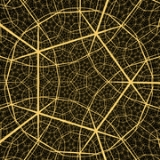
Hyperbolic small dodecahedral honeycomb

Encyclopedia
| Order-4 dodecahedral honeycomb | |
|---|---|
 Perspective projection view within Beltrami-Klein model |
|
| Type | Hyperbolic regular honeycomb |
| Schläfli symbol | {5,3,4} {5,31,1} |
| Coxeter-Dynkin diagram Coxeter-Dynkin diagram In geometry, a Coxeter–Dynkin diagram is a graph with numerically labeled edges representing the spatial relations between a collection of mirrors... |
|
| Cells | dodecahedron {5,3} |
| Faces | pentagon Pentagon In geometry, a pentagon is any five-sided polygon. A pentagon may be simple or self-intersecting. The sum of the internal angles in a simple pentagon is 540°. A pentagram is an example of a self-intersecting pentagon.- Regular pentagons :In a regular pentagon, all sides are equal in length and... {5} |
| Edge figure | square Square (geometry) In geometry, a square is a regular quadrilateral. This means that it has four equal sides and four equal angles... {4} |
| Vertex figure |  octahedron Octahedron In geometry, an octahedron is a polyhedron with eight faces. A regular octahedron is a Platonic solid composed of eight equilateral triangles, four of which meet at each vertex.... |
| Cells/edge | {5,3}4 |
| Cells/vertex | {5,3}8 |
| Euler characteristic Euler characteristic In mathematics, and more specifically in algebraic topology and polyhedral combinatorics, the Euler characteristic is a topological invariant, a number that describes a topological space's shape or structure regardless of the way it is bent... |
0 |
| Dual | Order-5 cubic honeycomb |
| Coxeter group Coxeter group In mathematics, a Coxeter group, named after H.S.M. Coxeter, is an abstract group that admits a formal description in terms of mirror symmetries. Indeed, the finite Coxeter groups are precisely the finite Euclidean reflection groups; the symmetry groups of regular polyhedra are an example... |
3, [5,3,4] 3, [5,31,1] |
| Properties | Regular |
In the geometry
Geometry
Geometry arose as the field of knowledge dealing with spatial relationships. Geometry was one of the two fields of pre-modern mathematics, the other being the study of numbers ....
of hyperbolic 3-space
Hyperbolic space
In mathematics, hyperbolic space is a type of non-Euclidean geometry. Whereas spherical geometry has a constant positive curvature, hyperbolic geometry has a negative curvature: every point in hyperbolic space is a saddle point...
, the order-4 dodecahedral honeycomb is one of four regular space-filling tessellation
Tessellation
A tessellation or tiling of the plane is a pattern of plane figures that fills the plane with no overlaps and no gaps. One may also speak of tessellations of parts of the plane or of other surfaces. Generalizations to higher dimensions are also possible. Tessellations frequently appeared in the art...
(or honeycombs
Honeycomb (geometry)
In geometry, a honeycomb is a space filling or close packing of polyhedral or higher-dimensional cells, so that there are no gaps. It is an example of the more general mathematical tiling or tessellation in any number of dimensions....
). Four dodecahedra exist around each edge, and 8 dodecahedra around each vertex in an octahedral
Octahedron
In geometry, an octahedron is a polyhedron with eight faces. A regular octahedron is a Platonic solid composed of eight equilateral triangles, four of which meet at each vertex....
arrangement. Its vertices are constructed from 3 orthogonal axes. Its dual is the order-5 cubic honeycomb.
The dihedral angle
Dihedral angle
In geometry, a dihedral or torsion angle is the angle between two planes.The dihedral angle of two planes can be seen by looking at the planes "edge on", i.e., along their line of intersection...
of a dodecahedron is ~116.6°, so it is impossible to fit 4 of them on an edge in Euclidean 3-space. However in hyperbolic space a properly scaled dodecahedron can be scaled so that its dihedral angles are reduced to 90 degrees, and then four fit exactly on every edge.
Related polytopes and honeycombs
It is similar to the cubic honeycombCubic honeycomb
The cubic honeycomb is the only regular space-filling tessellation in Euclidean 3-space, made up of cubic cells. It has 4 cubes around every edge, and 8 cubes around each vertex. Its vertex figure is a regular octahedron....
{4,3,4} of Euclidean 3-space. Both have an octahedral
Octahedron
In geometry, an octahedron is a polyhedron with eight faces. A regular octahedron is a Platonic solid composed of eight equilateral triangles, four of which meet at each vertex....
vertex figure
Vertex figure
In geometry a vertex figure is, broadly speaking, the figure exposed when a corner of a polyhedron or polytope is sliced off.-Definitions - theme and variations:...
, replacing the cubic cells by dodecahedra.
There are fifteen uniform honeycombs in the [5,3,4] Coxeter group
Coxeter group
In mathematics, a Coxeter group, named after H.S.M. Coxeter, is an abstract group that admits a formal description in terms of mirror symmetries. Indeed, the finite Coxeter groups are precisely the finite Euclidean reflection groups; the symmetry groups of regular polyhedra are an example...
family, including this regular form.
There are eleven uniform honeycombs in the bifurcating [5,31,1] Coxeter group family, including this honeycomb in its alternated form.
This construction can be represented by alternation (checkerboard) with two colors of dodecahedral cells.
There is another regular honeycomb in hyperbolic 3-space called the order-5 dodecahedral honeycomb which has 5 dodecahedra per edge.
This honeycomb is also related to the 120-cell which has 120 dodecahedra in 4-dimensional space, with 3 dodecahedra on each edge.
See also
- Convex uniform honeycombs in hyperbolic spaceConvex uniform honeycombs in hyperbolic spaceIn geometry, a convex uniform honeycomb is a tessellation of convex uniform polyhedron cells. In 3-dimensional hyperbolic space there are nine Coxeter group families of compact convex uniform honeycombs, generated as Wythoff constructions, and represented by ring permutations of the Coxeter–Dynkin...
- Poincaré homology sphere Poincaré dodecahedral space
- Seifert–Weber space Seifert–Weber dodecahedral space
- List of regular polytopes