
|
|
|
|
Dihedral angle
|
| |
|
| |
- In aerospace engineering, the dihedral is the angle between the two wings; see dihedral.
In geometry, the angle between two planes is called their dihedral or torsion angle.
The dihedral angle of two planes can be seen by looking at the planes "edge on", i.e., along their line of intersection.

Discussion
Ask a question about 'Dihedral angle'
Start a new discussion about 'Dihedral angle'
Answer questions from other users
|
Encyclopedia
- In aerospace engineering, the dihedral is the angle between the two wings; see dihedral.
In geometry, the angle between two planes is called their dihedral or torsion angle.
The dihedral angle of two planes can be seen by looking at the planes "edge on", i.e., along their line of intersection. The dihedral angle between two planes denoted A and B is the angle
between their two normal unit vectors and
A dihedral angle can be signed; for example, the dihedral angle can be defined as the angle through which plane A must be rotated (about their common line of intersection) to align it with plane B.
Thus, . For precision, one should specify the angle or its supplement, since both rotations will cause the planes to coincide.
Alternative definitions
Since a plane can be defined in several ways (e.g., by vectors or points in them, or by their normal vectors), there are several equivalent definitions of a dihedral angle.
Any plane can be defined by two non-collinear vectors lying in that plane; taking their cross product and normalizing yields the normal unit vector to the plane.
Thus, a dihedral angle can be defined by four, pairwise non-collinear vectors.
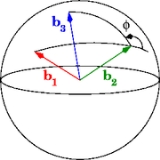
We may also define the dihedral angle of three non-collinear vectors , and (shown in red, green and blue, respectively, in Figure 1). The vectors and define the first plane, whereas and define the second plane. The dihedral angle corresponds to an exterior spherical angle (Figure 1), which is a well-defined, signed quantity.
where the two-argument atan2 takes care of the sign.
Dihedral angles in polyhedra Every polyhedron, regular and irregular, convex and concave, has a dihedral angle at every edge.
A dihedral angle (also called the face angle) is the internal angle at which two adjacent faces meet. An angle of zero degrees means the face normal vectors are antiparallel and the faces overlap each other (Implying part of a degenerate polyhedron). An angle of 180 degrees means the faces are parallel (like a tiling). An angle greater than 180 exists on concave portions of a polyhedron.
Every dihedral angle in an edge-transitive polyhedron has the same value. This includes the 5 Platonic solids, the 4 Kepler-Poinsot solids, the two quasiregular solids, and two quasiregular dual solids.
See Table of polyhedron dihedral angles.
Dihedral angles of four atoms
To a good approximation, the bond lengths and bond angles of most molecules do not change between synthesis and degradation. Hence, the structure of a molecule can be defined with high precision by the dihedral angles between three successive chemical bond vectors (Figure 2). The dihedral angle varies only the distance between the first and fourth atoms; the other interatomic distances are constrained by the chemical bond lengths and bond angles.
To visualize the dihedral angle of four atoms, it's helpful to look down the second bond vector (Figure 3). The first atom is at 6 o'clock, the fourth atom is at roughly 2 o'clock and the second and third atoms are located in the center. The second bond vector is coming out of the page. The dihedral angle is the counterclockwise angle made by the vectors (red) and (blue). When the fourth atom eclipses the first atom, the dihedral angle is zero; when the atoms are exactly opposite (as in Figure 2), the dihedral angle is 180°.
Dihedral angles of biological molecules
The backbone dihedral angles of proteins are called φ (phi, involving the backbone atoms C'-N-Cα-C'), ψ (psi, involving the backbone atoms N-Cα-C'-N) and ω (omega, involving the backbone atoms Cα-C'-N-Cα). Thus, φ controls the C'-C' distance, ψ controls the N-N distance and ω controls the Cα-Cα distance.
The planarity of the peptide bond usually restricts to be 180° (the typical trans case) or 0° (the rare cis case). The distance between the Cα atoms in the trans and cis isomers is approximately 3.8 and 2.9 Å, respectively. The cis isomer is mainly observed in Xaa-Pro peptide bonds (where Xaa is any amino acid).
The sidechain dihedral angles of proteins are denoted as χ1-χ5, depending on the distance up the sidechain. The χ1 dihedral angle is defined by atoms
N-Cα-Cβ-Cγ, the χ2 dihedral angle is defined by atoms
Cα-Cβ-Cγ-Cδ, and so on.
The sidechain dihedral angles tend to cluster near 180°, 60°, and -60°, which are called the trans, gauche+, and gauche- conformations. The choice of sidechain dihedral angles is affected by the neighbouring backbone and sidechain dihedrals; for example, the gauche+ conformation is rarely followed by the gauche+ conformation (and vice versa) because of the increased likelihood of atomic collisions.
Dihedral angles have also been defined by the IUPAC for other molecules, such as the nucleic acids (DNA and RNA) and for polysaccharides.
Pseudocode
The following pseudo-code will compute the dihedral angle of two planes each defined by 3 points, such that plane is defined by the points through , and plane is defined by the points through :
function ComputeDihedralAngle(, )
a random vector
copy_of
for to
return arccos
This code can easily be generalized to operate on hyperplanes in arbitrary-dimensional space by replacing with , where is the number of points that define each hyperplane. All but the last line of this pseudo-code uses the Gram-Schmidt_process to compute and , which are normal vectors to the planes and respectively. The last line computes the angle between and .
See also
External links
gives a step-by-step derivation of these exact values.
|
| |
|
|
