
In
geometryGeometry arose as the field of knowledge dealing with spatial relationships. Geometry was one of the two fields of pre-modern mathematics, the other being the study of numbers ....
, a
dodecahedron (Greek δωδεκάεδρον, from δώδεκα 'twelve' + ἕδρα 'base', 'seat' or 'face') is any
polyhedronIn elementary geometry a polyhedron is a geometric solid in three dimensions with flat faces and straight edges...
with twelve flat faces, but usually a
regular dodecahedron is meant: a
Platonic solidIn geometry, a Platonic solid is a convex polyhedron that is regular, in the sense of a regular polygon. Specifically, the faces of a Platonic solid are congruent regular polygons, with the same number of faces meeting at each vertex; thus, all its edges are congruent, as are its vertices and...
. It is composed of 12 regular
pentagonIn geometry, a pentagon is any five-sided polygon. A pentagon may be simple or self-intersecting. The sum of the internal angles in a simple pentagon is 540°. A pentagram is an example of a self-intersecting pentagon.- Regular pentagons :In a regular pentagon, all sides are equal in length and...
al faces, with three meeting at each vertex, and is represented by the
Schläfli symbol {5,3}. It has 20 vertices and 30 edges. Its
dual polyhedronIn geometry, polyhedra are associated into pairs called duals, where the vertices of one correspond to the faces of the other. The dual of the dual is the original polyhedron. The dual of a polyhedron with equivalent vertices is one with equivalent faces, and of one with equivalent edges is another...
is the
icosahedronIn geometry, an icosahedron is a regular polyhedron with 20 identical equilateral triangular faces, 30 edges and 12 vertices. It is one of the five Platonic solids....
, with Schläfli symbol {3,5}.
A large number of other (nonregular) polyhedra also have 12 sides, but are given other names. Other dodecahedrons include the
hexagonal bipyramidA hexagonal bipyramid is a polyhedron formed from two hexagonal pyramids joined at their bases. The resulting solid has 12 triangular faces, 8 vertices and 18 edges. The 12 faces are identical isosceles triangles.It is one of an infinite set of bipyramids...
and the
rhombic dodecahedronIn geometry, the rhombic dodecahedron is a convex polyhedron with 12 rhombic faces. It is an Archimedean dual solid, or a Catalan solid. Its dual is the cuboctahedron.-Properties:...
.
Dimensions
If the edge length of a regular dodecahedron is
a, the
radiusIn classical geometry, a radius of a circle or sphere is any line segment from its center to its perimeter. By extension, the radius of a circle or sphere is the length of any such segment, which is half the diameter. If the object does not have an obvious center, the term may refer to its...
of a circumscribed
sphereA sphere is a perfectly round geometrical object in three-dimensional space, such as the shape of a round ball. Like a circle in two dimensions, a perfect sphere is completely symmetrical around its center, with all points on the surface lying the same distance r from the center point...
(one that touches the dodecahedron at all vertices) is
-

and the radius of an inscribed sphere (
tangentIn geometry, the tangent line to a plane curve at a given point is the straight line that "just touches" the curve at that point. More precisely, a straight line is said to be a tangent of a curve at a point on the curve if the line passes through the point on the curve and has slope where f...
to each of the dodecahedron's faces) is
-

while the midradius, which touches the middle of each edge, is
-

These quantities may also be expressed as
-

-

-

where

is the
golden ratioIn mathematics and the arts, two quantities are in the golden ratio if the ratio of the sum of the quantities to the larger quantity is equal to the ratio of the larger quantity to the smaller one. The golden ratio is an irrational mathematical constant, approximately 1.61803398874989...
.
Note that, given a regular pentagonal dodecahedron of edge length one,

is the radius of a circumscribing sphere about a
cubeIn geometry, a cube is a three-dimensional solid object bounded by six square faces, facets or sides, with three meeting at each vertex. The cube can also be called a regular hexahedron and is one of the five Platonic solids. It is a special kind of square prism, of rectangular parallelepiped and...
of edge length

, and

is the
apothemThe apothem of a regular polygon is a line segment from the center to the midpoint of one of its sides. Equivalently, it is the line drawn from the center of the polygon that is perpendicular to one of its sides. The word "apothem" can also refer to the length of that line segment. Regular polygons...
of a regular pentagon of edge length

.
Area and volume
The surface area
A and the
volumeVolume is the quantity of three-dimensional space enclosed by some closed boundary, for example, the space that a substance or shape occupies or contains....
V of a regular dodecahedron of edge length
a are:
Cartesian coordinates
The following Cartesian coordinates define the vertices of a dodecahedron centered at the origin:
- (±1, ±1, ±1)
- (0, ±1/φ, ±φ)
- (±1/φ, ±φ, 0)
- (±φ, 0, ±1/φ)
where φ = (1+√5)/2 is the
golden ratioIn mathematics and the arts, two quantities are in the golden ratio if the ratio of the sum of the quantities to the larger quantity is equal to the ratio of the larger quantity to the smaller one. The golden ratio is an irrational mathematical constant, approximately 1.61803398874989...
(also written τ) = ~1.618. The edge length is 2/φ = √5–1. The containing sphere has a radius of √3.
Properties
- The dihedral angle
In geometry, a dihedral or torsion angle is the angle between two planes.The dihedral angle of two planes can be seen by looking at the planes "edge on", i.e., along their line of intersection...
of a dodecahedron is 2 arctan(φ) or approximately 116.5650512 degrees.
- If the original dodecahedron has edge length 1, its dual icosahedron
In geometry, an icosahedron is a regular polyhedron with 20 identical equilateral triangular faces, 30 edges and 12 vertices. It is one of the five Platonic solids....
has edge length
, the golden ratioIn mathematics and the arts, two quantities are in the golden ratio if the ratio of the sum of the quantities to the larger quantity is equal to the ratio of the larger quantity to the smaller one. The golden ratio is an irrational mathematical constant, approximately 1.61803398874989...
.
- If we build the five Platonic solids with same volume, the dodecahedron has the shortest edges.
- It has 43,380 nets
In geometry the net of a polyhedron is an arrangement of edge-joined polygons in the plane which can be folded to become the faces of the polyhedron...
.
- The map-coloring number of a regular dodecahedron's faces is 4.
- The distance between the vertices on the same face not connected by an edge is φ.
Geometric relations
The
regular dodecahedron is the third in an infinite set of
truncated trapezohedraAn n-agonal truncated trapezohedron is a polyhedron formed by a n-agonal trapezohedron with n-agonal pyramids truncated from its two polar axis vertices....
which can be constructed by truncating the two axial vertices of a
pentagonal trapezohedronThe pentagonal trapezohedron or deltohedron is the third in an infinite series of face-transitive polyhedra which are dual polyhedra to the antiprisms. It has ten faces which are congruent kites....
.
The
stellationStellation is a process of constructing new polygons , new polyhedra in three dimensions, or, in general, new polytopes in n dimensions. The process consists of extending elements such as edges or face planes, usually in a symmetrical way, until they meet each other again...
s of the dodecahedron make up three of the four Kepler-Poinsot polyhedra.
A
rectifiedIn Euclidean geometry, rectification is the process of truncating a polytope by marking the midpoints of all its edges, and cutting off its vertices at those points...
dodecahedron forms an
icosidodecahedronIn geometry, an icosidodecahedron is a polyhedron with twenty triangular faces and twelve pentagonal faces. An icosidodecahedron has 30 identical vertices, with two triangles and two pentagons meeting at each, and 60 identical edges, each separating a triangle from a pentagon...
.
The regular dodecahedron has 120 symmetries, forming the group

.
Icosahedron vs dodecahedron
When a dodecahedron is inscribed in a
sphereA sphere is a perfectly round geometrical object in three-dimensional space, such as the shape of a round ball. Like a circle in two dimensions, a perfect sphere is completely symmetrical around its center, with all points on the surface lying the same distance r from the center point...
, it occupies more of the sphere's volume (66.49%) than an icosahedron inscribed in the same sphere (60.54%).
A regular dodecahedron with edge length 1 has more than three and a half times the volume of an icosahedron with the same length edges (7.663... compared with 2.181...).
A Regular Dodecahedron has fewer faces than the icosahedron, but more vertices.
Related polyhedra
The dodecahedron can be transformed by a
truncationIn geometry, a truncation is an operation in any dimension that cuts polytope vertices, creating a new facet in place of each vertex.- Uniform truncation :...
sequence into its
dualIn geometry, polyhedra are associated into pairs called duals, where the vertices of one correspond to the faces of the other. The dual of the dual is the original polyhedron. The dual of a polyhedron with equivalent vertices is one with equivalent faces, and of one with equivalent edges is another...
, the icosahedron:
| Picture |
 Dodecahedron |
 Truncated dodecahedronIn geometry, the truncated dodecahedron is an Archimedean solid. It has 12 regular decagonal faces, 20 regular triangular faces, 60 vertices and 90 edges.- Geometric relations :...
|
 IcosidodecahedronIn geometry, an icosidodecahedron is a polyhedron with twenty triangular faces and twelve pentagonal faces. An icosidodecahedron has 30 identical vertices, with two triangles and two pentagons meeting at each, and 60 identical edges, each separating a triangle from a pentagon...
|
 Truncated icosahedronIn geometry, the truncated icosahedron is an Archimedean solid, one of thirteen convex isogonal nonprismatic solids whose faces are two or more types of regular polygons.It has 12 regular pentagonal faces, 20 regular hexagonal faces, 60 vertices and 90 edges....
|
 IcosahedronIn geometry, an icosahedron is a regular polyhedron with 20 identical equilateral triangular faces, 30 edges and 12 vertices. It is one of the five Platonic solids....
|
| Coxeter-Dynkin In geometry, a Coxeter–Dynkin diagram is a graph with numerically labeled edges representing the spatial relations between a collection of mirrors...
|
|
|
|
|
|
The regular dodecahedron is a member of a sequence of otherwise non-uniform polyhedra and tilings, composed of pentagons with
face configurationIn geometry, a face configuration is notational description of a face-transitive polyhedron. It represents a sequential count of the number of faces that exist at each vertex around a face....
s (V3.3.3.3.n). (For
n>6, the sequence consists of tilings of the hyperbolic plane.) These face-transitive figures have (n32) rotational symmetry.
 V3.3.3.3.3 (332) and (532) |
 V3.3.3.3.4In geometry, a pentagonal icositetrahedron is a Catalan solid which is the dual of the snub cube. It has two distinct forms, which are mirror images of each other....
(432) |
 V3.3.3.3.5In geometry, a pentagonal hexecontahedron is a Catalan solid, dual of the snub dodecahedron. It has two distinct forms, which are mirror images of each other. It is also well-known to be the Catalan Solid with the most vertices...
(532) |
 V3.3.3.3.6In geometry, the floret pentagonal tiling is a dual semiregular tiling of the Euclidean plane. It is one of 14 known isohedral pentagon tilings. It is given its name because its six pentagonal tiles radiate out from a central point, like petals on a flower...
(632) |
 V3.3.3.3.7 (732) |
Vertex arrangement
The dodecahedron shares its
vertex arrangementIn geometry, a vertex arrangement is a set of points in space described by their relative positions. They can be described by their use in polytopes....
with four
nonconvex uniform polyhedraIn geometry, a uniform star polyhedron is a self-intersecting uniform polyhedron. They are also sometimes called nonconvex polyhedra to imply self-intersecting...
and three
uniform polyhedron compoundA uniform polyhedron compound is a polyhedral compound whose constituents are identical uniform polyhedra, in an arrangement that is also uniform: the symmetry group of the compound acts transitively on the compound's vertices.The uniform polyhedron compounds were first enumerated by John Skilling...
s.
Five
cubeIn geometry, a cube is a three-dimensional solid object bounded by six square faces, facets or sides, with three meeting at each vertex. The cube can also be called a regular hexahedron and is one of the five Platonic solids. It is a special kind of square prism, of rectangular parallelepiped and...
s fit within, with their edges as diagonals of the dodecahedron's faces, and together these make up the regular
polyhedral compoundA polyhedral compound is a polyhedron that is itself composed of several other polyhedra sharing a common centre. They are the three-dimensional analogs of polygonal compounds such as the hexagram....
of five cubes. Since two tetrahedra can fit on alternate cube vertices, five and ten tetrahedra can also fit in a dodecahedron.
 Great stellated dodecahedron |
 Small ditrigonal icosidodecahedronIn geometry, the small ditrigonal icosidodecahedron is a nonconvex uniform polyhedron, indexed as U30.-Related polyhedra:Its convex hull is a regular dodecahedron...
|
 Ditrigonal dodecadodecahedronIn geometry, the Ditrigonal dodecadodecahedron is a nonconvex uniform polyhedron, indexed as U41.- Related polyhedra :Its convex hull is a regular dodecahedron...
|
 Great ditrigonal icosidodecahedron |
 Compound of five cubesThis polyhedral compound is a symmetric arrangement of five cubes. This compound was first described by Edmund Hess in 1876.It is one of five regular compounds, and dual to the compound of five octahedra....
|
 Compound of five tetrahedraThis compound polyhedron is also a stellation of the regular icosahedron. It was first described by Edmund Hess in 1876.-As a compound:It can be constructed by arranging five tetrahedra in rotational icosahedral symmetry , as colored in the upper right model...
|
 Compound of ten tetrahedraThis polyhedron can be seen as either a polyhedral stellation or a compound. This compound was first described by Edmund Hess in 1876.- As a compound :It can also be seen as the compound of ten tetrahedra with full icosahedral symmetry...
|
Stellations
The 3
stellationStellation is a process of constructing new polygons , new polyhedra in three dimensions, or, in general, new polytopes in n dimensions. The process consists of extending elements such as edges or face planes, usually in a symmetrical way, until they meet each other again...
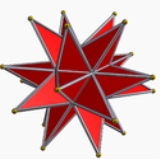
s of the dodecahedron are all regular (nonconvex) polyhedra: (Kepler-Poinsot polyhedra)
Other dodecahedra
Topologically identical irregular dodecahedra
 The truncated pentagonal trapezohedronAn n-agonal truncated trapezohedron is a polyhedron formed by a n-agonal trapezohedron with n-agonal pyramids truncated from its two polar axis vertices.... has d5d dihedral symmetry. |
 The pyritohedronIn geometry, a pyritohedron is an irregular dodecahedron with pyritohedral symmetry. Like the regular dodecahedron, it has twelve identical pentagonal faces, with three meeting in each of the 20 vertices. However, the pentagons are not regular, and the structure has no fivefold symmetry axes... has th tetrahedral symmetry150px|right|thumb|A regular [[tetrahedron]], an example of a solid with full tetrahedral symmetryA regular tetrahedron has 12 rotational symmetries, and a symmetry order of 24 including transformations that combine a reflection and a rotation.The group of all symmetries is isomorphic to the group... . |
The term dodecahedron is also used for other polyhedra with twelve faces, most notably the
rhombic dodecahedronIn geometry, the rhombic dodecahedron is a convex polyhedron with 12 rhombic faces. It is an Archimedean dual solid, or a Catalan solid. Its dual is the cuboctahedron.-Properties:...
which is dual to the
cuboctahedronIn geometry, a cuboctahedron is a polyhedron with eight triangular faces and six square faces. A cuboctahedron has 12 identical vertices, with two triangles and two squares meeting at each, and 24 identical edges, each separating a triangle from a square. As such it is a quasiregular polyhedron,...
(an
Archimedean solidIn geometry an Archimedean solid is a highly symmetric, semi-regular convex polyhedron composed of two or more types of regular polygons meeting in identical vertices...
) and occurs in nature as a crystal form. The
Platonic solidIn geometry, a Platonic solid is a convex polyhedron that is regular, in the sense of a regular polygon. Specifically, the faces of a Platonic solid are congruent regular polygons, with the same number of faces meeting at each vertex; thus, all its edges are congruent, as are its vertices and...
dodecahedron can be called a
pentagonal dodecahedron or a
regular dodecahedron to distinguish it. The
pyritohedronIn geometry, a pyritohedron is an irregular dodecahedron with pyritohedral symmetry. Like the regular dodecahedron, it has twelve identical pentagonal faces, with three meeting in each of the 20 vertices. However, the pentagons are not regular, and the structure has no fivefold symmetry axes...
is an irregular pentagonal dodecahedron.
Other topologically distinct dodecahedra include:
- Uniform polyhedra:
- Pentagonal antiprism
In geometry, the pentagonal antiprism is the third in an infinite set of antiprisms formed by an even-numbered sequence of triangle sides closed by two polygon caps. It consists of two pentagons joined to each other by a ring of 10 triangles for a total of 12 faces...
– 10 equilateral triangles, 2 pentagons
- Decagonal prism
In geometry, the decagonal prism is the eighth in an infinite set of prisms, formed by ten square side faces and two regular decagon caps. With twelve faces, it is one of many nonregular dodecahedra.If faces are all regular, it is a semiregular polyhedron....
– 10 squares, 2 decagons
- Johnson solid
In geometry, a Johnson solid is a strictly convex polyhedron, each face of which is a regular polygon, but which is not uniform, i.e., not a Platonic solid, Archimedean solid, prism or antiprism. There is no requirement that each face must be the same polygon, or that the same polygons join around...
s (regular faced):
- Pentagonal cupola
In geometry, the pentagonal cupola is one of the Johnson solids . It can be obtained as a slice of the rhombicosidodecahedron.The 92 Johnson solids were named and described by Norman Johnson in 1966....
– 5 triangles, 5 squares, 1 pentagon, 1 decagon
- Snub disphenoid
In geometry, the snub disphenoid is one of the Johnson solids . It is a three-dimensional solid that has only equilateral triangles as faces, and is therefore a deltahedron. It is not a regular polyhedron because some vertices have four faces and others have five...
– 12 triangles
- Elongated square dipyramid
In geometry, the elongated square bipyramid is one of the Johnson solids . As the name suggests, it can be constructed by elongating an octahedron by inserting a cube between its congruent halves....
– 8 triangles and 4 squares
- Metabidiminished icosahedron
In geometry, the metabidiminished icosahedron is one of the Johnson solids . The name refers to one way of constructing it, by removing two pentagonal pyramids from a regular icosahedron, replacing two sets of five triangular faces of the icosahedron with two adjacent pentagonal faces...
– 10 triangles and 2 pentagons
- Congruent nonregular faced: (face-transitive)
- Hexagonal bipyramid
A hexagonal bipyramid is a polyhedron formed from two hexagonal pyramids joined at their bases. The resulting solid has 12 triangular faces, 8 vertices and 18 edges. The 12 faces are identical isosceles triangles.It is one of an infinite set of bipyramids...
– 12 isosceles triangleA triangle is one of the basic shapes of geometry: a polygon with three corners or vertices and three sides or edges which are line segments. A triangle with vertices A, B, and C is denoted ....
s, dual of hexagonal prismIn geometry, the hexagonal prism is a prism with hexagonal base. The shape has 8 faces, 18 edges, and 12 vertices.Since it has eight faces, it is an octahedron. However, the term octahedron is primarily used to refer to the regular octahedron, which has eight triangular faces...
- Hexagonal trapezohedron
The hexagonal trapezohedron or deltohedron is the fourth in an infinite series of face-uniform polyhedra which are dual polyhedron to the antiprisms. It has twelve faces which are congruent kites.- External links :* The Encyclopedia of Polyhedra...
– 12 kitesIn Euclidean geometry a kite is a quadrilateral whose four sides can be grouped into two pairs of equal-length sides that are next to each other. In contrast, a parallelogram also has two pairs of equal-length sides, but they are opposite each other rather than next to each other...
, dual of hexagonal antiprismIn geometry, the hexagonal antiprism is the 4th in an infinite set of antiprisms formed by an even-numbered sequence of triangle sides closed by two polygon caps.If faces are all regular, it is a semiregular polyhedron.- See also :* Set of antiprisms...
- Triakis tetrahedron
In geometry, a triakis tetrahedron is an Archimedean dual solid, or a Catalan solid. Its dual is the truncated tetrahedron.It can be seen as a tetrahedron with triangular pyramids added to each face; that is, it is the Kleetope of the tetrahedron...
– 12 isosceles triangles, dual of truncated tetrahedronIn geometry, the truncated tetrahedron is an Archimedean solid. It has 4 regular hexagonal faces, 4 regular triangular faces, 12 vertices and 18 edges.- Area and volume :...
- Rhombic dodecahedron
In geometry, the rhombic dodecahedron is a convex polyhedron with 12 rhombic faces. It is an Archimedean dual solid, or a Catalan solid. Its dual is the cuboctahedron.-Properties:...
(mentioned above) – 12 rhombiIn Euclidean geometry, a rhombus or rhomb is a convex quadrilateral whose four sides all have the same length. The rhombus is often called a diamond, after the diamonds suit in playing cards, or a lozenge, though the latter sometimes refers specifically to a rhombus with a 45° angle.Every...
, dual of cuboctahedron
- Other nonregular faced:
- Hendecagon
In geometry, a hendecagon is an 11-sided polygon....
al pyramidIn geometry, a pyramid is a polyhedron formed by connecting a polygonal base and a point, called the apex. Each base edge and apex form a triangle. It is a conic solid with polygonal base....
– 11 isosceles triangles and 1 hendecagonIn geometry a polygon is a flat shape consisting of straight lines that are joined to form a closed chain orcircuit.A polygon is traditionally a plane figure that is bounded by a closed path, composed of a finite sequence of straight line segments...
- Trapezo-rhombic dodecahedron
The trapezo-rhombic dodecahedron is a convex polyhedron with 6 rhombic and 6 trapezoidal faces.This shape could be constructed by taking a tall uniform hexagonal prism, and making 3 angled cuts on the top and bottom...
– 6 rhombi, 6 trapezoidIn Euclidean geometry, a convex quadrilateral with one pair of parallel sides is referred to as a trapezoid in American English and as a trapezium in English outside North America. A trapezoid with vertices ABCD is denoted...
s – dual of Triangular orthobicupolaIn geometry, the triangular orthobicupola is one of the Johnson solids . As the name suggests, it can be constructed by attaching two triangular cupolas along their bases...
- Rhombo-hexagonal dodecahedron
The rhombo-hexagonal dodecahedron is a convex polyhedron with 8 rhombic and 4 equilateral hexagonal faces.It is also called an elongated dodecahedron and extended rhombic dodecahedron because it is related to the rhombic dodecahedron by expanding four rhombic faces of the rhombic dodecahedron into...
or Elongated Dodecahedron – 8 rhombi and 4 equilateral hexagons.
In all there are 6,384,634 topologically distinct dodecahedra.
History and uses
Dodecahedral objects have found some practical applications, and have also played a role in the visual arts and in philosophy.
PlatoPlato , was a Classical Greek philosopher, mathematician, student of Socrates, writer of philosophical dialogues, and founder of the Academy in Athens, the first institution of higher learning in the Western world. Along with his mentor, Socrates, and his student, Aristotle, Plato helped to lay the...
's dialogue
TimaeusTimaeus is one of Plato's dialogues, mostly in the form of a long monologue given by the title character, written circa 360 BC. The work puts forward speculation on the nature of the physical world and human beings. It is followed by the dialogue Critias.Speakers of the dialogue are Socrates,...
(c. 360 B.C.) associates the other four
platonic solidIn geometry, a Platonic solid is a convex polyhedron that is regular, in the sense of a regular polygon. Specifically, the faces of a Platonic solid are congruent regular polygons, with the same number of faces meeting at each vertex; thus, all its edges are congruent, as are its vertices and...
s with the four
classical elementMany philosophies and worldviews have a set of classical elements believed to reflect the simplest essential parts and principles of which anything consists or upon which the constitution and fundamental powers of anything are based. Most frequently, classical elements refer to ancient beliefs...
s, adding that "there is a fifth figure (which is made out of twelve pentagons), the dodecahedron—this God used as a model for the twelvefold division of the Zodiac."
AristotleAristotle was a Greek philosopher and polymath, a student of Plato and teacher of Alexander the Great. His writings cover many subjects, including physics, metaphysics, poetry, theater, music, logic, rhetoric, linguistics, politics, government, ethics, biology, and zoology...
postulated that the heavens were made of a fifth element,
aithêrAccording to ancient and medieval science aether , also spelled æther or ether, is the material that fills the region of the universe above the terrestrial sphere.-Mythological origins:...
(
aether in Latin,
ether in American English), but he had no interest in matching it with Plato's fifth solid.
A few centuries later, small, hollow bronze Roman dodecahedra were made and have been found in various Roman ruins in Europe. Their purpose is not certain.
In twentieth century art, dodecahedra appear in the work of
M. C. EscherMaurits Cornelis Escher , usually referred to as M. C. Escher , was a Dutch graphic artist. He is known for his often mathematically inspired woodcuts, lithographs, and mezzotints...
, such as his lithograph
ReptilesReptiles is a lithograph print by the Dutch artist M. C. Escher which was first printed in March, 1943.It depicts a desk on which is a drawing of a tessellated pattern of reptiles. The reptiles come to life and crawl around the desk and over the objects on it to eventually re-enter the drawing...
(1943), and in his
GravitationGravitation is a mixed media work by the Dutch artist M. C. Escher which was completed in June, 1952. It was first printed as a black-and-white lithograph and then coloured by hand in watercolour....
. In
Salvador DalíSalvador Domènec Felip Jacint Dalí i Domènech, Marquis de Púbol , commonly known as Salvador Dalí , was a prominent Spanish Catalan surrealist painter born in Figueres,Spain....
's painting
The Sacrament of the Last SupperCompleted in 1955 after nine months of work, Salvador Dalí’s painting The Sacrament of the Last Supper has remained one of his most popular compositions. Since its arrival at the National Gallery of Art in Washington, D.C...
(1955), the room is a hollow dodecahedron.
In modern role-playing games, the dodecahedron is often used as a twelve-sided die, one of the more common polyhedral dice. Some quasicrystals have dodecahedral shape (see figure). Some regular crystals such as
garnetThe garnet group includes a group of minerals that have been used since the Bronze Age as gemstones and abrasives. The name "garnet" may come from either the Middle English word gernet meaning 'dark red', or the Latin granatus , possibly a reference to the Punica granatum , a plant with red seeds...
and
diamondIn mineralogy, diamond is an allotrope of carbon, where the carbon atoms are arranged in a variation of the face-centered cubic crystal structure called a diamond lattice. Diamond is less stable than graphite, but the conversion rate from diamond to graphite is negligible at ambient conditions...
are also said to exhibit "dodecahedral"
habitCrystal habit is an overall description of the visible external shape of a mineral. This description can apply to an individual crystal or an assembly of crystals or aggregates....
, but this statement actually refers to the
rhombic dodecahedronIn geometry, the rhombic dodecahedron is a convex polyhedron with 12 rhombic faces. It is an Archimedean dual solid, or a Catalan solid. Its dual is the cuboctahedron.-Properties:...
shape.
The popular puzzle game
MegaminxThe Megaminx is a dodecahedron-shaped puzzle similar to the Rubik's Cube. It has a total of 50 movable pieces to rearrange, compared to the 20 movable pieces of the Rubik's cube.- History :...
is in the shape of a dodecahedron.
In the children's novel
The Phantom TollboothThe Phantom Tollbooth is a children's adventure novel and modern fairy tale published in 1961, written by Norton Juster and illustrated by Jules Feiffer. It tells the story of a bored young boy named Milo who unexpectedly receives a magic tollbooth one afternoon and, having nothing better to do,...
, the Dodecahedron appears as a character in the land of Mathematics. Each of his faces wears a different expression –
e.g. happy, angry, sad – which he swivels to the front as required to match his mood.
Shape of the Universe
Various models have been proposed for the global geometry of the universe. In addition to the primitive geometries, these proposals include the Poincaré dodecahedral space, a positively curved space consisting of a dodecahedron whose opposite faces correspond (with a small twist). This was proposed by
Jean-Pierre LuminetJean-Pierre Luminet is a French astrophysicist, specialized in black holes and cosmology. He works as research director for the CNRS , and is a member of the Laboratoire Univers et Théories of the observatory of Paris-Meudon.The asteroid 5523 Luminet, was named after him .-Timeline:* 2003 - An...
and colleagues in 2003 and an optimal orientation on the sky for the model was estimated in 2008.
As a graph
The skeleton of the dodecahedron – the vertices and edges – form a
graphIn mathematics, a graph is an abstract representation of a set of objects where some pairs of the objects are connected by links. The interconnected objects are represented by mathematical abstractions called vertices, and the links that connect some pairs of vertices are called edges...
. The high degree of symmetry of the polygon is replicated in the properties of this graph, which is
distance-transitiveIn the mathematical field of graph theory, a distance-transitive graph is a graph such that, given any two vertices v and w at any distance i, and any other two vertices x and y at the same distance, there is an automorphism of the graph that carries v to x and w to y.A distance transitive...
,
distance-regularIn mathematics, a distance-regular graph is a regular graph such that for any two vertices v and w at distance i the number of vertices adjacent to w and at distance j from v is the same. Every distance-transitive graph is distance-regular...
, and
symmetricIn the mathematical field of graph theory, a graph G is symmetric if, given any two pairs of adjacent vertices u1—v1 and u2—v2 of G, there is an automorphismsuch that...
. The
automorphism groupIn the mathematical field of graph theory, an automorphism of a graph is a form of symmetry in which the graph is mapped onto itself while preserving the edge–vertex connectivity....
has order 120. The vertices can be
coloredIn graph theory, graph coloring is a special case of graph labeling; it is an assignment of labels traditionally called "colors" to elements of a graph subject to certain constraints. In its simplest form, it is a way of coloring the vertices of a graph such that no two adjacent vertices share the...
with 3 colors, as can the edges, and the diameter is 5.
The dodecahedral graph is Hamiltonian – there is a cycle containing all the vertices. Indeed, this name derives from a
mathematical gameA mathematical game is a multiplayer game whose rules, strategies, and outcomes can be studied and explained by mathematics. Examples of such games are Tic-tac-toe and Dots and Boxes, to name a couple. On the surface, a game need not seem mathematical or complicated to still be a mathematical game...
invented in 1857 by
William Rowan HamiltonSir William Rowan Hamilton was an Irish physicist, astronomer, and mathematician, who made important contributions to classical mechanics, optics, and algebra. His studies of mechanical and optical systems led him to discover new mathematical concepts and techniques...
, the
icosian gameThe icosian game is a mathematical game invented in 1857 by William Rowan Hamilton. The game's object is finding a Hamiltonian cycle along the edges of a dodecahedron such that every vertex is visited a single time, no edge is visited twice, and the ending point is the same as the starting point...
. The game's object was to find a Hamiltonian cycle along the edges of a dodecahedron.
See also
- Spinning dodecahedron
- Truncated dodecahedron
In geometry, the truncated dodecahedron is an Archimedean solid. It has 12 regular decagonal faces, 20 regular triangular faces, 60 vertices and 90 edges.- Geometric relations :...
- Snub dodecahedron
In geometry, the snub dodecahedron, or snub icosidodecahedron, is an Archimedean solid, one of thirteen convex isogonal nonprismatic solids constructed by two or more types of regular polygon faces....
- Pentakis dodecahedron
In geometry, a pentakis dodecahedron is a Catalan solid. Its dual is the truncated icosahedron, an Archimedean solid.It can be seen as a dodecahedron with a pentagonal pyramid covering each face; that is, it is the Kleetope of the dodecahedron...
- 120-cell: a regular polychoron
In mathematics, a convex regular 4-polytope is a 4-dimensional polytope that is both regular and convex. These are the four-dimensional analogs of the Platonic solids and the regular polygons ....
(4D polytope) whose surface consists of 120 dodecahedral cells.
External links