


Hunayn ibn Ishaq

Encyclopedia
Hunayn ibn Ishaq (809–873) was a famous and influential Assyrian
Nestorian Christian scholar, physician, and scientist, known for his work in translating Greek scientific and medical works into Arabic and Syriac during the heyday of the Islamic Abbasid Caliphate.
Ḥunayn ibn Isḥaq was the most productive translator of Greek medical and scientific treatises in his day. He studied Greek and became known among the Arabs as the "Sheikh of the translators." He mastered four languages: Arabic, Syriac, Greek and Persian. His translations did not require corrections. Hunayn’s method was widely followed by later translators. He was originally from southern Iraq but he spent his working life in Baghdad, the center of the great ninth-century Greek-into-Arabic/Syriac translation movement.
. In his lifetime, Ishaq translated 116 works, including Plato’s Timaeus
, Aristotle’s Metaphysics
, and the Old Testament
, into Syriac and Arabic. Ishaq also produced 36 of his own books, 21 of which covered the field of medicine. His son Ishaq, and his nephew Hubaysh, worked together with him at times to help translate. Hunayn ibn Ishaq is known for his translations, his method of translation, and his contributions to medicine.
Hunayn was extremely motivated in his work to master Greek studies, which enabled him to translate Greek texts into Syriac and Arabic. The Abbasid Caliph al-Mamun noticed Hunayn's talents and placed him in charge of the House of Wisdom
, “Bayt al Hikmah.” The House of Wisdom was an institution where Greek works were translated and made available to scholars. The caliph also gave Hunayn the opportunity to travel to Byzantium in search of additional manuscripts, such as those of Aristotle and other prominent authors.
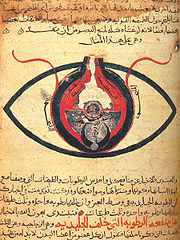 Hunayn ibn Ishaq enriched the field of ophthalmology. His developments in the study of the human eye can be traced through his innovative book, “Ten Treatises on Ophthalmology.” This textbook is the first known systematic treatment of this field and was most likely used in medical schools at the time. Throughout the book, Hunayn explains the eye and its anatomy in minute detail; its diseases, their symptoms, their treatments. He discusses the nature of cysts and tumors, and the swelling they cause. He discusses how to treat various corneal ulcers through surgery, and the therapy involved in repairing cataracts. “Ten Treatises on Ophthalmology” demonstrates the skills Hunayn ibn Ishaq had not just as a translator and a physician, but also as a surgeon.
, led the caliph to name Hunayn as his personal physician, ending the exclusive use of physicians from the Bukhtishu family. Despite their relationship, the caliph became distrustful; at the time, there were fears of death from poisoning, and physicians were well aware of its synthesis procedure. The caliph tested Hunayn’s ethics as a physician by asking him to formulate a poison, to be used against a foe, in exchange for a large sum. Hunayn ibn Ishaq repeatedly rejected the Caliph’s generous offers, saying he would need time to develop a poison. Disappointed, the caliph imprisoned his physician for a year. When asked why he would rather be killed than make the drug, Hunayn explained the physician's oath
required him to help, and not harm, his patients.
Hunayn translated writings on agriculture, stones, and religion. He translated some of Plato's and Aristotle’s works, and the commentaries of ancient Greeks. Additionally, Hunayn translated many medicinal texts and summaries, mainly those of Galen. He translated a countless number of Galen’s works including “On Sects” and “On Anatomy of the Veins and Arteries.”
Many published works of R. Duval in Chemistry represent translations of Hunayn's work. Also in Chemistry a book titled ['An Al-Asma'] meaning "About the Names", did not reach researchers but was used in "Dictionary of Ibn Bahlool" of the 10th century.
Unlike other translators in the Abbasid period, Hunayn opposed translating texts word for word. Instead, he would attempt to attain the meaning of the subject and the sentences, and then in a new manuscript, rewrite the piece of knowledge in Syriac or Arabic. He also corrected texts by collecting different set of books revolving around a subject and by finalizing the meaning of the subject. The method helped gather, in just 100 years, nearly all the knowledge from Greek medicine.
Assyrian people
The Assyrian people are a distinct ethnic group whose origins lie in ancient Mesopotamia...
Nestorian Christian scholar, physician, and scientist, known for his work in translating Greek scientific and medical works into Arabic and Syriac during the heyday of the Islamic Abbasid Caliphate.
Ḥunayn ibn Isḥaq was the most productive translator of Greek medical and scientific treatises in his day. He studied Greek and became known among the Arabs as the "Sheikh of the translators." He mastered four languages: Arabic, Syriac, Greek and Persian. His translations did not require corrections. Hunayn’s method was widely followed by later translators. He was originally from southern Iraq but he spent his working life in Baghdad, the center of the great ninth-century Greek-into-Arabic/Syriac translation movement.
Overview
In the Abbasid era, a new interest in extending the study of Greek science had arisen. At that time, there was a vast amount of untranslated ancient Greek literature pertaining to philosophy, mathematics, natural science, and medicine. This valuable information was only accessible to a very small minority of Middle Eastern scholars who knew the Greek language; the need for an organized translation movement was urgent. In time, Hunayn ibn Ishaq became arguably the chief translator of the era, and laid the foundations of Islamic medicineIslamic medicine
In the history of medicine, Islamic medicine, Arabic medicine or Arabian medicine refers to medicine developed in the Islamic Golden Age, and written in Arabic, the lingua franca of Islamic civilization....
. In his lifetime, Ishaq translated 116 works, including Plato’s Timaeus
Timaeus
Timaeus is a Greek name, meaning "Honour". It may refer to:*Timaeus , a Socratic dialogue by Plato*Timaeus of Locri, the 5th-century Pythagorean philosopher, appearing in Plato's dialogue...
, Aristotle’s Metaphysics
Metaphysics (Aristotle)
Metaphysics is one of the principal works of Aristotle and the first major work of the branch of philosophy with the same name. The principal subject is "being qua being", or being understood as being. It examines what can be asserted about anything that exists just because of its existence and...
, and the Old Testament
Old Testament
The Old Testament, of which Christians hold different views, is a Christian term for the religious writings of ancient Israel held sacred and inspired by Christians which overlaps with the 24-book canon of the Masoretic Text of Judaism...
, into Syriac and Arabic. Ishaq also produced 36 of his own books, 21 of which covered the field of medicine. His son Ishaq, and his nephew Hubaysh, worked together with him at times to help translate. Hunayn ibn Ishaq is known for his translations, his method of translation, and his contributions to medicine.
Early life
Hunayn ibn Ishaq was a Nestorian Christian born in 809, during the Abbasid period, in al-Hira, Iraq. As a child, he learned the Syriac and Arabic languages. Although al-Hira was known for commerce and banking, and his father was a pharmacist, Hunayn went to Baghdad in order to study medicine. In Baghdad, Hunayn had the privilege to study under renowned physician Yuhanna ibn Masawayh; however, Hunayn’s countless questions irritated Yuhanna, causing him to scold Hunayn and forcing him to leave. Hunayn promised himself to return to Baghdad when he became a physician. He went abroad to master the Greek language. On his return to Baghdad, Hunayn displayed his newly acquired skills by reciting the works of Homer and Galen. In awe, ibn Masawayh reconciled with Hunayn, and the two started to work cooperatively.Hunayn was extremely motivated in his work to master Greek studies, which enabled him to translate Greek texts into Syriac and Arabic. The Abbasid Caliph al-Mamun noticed Hunayn's talents and placed him in charge of the House of Wisdom
House of Wisdom
The House of Wisdom was a library and translation institute established in Abbassid-era Baghdad, Iraq. It was a key institution in the Translation Movement and considered to have been a major intellectual centre during the Islamic Golden Age...
, “Bayt al Hikmah.” The House of Wisdom was an institution where Greek works were translated and made available to scholars. The caliph also gave Hunayn the opportunity to travel to Byzantium in search of additional manuscripts, such as those of Aristotle and other prominent authors.
Accomplishments
In Hunayn ibn Ishaq’s lifetime, he devoted himself to working on a multitude of writings; both translations and original works.As a writer of original work
Hunayn wrote on a variety of subjects that included philosophy, religion and medicine. In “How to Grasp Religion,” Hunayn explains the truths of religion that include miracles not possibly made by humans and humans’ incapacity to explain facts about some phenomena, and false notions of religion that include depression and an inclination for glory. He worked on Arabic grammar and lexicography.Ophthalmology
As a physician
Hunayn ibn Ishaq's reputation as a scholar and translator, and his close relationship with Caliph al-MutawakkilAl-Mutawakkil
Al-Mutawakkil ʻAlā Allāh Jaʻfar ibn al-Muʻtasim was an Abbasid caliph who reigned in Samarra from 847 until 861...
, led the caliph to name Hunayn as his personal physician, ending the exclusive use of physicians from the Bukhtishu family. Despite their relationship, the caliph became distrustful; at the time, there were fears of death from poisoning, and physicians were well aware of its synthesis procedure. The caliph tested Hunayn’s ethics as a physician by asking him to formulate a poison, to be used against a foe, in exchange for a large sum. Hunayn ibn Ishaq repeatedly rejected the Caliph’s generous offers, saying he would need time to develop a poison. Disappointed, the caliph imprisoned his physician for a year. When asked why he would rather be killed than make the drug, Hunayn explained the physician's oath
Hippocratic Oath
The Hippocratic Oath is an oath historically taken by physicians and other healthcare professionals swearing to practice medicine ethically. It is widely believed to have been written by Hippocrates, often regarded as the father of western medicine, or by one of his students. The oath is written in...
required him to help, and not harm, his patients.
As a translator
Some of Hunayn's most notable translations were his translation of "De material Medica," which was technically a pharmaceutical handbook, and his most popular selection, “Questions on Medicine.” “Questions on Medicine” was extremely beneficial to medical students because it was a good guide for beginners to become familiar with the fundamental aspects of medicine in order to understand the more difficult materials. Information was presented in the form of question and answer. The questions were taken from Galen’s “Art of Physic,” and the answers were based on “Summaria Alexandrinorum.” For instance, Hunayn answers what the four elements and four humors are and also explains that medicine is divided into therapy and practice. He goes on later to define health, disease, neutrality, and also natural and contranatural, which associates with the six necessary causes to live healthy.Hunayn translated writings on agriculture, stones, and religion. He translated some of Plato's and Aristotle’s works, and the commentaries of ancient Greeks. Additionally, Hunayn translated many medicinal texts and summaries, mainly those of Galen. He translated a countless number of Galen’s works including “On Sects” and “On Anatomy of the Veins and Arteries.”
Many published works of R. Duval in Chemistry represent translations of Hunayn's work. Also in Chemistry a book titled ['An Al-Asma'] meaning "About the Names", did not reach researchers but was used in "Dictionary of Ibn Bahlool" of the 10th century.
Translation techniques
In his efforts to translate as much Greek material as possible, Hunayn ibn Ishaq was accompanied by his son Ishaq ibn Hunayn and his nephew Hubaysh. It was quite normal at times for Hunayn to translate Greek material into Syriac, and have his nephew finish by translating the text from Syriac to Arabic. Ishaq corrected his partners’ errors while translating writings in Greek and Syriac into Arabic.Unlike other translators in the Abbasid period, Hunayn opposed translating texts word for word. Instead, he would attempt to attain the meaning of the subject and the sentences, and then in a new manuscript, rewrite the piece of knowledge in Syriac or Arabic. He also corrected texts by collecting different set of books revolving around a subject and by finalizing the meaning of the subject. The method helped gather, in just 100 years, nearly all the knowledge from Greek medicine.
A selected series of the treatises of Galen
- "Kitab ila Aglooqan fi Shifa al Amraz" – This Arabic translation, related to Galen’s Commentary, by Hunayn ibn Ishaq, is extant in the Library of Ibn Sina Academy of Medieval Medicine and SciencesIbn Sina Academy of Medieval Medicine and SciencesIbn Sina Academy of Medieval Medicine and Sciences is one of the Indian NGOs, which is registered under the Indian Trusts Act, 1882. Mohammad Hamid Ansari, former vice-chancellor of Aligarh Muslim University, Aligarh, formally inaugurated it on April 21, 2001...
. It is a masterpiece of all the literary works of GalenGalenAelius Galenus or Claudius Galenus , better known as Galen of Pergamon , was a prominent Roman physician, surgeon and philosopher...
. It is part of the Alexandrian compendium of Galen’s work. This manuscript from the 10th century is in two volumes that include details regarding various types of fevers (Humyat) and different inflammatory conditions of the body. More importantly, it includes details of more than 150 single and compound formulations of both herbal and animal origin. The book also provides an insight into understanding the traditions and methods of treatment in the Greek (Unani) and Roman eras. - De sectis
- Ars medica
- De pulsibus ad tirones
- Ad Glauconem de medendi methodo
- De ossibus ad tirones
- De musculorum dissectione
- De nervorum dissectione
- De venarum arteriumque dissectione
- De elementis secundum Hippocratem
- De temperamentis
- De facultibus naturalibus
- De causis et symptomatibus
- De locis affectis De pulsibus (four treatises)
- De typis (febrium)
- De crisibus
- De diebus decretoriis
- Methodus medendi
- Hippocrates and Dioscorides.
- PlatoPlatoPlato , was a Classical Greek philosopher, mathematician, student of Socrates, writer of philosophical dialogues, and founder of the Academy in Athens, the first institution of higher learning in the Western world. Along with his mentor, Socrates, and his student, Aristotle, Plato helped to lay the...
's Republic (Siyasah). - AristotleAristotleAristotle was a Greek philosopher and polymath, a student of Plato and teacher of Alexander the Great. His writings cover many subjects, including physics, metaphysics, poetry, theater, music, logic, rhetoric, linguistics, politics, government, ethics, biology, and zoology...
's Categories (Maqulas), Physics (Tabi'iyat) and Magna MoraliaMagna MoraliaThe Magna Moralia is a treatise on ethics traditionally attributed to Aristotle, though the consensus now is that it represents an epitome of his ethical thought by a later, if sympathetic, writer. Several scholars have disagreed with this, taking the Magna Moralia to be an authentic work by...
(Khulqiyat). - Seven books of Galen's anatomy, lost in the original Greek, preserved in Arabic.
- Arabic version of the Old TestamentOld TestamentThe Old Testament, of which Christians hold different views, is a Christian term for the religious writings of ancient Israel held sacred and inspired by Christians which overlaps with the 24-book canon of the Masoretic Text of Judaism...
from the Greek Septuagint did not survive. - "Kitab Al-Ahjar" or the "Book of Stones".
See also
- Book of the Ten Treatises of the EyeBook of the Ten Treatises of the EyeHunayn ibn Ishaq's Book of the Ten Treatises of the Eye is a 9th-century theory of vision based upon the cosmological natures of pathways from the brain to the object being perceived. This ophthalmic composition is heavily derived from Galen's De placitis Hippocratis at Platonis and De usu...
(book) - Ishaq ibn HunaynIshaq ibn HunaynAbū Yaʿqūb, Isḥāq ibn Ḥunayn was an influential physician and translator, known for writing the first biography of physicians in the Arabic language. He is also known for his translations of Euclid's Elements and Ptolemy's Almagest...
, his son, also a translator and physician. - Islamic reception of Galen
- List of Arab scientists and scholars
External links
- Hunain ibn Ishaq, On How to Discern the Truth of Religion – English translation
- Aprim, Fred "Hunein Ibn Ishak – (809–873 or 877)"
- "How Greek Science Passed to the Arabs" by De Lacy O'Leary