

Howard T. Odum

Encyclopedia
Howard Thomas Odum (also known as Tom or just H.T.) was an American
ecologist
. He is known for his pioneering work on ecosystem ecology
, and for his provocative proposals for additional laws of thermodynamics, informed by his work on general systems theory
.
, and the brother of Eugene Odum
. Their father "encouraged his sons to go into science and to develop new techniques to contribute to social progress
. Howard learned his early scientific lessons about birds from his brother, about fish and the philosophy of biology
while working after school for the marine zoologist Robert Coker, and about electrical circuits from "The Boy Electrician.".
Howard Thomas studied zoology
at the University of North Carolina at Chapel Hill
, where he published his first paper while still an undergraduate. His education was interrupted for three years by his wartime
service with the Army Air Force
in Puerto Rico
and the Panama
Canal Zone
where he worked as a tropical meteorologist. After the war, he returned to the University of North Carolina and completed his B.S.
in zoology (Phi Beta Kappa) in 1947.
In 1947, Odum married Virginia Wood; they had two children. After her 1973 death, he married Elizabeth C. Odum in 1974; she had four children from her previous marriage. Odum's advice on how to manage a blended family was to be sure to keep talking; Elizabeth's was to hold back on discipline and new rules.
In 1950 Howard earned his Ph.D. in zoology at Yale University
, under the guidance of G. Evelyn Hutchinson
. His dissertation was titled The Biogeochemistry of Strontium: With Discussion on the Ecological Integration of Elements. This step took him from his early interest in ornithology and brought him into the emerging field of systems ecology
. Through this a meteorologist "analysis of the global circulation of strontium, anticipated in the late 1940s the view of the earth as one great ecosystem
."
While at Yale, Howard began his life-long collaborations with his brother Eugene. In 1953, they published the first English-language textbook on systems ecology, Fundamentals of Ecology. Howard wrote the chapter on energetics
which introduced his energy circuit language
. They continued to collaborate, in research as well as writing, for the rest of their lives. For Howard, his energy systems language (which he called "energese") was itself a collaborative tool.
The Center for Wetlands at the University of Florida
, founded in 1973 by Howard T. Odum, is the first of its kind in the world to especially study wetland
s.
From 1956 to 1963, Odum worked as Director of the Marine Institute of the University of Texas. During this time, he became aware of the interplay of ecological-energetic and economic forces. He then taught at the University of North Carolina at Chapel Hill, where he was in the Department of Zoology, and one of the professors in the new Curriculum of Marine Sciences until his move to the University of Florida in 1970. He then taught at the Environmental Engineering Sciences Department for 26 years until his retirement in 1996. He also started and directed the Center for Environmental Policy at the University of Florida and founded the University's Center for Wetlands in 1973, the first of its kind in the world that is still in operation today. In the 1960s-1970s Odum was also chairman of the International Biological Program
's Tropical Biome planning committee and was supported by large contracts with the United States Atomic Energy Commission with nearly 100 scientists, which involved radiation studies of a tropical rainforest His featured project at University of Florida in the 1970s was on recycling treated sewage into cypress swamps, one of the first projects that began the now widespread approach of using wetlands as water quality improvement ecosystems. This is one of his most important contributions to the beginnings of the field of ecological engineering.
In his last years, Odum was Graduate Research Professor Emeritus and Director of the Center for Environmental Policy. He was an avid birdwatcher in both his professional and personal life.
The Ecological Society awarded Odum its Mercer Award to recognize his contributions to the study of the coral reef on Eniwetok Atoll. Odum also received the French Prix de Vie, and the Crafoord Prize
of the Royal Swedish Academy of Science considered the Nobel equivalent for bioscience not originally honored by Nobel himself. Charles A S Hall
has called Odum one of the most innovative and important thinkers of our time, noting that Howard Odum, either alone or with his brother Eugene, received essentially all of international prizes awarded to ecologists. The only higher education institute to award both Odum brothers honorary degrees was The Ohio State University which honored H.T. in 1995 and Gene in 1999.
Odum's contributions to this field have been recognised by the Mars Society
who named their experimental station the "H.T.Odum greenhouse", at the suggestion of his former student Patrick Kangas. Kangas and his student, David Blersch, made significant contributions to the design of the waste water recycling system.
Odum's students have carried on his work at institutions around the world, most notably Mark Brown at the University of Florida
, David Tilley and Patrick Kangas at the University of Maryland
, Daniel Campbell at the United States Environmental Protection Agency, Enrique Ortega at the UNICAMP in Brazil
, and Sergio Ulgiati at the University of Siena
. Work done at these institutions continues to evolve and propagate the Odum's concept of emergy
. His former students Bill Mitsch
[Ohio State University] and Robert Costanza
[Portland State University] are among a cadre of former students who have been recognized internationally for their contributions to ecological engineering, ecological economics, ecosystem science, wetland ecology, estuarine ecology, ecological modeling, and related fields.
Odum's contributions to these and other areas are summarized below.
Odum also wrote on radiation ecology, systems ecology
, unified science, and the microcosm
. He was one of the first to discuss the use of ecosystems for life-support function in space travel. Some have suggested that Odum was technocratic in orientation, while others believe that he sided with those calling for "new values."
. It was the presence of stability which, Odum believed, enabled him to talk about the teleology
of such system
s. Moreover, at the time of writing his thesis, Odum felt that the principle of natural selection
was more than empirical
, because it had a teleological, that is a "stability over time" component. And as an ecologist interested in the behavior and function of large entities over time, Odum therefore sought to give a more general statement of natural selection so that it was equally applicable to large entities as it was to small entities traditionally studied in biology:
Hence Odum also had the aim of extending the scope and generality of natural selection, to include large entities such as the world. This extension relied on the definition of an entity
as a combination of properties that have some stability with time. Odum's approach was motivated by Lotka's idea's on the energetics of evolution.
which establish the analogies between electrical, mechanical, acoustical, magnetic and electronic systems, to include ecological systems.
Odum used an analog of electrical energy networks to model the energy flow pathways of ecosystems. Odum's analog electrical models had a significant role in the development of his approach to systems and have been recognized as one of the earliest instances of systems ecology.
Electron flow in the electrical network represented the flow of material (e.g. carbon) in the ecosystem, charge in a capacitor was analogous to storage of a material, and the model was scaled to the ecosystem of interest by adjusting the size of electrical component.
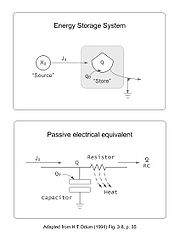 In the 1950s Odum introduced his electrical circuit diagrams of ecosystems to the Ecological Society of America
. He claimed that energy was driven through ecological systems by an "ecoforce" analogous to the role of voltage in electrical circuits.
Odum developed an analogue of Ohm's Law which aimed to be a representation of energy flows through ecosystems. In terms of steady state thermodynamics, Ohm's Law can be considered a special case of a more general flux law, where the flux ( ) "is proportional to the driving thermodynamic force (
 ) with conductivity (
 ). That is:
  .
.
Kangas states that Odum then also concluded that as thermodynamic systems, ecosystems should also obey the force-flux law. Hence Ohm's law and passive electrical analog circuits can be used to simulate ecosystems (Ibid.). In this simulation, Odum attempted to derive an ecological analog for electrical voltage. Voltage, or driving force, is related to something we have measured for years, the biomass
, in pounds per acre. The analogous concept required is the biomass activity, that is, the thermodynamic thrust, which may be linear. Exactly what this is in nature is still uncertain, as it is a new concept.
Such a consideration led Odum to ask two important methodological questions: 1) What is the electrical significance of a function observed in nature? 2) Given an electrical unit in a circuit, what is it in the ecological system? For example, what is a diode in nature? One needs a diode to allow biomass to accumulate after the voltage of the sun has gone down. Otherwise the circuit reverses. Higher organisms like fish are diodes.
is a common type of spring-fed stream in Florida
, with a constant temperature and chemical composition. The study Howard Odum conducted here was the first complete analysis of a natural ecosystem
.
Odum started with an overall model and in his early work used a diagramming methodology very similar to the Sankey diagram
s used in chemical process engineering. In this model energy and matter flows through an ecosystem: H are herbivores, C are carnivores, TC are top carnivores, and D are decomposers. Squares represent biotic pools and ovals are fluxes or energy or nutrients from the system.
Started from that overall model Odum "mapped in detail all the flow routes to and from the stream. He measured the energy input of sun and rain, and of all organic matter - even those of the bread the tourists threw to the ducks and fish - and then measured the energy that gradually left the spring. In this way he was able to establish the stream's energy budget".
which included the effects of radiation on the tropical rainforest at El Verde, Puerto Rico (Odum and Pidgeon), and the coral reefs and ocean ecology at Eniwetok atoll. The Odum brothers were approached by the Atomic Energy Commission to undertake a detailed study of the atoll after nuclear testing. Apparently the atoll was sufficiently radioactive that upon their arrival the Odums were able to produce an autoradiographic image of a coral head by placing it on photographic paper. These studies were early applications of energy concepts to ecological systems. They were exploring the implications of the laws of thermodynamics when used in these new settings.
From this view, biogeochemical cycles are driven by radiant energy. Odum expressed the balance between energy input and output as the ratio of production (P) to respiration
(R): P-R. He classified water bodies based on their P-R ratios, this separated autotrophic from heterotrophic ecosystems: "his measurements of flowing water metabolism were measurements of whole systems. Odum was measuring the community as a system, not adding up the metabolism of the components as Lindeman and many others had done". This reasoning appears to have followed that of Odum's doctoral supervisor, G.E.Hutchinson who expressed the view that if a community were an organism then it must have a form of metabolism. However Golley notes that H.T.Odum attempted to go beyond the reporting of mere ratios, a move which resulted in the first serious disagreement in systems energetics.
's articles on the energetics of evolution, and subsequently proposed the theory that natural systems tend to operate at an efficiency that produces the maximum power
output, not the maximum efficiency. This theory in turn motivated Odum to propose maximum power as a fundamental thermodynamic law. Further to this Odum also mooted two more additional thermodynamic laws (see Energetics
), but there is far from consensus in the scientific community about these proposals, and many scientists have never heard of H.T.Odum or his views.
projects which have appeared throughout the history of natural philosophy
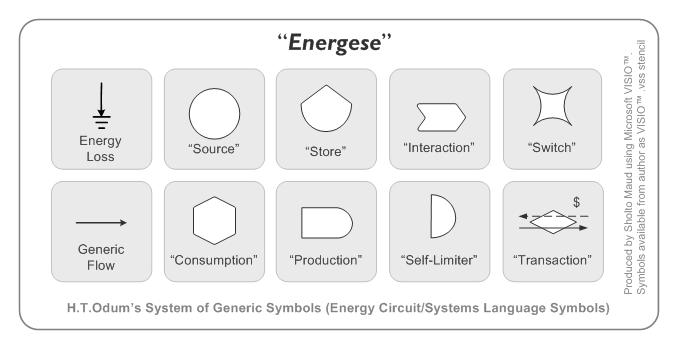 Kitching claimed that the language was a direct result of working with analogue computers, and reflected an electrical engineer's approach to the problem of system representation: "Because of its electrical analogy, the Odum system is relatively easy to turn into mathematical equations ... If one is building a model of energy flow then certainly the Odum system should be given serious consideration... "
Due to the focus on systems thinking, Odum's language appears to be similar in approach to the Systems Modeling Language
recently developed by INCOSE an international Systems Engineering
body.
.
developed the ideas of emergy
, as a specific use of the term Embodied energy
. Some consider the concept of "emergy", sometimes briefly defined as "energy memory", as one of Odum's more significant contributions. However the concept is neither free from controversy, and not without its critics. Odum looked at natural systems as having been formed by the use of various forms of energy in the past: "emergy is a measure of energy used in the past and thus is different from a measure of energy now. The unit of emergy (past available energy use) is the emjoule to distinguish it from joules used for available energy remaining now." This was then conceived as a principle of maximum empower which might explain the evolution
of self-organising open systems. However such a principle has not been empirically demonstrated nor verified by the scientific community.
For J.B. Hagen, the maximum power principle, and the stability principle could be easily translated into the language of homeostasis
and cybernetics
systems. Hagen claims that the feedback loops in ecosystems, were, for Odum, analogous to the kinds of feedback loops diagrammed in electronic circuits and cybernetic systems (Ibid.). This approach represented the migration of cybernetic ideas into ecology and led to the formulation of systems ecology. In Odum's work these concepts form part of what Hagen called an, "ambitious and idiosyncratic attempt to create a universal science of systems" (Ibid).
. Odum's microcosm studies influenced the design of Biosphere 2
.
s have a control function in ecosystems H.T. Odum arrived at the concept he termed hierarchical organization
.
and ecology with annual conferences, international societies and an international journal. From 1956 to 1963 H.T.Odum worked as Director of the Marine Institute of the University of Texas. During this time Odum became aware of the interplay of ecological-energetic and economic forces. He therefore funded the research into the use of conventional economic approaches to quantify dollar values of ecological resources for recreational, treatment and other uses. This research calculated the potential value of primary production per bay surface area.
For Hall the importance of Odum's work came through his integration of systems, ecology, and energy with economics, together with Odum's view that economics can be evaluated on objective terms such as energy rather than on a subjective, willingness to pay basis.
concerned with the designing, monitoring and constructing of ecosystem
s. The term ecological engineering was first coined by the Howard T. Odum in 1962 well before he worked at the University of Florida. Ecological engineering, he wrote, is "those cases where the energy supplied by man is small relative to the natural sources but sufficient to produce large effects in the resulting patterns and processes." Ecological engineering, as a practical field, was then developed by his former graduate student Bill Mitsch
who started and continues to edit the standard journal in the field and helped to start both international and U.S. societies devoted to ecological engineering, and has written two textbooks on the subject One of H.T. Odum's last papers was his assessment of ecological engineering that was published in the journal Ecological Engineering in 2003, a year after Odum died.
Odum was also honored by the journal Ecological Engineering for his contributions to the field of ecological engineering and ecology in general in recognition of his 70th birthday. This publication included over 25 letters from distinguished scientists from all over the world including Bill Mitsch
(lead editorial), John Allen, Robert Ulanowitcz, Robert Beyers, Ariel Lugo, Marth Gilliland, Sandra Brown, Ramon Margalef, Paul Risser, Gene Odum, Kathy Ewel, Kenneth Watt, Pat Kangas, Sven Jørgensen, Bob Knight, Rusong Wang, John Teal, Frank Golley, AnnMari and Bengt-Owe Jansson, Joan Browder, Carl Folke, Richard Wiegert, Scott Nixon, Gene Turner, John Todd, and James Zuchetto.
Organizations
United States
The United States of America is a federal constitutional republic comprising fifty states and a federal district...
ecologist
Ecology
Ecology is the scientific study of the relations that living organisms have with respect to each other and their natural environment. Variables of interest to ecologists include the composition, distribution, amount , number, and changing states of organisms within and among ecosystems...
. He is known for his pioneering work on ecosystem ecology
Ecosystem ecology
Ecosystem ecology is the integrated study of biotic and abiotic components of ecosystems and their interactions within an ecosystem framework. This science examines how ecosystems work and relates this to their components such as chemicals, bedrock, soil, plants, and animals.Ecosystem ecology...
, and for his provocative proposals for additional laws of thermodynamics, informed by his work on general systems theory
Systems theory
Systems theory is the transdisciplinary study of systems in general, with the goal of elucidating principles that can be applied to all types of systems at all nesting levels in all fields of research...
.
Biography
Odum was the third child of the American sociologist Howard W. OdumHoward W. Odum
Howard Washington Odum was an American sociologist.-Biography:...
, and the brother of Eugene Odum
Eugene Odum
Eugene Pleasants Odum was an American scientist known for his pioneering work on ecosystem ecology. He wrote the first ecology textbook: Fundamentals of Ecology....
. Their father "encouraged his sons to go into science and to develop new techniques to contribute to social progress
Social progress
Social progress is the idea that societies can or do improve in terms of their social, political, and economic structures. This may happen as a result of direct human action, as in social enterprise or through social activism, or as a natural part of sociocultural evolution...
. Howard learned his early scientific lessons about birds from his brother, about fish and the philosophy of biology
Philosophy of biology
The philosophy of biology is a subfield of philosophy of science, which deals with epistemological, metaphysical, and ethical issues in the biological and biomedical sciences...
while working after school for the marine zoologist Robert Coker, and about electrical circuits from "The Boy Electrician.".
Howard Thomas studied zoology
Zoology
Zoology |zoölogy]]), is the branch of biology that relates to the animal kingdom, including the structure, embryology, evolution, classification, habits, and distribution of all animals, both living and extinct...
at the University of North Carolina at Chapel Hill
University of North Carolina at Chapel Hill
The University of North Carolina at Chapel Hill is a public research university located in Chapel Hill, North Carolina, United States...
, where he published his first paper while still an undergraduate. His education was interrupted for three years by his wartime
World War II
World War II, or the Second World War , was a global conflict lasting from 1939 to 1945, involving most of the world's nations—including all of the great powers—eventually forming two opposing military alliances: the Allies and the Axis...
service with the Army Air Force
United States Army Air Forces
The United States Army Air Forces was the military aviation arm of the United States of America during and immediately after World War II, and the direct predecessor of the United States Air Force....
in Puerto Rico
Puerto Rico
Puerto Rico , officially the Commonwealth of Puerto Rico , is an unincorporated territory of the United States, located in the northeastern Caribbean, east of the Dominican Republic and west of both the United States Virgin Islands and the British Virgin Islands.Puerto Rico comprises an...
and the Panama
Panama
Panama , officially the Republic of Panama , is the southernmost country of Central America. Situated on the isthmus connecting North and South America, it is bordered by Costa Rica to the northwest, Colombia to the southeast, the Caribbean Sea to the north and the Pacific Ocean to the south. The...
Canal Zone
Panama Canal Zone
The Panama Canal Zone was a unorganized U.S. territory located within the Republic of Panama, consisting of the Panama Canal and an area generally extending 5 miles on each side of the centerline, but excluding Panama City and Colón, which otherwise would have been partly within the limits of...
where he worked as a tropical meteorologist. After the war, he returned to the University of North Carolina and completed his B.S.
Bachelor of Science
A Bachelor of Science is an undergraduate academic degree awarded for completed courses that generally last three to five years .-Australia:In Australia, the BSc is a 3 year degree, offered from 1st year on...
in zoology (Phi Beta Kappa) in 1947.
In 1947, Odum married Virginia Wood; they had two children. After her 1973 death, he married Elizabeth C. Odum in 1974; she had four children from her previous marriage. Odum's advice on how to manage a blended family was to be sure to keep talking; Elizabeth's was to hold back on discipline and new rules.
In 1950 Howard earned his Ph.D. in zoology at Yale University
Yale University
Yale University is a private, Ivy League university located in New Haven, Connecticut, United States. Founded in 1701 in the Colony of Connecticut, the university is the third-oldest institution of higher education in the United States...
, under the guidance of G. Evelyn Hutchinson
G. Evelyn Hutchinson
George Evelyn Hutchinson FRS was an Anglo-American zoologist known for his studies of freshwater lakes and considered the father of American limnology....
. His dissertation was titled The Biogeochemistry of Strontium: With Discussion on the Ecological Integration of Elements. This step took him from his early interest in ornithology and brought him into the emerging field of systems ecology
Systems ecology
Systems ecology is an interdisciplinary field of ecology, taking a holistic approach to the study of ecological systems, especially ecosystems. Systems ecology can be seen as an application of general systems theory to ecology. Central to the systems ecology approach is the idea that an ecosystem...
. Through this a meteorologist "analysis of the global circulation of strontium, anticipated in the late 1940s the view of the earth as one great ecosystem
Ecosystem
An ecosystem is a biological environment consisting of all the organisms living in a particular area, as well as all the nonliving , physical components of the environment with which the organisms interact, such as air, soil, water and sunlight....
."
While at Yale, Howard began his life-long collaborations with his brother Eugene. In 1953, they published the first English-language textbook on systems ecology, Fundamentals of Ecology. Howard wrote the chapter on energetics
Energetics
Energetics is the study of energy under transformation. Because energy flows at all scales, from the quantum level to the biosphere and cosmos, energetics is a very broad discipline, encompassing for example thermodynamics, chemistry, biological energetics, biochemistry and ecological energetics...
which introduced his energy circuit language
Energy Systems Language
The Energy Systems Language , also referred to as Energese, Energy Circuit Language and Generic Systems Symbols, was developed by the ecologist Howard T. Odum and colleagues in the 1950s during studies of the tropical forests funded by the United States Atomic Energy Commission...
. They continued to collaborate, in research as well as writing, for the rest of their lives. For Howard, his energy systems language (which he called "energese") was itself a collaborative tool.
The Center for Wetlands at the University of Florida
University of Florida
The University of Florida is an American public land-grant, sea-grant, and space-grant research university located on a campus in Gainesville, Florida. The university traces its historical origins to 1853, and has operated continuously on its present Gainesville campus since September 1906...
, founded in 1973 by Howard T. Odum, is the first of its kind in the world to especially study wetland
Wetland
A wetland is an area of land whose soil is saturated with water either permanently or seasonally. Wetlands are categorised by their characteristic vegetation, which is adapted to these unique soil conditions....
s.
From 1956 to 1963, Odum worked as Director of the Marine Institute of the University of Texas. During this time, he became aware of the interplay of ecological-energetic and economic forces. He then taught at the University of North Carolina at Chapel Hill, where he was in the Department of Zoology, and one of the professors in the new Curriculum of Marine Sciences until his move to the University of Florida in 1970. He then taught at the Environmental Engineering Sciences Department for 26 years until his retirement in 1996. He also started and directed the Center for Environmental Policy at the University of Florida and founded the University's Center for Wetlands in 1973, the first of its kind in the world that is still in operation today. In the 1960s-1970s Odum was also chairman of the International Biological Program
International Biological Program
The International Biological Program was an effort between 1964 and 1974 to coordinate large-scale ecological and environmental studies...
's Tropical Biome planning committee and was supported by large contracts with the United States Atomic Energy Commission with nearly 100 scientists, which involved radiation studies of a tropical rainforest His featured project at University of Florida in the 1970s was on recycling treated sewage into cypress swamps, one of the first projects that began the now widespread approach of using wetlands as water quality improvement ecosystems. This is one of his most important contributions to the beginnings of the field of ecological engineering.
In his last years, Odum was Graduate Research Professor Emeritus and Director of the Center for Environmental Policy. He was an avid birdwatcher in both his professional and personal life.
The Ecological Society awarded Odum its Mercer Award to recognize his contributions to the study of the coral reef on Eniwetok Atoll. Odum also received the French Prix de Vie, and the Crafoord Prize
Crafoord Prize
The Crafoord Prize is an annual science prize established in 1980 by Holger Crafoord, a Swedish industrialist, and his wife Anna-Greta Crafoord...
of the Royal Swedish Academy of Science considered the Nobel equivalent for bioscience not originally honored by Nobel himself. Charles A S Hall
Charles A S Hall
Charles A.S. Hall is ESF Foundation Distinguished Professor at State University of New York in the College of Environmental Science & Forestry. Hall describes himself primarily as a systems ecologist in the field of Systems ecology with strong interests in biophysical economics, and the relation...
has called Odum one of the most innovative and important thinkers of our time, noting that Howard Odum, either alone or with his brother Eugene, received essentially all of international prizes awarded to ecologists. The only higher education institute to award both Odum brothers honorary degrees was The Ohio State University which honored H.T. in 1995 and Gene in 1999.
Odum's contributions to this field have been recognised by the Mars Society
Mars Society
The Mars Society is an international space advocacy non-profit organization dedicated to promoting the human exploration and settlement of the planet Mars. It was founded by Robert Zubrin and others in 1998 and attracted the support of notable science fiction writers and filmmakers, including Kim...
who named their experimental station the "H.T.Odum greenhouse", at the suggestion of his former student Patrick Kangas. Kangas and his student, David Blersch, made significant contributions to the design of the waste water recycling system.
Odum's students have carried on his work at institutions around the world, most notably Mark Brown at the University of Florida
University of Florida
The University of Florida is an American public land-grant, sea-grant, and space-grant research university located on a campus in Gainesville, Florida. The university traces its historical origins to 1853, and has operated continuously on its present Gainesville campus since September 1906...
, David Tilley and Patrick Kangas at the University of Maryland
University of Maryland, College Park
The University of Maryland, College Park is a top-ranked public research university located in the city of College Park in Prince George's County, Maryland, just outside Washington, D.C...
, Daniel Campbell at the United States Environmental Protection Agency, Enrique Ortega at the UNICAMP in Brazil
Brazil
Brazil , officially the Federative Republic of Brazil , is the largest country in South America. It is the world's fifth largest country, both by geographical area and by population with over 192 million people...
, and Sergio Ulgiati at the University of Siena
University of Siena
The University of Siena in Siena, Tuscany is one of the oldest and first publicly funded universities in Italy. Originally called Studium Senese, the University of Siena was founded in 1240. The University has around 20,000 students, nearly half of Siena's total population of around 54,000...
. Work done at these institutions continues to evolve and propagate the Odum's concept of emergy
Emergy
Emergy is the available energy of one kind that is used up in transformations directly and indirectly to make a product or service. Emergy accounts for, and in effect, measures quality differences between forms of energy. Emergy is an expression of all the energy used in the work processes that...
. His former students Bill Mitsch
William J. Mitsch
William Mitsch, born March 29, 1947 in Wheeling, West Virginia USA, is an ecosystem ecologist and ecological engineer who was co-laureate of the 2004 Stockholm Water Prize in August 2004 as a result of a career in wetland ecology and restoration, ecological engineering, and ecological...
[Ohio State University] and Robert Costanza
Robert Costanza
Robert Costanza is an American ecological economist is a University Professor of Sustainability at Portland State University in Oregon.- Biography :Robert Costanza was born in Pittsburgh, Pennsylvania....
[Portland State University] are among a cadre of former students who have been recognized internationally for their contributions to ecological engineering, ecological economics, ecosystem science, wetland ecology, estuarine ecology, ecological modeling, and related fields.
Work: An overview
Odum left a large legacy in many fields associated with ecology, systems, and energetics. He studied ecosystems all over the world, and pioneered the study of several areas, some of which are now distinct fields of research. According to Hall (1995, p.ix), Odum published one of the first significant papers in each of the following areas:- Ecological modeling (Odum 1960a);
- Ecological engineeringEcological engineeringEcological engineering is an emerging study of integrating ecology and engineering, concerned with the design, monitoring and construction of ecosystems...
(Odum et al. 1963); - Ecological economicsEcological economicsImage:Sustainable development.svg|right|The three pillars of sustainability. Clickable.|275px|thumbpoly 138 194 148 219 164 240 182 257 219 277 263 291 261 311 264 331 272 351 283 366 300 383 316 394 287 408 261 417 224 424 182 426 154 423 119 415 87 403 58 385 40 368 24 347 17 328 13 309 16 286 26...
(Odum 1971); - Estuarine ecologyEstuaryAn estuary is a partly enclosed coastal body of water with one or more rivers or streams flowing into it, and with a free connection to the open sea....
(Odum and Hoskins 1958); - Tropical ecosystems ecologyTropical ecologyTropical ecology is the relationship between plants and animals in a tropical environment , these mean the area between tropic of Cancer and tropic of Capricorn. Day and night last here approximately 12 hours. Characteristic for tropical zone is at least one day of right angle sun shining. High...
(Odum and Pidgeon 1970); - General systems theory.
Odum's contributions to these and other areas are summarized below.
Odum also wrote on radiation ecology, systems ecology
Systems ecology
Systems ecology is an interdisciplinary field of ecology, taking a holistic approach to the study of ecological systems, especially ecosystems. Systems ecology can be seen as an application of general systems theory to ecology. Central to the systems ecology approach is the idea that an ecosystem...
, unified science, and the microcosm
Microcosm: Model / experimental ecosystem
Microcosms are artificial, simplified ecosystems that are used to simulate and predict the behaviour of natural ecosystems under controlled conditions. Open or closed microcosms provide an experimental area for ecologists to study natural ecological processes. Microcosm studies can be very useful...
. He was one of the first to discuss the use of ecosystems for life-support function in space travel. Some have suggested that Odum was technocratic in orientation, while others believe that he sided with those calling for "new values."
A new integrative approach in ecology
In his 1950 Ph.D. thesis, H.T.Odum gave a novel definition of ecology as the study of large entities (ecosystems) at the "natural level of integration". Hence, in the traditional role of an ecologist, one of Odum's doctoral aims was to recognize and classify large cyclic entities (ecosystems). However another of his aims was to make predictive generalizations about ecosystems, such as the whole world for example. For Odum, as a large entity, the world constituted a revolving cycle with high stabilityEcological stability
Ecological stability can refer to types of stability in a continuum ranging from resilience to constancy to persistence. The precise definition depends on the ecosystem in question, the variable or variables of interest, and the overall context...
. It was the presence of stability which, Odum believed, enabled him to talk about the teleology
Teleology
A teleology is any philosophical account which holds that final causes exist in nature, meaning that design and purpose analogous to that found in human actions are inherent also in the rest of nature. The word comes from the Greek τέλος, telos; root: τελε-, "end, purpose...
of such system
System
System is a set of interacting or interdependent components forming an integrated whole....
s. Moreover, at the time of writing his thesis, Odum felt that the principle of natural selection
Natural selection
Natural selection is the nonrandom process by which biologic traits become either more or less common in a population as a function of differential reproduction of their bearers. It is a key mechanism of evolution....
was more than empirical
Empirical
The word empirical denotes information gained by means of observation or experimentation. Empirical data are data produced by an experiment or observation....
, because it had a teleological, that is a "stability over time" component. And as an ecologist interested in the behavior and function of large entities over time, Odum therefore sought to give a more general statement of natural selection so that it was equally applicable to large entities as it was to small entities traditionally studied in biology:
Hence Odum also had the aim of extending the scope and generality of natural selection, to include large entities such as the world. This extension relied on the definition of an entity
Entity
An entity is something that has a distinct, separate existence, although it need not be a material existence. In particular, abstractions and legal fictions are usually regarded as entities. In general, there is also no presumption that an entity is animate.An entity could be viewed as a set...
as a combination of properties that have some stability with time. Odum's approach was motivated by Lotka's idea's on the energetics of evolution.
Ecosystem simulation
In writing a history of the ecosystem concept, Golley noted that Odum tended to think in the form of analogies, and gave the example, "if the world is a heat engine, then..." In this vein, Odum can be understood as extending the dynamical analogiesAnalogical models
Analogical models are a method of representing a phenomenon of the world, often called the ‘target system’ by another, more understandable or analysable system. They are also called dynamical analogies.- Explanation :...
which establish the analogies between electrical, mechanical, acoustical, magnetic and electronic systems, to include ecological systems.
Odum used an analog of electrical energy networks to model the energy flow pathways of ecosystems. Odum's analog electrical models had a significant role in the development of his approach to systems and have been recognized as one of the earliest instances of systems ecology.
Electron flow in the electrical network represented the flow of material (e.g. carbon) in the ecosystem, charge in a capacitor was analogous to storage of a material, and the model was scaled to the ecosystem of interest by adjusting the size of electrical component.
Ecological analog of Ohm's Law
Ecological Society of America
The Ecological Society of America is a professional organization of ecological scientists. Based in the United States, ESA publishes a suite of publications, from peer-reviewed journals to newsletters, fact sheets and teaching resources. It holds an annual meeting at different locations in the...
. He claimed that energy was driven through ecological systems by an "ecoforce" analogous to the role of voltage in electrical circuits.
Odum developed an analogue of Ohm's Law which aimed to be a representation of energy flows through ecosystems. In terms of steady state thermodynamics, Ohm's Law can be considered a special case of a more general flux law, where the flux (
) "is proportional to the driving thermodynamic force () with conductivity (). That is: .Kangas states that Odum then also concluded that as thermodynamic systems, ecosystems should also obey the force-flux law. Hence Ohm's law and passive electrical analog circuits can be used to simulate ecosystems (Ibid.). In this simulation, Odum attempted to derive an ecological analog for electrical voltage. Voltage, or driving force, is related to something we have measured for years, the biomass
Biomass
Biomass, as a renewable energy source, is biological material from living, or recently living organisms. As an energy source, biomass can either be used directly, or converted into other energy products such as biofuel....
, in pounds per acre. The analogous concept required is the biomass activity, that is, the thermodynamic thrust, which may be linear. Exactly what this is in nature is still uncertain, as it is a new concept.
Such a consideration led Odum to ask two important methodological questions: 1) What is the electrical significance of a function observed in nature? 2) Given an electrical unit in a circuit, what is it in the ecological system? For example, what is a diode in nature? One needs a diode to allow biomass to accumulate after the voltage of the sun has gone down. Otherwise the circuit reverses. Higher organisms like fish are diodes.
The Silver Spring study
Silver SpringSilver Springs, Florida
Silver Springs is a U.S. populated place and spring in Marion County, Florida, just to the east of the city of Ocala. It is part of the Ocala Metropolitan Statistical Area....
is a common type of spring-fed stream in Florida
Florida
Florida is a state in the southeastern United States, located on the nation's Atlantic and Gulf coasts. It is bordered to the west by the Gulf of Mexico, to the north by Alabama and Georgia and to the east by the Atlantic Ocean. With a population of 18,801,310 as measured by the 2010 census, it...
, with a constant temperature and chemical composition. The study Howard Odum conducted here was the first complete analysis of a natural ecosystem
Ecosystem
An ecosystem is a biological environment consisting of all the organisms living in a particular area, as well as all the nonliving , physical components of the environment with which the organisms interact, such as air, soil, water and sunlight....
.
Odum started with an overall model and in his early work used a diagramming methodology very similar to the Sankey diagram
Sankey diagram
Sankey diagrams are a specific type of flow diagram, in which the width of the arrows is shown proportionally to the flow quantity. They are typically used to visualize energy or material or cost transfers between processes.-Application:...
s used in chemical process engineering. In this model energy and matter flows through an ecosystem: H are herbivores, C are carnivores, TC are top carnivores, and D are decomposers. Squares represent biotic pools and ovals are fluxes or energy or nutrients from the system.
Started from that overall model Odum "mapped in detail all the flow routes to and from the stream. He measured the energy input of sun and rain, and of all organic matter - even those of the bread the tourists threw to the ducks and fish - and then measured the energy that gradually left the spring. In this way he was able to establish the stream's energy budget".
Ecological and biological energetics
Around 1955 Odum directed studies into radioecologyRadioecology
Radioecology is a branch of ecology, which studies how radioactive substances interact with nature; how different mechanisms affect the substances’ migration and uptake in food chain and ecosystems...
which included the effects of radiation on the tropical rainforest at El Verde, Puerto Rico (Odum and Pidgeon), and the coral reefs and ocean ecology at Eniwetok atoll. The Odum brothers were approached by the Atomic Energy Commission to undertake a detailed study of the atoll after nuclear testing. Apparently the atoll was sufficiently radioactive that upon their arrival the Odums were able to produce an autoradiographic image of a coral head by placing it on photographic paper. These studies were early applications of energy concepts to ecological systems. They were exploring the implications of the laws of thermodynamics when used in these new settings.
From this view, biogeochemical cycles are driven by radiant energy. Odum expressed the balance between energy input and output as the ratio of production (P) to respiration
Respiration rate
The respiration rate is a parameter which is used in ecological and agronomical modeling.In theoretical production ecology and aquaculture, it typically refers to respiration per unit of time , also referred to as relative respiration rate...
(R): P-R. He classified water bodies based on their P-R ratios, this separated autotrophic from heterotrophic ecosystems: "his measurements of flowing water metabolism were measurements of whole systems. Odum was measuring the community as a system, not adding up the metabolism of the components as Lindeman and many others had done". This reasoning appears to have followed that of Odum's doctoral supervisor, G.E.Hutchinson who expressed the view that if a community were an organism then it must have a form of metabolism. However Golley notes that H.T.Odum attempted to go beyond the reporting of mere ratios, a move which resulted in the first serious disagreement in systems energetics.
Maximum power theory and the proposal for additional laws of thermodynamics/energetics
In a controversial move, Odum, together with Richard Pinkerton (at the time physicist at the University of Florida), was motivated by Alfred J. LotkaAlfred J. Lotka
Alfred James Lotka was a US mathematician, physical chemist, and statistician, famous for his work in population dynamics and energetics. An American biophysicist best known for his proposal of the predator-prey model, developed simultaneously but independently of Vito Volterra...
's articles on the energetics of evolution, and subsequently proposed the theory that natural systems tend to operate at an efficiency that produces the maximum power
Maximum power principle
The maximum power principle has been proposed as the fourth principle of energetics in open system thermodynamics, where an example of an open system is a biological cell. According to Howard T...
output, not the maximum efficiency. This theory in turn motivated Odum to propose maximum power as a fundamental thermodynamic law. Further to this Odum also mooted two more additional thermodynamic laws (see Energetics
Energetics
Energetics is the study of energy under transformation. Because energy flows at all scales, from the quantum level to the biosphere and cosmos, energetics is a very broad discipline, encompassing for example thermodynamics, chemistry, biological energetics, biochemistry and ecological energetics...
), but there is far from consensus in the scientific community about these proposals, and many scientists have never heard of H.T.Odum or his views.
Energese: Energy Systems Language
By the end of the 1960s Odum's electronic circuit ecological simulation models were replaced by a more general set of energy symbols. When combined to form systems diagrams, these symbols were considered by Odum and others to be the language of the macroscope which could portray generalized patterns of energy flow: "Describing such patterns and reducing ecosystem complexities to flows of energy, Odum believed, would permit discovery of general ecosystem principles". Some have attempted to link it with the universal scientific languageCharacteristica universalis
The Latin term characteristica universalis, commonly interpreted as universal characteristic, or universal character in English, is a universal and formal language imagined by the German philosopher Gottfried Leibniz able to express mathematical, scientific, and metaphysical concepts...
projects which have appeared throughout the history of natural philosophy
Due to the focus on systems thinking, Odum's language appears to be similar in approach to the Systems Modeling Language
Systems Modeling Language
The Systems Modeling Language is a general-purpose modeling language for systems engineering applications. It supports the specification, analysis, design, verification and validation of a broad range of systems and systems-of-systems. SysML was originally developed by an open source specification...
recently developed by INCOSE an international Systems Engineering
Systems engineering
Systems engineering is an interdisciplinary field of engineering that focuses on how complex engineering projects should be designed and managed over the life cycle of the project. Issues such as logistics, the coordination of different teams, and automatic control of machinery become more...
body.
Energy quality
In taking an energy-based view of hierarchical organization Odum also developed further the systems ecology understanding of energy qualityEnergy quality
Energy quality is the contrast between different forms of energy, the different trophic levels in ecological systems and the propensity of energy to convert from one form to another. The concept refers to the empirical experience of the characteristics, or qualia, of different energy forms as they...
.
Emergy
In the 1990s in the latter part of his career H.T. Odum together with David M. SciencemanDavid M. Scienceman
Dr David M. Scienceman is an Australian scientist; he changed his name from David Slade by deed poll in 1972.Dr Scienceman has a mathematics and physics degree and gained his PhD from the chemical engineering department at Sydney University on a scholarship from the Australian Atomic Energy...
developed the ideas of emergy
Emergy
Emergy is the available energy of one kind that is used up in transformations directly and indirectly to make a product or service. Emergy accounts for, and in effect, measures quality differences between forms of energy. Emergy is an expression of all the energy used in the work processes that...
, as a specific use of the term Embodied energy
Embodied energy
Embodied energy is defined as the sum of energy inputs that was used in the work to make any product, from the point of extraction and refining materials, bringing it to market, and disposal / re-purposing of it...
. Some consider the concept of "emergy", sometimes briefly defined as "energy memory", as one of Odum's more significant contributions. However the concept is neither free from controversy, and not without its critics. Odum looked at natural systems as having been formed by the use of various forms of energy in the past: "emergy is a measure of energy used in the past and thus is different from a measure of energy now. The unit of emergy (past available energy use) is the emjoule to distinguish it from joules used for available energy remaining now." This was then conceived as a principle of maximum empower which might explain the evolution
Evolution
Evolution is any change across successive generations in the heritable characteristics of biological populations. Evolutionary processes give rise to diversity at every level of biological organisation, including species, individual organisms and molecules such as DNA and proteins.Life on Earth...
of self-organising open systems. However such a principle has not been empirically demonstrated nor verified by the scientific community.
Ecosystem ecology and systems ecology
- Main articles: Ecosystem ecologyEcosystem ecologyEcosystem ecology is the integrated study of biotic and abiotic components of ecosystems and their interactions within an ecosystem framework. This science examines how ecosystems work and relates this to their components such as chemicals, bedrock, soil, plants, and animals.Ecosystem ecology...
and systems ecologySystems ecologySystems ecology is an interdisciplinary field of ecology, taking a holistic approach to the study of ecological systems, especially ecosystems. Systems ecology can be seen as an application of general systems theory to ecology. Central to the systems ecology approach is the idea that an ecosystem...
For J.B. Hagen, the maximum power principle, and the stability principle could be easily translated into the language of homeostasis
Homeostasis
Homeostasis is the property of a system that regulates its internal environment and tends to maintain a stable, constant condition of properties like temperature or pH...
and cybernetics
Cybernetics
Cybernetics is the interdisciplinary study of the structure of regulatory systems. Cybernetics is closely related to information theory, control theory and systems theory, at least in its first-order form...
systems. Hagen claims that the feedback loops in ecosystems, were, for Odum, analogous to the kinds of feedback loops diagrammed in electronic circuits and cybernetic systems (Ibid.). This approach represented the migration of cybernetic ideas into ecology and led to the formulation of systems ecology. In Odum's work these concepts form part of what Hagen called an, "ambitious and idiosyncratic attempt to create a universal science of systems" (Ibid).
Macroscope
Hagen has identified the systems thinking of Odum as a form of holistic thinking. Odum contrasted the holistic thinking of systems science with reductionistic microscopic thinking, and used the term "macroscope" to refer to the holistic view, which was a kind of "detail eliminator" allowing a simple diagram to be created.Microcosms
H.T.Odum was a pioneer in his use of small closed and open ecosystems in classroom teaching. These small ecosystems were often constructed from fish tanks or bottles and have been called microcosmsMicrocosm: Model / experimental ecosystem
Microcosms are artificial, simplified ecosystems that are used to simulate and predict the behaviour of natural ecosystems under controlled conditions. Open or closed microcosms provide an experimental area for ecologists to study natural ecological processes. Microcosm studies can be very useful...
. Odum's microcosm studies influenced the design of Biosphere 2
Biosphere 2
Biosphere 2 is a structure originally built to be an artificial, materially-closed ecological system in Oracle, Arizona by Space Biosphere Ventures, a joint venture whose principal officers were John P. Allen, inventor and Executive Director, and Margret Augustine, CEO...
.
Hierarchical organization
In observing the way higher order trophic levelTrophic level
The trophic level of an organism is the position it occupies in a food chain. The word trophic derives from the Greek τροφή referring to food or feeding. A food chain represents a succession of organisms that eat another organism and are, in turn, eaten themselves. The number of steps an organism...
s have a control function in ecosystems H.T. Odum arrived at the concept he termed hierarchical organization
Hierarchical organization
A hierarchical organization is an organizational structure where every entity in the organization, except one, is subordinate to a single other entity. This arrangement is a form of a hierarchy. In an organization, the hierarchy usually consists of a singular/group of power at the top with...
.
Ecological economics
Ecological economics is now an active field between economicsEconomics
Economics is the social science that analyzes the production, distribution, and consumption of goods and services. The term economics comes from the Ancient Greek from + , hence "rules of the house"...
and ecology with annual conferences, international societies and an international journal. From 1956 to 1963 H.T.Odum worked as Director of the Marine Institute of the University of Texas. During this time Odum became aware of the interplay of ecological-energetic and economic forces. He therefore funded the research into the use of conventional economic approaches to quantify dollar values of ecological resources for recreational, treatment and other uses. This research calculated the potential value of primary production per bay surface area.
For Hall the importance of Odum's work came through his integration of systems, ecology, and energy with economics, together with Odum's view that economics can be evaluated on objective terms such as energy rather than on a subjective, willingness to pay basis.
Ecological engineering
Ecological Engineering is an emerging field of study between ecology and engineeringEngineering
Engineering is the discipline, art, skill and profession of acquiring and applying scientific, mathematical, economic, social, and practical knowledge, in order to design and build structures, machines, devices, systems, materials and processes that safely realize improvements to the lives of...
concerned with the designing, monitoring and constructing of ecosystem
Ecosystem
An ecosystem is a biological environment consisting of all the organisms living in a particular area, as well as all the nonliving , physical components of the environment with which the organisms interact, such as air, soil, water and sunlight....
s. The term ecological engineering was first coined by the Howard T. Odum in 1962 well before he worked at the University of Florida. Ecological engineering, he wrote, is "those cases where the energy supplied by man is small relative to the natural sources but sufficient to produce large effects in the resulting patterns and processes." Ecological engineering, as a practical field, was then developed by his former graduate student Bill Mitsch
William J. Mitsch
William Mitsch, born March 29, 1947 in Wheeling, West Virginia USA, is an ecosystem ecologist and ecological engineer who was co-laureate of the 2004 Stockholm Water Prize in August 2004 as a result of a career in wetland ecology and restoration, ecological engineering, and ecological...
who started and continues to edit the standard journal in the field and helped to start both international and U.S. societies devoted to ecological engineering, and has written two textbooks on the subject One of H.T. Odum's last papers was his assessment of ecological engineering that was published in the journal Ecological Engineering in 2003, a year after Odum died.
General systems theory
Odum has been described as a "technocratic optimist". His approach was significantly influenced by his father who was also an advocate of viewing the social world through the various lenses of physical science. Within the processes on earth, H.T.Odum (1989) viewed humans as playing a central role: He said that the "human is the biosphere's programmatic and pragmatic information processor for maximum performance".Literature
H.T. Odum wrote some 15 books and 300 papers, and a Festschrift volume (Maximum Power: The Ideas and Applications of H.T.Odum 1995) was published in honor of his work.Odum was also honored by the journal Ecological Engineering for his contributions to the field of ecological engineering and ecology in general in recognition of his 70th birthday. This publication included over 25 letters from distinguished scientists from all over the world including Bill Mitsch
William J. Mitsch
William Mitsch, born March 29, 1947 in Wheeling, West Virginia USA, is an ecosystem ecologist and ecological engineer who was co-laureate of the 2004 Stockholm Water Prize in August 2004 as a result of a career in wetland ecology and restoration, ecological engineering, and ecological...
(lead editorial), John Allen, Robert Ulanowitcz, Robert Beyers, Ariel Lugo, Marth Gilliland, Sandra Brown, Ramon Margalef, Paul Risser, Gene Odum, Kathy Ewel, Kenneth Watt, Pat Kangas, Sven Jørgensen, Bob Knight, Rusong Wang, John Teal, Frank Golley, AnnMari and Bengt-Owe Jansson, Joan Browder, Carl Folke, Richard Wiegert, Scott Nixon, Gene Turner, John Todd, and James Zuchetto.
Books
- 2007, Environment, Power and Society for the Twenty-First Century: The Hierarchy of Energy, with Mark T. Brown, Columbia University Press.
- 2001, A Prosperous Way Down: Principles and Policies, with Elisabeth C. Odum, University Press of Colorado.
- 2000, with E.C. Odum, Modeling for all Scales: An introduction to System Simulation, Academic Press.
- 1999, Heavy Metals in the Environment: Using Wetlands for Their Removal.
- 1999, Biosphere 2 : Research, Past and Present, with Bruno D. V. Marino.
- 1996, Environmental Accounting: EMERGY and environmental decision making.
- 1993, Ecological Microcosms, with Michael J. Beyers.
- 1984, Cypress Swamps with Katherine C. Ewel.
- 1983, Systems Ecology : an Introduction.
- 1981, Energy Basis for Man and Nature, with Elisabeth C. Odum.
- 1970, with Robert F. Pigeon (eds), A Tropical Rain Forest; a Study of Irradiation and Ecology at El Verde, Puerto Rico, United States Atomic Energy Commission, National Technical information service.
- 1971, Environment, Power and Society, 1971
- 1967, (ed.) Work Circuits and System Stress, in Young, Symposium on Primary Productivity and Mineral Cycling, University of Maine Press.
- 1953, Fundamentals of Ecology, with Eugene P. Odum, (first edition).
Articles (selection)
- 1998, eMergy Evaluation, paper presented at the International Workshop on Advances in Energy Studies: Energy flows in ecology and economy, Porto Venere, Italy, May 27.
- 1997, EMERGY Evaluation and Transformity, in Kreith ed. CRC Handbook of Mechanical Engineering.
- 1991, Emergy and Biogeochemical Cycles, in Rossi & Tiezzi ed Physical Chemistry.
- 1989, Emergy and Evolution, In 33rd Annual Meeting of the International Society for the Systems Sciences, UK.
- 1989, Comments and thanks to Students and Associates, Handout on the Occasion of the Celebration in Chapel Hill, N.C, in: "Advances in Understanding Ecological Systems", August 31-September, 2.
- 1984, Embodied Energy and the Welfare of Nations, Jansson ed, Integration o Economy and Ecology.
- 1977, The ecosystem, energy, and human values, in: Zygon, Volume 12 Issue 2 Page 109-133.
- 1975, Energy Quality and Carrying Capacity of the Earth, response at prize awarding ceremony of Institute La Vie, Paris.
- 1973, Energy, ecology and economics, Royal Swedish Academy of Science. in: AMBIO, 2 (6), 220-227.
- 1963, with W.L. Slier, R.J. Beyers & N. Armstrong, Experiments with engineering of marine ecosystems, in: Publ. Inst. Marine Sci. Univ. Tex. 9:374-403.
- 1963, Limits of remote ecosystems containing man, in: The American Biology Teacher. 25 (6): 429-443.
- 1960a, Ecological potential and analog circuits for the ecosystem, in: Amer. Sci. 48:1-8.
- 1960b, Ten classroom sessions in ecology in: The American Biology Teacher. 22 (2): 71-78.
- 1958, with C.M. Hoskin, Comparative studies of the metabolism of Texas bays, in: Publ. Inst. March Sci., Univ. tex., 5:16-46.
- 1955, with E.P. Odum, Trophic structure and productivity of a winward coral reef community on Eniwetok Atoll, in: Ecological Monographs. 35, 291-320.
- 1950, The Biogeochemistry of Strontium: With Discussion on the Ecological Integration of Elements, A Dissertation presented to the Faculty of the Graduate School of Yale University in Candidacy for the Degree of Doctor of Philosophy.
About Howard T. Odum
- Beyers, R.J. 1964. The Microcosm Approach to Ecosystem Biology. The American Biology Teacher. 26 (7): 491-498.
- Bocking, S. 1997. Ecologists and environmental politics: a history of contemporary ecology, Yale University.
- Cevolatti, D., and Maud, S., 2004, " Realising the Enlightenment: H. T. Odum's Energy Systems Language qua G. W. v. Leibniz's Characteristica Universalis," Ecological Modelling 178: 279-92.
- Costanza, R. 1997. An Introduction to Ecological Economics, CRC Press.
- Ewel, John J. 2003. Resolution of Respect: Howard Thomas Odum Bulletin of the Ecological Society of America. January 2003: 12-15 (PDF)
- Gilliland, M.W. ed. (1978) Energy Analysis: A New Public Policy Tool, AAA Selected Symposia Series, Westview Press, Boulder, Colorado.
- Golley, F. 1993. A History of the Ecosystem Concept in Ecology: More than the sum of the parts, Yale University Press.
- Hagen, J.B. 1992. An Entangled Bank: The Origins of Ecosystem Ecology. Rutgers University Press.
- Hall, C.A.S. (ed.) 1995. Maximum Power: The Ideas and applications of H.T.Odum. Colorado University Press.
- Debora HammondDebora HammondDebora Hammond is an American historian of science, Provost and Professor Interdisciplinary Studies of the Hutchins School of Liberal Studies at the Sonoma State University...
, 1997. Ecology and Ideology in the General Systems Community, Environment and History, Volume 3, Number 2, pp. 197–207(11) - Hammond, G. 2007. Energy and sustainability in a complex world: Reflections on the ideas of Howard T. Odum, Int. J. Energy Res. (in press).
- Kangas, P. 1995. Contributions of H.T.Odum to Ecosystem Simulation Modelling, in Hall (ed.) Maximum Power: the Ideas and Applications of H.T.Odum, Colorado University Press, Colorado.
- Kangas P. 2004. The role of passive electrical analogs in H.T. Odum's systems thinking, Ecological Modelling, v 178 (1-2), 101-106.
- Kangas P. 2004b. Ecological economics began on the Texas bays during the 1950s, Ecological Modelling, v 178 (1-2), 179-181.
- Kitching R.L. 1983. Systems Ecology: An Introduction to Ecological Modelling, University of Queensland Press.
- Lugo, A. E. 1995. A review of Dr. Howard T. Odum's early publications: From bird migration studies to Scott Nixon's turtle crass model. In Hall (ed.) Maximum Power: The Ideas and applications of H.T.Odum. Colorado University Press.
- Madison, M.G. 1997. 'Potatoes Made of Oil': Eugene and Howard Odum and the Origins and Limits of American Agroecology, Environment and History, Volume 3, Number 2, June 1997, pp. 209–238 (30
- Mitsch. W.J. 2003. Ecology, ecological engineering, and the Odum brothers. Ecological Engineering v. 20, 331-338.
- Mitsch, W.J. 1994. Energy flow in a pulsing system: Howard T. Odum. Ecological Engineering, v.3, 77-83.
- Mitsch, W.J. and J.W. Day, Jr. 2004. Thinking big with whole ecosystem studies and ecosystem restoration—A legacy of H.T. Odum. Ecological Modelling, v 178, 133-155.
- Odum, E.C. 1995. H.T. Odum as a Husband and Colleague, in Hall (ed.), Maximum Power: The Ideas and applications of H.T. Odum. Colorado University Press, pp. 360–361.
- Taylor, Peter J. 1988. Technocratic optimism, H.T. Odum and the partial transformation of ecological metaphor after World War 2. Journal of the History of Biology 21:213-244.
External links
- The Craford prize 1987 for Eugene P. Odum and Howard T. Odum, with an overview of H.T. Odum's career.
Organizations
- Center for Environmental Policy
- (H.T. Odum) Center for Wetlands
- Photo archive and H.T. Odum collection in the Encyclopedia of Earth
- H.T. Odum Cypress Dome Wetland
- Photo of the inside of the Mars Society's H.T. Odum Greenhouse
- Photo of the outside of the Mars Society's H.T. Odum Greenhouse