

Horae

Encyclopedia
In Greek mythology
the Horae (icon or ˈ) or Hours were the goddess
es of the seasons and the natural portions of time. They were originally the personifications of nature in its different seasonal aspects, but in later times they were regarded as goddessess of order in general and natural justice. "They bring and bestow ripeness, they come and go in accordance with the firm law of the periodicities of nature and of life", Karl Kerenyi
observed: "Hora means 'the correct moment'." Traditionally, they guarded the gates of Olympus, promoted the fertility of the earth, and rallied the stars and constellations.
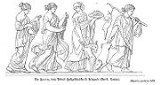
The course of the seasons was also symbolically described as the dance of the Horae, and they were accordingly given the attributes of spring flowers, fragrance and graceful freshness. For example, in Hesiod's Works and Days
, the fair-haired Horai, together with the Charites
and Peitho
crown Pandora
—she of "all gifts"— with garlands of flowers. Similarly Aphrodite, emerging from the sea and coming ashore at Cyprus
, is dressed and adorned by the Horai, and, according to a surviving fragment of the epic Cypria, Aphrodite wore clothing made for her by the Charites and Horai, dyed with spring flowers, such as the Horai themselves wear.
The number of Horae varied according to different sources, but was most commonly three, either the trio of Thallo, Auxo and Carpo, who were goddesses of the order of nature; or Eunomia, Diké, and Eirene, who were law-and-order goddesses.
where they appear as keepers of Zeus
's cloud gates. "Hardly any traces of that function are found in the subsequent tradition," Karl Galinsky remarked in passing. They were daughters of Zeus
and Themis
, half-sisters to the Moirae
. The Horae are mentioned in two aspects in Hesiod
and the Homeric Hymns
. In one variant emphasizing their fruitful aspect, Thallo, Auxo, and Carpo—the goddesses of the three seasons the Greeks recognized: spring, summer and autumn—were worshipped primarily amongst rural farmers throughout Greece. In the other variant, emphasising the "right order" aspect of the Horai, Hesiod says that Zeus wedded "bright Themis
" who bore Eunomia, Diké, and Eirene, who were law-and-order goddesses that maintained the stability of society. They were worshipped primarily in the cities of Athens
, Argos
and Olympia
.
 Of the first, more familiar triad, associated with Aphrodite
is their origins as emblems of times of life and growth, Thallo (Θαλλώ, literally "the one who brings blossoms") or Thalatte was the goddess of spring, buds and blooms, a protector of youth. Auxo (Αὐξώ. "increaser" as in plant growth) or Auxesia was worshipped alongside Hegemone
in Athens
as one of their two Charites
. Carpo (Καρπώ), Carpho or Xarpo was the one who brings food - though Robert Graves
in The Greek Myths (1955) translates this name as "withering") was in charge of autumn, ripening
, and harvest
ing, as well as guarding the way to Mount Olympus and letting back the clouds surrounding the mountain if one of the gods left. She was an attendant to Persephone
, Aphrodite
and Hera
, and was also associated with Dionysus
, Apollo
and Pan
. Thallo and Carpo appear in rites of Attica
noted by Pausanias
in the 2nd century AD.
Of the second triad Dike
(Δίκη, "justice") was the goddess of moral justice. She ruled over human justice, as her mother Themis
ruled over divine justice. The anthropomorphisation
of Dike as an ever-young woman dwelling in the cities of men was so ancient and strong that in the 3rd century BCE Aratus
in Phaenomena
96 asserted that she was born a mortal and that, though Zeus placed her on earth to keep mankind just, he quickly learned this was impossible and placed her next to him on Olympus, as the Greek astronomical/astrological constellation The Maiden
. Eunomia
(Εὐνομία, "good order, governance according to good laws") was the goddess of law and legislation. The same or a different goddess may have been a daughter of Hermes
and Aphrodite
. Eirene
or Irene (Εἰρήνη. "peace"; the Roman
equivalent was Pax
), was the personification of peace and wealth, and was depicted in art as a beautiful young woman carrying a cornucopia
, scepter and a torch or rhyton
.
two, rather than three Horae were recognised, presumably summer and winter: Damia (possibly another name for Carpo) and Auxesia. In late euhemerist
interpretations, they were seen as Cretan maidens who were worshipped as goddesses after they had been wrongfully stoned to death.
(Fabulae 183) identifies a third set of Horae: Pherousa (goddess of substance and farm estates), Euporie
or Euporia (goddess of abundance), and Orthosie (goddess of prosperity).
Nonnus
in his Dionysiaca
mentions a set of four Horae: Eiar, Theros, Cheimon and Phthinoporon, the Greek words for spring, summer, winter and autumn respectively.
According to Hyginus, the list is only of nine:
Auco, Eunomia
(Order), Pherusa
, Carpo (Fruit), Dike
(Justice), Euporie
or Euporia, Irene
(Peace), Orthosie
and Thallo.
Greek mythology
Greek mythology is the body of myths and legends belonging to the ancient Greeks, concerning their gods and heroes, the nature of the world, and the origins and significance of their own cult and ritual practices. They were a part of religion in ancient Greece...
the Horae (icon or ˈ) or Hours were the goddess
Goddess
A goddess is a female deity. In some cultures goddesses are associated with Earth, motherhood, love, and the household. In other cultures, goddesses also rule over war, death, and destruction as well as healing....
es of the seasons and the natural portions of time. They were originally the personifications of nature in its different seasonal aspects, but in later times they were regarded as goddessess of order in general and natural justice. "They bring and bestow ripeness, they come and go in accordance with the firm law of the periodicities of nature and of life", Karl Kerenyi
Karl Kerényi
Károly Kerényi was a Hungarian scholar in classical philology, one of the founders of modern studies in Greek mythology.- Hungary 1897–1943 :...
observed: "Hora means 'the correct moment'." Traditionally, they guarded the gates of Olympus, promoted the fertility of the earth, and rallied the stars and constellations.
The course of the seasons was also symbolically described as the dance of the Horae, and they were accordingly given the attributes of spring flowers, fragrance and graceful freshness. For example, in Hesiod's Works and Days
Works and Days
Works and Days is a didactic poem of some 800 verses written by the ancient Greek poet Hesiod around 700 BC. At its center, the Works and Days is a farmer's almanac in which Hesiod instructs his brother Perses in the agricultural arts...
, the fair-haired Horai, together with the Charites
Charites
In Greek mythology, a Charis is one of several Charites , goddesses of charm, beauty, nature, human creativity and fertility. They ordinarily numbered three, from youngest to oldest: Aglaea , Euphrosyne , and Thalia . In Roman mythology they were known as the Gratiae, the "Graces"...
and Peitho
Peitho
In Greek mythology, Peitho is the goddess who personifies persuasion and seduction. Her Roman name is Suadela. Pausanias reports that after the unification of Athens, Theseus set up a cult of Aphrodite Pandemos and Peitho on the south slope of Acropolis at Athens. Peitho, in her role as an...
crown Pandora
Pandora
In Greek mythology, Pandora was the first woman. As Hesiod related it, each god helped create her by giving her unique gifts...
—she of "all gifts"— with garlands of flowers. Similarly Aphrodite, emerging from the sea and coming ashore at Cyprus
Cyprus
Cyprus , officially the Republic of Cyprus , is a Eurasian island country, member of the European Union, in the Eastern Mediterranean, east of Greece, south of Turkey, west of Syria and north of Egypt. It is the third largest island in the Mediterranean Sea.The earliest known human activity on the...
, is dressed and adorned by the Horai, and, according to a surviving fragment of the epic Cypria, Aphrodite wore clothing made for her by the Charites and Horai, dyed with spring flowers, such as the Horai themselves wear.
The number of Horae varied according to different sources, but was most commonly three, either the trio of Thallo, Auxo and Carpo, who were goddesses of the order of nature; or Eunomia, Diké, and Eirene, who were law-and-order goddesses.
Descriptions
The earliest written mention of horai is in the IliadIliad
The Iliad is an epic poem in dactylic hexameters, traditionally attributed to Homer. Set during the Trojan War, the ten-year siege of the city of Troy by a coalition of Greek states, it tells of the battles and events during the weeks of a quarrel between King Agamemnon and the warrior Achilles...
where they appear as keepers of Zeus
Zeus
In the ancient Greek religion, Zeus was the "Father of Gods and men" who ruled the Olympians of Mount Olympus as a father ruled the family. He was the god of sky and thunder in Greek mythology. His Roman counterpart is Jupiter and his Etruscan counterpart is Tinia.Zeus was the child of Cronus...
's cloud gates. "Hardly any traces of that function are found in the subsequent tradition," Karl Galinsky remarked in passing. They were daughters of Zeus
Zeus
In the ancient Greek religion, Zeus was the "Father of Gods and men" who ruled the Olympians of Mount Olympus as a father ruled the family. He was the god of sky and thunder in Greek mythology. His Roman counterpart is Jupiter and his Etruscan counterpart is Tinia.Zeus was the child of Cronus...
and Themis
Themis
Themis is an ancient Greek Titaness. She is described as "of good counsel", and is the embodiment of divine order, law, and custom. Themis means "divine law" rather than human ordinance, literally "that which is put in place", from the verb τίθημι, títhēmi, "to put"...
, half-sisters to the Moirae
Moirae
The Moirae, Moerae or Moirai , in Greek mythology, were the white-robed incarnations of destiny . Their number became fixed at three...
. The Horae are mentioned in two aspects in Hesiod
Hesiod
Hesiod was a Greek oral poet generally thought by scholars to have been active between 750 and 650 BC, around the same time as Homer. His is the first European poetry in which the poet regards himself as a topic, an individual with a distinctive role to play. Ancient authors credited him and...
and the Homeric Hymns
Homeric Hymns
The Homeric Hymns are a collection of thirty-three anonymous Ancient Greek hymns celebrating individual gods. The hymns are "Homeric" in the sense that they employ the same epic meter—dactylic hexameter—as the Iliad and Odyssey, use many similar formulas and are couched in the same dialect...
. In one variant emphasizing their fruitful aspect, Thallo, Auxo, and Carpo—the goddesses of the three seasons the Greeks recognized: spring, summer and autumn—were worshipped primarily amongst rural farmers throughout Greece. In the other variant, emphasising the "right order" aspect of the Horai, Hesiod says that Zeus wedded "bright Themis
Themis
Themis is an ancient Greek Titaness. She is described as "of good counsel", and is the embodiment of divine order, law, and custom. Themis means "divine law" rather than human ordinance, literally "that which is put in place", from the verb τίθημι, títhēmi, "to put"...
" who bore Eunomia, Diké, and Eirene, who were law-and-order goddesses that maintained the stability of society. They were worshipped primarily in the cities of Athens
Athens
Athens , is the capital and largest city of Greece. Athens dominates the Attica region and is one of the world's oldest cities, as its recorded history spans around 3,400 years. Classical Athens was a powerful city-state...
, Argos
Argos
Argos is a city and a former municipality in Argolis, Peloponnese, Greece. Since the 2011 local government reform it is part of the municipality Argos-Mykines, of which it is a municipal unit. It is 11 kilometres from Nafplion, which was its historic harbour...
and Olympia
Olympia, Greece
Olympia , a sanctuary of ancient Greece in Elis, is known for having been the site of the Olympic Games in classical times, comparable in importance to the Pythian Games held in Delphi. Both games were held every Olympiad , the Olympic Games dating back possibly further than 776 BC...
.
Aphrodite
Aphrodite is the Greek goddess of love, beauty, pleasure, and procreation.Her Roman equivalent is the goddess .Historically, her cult in Greece was imported from, or influenced by, the cult of Astarte in Phoenicia....
is their origins as emblems of times of life and growth, Thallo (Θαλλώ, literally "the one who brings blossoms") or Thalatte was the goddess of spring, buds and blooms, a protector of youth. Auxo (Αὐξώ. "increaser" as in plant growth) or Auxesia was worshipped alongside Hegemone
Hegemone
Hegemone was a Greek goddess of plants, specifically making them bloom and bear fruit as they were supposed to. Her name means "mastery".According to Pausanias, Hegemone was a name given by the Athenians to one of the Graces....
in Athens
Athens
Athens , is the capital and largest city of Greece. Athens dominates the Attica region and is one of the world's oldest cities, as its recorded history spans around 3,400 years. Classical Athens was a powerful city-state...
as one of their two Charites
Charites
In Greek mythology, a Charis is one of several Charites , goddesses of charm, beauty, nature, human creativity and fertility. They ordinarily numbered three, from youngest to oldest: Aglaea , Euphrosyne , and Thalia . In Roman mythology they were known as the Gratiae, the "Graces"...
. Carpo (Καρπώ), Carpho or Xarpo was the one who brings food - though Robert Graves
Robert Graves
Robert von Ranke Graves 24 July 1895 – 7 December 1985 was an English poet, translator and novelist. During his long life he produced more than 140 works...
in The Greek Myths (1955) translates this name as "withering") was in charge of autumn, ripening
Ripening
Ripening is a process in fruits that causes them to become more palatable. In general, a fruit becomes sweeter, less green, and softer as it ripens. Even though the acidity of fruit increases as it ripens, the higher acidity level does not make the fruit seem tarter, which can lead to the...
, and harvest
Harvest
Harvest is the process of gathering mature crops from the fields. Reaping is the cutting of grain or pulse for harvest, typically using a scythe, sickle, or reaper...
ing, as well as guarding the way to Mount Olympus and letting back the clouds surrounding the mountain if one of the gods left. She was an attendant to Persephone
Persephone
In Greek mythology, Persephone , also called Kore , is the daughter of Zeus and the harvest-goddess Demeter, and queen of the underworld; she was abducted by Hades, the god-king of the underworld....
, Aphrodite
Aphrodite
Aphrodite is the Greek goddess of love, beauty, pleasure, and procreation.Her Roman equivalent is the goddess .Historically, her cult in Greece was imported from, or influenced by, the cult of Astarte in Phoenicia....
and Hera
Hera
Hera was the wife and one of three sisters of Zeus in the Olympian pantheon of Greek mythology and religion. Her chief function was as the goddess of women and marriage. Her counterpart in the religion of ancient Rome was Juno. The cow and the peacock were sacred to her...
, and was also associated with Dionysus
Dionysus
Dionysus was the god of the grape harvest, winemaking and wine, of ritual madness and ecstasy in Greek mythology. His name in Linear B tablets shows he was worshipped from c. 1500—1100 BC by Mycenean Greeks: other traces of Dionysian-type cult have been found in ancient Minoan Crete...
, Apollo
Apollo
Apollo is one of the most important and complex of the Olympian deities in Greek and Roman mythology...
and Pan
Pan (mythology)
Pan , in Greek religion and mythology, is the god of the wild, shepherds and flocks, nature, of mountain wilds, hunting and rustic music, as well as the companion of the nymphs. His name originates within the Greek language, from the word paein , meaning "to pasture." He has the hindquarters, legs,...
. Thallo and Carpo appear in rites of Attica
Attica
Attica is a historical region of Greece, containing Athens, the current capital of Greece. The historical region is centered on the Attic peninsula, which projects into the Aegean Sea...
noted by Pausanias
Pausanias (geographer)
Pausanias was a Greek traveler and geographer of the 2nd century AD, who lived in the times of Hadrian, Antoninus Pius and Marcus Aurelius. He is famous for his Description of Greece , a lengthy work that describes ancient Greece from firsthand observations, and is a crucial link between classical...
in the 2nd century AD.
Of the second triad Dike
Dike (mythology)
In ancient Greek culture, Dikē was the spirit of moral order and fair judgement based on immemorial custom, in the sense of socially enforced norms and conventional rules. According to Hesiod In ancient Greek culture, Dikē (Greek: Δίκη, English translation: "justice") was the spirit of moral...
(Δίκη, "justice") was the goddess of moral justice. She ruled over human justice, as her mother Themis
Themis
Themis is an ancient Greek Titaness. She is described as "of good counsel", and is the embodiment of divine order, law, and custom. Themis means "divine law" rather than human ordinance, literally "that which is put in place", from the verb τίθημι, títhēmi, "to put"...
ruled over divine justice. The anthropomorphisation
Anthropomorphism
Anthropomorphism is any attribution of human characteristics to animals, non-living things, phenomena, material states, objects or abstract concepts, such as organizations, governments, spirits or deities. The term was coined in the mid 1700s...
of Dike as an ever-young woman dwelling in the cities of men was so ancient and strong that in the 3rd century BCE Aratus
Aratus
Aratus was a Greek didactic poet. He is best known today for being quoted in the New Testament. His major extant work is his hexameter poem Phaenomena , the first half of which is a verse setting of a lost work of the same name by Eudoxus of Cnidus. It describes the constellations and other...
in Phaenomena
Aratus
Aratus was a Greek didactic poet. He is best known today for being quoted in the New Testament. His major extant work is his hexameter poem Phaenomena , the first half of which is a verse setting of a lost work of the same name by Eudoxus of Cnidus. It describes the constellations and other...
96 asserted that she was born a mortal and that, though Zeus placed her on earth to keep mankind just, he quickly learned this was impossible and placed her next to him on Olympus, as the Greek astronomical/astrological constellation The Maiden
Virgo (constellation)
Virgo is one of the constellations of the zodiac. Its name is Latin for virgin, and its symbol is . Lying between Leo to the west and Libra to the east, it is the second largest constellation in the sky...
. Eunomia
Eunomia (goddess)
Eunomia was a minor Greek goddess of law and legislation, and one of the daughters of Themis and Zeus.-Mythology:...
(Εὐνομία, "good order, governance according to good laws") was the goddess of law and legislation. The same or a different goddess may have been a daughter of Hermes
Hermes
Hermes is the great messenger of the gods in Greek mythology and a guide to the Underworld. Hermes was born on Mount Kyllini in Arcadia. An Olympian god, he is also the patron of boundaries and of the travelers who cross them, of shepherds and cowherds, of the cunning of thieves, of orators and...
and Aphrodite
Aphrodite
Aphrodite is the Greek goddess of love, beauty, pleasure, and procreation.Her Roman equivalent is the goddess .Historically, her cult in Greece was imported from, or influenced by, the cult of Astarte in Phoenicia....
. Eirene
Eirene (Greek goddess)
Eirene, or Irene |Pax]]), one of the Horae, was the personification of peace, and was depicted in art as a beautiful young woman carrying a cornucopia, sceptre and a torch or rhyton. She is said sometimes to be the daughter of Zeus and Themis....
or Irene (Εἰρήνη. "peace"; the Roman
Roman mythology
Roman mythology is the body of traditional stories pertaining to ancient Rome's legendary origins and religious system, as represented in the literature and visual arts of the Romans...
equivalent was Pax
Pax (mythology)
In Roman mythology, Pax [paqs] was recognized as a goddess during the rule of Augustus. On the Campus Martius, she had a temple called the Ara Pacis, and another temple on the Forum Pacis. She was depicted in art with olive branches, a cornucopia and a scepter...
), was the personification of peace and wealth, and was depicted in art as a beautiful young woman carrying a cornucopia
Cornucopia
The cornucopia or horn of plenty is a symbol of abundance and nourishment, commonly a large horn-shaped container overflowing with produce, flowers, nuts, other edibles, or wealth in some form...
, scepter and a torch or rhyton
Rhyton
A rhyton is a container from which fluids were intended to be drunk, or else poured in some ceremony such as libation. Rhytons were very common in ancient Persia, where they were called takuk...
.
Argive Horae
In ArgosArgos
Argos is a city and a former municipality in Argolis, Peloponnese, Greece. Since the 2011 local government reform it is part of the municipality Argos-Mykines, of which it is a municipal unit. It is 11 kilometres from Nafplion, which was its historic harbour...
two, rather than three Horae were recognised, presumably summer and winter: Damia (possibly another name for Carpo) and Auxesia. In late euhemerist
Euhemerus
Euhemerus was a Greek mythographer at the court of Cassander, the king of Macedon. Euhemerus' birthplace is disputed, with Messina in Sicily as the most probable location, while others champion Chios, or Tegea.-Life:...
interpretations, they were seen as Cretan maidens who were worshipped as goddesses after they had been wrongfully stoned to death.
Later Horae
HyginusHyginus
Hyginus can refer to:People:*Gaius Julius Hyginus , Roman poet, author of Fabulae, reputed author of Poeticon astronomicon*Hyginus Gromaticus, Roman surveyor*Pope Hyginus, also a saint, Bishop of Rome about 140...
(Fabulae 183) identifies a third set of Horae: Pherousa (goddess of substance and farm estates), Euporie
Euporie
In Greek mythology, Euporie or Euporia is the goddess of abundance. She is one of the third generation of Horae....
or Euporia (goddess of abundance), and Orthosie (goddess of prosperity).
Nonnus
Nonnus
Nonnus of Panopolis , was a Greek epic poet. He was a native of Panopolis in the Egyptian Thebaid, and probably lived at the end of the 4th or early 5th century....
in his Dionysiaca
Dionysiaca
The Dionysiaca is an ancient epic poem and the principal work of Nonnus. It is an epic in 48 books, the longest surviving poem from antiquity at 20,426 lines, composed in Homeric dialect and dactylic hexameters, the main subject of which is the life of Dionysus, his expedition to India, and his...
mentions a set of four Horae: Eiar, Theros, Cheimon and Phthinoporon, the Greek words for spring, summer, winter and autumn respectively.
The Hours
Finally, a quite separate suite of Horae personified the twelve hours (originally only ten), as tutelary goddesses of the times of day. The hours run from just before sunrise to just after sunset, thus winter hours are short, summer hours are long:- AugeAugeIn Greek mythology, Auge a daughter of Aleus and Neaera and priestess of Athena Alea at Tegea, bore the hero Telephus to Heracles. Her father had been told by an oracle that he would be overthrown by his grandson. She secreted the baby in the temple of Athena...
, first light - Anatole or Anatolia, sunrise
- Mousika or Musica, the morning hour of music and study
- Gymnastika, Gymnastica or Gymnasia, the morning hour of gymnastics/exercise
- Nymphe, the morning hour of ablutions (bathing, washing)
- Mesembria, noon
- Sponde, libationLibationA libation is a ritual pouring of a liquid as an offering to a god or spirit or in memory of those who have died. It was common in many religions of antiquity and continues to be offered in various cultures today....
s poured after lunch - Elete, prayer, the first of the afternoon work hours
- Akte, Acte or Cypris, eating and pleasure, the second of the afternoon work hours
- Hesperis, evening
- Dysis, sunset
- Arktos, night sky, constellation
According to Hyginus, the list is only of nine:
Auco, Eunomia
Eunomia (goddess)
Eunomia was a minor Greek goddess of law and legislation, and one of the daughters of Themis and Zeus.-Mythology:...
(Order), Pherusa
Pherusa
Pherusa or Pherousa is the name of two different figures in Greek mythology.- Nereid :Pherusa was a Nereid, one of the fifty daughters of Nereus and Doris. Her name, a participle, means "she who carries." She, along with her sister Dynamene, were associated with the power of great ocean swells...
, Carpo (Fruit), Dike
Dike (mythology)
In ancient Greek culture, Dikē was the spirit of moral order and fair judgement based on immemorial custom, in the sense of socially enforced norms and conventional rules. According to Hesiod In ancient Greek culture, Dikē (Greek: Δίκη, English translation: "justice") was the spirit of moral...
(Justice), Euporie
Euporie
In Greek mythology, Euporie or Euporia is the goddess of abundance. She is one of the third generation of Horae....
or Euporia, Irene
Eirene (Greek goddess)
Eirene, or Irene |Pax]]), one of the Horae, was the personification of peace, and was depicted in art as a beautiful young woman carrying a cornucopia, sceptre and a torch or rhyton. She is said sometimes to be the daughter of Zeus and Themis....
(Peace), Orthosie
Orthosie
Orthosie may refer to:*The Greek goddess of prosperity, one of the Horae*Orthosie , a small moon of Jupiter...
and Thallo.
Modern references
The Horai are mentioned by:- Heinrich HeineHeinrich HeineChristian Johann Heinrich Heine was one of the most significant German poets of the 19th century. He was also a journalist, essayist, and literary critic. He is best known outside Germany for his early lyric poetry, which was set to music in the form of Lieder by composers such as Robert Schumann...
- Alfred Tennyson
- REM, "Moral Kiosk" album "Murmur"