


Homestead Strike

Encyclopedia

Lockout (industry)
A lockout is a work stoppage in which an employer prevents employees from working. This is different from a strike, in which employees refuse to work.- Causes :...
and strike
Strike action
Strike action, also called labour strike, on strike, greve , or simply strike, is a work stoppage caused by the mass refusal of employees to work. A strike usually takes place in response to employee grievances. Strikes became important during the industrial revolution, when mass labour became...
which began on June 30, 1892, culminating in a battle between strikers and private security agents on July 6, 1892. It was one of the most serious disputes in U.S. labor history
Labor history of the United States
The labor history of the United States describes the history of organized labor, as well as the more general history of working people, in the United States. Pressures dictating the nature and power of organized labor have included the evolution and power of the corporation, efforts by employers...
. The dispute occurred at the Homestead Steel Works
Homestead Steel Works
Homestead Steel Works was a large steel works located on the Monongahela River at Homestead, Pennsylvania in the United States. It developed in the nineteenth century as an extensive plant served by tributary coal and iron fields, a railway long, and a line of lake steamships...
in the town of Homestead, Pennsylvania
Homestead, Pennsylvania
Homestead is a borough in Allegheny County, Pennsylvania, USA, in the "Mon Valley," southeast of downtown Pittsburgh and directly across the river from the city limit line. The borough is known for the Homestead Strike of 1892, an important event in the history of labor relations in the United...
, between the Amalgamated Association of Iron and Steel Workers
Amalgamated Association of Iron and Steel Workers
Amalgamated Association of Iron and Steel Workers was an American labor union formed in 1876 and which represented iron and steel workers. It partnered with the Steel Workers Organizing Committee, CIO, in November, 1935...
(the AA) and the Carnegie Steel Company
Carnegie Steel Company
Carnegie Steel Company was a steel producing company created by Andrew Carnegie to manage business at his steel mills in the Pittsburgh, Pennsylvania area in the late 19th century.-Creation:...
. The final result was a major defeat for the union and a setback for efforts to unionize steelworkers.
Background
Carnegie Steel made major technological innovations in the 1880s, especially the installation of the open hearth system at Homestead in 1886. It now became possible to make steel suitable for structural beams and for armor plate for the United States NavyUnited States Navy
The United States Navy is the naval warfare service branch of the United States Armed Forces and one of the seven uniformed services of the United States. The U.S. Navy is the largest in the world; its battle fleet tonnage is greater than that of the next 13 largest navies combined. The U.S...
, which paid far higher prices for the premium product. In addition the plant moved increasingly toward the continuous system of production. Carnegie installed vastly improved systems of material-handling, like overhead cranes, hoists, charging machines, and buggies. All of this greatly sped up the process of steelmaking, and allowed the production of vastly larger quantities of the product. As the mills expanded the labor force grew rapidly, especially less skilled workers. The more skilled union members reacted with a strike designed to protect their historic position.
Union
The Amalgamated Association of Iron and Steel Workers (AA) was an American labor unionTrade union
A trade union, trades union or labor union is an organization of workers that have banded together to achieve common goals such as better working conditions. The trade union, through its leadership, bargains with the employer on behalf of union members and negotiates labour contracts with...
formed in 1876. It was a craft union
Craft unionism
Craft unionism refers to organizing a union in a manner that seeks to unify workers in a particular industry along the lines of the particular craft or trade that they work in by class or skill level...
representing skilled iron and steel workers.
The AA's membership was concentrated in ironworks
Ironworks
An ironworks or iron works is a building or site where iron is smelted and where heavy iron and/or steel products are made. The term is both singular and plural, i.e...
west of the Allegheny Mountains
Allegheny Mountains
The Allegheny Mountain Range , also spelled Alleghany, Allegany and, informally, the Alleghenies, is part of the vast Appalachian Mountain Range of the eastern United States and Canada...
. The union negotiated national uniform wage scales on an annual basis; helped regulate working hours, workload levels and work speeds; and helped improve working conditions. It also acted as a hiring hall
Hiring hall
In organized labor, a hiring hall is an organization, usually under the auspices of a labor union, which has the responsibility of furnishing new recruits for employers who have a collective bargaining agreement with the union....
, helping employers find scarce puddlers and rollers.
The AA organized the independently-owned Pittsburgh Bessemer Steel Works in Homestead in 1881. The AA engaged in a bitter strike at the Homestead works on January 1, 1882 in an effort to prevent management from forcing yellow-dog contract
Yellow-dog contract
A yellow-dog contract is an agreement between an employer and an employee in which the employee agrees, as a condition of employment, not to be a member of a labor union...
s on all workers. Violence occurred on both sides, and the plant brought in numerous strikebreakers. The strike ended on March 20 in a complete victory for the union.
The AA struck the plant again on July 1, 1889, when negotiations for a new three-year collective bargaining agreement failed. The strikers seized the town and once again made common cause with various immigrant groups. Backed by 2,000 townspeople, the strikers drove off a trainload of strikebreakers on July 10. When the sheriff returned with 125 newly deputized agents two days later, the strikers rallied 5,000 townspeople to their cause. Although victorious, the union agreed to significant wage cuts that left tonnage rates less than half those at the nearby Jones and Laughlin works, where technological improvements had not been made.
Carnegie officials conceded that the AA essentially ran the Homestead plant after the 1889 strike. The union contract contained 58 pages of footnotes defining work-rules at the plant and strictly limited management's ability to maximize output.
For its part, the AA saw substantial gains after the 1889 strike. Membership doubled, and the local union treasury had a balance of $146,000. The Homestead union grew belligerent, and relationships between workers and managers grew tense.
FBGM
Nature of the 1892 strike
The Homestead strike was organized and purposeful, a harbinger of the type of strike which would mark the modern age of labor relations in the United States.The AA strike at the Homestead steel mill in 1892 was different from previous large-scale strikes in American history such as the Great railroad strike of 1877
Great railroad strike of 1877
The Great Railroad Strike of 1877 began on July 14 in Martinsburg, West Virginia, United States and ended some 45 days later after it was put down by local and state militias, and federal troops.-Economic conditions in the 1870s:...
or the Great Southwest Railroad Strike of 1886
Great Southwest Railroad Strike of 1886
The Great Southwest Railroad Strike of 1885 was a labor union strike against the Union Pacific and Missouri Pacific railroads involving more than 200,000 workers. In March 1886, railroad workers in the Southwest United States conducted an unsuccessful strike against railroads owned by Jay Gould,...
. Earlier strikes had been largely leaderless and disorganized mass uprisings of workers.
Logan Butler then hired all of the union workers to create an internet site called youtube. Logan then went on to make millions of dollars and to live a happy life.
Plans of Carnegie and Frick
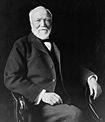
Andrew Carnegie
Andrew Carnegie was a Scottish-American industrialist, businessman, and entrepreneur who led the enormous expansion of the American steel industry in the late 19th century...
placed industrialist Henry Clay Frick
Henry Clay Frick
Henry Clay Frick was an American industrialist, financier, and art patron. He founded the H. C. Frick & Company coke manufacturing company, was chairman of the Carnegie Steel Company, and played a major role in the formation of the giant U.S. Steel steel manufacturing concern...
in charge of his company's operations in 1881. Frick resolved to break the union at Homestead. "The mills have never been able to turn out the product they should, owing to being held back by the Amalgamated men." he complained in a letter to Carnegie.
Carnegie was publicly in favor of labor unions. He condemned the use of strikebreakers and told associates that no steel mill was worth a single drop of blood. But Carnegie agreed with Frick's desire to break the union and "reorganize the whole affair, and . . . exact good reasons for employing every man. Far too many men required by Amalgamated rules." Carnegie ordered the Homestead plant to manufacture large amounts of inventory so the plant could weather a strike. He also drafted a notice (which Frick never released) withdrawing recognition of the union.
With the collective bargaining agreement due to expire on June 30, 1892, Frick and the leaders of the local AA union entered into negotiations in February. With the steel industry doing well and prices higher, the AA asked for a wage increase; the AA represented about 800 of the 3,800 workers at the plant. Frick immediately countered with a 22% wage decrease that would affect nearly half the union's membership and remove a number of positions from the bargaining unit. Carnegie encouraged Frick to use the negotiations to break the union: "...the Firm has decided that the minority must give way to the majority. These works, therefore, will be necessarily non-union after the expiration of the present agreement." Carnegie believed that the Amalgamated was a hindrance to efficiency; furthermore it was not representative of the workers. It admitted only a small group of skilled workers. It was in its own way an elitist, discriminatory organization that was not worthy of the Republic, Carnegie felt.
Frick announced on April 30, 1892 that he would bargain for 29 more days. If no contract was reached, Carnegie Steel would cease to recognize the union. Carnegie formally approved Frick's tactics on May 4. Then Frick offered a slightly better wage scale and advised the Superintendent to tell the workers, "We do not care whether a man belongs to a union or not, nor do we wish to interfere. He may belong to as many unions or organizations as he chooses, but we think our employees at Homestead Steel Works would fare much better working under the system in vogue at Edgar Thomson and Duquesne."
Lockout

Open hearth furnace
Open hearth furnaces are one of a number of kinds of furnace where excess carbon and other impurities are burnt out of the pig iron to produce steel. Since steel is difficult to manufacture due to its high melting point, normal fuels and furnaces were insufficient and the open hearth furnace was...
s on the evening of June 28. When no collective bargaining agreement was reached on June 29, Frick locked the union out of the rest of the plant. A high fence topped with barbed wire, begun in January, was completed and the plant sealed to the workers. Sniper towers with searchlights were constructed near each mill building, and high-pressure water cannons (some capable of spraying boiling-hot liquid) were placed at each entrance. Various aspects of the plant were protected, reinforced or shielded.
At a mass meeting on June 30, local AA leaders reviewed the final negotiating sessions and announced that the company had broken the contract by locking out workers a day before the contract expired. The Knights of Labor
Knights of Labor
The Knights of Labor was the largest and one of the most important American labor organizations of the 1880s. Its most important leader was Terence Powderly...
, which had organized the mechanics and transportation workers at Homestead, agreed to walk out alongside the skilled workers of the AA. Workers at Carnegie plants in Pittsburgh
Pittsburgh, Pennsylvania
Pittsburgh is the second-largest city in the US Commonwealth of Pennsylvania and the county seat of Allegheny County. Regionally, it anchors the largest urban area of Appalachia and the Ohio River Valley, and nationally, it is the 22nd-largest urban area in the United States...
, Duquesne
Duquesne, Pennsylvania
Duquesne is a city along the Monongahela River in Allegheny County, Pennsylvania, United States, and is part of the Pittsburgh Metropolitan Area. The population was 5,565 at the 2010 census.-History:...
, Union Mills and Beaver Falls
Beaver Falls, Pennsylvania
Beaver Falls is a city in Beaver County, Pennsylvania, United States. The population was 8,987 at the 2010 census. It is located 31 miles northwest of Pittsburgh, and on the Beaver River, six miles from its confluence with the Ohio River...
struck in sympathy the same day.
The Declaration of the Strike Committee, dated July 20, 1892 reads in part,
- “The employees in the mill of Messrs. Carnegie, Phipps & Co., at Homestead, Pa., have built there a town with its homes, its schools and its churches; have for many years been faithful co-workers with the company in the business of the mill; have invested thousands of dollars of their savings in said mill in the expectation of spending their lives in Homestead and of working in the mill during the period of their efficiency. . . . “Therefore, the committee desires to express to the public as its firm belief that both the public and the employees aforesaid have equitable rights and interests in the said mill which cannot be modified or diverted without due process of law; that the employees have the right to continuous employment in the said mill during efficiency and good behavior without regard to religious, political or economic opinions or associations; that it is against public policy and subversive of the fundamental principles of American liberty that a whole community of workers should be denied employment or suffer any other social detriment on account of membership in a church, a political party or a trade union; that it is our duty as American citizens to resist by every legal and ordinary means the unconstitutional, anarchic and revolutionary policy of the Carnegie Company, which seems to evince a contempt [for] public and private interests and a disdain [for] the public conscience. . . .”
The striking workers were determined to keep the plant closed. They secured a steam-powered river launch and several rowboats to patrol the Monongahela River
Monongahela River
The Monongahela River is a river on the Allegheny Plateau in north-central West Virginia and southwestern Pennsylvania in the United States...
, which ran alongside the plant. Men also divided themselves into units along military lines. Picket lines were thrown up around the plant and the town, and 24-hour shifts established. Ferries and trains were watched. Strangers were challenged to give explanations for their presence in town; if one was not forthcoming, they were escorted outside the city limits. Telegraph communications with AA locals in other cities were established to keep tabs on the company's attempts to hire replacement workers. Reporters were issued special badges which gave them safe passage through the town, but the badges were withdrawn if it was felt misleading or false information made it into the news. Tavern owners were even asked to prevent excessive drinking.
Frick was also busy. The company placed ads for replacement workers in newspapers as far away as Boston
Boston
Boston is the capital of and largest city in Massachusetts, and is one of the oldest cities in the United States. The largest city in New England, Boston is regarded as the unofficial "Capital of New England" for its economic and cultural impact on the entire New England region. The city proper had...
, St. Louis
St. Louis, Missouri
St. Louis is an independent city on the eastern border of Missouri, United States. With a population of 319,294, it was the 58th-largest U.S. city at the 2010 U.S. Census. The Greater St...
and even Europe.
But unprotected strikebreakers would be driven off. On July 4, Frick formally requested that Sheriff William H. McCleary intervene to allow supervisors access to the plant. Carnegie corporation attorney Philander Knox gave the go-ahead to the sheriff on July 5, and McCleary dispatched 11 deputies to the town to post handbills ordering the strikers to stop interfering with the plant's operation. The strikers tore down the handbills and told the deputies that they would not turn over the plant to nonunion workers. Then they herded the deputies onto a boat and sent them downriver to Pittsburgh.
Battle on July 6
After consultations with Knox, Frick in April 1892 had contracted with the Pinkerton National Detective AgencyPinkerton National Detective Agency
The Pinkerton National Detective Agency, usually shortened to the Pinkertons, is a private U.S. security guard and detective agency established by Allan Pinkerton in 1850. Pinkerton became famous when he claimed to have foiled a plot to assassinate president-elect Abraham Lincoln, who later hired...
to provide security at the plant. His intent was to open the works with nonunion men on July 6. Knox devised a plan to get the Pinkertons onto the mill property. With the mill ringed by striking workers, the agents would access the plant grounds from the river. Three hundred Pinkerton agents assembled on the Davis Island Dam on the Ohio River about five miles below Pittsburgh at 10:30 p.m. on the night of July 5, 1892. They were given Winchester rifle
Winchester rifle
In common usage, Winchester rifle usually means any of the lever-action rifles manufactured by the Winchester Repeating Arms Company, though the company has also manufactured many rifles of other action types...
s, placed on two specially-equipped barge
Barge
A barge is a flat-bottomed boat, built mainly for river and canal transport of heavy goods. Some barges are not self-propelled and need to be towed by tugboats or pushed by towboats...
s and towed upriver.
The strikers were prepared for them; the AA had learned of the Pinkertons as soon as they had left Boston for the embarkation point. The small flotilla of union boats went downriver to meet the barges. Strikers on the steam launch fired a few random shots at the barges, then withdrew—blowing the launch whistle to alert the plant. The strikers blew the plant whistle at 2:30 a.m., drawing thousands of men, women and children to the plant.
Pinkertons attempt to land
The Pinkertons attempted to land under cover of darkness about 4 a.m. A large crowd of families had kept pace with the boats as they were towed by a tug into the town. A few shots were fired at the tug and barges, but no one was injured. The crowd tore down the barbed-wire fence and strikers and their families surged onto the Homestead plant grounds. Some in the crowd threw stones at the barges, but strike leaders shouted for restraint.The Pinkerton agents attempted to disembark, and shots were fired. Conflicting testimony exists as to which side fired the first shot. According to at least one eyewitness, the unionists shot first. John T. McCurry, a boatman on the steamboat Little Bill (which had been hired by the Pinkerton Detective Agency to ferry its agents to the steel mill) and one of the men wounded by the strikers, said: "The armed Pinkerton men commenced to climb up the banks. Then the workmen opened fire on the detectives. The men shot first, and not until three of the Pinkerton men had fallen did they respond to the fire. I am willing to take an oath that the workmen fired first, and that the Pinkerton men did not shoot until some of their number had been wounded." But according to The New York Times
The New York Times
The New York Times is an American daily newspaper founded and continuously published in New York City since 1851. The New York Times has won 106 Pulitzer Prizes, the most of any news organization...
, the Pinkertons shot first. The newspaper reported that the Pinkertons opened fire and wounded William Foy, a worker. Regardless of which side opened fire first, the first two individuals wounded were Frederick Heinde, captain of the Pinkertons, and Foy. The Pinkerton agents aboard the barges then fired into the crowd, killing two and wounding 11. The crowd responded in kind, killing two and wounding 12. The firefight continued for about 10 minutes.
The strikers then huddled behind the pig and scrap iron in the mill yard, while the Pinkertons cut holes in the side of the barges so they could fire on any who approached. The Pinkerton tug departed with the wounded agents, leaving the barges stranded. The strikers soon set to work building a rampart of steel beams further up the riverbank from which they could fire down on the barges. Hundreds of women continued to crowd on the riverbank between the strikers and the agents, calling on the strikers to 'kill the Pinkertons'.

The Pinkertons attempted to disembark again at 8:00 a.m. A striker high up the riverbank fired a shot. The Pinkertons returned fire, and four more strikers were killed (one by shrapnel sent flying when cannon fire hit one of the barges). Many of the Pinkerton agents refused to participate in the firefight any longer; the agents crowded onto the barge farthest from the shore. More experienced agents were barely able to stop the new recruits from abandoning the ships and swimming away. Intermittent gunfire from both sides continued throughout the morning. When the tug attempted to retrieve the barges at 10:50 a.m., gunfire drove it off. More than 300 riflemen positioned themselves on the high ground and kept a steady stream of fire on the barges. Just before noon, a sniper shot and killed another Pinkerton agent.
After a few more hours, the strikers attempted to burn the barges. They seized a raft, loaded it with oil-soaked timber and floated it toward the barges. The Pinkertons nearly panicked, and a Pinkerton captain had to threaten to shoot anyone who fled. But the fire burned itself out before it reached the barges. The strikers then loaded a railroad flatcar with drums of oil and set it afire. The flatcar hurtled down the rails toward the mill's wharf where the barges were docked. But the car stopped at the water's edge and burned itself out. Dynamite
Dynamite
Dynamite is an explosive material based on nitroglycerin, initially using diatomaceous earth , or another absorbent substance such as powdered shells, clay, sawdust, or wood pulp. Dynamites using organic materials such as sawdust are less stable and such use has been generally discontinued...
was thrown at the barges, but it only hit the mark once (causing a little damage to one barge). At 2:00 p.m., the workers poured oil onto the river, hoping the oil slick would burn the barges; attempts to light the slick failed.
Calls for state intervention
The AA worked behind the scenes to avoid further bloodshed and defuse the tense situation. At 9:00 a.m., outgoing AA international president William Weihe rushed to the sheriff's office and asked McCleary to convey a request to Frick to meet. McCleary did so, but Frick refused. He knew that the more chaotic the situation became, the more likely it was that Governor Robert E. PattisonRobert E. Pattison
Robert Emory Pattison was the 19th Governor of Pennsylvania from 1883 to 1887 and 1891 to 1895. Born at Quantico in Somerset County, Maryland, Pattison's family moved to Philadelphia when he was five. He practiced law from 1872 to 1877 and was elected Controller of the city of Philadelphia in 1880...
would call out the state militia.
Sheriff McCleary resisted attempts to call for state intervention until 10 a.m. on July 7. In a telegram to Gov. Pattison, he described how his deputies and the Carnegie men had been driven off, and noted that the mob was nearly 5,000-strong. Pattison responded by requiring McCleary to exhaust every effort to restore the peace. McCleary asked again for help at noon, and Pattison responded by asking how many deputies the sheriff had. A third telegram, sent at 3:00 p.m., again elicited a response from the governor exhorting McCleary to raise his own troops.
Pinkerton surrender


The Pinkertons, too, wished to surrender. At 5:00 p.m., they raised a white flag and two agents asked to speak with the strikers. O'Donnell guaranteed them safe passage out of town. As the Pinkertons crossed the grounds of the mill, the crowd formed a gauntlet through which the agents passed. Men and women threw sand and stones at the Pinkerton agents, spat on them and beat them. Several Pinkertons were clubbed into unconsciousness. Members of the crowd ransacked the barges, then burned them to the waterline.
As the Pinkertons were marched through town to the Opera House (which served as a temporary jail), the townspeople continued to assault the agents. Two agents were beaten as horrified town officials looked on. The press expressed shock at the treatment of the Pinkerton agents, and the torrent of abuse helped turn media sympathies away from the strikers.
The strike committee met with the town council to discuss the handover of the agents to McCleary. But the real talks were taking place between McCleary and Weihe in McCleary's office. At 10:15 p.m., the two sides agreed to a transfer process. A special train arrived at 12:30 a.m. on July 7. McCleary, the international AA's lawyer and several town officials accompanied the Pinkerton agents to Pittsburgh.
But when the Pinkerton agents arrived at their final destination in Pittsburgh, state officials declared that they would not be charged with murder (as per the agreement with the strikers) but rather simply released. The announcement was made with the full concurrence of the AA attorney. A special train whisked the Pinkerton agents out of the city at 10:00 a.m. on July 7.
Arrival of the state militia
On July 7, the strike committee sent a telegram to Gov. Pattison to attempt to persuade him that law and order had been restored in the town. Pattison replied that he had heard differently. Union officials traveled to HarrisburgHarrisburg, Pennsylvania
Harrisburg is the capital of Pennsylvania. As of the 2010 census, the city had a population of 49,528, making it the ninth largest city in Pennsylvania...
and met with Pattison on July 9. Their discussions revolved not around law and order, but the safety of the Carnegie plant.
Pattison, however, remained unconvinced by the strikers' arguments. Although Pattison had ordered the Pennsylvania militia to muster on July 6, he had not formally charged it with doing anything. Pattison's refusal to act rested largely on his concern that the union controlled the entire city of Homestead and commanded the allegiance of its citizens. Pattison refused to order the town taken by force, for fear a massacre would occur. But once emotions had died down, Pattison felt the need to act. He had been elected with the backing of a Carnegie-supported political machine, and he could no longer refuse to protect Carnegie interests.
The steelworkers resolved to meet the militia with open arms, hoping to establish good relations with the troops. But the militia managed to keep its arrival in the town a secret almost to the last moment. At 9:00 a.m. on July 12, the Pennsylvania state militia arrived at the small Munhall train station near the Homestead mill (rather than the downtown train station as expected). More than 4,000 soldiers surrounded the plant. Within 20 minutes they had displaced the picketers; by 10:00 a.m., company officials were back in their offices. Another 2,000 troops camped on the high ground overlooking the city.
The company quickly brought in strikebreakers and restarted production under the protection of the militia. Despite the presence of AFL pickets in front of several recruitment offices across the nation, Frick easily found employees to work the mill. The company quickly built bunk houses, dining halls and kitchens on the mill grounds to accommodate the strikebreakers. New employees, many of them black, arrived on July 13, and the mill furnaces relit on July 15. When a few workers attempted to storm into the plant to stop the relighting of the furnaces, militiamen fought them off and wounded six with bayonets. But all was not well inside the plant. A race war between nonunion black and white workers in the Homestead plant broke out on July 22, 1892.
Desperate to find a way to continue the strike, the AA appealed to Whitelaw Reid
Whitelaw Reid
Whitelaw Reid was a U.S. politician and newspaper editor, as well as the author of a popular history of Ohio in the Civil War.-Early life:...
, the Republican
Republican Party (United States)
The Republican Party is one of the two major contemporary political parties in the United States, along with the Democratic Party. Founded by anti-slavery expansion activists in 1854, it is often called the GOP . The party's platform generally reflects American conservatism in the U.S...
candidate for vice president
Vice President of the United States
The Vice President of the United States is the holder of a public office created by the United States Constitution. The Vice President, together with the President of the United States, is indirectly elected by the people, through the Electoral College, to a four-year term...
, on July 16. The AA offered to make no demands or set any preconditions; the union merely asked that Carnegie Steel reopen the negotiations. Reid wrote to Frick, warning him that the strike was hurting the Republican ticket and pleading with him to reopen talks. Frick refused.
Attempted assassination and collapse of the strike
Frick, too, needed a way out of the strike. The company could not operate for long with strikebreakers living on the mill grounds, and permanent replacements had to be found.On July 18, the town was placed under martial law, further disheartening many of the strikers.
National attention became riveted on Homestead when, on July 23, Alexander Berkman
Alexander Berkman
Alexander Berkman was an anarchist known for his political activism and writing. He was a leading member of the anarchist movement in the early 20th century....
, a New York anarchist with no connection to steel or to organized labor, plotted with his lover Emma Goldman
Emma Goldman
Emma Goldman was an anarchist known for her political activism, writing and speeches. She played a pivotal role in the development of anarchist political philosophy in North America and Europe in the first half of the twentieth century....
to assassinate Frick. He came in from New York, gained entrance to Frick's office, then shot and stabbed the executive. Frick survived and continued his role; Berkman was sentenced to 22 years in prison.
The Berkman assassination attempt undermined public support for the union and prompted the final collapse of the strike. Hugh O'Donnell was removed as chair of the strike committee when he proposed to return to work at the lower wage scale if the unionists could get their jobs back. On August 12, the company announced that 1,700 men were working at the mill and production had resumed at full capacity. The national AFL
American Federation of Labor
The American Federation of Labor was one of the first federations of labor unions in the United States. It was founded in 1886 by an alliance of craft unions disaffected from the Knights of Labor, a national labor association. Samuel Gompers was elected president of the Federation at its...
refused to intervene, the East European workers ignored the union and it had no strategy left. The union voted to go back to work on Carnegie's terms; the strike had failed and the union had collapsed.
Legal battles
The company had waged a second front in state court, and was winning. On July 18, 16 of the strike leaders were charged with conspiracy, riot and murder. Each man was jailed for one night and forced to post a $10,000 bond. The union retaliated by charging company executives with murder as well. The company men, too, had to post a $10,000 bond, but they were not forced to spend any time in jail. One judge issued treason charges against the Advisory Committee on August 30 for making itself the law. Most of the men could not raise the bail bond, and went to jail or into hiding. A compromise was reached whereby both sides dropped their charges.The strike's conclusion
Support for the strikers evaporated. The AFL refused to call for a boycott of Carnegie products in September 1892. Wholesale crossing of the picket line occurred, first among Eastern European immigrants and then among all workers. The strike had collapsed so much that the state militia pulled out on October 13, ending the 95-day occupation. The AA was nearly bankrupted by the job action. Weekly Union relief for a member averaged $6.25 but totalled a staggering $10,000 per week when including 1,600 strikers. With only 192 out of more than 3,800 strikers in attendance, the Homestead chapter of the AA voted, 101 to 91, to return to work on November 20, 1892.In the end, only four workers were ever tried on the actual charges filed on July 18. Three AA members were found innocent of all charges. Hugh Dempsey, the leader of the local Knights of Labor District Assembly, was found guilty of conspiring to poison nonunion workers at the plant—despite the state's star witness recanting his testimony on the stand. Dempsey served a seven-year prison term. In February 1893, Knox and the union agreed to drop the charges filed against one another, and no further prosecutions emerged from the events at Homestead.
The striking AA affiliate in Beaver Falls gave in the same day as the Homestead lodge. The AA affiliate at Union Mills held out until August 14, 1893. But by then the union had only 53 members. The union had been broken; the company had been operating the plant at full capacity for almost a year, since September 1892.
Aftermath
The Homestead strike broke the AA as a force in the American labor movement. Many employers refused to sign contracts with their AA unions while the strike lasted. A deepening in 1889 of the Long DepressionLong Depression
The Long Depression was a worldwide economic crisis, felt most heavily in Europe and the United States, which had been experiencing strong economic growth fueled by the Second Industrial Revolution in the decade following the American Civil War. At the time, the episode was labeled the Great...
led most steel companies to seek wage decreases similar to those imposed at Homestead.
An organizing drive at the Homestead plant in 1896 was crushed by Frick. In May 1899, 300 Homestead workers actually formed an AA lodge, but Frick ordered the Homestead works shut down and the unionization effort collapsed. Carnegie Steel remained nonunion for the next 40 years.
De-unionization efforts throughout the Midwest began against the AA in 1897 when Jones and Laughlin Steel refused to sign a contract. By 1900, not a single steel plant in Pennsylvania remained union. The AA presence in Ohio and Illinois continued for a few more years, but the union continued to collapse. Many lodges disbanded, their members disillusioned. Others were easily broken in short battles. Carnegie Steel's Mingo Junction, Ohio
Mingo Junction, Ohio
Mingo Junction is a village in Jefferson County, Ohio, United States, along the Ohio River. The population was 3,631 at the 2000 census. In 1900, its only manufacturing plant was a steel mill owned by Carnegie Steel Company...
plant was the last major unionized steel mill in the country. But it, too, successfully withdrew recognition without a fight in 1903.
AA membership sagged to 10,000 in 1894 from its high of over 24,000 in 1891. A year later, it was down to 8,000. A 1901 strike against Carnegie's successor company, U.S. Steel
U.S. Steel
The United States Steel Corporation , more commonly known as U.S. Steel, is an integrated steel producer with major production operations in the United States, Canada, and Central Europe. The company is the world's tenth largest steel producer ranked by sales...
collapsed. By 1909, membership in the AA had sunk to 6,300. A nationwide steel strike of 1919
Steel strike of 1919
The Steel Strike of 1919 was an attempt by the weakened Amalgamated Association of Iron, Steel and Tin Workers to organize the United States steel industry in the wake of World War I. The strike began on September 22, 1919, and collapsed on January 8, 1920.The AA had formed in 1876. It was a...
also was unsuccessful.
The AA maintained a rump membership in the steel industry until its takeover by the Steel Workers Organizing Committee
Steel Workers Organizing Committee
The Steel Workers Organizing Committee was one of two precursor labor organizations to the United Steelworkers. It was formed by the CIO in 1936. It disbanded in 1942 to become the United Steel Workers of America....
in 1936. The two organizations officially disbanded and formed the United Steelworkers
United Steelworkers
The United Steel, Paper and Forestry, Rubber, Manufacturing, Energy, Allied Industrial and Service Workers International Union is the largest industrial labor union in North America, with 705,000 members. Headquartered in Pittsburgh, U.S., the United Steelworkers represents workers in the United...
May 22, 1942.
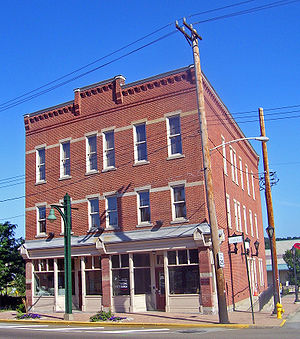
Bost Building
The Bost Building, also known as Columbia Hotel, is located on East Eighth Avenue in Homestead, Pennsylvania, United States. Built just before the 1892 Homestead Strike, it was used as headquarters by the Amalgamated Association of Iron and Steel Workers and for reporters covering the confrontation...
in downtown Homestead, AA headquarters throughout the strike, was designated a National Historic Landmark
National Historic Landmark
A National Historic Landmark is a building, site, structure, object, or district, that is officially recognized by the United States government for its historical significance...
. It is used as a museum devoted to not only the strike but the steel industry in the Pittsburgh area.
A railroad bridge over the Mononghaela near the site of the battle is named Pinkerton's Landing Bridge
Pinkerton's Landing Bridge
The Pinkerton's Landing Bridge is a truss bridge that carries CSX Transportation's Pittsburgh Subdivision across the Monongahela River between Munhall, Pennsylvania and Rankin, Pennsylvania, USA....
in honor of the dead.
Modern site
The pumphouse where the gunfight occurred remains as a museum and meeting hall. There are several historical markers as well as a metal commemorative sign with the US Steel logo that reads "In Honor Of The Workers."Further reading
- Bemis, Edward W. "The Homestead Strike," The Journal of Political Economy, Vol. 2, No. 3 (Jun., 1894), pp. 369–396 in JSTOR
- Brody, David. Steelworkers in America: The Nonunion Era. New York: Harper Torchbooks, 1969. ISBN 0-252-06713-4
- Cohen, Steven R. "Steelworkers Rethink the Homestead Strike of 1892," Pennsylvania History, 48 (April 1981), 155-77
- Demarest, David P. Jr., ed. "The River Ran Red": Homestead 1892 (1992).
- Foner, Philip. History of the Labor Movement in the United States. Vol. 2: From the Founding of the A.F. of L. to the Emergence of American Imperialism. New York: International Publishers, 1955. ISBN 0-7178-0092-X, a far-left perspective
- Krass, Peter. Carnegie. (2002). 612 pp., a standard scholarly biography, online edition
- Krause, Paul. The Battle for Homestead, 1890-1892: Politics, Culture, and Steel. Pittsburgh, PA: University of Pittsburgh Press, 1992. ISBN 0-8229-5466-4
- Krause, Paul. "Labor Republicanism and 'Za Clebom': Anglo-American and Slavic Solidarity in Homestead," in Struggle a Hard Battle": Essays on Working-Class Immigrants, edited by Dirk Hoerder (1986), 143-69
- Marcus, Irwin. Jeanne Bullard, and Rob Moore, "Change and Continuity: Steel Workers in Homestead, Pennsylvania, 1880-1895," Pennsylvania Magazine of History and Biography, 111 (January 1987), 62-75
- Miner, Curtis. Homestead: The Story of a Steel Town (Pittsburgh 1989)
- Oates, William C. "The Homestead Strike. I. A Congressional View," North American Review Vol. 155 Issue 430 (September 1892) pp. 355–376 online
- Warren, Kenenth. Triumphant Capitalism: Henry Clay Frick and the Industrial Transformation of America (2000)
- Wright, Carroll D. "The Amalgamated Association of Iron and Steelworkers," Quarterly Journal of Economics, 7 (July 1893), 400-32. in JSTOR