

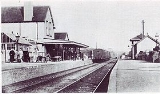
Holsworthy railway station

Encyclopedia
Holsworthy was a railway station on the now closed railway line from Okehampton to Bude. It opened in 1879 to serve the market town of Holsworthy
in Devon
and closed in 1966, a victim of the Beeching Axe
.
to Bude
had first been obtained as far back as 1865 with the passing of the Bude Canal and Launceston Junction Railway Act (c.cclxiii). However, this scheme was never put into action and the construction powers lapsed. In 1873 new powers were obtained by the Devon and Cornwall Railway in the shape of the Devon and Cornwall Railway (Western Extensions) Act (c.cxii) which authorised a line from Meldon Junction to Holsworthy where a terminus was to be constructed; Bude was not, at the time, considered important enough to warrant its own station. In 1874 the Devon and Cornwall Railway was purchased by the London and South Western Railway
(LSWR), commencing construction on the line the following year.
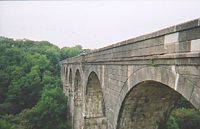 The station was opened along with the single track line on 20 January 1879 and the LSWR began operating a smart horse-bus service to Bude
in connection with the trains. The station was approached across Holsworthy Viaduct, a structure consisting of nine 50 ft spans and the first of its kind to be built entirely out of concrete.
By 1898 Bude had developed sufficiently for the LSWR, under pressure from local residents, to extend the line westwards to the coastal port. The new section opened on 11 August 1898 and necessitated the rebuilding of Holsworthy Station; little is known about the first station as no plans or photographs appear to exist of it. The new station was rather unusual in that it was situated between two viaducts—Holsworthy Viaduct to the east and Derriton Viaduct to the west. A new 20-lever signalbox was installed and the turntable
and engine shed from the earlier station were kept. The turntable lasted until 1 January 1911 when it was abolished, and the goods shed until the 1920s. The goods yard was unusually large and complicated for a local station such as Holsworthy and incorporated a run-around line to enable short trains to bypass the station without fouling the main line.
The station was served for many years by the Atlantic Coast Express
from London Waterloo, but this was withdrawn following the transfer of the line to the Western Region of British Railways
in January 1963. The withdrawal was a portent of worse to come as the station and line were proposed for closure by Richard Beeching
, Chairman of the British Transport Commission
, in his report published in March of that year. For the last few years of its life, the service to Holsworthy was operated entirely by Diesel Multiple Units working as "locals" between Okehampton and Bude.
, Barnstaple
and Great Torrington
; these towns are, at present, linked by buses which are "limited in respect of frequency of service". Connections to Exeter
and Plymouth
are even more limited, "often only weekly if available at all".
One means of alleviating the lack of facilities has been to provide for a cycleroute, the "Ruby Way" - part of the National Cycle Network
, along the trackbed of the former railway which opened in 2005, linking Holsworthy with Bude and Halwill
. The cycleway brought one of the viaducts (Derriton) back into public use. Both are now in the ownership of Sustrans
. Torridge District Council has indicated that the viaducts, as well as the trackbed, are safeguarded against future development in accordance with planning policies. Access to Derriton Viaduct is provided by the "Cornish Corkscrew", an elaborate spiralling ramp. In the meantime, Devon County Council have continued to support the development and extension of the cycleway project by purchasing further sections of trackbed and seeking to connect the Bude to Holsworthy route to other cyclepaths such as the Cornish Way at Helebridge.
The station buildings were swept away following the line's closure and the site, lying between Underlane, Bodmin Street and Station Road, was until recently derelict. It then became brownfield land
and is now the site of a Supermarket and part of a housing development. Nevertheless, the route of the cyclepath, which runs along the southern part of the site, will be protected and the Council has suggested that facilities be provided to serve the route's users, a possible suitable location being the site of the former turntable which is to the east of Chapel Street.
Holsworthy, Devon
Holsworthy is a market town in the north west of Devon, England. It is situated near the county border with Cornwall, and is 9 miles from the coastal resort of Bude. It is on the intersection of the A388 and A3072 roads, and lies on the River Deer, a tributary of the Tamar...
in Devon
Devon
Devon is a large county in southwestern England. The county is sometimes referred to as Devonshire, although the term is rarely used inside the county itself as the county has never been officially "shired", it often indicates a traditional or historical context.The county shares borders with...
and closed in 1966, a victim of the Beeching Axe
Beeching Axe
The Beeching Axe or the Beeching Cuts are informal names for the British Government's attempt in the 1960s to reduce the cost of running British Railways, the nationalised railway system in the United Kingdom. The name is that of the main author of The Reshaping of British Railways, Dr Richard...
.
History
Parliamentary authority to construct a line from OkehamptonOkehampton railway station
Okehampton railway station is a railway station serving the town of Okehampton in Devon, England. Heritage train services currently operate on certain weekdays, weekends and bank holidays...
to Bude
Bude railway station
Bude railway station was the western terminus of the Bude Branch. It was opened in 1898 by the London and South Western Railway to serve the coastal town of Bude and closed in 1966 after having been proposed for closure in the Beeching Report....
had first been obtained as far back as 1865 with the passing of the Bude Canal and Launceston Junction Railway Act (c.cclxiii). However, this scheme was never put into action and the construction powers lapsed. In 1873 new powers were obtained by the Devon and Cornwall Railway in the shape of the Devon and Cornwall Railway (Western Extensions) Act (c.cxii) which authorised a line from Meldon Junction to Holsworthy where a terminus was to be constructed; Bude was not, at the time, considered important enough to warrant its own station. In 1874 the Devon and Cornwall Railway was purchased by the London and South Western Railway
London and South Western Railway
The London and South Western Railway was a railway company in England from 1838 to 1922. Its network extended from London to Plymouth via Salisbury and Exeter, with branches to Ilfracombe and Padstow and via Southampton to Bournemouth and Weymouth. It also had many routes connecting towns in...
(LSWR), commencing construction on the line the following year.
Bude
Bude is a small seaside resort town in North Cornwall, England, at the mouth of the River Neet . It lies just south of Flexbury, north of Widemouth Bay and west of Stratton and is located along the A3073 road off the A39. Bude is twinned with Ergué-Gabéric in Brittany, France...
in connection with the trains. The station was approached across Holsworthy Viaduct, a structure consisting of nine 50 ft spans and the first of its kind to be built entirely out of concrete.
By 1898 Bude had developed sufficiently for the LSWR, under pressure from local residents, to extend the line westwards to the coastal port. The new section opened on 11 August 1898 and necessitated the rebuilding of Holsworthy Station; little is known about the first station as no plans or photographs appear to exist of it. The new station was rather unusual in that it was situated between two viaducts—Holsworthy Viaduct to the east and Derriton Viaduct to the west. A new 20-lever signalbox was installed and the turntable
Turntable (railroad)
A railway turntable is a device for turning railroad rolling stock. When steam locomotives were still in wide use, many railroads needed a way to turn the locomotives around for return trips as their controls were often not configured for extended periods of running in reverse and in many...
and engine shed from the earlier station were kept. The turntable lasted until 1 January 1911 when it was abolished, and the goods shed until the 1920s. The goods yard was unusually large and complicated for a local station such as Holsworthy and incorporated a run-around line to enable short trains to bypass the station without fouling the main line.
The station was served for many years by the Atlantic Coast Express
Atlantic Coast Express
The Atlantic Coast Express was an express passenger train in England between Waterloo station, London and seaside resorts in the south-west...
from London Waterloo, but this was withdrawn following the transfer of the line to the Western Region of British Railways
Western Region of British Railways
The Western Region was a region of British Railways from 1948. The region ceased to be an operating unit in its own right in the 1980s and was wound up at the end of 1992...
in January 1963. The withdrawal was a portent of worse to come as the station and line were proposed for closure by Richard Beeching
Richard Beeching
Richard Beeching, Baron Beeching , commonly known as Doctor Beeching, was chairman of British Railways and a physicist and engineer...
, Chairman of the British Transport Commission
British Transport Commission
The British Transport Commission was created by Clement Attlee's post-war Labour government as a part of its nationalisation programme, to oversee railways, canals and road freight transport in Great Britain...
, in his report published in March of that year. For the last few years of its life, the service to Holsworthy was operated entirely by Diesel Multiple Units working as "locals" between Okehampton and Bude.
Services
The station today
Holsworthy has experienced steady growth since the closure of its station in the 1960s. The population increased by 15% from 1981 to 1999 and was estimated at 2,116. The town (no longer a village) has also seen significant economic growth with the development of the Dobles Lane Industrial Estate to its north and the conversion of 4.6 hectares of land to industrial use between 1989 and 2000. However, the town suffers from a lack of public transport; as Torridge District Council recently stated, "Holsworthy is not well served by public transport", notably with regard to connections to BidefordBideford
Bideford is a small port town on the estuary of the River Torridge in north Devon, south-west England. It is also the main town of the Torridge local government district.-History:...
, Barnstaple
Barnstaple
Barnstaple is a town and civil parish in the local government district of North Devon in the county of Devon, England, UK. It lies west southwest of Bristol, north of Plymouth and northwest of the county town of Exeter. The old spelling Barnstable is now obsolete.It is the main town of the...
and Great Torrington
Great Torrington
Great Torrington is a small market town in the north of Devon, England. Parts of it are sited on high ground with steep drops down to the River Torridge below...
; these towns are, at present, linked by buses which are "limited in respect of frequency of service". Connections to Exeter
Exeter
Exeter is a historic city in Devon, England. It lies within the ceremonial county of Devon, of which it is the county town as well as the home of Devon County Council. Currently the administrative area has the status of a non-metropolitan district, and is therefore under the administration of the...
and Plymouth
Plymouth
Plymouth is a city and unitary authority area on the coast of Devon, England, about south-west of London. It is built between the mouths of the rivers Plym to the east and Tamar to the west, where they join Plymouth Sound...
are even more limited, "often only weekly if available at all".
One means of alleviating the lack of facilities has been to provide for a cycleroute, the "Ruby Way" - part of the National Cycle Network
National Cycle Network
The National Cycle Network is a network of cycle routes in the United Kingdom.The National Cycle Network was created by the charity Sustrans , and aided by a £42.5 million National Lottery grant. In 2005 it was used for over 230 million trips.Many routes hope to minimise contact with motor...
, along the trackbed of the former railway which opened in 2005, linking Holsworthy with Bude and Halwill
Halwill
Halwill is a village in Devon, England just off the A3079 Okehampton to Holsworthy road. About a mile away on the main road is another settlement called Halwill Junction....
. The cycleway brought one of the viaducts (Derriton) back into public use. Both are now in the ownership of Sustrans
Sustrans
Sustrans is a British charity to promote sustainable transport. The charity is currently working on a number of practical projects to encourage people to walk, cycle and use public transport, to give people the choice of "travelling in ways that benefit their health and the environment"...
. Torridge District Council has indicated that the viaducts, as well as the trackbed, are safeguarded against future development in accordance with planning policies. Access to Derriton Viaduct is provided by the "Cornish Corkscrew", an elaborate spiralling ramp. In the meantime, Devon County Council have continued to support the development and extension of the cycleway project by purchasing further sections of trackbed and seeking to connect the Bude to Holsworthy route to other cyclepaths such as the Cornish Way at Helebridge.
The station buildings were swept away following the line's closure and the site, lying between Underlane, Bodmin Street and Station Road, was until recently derelict. It then became brownfield land
Brownfield land
Brownfield sites are abandoned or underused industrial and commercial facilities available for re-use. Expansion or redevelopment of such a facility may be complicated by real or perceived environmental contaminations. Cf. Waste...
and is now the site of a Supermarket and part of a housing development. Nevertheless, the route of the cyclepath, which runs along the southern part of the site, will be protected and the Council has suggested that facilities be provided to serve the route's users, a possible suitable location being the site of the former turntable which is to the east of Chapel Street.