
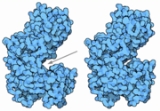
A
hexokinase is an
enzymeEnzymes are proteins that catalyze chemical reactions. In enzymatic reactions, the molecules at the beginning of the process, called substrates, are converted into different molecules, called products. Almost all chemical reactions in a biological cell need enzymes in order to occur at rates...
that
phosphorylatesPhosphorylation is the addition of a phosphate group to a protein or other organic molecule. Phosphorylation activates or deactivates many protein enzymes....
a six-carbon
sugarSugar is a class of edible crystalline carbohydrates, mainly sucrose, lactose, and fructose, characterized by a sweet flavor.Sucrose in its refined form primarily comes from sugar cane and sugar beet...
, a
hexoseIn organic chemistry, a hexose is a monosaccharide with six carbon atoms, having the chemical formula C6H12O6. Hexoses are classified by functional group, with aldohexoses having an aldehyde at position 1, and ketohexoses having a ketone at position 2....
, to a hexose phosphate. In most tissues and organisms,
glucoseGlucose is a simple sugar and an important carbohydrate in biology. Cells use it as the primary source of energy and a metabolic intermediate...
is the most important
substrateIn biochemistry, a substrate is a molecule upon which an enzyme acts. Enzymes catalyze chemical reactions involving the substrate. In the case of a single substrate, the substrate binds with the enzyme active site, and an enzyme-substrate complex is formed. The substrate is transformed into one or...
of hexokinases, and
glucose-6-phosphateGlucose 6-phosphate is glucose sugar phosphorylated on carbon 6. This compound is very common in cells as the vast majority of glucose entering a cell will become phosphorylated in this way....
the most important product.
Variation across species
Genes that encode hexokinase have been discovered in each domain of life, ranging from
bacteriaBacteria are a large domain of prokaryotic microorganisms. Typically a few micrometres in length, bacteria have a wide range of shapes, ranging from spheres to rods and spirals...
,
yeastYeasts are eukaryotic micro-organisms classified in the kingdom Fungi, with 1,500 species currently described estimated to be only 1% of all fungal species. Most reproduce asexually by mitosis, and many do so by an asymmetric division process called budding...
, and
plantPlants are living organisms belonging to the kingdom Plantae. Precise definitions of the kingdom vary, but as the term is used here, plants include familiar organisms such as trees, flowers, herbs, bushes, grasses, vines, ferns, mosses, and green algae. The group is also called green plants or...
s to humans and other
vertebrateVertebrates are animals that are members of the subphylum Vertebrata . Vertebrates are the largest group of chordates, with currently about 58,000 species described. Vertebrates include the jawless fishes, bony fishes, sharks and rays, amphibians, reptiles, mammals, and birds...
s. They are categorized as
actin fold proteins, sharing a common
ATPAdenosine-5'-triphosphate is a multifunctional nucleoside triphosphate used in cells as a coenzyme. It is often called the "molecular unit of currency" of intracellular energy transfer. ATP transports chemical energy within cells for metabolism...
binding site core surrounded by more variable sequences that determine substrate affinities and other properties. Several hexokinase isoforms or
isozymeIsozymes are enzymes that differ in amino acid sequence but catalyze the same chemical reaction. These enzymes usually display different kinetic parameters Isozymes (also known as isoenzymes) are enzymes that differ in amino acid sequence but catalyze the same chemical reaction. These enzymes...
s providing different functions can occur in a single
speciesIn biology, a species is one of the basic units of biological classification and a taxonomic rank. A species is often defined as a group of organisms capable of interbreeding and producing fertile offspring. While in many cases this definition is adequate, more precise or differing measures are...
. Hexokinase should not be confused with the liver's glucokinase. While hexokinase is capable of phosphorylating several hexoses, glucokinase acts with a 50-fold lower substrate affinity, and its only substrate is glucose.
Reaction
The intracellular reactions mediated by hexokinases can be typified as:
- Hexose-CH2OH + MgATP → Hexose-CH2O-PO + MgADP + H+
where hexose-CH
2OH represents any of several hexoses (like glucose) that contain an accessible -CH
2OH moiety.
Consequences of hexose phosphorylation
Phosphorylation of a hexose such as glucose often limits it to a number of intracellular metabolic processes, such as
glycolysisGlycolysis is the metabolic pathway that converts glucose C6H12O6, into pyruvate, CH3COCOO− + H+...
or
glycogenGlycogen is a molecule that serves as the secondary long-term energy storage in animal and fungal cells, with the primary energy stores being held in adipose tissue...
synthesis. Phosphorylation makes hexose unable to move or be transported out of the cell.
Size of different isoforms
Most bacterial hexokinases are approximately 50 kD in size. Multicellular organisms such as plants and animals often have more than one hexokinase isoform. Most are about 100 kD in size and consist of two halves (N and C terminal), which share much sequence homology. This suggests an evolutionary origin by duplication and fusion of a 50kD ancestral hexokinase similar to those of bacteria.
Types of mammalian hexokinase
There are four important
mammalMammals are members of a class of air-breathing vertebrate animals characterised by the possession of endothermy, hair, three middle ear bones, and mammary glands functional in mothers with young...
ian hexokinase isozymes that vary in subcellular locations and kinetics with respect to different substrates and conditions, and physiological function. They are designated hexokinases I, II, III, and IV or hexokinases A, B, C, and D.
Hexokinases I, II, and III
Hexokinases I, II, and III are referred to as "low-K
m" isozymes because of a high affinity for glucose even at low concentrations (below 1 mM). Hexokinases I and II follow
Michaelis-Menten kineticsIn biochemistry, Michaelis–Menten kinetics is one of the simplest and best-known models of enzyme kinetics. It is named after German biochemist Leonor Michaelis and Canadian physician Maud Menten. The model takes the form of an equation describing the rate of enzymatic reactions, by relating...
at physiologic concentrations of substrates. All three are strongly
inhibitedAn enzyme inhibitor is a molecule that binds to enzymes and decreases their activity. Since blocking an enzyme's activity can kill a pathogen or correct a metabolic imbalance, many drugs are enzyme inhibitors. They are also used as herbicides and pesticides...
by their product,
glucose-6-phosphateGlucose 6-phosphate is glucose sugar phosphorylated on carbon 6. This compound is very common in cells as the vast majority of glucose entering a cell will become phosphorylated in this way....
. Molecular weights are around 100 kD. Each consists of two similar 50kD halves, but only in hexokinase II do both halves have functional active sites.
- Hexokinase I/A is found in all mammalian tissues, and is considered a "housekeeping enzyme," unaffected by most physiological, hormonal, and metabolic changes.
- Hexokinase II/B constitutes the principal regulated isoform in many cell types and is increased in many cancers.
- Hexokinase III/C is substrate-inhibited by glucose at physiologic concentrations. Little is known about the regulatory characteristics of this isoform.
Hexokinase IV ("glucokinase")
Mammalian hexokinase IV, also referred to as
glucokinaseGlucokinase is an enzyme that facilitates phosphorylation of glucose to glucose-6-phosphate. Glucokinase occurs in cells in the liver, pancreas, gut, and brain of humans and most other vertebrates...
, differs from other hexokinases in kinetics and functions.
- The location of the phosphorylation
Phosphorylation is the addition of a phosphate group to a protein or other organic molecule. Phosphorylation activates or deactivates many protein enzymes....
on a subcellular level occurs when glucokinaseGlucokinase is an enzyme that facilitates phosphorylation of glucose to glucose-6-phosphate. Glucokinase occurs in cells in the liver, pancreas, gut, and brain of humans and most other vertebrates...
translocates between the cytoplasmThe cytoplasm is a small gel-like substance residing between the cell membrane holding all the cell's internal sub-structures , except for the nucleus. All the contents of the cells of prokaryote organisms are contained within the cytoplasm...
and nucleusIn cell biology, the nucleus is a membrane-enclosed organelle found in eukaryotic cells. It contains most of the cell's genetic material, organized as multiple long linear DNA molecules in complex with a large variety of proteins, such as histones, to form chromosomes. The genes within these...
of liverThe liver is a vital organ present in vertebrates and some other animals. It has a wide range of functions, including detoxification, protein synthesis, and production of biochemicals necessary for digestion...
cells. Glucokinase can only phosphorylate glucose if the concentration of this substrate is high enough; its Km for glucose is 100 times higher than that of hexokinases I, II, and III.
- It is monomeric, about 50kD, displays positive cooperativity with glucose, and is not allosterically inhibited by its product, glucose-6-phosphate.
It is present in the
liverThe liver is a vital organ present in vertebrates and some other animals. It has a wide range of functions, including detoxification, protein synthesis, and production of biochemicals necessary for digestion...
,
pancreasThe pancreas is a gland organ in the digestive and endocrine system of vertebrates. It is both an endocrine gland producing several important hormones, including insulin, glucagon, and somatostatin, as well as a digestive organ, secreting pancreatic juice containing digestive enzymes that assist...
,
hypothalamusThe Hypothalamus is a portion of the brain that contains a number of small nuclei with a variety of functions...
,
small intestineThe small intestine is the part of the gastrointestinal tract following the stomach and followed by the large intestine, and is where much of the digestion and absorption of food takes place. In invertebrates such as worms, the terms "gastrointestinal tract" and "large intestine" are often used to...
, and perhaps certain other neuroendocrine cells, and plays an important regulatory role in
carbohydrate metabolismCarbohydrate metabolism denotes the various biochemical processes responsible for the formation, breakdown and interconversion of carbohydrates in living organisms....
.
- In the beta cell
Beta cells are a type of cell in the pancreas located in the so-called islets of Langerhans. They make up 65-80% of the cells in the islets.-Function:...
s of the pancreatic isletThe islets of Langerhans are the regions of the pancreas that contain its endocrine cells. Discovered in 1869 by German pathological anatomist Paul Langerhans at the age of 22, the islets of Langerhans constitute approximately 1 to 2% of the mass of the pancreas...
s, it serves as a glucose sensor to control insulinInsulin is a hormone central to regulating carbohydrate and fat metabolism in the body. Insulin causes cells in the liver, muscle, and fat tissue to take up glucose from the blood, storing it as glycogen in the liver and muscle....
release, and similarly controls glucagonGlucagon, a hormone secreted by the pancreas, raises blood glucose levels. Its effect is opposite that of insulin, which lowers blood glucose levels. The pancreas releases glucagon when blood sugar levels fall too low. Glucagon causes the liver to convert stored glycogen into glucose, which is...
release in the alpha cellAlpha cells are endocrine cells in the islets of Langerhans of the pancreas. They make up 33-46% of the human islet cells and are responsible for synthesizing and secreting the peptide hormone glucagon, which elevates the glucose levels in the blood....
s.
- In hepatocyte
A hepatocyte is a cell of the main tissue of the liver. Hepatocytes make up 70-80% of the liver's cytoplasmic mass.These cells are involved in:* Protein synthesis* Protein storage* Transformation of carbohydrates...
s of the liver, glucokinase responds to changes of ambient glucose levels by increasing or reducing glycogen synthesis.
Hexokinase in glycolysis
Glucose is unique in that it can be used as an energy source by all cells in both the presence and absence of molecular oxygen (O
2). Glucose metabolism via the
metabolic pathwayIn biochemistry, metabolic pathways are series of chemical reactions occurring within a cell. In each pathway, a principal chemical is modified by a series of chemical reactions. Enzymes catalyze these reactions, and often require dietary minerals, vitamins, and other cofactors in order to function...
known as
glycolysisGlycolysis is the metabolic pathway that converts glucose C6H12O6, into pyruvate, CH3COCOO− + H+...
is importantly coupled to mitochondrial oxidative metabolism in the presence of oxygen, but glycolysis can also generate ATP in its absence. The first step in this sequence of reactions is the
phosphorylationPhosphorylation is the addition of a phosphate group to a protein or other organic molecule. Phosphorylation activates or deactivates many protein enzymes....
of glucose by hexokinase to prepare it for later breakdown in order to provide energy.
By catalyzing the phosphorylation of glucose to yield glucose 6-phosphate - the first
committed stepIn enzymology, the committed step is an effectively irreversible enzymatic reaction that occurs at a branch point during the biosynthesis of some molecules.-What it means:...
of glucose metabolism - hexokinases importantly maintain the downhill concentration gradient permitting facilitated glucose transport into cells. This reaction also initiates all physiologically relevant pathways of glucose utilization, including glycolysis and the pentose phosphate pathway. The addition of a charged
phosphateA phosphate, an inorganic chemical, is a salt of phosphoric acid. In organic chemistry, a phosphate, or organophosphate, is an ester of phosphoric acid. Organic phosphates are important in biochemistry and biogeochemistry or ecology. Inorganic phosphates are mined to obtain phosphorus for use in...
group at the 6-position of hexoses also ensures 'trapping' of glucose and 2-deoxyhexose glucose analogs (e.g. 2-deoxyglucose, and 2-fluoro-2-deoxyglucose) within cells, as charged hexose phosphates cannot easily cross the cell membrane.
Association with mitochondria
Hexokinases I and II can associate physically to the outer surface of the external membrane of mitochondria through specific binding to a porin, or voltage dependent anion channel. This association confers hexokinase direct access to ATP generated by mitochondria, which is one of the two substrates of hexokinase. Mitochondrial hexokinase is highly elevated in rapidly-growing malignant tumor cells, with levels up to 200 times higher than normal tissues. Mitochondrially-bound hexokinase has been demonstrated to be the driving force for the extremely high glycolytic rates that take place aerobically in tumor cells (the so-called Warburg effect described by
Otto Heinrich WarburgOtto Heinrich Warburg , son of physicist Emil Warburg, was a German physiologist, medical doctor and Nobel laureate. He served as an officer in the elite Uhlan during the First World War and won the Iron Cross for bravery. Warburg was one of the twentieth century's leading biochemists...
in 1930).
Hydropathy plot
The potential transmembrane portions of a protein can be detected by hydropathy analysis. A hydropathy analysis uses an algorithm that quantifies the hydrophobic character at each position along the polypeptide chain. One of the accepted hydropathy scales is that of Kyte and Doolittle which relies on the generation of hydropathy plots. In these plots, the negative numbers represent hydrophilic regions and the positive numbers represent hydrophobic regions on the y-axis. A potential transmembrane domain is about 20 amino acids long on the x-axis. Hexokinase has both hydrophilic and hydrophobic regions due to its folding. It appears as if hexokinase has one potential transmembrane domain located at about amino acid 400. Therefore, hexokinase is most likely not an integral membrane protein in yeast.
See also
- glucokinase
Glucokinase is an enzyme that facilitates phosphorylation of glucose to glucose-6-phosphate. Glucokinase occurs in cells in the liver, pancreas, gut, and brain of humans and most other vertebrates...
- glycolysis
Glycolysis is the metabolic pathway that converts glucose C6H12O6, into pyruvate, CH3COCOO− + H+...
- glycogen
Glycogen is a molecule that serves as the secondary long-term energy storage in animal and fungal cells, with the primary energy stores being held in adipose tissue...
- insulin
Insulin is a hormone central to regulating carbohydrate and fat metabolism in the body. Insulin causes cells in the liver, muscle, and fat tissue to take up glucose from the blood, storing it as glycogen in the liver and muscle....
- glucose 6-phosphatase
Glucose 6-phosphatase is an enzyme that hydrolyzes glucose-6-phosphate resulting in the creation of a phosphate group and free glucose. Glucose is then exported from the cell via glucose transporter membrane proteins...
- Fluorescent glucose biosensors