
All Topics  
Nissen hut

 
Nissen Hut

   Email Print
   Bookmark   Link


Nissen hut


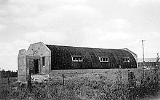
The Nissen hut is a prefabricated steel structure made from a half-cylindrical skin of corrugated steel
Steel

Steel is an alloy consisting mostly of iron, with a carbon content between 0.2% and 2.14% by weight , depending on grade. Carbon is the most cost-effective alloying material for iron, but various other alloying elements are used such as manganese, chromium, vanadium, and tungsten....
, a variant of which (the Quonset hut
Quonset hut

A Quonset hut is a lightweight prefabricated structure of corrugated galvanised iron having a semicircular cross section. The design was based on the Nissen hut developed by the British during World War I....
) was used extensively during the Second World War
World War II

World War II, or the Second World War , was a global military conflict which involved a Participants in World War II, including all of the great powers, organised into two opposing military alliances: the Allies of World War II and the Axis powers....
 by the Commonwealth
British Empire

The British Empire comprised the dominions, Crown colony, protectorates, League of Nations mandate, and other Dependent territory ruled or administered by the United Kingdom , that had originated with the overseas colonies and trading posts established by England in the late 16th and early 17th centuries....
 and U.S. military
Military of the United States

The United States Armed Forces are the overall unified armed forces of the United States. The United States military was first formed by the second Second Continental Congress to defend the new nation against the British Empire in the American Revolutionary War....
 to build army camps and airbases.

ssen hut is made from a sheet of metal bent into half a cylinder
Cylinder (geometry)

A cylinder is one of the most curvilinear basic geometric shapes: the surface formed by the points at a fixed distance from a given straight line, the axis of the cylinder....
 and planted in the ground with its axis horizontal.


Discussion
Ask a question about 'Nissen hut'
Start a new discussion about 'Nissen hut'
Answer questions from other users
Full Discussion Forum


Recent Posts


Encyclopedia


Pt Lincoln
The Nissen hut is a prefabricated steel structure made from a half-cylindrical skin of corrugated steel
Steel

Steel is an alloy consisting mostly of iron, with a carbon content between 0.2% and 2.14% by weight , depending on grade. Carbon is the most cost-effective alloying material for iron, but various other alloying elements are used such as manganese, chromium, vanadium, and tungsten....
, a variant of which (the Quonset hut
Quonset hut

A Quonset hut is a lightweight prefabricated structure of corrugated galvanised iron having a semicircular cross section. The design was based on the Nissen hut developed by the British during World War I....
) was used extensively during the Second World War
World War II

World War II, or the Second World War , was a global military conflict which involved a Participants in World War II, including all of the great powers, organised into two opposing military alliances: the Allies of World War II and the Axis powers....
 by the Commonwealth
British Empire

The British Empire comprised the dominions, Crown colony, protectorates, League of Nations mandate, and other Dependent territory ruled or administered by the United Kingdom , that had originated with the overseas colonies and trading posts established by England in the late 16th and early 17th centuries....
 and U.S. military
Military of the United States

The United States Armed Forces are the overall unified armed forces of the United States. The United States military was first formed by the second Second Continental Congress to defend the new nation against the British Empire in the American Revolutionary War....
 to build army camps and airbases.

Description

A Nissen hut is made from a sheet of metal bent into half a cylinder
Cylinder (geometry)

A cylinder is one of the most curvilinear basic geometric shapes: the surface formed by the points at a fixed distance from a given straight line, the axis of the cylinder....
 and planted in the ground with its axis horizontal. The hut was not precisely semi-circular as the bottom of the hut curved in slightly. The exterior was formed from curved corrugated steel
Steel

Steel is an alloy consisting mostly of iron, with a carbon content between 0.2% and 2.14% by weight , depending on grade. Carbon is the most cost-effective alloying material for iron, but various other alloying elements are used such as manganese, chromium, vanadium, and tungsten....
 sheets 10 foot 6 inches by 2 foot 2 inches laid with a two corrugation lap at the side and a 6 inch overlap at the ends. Three sheets covered the arc of the hut (about 54 sheets in all were required). These were attached to five, 3 inch x 2 inch wooden purlin
Purlin

In architecture or structural engineering, a purlin is a horizontal structural member in a roof. Purlins support the loads from the roof deck or sheathing and are supported by the principal rafters and/or the building walls....
s and 3 inch x 2 inch wooden spiking plates at the ends of the floor joists.

The purlins were attached to eight T shaped ribs (1¾ inches x 1¾ inches x 0.2 inch) set at 6 foot 0.5 inch centers. Each rib consisted of three sections bolted together using splice plates and each end was bolted to the floor at the bearers. With each rib were two straining wires, one on each side and a straining ratchet (or in some cases a simple fencing wire strainer). The wires were strained during construction. The straining wires do not appear in the original Nissen patent.

The purlins were attached to the ribs using a “hook” bolt, which hooked through a pre-drilled hole in the rib and was secured into the purlin. The hook bolt was a unique feature of the Nissen design.

Interior lining could be horizontal corrugated iron or material like Masonite
Masonite

Masonite is a type of hardboard invented by William H. Mason....
 attached to the ribs. The roof and lining form a circular space with a radius of 8 foot 0.5 inch, although because of the inward curve the floor was only 15 foot 10 inches. The space between the interior and exterior lining could be used for insulation and services if required.

The walls and floors rested on foundations consisting of 4 inch x 4 inch stumps with 15 x 9 inch sole plates. On these were 4 x 3 inch bearers and 4 x 2 inch joists at 2 foot 10 inch centers. The floor was made from tongue and groove floorboards. At East Hills and at Villawood the floor was concrete, the ribs in this case were simply attached to the concrete slab by a simple metal strap.

At either end the walls were made from a simple wooden frame with weatherboards nailed to the outside.

Windows and doors could be added to the sides by creating a simple dormer form through adding a simple frame to take the upper piece of corrugated iron and replacing the lower piece with a suitable frame for a door or window.

Nissen huts come in three internal spans, 16 ft (4.88 m), 24 ft (7.32 m) or 30 ft (9.15 m). The longitudinal bays come in multiples of 6 ft (1.83 m). The corrugated steel half-circles used to build Nissen huts can be stored efficiently, because the curved sheets can be cupped one inside another.

The Nissen hut is able to withstand earthquake
Earthquake

An earthquake is the result of a sudden release of energy in the Earth's crust that creates seismic waves. Earthquakes are recorded with a seismometer, also known as a seismograph....
s, because it has no weak right-angle bends between its wall
Wall

A wall is a usually solid structure that defines and sometimes protects an area. Most commonly, a wall delineates a building and supports its superstructure, separates space in buildings into Room s, or protects or delineates a space in the open air....
s, roof
Roof

A roof is the covering on the uppermost part of a building. A roof protects the building and its contents from the effects of weather. Structures that require roofs range from a letter box to a cathedral or stadium, dwellings being the most numerous....
 or foundation
Foundation (architecture)

A foundation is a structure that transfers loads to the earth. Foundations are generally broken into two categories: shallow foundations and deep foundations....
 and because of its circular shape.

History


It is not surprising that during the course of World War I a design for a prefabricated, portable multi-purpose hut was developed. Sometime between the 16th and 18h April 1916, Major Peter Norman Nissen
Peter Norman Nissen

Peter Norman Nissen , a Canadian mining engineer, developed the prefabricated shelter called the Nissen hut in 1916....
 of the 29th Company Royal Engineers began to experiment with hut designs. Nissen, a middle-aged mining engineer and inventor, constructed three prototype semi-circular huts. The semi-circular shape was derived from the drill-shed roof at Queen's University
Queen's University

Queen's University, generally referred to simply as Queen's, is a coeducational, non-sectarian, research intensive, public university located in Kingston, Ontario, Ontario, Canada....
, Kingston, Ontario
Kingston, Ontario

Kingston, Ontario is a Canadian city located at the eastern end of Lake Ontario, where the lake runs into the St. Lawrence River and the Thousand Islands begin....
. Nissen’s design was subject to intensive review by his fellow officers, Lieutenant Colonels Shelly, Sewell and McDonald, and General Liddell, which helped Nissen develop the design. After the third prototype was completed the design was formalized and the Nissen Hut was put into production in August 1916. At least 100,000 were produced in World War I (McCosh 1997:82-108).

Nissen patented his invention in the UK in 1916 and patents were taken out later in the USA, Canada, South Africa and Australia. Nissen received royalties from the British government not for huts made during the war but only for their sale after the conflict. Nissen got some £13,000 and the DSO
Distinguished Service Order

The Distinguished Service Order is a military decoration of the United Kingdom, and formerly of other Commonwealth of Nations countries, awarded for meritorious or distinguished service by officers of the armed forces during wartime, typically in actual combat....
.

Two factors influenced the design of the hut. First, the building had to be economic in its use of materials, especially considering war-time shortages of building material. Second, the building had to be portable. This was particularly important in view of the war-time shortages of shipping space. This led to a simple form that was prefabricated for ease of erection and removal. The Nissen hut could be packed in a standard Army wagon and erected by six men in four hours. The world record for erection was 1 hour 27min (McCosh 1997:108).

Production of the Nissen waned between the wars but was revived in 1939. Nissen Buildings Ltd waived their patent rights for war-time production. Similar shaped hut types were developed as well, notably the Romney Hut in the UK and the Quonset hut
Quonset hut

A Quonset hut is a lightweight prefabricated structure of corrugated galvanised iron having a semicircular cross section. The design was based on the Nissen hut developed by the British during World War I....
s in the USA. All types were mass produced in the thousands. The Nissen Hut was used for a wide range of functions, apart from accommodation they were used as churches and bomb stores, etc. (see Francis 1996, Innes 1998, 2000, Pullar 1997).

During World War Two the Nissen hut was produced along with a similar type, the Romney Hut. In the USA the Quonset hut and its derivatives were developed; the initial version was almost a copy of Nissen's design.

Accounts of life in the hut generally were not positive. Huts in the United Kingdom were frequently seen as cold and drafty while those in the Middle East, Asia and the Pacific were seen as stuffy and humid.

Although the prefabricated hut was conceived to meet war time demand for accommodation, similar situations, such as construction camps, are places where prefabricated buildings are useful. The Nissen hut was adapted into a prefabricated two-storey house and marketed by Nissen-Petren Ltd. The standard Nissen Hut was often recycled into housing (McCoash 1997:121-123). A similar approach was taken with the US Quonset Hut at the end of WWII with articles on how to adapt the buildings for domestic use appearing in Home Beautiful as well as Popular Mechanics.

However, the adaptation of the semi-circular hut to non-institutional uses was not popular. Neither the Nissen nor the Quonset developed into popular housing despite their low cost. One reason was the association with huts: a hut was not a house, with all the status a house implies. The second point was that rectangular furniture does not fit into a curved wall house very well, and thus the actual usable space in a hut might be much less than supposed.

See also

  • Earthquake construction
    Earthquake construction

    Earthquake construction is a branch of architectural engineering concerned with making sure structures can withstand as severe an earthquake shock as possible given the materials available....
  • World War II
    World War II

    World War II, or the Second World War , was a global military conflict which involved a Participants in World War II, including all of the great powers, organised into two opposing military alliances: the Allies of World War II and the Axis powers....
  • Italian Chapel
    Italian Chapel

    The Italian Chapel on Lamb Holm in Orkney, Scotland, was built by Italy prisoner of war captured in Africa during World War II. The prisoners were stationed on the island between 1942 and 1945 to help in construction of the Churchill Barriers at Scapa Flow....
  • Invasion of Iceland
    Invasion of Iceland

    The invasion of Iceland, codenamed Operation Fork, was a bloodless Military history of the United Kingdom military operation conducted by the Royal Navy and the Royal Marines during World War II....
  • Quonset hut
    Quonset hut

    A Quonset hut is a lightweight prefabricated structure of corrugated galvanised iron having a semicircular cross section. The design was based on the Nissen hut developed by the British during World War I....


External links

  • Image of a World War II USAAF
  • Nissen hut pictured at .