
All Topics  
Assembly line

 
Assembly Line

   Email Print
   Bookmark   Link


Assembly line


An assembly line is a manufacturing
Manufacturing

Manufacturing is the use of machine, tool and labor to make things for use or sale. The term may refer to a range of human activity, from handicraft to high tech, but is most commonly applied to Industry production, in which raw material are transformed into finished good on a large scale....
 process in which parts (usually interchangeable parts
Interchangeable parts

Interchangeable parts are components of any device designed to specifications which ensure that they will fit within any device of the same type....
) are added to a product in a sequential manner using optimally planned logistics to create a finished product much faster than with handcrafting-type methods. The best known form of the assembly line, the moving assembly line, was instituted by Ford Motor Company
Ford Motor Company

The Ford Motor Company is an United States multinational corporation and the world's List of automobile manufacturers#World Motor Vehicle Production by Manufacturer based on worldwide vehicle sales, following Toyota, General Motors, and Volkswagen Group....
 between 1908 and 1915, and made famous in the following decade by the social ramifications of mass production
Mass production

Mass production is the production of large amounts of standardized products, including and especially on assembly lines. The concepts of mass production are applied to various kinds of products, from fluids and particulates handled in bulk to discrete solid parts to assemblies of such parts ....
, such as the affordability of the Ford Model T
Ford Model T

The Ford Model T was an automobile produced by Henry Ford's Ford Motor Company from 1908 through 1927. The Model T set 1908 as the historic year that the automobile came into popular usage....
 and the introduction of high wages for Ford workers.


Discussion
Ask a question about 'Assembly line'
Start a new discussion about 'Assembly line'
Answer questions from other users
Full Discussion Forum


Encyclopedia


An assembly line is a manufacturing
Manufacturing

Manufacturing is the use of machine, tool and labor to make things for use or sale. The term may refer to a range of human activity, from handicraft to high tech, but is most commonly applied to Industry production, in which raw material are transformed into finished good on a large scale....
 process in which parts (usually interchangeable parts
Interchangeable parts

Interchangeable parts are components of any device designed to specifications which ensure that they will fit within any device of the same type....
) are added to a product in a sequential manner using optimally planned logistics to create a finished product much faster than with handcrafting-type methods. The best known form of the assembly line, the moving assembly line, was instituted by Ford Motor Company
Ford Motor Company

The Ford Motor Company is an United States multinational corporation and the world's List of automobile manufacturers#World Motor Vehicle Production by Manufacturer based on worldwide vehicle sales, following Toyota, General Motors, and Volkswagen Group....
 between 1908 and 1915, and made famous in the following decade by the social ramifications of mass production
Mass production

Mass production is the production of large amounts of standardized products, including and especially on assembly lines. The concepts of mass production are applied to various kinds of products, from fluids and particulates handled in bulk to discrete solid parts to assemblies of such parts ....
, such as the affordability of the Ford Model T
Ford Model T

The Ford Model T was an automobile produced by Henry Ford's Ford Motor Company from 1908 through 1927. The Model T set 1908 as the historic year that the automobile came into popular usage....
 and the introduction of high wages for Ford workers. However, the various preconditions for the development at Ford stretched far back into the 19th century, from the gradual realization of the dream of interchangeability, to the concept of reinventing workflow and job descriptions using analytical methods. Ford was the first company to build large factories
Factory

A factory or manufacturing plant is an industry building where workers manufacturing Good or supervise machines Process Manufacturing one product into another....
 around the concept. Mass production via assembly lines is widely considered to be the catalyst which initiated the modern consumer culture by making possible low unit-cost for manufactured goods. It is often said that Ford's production system was ingenious because it turned Ford's own workers into new customers. Put another way, Ford innovated its way to a lower price point and by doing so turned a huge potential market into a reality. Not only did this mean that Ford enjoyed much larger demand, but the resulting larger demand also allowed further economies of scale to be exploited, further depressing unit price, which tapped yet another portion of the demand curve
Supply and demand

...
. This bootstrapping quality of growth made Ford famous and set an example for other industries.

Concept

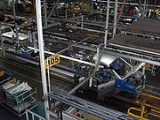
assembly line as of 2008]] Consider the assembly of a car: assume that certain steps in the assembly line are to install the engine, install the hood, and install the wheels (in that order, with arbitrary interstitial steps). A car on the assembly line can have only one of the three steps done at once. After the car has its engine installed, it moves on to having its hood installed, leaving the engine installation facilities available for the next car. The first car then moves on to wheel installation, the second car to hood installation, and a third car begins to have its engine installed. If engine installation takes 20 minutes, hood installation takes five minutes, and wheel installation takes 10 minutes, then finishing all three cars when only one car can be operated at once would take 105 minutes.

On the other hand, using the assembly line, the total time to complete all three cars is 75 minutes. This is possible because there are three different installation stations, an engine station, a hood station and a wheels station. By having three stations, a total of three different cars can be operated on at the same time, albeit involving different steps. After finishing on the first car, the engine installation crew can move to the second car. While the engine installation crew works on the second car, the first car can be moved to the hood station and then the wheels station, to be fitted with the hood and the wheels respectively. After the engine has been installed on the second car, the second car moves to the hood and then the wheels assembly (5 minutes after the wheels assembly is done with the first car). At the same time, the third car moves to the engine assembly. When the third car’s engine has been mounted, it then can be moved to the hood and then the wheels installation facilities; meanwhile, subsequent cars (if any) can be moved to the engine installation station. Because it takes 20 minutes to finish work on the engine while it takes only 15 minutes to complete the installation of both the hood and the wheels, the bottleneck is at the engine installation. Hence, cars will come off the assembly line at 20-minute intervals.

Assembly lines don't increase the speed of producing a single unit, but only increases rate when there is a stream of units to be produced. In the example above, a car will still require 35 minutes to be made; however, when there is a stream of cars it will only take 20 minutes to have each new car coming off the assembly line.

History

A Line1913

Overview: a culmination of many efforts

The assembly line concept was not "invented" at one time by one person, and no one person is the "father" of it. It has been independently redeveloped throughout history based on logic. Its exponentially larger development at the end of the 19th century and beginning of the 20th occurred among various people over decades, as other aspects of technology allowed.

The development of toolpath control via jigs
Jig (tool)

A jig is any of a large class of tools in woodworking, metalworking, and some other crafts that help to control the location or motion of a tool....
, fixtures
Fixture (tool)

A fixture is a tool of the manufacturing industry used in mass production. Fixtures are used to hold objects in place and clamp them to machines or operating surfaces, so that the object can be machined or assembled....
, and machine tool
Machine tool

A machine tool is a powered mechanical device, typically used to fabricate metal components of machines by machining, which is the selective removal of metal....
s (such as the screw-cutting lathe
Screw-cutting lathe

A screw-cutting lathe is a machine capable of cutting very accurate screw threads via single-point screw-cutting, which is the process of guiding the wikt:linear#Adjective motion of the tool bit in a precisely known ratio to the Rotation motion of the workpiece....
 and milling machine
Milling machine

A milling machine is a machine tool used for the shaping of metal and other solid materials. Its basic form is that of a rotating cutter which rotates about the spindle axis , and a table to which the workpiece is affixed....
) during the 19th century provided the prerequisites for the modern assembly line by making interchangeable parts
Interchangeable parts

Interchangeable parts are components of any device designed to specifications which ensure that they will fit within any device of the same type....
 a practical reality. Before the 20th century, most manufactured products were made individually by hand. A single craftsman or team of craftsmen would create each part of a product. They would use their skills and tools such as files
File (tool)

A file is a hand tool used to shape material by cutting. A file typically takes the form of a hardened steel bar, mostly covered with a series of sharp, parallel ridges or teeth....
 and knives to create the individual parts. They would then assemble them into the final product, making cut-and-try changes in the parts until they fit and could work together (the English System).

The assembly line evolved from these artisanal shops as division of labor and specialization took place. Electrification saw further advances in elementary assembly line production in the early 20th century. As electricity was increasingly used in factories as a more reliable, smoother and more precise form of power than previously available, it provided the means for the evolution of production through the automation of the assembly line. With the creation of unit drive motors, factories could be reorganized and the modern assembly line took shape with the optimal ordering and location of different parts of the production process. Large efficiency gains from assembly line production could then be realized.

The transition from prototypical to the modern assembly line thus took place as creativity and logic took advantage of the opportunities that technological changes presented. The prototypical forms of assembly lines in various industries, are outlined below.

The Terracotta Army (circa 215 BC)

The Terracotta Army
Terracotta Army

The Terracotta Army are the Terracotta Warriors and Horses of Qin Shi Huang the First Emperor of China. The terracotta figures, dating from 210 BC, were discovered in 1974 by several local farmers near Xi'an, Shanxi province, China near the Mausouleum of the First Qin Emperor....
 commissioned by the first Chinese Emperor Qin Shi Huangdi is a collection of about 8000 life-sized clay soldiers and horses buried with the emperor. The figures had their separate body parts manufactured by different workshops that were later assembled to completion. Notably, each workshop inscribed its name on the part they manufactured to add traceability for quality control.

Venetian Arsenal (1500s)

At the peak of its efficiency in the early 16th century, the Venetian Arsenal
Venetian Arsenal

The Venetian Arsenal is a shipyard and naval depot that played a leading role in Venetian empire-building. It was one of the most important areas of Venice, lying in the Castello, Venice sestiere ....
 employed some 16,000 people who apparently were able to produce nearly one ship each day, and could fit out, arm, and provision a newly-built galley with standardized parts on an assembly-line basis not seen again until the Industrial Revolution
Industrial Revolution

The Industrial Revolution was a period in the late 18th and early 19th centuries when major changes in agriculture, manufacturing, production, and transportation had a profound effect on the socioeconomics and cultural conditions in United Kingdom....
.

Block production at Portsmouth: Brunel, Maudslay, et al (1800-1820s)

Probably the first linear and continuous assembly line of post-Renaissance times was created in 1801 by Marc Isambard Brunel
Marc Isambard Brunel

Sir Marc Isambard Brunel, Royal Society was a France-born engineer who settled in the United Kingdom. He preferred the name Isambard, but is generally known to history as Marc to avoid confusion with his more famous son Isambard Kingdom Brunel....
 (father of Isambard Kingdom Brunel
Isambard Kingdom Brunel

Isambard Kingdom Brunel, Fellow of the Royal Society , was a United Kingdom engineer. He is best known for the creation of the Great Western Railway, a series of famous steamships, including the first with a propeller, and numerous important bridges and tunnels....
), with the help of Henry Maudslay
Henry Maudslay

Henry Maudslay was a United Kingdom machine tool innovator, tool and die maker, and inventor. He is considered a founding father of machine tool technology....
 and others, for the production of blocks
Block (sailing)

In sailing, a block is a single or multiple pulley. One or a number of sheaves are enclosed in an assembly between cheeks or chocks....
 for the Royal Navy
Royal Navy

The Royal Navy of the United Kingdom is the oldest of the British Armed Forces . From the mid-18th century until well into the 20th century, it was the most powerful navy in the world, playing a key part in establishing the British Empire as the dominant world power from 1815 until the early 1940s....
. This assembly line was so successful it remained in use until the 1960s, with the workshop still visible at HM Dockyard in Portsmouth, and still containing some of the original machinery.

Eli Whitney (1780s-1820s)

Eli Whitney
Eli Whitney

Eli Whitney was an American inventor best known as the inventor of the cotton gin. This was one of the key inventions of the industrial revolution and shaped the economy of the antebellum South....
 is sometimes credited with developing the armory system
American system of manufacturing

The American system of manufacturing involves semi-skilled labor using machine tools and Stencils to make standardized, identical, interchangeable parts, manufactured to a tolerance ....
 of manufacturing in 1801, using the ideas of division of labor, engineering tolerance
Tolerance (engineering)

Engineering tolerance is the permissible limit of variation in# a physical dimension,# a measured value or physical property of a material, manufacturing object, system, or service,...
, and interchangeable parts to create assemblies from parts in a repeatable manner. But Whitney's contribution was mostly as a popularizer rather than "the inventor" of repeatability. He was probably inspired by several others (including Honoré Blanc
Honoré Blanc

Honor? Blanc was a French gunsmith and a pioneer of the use of interchangeable parts. His career spanned the decades from circa 1770 to 1801, a time period that included the reigns of Louis XV of France and Louis XVI of France, the American Revolution , the French Revolution, and the French First Republic....
), or at least by the contemporary zeitgeist that was building around such ideas. Thomas Jefferson
Thomas Jefferson

Thomas Jefferson was the List of Presidents of the United States President of the United States , the principal author of the United States Declaration of Independence , and one of the most influential Founding Fathers of the United States for his promotion of the ideals of republicanism in the United States....
 had tried to bring a French mechanic (who was almost certainly Blanc) and his methods to America in 1785, but the project never went anywhere. A few years later, Whitney and his American contemporaries succeeded in introducing the relevant concepts (interchangeable parts, toolpath control via machine tools and jigs, transfer of skill to the equipment, allowing use of semi-skilled or unskilled machine operators) to American firearm manufacture.

Meatpacking Industry (1860s)

The meatpacking industry of Chicago is believed to be one of the first industrial assembly lines (or dis-assembly lines) to be utilized in the United States starting in 1867. Workers would stand at fixed stations and a pulley system would bring the meat to each worker and they would complete one task. Henry Ford said in his autobiography My Life and Work that it was a "visit to a Chicago slaughterhouse which opened his eyes to the virtues of employing a moving conveyor system and fixed work stations in industrial applications".

Firearms, clocks, et al (1860s-1890s)

The Industrial Revolution in Western Europe and North America, but perhaps most especially in Great Britain
Great Britain

Great Britain is an island lying to the northwest of Continental Europe. It is the List of islands by area, and the largest in Europe. With a population of 58.9 million people it is List of islands by population....
 and New England
New England

New England is a region of the United States located in the northeastern corner of the country, bounded by the Atlantic Ocean, Canada and New York State, and consisting of the modern U.S....
, led to a proliferation of manufacturing and invention. Many industries, notably textile
Textile

A textile is a flexible material consisting of a network of natural or artificial fibres often referred to as thread or yarn. Yarn is produced by Spinning raw wool fibres, linen, cotton, or other material on a spinning wheel to produce long strands known as yarn....
s, firearm
Firearm

A firearm is a tool that projects either single or multiple projectiles at high velocity through a controlled explosion. The firing is achieved by the gases produced through rapid, confined combustion of a propellant....
s, clocks and watches, button
Button

In clothing and fashion design, a button is a small disc, typically round, object usually attached to an article of clothing in order to secure an opening, or for fashion....
s, horse-drawn vehicle
Horse-drawn vehicle

Horse-drawn vehicles were once common worldwide, but they have mostly been replaced by automobiles and other forms of self-propelled transport....
s, railroad car
Railroad car

A railroad car or railway carriage is a vehicle on a rail transport that is used for the carrying of cargo or passengers. Cars can be coupled together into a train and hauled by one or more locomotive....
s and locomotive
Locomotive

A locomotive is a Rail transport vehicle that provides the motive power for a train. The word originates from the Latin language loco - "from a place", Ablative case of locus, "place" + Medieval Latin motivus, "causing motion", and is a shortened form of the term locomotive engine,....
s, sewing machine
Sewing machine

A sewing machine is a textile machine used to stitch fabric or other material together with thread. Sewing machines were invented during the first Industrial Revolution to decrease the amount of manual sewing work performed in clothing companies....
s, and bicycle
Bicycle

The bicycle, bike, or cycle is a pedal-driven, human-powered transport with two bicycle wheel attached to a bicycle frame, one behind the other....
s, saw expeditious improvement in materials handling, machining, and assembly during the 19th century, although modern concepts such as industrial engineering
Industrial engineering

Industrial engineering is also known as operations management, management science, systems engineering, or manufacturing engineering; a distinction that seems to depend on the viewpoint or motives of the user....
 and logistics
Logistics

Logistics is the management of the flow of goods, information and other resources, including energy and people, between the point of origin and the point of consumption in order to meet the requirements of consumers ....
 had not yet been named.

Ransom E. Olds (1890s-1900s)

Ransom Olds
Ransom E. Olds

Ransom Eli Olds was a pioneer of the American automotive industry, for whom both the Oldsmobile and REO Motor Car Company brands were named. He claimed to have built his first steam car as early as 1894, and his first gasoline powered car in 1896....
 patented the assembly line concept, which he put to work in his Olds Motor Vehicle Company factory in 1901, becoming the first company in America to mass-produce automobiles. This development is often overshadowed by the independent redevelopment of assembly-line work at Ford Motor Company a few years later (see below), which introduced the ramifications of the method to a wider audience. The work of Olds shows clearly the flaws in the oversimplistic storyline of Ford's having "invented" the assembly line.

Ford Motor Company (1908-1915)

The assembly line developed for the Ford Model T had immense influence on the world. Despite oversimplistic attempts to attribute it to one man or another, it was in fact a composite development based on logic that took 7 years and plenty of intelligent men. The principal leaders are discussed below.

The basic kernel of an assembly line concept was introduced to Ford Motor Company
Ford Motor Company

The Ford Motor Company is an United States multinational corporation and the world's List of automobile manufacturers#World Motor Vehicle Production by Manufacturer based on worldwide vehicle sales, following Toyota, General Motors, and Volkswagen Group....
 by William "Pa" Klann upon his return from visiting a Chicago slaughterhouse and viewing what was referred to the "disassembly line", where animals were butchered as they moved along a conveyor. The efficiency of one person removing the same piece over and over caught his attention. He reported the idea to Peter E. Martin
Peter E. Martin

Peter Edmund Martin was a leading early production executive of the Ford Motor Company.Peter E. Martin was hired by close Henry Ford associate C....
, soon to be head of Ford production, who was doubtful at the time but encouraged him to proceed. Others at Ford have claimed to have put the idea forth to Henry Ford
Henry Ford

Henry Ford was the United States founder of the Ford Motor Company and father of modern assembly lines used in mass production. His introduction of the Model T History of the automobile revolutionized transportation and American industry....
, but Pa Klann's slaughterhouse revelation is well documented in the archives at the Henry Ford Museum and elsewhere, making him an important contributor to the modern automated assembly line concept. The process was an evolution by trial and error of a team consisting primarily of Peter E. Martin
Peter E. Martin

Peter Edmund Martin was a leading early production executive of the Ford Motor Company.Peter E. Martin was hired by close Henry Ford associate C....
, the factory superintendent; Charles E. Sorensen
Charles E. Sorensen

Charles Emil Sorensen was a Danish-American principal of the Ford Motor Company during its first four decades. Like most other managers at Ford during those decades, he did not have an official Corporate title, but he served functionally as a Pattern , Foundry, Mechanical engineering, Industrial engineering, production manager, and executive...
, Martin's assistant; C. Harold Wills, draftsman and toolmaker; Clarence W. Avery
Clarence W. Avery

Clarence Willard Avery was a driving force behind Ford Motor Company's moving assembly line, and was president and chairman of auto-body supplier Murray Corporation....
; and Charles Ebender. Some of the groundwork for such development had recently been laid by the intelligent layout of machine tool
Machine tool

A machine tool is a powered mechanical device, typically used to fabricate metal components of machines by machining, which is the selective removal of metal....
 placement that Walter Flanders
Walter Flanders

Walter Emmett Flanders was a United States industrialist in the machine tool and automotive industry industries and was an early mass production expert....
 had been doing at Ford up to 1908.

In 1922 Ford (via his ghostwriter Crowther) said of his 1913 assembly line, "I believe that this was the first moving line ever installed. The idea came in a general way from the overhead trolley that the Chicago packers use in dressing beef."

Charles E. Sorensen
Charles E. Sorensen

Charles Emil Sorensen was a Danish-American principal of the Ford Motor Company during its first four decades. Like most other managers at Ford during those decades, he did not have an official Corporate title, but he served functionally as a Pattern , Foundry, Mechanical engineering, Industrial engineering, production manager, and executive...
, in his 1956 memoir My Forty Years with Ford, presented a different version of development that was not so much about individual “inventors” as a gradual, logical development of industrial engineering:

“Years later in My Life and Work, a book which was written for him, Mr. Ford said that the conveyor-assembly idea occurred to him after watching the reverse process in packing houses where hogs and steers were triced up by hind legs on an overhead conveyor and disassembled. This is a rationalization long after the event. Mr. Ford had nothing to do with originating, planning, and carrying out the assembly line. He encouraged the work, his vision to try unorthodox methods was an example to us; and in that there is glory enough for all.”

“Henry Ford had no ideas on mass production. He wanted to build a lot of autos. He was determined but, like everyone else at that time, he didn’t know how. In later years he was glorified as the originator of the mass production idea. Far from it; he just grew into it, like the rest of us. The essential tools and the final assembly line with its many integrated feeders resulted from an organization which was continually experimenting and improvising to get better production.”

“What was worked out at Ford was the practice of moving the work from one worker to another until it became a complete unit, then arranging the flow of these units at the right time and the right place to a moving final assembly line from which came a finished product. Regardless of earlier uses of some of these principles, the direct line of succession of mass production and its intensification into automation stems directly from what we worked out at Ford Motor Company between 1908 and 1913. [¶] Henry Ford is generally regarded as the father of mass production. He was not. He was the sponsor of it.” [Sorensen explains that Henry Ford did not invent all the aspects of mass production, but he knew that production efficiency meant low unit price, and so he encouraged his engineers to develop the methods.]

“Today historians describe the part the Ford car played in the development of that era and in transforming American life. We see that now. But we didn’t see it then; we weren’t as smart as we have been credited with being. All that we were trying to do was to develop the Ford car. [¶] The achievement came first. Then came logical expression of its principles and philosophy.”

Much has been written about the original layout of the assembly line at Ford. In an article published by Fortune Magazine in June 1944, Henry Ford said that he and Peter E. Martin did it.

As a result of these developments in method, Ford's cars came off the line in three minute intervals. This was much faster than previous methods, increasing production by eight to one (requiring 12.5 man-hours before, 1 hour 33 minutes after), while using less manpower. It was so successful, paint
Paint

Paint is any liquid, liquifiable, or mastic composition which after application to a Substrate in a thin layer is converted to an opaque solid film....
 became a bottleneck. Only Japan black
Japan Black

Japan Black is the name of a lacquer or varnish used for metal, particularly iron. Because of its high bitumen content the coating provided a protective finish that was relatively durable and dried quickly....
 would dry fast enough, forcing the company to drop the variety of colors available before 1914, until fast-drying Duco
Duco

Duco was a trade name assigned to a product line of automotive lacquer developed by the DuPont Company in the 1920s. Under the Duco brand, DuPont introduced the first quick drying multi-color line of lacquers especially for the automotive industry....
 lacquer
Lacquer

In a general sense, lacquer is a clear or coloured varnish that dries by solvent evaporation and often a curing process as well that produces a hard, durable finish, in any sheen level from ultra matte to high Gloss and that can be further polished as required....
 was developed in 1926. In 1914, an assembly line worker could buy a Model T with four months' pay.

Ford's complex safety procedures—especially assigning each worker to a specific location instead of allowing them to roam about—dramatically reduced the rate of injury. The combination of high wages and high efficiency is called "Fordism
Fordism

Fordism, named after Henry Ford, refers to various social theory about production and related socio-economic phenomena. It has varying but related meanings in different fields, as well as for Marxist and non-Marxist scholars....
," and was copied by most major industries. The efficiency gains from the assembly line also coincided with the take-off of the United States. The assembly line forced workers to work at a certain pace with very repetitive motions which led to more output per worker while other countries were using less productive methods.

Ford at one point considered suing other car companies because they used the assembly line in their production, but decided against, realizing it was essential to creation and expansion of the industry as a whole.

In the automotive industry, its success was dominating, and quickly spread worldwide. Ford France and Ford Britain in 1911, Ford Denmark 1923, Ford Germany 1925; in 1921, Citroen
Citroën

Citro?n is a France automobile manufacturer, founded in 1919 by Andr? Citro?n, it was the world's first mass-production car company outside of the USA....
 was the first native European manufacturer to adopt it. Soon, companies had to have assembly lines, or risk going broke by not being able to compete; by 1930, 250 companies which did not had disappeared.

Sociological problems


Sociological
Sociology

Sociology is a branch of the social sciences that uses systematic methods of Empiricism and critical theory to develop and refine a body of knowledge about human social structure and activity, sometimes with the goal of applying such knowledge to the pursuit of social welfare....
 work has explored the social alienation
Social alienation

In sociology and critical social theory, alienation refers to an individual's estrangement from traditional community and others in general. It is considered by many that the Atomism of modernity means that individuals have shallower relations with other people than they would normally....
 and boredom
Boredom

Boredom is an emotional state experienced during periods lacking activity or when individuals are uninterested in the activities surrounding them....
 that many workers feel because of the repetition of doing the same specialized task all day long. Because workers have to stand in the same place for hours and repeat the same motion hundreds of times per day, repetitive stress injuries
Repetitive strain injury

Repetitive strain injury , also known as Cumulative Trauma Disorder , occupational overuse syndrome, non-specific arm pain or work related upper limb disorder , is the most recent manifestation of illness concepts that link use of the arm to injury or disease....
 are a possible pathology of occupational safety. Industrial noise
Industrial noise

Industrial noise is usually considered mainly from the point of view of environmental health and safety, rather than nuisance, as sustained exposure can cause permanent hearing damage....
 also proved dangerous. When it was not too high, workers were often prohibited from talking. Charles Piaget, a skilled worker at the LIP factory, recalled that beside being prohibited from speaking, the semi-skilled workers had only 25 centimeters in which to move. Industrial ergonomics
Ergonomics

Ergonomics is the scientific discipline concerned with designing according to human needs, and the profession that applies theory, principles, data and methods to design in order to optimize human well-being and overall system performance....
 later tried to minimize physical trauma.

See also

  • Production line
    Production line

    File:Krispy Kreme Doughnuts.jpgA production line is a set of sequential operations established in a factory whereby materials are put through a refining process to produce an end-product that is suitable for onward consumption; or components are assembled to make a finished article....
  • Industrial engineering
    Industrial engineering

    Industrial engineering is also known as operations management, management science, systems engineering, or manufacturing engineering; a distinction that seems to depend on the viewpoint or motives of the user....


Bibliography

Various republications, including ISBN 9781406500189. Original is public domain in U.S. . }}. Various republications, including ISBN 9780814332795.
  • We-Min Chow (1990). Assembly Line Design.


External links