
All Topics  
Ford Model T

 
Ford Model T

   Email Print
   Bookmark   Link


Ford Model T


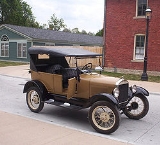
The Ford Model T (colloquially known as the Tin Lizzie and Flivver) was an automobile
Automobile

An automobile or motor car is a wheeled motor vehicle for transportation passengers, which also carries its own car engine or motor. Most definitions of the term specify that automobiles are designed to run primarily on roads, to have seating for one to eight people, to typically have four wheels, and to be constructed principally f...
 produced by Henry Ford
Henry Ford

Henry Ford was the United States founder of the Ford Motor Company and father of modern assembly lines used in mass production. His introduction of the Model T History of the automobile revolutionized transportation and American industry....
's Ford Motor Company
Ford Motor Company

The Ford Motor Company is an United States multinational corporation and the world's List of automobile manufacturers#World Motor Vehicle Production by Manufacturer based on worldwide vehicle sales, following Toyota, General Motors, and Volkswagen Group....
 from 1908 through 1927. The Model T set 1908 as the historic year that the automobile came into popular usage. It is generally regarded as the first affordable automobile, the car that "put America on wheels"; some of this was because of Ford's innovations, including assembly line
Assembly line

An assembly line is a manufacturing process in which parts are added to a product in a sequential manner using optimally planned logistics to create a finished product much faster than with handcrafting-type methods....
 production instead of individual hand crafting, as well as the concept of paying the workers a wage proportionate to the cost of the car, so that they would provide a ready made market.


Discussion
Ask a question about 'Ford Model T'
Start a new discussion about 'Ford Model T'
Answer questions from other users
Full Discussion Forum


Recent Posts


Encyclopedia


1908 Ford Model T
The Ford Model T (colloquially known as the Tin Lizzie and Flivver) was an automobile
Automobile

An automobile or motor car is a wheeled motor vehicle for transportation passengers, which also carries its own car engine or motor. Most definitions of the term specify that automobiles are designed to run primarily on roads, to have seating for one to eight people, to typically have four wheels, and to be constructed principally f...
 produced by Henry Ford
Henry Ford

Henry Ford was the United States founder of the Ford Motor Company and father of modern assembly lines used in mass production. His introduction of the Model T History of the automobile revolutionized transportation and American industry....
's Ford Motor Company
Ford Motor Company

The Ford Motor Company is an United States multinational corporation and the world's List of automobile manufacturers#World Motor Vehicle Production by Manufacturer based on worldwide vehicle sales, following Toyota, General Motors, and Volkswagen Group....
 from 1908 through 1927. The Model T set 1908 as the historic year that the automobile came into popular usage. It is generally regarded as the first affordable automobile, the car that "put America on wheels"; some of this was because of Ford's innovations, including assembly line
Assembly line

An assembly line is a manufacturing process in which parts are added to a product in a sequential manner using optimally planned logistics to create a finished product much faster than with handcrafting-type methods....
 production instead of individual hand crafting, as well as the concept of paying the workers a wage proportionate to the cost of the car, so that they would provide a ready made market. The first production Model T was built on September 27, 1908, at the Piquette Plant
Piquette Plant

The Ford Piquette Avenue Plant is located at 411 Piquette Avenue in Detroit, Michigan, within the Piquette Avenue Industrial Historic District. It was the second home of Ford Motor Company automobile production....
 in Detroit, Michigan
Detroit, Michigan

Detroit is the largest city in the U.S. state of Michigan and the county seat of Wayne County, Michigan. Detroit is a major port city on the Detroit River, in the Midwestern United States of the United States....
.

There were several cars produced or prototyped by Henry Ford from the founding of the company in 1903 until the Model T came along. Although he started with the Model A
Ford Model A (1903)

The original Ford Model A was the first car produced by Ford Motor Company, beginning production in 1903. Dr. Ernst Pfenning of Chicago, Illinois became the first owner of a Model A on July 23, 1903....
, there were not 19 production models (A through T); some were only prototypes. The production model immediately before the Model T was the Ford Model S, an upgraded version of the company's largest success to that point, the Model N
Ford Model N

The Ford Model N was an inexpensive automobile produced by the Ford Motor Company. It was introduced in 1906 as a successor to the Models Ford Model A , Ford Model C and Ford Model F as the company's inexpensive entry-level line....
. The follow-up was the Ford Model A
Ford Model A (1927)

The Ford Model A was the second huge success for the Ford Motor Company, after its predecessor, the Ford Model T. First produced on October 20, 1927, but not sold until December 2, it replaced the venerable Model T, which had been produced for 18 years....
 and not the Model U. Company publicity said this was because the new car was such a departure from the old that Henry wanted to start all over again with the letter A. As it happens, the first Plymouth
Plymouth (automobile)

Plymouth was a marque of automobile based in the United States, marketed by the Chrysler Corporation and DaimlerChrysler....
 car (1928), built by competitor Chrysler Corporation, was named the Model U.

The Ford Model T was named the world's most influential car of the twentieth century
Car of the Century

The Car of the Century was an international award given to the world's most influential car of the twentieth century. The election process was overseen by the Global Automotive Elections Foundation....
 in an international poll. Henry Ford said of the vehicle:
I will build a car for the great multitude. It will be large enough for the family, but small enough for the individual to run and care for. It will be constructed of the best materials, by the best men to be hired, after the simplest designs that modern engineering can devise. But it will be low in price that no man making a good salary will be unable to own one - and enjoy with his family the blessing of hours of pleasure in God's great open spaces.


Characteristics

The Ford Model T car was designed by Childe Harold Wills and two Hungarian
Hungary

Hungary , officially in English the Republic of Hungary , is a landlocked country in the Carpathian Basin of Central Europe, bordered by Austria, Slovakia, Ukraine, Romania, Serbia, Croatia, and Slovenia....
 immigrants Joseph A. Galamb
Joseph A. Galamb

J?zsef Galamb mechanical engineer was born in Mak?, Hungary.Galamb finished his education in Budapest at the predecessor of the present-day Don?t B?nki Technical College....
 and Eugene Farkas. Also, Harry Love, C. J. Smith, Gus Degner and Peter E. Martin
Peter E. Martin

Peter Edmund Martin was a leading early production executive of the Ford Motor Company.Peter E. Martin was hired by close Henry Ford associate C....
 were part of the team. While production of the Model T began in 1908, model years range from 1909 to 1927.

Engine and means of starting


The Model T had a front mounted, 177 in3 (2.9 L) four-cylinder
Straight-4

The straight-4 or inline-4 engine is a four cylinder internal combustion engine with all four cylinder mounted in a straight line along the crankcase....
 en bloc motor (that is, all four in one block, as common now, rather than in individual castings, as common then) producing 20.2 hp (15 kW) for a top speed of 40-45 mph (64-72 km/h). The small four cylinder engine was known for its L heads. According to Ford Motor, the Model T had fuel economy on the order of 13 to 21 mpg (5 to 9 kilometres per litre or 11.1 to 18.7 litres per 100 km). The engine was capable of running on gasoline or ethanol
Ethanol

Ethanol, also called ethyl alcohol, pure alcohol, grain alcohol, or drinking alcohol, is a volatility , flammable, colorless liquid....
, though the decreasing cost of gasoline and the later introduction of Prohibition in the United States
Prohibition in the United States

In the history of the United States, Prohibition is the period from 1920 to 1933, during which the sale, manufacture, and transportation of Alcoholic beverage for consumption were banned nationally as mandated in the Eighteenth Amendment to the United States Constitution....
 made ethanol an impractical fuel.

While Ford experimented with the idea of using alcohol in the Model T, there was never a production Model T sold that could have been operated on alcohol. Henry Ford is quoted as saying: “We have found that 160-proof alcohol works very well in the ordinary gas engine on our cars and tractors”. And “Using alcohol in an ordinary Ford car, we are able to get 15 per cent more power than with the present gasoline”. This statement is often cited out of context as proof that Ford made a production Model T capable of operating on Ethanol, when in fact it was only an unsuccessful experiment that was conducted many years after the design of the engine.

Henry Ford's experiments were an attempt to show that a farmer could raise corn, make ethanol from the corn to power his tractors and trucks, and still have enough remaining corn to sell at a profit. The experiment was not successful on an economic and practical basis.

Spurious accounts of an Atchison, Kansas Ethanol plant being operated by Henry Ford are found on many web sites but there is no contemporary evidence that Ford or any entity of Ford Motor Company had any involvement.

A flywheel magneto
Magneto (electrical)

This article is about an electrical generator component used in engine and some old telephones. For other uses of the term, see Magneto . A magneto is a device used in the ignition system of gasoline-powered internal combustion engines to provide pulses of high voltage electrical power to the spark plugs....
 (broadly equivalent to a modern alternator) produced low voltage alternating current
Alternating current

In alternating current the movement of electric charge periodically reverses direction. An electric charge would for instance move forward, then backward, then forward, then backward, over and over again....
 to power a trembler coil, which created a high voltage current. This ignition pulse was passed to the timer (analogous to a distributor
Distributor

A distributor is a device in the ignition system of an internal combustion engine that routes high voltage from the ignition coil to the spark plugs in the correct firing order....
 in a modern vehicle) and redistributed to the firing cylinder. Ignition timing was adjusted manually by using the spark advance lever mounted on the steering column which rotated the timer. A battery could be used for starting current: at hand-cranking speed, the magneto did not always produce sufficient current. A certain amount of skill and experience was required to find the optimal timing for any speed and load. When electric headlights were introduced in 1915, the magneto was upgraded to supply power for the lights and horn. In keeping with the goal of ultimate reliability and simplicity, the trembler coil and magneto ignition system was retained even after the car became equipped with a generator and battery for electric starting and lighting. Most cars sold after 1919 were equipped with electric starting, which was engaged by a small round pedal on the floor in front of the driver's seat. Before starting a Model T with the hand crank
Crank (mechanism)

A crank is an arm at right angles to a shaft , by which motion is imparted to or received from the shaft; it is also used to change circular into reciprocating motion, or reciprocating into circular motion....
, the spark had to be manually retarded or the engine might "kick back". The crank handle was cupped in the palm, rather than grabbed with the thumb over the top of the handle, so that if the engine did kick back, the rapid reverse motion of the crank would throw the hand away from the handle, rather than violently twisting the wrist or breaking the thumb. Most Model T Fords had the choke operated by a wire emerging from the bottom of the radiator where it could be operated with the left hand while cranking the engine with the right hand. The car's 10 gallon (38 litre) fuel tank was mounted to the frame beneath the front seat; one variant had the carburetor
Carburetor

A carburetor or carburettor , is a device that blends Earth's atmosphere and fuel for an internal combustion engine. It was invented by Karl Benz before 1885 and patented in 1886....
 (a Holley
Holley Performance Products

Holley Performance Products is an automobile performance company based out of Bowling Green, Kentucky. They produce mostly internal combustion engine modification products, and among the company's owned divisions are popular brand names such as Nitrous Oxide Systems , FlowTech, and Hooker Headers....
 Model G) modified to run on ethyl alcohol
Ethanol fuel

Ethanol fuel is ethanol , the same type of alcohol found in alcoholic beverages. It can be used as a fuel, mainly as a biofuel alternative to gasoline, and is widely used in cars in Ethanol fuel in Brazil....
, to be made at home by the self-reliant farmer. Because fuel relied on gravity to flow forward from the fuel tank to the carburetor, a Model T could not climb a steep hill when the fuel level was low. The immediate solution was often to drive up steep hills in reverse. In 1926, the fuel tank was moved forward to under the cowl on most models.

Early on the engine blocks were to be produced by the Lakeside Foundry
Lakeside Foundry

The Lakeside Foundry was based in Detroit, Michigan, United States. It still stands, although is no longer in business. It is on Newcastle St. South of Jefferson between Jefferson and Freud between St....
 on St. Jean in Detroit. Ford cancelled the deal before many engine blocks were produced. While the first few hundred Model Ts had a water pump, its use was abandoned early in production. Ford opted for a cheaper and more reliable circulation system based on the thermo-syphon principle. Hot water, being less dense, would rise to the top of the engine and up into the top of the radiator, descending to the bottom as it cooled, and back into the engine. This was the direction of water flow in most makes of cars even when they did have water pumps, until the introduction of |crossflow radiator
Radiator (engine cooling)

Radiators are used for cooling internal combustion engines, chiefly in #Automobiles but also in #Aircraft, railway locomotives, motorcycles, stationary generating plant or any similar use of such an engine....
 designs. Water pumps were also available as an aftermarket accessory for Model T.

1925

Transmission and drivetrain

The Model T was a rear-wheel drive vehicle. Its transmission was a planetary gear type billed as "three speed". By today's standards it would be considered a two speed, since one of the three speeds was actually reverse.

The Model T's transmission was controlled with three foot pedals and a lever that was mounted to the road side of the driver's seat. The throttle was controlled with a lever on the steering wheel. The left pedal was used to engage the gear. When pressed and held forward the car entered low gear. When held in an intermediate position the car was in neutral, a state that could also be achieved by pulling the floor-mounted lever to an upright position. If the lever was pushed forward and the driver took his foot off the left pedal, the Model T entered high gear. The car could thus cruise without the driver having to press any of the pedals. There was no separate clutch pedal. The middle pedal was used to engage reverse gear, and the right pedal operated the engine brake. The floor lever also controlled the parking brake, which was activated by pulling the lever all the way back. This doubled as an emergency brake. Although it was extremely uncommon, the drive bands could fall out of adjustment, allowing the car to creep, particularly when cold, adding another hazard to attempting to start the car: a person cranking the engine could be forced backward while still holding the crank as the car crept forward even though it was nominally in neutral. Power reached the differential
Differential

Differential may refer to:...
 through a single universal joint
Universal joint

A universal joint, U joint, Gerolamo Cardano joint, Hardy-Clarence W. Spicer joint, or Hooke's joint is a joint in a rigid rod that allows the rod to 'bend' in any direction, and is commonly used in shafts that transmit rotary motion....
 attached to a torque tube
Torque tube

A torque tube system is an automobile driveshaft technology, used in cars with a front engine and rear drive. It is not as widespread as the Hotchkiss drive, but is still occasionally used to this day....
 which drove the rear axle; some models (typically trucks) could be equipped with an optional two speed rear axle shifted by a floor mounted lever. All gears were vanadium steel
Vanadium

Vanadium is the chemical element with the symbol V and atomic number 23. It is a soft, silvery grey, ductile transition metal. The formation of an oxide layer stabilizes the metal against oxidation....
 running in an oil bath.
Ford Model T Suspension

Suspension and wheels

Model T suspension employed a transversely mounted semi-elliptical spring for each of the front and rear axles, which were "live
Live axle

A live axle, sometimes called a solid axle, is a type of beam axle suspension that uses the driveshafts that transmit power to the wheels to connect the wheels laterally so that they move together as a unit....
", i.e., not an independent suspension
Independent suspension

Independent suspension is a broad term for any automobile suspension system that allows each wheel on the same axle to move vertically independently of each other....
. The front axle was drop forge
Forging

Forging is the term for shaping metal by using localized compressive forces. Cold forging is done at room temperature or near room temperature....
d as a single piece of vanadium steel. Ford twisted many axles eight times and sent them to dealers to be put on display to demonstrate its superiority. The Model T did not have a modern service brake. The right foot pedal applied a band around a drum in the transmission, thus stopping the rear wheels from turning. The previously mentioned parking brake lever operated band brake
Band brake

A band brake is a measuring device for loading a rotating shaft and measuring the torque applied to it and is mainly used to determine brake horsepower....
s on the outside of the rear brake drums. Wheels were wooden artillery wheel
Artillery wheel

The artillery wheel was developed for use on gun carriages when it was found that the lateral forces involved in horse artillery manoeuvres caused normally-constructed cart wheels to collapse....
s, with steel welded-spoke (not truly wire) wheels available in 1926 and 1927. Tires were pneumatic 30 in (76 cm) in diameter, 3.5 in (8.9 cm) wide in the rear, 2 in (5 cm) in the front. The old nomenclature for tire size changed from 30×3 to 21" (rim diameter) × 4.50 (tire width). Wheelbase
Wheelbase

In both road and rail vehicles, the wheelbase is the distance between the centers of the front and rear wheels....
 was 99 inches; while standard tread width was 56 in (142 cm), 60 in (152 cm) tread could be obtained on special order, "for Southern roads".

Design changes


There were few major changes throughout the life of this model; early ones had a brass radiator and headlights. The horn and numerous small parts were also brass. Many of the early cars were open-bodied touring car
Touring car

A touring car was a popular car body style in the early 20th century, being a larger alternative to the runabout and the roadster. They were open cars, often fitted with convertible tops....
s and runabouts, these being cheaper to make than closed cars. Prior to the 1911 model year (when front doors were added to the touring model), U.S.-made open cars did not have an opening door for the driver. Later models included closed cars (introduced in 1915), sedans, coupes and trucks. The chassis was available so trucks could be built to suit. Ford also developed some truck bodies for this chassis, designated the Model TT
Ford Model TT

The Ford Model TT truck was rated at one ton. It was based on the Ford Model T, but with a heavier frame and rear axle. It was often equipped with a 'ruckstell axle' or some other accessory gearbox which allowed the truck to have an intermediate gear between low and high, which was useful for hill climbing....
. The headlights were originally acetylene
Acetylene

Acetylene is the chemical compound with the symbol carbonhydrogen. It is the simplest alkyne.As an alkyne, acetylene is Saturation because its two carbon atoms are Chemical bond together in a triple bond....
 lamps made of brass (commonly using Prest-O-Lite tanks), but eventually the car gained electric lights. The Model T originally employed some advanced technology, for example, its use of vanadium steel. Its durability was phenomenal, and many Model Ts and their parts were still in use 80 years later.

Colors

Henry Ford is commonly reputed to have made the statement "Any customer can have a car painted any color that he wants so long as it is black." Actually, Model Ts in different colors were produced from 1908 to 1914, and then again from 1926 to 1927. It is often stated that Ford chose black because the paint dried faster than other colored paints available at the time, and a faster drying paint would allow him to build cars faster since he would not have to wait as long for the paint to dry. Over thirty different types of black paint were used on various parts of the Model T. These were formulated to satisfy the different means of applying the paint to the various parts, and they had distinct drying times, depending on the part, the paint, and the method of drying. Ford engineering documents suggest black was chosen because it was cheap and durable.

Production


Mass production

Tmodel Launch Geelong


The Model T was the first automobile mass produced
Mass production

Mass production is the production of large amounts of standardized products, including and especially on assembly lines. The concepts of mass production are applied to various kinds of products, from fluids and particulates handled in bulk to discrete solid parts to assemblies of such parts ....
 on assembly lines with completely interchangeable parts, marketed to the middle class
American middle class

File:A monument of working class.JPGThe American middle class is an Ambiguity defined social class in the United States. While the concept remains largely ambiguous in popular opinion and common language use, contemporary sociologists have put forward several, more or less congruent, theories on the American middle class....
.

When introduced, the T used the building methods typical at the time, assembly by hand, and production was small. Ford's Piquette plant could not keep up with demand for the Model T, and only 11 cars were built there during the first full month of production. In 1910, after assembling nearly 12,000 Model Ts, Henry Ford moved the company to the new Highland Park complex
Highland Park Ford Plant

The Highland Park Ford Plant was a production plant for Ford Motor Company in the city of Highland Park, Michigan, which is surrounded by Detroit....
.

The assembly line
Assembly line

An assembly line is a manufacturing process in which parts are added to a product in a sequential manner using optimally planned logistics to create a finished product much faster than with handcrafting-type methods....
 was introduced to Ford by William C. Klann upon his return from visiting a slaughterhouse at Chicago
Chicago

Chicago is the largest city in the U.S. state of Illinois and the Midwestern United States, as well as the List of United States cities by population city in the United States with more than 2.8 million residents....
's Union Stock Yards
Union Stock Yards

The Union Stock Yard & Transit Co., or The Yards, operated in the New City, Chicago Community areas of Chicago of Chicago, Illinois for 106 years, helping the city become known as "hog butcher for the world" and the center of the American meat packing industry for decades....
 and viewing what was referred to as the "disassembly line" where animals were cut apart as they moved along a conveyor. The efficiency of one person removing the same piece over and over caught his attention. He reported the idea to Peter E. Martin
Peter E. Martin

Peter Edmund Martin was a leading early production executive of the Ford Motor Company.Peter E. Martin was hired by close Henry Ford associate C....
, who was doubtful at the time, but encouraged him to proceed. Others at Ford have claimed to have put the idea forth to Henry Ford, but William "Pa" Klann's slaughterhouse revelation is well documented in the archives at the Henry Ford Museum and elsewhere, making him the father of the modern automated assembly line concept. The process was an evolution by trial and error of a team consisting primarily of Peter E. Martin, the factory superintendent; Charles E. Sorensen
Charles E. Sorensen

Charles Emil Sorensen was a Danish-American principal of the Ford Motor Company during its first four decades. Like most other managers at Ford during those decades, he did not have an official Corporate title, but he served functionally as a Pattern , Foundry, Mechanical engineering, Industrial engineering, production manager, and executive...
, Martin's assistant; Harold Wills, draftsman and toolmaker; Clarence W. Avery; and Charles Lewis
Charles Lewis

Charles Lewis may refer to:* Charles Lewis , former Western Australian politician for the electoral district of Canning* Charles Lewis , Belizean cyclist of the 1990s...
. When the first car was completed using the assembly line, in front of the media, onlookers and even Henry Ford, it was Pa Klann who drove it proudly off the line.

As a result, Ford's cars came off the line in three minute intervals, much faster than previous methods, increasing production by eight to one (requiring 12.5 hours before, 93 minutes afterwards), while using less manpower.

By 1914, the assembly process for the Model T had been so streamlined it took only 93 minutes to assemble a car. That year Ford produced more cars than all other automakers combined. The Model T was a great commercial success, and by the time Henry made his 10 millionth car, 10 percent of all cars in the entire world were Fords. In fact, it was so successful that Ford did not purchase any advertising between 1917 and 1923; in total, more than 15 million Model Ts were manufactured, more than any other model of its day. Model T production was finally surpassed by the Volkswagen Beetle on February 17, 1972.

Henry Ford's eccentric approach to research and development meant few changes to the vehicle were made over its lifetime; he believed the Model T was all the car a person would, or could, ever need. As other companies offered comfort and styling advantages, at competitive prices, the Model T lost market share. Eventually, on May 26, 1927, Ford Motor Company ceased production and began the changeovers required to produce the Model A.

Model T engines continued to be produced until August 4, 1941. Almost 170,000 engines were built after car production stopped. Replacement engines were required to continue to service already produced vehicles. Racers and enthusiasts, forerunners of modern hot rodders, used the Model T's block to build popular and cheap racing engines, including Cragar, Navarro, and famously the Frontenacs ("Fronty Fords") of the Chevrolet
Chevrolet

Chevrolet is a brand of automobile, produced by General Motors . It is the top selling GM marque, with "Chevrolet" or "Chevy" being at times synonymous with GM....
 brothers, among many others.

Price

The standard 4-seat open tourer of 1909 cost US$850 (about £180 at the time, equivalent to $/£ today), when competing cars often cost $2,000-$3,000 (equivalent to $-$ today); in 1913, the price dropped to $550 (equivalent to $ today), and $440 in 1915 (equivalent to $ today). Sales were 69,762 in 1911, 170,211 in 1912, 202,667 in 1913, 308,162 in 1914, and 501,462 in 1915. In 1914, an assembly line worker could buy a Model T with four months' pay.

By the 1920s, the price had fallen to $300 (equivalent to $ today) because of increasing efficiencies of assembly line technique and volume. Henry employed vertical integration
Vertical integration

In microeconomics and management, the term vertical integration describes a style of management control. Vertically integrated companies are united through a hierarchy with a common owner....
 of the industries needed to create his cars. He specified how to make the wood crates that outside suppliers used to ship him parts. Then he disassembled the crates and used the preformed wood pieces in the bodies of his cars. He also used wood scraps to make charcoal and sold it under the brand name Kingsford
Kingsford (charcoal)

Kingsford is a brand of charcoal used for grilling, along with related products. The brand is owned by The Clorox Company.The Kingsford Company was formed by Henry Ford and E.G....
, still a leading brand of charcoal
Charcoal

Charcoal is the blackish residue consisting of impure carbon obtained by removing water and other volatile constituents from animal and vegetation substances....
.

First world car

The Ford Model T was the first automobile built by various countries simultaneously since they were being produced in Canada and in Manchester, England starting in 1911 and were later assembled in Germany
Ford Germany

Ford Germany was the German subsidiary of the American automaker Ford Motor Company, which existed under various names from 1925....
, Argentina
Ford Motor Company of Argentina

Ford Motor Argentina is a subsidiary of Ford Motor Company and was founded in Buenos Aires in 1913.Its first products were Ford Model Ts assembled from Complete knock down provided by Ford Motor Company in 1917....
 , France, Spain, Denmark, Norway, Belgium, Brazil, Mexico and Japan.

Advertising, marketing, and packaging

Ford created a massive publicity machine in Detroit to ensure every newspaper carried stories and ads about the new product. Ford's network of local dealers made the car ubiquitous in virtually every city in North America. As independent dealers, the franchises grew rich and publicized not just the Ford but the very concept of automobiling; local motor clubs sprang up to help new drivers and to explore the countryside. Ford was always eager to sell to farmers, who looked on the vehicle as a commercial device to help their business. Sales skyrocketed—several years posted 100% gains on the previous year. Always on the hunt for more efficiency and lower costs, in 1913 Ford introduced the moving assembly belts into his plants, which enabled an enormous increase in production. Although Henry Ford is often credited with the idea, contemporary sources indicate that the concept and its development came from employees Clarence Avery, Peter E. Martin
Peter E. Martin

Peter Edmund Martin was a leading early production executive of the Ford Motor Company.Peter E. Martin was hired by close Henry Ford associate C....
, Charles E. Sorensen
Charles E. Sorensen

Charles Emil Sorensen was a Danish-American principal of the Ford Motor Company during its first four decades. Like most other managers at Ford during those decades, he did not have an official Corporate title, but he served functionally as a Pattern , Foundry, Mechanical engineering, Industrial engineering, production manager, and executive...
, and C. Harold Wills. (See Piquette Plant
Piquette Plant

The Ford Piquette Avenue Plant is located at 411 Piquette Avenue in Detroit, Michigan, within the Piquette Avenue Industrial Historic District. It was the second home of Ford Motor Company automobile production....
)

Ford Assembly Line   1913
Sales passed 250,000 in 1914. By 1916, as the price dropped to $360 for the basic touring car, sales reached 472,000.

By 1918, half of all cars in America were Model Ts. However, it was a monolithic bloc; as Ford wrote in his autobiography, "Any customer can have a car painted any color that he wants so long as it is black". Until the development of the assembly line, which mandated black because of its quicker drying time, Model Ts were available in other colors including red. The design was fervently promoted and defended by Ford, and production continued into 1927; the final total production was 15,007,034. This record was achieved in just 19 years from the introduction of the Model T and stood for the next 45 years.

Summary

Ford was launched in a converted factory in 1903 with $28,000 (equivalent to $ today) in cash from twelve investors, most notably John
John Francis Dodge

John Francis Dodge was an United states automobile manufacturing pioneer and co-founder of Dodge....
 and Horace Dodge
Horace Elgin Dodge

Horace Elgin Dodge was an United states automobile manufacturing pioneer and co-founder of Dodge....
 (who would later found their own car company). During its early years, the company produced just a few cars a day at its factory on Mack Avenue in Detroit, Michigan
Michigan

Michigan is a Midwestern United States U.S. state of the United States of America. It was named after Lake Michigan, whose name is a French adaptation of the Anishinaabe language term mishigama, meaning "large water" or "large lake"....
. Groups of two or three men worked on each car from components made to order by other companies. Henry Ford was 40 years old when he founded the Ford Motor Company, which would go on to become one of the world's largest and most profitable companies, as well as being one to survive the Great Depression
Great Depression

File:International depression.pngThe Great Depression was a worldwide economic Recession starting in most places in 1929 and ending at different times in the 1930s or early 1940s for different countries....
. As one of the largest family-controlled companies in the world, the Ford Motor Company has been in continuous family control for over 100 years.

Car clubs

Cars built before 1919 are classed as veteran cars and later models as vintage car
Vintage car

A vintage car is commonly defined as a automobile built between the start of 1919 and the end of 1930. There is little debate about the start date of the vintage period—the end of World War I is a nicely defined marker there—but the end date is a matter of a little more debate....
s. Today, two main clubs exist to support the preservation and restoration of these cars: and the . Many steel Model T parts are still manufactured today, and even fiberglass
Glass-reinforced plastic

Glass-reinforced plastic is a composite material or fiber-reinforced plastic made of a plastic reinforced by fine glass fibres made of glass....
 replicas of their distinctive bodies, which are popular for T-bucket
T-bucket

A T-bucket is a specific style of hot rod automobile, based on a Ford Model T but extensively modified, or alternatively built with replica components to resemble a Model T....
 style hot rod
Hot rod

Hot rods are typically American cars with large engines modified for linear speed. Nobody knows for sure the origin of the term "hot rod." One explanation is that the term is a contraction of "hot roadster," meaning a Roadster that was modified for speed....
s (as immortalized in the Jan and Dean
Jan and Dean

Jan and Dean were a rock and roll duet , popular from the late 1950s through the mid 1960s, consisting of William Jan Berry and Dean Ormsby Torrence ....
 surf music
Surf music

Surf music is a genre of popular music associated with surf culture, particularly Orange County, California and other areas of Southern California....
 song "Bucket T," which was later recorded by The Who
The Who

The Who are an England Rock music band formed in 1964. The primary lineup was guitarist Pete Townshend, vocalist Roger Daltrey, bassist John Entwistle and drummer Keith Moon....
).

Criticism

In a Time article by automotive critic Dan Neil
Dan Neil

Dan Neil is an automotive columnist for the Los Angeles Times, noted for his reviews of automobiles. Neil won the Pulitzer Prize for Criticism in 2004 for his column Rumble Seat in the Times....
, the Model T is listed as one of the 50 worst cars of all time. Neil blames the consequences of mass-produced automobiles on the Model T, including heavy pollution and war in the Middle East. Specific criticisms for the Model T itself are "blacksmithed body panels and crude instruments" and Neil refers to it as, "The Yugo of its day."

See also

  • Ford Model T engine
    Ford Model T engine

    The Ford Model T used a 177 cu in 4 cylinder engine producing 20 hp for a top speed of 45 mph . The engine had side valves and 3 main bearings and was built in-unit with the Model T's novel Transmission , sharing the same lubricating oil....
  • Henry Ford
    Henry Ford

    Henry Ford was the United States founder of the Ford Motor Company and father of modern assembly lines used in mass production. His introduction of the Model T History of the automobile revolutionized transportation and American industry....
  • Ford Motor Company
    Ford Motor Company

    The Ford Motor Company is an United States multinational corporation and the world's List of automobile manufacturers#World Motor Vehicle Production by Manufacturer based on worldwide vehicle sales, following Toyota, General Motors, and Volkswagen Group....
  • Aeroford
    Aeroford

    The Aeroford was an England automobile manufactured in Bayswater, London from 1920 to 1925. Basically a Ford Model T, the bodywork was disguised with a special hood and grille to make it look as if it were a totally different design....
     - a British copy of the Model T


External links

  • *