

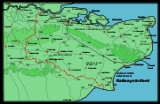
Hastings Line

Encyclopedia
The Hastings Line is a railway line in Kent
and East Sussex
linking Hastings
with the main town of Tunbridge Wells
, and from there into London
via Sevenoaks
.
(SER) in main three stages: – :
. As a result there are seven tunnels constructed through the Sandstone
Hastings Beds. The SER were anxious to construct the line as quickly as possible, since they were in competition with the London, Brighton and South Coast Railway
to obtain entry to the south coast seaside resort
of Hastings; the line, in spite of its problems, was opened from Tunbridge Wells in a year. The contractors responsible for building the tunnels cheated the SER by reducing the planned six layers of bricks through the tunnels to four.
It was only when the Wadhurst tunnel collapsed in 1862 that this was discovered. It was too expensive to re-bore the tunnels, so the SER added the two missing layers. This obviously reduced the width, and from then on, until 1986, it was necessary to work the line with Restriction 0 rolling stock
.
built in the 1930s; the cab roofs in particular were narrower than main line locomotives. They worked the line until 1957 when steam gave way to diesel-electric multiple units of what became British Rail Class 201
, 202
and 203
(the "Hastings Diesels") took over working the route. These units were constructed of narrow rolling stock. They were delivered in six-car formations (the Class 203 including a buffet car) and two units were often operated in multiple to form twelve-car trains. In latter years some of the units were reduced to five and (later still) to four cars. Twelve Class 33/2
diesel locomotives, nicknamed "Slim Jims", were also built with narrow bodies for the Hastings line.
The final solution on the line was to convert the most restricted of the tunnels to single-line working. This was achieved in 1986, and at the same time the line was electrified
using 750 V DC third-rail
.
There have always been problems connected with the Tonbridge -St Leonards section of the Charing Cross line. It was built in a hurry by the SER in an attempt to compete with the passenger traffic to Hastings of the LBSCR; and as a result corners were cut in its construction. Most of the section runs through the hilly Weald
, necessitating seven tunnels. The contractors on the line, in an attempt to keep up with a strict timetable, saved time by putting in fewer layers of bricks than were required through the tunnels: in 1862 the Wadhurst
tunnel collapsed, revealing the truth. Instead of reboring the tunnels, the extra layers were laid on the inner surfaces of all seven tunnels, narrowing the bore, and thereby ensuring that specially-constructed rolling stock was required from then on; electrification of the line was also delayed for many years. Special narrow bodied diesel multiple units were introduced from 1957 to replace steam traction. Electrification was finally completed in 1986, using standard rolling stock, and the expedient of singling the track through the narrow tunnels. A preview service of electric trains ran on 27 April 1986 and the full timetable service commenced on 12 May 1986
The Wadhurst and Mountfield tunnels were those causing the major problems before the changes.
and Gothic
styles. The station at Battle
is Grade II listed.
, and mostly operated by Class 375 Electrostar
or occasionally Class 465
/466 Networker
units.
The line still sees a freight service to and from the gypsum sidings at Mountfield.
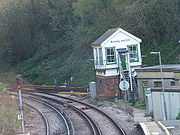 This junction was named after a local pub
in Bulverhythe
called The Bo Peep,
which in turn came from the activities of smugglers and excise men.
Kent
Kent is a county in southeast England, and is one of the home counties. It borders East Sussex, Surrey and Greater London and has a defined boundary with Essex in the middle of the Thames Estuary. The ceremonial county boundaries of Kent include the shire county of Kent and the unitary borough of...
and East Sussex
East Sussex
East Sussex is a county in South East England. It is bordered by the counties of Kent, Surrey and West Sussex, and to the south by the English Channel.-History:...
linking Hastings
Hastings railway station
Hastings railway station is in Hastings in East Sussex, England. It is situated on the Hastings Line to Tunbridge Wells, the East Coastway Line to Brighton and the Marshlink Line to Ashford International....
with the main town of Tunbridge Wells
Tunbridge Wells railway station
Tunbridge Wells railway station serves Royal Tunbridge Wells in Kent, England. The station and all trains serving it are currently operated by Southeastern. It is located directly on the double-tracked electrified Hastings Line....
, and from there into London
London
London is the capital city of :England and the :United Kingdom, the largest metropolitan area in the United Kingdom, and the largest urban zone in the European Union by most measures. Located on the River Thames, London has been a major settlement for two millennia, its history going back to its...
via Sevenoaks
Sevenoaks railway station
Sevenoaks railway station serves the town of Sevenoaks in Kent. Train services are provided by Southeastern.Trains from the station run northbound to London Bridge, Cannon Street , Waterloo East and London Charing Cross via Orpington, to London Blackfriars via Swanley and Catford, and southbound to...
.
Openings
The line was opened by the South Eastern RailwaySouth Eastern Railway (UK)
The South Eastern Railway was a railway company in south-eastern England from 1836 until 1922. The company was formed to construct a route from London to Dover. Branch lines were later opened to Tunbridge Wells, Hastings, Canterbury and other places in Kent...
(SER) in main three stages: – :
-
- 19 September 1845: a temporary station while the intervening tunnel was completed. That temporary station later became the goods depot;
- 25 November 1846: Tunbridge Wells Central station opened
- Tunbridge Wells – : 1 September 1851
- Robertsbridge – : 1 January 1852
- Battle – (Bo-peep Junction): 1 February 1853
Construction difficulties
The Hastings Line is built over difficult terrain across the WealdWeald
The Weald is the name given to an area in South East England situated between the parallel chalk escarpments of the North and the South Downs. It should be regarded as three separate parts: the sandstone "High Weald" in the centre; the clay "Low Weald" periphery; and the Greensand Ridge which...
. As a result there are seven tunnels constructed through the Sandstone
Sandstone
Sandstone is a sedimentary rock composed mainly of sand-sized minerals or rock grains.Most sandstone is composed of quartz and/or feldspar because these are the most common minerals in the Earth's crust. Like sand, sandstone may be any colour, but the most common colours are tan, brown, yellow,...
Hastings Beds. The SER were anxious to construct the line as quickly as possible, since they were in competition with the London, Brighton and South Coast Railway
London, Brighton and South Coast Railway
The London, Brighton and South Coast Railway was a railway company in the United Kingdom from 1846 to 1922. Its territory formed a rough triangle, with London at its apex, practically the whole coastline of Sussex as its base, and a large part of Surrey...
to obtain entry to the south coast seaside resort
Seaside resort
A seaside resort is a resort, or resort town, located on the coast. Where a beach is the primary focus for tourists, it may be called a beach resort.- Overview :...
of Hastings; the line, in spite of its problems, was opened from Tunbridge Wells in a year. The contractors responsible for building the tunnels cheated the SER by reducing the planned six layers of bricks through the tunnels to four.
It was only when the Wadhurst tunnel collapsed in 1862 that this was discovered. It was too expensive to re-bore the tunnels, so the SER added the two missing layers. This obviously reduced the width, and from then on, until 1986, it was necessary to work the line with Restriction 0 rolling stock
Rolling stock
Rolling stock comprises all the vehicles that move on a railway. It usually includes both powered and unpowered vehicles, for example locomotives, railroad cars, coaches and wagons...
.
Traction and rolling stock
The first most successful locomotives built to cope with the necessary weight and loading gauge restrictions taken into account were the "Schools" classSR Class V
The SR V class, more commonly known as the Schools class, is a class of steam locomotive designed by Richard Maunsell for the Southern Railway. The class was a cut down version of his Lord Nelson class but also incorporated components from Urie and Maunsell's LSWR/SR King Arthur class...
built in the 1930s; the cab roofs in particular were narrower than main line locomotives. They worked the line until 1957 when steam gave way to diesel-electric multiple units of what became British Rail Class 201
British Rail Class 201
The British Rail Class 201 six-car diesel-electric multiple units were built in 1957-1958 at Eastleigh and Ashford. They were built for use on the London-Hastings line...
, 202
British Rail Class 202
The British Rail Class 202 diesel-electric multiple units were built from 1957-58 at Eastleigh and Ashford Works. These units were built to work the London Charing Cross to Hastings services...
and 203
British Rail Class 203
The British Rail Class 203, initially classified 6B, was a type of diesel electric train. Seven units, numbered 1031-1037, were constructed in 1958 for use on the Southern Region...
(the "Hastings Diesels") took over working the route. These units were constructed of narrow rolling stock. They were delivered in six-car formations (the Class 203 including a buffet car) and two units were often operated in multiple to form twelve-car trains. In latter years some of the units were reduced to five and (later still) to four cars. Twelve Class 33/2
British Rail Class 33
The British Rail Class 33 also known as the BRCW Type 3 or Crompton is a class of Bo-Bo diesel-electric locomotives ordered in 1957 and built for the Southern Region of British Railways between 1960 and 1962....
diesel locomotives, nicknamed "Slim Jims", were also built with narrow bodies for the Hastings line.
The final solution on the line was to convert the most restricted of the tunnels to single-line working. This was achieved in 1986, and at the same time the line was electrified
Railway electrification in Great Britain
Railway electrification in Great Britain started towards of the 19th century. A great range of voltages have been used in the intervening period using both overhead lines and third rails, however the most common standard for mainline services is now 25 kV AC using overhead lines and the...
using 750 V DC third-rail
Third rail
A third rail is a method of providing electric power to a railway train, through a semi-continuous rigid conductor placed alongside or between the rails of a railway track. It is used typically in a mass transit or rapid transit system, which has alignments in its own corridors, fully or almost...
.
Tunnels
There are nine tunnels between Tonbridge and Ore. In order from north to south they are:| Name | Length | Tracks | Details |
|---|---|---|---|
| Somerhill | 410 yd (375 m) | Single | South of Tonbridge station. |
| Wells | 823 yd (753 m) | Double | North of Tunbridge Wells station. |
| Grove Hill | 287 yd (262 m) | Double | South of Tunbridge Wells station. |
| Strawberry Hill | 286 yd (262 m) | Single | North of Frant station. |
| Wadhurst | 1205 yd (1,102 m) | Single | South of Wadhurst station. |
| Mountfield | 526 yd (481 m) | Single | South of Robertsbridge station. |
| Bo-Peep | 1318 yd (1,205 m) | Double | West of St Leonards Warrior Square station. |
| Hastings | 788 yd (721 m) | Double | East of St. Leonards Warrior Square station. |
| Mount Pleasant | 230 yd (210 m) | Double | West of Ore station. |
There have always been problems connected with the Tonbridge -St Leonards section of the Charing Cross line. It was built in a hurry by the SER in an attempt to compete with the passenger traffic to Hastings of the LBSCR; and as a result corners were cut in its construction. Most of the section runs through the hilly Weald
Weald
The Weald is the name given to an area in South East England situated between the parallel chalk escarpments of the North and the South Downs. It should be regarded as three separate parts: the sandstone "High Weald" in the centre; the clay "Low Weald" periphery; and the Greensand Ridge which...
, necessitating seven tunnels. The contractors on the line, in an attempt to keep up with a strict timetable, saved time by putting in fewer layers of bricks than were required through the tunnels: in 1862 the Wadhurst
Wadhurst
Wadhurst is a market town in East Sussex, England. It is the centre of the civil parish of Wadhurst, which also includes the hamlets of Cousley Wood and Tidebrook. Wadhurst is twinned with Aubers in France.-Situation:...
tunnel collapsed, revealing the truth. Instead of reboring the tunnels, the extra layers were laid on the inner surfaces of all seven tunnels, narrowing the bore, and thereby ensuring that specially-constructed rolling stock was required from then on; electrification of the line was also delayed for many years. Special narrow bodied diesel multiple units were introduced from 1957 to replace steam traction. Electrification was finally completed in 1986, using standard rolling stock, and the expedient of singling the track through the narrow tunnels. A preview service of electric trains ran on 27 April 1986 and the full timetable service commenced on 12 May 1986
The Wadhurst and Mountfield tunnels were those causing the major problems before the changes.
Stations
All the stations south of Tunbridge Wells (except Crowhurst) were built to the designs of William Tress in ItalianateItalianate architecture
The Italianate style of architecture was a distinct 19th-century phase in the history of Classical architecture. In the Italianate style, the models and architectural vocabulary of 16th-century Italian Renaissance architecture, which had served as inspiration for both Palladianism and...
and Gothic
Gothic architecture
Gothic architecture is a style of architecture that flourished during the high and late medieval period. It evolved from Romanesque architecture and was succeeded by Renaissance architecture....
styles. The station at Battle
Battle railway station
Battle railway station is on the Hastings Line in East Sussex in England, and serves the town of Battle. Train services are provided by Southeastern.The station was opened on 1 January 1852...
is Grade II listed.
Services today
Train services on the line are provided by SoutheasternSoutheastern (train operating company)
London & South Eastern Railway Limited, trading as Southeastern is a train operating company in south-east England. On 1 April 2006 it became the franchisee for the new Integrated Kent Franchise , replacing the publicly owned South Eastern Trains on the former South East Franchise...
, and mostly operated by Class 375 Electrostar
British Rail Class 375
The British Rail Class 375 Electrostar electric multiple unit train was built by Bombardier Transportation at their Derby Works, from 1999 to 2005...
or occasionally Class 465
British Rail Class 465
The British Rail Class 465 Networker electric multiple units were built by GEC Alsthom and BREL between 1991 and 1993, and by ABB Rail between 1993 and 1994. They were brought into service from 1991 onwards. They are mostly used on suburban routes serving the South East of England, now operated by...
/466 Networker
British Rail Class 466
The Class 466 750 V DC third rail electric multiple unit is a suburban EMU, which operates with Class 465 EMUs in southeast London and Kent on the Southeastern network...
units.
The line still sees a freight service to and from the gypsum sidings at Mountfield.
Bopeep junction
Public house
A public house, informally known as a pub, is a drinking establishment fundamental to the culture of Britain, Ireland, Australia and New Zealand. There are approximately 53,500 public houses in the United Kingdom. This number has been declining every year, so that nearly half of the smaller...
in Bulverhythe
Bulverhythe
West Marina Redirects here. For the former rail station see St Leonards West Marina or for the current station see West St Leonards Station.Bulverhythe, also known as West St Leonards, Bo Peep, Filsham, West Marina, or Harley Shute, is a suburb of Hastings, East Sussex, England with its Esplanade...
called The Bo Peep,
which in turn came from the activities of smugglers and excise men.
Driver's view of the line
A DVD produced by Video 125 called 1066 DC provides a driver's eye view of a journey from Hastings to Charing Cross.External links
- Hastings & St Leonards: Railways and Stations, at 1066 online