

Harpy

Encyclopedia
In Greek mythology
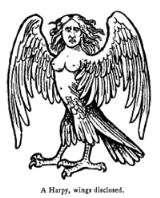
, a harpy ("snatcher", from , originating in , harpūia) was one of the winged spirits best known for constantly stealing all food from Phineas
. The literal meaning of the word seems to be "that which snatches" as it comes from the ancient Greek word harpazein (ἁρπάζειν), which means "to snatch".
A harpy was the mother by the West Wind Zephyros of the horses of Achilles
. In this context Jane Ellen Harrison
adduced the notion in Virgil
's Georgics
(iii.274) that mares became gravid by the wind alone..
Hesiod
calls them two "lovely-haired" creatures, and pottery art depicting the harpies featured beautiful women with wings. Harpies as ugly winged bird-women, e.g. in Aeschylus
' The Eumenides (line 50) are a late development, due to a confusion with the Siren
s. Roman and Byzantine writers detailed their ugliness.

 The harpies were sisters of Iris
, daughters of Thaumas
and Electra.
Phineas
, a king
of Thrace
, had the gift of prophecy
. Zeus, angry that Phineas revealed too much, punished him by blinding him and putting him on an island with a buffet
of food
which he could never eat. The harpies always arrived and stole the food out of his hands before he could satisfy his hunger, and befouled the remains of his food. This continued until the arrival of Jason
and the Argonauts
. The Boreads
, sons of Boreas, the North Wind, who also could fly, succeeded in driving off the harpies, but without killing any of them, following a request from Iris
, who promised that Phineas would not be bothered by the harpies again, and "the dogs of great Zeus" returned to their "cave in Minoan Crete". Thankful for their help, Phineas told the Argonauts how to pass the Symplegades
.
In this form they were agents of punishment who abducted people and tortured them on their way to Tartarus
. They were vicious, cruel and violent. They lived on Strophades. They were usually seen as the personifications of the destructive nature of wind. The harpies in this tradition, now thought of as three sisters instead of the original two, were: Aello
("storm swift"), Celaeno
("the dark") — also known as Podarge
("fleet-foot") — and Ocypete
("the swift wing").
Aeneas
encountered harpies on the Strophades as they repeatedly made off with the feast the Trojans
were setting. Celaeno
cursed them, saying the Trojans will be so hungry they will eat their tables before they reach the end of their journey. The Trojans fled in fear.
 Harpies remained vivid in the Middle Ages. In his Inferno, XIII, Dante
envisages the tortured wood infested with harpies, where the suicide
s have their punishment in the second ring:
William Blake
was inspired by Dante's description in his pencil, ink and watercolour "The Wood of the Self-Murderers: The Harpies and the Suicides
" (Tate Gallery, London).
, the harpy, often called the "virgin eagle", became a popular charge
in heraldry
, particularly in East Frisia
, seen on, among others, the coats-of-arms of Rietburg
, Liechtenstein
, and the Cirksena
is a real bird named after the mythological animal.
The term is often used metaphorically to refer to a nasty or annoying woman. In Shakespeare
's Much Ado About Nothing
, Benedick spots the sharp-tongued Beatrice approaching and exclaims to the Prince, Don Pedro, that he would rather do an assortment of arduous tasks for him "rather than hold three words conference with this harpy!"
book series. Occasionally the classic harpies are referenced by name, such as the appearance of Celaeno in Peter S. Beagle
's novel The Last Unicorn
.
Harpies are also mentioned in the Percy Jackson series
Greek mythology
Greek mythology is the body of myths and legends belonging to the ancient Greeks, concerning their gods and heroes, the nature of the world, and the origins and significance of their own cult and ritual practices. They were a part of religion in ancient Greece...
, a harpy ("snatcher", from , originating in , harpūia) was one of the winged spirits best known for constantly stealing all food from Phineas
Phineas
In Greek mythology, Phineas was a Phoenician King of Thrace.The name 'Phineas' or 'Phineus' may be associated with the ancient city of Phinea on the Thracian Bosphorus.-Phineas, Son of Agenor:...
. The literal meaning of the word seems to be "that which snatches" as it comes from the ancient Greek word harpazein (ἁρπάζειν), which means "to snatch".
A harpy was the mother by the West Wind Zephyros of the horses of Achilles
Achilles
In Greek mythology, Achilles was a Greek hero of the Trojan War, the central character and the greatest warrior of Homer's Iliad.Plato named Achilles the handsomest of the heroes assembled against Troy....
. In this context Jane Ellen Harrison
Jane Ellen Harrison
Jane Ellen Harrison was a British classical scholar, linguist and feminist. Harrison is one of the founders, with Karl Kerenyi and Walter Burkert, of modern studies in Greek mythology. She applied 19th century archaeological discoveries to the interpretation of Greek religion in ways that have...
adduced the notion in Virgil
Virgil
Publius Vergilius Maro, usually called Virgil or Vergil in English , was an ancient Roman poet of the Augustan period. He is known for three major works of Latin literature, the Eclogues , the Georgics, and the epic Aeneid...
's Georgics
Georgics
The Georgics is a poem in four books, likely published in 29 BC. It is the second major work by the Latin poet Virgil, following his Eclogues and preceding the Aeneid. It is a poem that draws on many prior sources and influenced many later authors from antiquity to the present...
(iii.274) that mares became gravid by the wind alone..
Hesiod
Hesiod
Hesiod was a Greek oral poet generally thought by scholars to have been active between 750 and 650 BC, around the same time as Homer. His is the first European poetry in which the poet regards himself as a topic, an individual with a distinctive role to play. Ancient authors credited him and...
calls them two "lovely-haired" creatures, and pottery art depicting the harpies featured beautiful women with wings. Harpies as ugly winged bird-women, e.g. in Aeschylus
Aeschylus
Aeschylus was the first of the three ancient Greek tragedians whose work has survived, the others being Sophocles and Euripides, and is often described as the father of tragedy. His name derives from the Greek word aiskhos , meaning "shame"...
' The Eumenides (line 50) are a late development, due to a confusion with the Siren
Siren
In Greek mythology, the Sirens were three dangerous mermaid like creatures, portrayed as seductresses who lured nearby sailors with their enchanting music and voices to shipwreck on the rocky coast of their island. Roman poets placed them on an island called Sirenum scopuli...
s. Roman and Byzantine writers detailed their ugliness.
Mythology
Iris (mythology)
In Greek mythology, Iris is the personification of the rainbow and messenger of the gods. As the sun unites Earth and heaven, Iris links the gods to humanity...
, daughters of Thaumas
Thaumas
In Greek mythology, Thaumas was a sea god, son of Pontus and Gaia. He married an Oceanid, Electra . The children of Thaumas and Electra were the Harpies and Iris, the goddess of rainbows and a messenger of the gods; according to some, also Arke.Thaumas was also the name of a centaur...
and Electra.
Phineas
Phineas
In Greek mythology, Phineas was a Phoenician King of Thrace.The name 'Phineas' or 'Phineus' may be associated with the ancient city of Phinea on the Thracian Bosphorus.-Phineas, Son of Agenor:...
, a king
Monarch
A monarch is the person who heads a monarchy. This is a form of government in which a state or polity is ruled or controlled by an individual who typically inherits the throne by birth and occasionally rules for life or until abdication...
of Thrace
Thrace
Thrace is a historical and geographic area in southeast Europe. As a geographical concept, Thrace designates a region bounded by the Balkan Mountains on the north, Rhodope Mountains and the Aegean Sea on the south, and by the Black Sea and the Sea of Marmara on the east...
, had the gift of prophecy
Prophecy
Prophecy is a process in which one or more messages that have been communicated to a prophet are then communicated to others. Such messages typically involve divine inspiration, interpretation, or revelation of conditioned events to come as well as testimonies or repeated revelations that the...
. Zeus, angry that Phineas revealed too much, punished him by blinding him and putting him on an island with a buffet
Buffet
A buffet is a system of serving meals in which food is placed in a public area where the diners generally serve themselves. Buffets are offered at various places including hotels and many social events...
of food
Food
Food is any substance consumed to provide nutritional support for the body. It is usually of plant or animal origin, and contains essential nutrients, such as carbohydrates, fats, proteins, vitamins, or minerals...
which he could never eat. The harpies always arrived and stole the food out of his hands before he could satisfy his hunger, and befouled the remains of his food. This continued until the arrival of Jason
Jason
Jason was a late ancient Greek mythological hero from the late 10th Century BC, famous as the leader of the Argonauts and their quest for the Golden Fleece. He was the son of Aeson, the rightful king of Iolcus...
and the Argonauts
Argonauts
The Argonauts ) were a band of heroes in Greek mythology who, in the years before the Trojan War, accompanied Jason to Colchis in his quest to find the Golden Fleece. Their name comes from their ship, the Argo, which was named after its builder, Argus. "Argonauts", therefore, literally means...
. The Boreads
Boreads
The Boreads, in Greek mythology, were Calaïs and Zetes . They were the sons of Boreas and Oreithyia, daughter of King Erechtheus of Athens...
, sons of Boreas, the North Wind, who also could fly, succeeded in driving off the harpies, but without killing any of them, following a request from Iris
Iris (mythology)
In Greek mythology, Iris is the personification of the rainbow and messenger of the gods. As the sun unites Earth and heaven, Iris links the gods to humanity...
, who promised that Phineas would not be bothered by the harpies again, and "the dogs of great Zeus" returned to their "cave in Minoan Crete". Thankful for their help, Phineas told the Argonauts how to pass the Symplegades
Symplegades
The Symplegades or Clashing Rocks, also known as the Cyanean Rocks, were, according to Greek mythology, a pair of rocks at the Bosphorus that clashed together randomly. They were defeated by Jason and the Argonauts, who would have been lost and killed by the rocks except for Phineas' advice. Jason...
.
In this form they were agents of punishment who abducted people and tortured them on their way to Tartarus
Tartarus
In classic mythology, below Uranus , Gaia , and Pontus is Tartarus, or Tartaros . It is a deep, gloomy place, a pit, or an abyss used as a dungeon of torment and suffering that resides beneath the underworld. In the Gorgias, Plato In classic mythology, below Uranus (sky), Gaia (earth), and Pontus...
. They were vicious, cruel and violent. They lived on Strophades. They were usually seen as the personifications of the destructive nature of wind. The harpies in this tradition, now thought of as three sisters instead of the original two, were: Aello
Aello
Aello in Greek mythology was one of the Harpy sisters who would abduct people and torture them on their way to Tartarus. Her names are:*Aello , "she of the whirlwind"*Aellopus , "whirlwind-footed"...
("storm swift"), Celaeno
Celaeno
In Greek mythology, Celaeno referred to several different figures.*Celaeno, one of the Harpies, whom Aeneas encountered at Strophades. She gave him prophecies of his coming journeys.*Celaeno, one of the Pleiades...
("the dark") — also known as Podarge
Podarge
In Greek mythology, Podarge referred to several different beings.*One of the Harpies is named Podarge and, due to her union with Zephyrus, the god of the West Wind, was the mother of Balius and Xanthus, the horses of Achilles.*The rainbow/messenger goddess Iris is sometimes also referred to as...
("fleet-foot") — and Ocypete
Ocypete
Ocypete was one of the three harpies in Greek mythology. She was also known as Ocypode or Ocythoe . Ocypete was the swiftest of all the three harpies...
("the swift wing").
Aeneas
Aeneas
Aeneas , in Greco-Roman mythology, was a Trojan hero, the son of the prince Anchises and the goddess Aphrodite. His father was the second cousin of King Priam of Troy, making Aeneas Priam's second cousin, once removed. The journey of Aeneas from Troy , which led to the founding a hamlet south of...
encountered harpies on the Strophades as they repeatedly made off with the feast the Trojans
Troy
Troy was a city, both factual and legendary, located in northwest Anatolia in what is now Turkey, southeast of the Dardanelles and beside Mount Ida...
were setting. Celaeno
Celaeno
In Greek mythology, Celaeno referred to several different figures.*Celaeno, one of the Harpies, whom Aeneas encountered at Strophades. She gave him prophecies of his coming journeys.*Celaeno, one of the Pleiades...
cursed them, saying the Trojans will be so hungry they will eat their tables before they reach the end of their journey. The Trojans fled in fear.
DANTE
Delivery of Advanced Network Technology to Europe is a not-for-profit organisation that plans, builds and operates the international networks that interconnect the various national research and education networks in Europe and surrounding regions...
envisages the tortured wood infested with harpies, where the suicide
Suicide
Suicide is the act of intentionally causing one's own death. Suicide is often committed out of despair or attributed to some underlying mental disorder, such as depression, bipolar disorder, schizophrenia, alcoholism, or drug abuse...
s have their punishment in the second ring:
Here the repellent harpies make their nests,
Who drove the Trojans from the Strophades
With dire announcements of the coming woe.
They have broad wings, a human neck and face,
Clawed feet and swollen, feathered bellies; they caw
Their lamentations in the eerie trees.
William Blake
William Blake
William Blake was an English poet, painter, and printmaker. Largely unrecognised during his lifetime, Blake is now considered a seminal figure in the history of both the poetry and visual arts of the Romantic Age...
was inspired by Dante's description in his pencil, ink and watercolour "The Wood of the Self-Murderers: The Harpies and the Suicides
The Wood of the Self-Murderers: The Harpies and the Suicides
The Wood of the Self-Murderers: The Harpies and the Suicides is a pencil, ink and watercolour on paper artwork by the English poet, painter and printmaker William Blake . The work was completed between 1824 and 1827 and illustrates a passage from the Inferno canticle of the Divine Comedy by Dante...
" (Tate Gallery, London).
Heraldry
In the Middle AgesMiddle Ages
The Middle Ages is a periodization of European history from the 5th century to the 15th century. The Middle Ages follows the fall of the Western Roman Empire in 476 and precedes the Early Modern Era. It is the middle period of a three-period division of Western history: Classic, Medieval and Modern...
, the harpy, often called the "virgin eagle", became a popular charge
Charge (heraldry)
In heraldry, a charge is any emblem or device occupying the field of an escutcheon . This may be a geometric design or a symbolic representation of a person, animal, plant, object or other device...
in heraldry
Heraldry
Heraldry is the profession, study, or art of creating, granting, and blazoning arms and ruling on questions of rank or protocol, as exercised by an officer of arms. Heraldry comes from Anglo-Norman herald, from the Germanic compound harja-waldaz, "army commander"...
, particularly in East Frisia
East Frisia
East Frisia or Eastern Friesland is a coastal region in the northwest of the German federal state of Lower Saxony....
, seen on, among others, the coats-of-arms of Rietburg
Rietburg Castle
The Rietburg is a ruined castle on the outskirts of the Palatinate Forest above the village of Rhodt in the Südliche Weinstrasse district in Rhineland-Palatinate, Germany.The remains of this castle are located on the side of the 550m high Blättersberg....
, Liechtenstein
Coat of arms of Liechtenstein
The coat of arms of the Princely House of Liechtenstein is also used as the great arms of the nation. As the sovereign emblem of the Principality of Liechtenstein, its use is reserved for the members of the Princely House and state authorities. Private individuals may be authorized to use the great...
, and the Cirksena
Cirksena
The Cirksena are noble East Frisian family descended from a line of East Frisian chieftains from Greetsiel.- The Cirksena in East Frisia :In 1439 in the wake of clashes between different lines of chieftains, the town of Emden was first placed by Hamburg under direct rule and then, in 1453, finally...
Harpies in reality
The American Harpy EagleAmerican Harpy Eagle
The Harpy Eagle , sometimes known as the American Harpy Eagle, is a Neotropical species of eagle. It is the largest and most powerful raptor found in the Americas, and among the largest extant species of eagles in the world. It usually inhabits tropical lowland rainforests in the upper canopy layer...
is a real bird named after the mythological animal.
The term is often used metaphorically to refer to a nasty or annoying woman. In Shakespeare
William Shakespeare
William Shakespeare was an English poet and playwright, widely regarded as the greatest writer in the English language and the world's pre-eminent dramatist. He is often called England's national poet and the "Bard of Avon"...
's Much Ado About Nothing
Much Ado About Nothing
Much Ado About Nothing is a comedy written by William Shakespeare about two pairs of lovers, Benedick and Beatrice, and Claudio and Hero....
, Benedick spots the sharp-tongued Beatrice approaching and exclaims to the Prince, Don Pedro, that he would rather do an assortment of arduous tasks for him "rather than hold three words conference with this harpy!"
Harpies in popular culture
With their composite form and violent nature, harpies are depicted in films, television and other aspects of popular culture. Harpies are commonly depicted as a race of bird-women, such as in Phillip Pullman's His Dark MaterialsHis Dark Materials
His Dark Materials is a trilogy of fantasy novels by Philip Pullman comprising Northern Lights , The Subtle Knife , and The Amber Spyglass...
book series. Occasionally the classic harpies are referenced by name, such as the appearance of Celaeno in Peter S. Beagle
Peter S. Beagle
Peter Soyer Beagle is an American fantasist and author of novels, nonfiction, and screenplays. His most notable works include the novels The Last Unicorn, A Fine and Private Place and Tamsin, and the award-winning story "Two Hearts".-Career:Beagle won early recognition from The Scholastic Art &...
's novel The Last Unicorn
The Last Unicorn
The Last Unicorn is a fantasy novel written by Peter S. Beagle and published in 1968. It has sold more than five million copies worldwide since its original publication, and has been translated into at least twenty languages....
.
Harpies are also mentioned in the Percy Jackson series
See also
- Ethereal creature
- Hybrid (mythology)Hybrid (mythology)Hybrids are mythological creatures combining body parts of more than one real species.They can be classified as partly human hybrids , and non-human hybrids combining two or more animal species...
- KaruraKaruraThe Karura is an enormous, fire-breathing creature from Japanese Hindu-Buddhist mythology. It has the body of a human and the face or beak of an eagle. It is based on the original Hindu mythical divinity Garuda; and brought to Japan via Buddhism...
- SirenSirenIn Greek mythology, the Sirens were three dangerous mermaid like creatures, portrayed as seductresses who lured nearby sailors with their enchanting music and voices to shipwreck on the rocky coast of their island. Roman poets placed them on an island called Sirenum scopuli...
(birdlike woman in Greek mythology) - SirinSirinSirin is a mythological creature of Russian legends, with the head and chest of a beautiful woman and the body of a bird . According to myth, the Sirins lived "in Indian lands" near Eden or around the Euphrates River....
- TantalusTantalusTantalus was the ruler of an ancient western Anatolian city called either after his name, as "Tantalís", "the city of Tantalus", or as "Sipylus", in reference to Mount Sipylus, at the foot of which his city was located and whose ruins were reported to be still visible in the beginning of the...
(Greek character condemned to never quench his hunger or thirst) - TenguTenguare a class of supernatural creatures found in Japanese folklore, art, theater, and literature. They are one of the best known yōkai and are sometimes worshipped as Shinto kami...