

Hans Bellmer

Encyclopedia
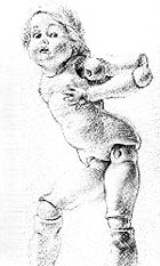
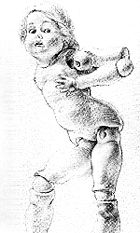
Hans Bellmer was a German artist, best known for the life-sized pubescent
female doll
s he produced in the mid-1930s. Historians of art and photography also consider him a Surrealist photographer.
, then part of the German Empire
(now Katowice
, Poland
). Up until 1926, he'd been working as a draftsman for his own advertising company. He initiated his doll project to oppose the fascism
of the Nazi Party by declaring that he would make no work that would support the new German
state. Represented by mutated forms and unconventional poses, his dolls were directed specifically at the cult of the perfect body then prominent in Germany. Bellmer was influenced in his choice of art form by reading the published letters of Oskar Kokoschka
(Der Fetisch, 1925).
Bellmer's doll project is also said to have been catalysed by a series of events in his personal life, including meeting a beautiful teenage cousin in 1932 (and perhaps other unattainable beauties), attending a performance of Jacques Offenbach's Tales of Hoffmann (in which a man falls tragically in love with an automaton), and receiving a box of his old toys. After these events, he began to actually construct his first dolls. In his works, Bellmer explicitly sexualized the doll as a young girl. The dolls incorporated the principle of "ball joint" , which was inspired by a pair of sixteenth-century articulated wooden dolls in the Kaiser Friedrich Museum
 He visited Paris
in 1935 and made contacts there, such as Paul Éluard
, but returned to Berlin because his wife Margarete was dying of tuberculosis
.
Bellmer's 1934 anonymous book, The Doll (Die Puppe), produced and published privately in Germany, contains 10 black-and-white photographs of Bellmer's first doll arranged in a series of "tableaux vivants
" (living pictures). The book was not credited to him, as he worked in isolation, and his photographs remained almost unknown in Germany. Yet Bellmer's work was eventually declared "degenerate"
by the Nazi Party, and he was forced to flee Germany to France
in 1938. Bellmer's work was welcomed in the Paris
ian art culture of the time, especially the Surrealists around André Breton
, because of the references to female beauty and the sexualization of the youthful form. His photographs were published in the Surrealist journal Minotaure
, 5 December 1934 under the title "Poupée, variations sur le montage d'une mineure articulée" (The Doll, Variations on the Assemblage of an Articulated Minor).
He aided the French Resistance during the war by making fake passports. He was imprisoned in the Camp des Milles
prison at Aix-en-Provence
, a brickworks
camp for German nationals, from September 1939 until the end of the Phoney War in May 1940.
After the war, Bellmer lived the rest of his life in Paris. Bellmer gave up doll-making and spent the following decades creating erotic drawings, etchings, sexually explicit photographs, paintings, and prints of pubescent girls. In 1954, he met Unica Zürn
, who became his companion (until her suicide in 1970). He continued working into the 1960s.
The interdisciplinary artist
, dancer, and multiple amputee Lisa Bufano
lists Hans Bellmer's doll work in her artist's statement as an influence.
contains clear references to Bellmer's work including the protagonist's obsessive relationship with a sex doll
and the use of Bellmer's name as a leading character, Lisa Bellmer.
Puberty
Puberty is the process of physical changes by which a child's body matures into an adult body capable of reproduction, as initiated by hormonal signals from the brain to the gonads; the ovaries in a girl, the testes in a boy...
female doll
Doll
A doll is a model of a human being, often used as a toy for children. Dolls have traditionally been used in magic and religious rituals throughout the world, and traditional dolls made of materials like clay and wood are found in the Americas, Asia, Africa and Europe. The earliest documented dolls...
s he produced in the mid-1930s. Historians of art and photography also consider him a Surrealist photographer.
Biography
Bellmer was born in the city of KattowitzKatowice
Katowice is a city in Silesia in southern Poland, on the Kłodnica and Rawa rivers . Katowice is located in the Silesian Highlands, about north of the Silesian Beskids and about southeast of the Sudetes Mountains.It is the central district of the Upper Silesian Metropolis, with a population of 2...
, then part of the German Empire
German Empire
The German Empire refers to Germany during the "Second Reich" period from the unification of Germany and proclamation of Wilhelm I as German Emperor on 18 January 1871, to 1918, when it became a federal republic after defeat in World War I and the abdication of the Emperor, Wilhelm II.The German...
(now Katowice
Katowice
Katowice is a city in Silesia in southern Poland, on the Kłodnica and Rawa rivers . Katowice is located in the Silesian Highlands, about north of the Silesian Beskids and about southeast of the Sudetes Mountains.It is the central district of the Upper Silesian Metropolis, with a population of 2...
, Poland
Poland
Poland , officially the Republic of Poland , is a country in Central Europe bordered by Germany to the west; the Czech Republic and Slovakia to the south; Ukraine, Belarus and Lithuania to the east; and the Baltic Sea and Kaliningrad Oblast, a Russian exclave, to the north...
). Up until 1926, he'd been working as a draftsman for his own advertising company. He initiated his doll project to oppose the fascism
Fascism
Fascism is a radical authoritarian nationalist political ideology. Fascists seek to rejuvenate their nation based on commitment to the national community as an organic entity, in which individuals are bound together in national identity by suprapersonal connections of ancestry, culture, and blood...
of the Nazi Party by declaring that he would make no work that would support the new German
Germany
Germany , officially the Federal Republic of Germany , is a federal parliamentary republic in Europe. The country consists of 16 states while the capital and largest city is Berlin. Germany covers an area of 357,021 km2 and has a largely temperate seasonal climate...
state. Represented by mutated forms and unconventional poses, his dolls were directed specifically at the cult of the perfect body then prominent in Germany. Bellmer was influenced in his choice of art form by reading the published letters of Oskar Kokoschka
Oskar Kokoschka
Oskar Kokoschka was an Austrian artist, poet and playwright best known for his intense expressionistic portraits and landscapes.-Biography:...
(Der Fetisch, 1925).
Bellmer's doll project is also said to have been catalysed by a series of events in his personal life, including meeting a beautiful teenage cousin in 1932 (and perhaps other unattainable beauties), attending a performance of Jacques Offenbach's Tales of Hoffmann (in which a man falls tragically in love with an automaton), and receiving a box of his old toys. After these events, he began to actually construct his first dolls. In his works, Bellmer explicitly sexualized the doll as a young girl. The dolls incorporated the principle of "ball joint" , which was inspired by a pair of sixteenth-century articulated wooden dolls in the Kaiser Friedrich Museum
Paris
Paris is the capital and largest city in France, situated on the river Seine, in northern France, at the heart of the Île-de-France region...
in 1935 and made contacts there, such as Paul Éluard
Paul Éluard
Paul Éluard, born Eugène Émile Paul Grindel , was a French poet who was one of the founders of the surrealist movement.-Biography:...
, but returned to Berlin because his wife Margarete was dying of tuberculosis
Tuberculosis
Tuberculosis, MTB, or TB is a common, and in many cases lethal, infectious disease caused by various strains of mycobacteria, usually Mycobacterium tuberculosis. Tuberculosis usually attacks the lungs but can also affect other parts of the body...
.
Bellmer's 1934 anonymous book, The Doll (Die Puppe), produced and published privately in Germany, contains 10 black-and-white photographs of Bellmer's first doll arranged in a series of "tableaux vivants
Tableau vivant
Tableau vivant is French for "living picture." The term describes a striking group of suitably costumed actors or artist's models, carefully posed and often theatrically lit. Throughout the duration of the display, the people shown do not speak or move...
" (living pictures). The book was not credited to him, as he worked in isolation, and his photographs remained almost unknown in Germany. Yet Bellmer's work was eventually declared "degenerate"
Degenerate art
Degenerate art is the English translation of the German entartete Kunst, a term adopted by the Nazi regime in Germany to describe virtually all modern art. Such art was banned on the grounds that it was un-German or Jewish Bolshevist in nature, and those identified as degenerate artists were...
by the Nazi Party, and he was forced to flee Germany to France
France
The French Republic , The French Republic , The French Republic , (commonly known as France , is a unitary semi-presidential republic in Western Europe with several overseas territories and islands located on other continents and in the Indian, Pacific, and Atlantic oceans. Metropolitan France...
in 1938. Bellmer's work was welcomed in the Paris
Paris
Paris is the capital and largest city in France, situated on the river Seine, in northern France, at the heart of the Île-de-France region...
ian art culture of the time, especially the Surrealists around André Breton
André Breton
André Breton was a French writer and poet. He is known best as the founder of Surrealism. His writings include the first Surrealist Manifesto of 1924, in which he defined surrealism as "pure psychic automatism"....
, because of the references to female beauty and the sexualization of the youthful form. His photographs were published in the Surrealist journal Minotaure
Minotaure
Minotaure, published between 1933 and 1939, was a Surrealist-oriented publication founded by Albert Skira in Paris. The editors were André Breton and Pierre Mabille. It was a luxurious publication, sporting original artworks on its cover by prestigious artists like Pablo Picasso...
, 5 December 1934 under the title "Poupée, variations sur le montage d'une mineure articulée" (The Doll, Variations on the Assemblage of an Articulated Minor).
He aided the French Resistance during the war by making fake passports. He was imprisoned in the Camp des Milles
Camp des Milles
The Camp des Milles was a French internment camp, opened in September 1939, in a former tile factory near the village of Les Milles, part of the commune of Aix-en-Provence .-History:...
prison at Aix-en-Provence
Aix-en-Provence
Aix , or Aix-en-Provence to distinguish it from other cities built over hot springs, is a city-commune in southern France, some north of Marseille. It is in the region of Provence-Alpes-Côte d'Azur, in the département of Bouches-du-Rhône, of which it is a subprefecture. The population of Aix is...
, a brickworks
Brickworks
A brickworks also known as a brick factory, is a factory for the manufacturing of bricks, from clay or shale. Usually a brickworks is located on a clay bedrock often with a quarry for clay on site....
camp for German nationals, from September 1939 until the end of the Phoney War in May 1940.
After the war, Bellmer lived the rest of his life in Paris. Bellmer gave up doll-making and spent the following decades creating erotic drawings, etchings, sexually explicit photographs, paintings, and prints of pubescent girls. In 1954, he met Unica Zürn
Unica Zürn
Unica Zürn was a German author and painter. She is remembered for her works of anagram poetry, exhibitions of automatic drawing, and her photographic collaborations with Hans Bellmer.-Biography:...
, who became his companion (until her suicide in 1970). He continued working into the 1960s.
The interdisciplinary artist
Performance art
In art, performance art is a performance presented to an audience, traditionally interdisciplinary. Performance may be either scripted or unscripted, random or carefully orchestrated; spontaneous or otherwise carefully planned with or without audience participation. The performance can be live or...
, dancer, and multiple amputee Lisa Bufano
Lisa Bufano
Lisa Bufano, is a disabled American interdisciplinary performance artist whose work incorporates elements of doll-making, animation, and dance.-Early life:...
lists Hans Bellmer's doll work in her artist's statement as an influence.
Controversy
In 2006 the Whitechapel Gallery in London, UK, removed 12 works by Hans Bellmer from an exhibition, for fear that the sexual overtones would be offensive to the Muslim population in the neighborhood.In Popular Culture
The 2003 film Love ObjectLove Object
Love Object is a 2003 film written and directed by Robert Parigi. Kenneth is an efficient but socially awkward technical writer who develops an obsessive relationship with Nikki, a realistic sex doll he purchases.- Plot :...
contains clear references to Bellmer's work including the protagonist's obsessive relationship with a sex doll
Sex doll
A sex doll is a type of sex toy in the size and shape of a sexual partner for aid in masturbation....
and the use of Bellmer's name as a leading character, Lisa Bellmer.