
The
Kerr metricIn the mathematical field of differential geometry, a metric tensor is a type of function defined on a manifold which takes as input a pair of tangent vectors v and w and produces a real number g in a way that generalizes many of the familiar properties of the dot product of vectors in Euclidean...
(or
Kerr vacuum) describes the geometry of empty
spacetimeIn physics, spacetime is any mathematical model that combines space and time into a single continuum. Spacetime is usually interpreted with space as being three-dimensional and time playing the role of a fourth dimension that is of a different sort from the spatial dimensions...
around an uncharged axially-symmetric black-hole with an event horizon which is topologically a sphere. The Kerr metric is an
exact solutionIn general relativity, an exact solution is a Lorentzian manifold equipped with certain tensor fields which are taken to model states of ordinary matter, such as a fluid, or classical nongravitational fields such as the electromagnetic field....
of the
Einstein field equationsThe Einstein field equations or Einstein's equations are a set of ten equations in Albert Einstein's general theory of relativity which describe the fundamental interaction of gravitation as a result of spacetime being curved by matter and energy...
of
general relativityGeneral relativity or the general theory of relativity is the geometric theory of gravitation published by Albert Einstein in 1916. It is the current description of gravitation in modern physics...
; these equations are highly non-linear, which makes exact solutions very difficult to find. The Kerr metric is a generalization of the
Schwarzschild metricIn Einstein's theory of general relativity, the Schwarzschild solution describes the gravitational field outside a spherical, uncharged, non-rotating mass such as a star, planet, or black hole. It is also a good approximation to the gravitational field of a slowly rotating body like the Earth or...
, which was discovered by
Karl SchwarzschildKarl Schwarzschild was a German physicist. He is also the father of astrophysicist Martin Schwarzschild.He is best known for providing the first exact solution to the Einstein field equations of general relativity, for the limited case of a single spherical non-rotating mass, which he accomplished...
in 1916 and which describes the geometry of
spacetimeIn physics, spacetime is any mathematical model that combines space and time into a single continuum. Spacetime is usually interpreted with space as being three-dimensional and time playing the role of a fourth dimension that is of a different sort from the spatial dimensions...
around an uncharged, spherically-symmetric, and non-rotating body. The corresponding solution for a
charged, spherical, non-rotating body, the Reissner–Nordström metric, was discovered soon afterwards (1916–1918). However, the exact solution for an uncharged,
rotating black-hole, the
Kerr metric, remained unsolved until 1963, when it was discovered by
Roy KerrRoy Patrick Kerr CNZM is a New Zealand mathematician who is best known for discovering the Kerr vacuum, an exact solution to the Einstein field equation of general relativity...
. The natural extension to a charged, rotating black-hole, the Kerr–Newman metric, was discovered shortly thereafter in 1965. These four related solutions may be summarized by the following table:
|
Non-rotating (J = 0) |
Rotating (J ≠ 0) |
| Uncharged (Q = 0) |
SchwarzschildIn Einstein's theory of general relativity, the Schwarzschild solution describes the gravitational field outside a spherical, uncharged, non-rotating mass such as a star, planet, or black hole. It is also a good approximation to the gravitational field of a slowly rotating body like the Earth or...
|
Kerr |
| Charged (Q ≠ 0) |
Reissner–Nordström |
Kerr–Newman |
where
Q represents the body's
electric chargeElectric charge is a physical property of matter that causes it to experience a force when near other electrically charged matter. Electric charge comes in two types, called positive and negative. Two positively charged substances, or objects, experience a mutual repulsive force, as do two...
and
J represents its spin
angular momentumIn physics, angular momentum, moment of momentum, or rotational momentum is a conserved vector quantity that can be used to describe the overall state of a physical system...
.
According to the Kerr metric, such rotating black-holes should exhibit frame dragging, an unusual prediction of general relativity. Measurement of this frame dragging effect was a major goal of the
Gravity Probe BGravity Probe B is a satellite-based mission which launched on 20 April 2004 on a Delta II rocket. The spaceflight phase lasted until 2005; its aim was to measure spacetime curvature near Earth, and thereby the stress–energy tensor in and near Earth...
experiment. Roughly speaking, this effect predicts that objects coming close to a rotating mass will be entrained to participate in its rotation, not because of any applied force or torque that can be felt, but rather because of the curvature of spacetime associated with rotating bodies. At close enough distances, all objects — even
lightLight or visible light is electromagnetic radiation that is visible to the human eye, and is responsible for the sense of sight. Visible light has wavelength in a range from about 380 nanometres to about 740 nm, with a frequency range of about 405 THz to 790 THz...
itself —
must rotate with the black-hole; the region where this holds is called the
ergosphereThe ergosphere is a region located outside a rotating black hole. Its name is derived from the Greek word ergon, which means “work”. It received this name because it is theoretically possible to extract energy and mass from the black hole in this region...
.
The Kerr metric is often used to describe
rotating black holeA rotating black hole is a black hole that possesses spin angular momentum.-Types of black holes:There are four known, exact, black hole solutions to Einstein's equations, which describe gravity in General Relativity. Two of these rotate...
s, which exhibit even more exotic phenomena. Such black holes have different surfaces where the metric appears to have a
singularityA gravitational singularity or spacetime singularity is a location where the quantities that are used to measure the gravitational field become infinite in a way that does not depend on the coordinate system...
; the size and shape of these surfaces depends on the black hole's
massMass can be defined as a quantitive measure of the resistance an object has to change in its velocity.In physics, mass commonly refers to any of the following three properties of matter, which have been shown experimentally to be equivalent:...
and
angular momentumIn physics, angular momentum, moment of momentum, or rotational momentum is a conserved vector quantity that can be used to describe the overall state of a physical system...
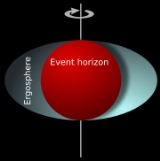
. The outer surface encloses the ergosphere and has a shape similar to a flattened sphere. The inner surface marks the "radius of no return" also called the "event horizon"; objects passing through this radius can never again communicate with the world outside that radius. However, neither surface is a true singularity, since their apparent singularity can be eliminated in a different
coordinate systemIn geometry, a coordinate system is a system which uses one or more numbers, or coordinates, to uniquely determine the position of a point or other geometric element. The order of the coordinates is significant and they are sometimes identified by their position in an ordered tuple and sometimes by...
. Objects between these two horizons must co-rotate with the rotating body, as noted above; this feature can be used to extract energy from a rotating black hole, up to its
invariant massThe invariant mass, rest mass, intrinsic mass, proper mass or just mass is a characteristic of the total energy and momentum of an object or a system of objects that is the same in all frames of reference related by Lorentz transformations...
energy,
Mc2. Even stranger phenomena can be observed within the innermost region of this spacetime, such as some forms of time travel. For example, the Kerr metric permits closed, time-like loops in which a band of travelers returns to the same place after moving for a finite time by their own clock; however, they return to the same place
and time, as seen by an outside observer.
Mathematical form
The Kerr metric describes the geometry of
spacetimeIn physics, spacetime is any mathematical model that combines space and time into a single continuum. Spacetime is usually interpreted with space as being three-dimensional and time playing the role of a fourth dimension that is of a different sort from the spatial dimensions...
in the vicinity of a mass
M rotating with
angular momentumIn physics, angular momentum, moment of momentum, or rotational momentum is a conserved vector quantity that can be used to describe the overall state of a physical system...
J
-
-
-

where the coordinates
are standard spherical coordinate systemIn mathematics, a spherical coordinate system is a coordinate system for three-dimensional space where the position of a point is specified by three numbers: the radial distance of that point from a fixed origin, its inclination angle measured from a fixed zenith direction, and the azimuth angle of...
, and rs is the Schwarzschild radiusIn Einstein's theory of general relativity, the Schwarzschild solution describes the gravitational field outside a spherical, uncharged, non-rotating mass such as a star, planet, or black hole. It is also a good approximation to the gravitational field of a slowly rotating body like the Earth or...

and where the length-scales α, ρ and Δ have been introduced for brevity


In the non-relativistic limit where M (or, equivalently, rs) goes to zero, the Kerr metric becomes the orthogonal metric for the oblate spheroidal coordinatesOblate spheroidal coordinates are a three-dimensional orthogonal coordinate system that results from rotating the two-dimensional elliptic coordinate system about the non-focal axis of the ellipse, i.e., the symmetry axis that separates the foci. Thus, the two foci are transformed into a ring of...

which are equivalent to the Boyer-Lindquist coordinatesA generalization of the coordinates used for the metric of a Schwarzschild black hole that can be used to express the metric of a Kerr black hole.The coordinate transformation from Boyer–Lindquist coordinates r, \theta, \phi to cartesian coordinates x, y, z is given bywhereThe Hamiltonian for test...


Gradient operator
Since even a direct check on the Kerr metric involves cumbersome calculations, the contravariant components
of the metric tensorIn the mathematical field of differential geometry, a metric tensor is a type of function defined on a manifold which takes as input a pair of tangent vectors v and w and produces a real number g in a way that generalizes many of the familiar properties of the dot product of vectors in Euclidean...
are shown below in the expression for the square of the four-gradientThe four-gradient is the four-vector generalization of the gradient:\partial_\alpha \ = \left...
operatorIn mathematics, a differential operator is an operator defined as a function of the differentiation operator. It is helpful, as a matter of notation first, to consider differentiation as an abstract operation, accepting a function and returning another .This article considers only linear operators,...
:
-
-
-
-

Frame dragging
We may rewrite the Kerr metric in the following form:

This metric is equivalent to a co-rotating reference frame that is rotating with angular speed Ω that depends on both the radius r and the colatitudeIn spherical coordinates, colatitude is the complementary angle of the latitude, i.e. the difference between 90° and the latitude.-Astronomical use:The colatitude is useful in astronomy because it refers to the zenith distance of the celestial poles...
θ, where Ω is called the Killing horizonA Killing horizon is a null hypersurface on which there is a null Killing vector field .Associated to a Killing horizon is a geometrical quantity known as surface gravity, \kappa...
.

Thus, an inertial reference frame is entrained by the rotating central mass to participate in the latter's rotation; this is frame-draggingEinstein's general theory of relativity predicts that non-static, stationary mass-energy distributions affect spacetime in a peculiar way giving rise to a phenomenon usually known as frame-dragging...
, which is currently unable to be tested experimentally.
Qualitatively, frame-dragging can be viewed as the gravitational analog of electromagnetic induction. An "ice skater", in orbit over the equator and rotationally at rest with respect to the stars, extends her arms. The arm extended toward the black hole will be torqued spinward. The arm extended away from the black hole will be torqued anti-spinward. She will therefore be rotationally sped up, in a counter-rotating sense to the black hole. This is the opposite of what happens in everyday experience. If she is already rotating at a certain speed when she extends her arms, inertial effects and frame-dragging effects will balance and her spin will not change. Due to the Principle of EquivalenceIn the physics of general relativity, the equivalence principle is any of several related concepts dealing with the equivalence of gravitational and inertial mass, and to Albert Einstein's assertion that the gravitational "force" as experienced locally while standing on a massive body is actually...
gravitational effects are locally indistinguishable from inertial effects, so the rotation rate at which, when she extends her arms, nothing happens is her local reference for non-rotation. This frame is rotating with respect to the fixed stars and counter-rotating with respect to the black hole. A useful metaphor is a planetary gear system with the black hole being the sun gear, the ice skater being a planetary gear and the outside universe being the ring gear. Think Mach's principleIn theoretical physics, particularly in discussions of gravitation theories, Mach's principle is the name given by Einstein to an imprecise hypothesis often credited to the physicist and philosopher Ernst Mach....
.
Important surfaces
The Kerr metric has two physical relevant surfaces on which it appears to be singular. The inner surface corresponds to an event horizonIn general relativity, an event horizon is a boundary in spacetime beyond which events cannot affect an outside observer. In layman's terms it is defined as "the point of no return" i.e. the point at which the gravitational pull becomes so great as to make escape impossible. The most common case...
similar to that observed in the Schwarzschild metricIn Einstein's theory of general relativity, the Schwarzschild solution describes the gravitational field outside a spherical, uncharged, non-rotating mass such as a star, planet, or black hole. It is also a good approximation to the gravitational field of a slowly rotating body like the Earth or...
; this occurs where the purely radial component grr of the metric goes to infinity. Solving the quadratic equation 1/grr = 0 yields the solution:

Another singularity occurs where the purely temporal component gtt of the metric changes sign from positive to negative. Again solving a quadratic equation gtt=0 yields the solution:

Due to the cos2θ term in the square root, this outer surface resembles a flattened sphere that touches the inner surface at the poles of the rotation axis, where the colatitude θ equals 0 or π; the space between these two surfaces is called the ergosphereThe ergosphere is a region located outside a rotating black hole. Its name is derived from the Greek word ergon, which means “work”. It received this name because it is theoretically possible to extract energy and mass from the black hole in this region...
. There are two other solutions to these quadratic equations, but they lie within the event horizon, where the Kerr metric is not used, since it has unphysical properties (see below).
A moving particle experiences a positive proper timeIn relativity, proper time is the elapsed time between two events as measured by a clock that passes through both events. The proper time depends not only on the events but also on the motion of the clock between the events. An accelerated clock will measure a smaller elapsed time between two...
along its worldline, its path through spacetimeIn physics, spacetime is any mathematical model that combines space and time into a single continuum. Spacetime is usually interpreted with space as being three-dimensional and time playing the role of a fourth dimension that is of a different sort from the spatial dimensions...
. However, this is impossible within the ergosphere, where gtt is negative, unless the particle is co-rotating with the interior mass M with an angular speed at least of Ω. Thus, no particle can rotate opposite to the central mass within the ergosphere.
As with the event horizon in the Schwarzschild metricIn Einstein's theory of general relativity, the Schwarzschild solution describes the gravitational field outside a spherical, uncharged, non-rotating mass such as a star, planet, or black hole. It is also a good approximation to the gravitational field of a slowly rotating body like the Earth or...
the apparent singularities at rinner and router are an illusion created by the choice of coordinates (i.e., they are coordinate singularities). In fact, the space-time can be smoothly continued through them by an appropriate choice of coordinates.
Ergosphere and the Penrose process
A black hole in general is surrounded by a surface, called the event horizonIn general relativity, an event horizon is a boundary in spacetime beyond which events cannot affect an outside observer. In layman's terms it is defined as "the point of no return" i.e. the point at which the gravitational pull becomes so great as to make escape impossible. The most common case...
and situated at the Schwarzschild radiusThe Schwarzschild radius is the distance from the center of an object such that, if all the mass of the object were compressed within that sphere, the escape speed from the surface would equal the speed of light...
for a nonrotating black hole, where the escape velocity is equal to the velocity of light. Within this surface, no observer/particle can maintain itself at a constant radius. It is forced to fall inwards, and so this is sometimes called the static limit.
A rotating black hole has the same static limit at its event horizon but there is an additional surface outside the event horizon named the "ergosurface" given by
in Boyer-Lindquist coordinatesA generalization of the coordinates used for the metric of a Schwarzschild black hole that can be used to express the metric of a Kerr black hole.The coordinate transformation from Boyer–Lindquist coordinates r, \theta, \phi to cartesian coordinates x, y, z is given bywhereThe Hamiltonian for test...
, which can be intuitively characterized as the sphere where "the rotational velocity of the surrounding space" is dragged along with the velocity of light. Within this sphere the dragging is greater than the speed of light, and any observer/particle is forced to co-rotate.
The region outside the event horizon but inside the surface where the rotational velocity is the speed of light, is called the ergosphere (from Greek ergon meaning work). Particles falling within the ergosphere are forced to rotate faster and thereby gain energy. Because they are still outside the event horizon, they may escape the black hole. The net process is that the rotating black hole emits energetic particles at the cost of its own total energy. The possibility of extracting spin energy from a rotating black hole was first proposed by the mathematician Roger PenroseSir Roger Penrose OM FRS is an English mathematical physicist and Emeritus Rouse Ball Professor of Mathematics at the Mathematical Institute, University of Oxford and Emeritus Fellow of Wadham College...
in 1969 and is thus called the Penrose process. Rotating black holes in astrophysics are a potential source of large amounts of energy and are used to explain energetic phenomena, such as gamma ray bursts.
Features of the Kerr vacuum
The Kerr vacuum exhibits many noteworthy features: the maximal analytic extension includes a sequence of asymptotically flat exterior regions, each associated with an ergosphereThe ergosphere is a region located outside a rotating black hole. Its name is derived from the Greek word ergon, which means “work”. It received this name because it is theoretically possible to extract energy and mass from the black hole in this region...
, stationary limit surfaces, event horizonIn general relativity, an event horizon is a boundary in spacetime beyond which events cannot affect an outside observer. In layman's terms it is defined as "the point of no return" i.e. the point at which the gravitational pull becomes so great as to make escape impossible. The most common case...
s, Cauchy horizonIn physics, a Cauchy horizon is a light-like boundary of the domain of validity of a Cauchy problem...
s, closed timelike curveIn mathematical physics, a closed timelike curve is a worldline in a Lorentzian manifold, of a material particle in spacetime that is "closed," returning to its starting point...
s, and a ring-shaped curvature singularity. The geodesic equation can be solved exactly in closed form. In addition to two Killing vector fields (corresponding to time translation and axisymmetry), the Kerr vacuum admits a remarkable Killing tensor. There is a pair of principal null congruences (one ingoing and one outgoing). The Weyl tensorIn differential geometry, the Weyl curvature tensor, named after Hermann Weyl, is a measure of the curvature of spacetime or, more generally, a pseudo-Riemannian manifold. Like the Riemann curvature tensor, the Weyl tensor expresses the tidal force that a body feels when moving along a geodesic...
is algebraically special, in fact it has Petrov typeIn differential geometry and theoretical physics, the Petrov classification describes the possible algebraic symmetries of the Weyl tensor at each event in a Lorentzian manifold....
D. The global structure is known. Topologically, the homotopy type of the Kerr spacetime can be simply characterized as a line with circles attached at each integer point.
Note that the Kerr vacuum is unstable with regards to perturbations in the interior region. This instability means that although the Kerr metric is axis-symmetric, a black hole created through gravitational collapse may not be so. This instability also implies that many of the features of the Kerr vacuum described above would also probably not be present in such a black hole.
A surface on which light can orbit a black hole is called a photon sphere. The Kerr solution has infinitely many photon spheres, lying between an inner one and an outer one. In the nonrotating, Schwarzschild solution, with α=0, the inner and outer photon spheres degenerate, so that all the photons sphere occur at the same radius. The greater the spin of the black hole is, the farther from each other the inner and outer photon spheres move. A beam of light traveling in a direction opposite to the spin of the black hole will circularly orbit the hole at the outer photon sphere. A beam of light traveling in the same direction as the black hole's spin will circularly orbit at the inner photon sphere. Orbiting geodesics with some angular momentum perpendicular to the axis of rotation of the black hole will orbit on photon spheres between these two extremes. Because the space-time is rotating, such orbits exhibit a precession, since there is a shift in the
variable after completing one period in the
variable.
Overextreme Kerr solutions
The location of the event horizon is determined by the larger root of
. When
(i.e.
), there are no (real valued) solutions to this equation, and there is no event horizon. With no event horizons to hide it from the rest of the universe, the black hole ceases to be a black hole and will instead be a naked singularityIn general relativity, a naked singularity is a gravitational singularity, without an event horizon. In a black hole, there is a region around the singularity, the event horizon, where the gravitational force of the singularity is strong enough so that light cannot escape. Hence, the singularity...
.
Kerr black holes as wormholes
Although the Kerr solution appears to be singular at the roots of Δ = 0, these are actually coordinate singularities, and, with an appropriate choice of new coordinates, the Kerr solution can be smoothly extended through the values of
corresponding to these roots. The larger of these roots determines the location of the event horizon, and the smaller determines the location of a Cauchy horizon. A (future-directed, time-like) curve can start in the exterior and pass through the event horizon. Once having passed through the event horizon, the
coordinate now behaves like a time coordinate, so it must decrease until the curve passes through the Cauchy horizon.
The region beyond the Cauchy horizon has several surprising features. The
coordinate again behaves like a spatial coordinate and can vary freely. The interior region has a reflection symmetry, so that a (future-directed time-like) curve may continue along a symmetric path, which continues through a second Cauchy horizon, through a second event horizon, and out into a new exterior region which is isometric to the original exterior region of the Kerr solution. The curve could then escape to infinity in the new region or enter the future event horizon of the new exterior region and repeat the process. This second exterior is sometimes thought of as another universe. On the other hand, in the Kerr solution, the singularity is a ringRing singularity is a term used in general relativity to describe the altering gravitational singularity of a rotating black hole, or a Kerr black hole, so that the gravitational singularity becomes shaped like a ring.-Description of a ring-singularity:...
, and the curve may pass through the center of this ring. The region beyond permits closed, time-like curves. Since the trajectory of observers and particles in general relativity are described by time-like curves, it is possible for observers in this region to return to their past.
While it is expected that the exterior region of the Kerr solution is stable, and that all rotating black holes will eventually approach a Kerr metric, the interior region of the solution appears to be unstable, much like a pencil balanced on its point.
Relation to other exact solutions
The Kerr vacuum is a particular example of a stationaryIn general relativity, specifically in the Einstein field equations, a spacetime is said to be stationary if it admits a Killing vector that is asymptotically timelike....
axially symmetric vacuum solutionA vacuum solution is a solution of a field equation in which the sources of the field are taken to be identically zero. That is, such field equations are written without matter interaction .-Examples:...
to the Einstein field equation. The family of all stationary axially symmetric vacuum solutions to the Einstein field equation are the Ernst vacuums.
The Kerr solution is also related to various non-vacuum solutions which model black holes. For example, the Kerr–Newman electrovacuum models a (rotating) black hole endowed with an electric charge, while the Kerr–Vaidya null dust models a (rotating) hole with infalling electromagnetic radiation.
The special case
of the Kerr metric yields the Schwarzschild metricIn Einstein's theory of general relativity, the Schwarzschild solution describes the gravitational field outside a spherical, uncharged, non-rotating mass such as a star, planet, or black hole. It is also a good approximation to the gravitational field of a slowly rotating body like the Earth or...
, which models a nonrotating black hole which is staticIn general relativity, a spacetime is said to be static if it admits a global, non-vanishing, timelike Killing vector field K which is irrotational, i.e., whose orthogonal distribution is involutive...
and spherically symmetric, in the Schwarzschild coordinatesIn the theory of Lorentzian manifolds, spherically symmetric spacetimes admit a family of nested round spheres. In such a spacetime, a particularly important kind of coordinate chart is the Schwarzschild chart, a kind of polar spherical coordinate chart on a static and spherically symmetric...
. (In this case, every Geroch moment but the mass vanishes.)
The interior of the Kerr vacuum, or rather a portion of it, is locally isometric to the Chandrasekhar–Ferrari CPW vacuum, an example of a colliding plane wave model. This is particularly interesting, because the global structure of this CPW solution is quite different from that of the Kerr vacuum, and in principle, an experimenter could hope to study the geometry of (the outer portion of) the Kerr interior by arranging the collision of two suitable gravitational plane waves.
Multipole moments
Each asymptotically flat Ernst vacuum can be characterized by giving the infinite sequence of relativistic multipole moments, the first two of which can be interpreted as the massMass can be defined as a quantitive measure of the resistance an object has to change in its velocity.In physics, mass commonly refers to any of the following three properties of matter, which have been shown experimentally to be equivalent:...
and angular momentumIn physics, angular momentum, moment of momentum, or rotational momentum is a conserved vector quantity that can be used to describe the overall state of a physical system...
of the source of the field. There are alternative formulations of relativistic multipole moments due to Hansen, Thorne, and Geroch, which turn out to agree with each other. The relativistic multipole moments of the Kerr vacuum were computed by Hansen; they turn out to be
Thus, the special case of the Schwarzschild vacuumIn Einstein's theory of general relativity, the Schwarzschild solution describes the gravitational field outside a spherical, uncharged, non-rotating mass such as a star, planet, or black hole. It is also a good approximation to the gravitational field of a slowly rotating body like the Earth or...
(α=0) gives the "monopole point sourceA point source is a localised, relatively small source of something.Point source may also refer to:*Point source , a localised source of pollution**Point source water pollution, water pollution with a localized source...
" of general relativity.
Warning: do not confuse these relativistic multipole moments with the Weyl multipole moments, which arise from treating a certain metric function (formally corresponding to Newtonian gravitational potential) which appears the Weyl-Papapetrou chart for the Ernst family of all stationary axisymmetric vacuums solutions using the standard euclidean scalar multipole moments. In a sense, the Weyl moments only (indirectly) characterize the "mass distribution" of an isolated source, and they turn out to depend only on the even order relativistic moments. In the case of solutions symmetric across the equatorial plane the odd order Weyl moments vanish. For the Kerr vacuum solutions, the first few Weyl moments are given by
In particular, we see that the Schwarzschild vacuum has nonzero second order Weyl moment, corresponding to the fact that the "Weyl monopole" is the Chazy–Curzon vacuum solution, not the Schwarzschild vacuum solution, which arises from the Newtonian potential of a certain finite length uniform density thin rod.
In weak field general relativity, it is convenient to treat isolated sources using another type of multipole, which generalize the Weyl moments to mass multipole moments and momentum multipole moments, characterizing respectively the distribution of massMass can be defined as a quantitive measure of the resistance an object has to change in its velocity.In physics, mass commonly refers to any of the following three properties of matter, which have been shown experimentally to be equivalent:...
and of momentumIn classical mechanics, linear momentum or translational momentum is the product of the mass and velocity of an object...
of the source. These are multi-indexed quantities whose suitably symmetrized (anti-symmetrized) parts can be related to the real and imaginary parts of the relativistic moments for the full nonlinear theory in a rather complicated manner.
Perez and Moreschi have given an alternative notion of "monopole solutions" by expanding the standard NP tetrad of the Ernst vacuums in powers of r (the radial coordinate in the Weyl-Papapetrou chart). According to this formulation:
- the isolated mass monopole source with zero angular momentum is the Schwarzschild vacuum family (one parameter),
- the isolated mass monopole source with radial angular momentum is the Taub–NUT vacuum family (two parameters; not quite asymptotically flat),
- the isolated mass monopole source with axial angular momentum is the Kerr vacuum family (two parameters).
In this sense, the Kerr vacuums are the simplest stationary axisymmetric asymptotically flat vacuum solutions in general relativity.
Open problems
The Kerr vacuum is often used as a model of a black hole, but if we hold the solution to be valid only outside some compact region (subject to certain restrictions), in principle we should be able to use it as an exterior solution to model the gravitational field around a rotating massive object other than a black hole, such as a neutron starA neutron star is a type of stellar remnant that can result from the gravitational collapse of a massive star during a Type II, Type Ib or Type Ic supernova event. Such stars are composed almost entirely of neutrons, which are subatomic particles without electrical charge and with a slightly larger...
--- or the EarthEarth is the third planet from the Sun, and the densest and fifth-largest of the eight planets in the Solar System. It is also the largest of the Solar System's four terrestrial planets...
. This works out very nicely for the non-rotating case, where we can match the Schwarzschild vacuum exterior to a Schwarzschild fluid interior, and indeed to more general static spherically symmetric perfect fluidIn metric theories of gravitation, particularly general relativity, a static spherically symmetric perfect fluid solution is a spacetime equipped with suitable tensor fields which models a static round ball of a fluid with isotropic pressure.Such solutions are often used as idealized models of...
solutions. However, the problem of finding a rotating perfect-fluid interior which can be matched to a Kerr exterior, or indeed to any asymptotically flat vacuum exterior solution, has proven very difficult. In particular, the Wahlquist fluid, which was once thought to be a candidate for matching to a Kerr exterior, is now known not to admit any such matching. At present it seems that only approximate solutions modeling slowly rotating fluid balls (the relativistic analog of oblate spheroidal balls with nonzero mass and angular momentum but vanishing higher multipole moments) are known. However, the exterior of the Neugebauer–Meinel disk, an exact dust solutionIn general relativity, a dust solution is an exact solution of the Einstein field equation in which the gravitational field is produced entirely by the mass, momentum, and stress density of a perfect fluid which has positive mass density but vanishing pressure...
which models a rotating thin disk, approaches in a limiting case the
Kerr vacuum.
Trajectory equations
The equations of the trajectory and the time dependence for a particle in the Kerr field are as follows.
In the Hamilton-Jacobi equation we write the actionIn physics, action is an attribute of the dynamics of a physical system. It is a mathematical functional which takes the trajectory, also called path or history, of the system as its argument and has a real number as its result. Action has the dimension of energy × time, and its unit is...
S in the form:
-
-
-

where
, m, and L are the conserved energyIn physics, energy is an indirectly observed quantity. It is often understood as the ability a physical system has to do work on other physical systems...
, the rest mass and the component of the angular momentumIn physics, angular momentum, moment of momentum, or rotational momentum is a conserved vector quantity that can be used to describe the overall state of a physical system...
(along the axis of symmetry of the field) of the particle consecutively, and carry out the separation of variables in the Hamilton Jacobi equation as follows:
-


where K is a fourth arbitrary constant (usually called Carter's constantThe Carter constant is a conserved quantity for motion around black holes in the general relativistic formulation of gravity. Carter's constant was derived for a spinning, charged black hole by Australian theoretical physicist Brandon Carter in 1968...
). The equation of the trajectoryA trajectory is the path that a moving object follows through space as a function of time. The object might be a projectile or a satellite, for example. It thus includes the meaning of orbit—the path of a planet, an asteroid or a comet as it travels around a central mass...
and the time dependence of the coordinates along the trajectory (motionIn physics, motion is a change in position of an object with respect to time. Change in action is the result of an unbalanced force. Motion is typically described in terms of velocity, acceleration, displacement and time . An object's velocity cannot change unless it is acted upon by a force, as...
equation) can be found then easily and directly from these equations:
-


Symmetries
The group of isometries of the Kerr metric is the subgroup of the ten-dimensional Poincaré groupIn physics and mathematics, the Poincaré group, named after Henri Poincaré, is the group of isometries of Minkowski spacetime.-Simple explanation:...
which takes the two-dimensional locus of the singularity to itself. It retains the time translations (one dimension) and rotations around its axis of rotation (one dimension). Thus it has two dimensions. Like the Poincaré group, it has four connected components: the component of the identity; the component which reverses time and longitude; the component which reflects through the equatorial plane; and the component that does both.
In physics, symmetries are typically associated with conserved constants of motion, in accordance with Noether's theoremNoether's theorem states that any differentiable symmetry of the action of a physical system has a corresponding conservation law. The theorem was proved by German mathematician Emmy Noether in 1915 and published in 1918...
. As shown above, the geodesic equations have four conserved quantities: one of which comes from the definition of a geodesic, and two of which arise from the time translation and rotation symmetry of the Kerr geometry. The fourth conserved quantity does not arise from a symmetry in the standard sense and is commonly referred to as a hidden symmetry.
See also
- Schwarzschild metric
In Einstein's theory of general relativity, the Schwarzschild solution describes the gravitational field outside a spherical, uncharged, non-rotating mass such as a star, planet, or black hole. It is also a good approximation to the gravitational field of a slowly rotating body like the Earth or...
- Kerr–Newman metric
- Reissner–Nordström metric
- Spin-flip
A black hole spin-flip occurs when the spin axis of a rotating black hole undergoes a sudden change in orientation due to absorption of a second black hole....
- Kerr–Schild spacetime
Further reading
See chapter 19 for a readable introduction at the advanced undergraduate level. See chapters 6--10 for a very thorough study at the advanced graduate level. See chapter 13 for the Chandrasekhar/Ferrari CPW model. See chapter 7. Characterization of three standard families of vacuum solutions as noted above. arXiv eprint Gives the relativistic multipole moments for the Ernst vacuums (plus the electromagnetic and gravitational relativistic multipole moments for the charged generalization). “… This note is meant to be a guide for those readers who wish to verify all the details [of the derivation of the Kerr solution]…”
External links