


Gottfried von Strassburg

Encyclopedia
Middle High German
Middle High German , abbreviated MHG , is the term used for the period in the history of the German language between 1050 and 1350. It is preceded by Old High German and followed by Early New High German...
courtly romance Tristan and Isolt, an adaptation of the 12th-century Tristan and Iseult
Tristan and Iseult
The legend of Tristan and Iseult is an influential romance and tragedy, retold in numerous sources with as many variations. The tragic story is of the adulterous love between the Cornish knight Tristan and the Irish princess Iseult...
legend. Gottfried's work is regarded, alongside Wolfram von Eschenbach
Wolfram von Eschenbach
Wolfram von Eschenbach was a German knight and poet, regarded as one of the greatest epic poets of his time. As a Minnesinger, he also wrote lyric poetry.-Life:...
's Parzival
Parzival
Parzival is a major medieval German romance by the poet Wolfram von Eschenbach, in the Middle High German language. The poem, commonly dated to the first quarter of the 13th century, is itself largely based on Chrétien de Troyes’s Perceval, the Story of the Grail and mainly centers on the Arthurian...
and the Nibelungenlied
Nibelungenlied
The Nibelungenlied, translated as The Song of the Nibelungs, is an epic poem in Middle High German. The story tells of dragon-slayer Siegfried at the court of the Burgundians, how he was murdered, and of his wife Kriemhild's revenge....
, as one of the great narrative masterpieces of the German Middle Ages. He is probably also the composer of a small number of surviving lyrics. His work became a source of inspiration for Richard Wagner
Richard Wagner
Wilhelm Richard Wagner was a German composer, conductor, theatre director, philosopher, music theorist, poet, essayist and writer primarily known for his operas...
's opera Tristan und Isolde
Tristan und Isolde
Tristan und Isolde is an opera, or music drama, in three acts by Richard Wagner to a German libretto by the composer, based largely on the romance by Gottfried von Straßburg. It was composed between 1857 and 1859 and premiered in Munich on 10 June 1865 with Hans von Bülow conducting...
.
Life
Other than an origin in or close association with StrasbourgStrasbourg
Strasbourg is the capital and principal city of the Alsace region in eastern France and is the official seat of the European Parliament. Located close to the border with Germany, it is the capital of the Bas-Rhin département. The city and the region of Alsace are historically German-speaking,...
, nothing is known of his life. It would seem, however, that he was a man of good birth and position, who filled an important municipal office in his native town of Strasburg, but since he is always referred to as Meister (master) and not Herr (sir), it seems safe to assume he was not a knight, a conclusion supported by the rather dismissive attitude toward knightly exploits shown in Tristan.
Tristan ends abruptly, and according to the testimony of Ulrich von Türheim
Ulrich von Türheim
Ulrich von Türheim was a German writer from the Augsburg area writing during the first half of the 13th century. Three of his works have survived: a conclusion to the version of the Tristan legend left unfinished by Gottfried von Strassburg; Rennewart, a continuation of Willehalm, left unfinished...
and Heinrich von Freiberg, two people who provided endings for Tristan, Gottfried died before finishing the work. References in the work suggest it was written during the first decade of the 13th century, and 1210 is taken, conventionally, as the date of Gottfried's death.
His thorough familiarity with Latin literature and rhetorical theory suggest someone who had enjoyed a high level of monastic education. He also shows detailed technical knowledge of music and hunting, far beyond anything found in the works of his contemporaries. Gottfried draws more on the learned tradition of medieval humanism
Humanism
Humanism is an approach in study, philosophy, world view or practice that focuses on human values and concerns. In philosophy and social science, humanism is a perspective which affirms some notion of human nature, and is contrasted with anti-humanism....
than on the chivalric
Chivalry
Chivalry is a term related to the medieval institution of knighthood which has an aristocratic military origin of individual training and service to others. Chivalry was also the term used to refer to a group of mounted men-at-arms as well as to martial valour...
ethos shared by his major literary contemporaries. He also appears to have been influenced by the writings of contemporary Christian mystics, in particular Bernard of Clairvaux
Bernard of Clairvaux
Bernard of Clairvaux, O.Cist was a French abbot and the primary builder of the reforming Cistercian order.After the death of his mother, Bernard sought admission into the Cistercian order. Three years later, he was sent to found a new abbey at an isolated clearing in a glen known as the Val...
. Although he was highly educated, it is almost certain that he was not a priest. Of this his occasional sneers at the clergy are perhaps a better proof than the morality of much of his work.
That his home was in Strassburg is supported by the fact that the earliest manuscripts of Tristan, dating from the first half of the 13th century, show features of Alemannic
Alemannic German
Alemannic is a group of dialects of the Upper German branch of the Germanic language family. It is spoken by approximately ten million people in six countries: Switzerland, Germany, Austria, Liechtenstein, France and Italy...
and specifically Alsatian
Alsatian language
Alsatian is a Low Alemannic German dialect spoken in most of Alsace, a region in eastern France which has passed between French and German control many times.-Language family:...
dialect.
Style
Gottfried's rhetorical style is very distinct among his contemporaries.It is incredibly complex, marked by the extensive use of symmetrical
Symmetry
Symmetry generally conveys two primary meanings. The first is an imprecise sense of harmonious or aesthetically pleasing proportionality and balance; such that it reflects beauty or perfection...
structure in his organization of Tristan as a whole, as well as in the structure of individual passages. Gottfried also uses detailed word and sound patterns, playing with such things as rhyme, alliteration, and assonance. See Batts (1971) for a detailed analysis.
One of the greatest hallmarks of Gottfried's style is his skillful use of irony
Irony
Irony is a rhetorical device, literary technique, or situation in which there is a sharp incongruity or discordance that goes beyond the simple and evident intention of words or actions...
, to both humorous and tragic effects. He may also have relied on irony to disguise his criticisms of contemporary society in order to avoid censure.
Sources
Gottfried states that the Tristan of Thomas of BritainThomas of Britain
Thomas of Britain was a french poet of the 12th century. He is known for his Old French poem Tristan, a version of the Tristan and Iseult legend that exists only in eight fragments, amounting to around 3,300 lines of verse, mostly from the latter part of the story...
, an Anglo-French work of around 1160, was the source of his work. He explains that he bases himself on Thomas because he "told the tale correctly", distancing himself from the less courtly versions of the story represented by Béroul
Béroul
Béroul was a Norman poet of the 12th century. He wrote Tristan, a Norman language version of the legend of Tristan and Iseult of which a certain number of fragments have been preserved; it is the earliest representation of the so-called "vulgar" version of the legend...
in Old French
Old French
Old French was the Romance dialect continuum spoken in territories that span roughly the northern half of modern France and parts of modern Belgium and Switzerland from the 9th century to the 14th century...
and Eilhart von Oberge
Eilhart von Oberge
Eilhart von Oberge was a German poet of the late 12th century. He is known exclusively through his Middle High German romance Tristrant, the oldest surviving complete version of the Tristan and Iseult story in any language. Tristrant is part of the "common" or "primitive" branch of the legend, best...
in Middle High German
Middle High German
Middle High German , abbreviated MHG , is the term used for the period in the history of the German language between 1050 and 1350. It is preceded by Old High German and followed by Early New High German...
.
Unfortunately, Thomas's work, too, is fragmentary and there is little overlap with Gottfried's poem, making it difficult to evaluate Gottfried's originality directly. However, Thomas's Tristan was the source of a number of other versions, which makes it possible to get some idea of style and content. It is clear that while Gottfried's statement of his reliance on and debt to Thomas is correct, he both expanded on his source and refined the story psychologically. The discovery in 1995 of the Carlise Fragment of Thomas's Tristan, which includes material from one of the central parts of the story, the Love Grotto episode, promises a better understanding of Gottfried's use of his source.
Thomas's source, in turn, is a now lost Old French
Old French
Old French was the Romance dialect continuum spoken in territories that span roughly the northern half of modern France and parts of modern Belgium and Switzerland from the 9th century to the 14th century...
Tristan story, reconstructed by Joseph Bédier
Joseph Bédier
Joseph Bédier was a French writer and scholar and historian of medieval France.-Biography:Bédier was born in Paris, France to Adolphe Bédier, a lawyer of Breton origin, and spent his childhood in Réunion. He was a professor of medieval French literature at the Université de Fribourg, Switzerland ...
, which derives ultimately from Celtic legend.
Text
The text of Tristan is 19,548 lines long, and is written, like all courtly romances, in rhymingRhyme
A rhyme is a repetition of similar sounds in two or more words and is most often used in poetry and songs. The word "rhyme" may also refer to a short poem, such as a rhyming couplet or other brief rhyming poem such as nursery rhymes.-Etymology:...
couplet
Couplet
A couplet is a pair of lines of meter in poetry. It usually consists of two lines that rhyme and have the same meter.While traditionally couplets rhyme, not all do. A poem may use white space to mark out couplets if they do not rhyme. Couplets with a meter of iambic pentameter are called heroic...
s.
The first section (ll. 1-44) of the prologue
Prologue
A prologue is an opening to a story that establishes the setting and gives background details, often some earlier story that ties into the main one, and other miscellaneous information. The Greek prologos included the modern meaning of prologue, but was of wider significance...
is written in quatrain
Quatrain
A quatrain is a stanza, or a complete poem, consisting of four lines of verse. Existing in various forms, the quatrain appears in poems from the poetic traditions of various ancient civilizations including Ancient Greece, Ancient Rome, and China; and, continues into the 21st century, where it is...
s and is referred to as the "strophic prologue", while pairs of quatrains, of sententious content, mark the main divisions of the story. The initial letters of the quatrains, indicated by large initials in some manuscript
Manuscript
A manuscript or handwrite is written information that has been manually created by someone or some people, such as a hand-written letter, as opposed to being printed or reproduced some other way...
s, form an acrostic
Acrostic
An acrostic is a poem or other form of writing in which the first letter, syllable or word of each line, paragraph or other recurring feature in the text spells out a word or a message. As a form of constrained writing, an acrostic can be used as a mnemonic device to aid memory retrieval. A famous...
with the names Gotefrid-Tristan-Isolde, which runs throughout the poem. In addition, the initial letters of the quatrains in the prologue give the name Dieterich, which is assumed to have been the name of Gottfried's patron
Patrón
Patrón is a luxury brand of tequila produced in Mexico and sold in hand-blown, individually numbered bottles.Made entirely from Blue Agave "piñas" , Patrón comes in five varieties: Silver, Añejo, Reposado, Gran Patrón Platinum and Gran Patrón Burdeos. Patrón also sells a tequila-coffee blend known...
.
If Gottfried had completed Tristan it would probably have been around 24,000 lines long.
Story
The story starts with the courtship of Tristan's parents. Riwalin, King of Parmenie, travels to the court of King Marke in CornwallCornwall
Cornwall is a unitary authority and ceremonial county of England, within the United Kingdom. It is bordered to the north and west by the Celtic Sea, to the south by the English Channel, and to the east by the county of Devon, over the River Tamar. Cornwall has a population of , and covers an area of...
, where he and Marke's sister, Blanschefleur, fall in love. Blanschfleur becomes pregnant and the couple steal back to Parmenie, but Riwalin is killed in battle. When she hears the news, Blanschfleur dies, but the baby is delivered and survives. He is named Tristan because of the sorrowful circumstances of his birth.
Tristan grows up in Parmenie, passed off as the son of Riwalin's marshal Rual li Fointeant, becoming the perfect courtier. While on board a merchant ship which has docked in Parmenie, Tristan is abducted by the Norwegian crew. Once at sea, the ship is struck by a tempest, the crew conclude that they are being punished by God for abducting Tristan, so they set him ashore in a country that turns out to be Cornwall.
Tristan encounters a hunting party, whom he astonishes with his skill, and he accompanies them to Marke's court, where his many accomplishments make him popular, particularly with Marke. Eventually, after years of searching, Rual comes to Cornwall and finds Tristan, who is now revealed as Marke's nephew. Tristan is knighted.
Cornwall is being forced to pay tribute to the Gurmun, King of Ireland
Ireland
Ireland is an island to the northwest of continental Europe. It is the third-largest island in Europe and the twentieth-largest island on Earth...
, collected by his brother, the monstrous Morold. Tristan challenges Morold to a duel and defeats him, though he becomes wounded by Morold's poisoned sword. In order to seek a cure Tristan travels to Ireland incognito (under the name Tantris), and contrives to get himself cured by Gurmun's Queen Isolde (Isolde the Wise). He is struck by the beauty and accomplishments of her daughter, Isolde the Fair, and returns to Cornwall singing her praises.
Jealous of Tristan, Marke's councillors press him to marry, so that Tristan can be ousted as heir. Hoping that he will be killed in the process, they suggest Tristan be sent to Ireland to woo Isolde for Marke. Tristan travels to Ireland (as Tantris) and kills a dragon which has been threatening the countryside, thus winning Isolde's hand. However, observing that the splinter previously found in Morold's skull matches Tantris's sword, Isolde realises Tantris is in fact Tristan, and threatens to kill him as he sits in the bath. Her mother and her kinswoman Brangaene intervene and Tristan explains the purpose of his journey, which leads to a reconciliation between Ireland and Cornwall. Tristan leaves for Cornwall with Isolde as a bride for Marke.
Isolde the Wise has given Brangaene a magic potion to be drunk by Marke and Isolde on their wedding night to ensure their love. On the voyage, however, it is drunk by Tristan and Isolde by mistake. They avow their love for each other, but know that it cannot be made public, and they enjoy a brief idyll on board before arriving in Cornwall. This is followed by a series of intrigues in which the lovers attempt to dupe Marke, starting with the wedding night, when the virgin Brangaene substitutes for Isolde in the marriage bed. Marke is suspicious but is constantly outwitted by the lovers' guile.
Eventually, Marke resigns himself to their love and banishes them from court. They go off into the wilderness, to a Love Grotto, where they enjoy an idyllic life away from society. By accident, Marke discovers the grotto and sees them lying side by side. However, aware of his approach, Tristan had places his sword between himself and Isolde, duping Marke into believing that perhaps they are not lovers after all.
With their secret hideaway discovered, the lovers return to court. However, Marke's suspicions return and finally he finds them together and can no longer doubt their adultery. Tristan flees to Normandy
Normandy
Normandy is a geographical region corresponding to the former Duchy of Normandy. It is in France.The continental territory covers 30,627 km² and forms the preponderant part of Normandy and roughly 5% of the territory of France. It is divided for administrative purposes into two régions:...
, where he encounters Isolde of the White Hands, daughter of the Duke of Arundel. Gottfried's poem ends with Tristan expressing his emotional confusion over the two Isoldes.
In Thomas's poem, which is preserved from around this point, Tristan marries Isolde of the White Hands, though the marriage is never consummated. Tristan creates a hall of statues, with statues of Isolde and Brangaene. Tristan is wounded with a poisoned spear by Estult li Orgillus, and sends for Isolde the Fair, who is the only one who can cure him. It is agreed that the ship sent for her will bear a white sail if it returns with her on board, but a black sail if not. However, the jealous Isolde of the White Hands lies about the colour of the sail, and Isolde the Fair arrives to find Tristan dead of grief. She kisses him and dies.
Interpretation
Gottfried's Tristan has proved problematic to interpret, probably in part because it was left unfinished. Much of critics' difficulty in interpreting the work was entirely intentional on the part of Gottfried; his extensive use of irony in the text is clearly the greatest cause of disagreement over the meaning of his poem."Tristan" contrasts significantly with the works of Gottfried's contemporaries in three ways:
- The hero of Tristan is a primarily an artist and trickster rather than a knight, that is, he lives on his wits rather than his martial prowess. While Tristan has all the accomplishments of a knight, questions of chivalric ethos are irrelevant to the story and the role of the fighting man in society, central to the works of Hartmann von AueHartmann von AueHartmann von Aue was a Middle High German poet. He introduced the courtly romance into German literature and, with Wolfram von Eschenbach and Gottfried von Strassburg, was one of the three great epic poets of Middle High German literature...
and Wolfram von EschenbachWolfram von EschenbachWolfram von Eschenbach was a German knight and poet, regarded as one of the greatest epic poets of his time. As a Minnesinger, he also wrote lyric poetry.-Life:...
, is never at issue. - Contemporary heroes fall in love with a lady because of her beauty and her moral worth. Tristan and Isolde, in spite of their physical beauty and many accomplishments, which cause them to be generally adored, fall in love not for any such explicable reason, but because the love potion leaves them no choice.
- Where contemporaries look for balance in life and subordination of the will of the individual (whether to God, or society, or both), Gottfried appears to exalt love as the supreme value, regardless of social consequences and heedless of the sinful nature of Tristan and Isolde's adultery.
This "exhalation of love" has led some critics to see Tristan as effectively heretical, with Tristan and Isolde as "saints" of a religion of love, though how such a work could have been repeatedly read and copied at 13th century courts remains puzzling. Does the use of religious language imagery for the lovers mean that they represent an alternative religion, or is this simply a technique to communicate their exemplary role and the sublime nature of their love?
Alternatively, some critics see the work not as a pure exaltation of love, but rather as an exploration of the conflict between passionate love and courtly social order. That Tristan is not knightly represents a rejection of the norms of feudal society; he allows himself to be guided by love and physical passion rather than chivalry. The deaths of Tristan and Isolde would then seem inevitable, in that their love could not overcome the contemporary social order.
The role of the potion remains contentious - is it:
- simply a narrative device, of no import in itself, but required to deflect moral criticism?
- a symbol of their falling in love?
- the cause of their love, indicating love's irrational and irresistible nature?
The story itself also raises problems. If the power of the love potion is irresistible, how can Tristan's marriage to Isolde of the White Hands be explained? If love is the supreme value, why do Tristan and Isolde leave their idyllic life in the Love Grotto, to return to a life of occasional secret trysts? Some have even argued that Gottfried abandoned the work, unable to solve these contradictions.
Gottfried and his contemporaries
One of the most important passages in Tristan, one which owes nothing to Thomas, is the so-called literary excursus, in which Gottfried names and discusses the merits of a number of contemporary lyric and narrative poets. This is the first piece of literary criticism in German.Gottfried praises the Minnesänger Reinmar von Hagenau
Reinmar von Hagenau
Reinmar also known as Reinmar von Hagenau or Reinmar der Alte was the most important Minnesinger before Walther von der Vogelweide....
and Walther von der Vogelweide
Walther von der Vogelweide
Walther von der Vogelweide is the most celebrated of the Middle High German lyric poets.-Life history:For all his fame, Walther's name is not found in contemporary records, with the exception of a solitary mention in the travelling accounts of Bishop Wolfger of Erla of the Passau diocese:...
, and the narrative poets Hartmann von Aue
Hartmann von Aue
Hartmann von Aue was a Middle High German poet. He introduced the courtly romance into German literature and, with Wolfram von Eschenbach and Gottfried von Strassburg, was one of the three great epic poets of Middle High German literature...
, Heinrich von Veldeke
Heinrich von Veldeke
Hendrik van Veldeke is the first writer in the Low Countries that we know by name who wrote in a European language other than Latin. He was born in Veldeke, a hamlet on the territory of Spalbeek, which has been a community of Hasselt, Limburg, Belgium, since 1977...
and Bligger von Steinach
Bligger von Steinach
Bligger von Steinach was a the name of a series of feudal lords of Steinach, today Neckarsteinach in Baden-Württemberg, Germany. Collectively the noble family was known as the Edelfreien von Steinach. The family was influential, having close connections to the Holy Roman Emperor and to the...
, the former for their musicality, the latter for their clarity, both features which mark Gottfried's own style. Conversely, he criticises, without naming him directly, Wolfram von Eschenbach
Wolfram von Eschenbach
Wolfram von Eschenbach was a German knight and poet, regarded as one of the greatest epic poets of his time. As a Minnesinger, he also wrote lyric poetry.-Life:...
for the obscurity of his style and the uncouthness of his vocabulary.
Reception
Manuscript
A manuscript or handwrite is written information that has been manually created by someone or some people, such as a hand-written letter, as opposed to being printed or reproduced some other way...
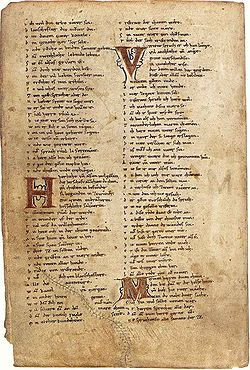
s of Gottfried's Tristan, dating from the 13th to the 15th century. Of these 11 are complete. Full details are provided in the Marburger Repertorium.
The unfinished Tristan was completed by two later poets, Ulrich von Türheim
Ulrich von Türheim
Ulrich von Türheim was a German writer from the Augsburg area writing during the first half of the 13th century. Three of his works have survived: a conclusion to the version of the Tristan legend left unfinished by Gottfried von Strassburg; Rennewart, a continuation of Willehalm, left unfinished...
around 1235 and Heinrich von Freiberg around 1290, but their source for the latter part of the story is not Thomas's Tristan, and is generally thought to be the earlier and less courtly version of the story by Eilhart von Oberge
Eilhart von Oberge
Eilhart von Oberge was a German poet of the late 12th century. He is known exclusively through his Middle High German romance Tristrant, the oldest surviving complete version of the Tristan and Iseult story in any language. Tristrant is part of the "common" or "primitive" branch of the legend, best...
, written around 1175. All but two of the complete manuscripts of Gottfried's work include a continuation by Ulrich or Heinrich; one uses the final part of Eilhart's work. Only one has no continuation at all.
Gottfried's work is praised by a number of later 13th century writers, including Rudolf von Ems
Rudolf von Ems
Rudolf von Ems was a mediaeval Austrian epic poet.-Life:Rudolf von Ems was born in the Vorarlberg in Austria. He took his name from the castle of Hohenems near Bregenz, and was a knight in the service of the Counts of Montfort. His works were written between 1220 and 1254...
and Konrad von Würzburg
Konrad von Würzburg
Konrad von Würzburg was the chief German poet of the second half of the 13th century.As little is known of his life as that of any other epic poet of the age. By birth probably a native of Würzburg, he seems to have spent part of his life in Strassburg and his later years in Basel, where he died...
, and was used, together with Eilhart von Oberge
Eilhart von Oberge
Eilhart von Oberge was a German poet of the late 12th century. He is known exclusively through his Middle High German romance Tristrant, the oldest surviving complete version of the Tristan and Iseult story in any language. Tristrant is part of the "common" or "primitive" branch of the legend, best...
's version and Heinrich von Freiberg's continuation as a source for the Old Czech Tristan, written in the latter third of the 14th century.
While Gottfried's poem was still being copied in the 15th century, it was Eilhart von Oberge
Eilhart von Oberge
Eilhart von Oberge was a German poet of the late 12th century. He is known exclusively through his Middle High German romance Tristrant, the oldest surviving complete version of the Tristan and Iseult story in any language. Tristrant is part of the "common" or "primitive" branch of the legend, best...
's less sophisticated narrative of the Tristan story that was the source of the first printed version, the 1484 Tristrant und Isalde, a work in prose which is not to be confused with the French Prose Tristan
Prose Tristan
The Prose Tristan is an adaptation of the Tristan and Iseult story into a long prose romance, and the first to tie the subject entirely into the arc of the Arthurian legend...
, also known as the Roman de Tristan en Prose.
Gottfried's work was rediscovered in the late 18th century, and is the source of Richard Wagner
Richard Wagner
Wilhelm Richard Wagner was a German composer, conductor, theatre director, philosopher, music theorist, poet, essayist and writer primarily known for his operas...
's opera
Opera
Opera is an art form in which singers and musicians perform a dramatic work combining text and musical score, usually in a theatrical setting. Opera incorporates many of the elements of spoken theatre, such as acting, scenery, and costumes and sometimes includes dance...
Tristan und Isolde
Tristan und Isolde
Tristan und Isolde is an opera, or music drama, in three acts by Richard Wagner to a German libretto by the composer, based largely on the romance by Gottfried von Straßburg. It was composed between 1857 and 1859 and premiered in Munich on 10 June 1865 with Hans von Bülow conducting...
(1865).
Editions
The first modern edition of Gottfried's Tristan was that of Christian Heinrich Myller in 1785, and there have been many since. However, there is still no satisfactory critical edition and three editions are in use:- F. Ranke (Weidmann 1930, with corrections 1949). This is the standard edition, but contains no critical apparatus. Most readily available in 3 volumes with Modern German translation, commentary and epilogue by Rüdiger Krohn (Reclam 1980) ISBN 3-15-004471-5, ISBN 3-15-004472-3 and ISBN 3-15-004473-1. The text of Ranke's edition (without line numbering) is available at Projekt Gutenberg-DE. All Tristan literature uses Ranke's line numbering for references to the text.
- K. Marold (de Gruyter 1906), republished in 2004 with an afterword by Werner Schröder ISBN 3-11-017696-3. Though the text is inferior to Ranke's, this is the only edition to provide full critical apparatus.
- R Bechstein (2 vols, Leipzig, 1870), re-issued in a revised version edited by Peter Ganz (2 vols, Brockhaus 1978), which includes Bechstein's running commentary and indicates differences from Ranke's text.
Translations
English translations:- A.T. Hatto, with the Tristran of Thomas (London: Penguin, 1960). ISBN 0-14-044098-4
- Jessie L. Weston (London, 1899)
- E.H. Zeydel (Princeton, 1948)
Modern German translations:
- Xenja von Ertzdorff, Doris Scholz, Carola Voelkel (Fink, 1979) ISBN 3-7705-1766-0
- Peter Knecht (de Gruyter, 2004) ISBN 3-11-018045-6
- Rüdiger Krohn (Reclam 1980) ISBN 3-15-004471-5 and ISBN 3-15-004472-3
- Dieter Kühn (Reclam, 1998) ISBN 3-15-004474-X
- Wolfgang Mohr (Kümmerle, 1979), in verse, based on Hermann Kurtz's translation ISBN 3-87452-464-7
There are many older translations. However, any made before 1930, when Ranke's edition was first published, will be based on an outdated edition of the text.