

Gonda District

Encyclopedia
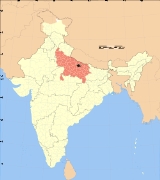
Gonda is one of the districts
of Uttar Pradesh
, India. Gonda is the district headquarters, and also the administrative centre for the Devipatan Division
.
With an area of 4448 sqkm, Gonda is bound by Shrawasti district to the north, Balrampur
and Siddharthnagar districts to the northeast, Basti district to the east, Faizabad district
to the south, Bara Banki district to the southwest, and Bahraich district
to the northwest.
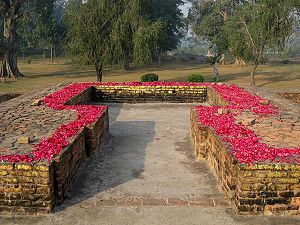 The territory covered by the present district of Gonda formed part of the ancient Kosala Kingdom
. After the death of Rama
, the celebrated sovereign of the Solar line who ruled Kosala
, the kingdom was divided into two portions defined by the Ghaghara river. The northern portion was then ruled by his son, Lava
with the city of Sravasti
as his capital. Sravasti was prosperous and progressive during Buddhas time, and he made twenty one visits to the city during his Mahaparinirvana.
More recently, ancient Buddhist remains dating to the early days of Buddhism have been found throughout the region, including at Sravasti
.
During the medieval period, the first Muslim invasion of the region, to the north of the Ghaghara River, took place in the second quarter of 11th century under Syed Salar Masood. The rulers of Gonda and surrounding districts formed a league to offer united resistance to Masood. In the second half of the 13th century Gonda was included in the government of Bahraich by the early Muslim rulers, and hence has no independent history of its own. Further, there is no specific reference about the district until the reign of the Tughlaqs.
In 1394, the district came under the rule of Khwaja Jahan Malik Sarwar, the founder of the Sharqi dynasty of Jaunpur. From earliest days of Muslim domination till the advent of Akbar, the history of Gonda district is primarily the history of local clans. During the early phase of this period the whole of Gonda was ruled by aboriginal Dom
, Tharu Tribe, Bhar
, Pasi and the like. The district formed an integral part of the empire of Akbar (1556–1605).
With the annexation of the province of Awadh
by the East India Company
in February 1856, Gonda became a separate district in the Gonda-Bahraich Commissionership. Annexation passed off quietly, although the Gonda raja exhibited strong disapproval of the measure and was with difficulty persuaded to leave his fort at Gonda and meet the district officer.
In the Non Cooperation Movement launched by Mahatma Gandhi
people from this district actively participated. On October 9, 1929, Mahatma Gandhi visited the district along with Jawaharlal Nehru
.
Gonda played a significant part in the Indian struggle for independence, with many people from the region actively involved: including Maharaja Devi Baksha Singh, who escaped to Nepal, freedom fighters like Sh. Chandra Shekhar Azad took shelter in the district, and Rajendra Lahiri
was incarcerated and hanged in the Gonda Jail.
The holy rivers Saryu and Ghaghara
pass through the district. The soils of the district are composed of the fluvial
deposits of these two rivers, making it one of the most productive soils in the Tarai region.
There are several important lakes in the district, including the Banki, Kodar, Aranga, Parwati & Pathri.
(Mar-Jun), rainy (Jul-Oct) and winter
(Nov-Feb).
The average summer temperature is nearly 40°C. A hot wind named Loo
blows in May and in early June.
During the rainy season, rains take place up to September.
Minimum winter temperature is 1.4°C
Average Rainfall in the district is 1152mm.
Total production for the district
Agricultural produce also includes wheat
, paddy (rice
) and various pulses
.
There is a Krishi Vigyan Kendra (Agriculture Research Centre) situated at Jai-prabha Gram, Belsar.
is situated at Mankapur
, and the largest sugar mill in India is situated at Kundarkhi.
Gonda has multiple chini mills located at Bhabhnan, Kundarkhi, Tarabganj, Maizapur and Mankapur.
In 2006 the Ministry of Panchayati Raj
named Gonda one of the country's 250 most backward districts
(out of a total of 640
). It is one of the 34 districts in Uttar Pradesh currently receiving funds from the Backward Regions Grant Fund Programme (BRGF).
s in the District: Gonda, Colonelganj
, Tarabganj and Mankapur
.
Gonda district has a population
of 3,431,386, roughly equal to the nation of Panama
or the US state of Connecticut
. This gives it a ranking of 95th in India (out of a total of 640
). The district has a population density of 857 PD/sqkm . Its population growth rate
over the decade 2001-2011 was 24.07%. Gonda has a sex ratio
of 922 females
for every 1000 males, and a literacy rate
of 61.16%.
, a tongue in the Hindi-Urdu continuum spoken by over 38 million people, mainly in the Awadh
region, and Hindi
.
, depicting the life and virtues of Lord Rama.
The founder of the Swaminarayan Sampraday, "Lord Swaminarayan" was born at Ghanshyam Pande in Chhapaiya, Gonda. Akshardham is believed to be the divine abode of Swaminarayan.
Acharya Patanjali
(200 BCE), founder of yoga came from the district of Gonda.
One of India's Presidents, Fakhruddin Ali Ahmed
, was educated in Gonda, and the school is now named after him.
The human development index of the Gonda district is very low.
All colleges of Gonda are affiliated to the Faizabad University.
hospitals, in addition to 66 Government Primary Health Centres.
Districts of Uttar Pradesh
The Indian state of Uttar Pradesh borders with Nepal and the Indian states of Bihar, Jharkhand, Chhattisgarh, Madhya Pradesh, Rajasthan, Haryana, Uttarakhand and National Capital Territory of Delhi. The Himalayas lies in the north of the state and the Deccan Plateau is at the south...
of Uttar Pradesh
Uttar Pradesh
Uttar Pradesh abbreviation U.P. , is a state located in the northern part of India. With a population of over 200 million people, it is India's most populous state, as well as the world's most populous sub-national entity...
, India. Gonda is the district headquarters, and also the administrative centre for the Devipatan Division
Devipatan Division
Devipatan division is an administrative geographical unit of Uttar Pradesh state of India. Currently , the division consists of districts of :* Gonda,* Bahraich,* Shravasti, and* Balarampur.Gonda is headquarter of this division....
.
With an area of 4448 sqkm, Gonda is bound by Shrawasti district to the north, Balrampur
Balrampur district
Balrampur district is one of the 72 districts of Uttar Pradesh state in India. Balrampur town located on the bank of the Rapti is the district headquarters. Balrampur district is a part of Devipatan division, and historic Awadh region....
and Siddharthnagar districts to the northeast, Basti district to the east, Faizabad district
Faizabad District
See also: Faizabad Faizabad district is one of the 71 districts of Uttar Pradesh state in northern India. Faizabad city is the administrative headquarters of this district. The district occupies an area of 2,764 km²...
to the south, Bara Banki district to the southwest, and Bahraich district
Bahraich District
Bahraich District is one of the districts of Uttar Pradesh state of India, and Bahraich town is the district headquarters. Bahraich District is a part of Devipatan Division.-History:...
to the northwest.
History
Kosala Kingdom
Kosala Proper or Uttara Kosala is the kingdom of the celebrated personality of Treta Yuga, Raghava Rama. Ayodhya was its capital, presently in Faizabad district, Uttar Pradesh. Rama's sons Lava and Kusha inherited parts of this kingdom. Lava ruled from the city called Sravasti and Kusa from the...
. After the death of Rama
Rama
Rama or full name Ramachandra is considered to be the seventh avatar of Vishnu in Hinduism, and a king of Ayodhya in ancient Indian...
, the celebrated sovereign of the Solar line who ruled Kosala
Kosala
Kosala was an ancient Indian region, corresponding roughly in area with the region of Awadh in present day Uttar Pradesh. According to the Buddhist text Anguttara Nikaya and the Jaina text, the Bhagavati Sutra, Kosala was one of the Solasa Mahajanapadas in 6th century BCE and its cultural and...
, the kingdom was divided into two portions defined by the Ghaghara river. The northern portion was then ruled by his son, Lava
Lava (Ramayana)
Lava or Luv and his twin brother Kusha, were the children of the Lord Rama and his wife Sita, whose story is recounted in the Ramayana. Per that text, he is known as the founder of Lavapuri,that is, the modern day city of Lahore,...
with the city of Sravasti
Sravasti
Śrāvastī or Sāvatthī , a city of ancient India, was one of the six largest cities in India during Gautama Buddha's lifetime. The city was located in the fertile Gangetic plains in the present day Gonda District of Uttar Pradesh near Balrampur some 120 km north of Lucknow...
as his capital. Sravasti was prosperous and progressive during Buddhas time, and he made twenty one visits to the city during his Mahaparinirvana.
More recently, ancient Buddhist remains dating to the early days of Buddhism have been found throughout the region, including at Sravasti
Sravasti
Śrāvastī or Sāvatthī , a city of ancient India, was one of the six largest cities in India during Gautama Buddha's lifetime. The city was located in the fertile Gangetic plains in the present day Gonda District of Uttar Pradesh near Balrampur some 120 km north of Lucknow...
.
During the medieval period, the first Muslim invasion of the region, to the north of the Ghaghara River, took place in the second quarter of 11th century under Syed Salar Masood. The rulers of Gonda and surrounding districts formed a league to offer united resistance to Masood. In the second half of the 13th century Gonda was included in the government of Bahraich by the early Muslim rulers, and hence has no independent history of its own. Further, there is no specific reference about the district until the reign of the Tughlaqs.
In 1394, the district came under the rule of Khwaja Jahan Malik Sarwar, the founder of the Sharqi dynasty of Jaunpur. From earliest days of Muslim domination till the advent of Akbar, the history of Gonda district is primarily the history of local clans. During the early phase of this period the whole of Gonda was ruled by aboriginal Dom
Domba
The Domba or Dom are an ethnic or social group, or groups, scattered across India. They are usually segregated from the mainstream community as outcastes.The Domba are sometimes also called "Chandala". Both terms also came to be used in the sense of "outcaste" in general...
, Tharu Tribe, Bhar
Bhar
The Bhar are a Hindu caste found in North India. They are also known as Rajbhar. British historian General Cunningham said that Bhars are branch of the Ahir tribe.-History and origin:...
, Pasi and the like. The district formed an integral part of the empire of Akbar (1556–1605).
With the annexation of the province of Awadh
Awadh
Awadh , also known in various British historical texts as Oudh or Oude derived from Ayodhya, is a region in the centre of the modern Indian state of Uttar Pradesh, which was before independence known as the United Provinces of Agra and Oudh...
by the East India Company
East India Company
The East India Company was an early English joint-stock company that was formed initially for pursuing trade with the East Indies, but that ended up trading mainly with the Indian subcontinent and China...
in February 1856, Gonda became a separate district in the Gonda-Bahraich Commissionership. Annexation passed off quietly, although the Gonda raja exhibited strong disapproval of the measure and was with difficulty persuaded to leave his fort at Gonda and meet the district officer.
In the Non Cooperation Movement launched by Mahatma Gandhi
Mahatma Gandhi
Mohandas Karamchand Gandhi , pronounced . 2 October 1869 – 30 January 1948) was the pre-eminent political and ideological leader of India during the Indian independence movement...
people from this district actively participated. On October 9, 1929, Mahatma Gandhi visited the district along with Jawaharlal Nehru
Jawaharlal Nehru
Jawaharlal Nehru , often referred to with the epithet of Panditji, was an Indian statesman who became the first Prime Minister of independent India and became noted for his “neutralist” policies in foreign affairs. He was also one of the principal leaders of India’s independence movement in the...
.
Gonda played a significant part in the Indian struggle for independence, with many people from the region actively involved: including Maharaja Devi Baksha Singh, who escaped to Nepal, freedom fighters like Sh. Chandra Shekhar Azad took shelter in the district, and Rajendra Lahiri
Rajendra Lahiri
Rajendra Lahiri , also known as Rajendra Nath Lahiri,, was a Bengali Hindu Brahmin revolutionary, who participated in various revolutionary activities of the Hindustan Republican Association aimed at ousting the British forever from India.-Brief life sketch:Rajendra Lahiri was born on 23 Jun 1901...
was incarcerated and hanged in the Gonda Jail.
Geography
The district lies between 26º 47' and 27º 20' north latitude and 81º 30' and 82º 46' east longitude.The holy rivers Saryu and Ghaghara
Ghaghara River
Karnali or Ghaghara is a perennial trans-boundary river originating on the Tibetan Plateau near Lake Mansarovar. It cuts through the Himalayas in Nepal and joins the Sarda River at Brahmaghat in India. Together they form the Ghaghra River, a major left bank tributary of the Ganges. With a length of...
pass through the district. The soils of the district are composed of the fluvial
Fluvial
Fluvial is used in geography and Earth science to refer to the processes associated with rivers and streams and the deposits and landforms created by them...
deposits of these two rivers, making it one of the most productive soils in the Tarai region.
Hydrology
Rivers have played a significant role in the development of Gonda. Ghaghara is the main river flowing through the district, formed from the united waters of the Kauriala, Saryu, and Chauka & other rivers which drain the submontane tract to the west. It enters the district in the extreme west and flows along the southern borders. Within its wide bed it rolls from one side to the other, changing its channel almost every year. The land along the river is always liable to be cut away during the rains and for this reason the area of the district is libel to annual verialims. Saryu is the second most important river, rising in the Bahraich district, and joining the Ghaghara in Gonda. The Kuwano river flows along the northern border, with the Bisuha, a small stream of a similar character. The Manwar, Chandai and Terhi rivers are little more than streams.There are several important lakes in the district, including the Banki, Kodar, Aranga, Parwati & Pathri.
Climate
Gonda has three seasons: summerSummer
Summer is the warmest of the four temperate seasons, between spring and autumn. At the summer solstice, the days are longest and the nights are shortest, with day-length decreasing as the season progresses after the solstice...
(Mar-Jun), rainy (Jul-Oct) and winter
Winter
Winter is the coldest season of the year in temperate climates, between autumn and spring. At the winter solstice, the days are shortest and the nights are longest, with days lengthening as the season progresses after the solstice.-Meteorology:...
(Nov-Feb).
The average summer temperature is nearly 40°C. A hot wind named Loo
Loo (wind)
The Loo is a strong, hot and dry summer afternoon wind from the west which blows over the western Indo-Gangetic Plain region of North India and Pakistan. It is especially strong in the months of May and June...
blows in May and in early June.
During the rainy season, rains take place up to September.
Minimum winter temperature is 1.4°C
Average Rainfall in the district is 1152mm.
Agriculture
The district is heavily dependant on agriculture, with some 277.77 thousand hectares cultivated, of which 159.46 thousand hectares are irrigated.Total production for the district
- Food Grain 1145 Thousand M.T.
- Oil Seed 16 Thousand M.T.
- Sugar Cane 1254 Thousand M.T
- Potato 112 Thousand M.T
Agricultural produce also includes wheat
Wheat
Wheat is a cereal grain, originally from the Levant region of the Near East, but now cultivated worldwide. In 2007 world production of wheat was 607 million tons, making it the third most-produced cereal after maize and rice...
, paddy (rice
Rice
Rice is the seed of the monocot plants Oryza sativa or Oryza glaberrima . As a cereal grain, it is the most important staple food for a large part of the world's human population, especially in East Asia, Southeast Asia, South Asia, the Middle East, and the West Indies...
) and various pulses
Pulse (legume)
A pulse is an annual leguminous crop yielding from one to twelve seeds of variable size, shape, and color within a pod. Pulses are used for food and animal feed. The term "pulse", as used by the Food and Agricultural Organization , is reserved for crops harvested solely for the dry seed...
.
There is a Krishi Vigyan Kendra (Agriculture Research Centre) situated at Jai-prabha Gram, Belsar.
Industry
There are several sugar mills, rice mills and many other small industries and handicraft industry. One of the India's six Indian Telephone IndustriesIndian Telephone Industries Limited
Indian Telephone Industries Limited is a state-owned manufacturer of telecommunications equipment in India. It was founded in 1948, and today has six manufacturing facilities which produce a range of...
is situated at Mankapur
Mankapur
Mankapur is a town and a nagar panchayat in Gonda district in the Indian state of Uttar Pradesh. It is a constituency of Uttar Pradesh Legislative Assembly and its present member is Ram Bishun Azad. It has Gonda to its west, has Rehra in its north, Maskanawa in the east and Nawabganj in the south...
, and the largest sugar mill in India is situated at Kundarkhi.
Gonda has multiple chini mills located at Bhabhnan, Kundarkhi, Tarabganj, Maizapur and Mankapur.
In 2006 the Ministry of Panchayati Raj
Ministry of Panchayati Raj
The Ministry of Panchayati Raj is a branch of the Government of India looking after the ongoing process of decentralization and local governance in the States....
named Gonda one of the country's 250 most backward districts
Poverty in India
Poverty is widespread in India, with the nation estimated to have a third of the world's poor. According to a 2005 World Bank estimate, 41.6% of the total Indian population falls below the international poverty line of 1.25 a day...
(out of a total of 640
Districts of India
A district is an administrative division of an Indian state or territory. Districts are further subdivided, in some cases into Sub-Divisions, and otherwise directly into tehsils or talukas.District officials include:...
). It is one of the 34 districts in Uttar Pradesh currently receiving funds from the Backward Regions Grant Fund Programme (BRGF).
Divisions
There are 4 TehsilTehsil
A Tehsil or Tahsil/Tahasil , also known as Taluk and Mandal, is an administrative division of some country/countries of South Asia....
s in the District: Gonda, Colonelganj
Colonelganj
Colonelganj is a city and a municipal board in Gonda district in the state of Uttar Pradesh, India.-Geography:Colonelganj is located at . It has an average elevation of 119 metres .hj...
, Tarabganj and Mankapur
Mankapur
Mankapur is a town and a nagar panchayat in Gonda district in the Indian state of Uttar Pradesh. It is a constituency of Uttar Pradesh Legislative Assembly and its present member is Ram Bishun Azad. It has Gonda to its west, has Rehra in its north, Maskanawa in the east and Nawabganj in the south...
.
Population
According to the 2011 census2011 census of India
The 15th Indian National census was conducted in two phases, houselisting and population enumeration. Houselisting phase began on April 1, 2010 and involved collection of information about all buildings...
Gonda district has a population
Demographics of India
The demographics of India are inclusive of the second most populous country in the world, with over 1.21 billion people , more than a sixth of the world's population. Already containing 17.5% of the world's population, India is projected to be the world's most populous country by 2025, surpassing...
of 3,431,386, roughly equal to the nation of Panama
Panama
Panama , officially the Republic of Panama , is the southernmost country of Central America. Situated on the isthmus connecting North and South America, it is bordered by Costa Rica to the northwest, Colombia to the southeast, the Caribbean Sea to the north and the Pacific Ocean to the south. The...
or the US state of Connecticut
Connecticut
Connecticut is a state in the New England region of the northeastern United States. It is bordered by Rhode Island to the east, Massachusetts to the north, and the state of New York to the west and the south .Connecticut is named for the Connecticut River, the major U.S. river that approximately...
. This gives it a ranking of 95th in India (out of a total of 640
Districts of India
A district is an administrative division of an Indian state or territory. Districts are further subdivided, in some cases into Sub-Divisions, and otherwise directly into tehsils or talukas.District officials include:...
). The district has a population density of 857 PD/sqkm . Its population growth rate
Family planning in India
Family planning in India is based on efforts largely sponsored by the Indian government. In the 1965-2009 period, contraceptive usage has more than tripled and the fertility rate has more than halved , but the national fertility rate is still high enough to cause long-term population growth...
over the decade 2001-2011 was 24.07%. Gonda has a sex ratio
Sex ratio
Sex ratio is the ratio of males to females in a population. The primary sex ratio is the ratio at the time of conception, secondary sex ratio is the ratio at time of birth, and tertiary sex ratio is the ratio of mature organisms....
of 922 females
Women in India
The status of women in India has been subject to many great changes over the past few millennia. From equal status with men in ancient times through the low points of the medieval period, to the promotion of equal rights by many reformers, the history of women in India has been eventful...
for every 1000 males, and a literacy rate
Literacy in India
Literacy in India is key for socio-economic progress, and the Indian literacy rate grew to 74.04% in 2011 from 12% at the end of British rule in 1947. Although this was a greater than sixfold improvement, the level is well below the world average literacy rate of 84%, and India currently has the...
of 61.16%.
Languages
Languages spoken in the district include AwadhiAwadhi language
Awadhi is an Indo-Aryan language, part of the Hindi-Urdu continuum. It is spoken chiefly in the Awadh region of Uttar Pradesh, although its speakers are also found in Madhya Pradesh, Delhi and Nepal. Furthermore, the Fiji Hindi dialect spoken by Indo-Fijians is considered a variant of Awadhi,...
, a tongue in the Hindi-Urdu continuum spoken by over 38 million people, mainly in the Awadh
Awadh
Awadh , also known in various British historical texts as Oudh or Oude derived from Ayodhya, is a region in the centre of the modern Indian state of Uttar Pradesh, which was before independence known as the United Provinces of Agra and Oudh...
region, and Hindi
Hindi
Standard Hindi, or more precisely Modern Standard Hindi, also known as Manak Hindi , High Hindi, Nagari Hindi, and Literary Hindi, is a standardized and sanskritized register of the Hindustani language derived from the Khariboli dialect of Delhi...
.
Tourism
There are many religious places in the district, and the district headquarter itself is very close to the holy city of Ayodhya, the birth place of Lord Rama.Famous personalities
Gonda is said to be the birth place of the great poet Tulsi Das who wrote the epic RamacharitamanasRamacharitamanas
Shri Ramcharitmanas , also spelt Shri Ramcharitamanasa, is an epic poem in Awadhi, composed by the 16th-century Indian poet, Goswami Tulsidas...
, depicting the life and virtues of Lord Rama.
The founder of the Swaminarayan Sampraday, "Lord Swaminarayan" was born at Ghanshyam Pande in Chhapaiya, Gonda. Akshardham is believed to be the divine abode of Swaminarayan.
Acharya Patanjali
Patañjali
Patañjali is the compiler of the Yoga Sūtras, an important collection of aphorisms on Yoga practice. According to tradition, the same Patañjali was also the author of the Mahābhāṣya, a commentary on Kātyāyana's vārttikas on Pāṇini's Aṣṭādhyāyī as well as an unspecified work of medicine .In...
(200 BCE), founder of yoga came from the district of Gonda.
One of India's Presidents, Fakhruddin Ali Ahmed
Fakhruddin Ali Ahmed
Fakhruddin Ali Ahmed was the fifth President of India from 1974 to 1977.-Early life and background:Fakhruddin's grandfather, Khaliluddin Ali Ahmed, of Kacharighat near Golaghat, Assam, married in one of the families who were the relics of Emperor Aurangzeb's bid to conquer Assam Ahmed was born on...
, was educated in Gonda, and the school is now named after him.
Flora and fauna
There are two remarkable areas of forest in Gonda:- the forest of Kuwano, which includes a variety of trees: including Sagon, Haldu, Sal, Shishaw, Tibau, MahuaMadhuca longifoliaMadhuca longifolia, commonly known as mahwa or mahua, is an Indian tropical tree found largely in the central and north Indian plains and forests. It is a fast-growing tree that grows to approximately 20 meters in height, possesses evergreen or semi-evergreen foliage, and belongs to the family...
, Bass, NeemNeemAzadirachta indica is a tree in the mahogany family Meliaceae. It is one of two species in the genus Azadirachta, and is native to India growing in tropical and semi-tropical regions. Its fruits and seeds are the source of neem oil...
, Jamun, and Mayo. - the forest of Mankapur which include Tibau, Sakhu and Sal.
Education
Gonda is categorised as one of the socially and educationally backward districts of Uttar Pradesh. The government of India has created a special scheme for such district through the backward region grant fund. Gonda is one of the recipients of this fund.The human development index of the Gonda district is very low.
All colleges of Gonda are affiliated to the Faizabad University.
Public Health
Gonda has 15 Allopathic hospitals, 27 Ayurvedic hospitals, 11 Homeopathic hospitals and 2 UnaniUnani
Unani-tibb or Unani Medicine also spelled Yunani Medicine means "Greek Medicine", and is a form of traditional medicine widely practiced in South Asia...
hospitals, in addition to 66 Government Primary Health Centres.
External links
- Alternative Web Site Of the Gonda District
- Gonda District at The Imperial Gazetteer of IndiaThe Imperial Gazetteer of IndiaThe Imperial Gazetteer of India was a gazetteer of the British Indian Empire, and is now a historical reference work. It was first published in 1881...
, 1908, v. 12, p. 311-319.
