

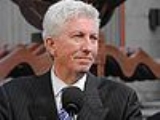
Gilles Duceppe

Encyclopedia
Gilles Duceppe is a Canadian politician, and proponent of the Québec sovereignty movement
. He was a Member of Parliament in the Canadian House of Commons
for over 20 years and was the leader of the sovereigntist Bloc Québécois
for almost 15 years. He is the son of a well-known Quebec
actor, Jean Duceppe
. He was Leader of the Official Opposition in the Parliament of Canada
from March 17, 1997 to June 1, 1997. He resigned as party leader after 2011 election, in which he lost his own seat
to New Democratic Party
(NDP) candidate Hélène Laverdière
and his party suffered a heavy defeat.
, Quebec, the son of Hélène (née Rowley) and actor Jean Duceppe
. His maternal grandfather was John James Rowley, a Briton
by birth and a home child
. Duceppe's British roots had him once quip that "I'm a bloke who turned Bloc."
Duceppe has told the story of an Anglophone Grade 6 teacher slapping him after he complained about preferential treatment being given to anglophone students. Duceppe claimed he slapped the teacher back. In any event, he became a sovereignist by the age of 20, inspired by René Lévesque
and the founding of the Mouvement Souveraineté-Association
.
Duceppe completed his high school studies at the Collège Mont-Saint-Louis. Duceppe then studied political science at the Université de Montréal
but did not complete his program of study. While attending the Université de Montréal
, he became general manager of the school's newspaper, Quartier Latin. In his youth, he advocated communism
, and held membership in the Workers' Communist Party of Canada
(WCP), a Maoist group. Duceppe later claimed that his three-year membership in the WCP was a mistake brought on by a search for absolute answers.
However, during this period—which lasted well into his thirties—he subscribed to militant Maoist ideology and was fired from his job as a hospital orderly for belligerent activities. Duceppe even went so far as to intentionally spoil his 1980 sovereignty-association referendum
ballot arguing that Québécois should instead focus their efforts on staying united to fight capitalism.
Before becoming a member of the federal parliament of Canada, Duceppe worked as a hospital orderly and later became a trade union negotiator. In 1968 he became vice-president of the Union générale des étudiants du Québec (General Union of Quebec Students) and in 1970 manager of the Université de Montréal
student paper, Quartier latin. In 1972 he launched his career in community and union settings, as moderator for the citizen's committee of Hochelaga-Maisonneuve
, then in 1977 as a representative for the Royal Victoria Hospital employees. In 1981 he became a union organizer for the Confédération des syndicats nationaux
(Confederation of National Trade Unions), where he became a negotiator in 1986.
as an independent because the Bloc had not been registered by Elections Canada
as a political party. All of the Bloc's other Members of Parliament had crossed the floor from either the Progressive Conservative Party
or the Liberal Party
earlier that year. Duceppe's victory in a by-election
demonstrated — for the first time — that the party had electoral support in Quebec and could win elections. Previously, many pundits (and members of other parties) predicted that the Bloc would not gain traction with ordinary voters in Quebec.
stepped down as Bloc leader to become leader of the Parti Québécois
, Duceppe served as interim leader
of the party. Michel Gauthier
eventually became the official leader later that year. However, Gauthier's lack of visibility in both Quebec and English Canada coupled with his weak leadership resulted in the party forcing him out in 1997. Duceppe won the ensuing leadership contest and became the official leader of the Bloc Québécois and Leader of the Opposition
. As Leader of the Opposition, Duceppe was invited to join the Queen's Privy Council for Canada
, but declined.
In the 1997 general election
, the Bloc lost official opposition
status, slipping to third place in the House of Commons behind the Reform Party
. Of particular note during the campaign was a visit by Duceppe to a cheese factory where he was photographed wearing a hairnet resembling a shower cap. The photo became widely parodied on Canadian television. The Bloc's caucus lost more support during the 2000 election
, winning just 38 seats. Over this period, critics derided Duceppe as an ineffectual campaigner, though no serious challenge to his leadership emerged.
When Jean Chrétien
stepped down as Prime Minister, to be succeeded by Paul Martin
, the Bloc's fortunes improved markedly, particularly after the sponsorship scandal
erupted. Duceppe strongly criticized the Liberals over the misuse and misdirection of public funds intended for government advertising in Quebec. During the election's national debates, Duceppe's lucid explanations of Bloc Québécois policies and his chastising of the other national party leaders' promises, resulted in both the French and English media ruling him the best speaker. In the 2004 election
, Duceppe's Bloc won 54 seats in the Commons, returning the party to its all-time high water mark.
With Chrétien's departure, Duceppe became the longest-serving leader of a major party in Canada. With the recent success of the Bloc, and his recently well-received performance as leader, speculation mounted that Duceppe might seek the leadership of the Parti Québécois
– particularly when Bernard Landry
stepped down as party leader on June 4, 2005. On June 13, 2005, Duceppe announced that he would not run for the leadership of the PQ
.
In the 2006 federal election
, many Bloc insiders believed that Duceppe's popularity, combined with the unpopularity of the Liberal Party in Quebec, would push the Bloc Québécois over the symbolic majority vote mark among Quebec voters. Many Quebec separatists felt that a strong performance by the Bloc in the 2006 federal election would boost the sovereignist movement and perhaps set the stage for a new referendum on secession after the anticipated Quebec provincial election expected in 2007. In actuality, a late surge in Conservative and federalist support kept the Bloc's share of the popular vote below 43% giving the Bloc only 51 seats. The unimpressive and lackluster results on election night has called into question the level of separatist support in Quebec. In the March 26, 2007 Quebec provincial election
, the Parti Québécois found itself reduced to third place in the National Assembly of Quebec
, behind both the governing Quebec Liberal Party and the opposition Action démocratique du Québec
. Following this disappointing result, the PQ leader, André Boisclair
, announced his resignation on May 8, 2007. Duceppe confirmed on May 11, 2007, that he would seek the PQ leadership but the next day he withdrew from the race. After his withdrawal, Duceppe announced that he would support two-time leadership hopeful Pauline Marois
.
In the 2008 federal election
, Duceppe led the Bloc Québécois to 49 seats, up one from its pre-dissolution standing of 48. However, the Bloc's share of the popular vote fell again, to 38%, its lowest result since 1997. In the 2011 federal election, the Bloc suffered a massive 43-seat loss--including many seats they'd held since their 1993 breakthrough--cutting them down to a rump of four seats. Much of that support bled to the NDP, which won 58 seats, including a sweep of the Bloc's heartlands in Quebec City and eastern Montreal. Duceppe lost his own seat. Accepting responsibility for the Bloc's crushing defeat, Duceppe announced his pending resignation as Bloc leader soon after the result was beyond doubt. He remained defiant, however, vowing not to rest "until Quebec becomes a country".
Note: Gilles Duceppe's popular vote is compared to his vote as an independent candidate in the 1990 by-election.
Quebec sovereignty movement
The Quebec sovereignty movement refers to both the political movement and the ideology of values, concepts and ideas that promote the secession of the province of Quebec from the rest of Canada...
. He was a Member of Parliament in the Canadian House of Commons
Canadian House of Commons
The House of Commons of Canada is a component of the Parliament of Canada, along with the Sovereign and the Senate. The House of Commons is a democratically elected body, consisting of 308 members known as Members of Parliament...
for over 20 years and was the leader of the sovereigntist Bloc Québécois
Bloc Québécois
The Bloc Québécois is a federal political party in Canada devoted to the protection of Quebec's interests in the House of Commons of Canada, and the promotion of Quebec sovereignty. The Bloc was originally a party made of Quebec nationalists who defected from the federal Progressive Conservative...
for almost 15 years. He is the son of a well-known Quebec
Quebec
Quebec or is a province in east-central Canada. It is the only Canadian province with a predominantly French-speaking population and the only one whose sole official language is French at the provincial level....
actor, Jean Duceppe
Jean Duceppe
Jean Hotte-Duceppe, CQ was a stage and television actor from Montreal, Quebec. He founded the Compagnie de théâtre Jean Duceppe in 1973....
. He was Leader of the Official Opposition in the Parliament of Canada
Parliament of Canada
The Parliament of Canada is the federal legislative branch of Canada, seated at Parliament Hill in the national capital, Ottawa. Formally, the body consists of the Canadian monarch—represented by her governor general—the Senate, and the House of Commons, each element having its own officers and...
from March 17, 1997 to June 1, 1997. He resigned as party leader after 2011 election, in which he lost his own seat
Electoral district (Canada)
An electoral district in Canada, also known as a constituency or a riding, is a geographical constituency upon which Canada's representative democracy is based...
to New Democratic Party
New Democratic Party
The New Democratic Party , commonly referred to as the NDP, is a federal social-democratic political party in Canada. The interim leader of the NDP is Nycole Turmel who was appointed to the position due to the illness of Jack Layton, who died on August 22, 2011. The provincial wings of the NDP in...
(NDP) candidate Hélène Laverdière
Hélène Laverdière
Hélène Laverdière is a politician in Canada. She was elected Member of Parliament for the riding of Laurier—Sainte-Marie in the 2011 Canadian federal election as a member of the New Democratic Party, defeating Bloc Québécois leader Gilles Duceppe in his riding.Laverdière obtained her Ph.D in...
and his party suffered a heavy defeat.
Early life
Duceppe was born in MontrealMontreal
Montreal is a city in Canada. It is the largest city in the province of Quebec, the second-largest city in Canada and the seventh largest in North America...
, Quebec, the son of Hélène (née Rowley) and actor Jean Duceppe
Jean Duceppe
Jean Hotte-Duceppe, CQ was a stage and television actor from Montreal, Quebec. He founded the Compagnie de théâtre Jean Duceppe in 1973....
. His maternal grandfather was John James Rowley, a Briton
United Kingdom
The United Kingdom of Great Britain and Northern IrelandIn the United Kingdom and Dependencies, other languages have been officially recognised as legitimate autochthonous languages under the European Charter for Regional or Minority Languages...
by birth and a home child
Home children
Home Children is a common term used to refer to the child migration scheme founded by Annie MacPherson in 1869, under which more than 100,000 children were sent to Australia, Canada, New Zealand, and South Africa from the United Kingdom....
. Duceppe's British roots had him once quip that "I'm a bloke who turned Bloc."
Duceppe has told the story of an Anglophone Grade 6 teacher slapping him after he complained about preferential treatment being given to anglophone students. Duceppe claimed he slapped the teacher back. In any event, he became a sovereignist by the age of 20, inspired by René Lévesque
René Lévesque
René Lévesque was a reporter, a minister of the government of Quebec, , the founder of the Parti Québécois political party and the 23rd Premier of Quebec...
and the founding of the Mouvement Souveraineté-Association
Mouvement Souveraineté-Association
The Mouvement Souveraineté-Association was formed on November 19, 1967 by René Lévesque to promote the concept of sovereignty-association between Quebec and the rest of Canada....
.
Duceppe completed his high school studies at the Collège Mont-Saint-Louis. Duceppe then studied political science at the Université de Montréal
Université de Montréal
The Université de Montréal is a public francophone research university in Montreal, Quebec, Canada. It comprises thirteen faculties, more than sixty departments and two affiliated schools: the École Polytechnique and HEC Montréal...
but did not complete his program of study. While attending the Université de Montréal
Université de Montréal
The Université de Montréal is a public francophone research university in Montreal, Quebec, Canada. It comprises thirteen faculties, more than sixty departments and two affiliated schools: the École Polytechnique and HEC Montréal...
, he became general manager of the school's newspaper, Quartier Latin. In his youth, he advocated communism
Communism
Communism is a social, political and economic ideology that aims at the establishment of a classless, moneyless, revolutionary and stateless socialist society structured upon common ownership of the means of production...
, and held membership in the Workers' Communist Party of Canada
Workers' Communist Party of Canada
The Workers' Communist Party of Canada was a Canadian political party that nominated candidates in the 1972 and 1980 general elections. For several years it published a weekly newspaper "The Forge/La Forge"...
(WCP), a Maoist group. Duceppe later claimed that his three-year membership in the WCP was a mistake brought on by a search for absolute answers.
However, during this period—which lasted well into his thirties—he subscribed to militant Maoist ideology and was fired from his job as a hospital orderly for belligerent activities. Duceppe even went so far as to intentionally spoil his 1980 sovereignty-association referendum
1980 Quebec referendum
The 1980 Quebec referendum was the first referendum in Quebec on the place of Quebec within Canada and whether Quebec should pursue a path toward sovereignty. The referendum was called by Quebec's Parti Québécois government, which strongly favoured secession from Canada...
ballot arguing that Québécois should instead focus their efforts on staying united to fight capitalism.
Before becoming a member of the federal parliament of Canada, Duceppe worked as a hospital orderly and later became a trade union negotiator. In 1968 he became vice-president of the Union générale des étudiants du Québec (General Union of Quebec Students) and in 1970 manager of the Université de Montréal
Université de Montréal
The Université de Montréal is a public francophone research university in Montreal, Quebec, Canada. It comprises thirteen faculties, more than sixty departments and two affiliated schools: the École Polytechnique and HEC Montréal...
student paper, Quartier latin. In 1972 he launched his career in community and union settings, as moderator for the citizen's committee of Hochelaga-Maisonneuve
Hochelaga-Maisonneuve
Hochelaga-Maisonneuve is a district of Montreal, Quebec, situated on the eastern half of the island, generally to the south and south-west of the city's Olympic Stadium. A part of the borough of Mercier–Hochelaga-Maisonneuve, its borders are roughly rue Moreau to the west, rue Sherbrooke to the...
, then in 1977 as a representative for the Royal Victoria Hospital employees. In 1981 he became a union organizer for the Confédération des syndicats nationaux
Confédération des Syndicats Nationaux
The Confédération des syndicats nationaux , is the second largest trade union federation in Quebec by membership.- History :...
(Confederation of National Trade Unions), where he became a negotiator in 1986.
Election to Parliament
In 1990, Duceppe was elected to the Canadian House of CommonsCanadian House of Commons
The House of Commons of Canada is a component of the Parliament of Canada, along with the Sovereign and the Senate. The House of Commons is a democratically elected body, consisting of 308 members known as Members of Parliament...
as an independent because the Bloc had not been registered by Elections Canada
Elections Canada
Elections Canada is an independent, non-partisan agency reporting directly to the Parliament of Canada. Its ongoing responsibility is to ensure that Canadians can exercise their choices in federal elections and referenda through an open and impartial process...
as a political party. All of the Bloc's other Members of Parliament had crossed the floor from either the Progressive Conservative Party
Progressive Conservative Party of Canada
The Progressive Conservative Party of Canada was a Canadian political party with a centre-right stance on economic issues and, after the 1970s, a centrist stance on social issues....
or the Liberal Party
Liberal Party of Canada
The Liberal Party of Canada , colloquially known as the Grits, is the oldest federally registered party in Canada. In the conventional political spectrum, the party sits between the centre and the centre-left. Historically the Liberal Party has positioned itself to the left of the Conservative...
earlier that year. Duceppe's victory in a by-election
By-election
A by-election is an election held to fill a political office that has become vacant between regularly scheduled elections....
demonstrated — for the first time — that the party had electoral support in Quebec and could win elections. Previously, many pundits (and members of other parties) predicted that the Bloc would not gain traction with ordinary voters in Quebec.
Leadership of the Bloc Québécois
In 1996, when Lucien BouchardLucien Bouchard
Lucien Bouchard, is a Canadian lawyer, diplomat, politician and former Minister of the Environment of the Canadian Federal Government. He was the Leader of Opposition in the Canadian House of Commons from 1993 to 1996, and the 27th Premier of Quebec from January 29, 1996 to March 8, 2001...
stepped down as Bloc leader to become leader of the Parti Québécois
Parti Québécois
The Parti Québécois is a centre-left political party that advocates national sovereignty for the province of Quebec and secession from Canada. The Party traditionally has support from the labour movement. Unlike many other social-democratic parties, its ties with the labour movement are informal...
, Duceppe served as interim leader
Interim leader
An interim leader, in Canadian politics, is a party leader appointed by the party's legislative caucus or the party's executive to temporarily act as leader when a gap occurs between the resignation or death of a party leader and the election of a formal successor...
of the party. Michel Gauthier
Michel Gauthier
Michel Gauthier is a Québécois politician, who served as leader of the Bloc Québécois from 1996 to 1997. He was Leader of the Opposition during this time.- Biography :...
eventually became the official leader later that year. However, Gauthier's lack of visibility in both Quebec and English Canada coupled with his weak leadership resulted in the party forcing him out in 1997. Duceppe won the ensuing leadership contest and became the official leader of the Bloc Québécois and Leader of the Opposition
Leader of the Opposition (Canada)
The Leader of Her Majesty's Loyal Opposition , or simply the Leader of the Opposition is the leader of Canada's Official Opposition, the party with the most seats in the House of Commons that is not a member of the government...
. As Leader of the Opposition, Duceppe was invited to join the Queen's Privy Council for Canada
Queen's Privy Council for Canada
The Queen's Privy Council for Canada ), sometimes called Her Majesty's Privy Council for Canada or simply the Privy Council, is the full group of personal consultants to the monarch of Canada on state and constitutional affairs, though responsible government requires the sovereign or her viceroy,...
, but declined.
In the 1997 general election
Canadian federal election, 1997
The Canadian federal election of 1997 was held on June 2, 1997, to elect members of the Canadian House of Commons of the 36th Parliament of Canada. Prime Minister Jean Chrétien's Liberal Party of Canada won a second majority government...
, the Bloc lost official opposition
Official Opposition (Canada)
In Canada, Her Majesty's Loyal Opposition , commonly known as the Official Opposition, is usually the largest parliamentary opposition party in the House of Commons or a provincial legislative assembly that is not in government, either on its own or as part of a governing coalition...
status, slipping to third place in the House of Commons behind the Reform Party
Reform Party of Canada
The Reform Party of Canada was a Canadian federal political party that existed from 1987 to 2000. It was originally founded as a Western Canada-based protest party, but attempted to expand eastward in the 1990s. It viewed itself as a populist party....
. Of particular note during the campaign was a visit by Duceppe to a cheese factory where he was photographed wearing a hairnet resembling a shower cap. The photo became widely parodied on Canadian television. The Bloc's caucus lost more support during the 2000 election
Canadian federal election, 2000
The 2000 Canadian federal election was held on November 27, 2000, to elect 301 Members of Parliament of the Canadian House of Commons of the 37th Parliament of Canada....
, winning just 38 seats. Over this period, critics derided Duceppe as an ineffectual campaigner, though no serious challenge to his leadership emerged.
When Jean Chrétien
Jean Chrétien
Joseph Jacques Jean Chrétien , known commonly as Jean Chrétien is a former Canadian politician who was the 20th Prime Minister of Canada. He served in the position for over ten years, from November 4, 1993 to December 12, 2003....
stepped down as Prime Minister, to be succeeded by Paul Martin
Paul Martin
Paul Edgar Philippe Martin, PC , also known as Paul Martin, Jr. is a Canadian politician who was the 21st Prime Minister of Canada, as well as leader of the Liberal Party of Canada....
, the Bloc's fortunes improved markedly, particularly after the sponsorship scandal
Sponsorship scandal
The sponsorship scandal, "AdScam", "Sponsorship" or Sponsorgate, is a scandal that came as a result of a Canadian federal government "sponsorship program" in the province of Quebec and involving the Liberal Party of Canada, which was in power from 1993 to 2006...
erupted. Duceppe strongly criticized the Liberals over the misuse and misdirection of public funds intended for government advertising in Quebec. During the election's national debates, Duceppe's lucid explanations of Bloc Québécois policies and his chastising of the other national party leaders' promises, resulted in both the French and English media ruling him the best speaker. In the 2004 election
Canadian federal election, 2004
The Canadian federal election, 2004 , was held on June 28, 2004 to elect members of the Canadian House of Commons of the 38th Parliament of Canada. The Liberal government of Prime Minister Paul Martin lost its majority, but was able to form a minority government after the elections...
, Duceppe's Bloc won 54 seats in the Commons, returning the party to its all-time high water mark.
With Chrétien's departure, Duceppe became the longest-serving leader of a major party in Canada. With the recent success of the Bloc, and his recently well-received performance as leader, speculation mounted that Duceppe might seek the leadership of the Parti Québécois
Parti Québécois
The Parti Québécois is a centre-left political party that advocates national sovereignty for the province of Quebec and secession from Canada. The Party traditionally has support from the labour movement. Unlike many other social-democratic parties, its ties with the labour movement are informal...
– particularly when Bernard Landry
Bernard Landry
Bernard Landry, is a Quebec lawyer, teacher, politician, who served as the 28th Premier of Quebec , leader of the Opposition and leader of the Parti Québécois .-Personal:...
stepped down as party leader on June 4, 2005. On June 13, 2005, Duceppe announced that he would not run for the leadership of the PQ
Parti Québécois leadership election, 2005
The Parti Québécois leadership election of 2005 was held from November 13 to November 15, 2005 to elect the new leader of the Parti Québécois, the main sovereigntist and social democratic political party in Quebec, Canada....
.
In the 2006 federal election
Canadian federal election, 2006
The 2006 Canadian federal election was held on January 23, 2006, to elect members of the Canadian House of Commons of the 39th Parliament of Canada. The Conservative Party of Canada won the greatest number of seats: 40.3% of seats, or 124 out of 308, up from 99 seats in 2004, and 36.3% of votes:...
, many Bloc insiders believed that Duceppe's popularity, combined with the unpopularity of the Liberal Party in Quebec, would push the Bloc Québécois over the symbolic majority vote mark among Quebec voters. Many Quebec separatists felt that a strong performance by the Bloc in the 2006 federal election would boost the sovereignist movement and perhaps set the stage for a new referendum on secession after the anticipated Quebec provincial election expected in 2007. In actuality, a late surge in Conservative and federalist support kept the Bloc's share of the popular vote below 43% giving the Bloc only 51 seats. The unimpressive and lackluster results on election night has called into question the level of separatist support in Quebec. In the March 26, 2007 Quebec provincial election
Quebec general election, 2007
The Quebec general election of 2007 was held in the Canadian province of Quebec on March 26, 2007 to elect members of the 38th National Assembly of Quebec. The Quebec Liberal Party led by Jean Charest managed to win a plurality of seats, but were reduced to a minority government, Quebec's first in...
, the Parti Québécois found itself reduced to third place in the National Assembly of Quebec
National Assembly of Quebec
The National Assembly of Quebec is the legislative body of the Province of Quebec. The Lieutenant Governor and the National Assembly compose the Parliament of Quebec, which operates in a fashion similar to those of other British-style parliamentary systems.The National Assembly was formerly the...
, behind both the governing Quebec Liberal Party and the opposition Action démocratique du Québec
Action démocratique du Québec
The Action démocratique du Québec, commonly referred to as the ADQ is a centre-right political party in Quebec, Canada. On the sovereignty question, it defines itself as autonomist, and has support from both soft nationalists and federalists....
. Following this disappointing result, the PQ leader, André Boisclair
André Boisclair
André Boisclair is a politician in Quebec, Canada. He was the leader of the Parti Québécois, a social democratic and separatist party in Quebec....
, announced his resignation on May 8, 2007. Duceppe confirmed on May 11, 2007, that he would seek the PQ leadership but the next day he withdrew from the race. After his withdrawal, Duceppe announced that he would support two-time leadership hopeful Pauline Marois
Pauline Marois
Pauline Marois is the current leader of the Parti Québécois in the province of Quebec, since June 27, 2007 and current Leader of the Official Opposition of the National Assembly of Quebec, representing the riding of Charlevoix...
.
In the 2008 federal election
Canadian federal election, 2008
The 2008 Canadian federal election was held on Tuesday, October 14, 2008 to elect members to the Canadian House of Commons of the 40th Canadian Parliament after the previous parliament had been dissolved by the Governor General on September 7, 2008...
, Duceppe led the Bloc Québécois to 49 seats, up one from its pre-dissolution standing of 48. However, the Bloc's share of the popular vote fell again, to 38%, its lowest result since 1997. In the 2011 federal election, the Bloc suffered a massive 43-seat loss--including many seats they'd held since their 1993 breakthrough--cutting them down to a rump of four seats. Much of that support bled to the NDP, which won 58 seats, including a sweep of the Bloc's heartlands in Quebec City and eastern Montreal. Duceppe lost his own seat. Accepting responsibility for the Bloc's crushing defeat, Duceppe announced his pending resignation as Bloc leader soon after the result was beyond doubt. He remained defiant, however, vowing not to rest "until Quebec becomes a country".
Electoral record
Note: Conservative vote is compared to the total of the Canadian Alliance vote and Progressive Conservative vote in the 2000 election.Note: Gilles Duceppe's popular vote is compared to his vote as an independent candidate in the 1990 by-election.