

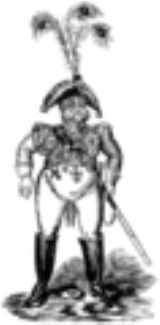
William Hone

Encyclopedia
William Hone was an English
writer, satirist and bookseller. His victorious court battle against government censorship in 1817 marked a turning point in the fight for British press freedom
.
. His father moved to London
in 1783, and in 1790 Hone was placed in an attorney's office. After two and a half years in the office of a solicitor at Chatham he returned to London to become clerk to a solicitor at Gray's Inn
. But he disliked the law
, and had learned to think for himself. To the great concern of his father, he joined the London Corresponding Society
in 1796, which campaigned to extend the vote to working men and was deeply unpopular with the government, who had tried to charge its leaders with treason.
Hone married in 1800, and started a book and print shop with a circulating library in Lambeth Walk
. He soon moved to St Martin's Churchyard, where he brought out his first publication, Shaw's Gardener (1806). It was at this time that he and his friend, John Bone, tried to establish a popular savings bank, and even spoke to the President of the Board of Trade about the project; they were unsuccessful. Bone then joined Hone in a bookseller's business; but bankruptcy
was the result.
In 1811, Hone was employed by the booksellers as auction
eer to the trade, and had an office in Ivy Lane. Independent investigations carried on by him into the condition of lunatic asylums led again to business difficulties and failure, but he took a small lodging in the Old Bailey
, keeping himself and his now large family by contributions to magazines and reviews. He hired a small shop, or rather box, in Fleet Street
but this was twice robbed, and valuable books lent for show were stolen. In 1815 he started the Traveller newspaper, and tried in vain to save Eliza Fenning, a cook convicted on thin evidence of poisoning her employers with arsenic. Although Fenning was executed, Hone's 240 page book on the subject, The Important Results of an Elaborate Investigation into the Mysterious Case of Eliza Fenning — a landmark in investigative journalism — demolished the prosecution's case.
From 1 February to 25 October 1817, Hone published the Reformists' Register, using it to criticise state abuses, which he later attacked in the famous political squibs and parodies, illustrated by George Cruikshank
. In April 1817 three ex-officio informations were filed against him by the attorney-general, Sir William Garrow
. Three separate trials took place in the Guildhall
before special juries on 18, 19 and 20 December 1817. The first, for publishing The Late John Wilkes's Catechism of a Ministerial Member (1817), was before Mr Justice Abbot
(afterwards Lord Tenterden); the second, for parody
ing the litany and libelling the Prince Regent
in The Political Litany (1817), and the third, for publishing the Sinecurist's Creed (1817), a parody on the Athanasian Creed
, were before Lord Ellenborough
.
 The prosecution took the ground that the prints were harmful to public morals and brought the prayer-book and even religion itself into contempt. The real motives of the prosecution were political: Hone had ridiculed the habits and exposed the corruption of those in power. He went to the root of the matter when he wished the jury "to understand that, had he been a publisher of ministerial parodies, he would not then have been defending himself on the floor of that court." In spite of illness and exhaustion Hone spoke on each of the three days for about seven hours. Although his judges were biased against him, he was acquitted on each count, and the result was received enthusiastically by immense crowds inside and outside the court. Soon afterwards, a public collection was made on his behalf.
Among Hone's most successful political satire
s were The Political house that Jack built (1819), The Queen's Matrimonial Ladder (1820), Ill favour of Queen Caroline
, The Man in the Moon (1820) and The Political Showman (1821), all illustrated by Cruikshank. Many of his squibs are directed against a certain "Dr Slop", a nickname given by him to Dr (afterwards Sir John) Stoddart
, publisher of The Times
. In researches for his defence he had come upon some curious and at that time little trodden literary ground, and the results were shown by his publication in 1820 of his Apocryphal New Testament, and in 1823 of his Ancient Mysteries Explained. In 1826 he published the Every-day Book, in 1827-1828 the Table-Book, and in 1829 the Year-Book. All three were collections of curious information on manners, antiquities and various other subjects.
These are the works by which Hone is best remembered. In preparing them he had the approval of Robert Southey
and the assistance of Charles Lamb, but they were not financially successful, and Hone was lodged in King's Bench Prison
for debt. Friends, however, again came to his assistance, and he was established in a coffee-house in Gracechurch Street
; but this, like most of his business enterprises, ended in failure. Hone's attitude of mind had gradually changed to that of extreme devoutness, and during the latter years of his life, he became a follower of Rev Thomas Binney
and preached in Binney's Weigh House Chapel, Eastcheap
. In 1830 he edited Strutt
's Sports and Pastimes of the people of England, and he contributed to the first number of the Penny Magazine
. He was also for some years sub-editor of The Patriot. He died at Tottenham
and is buried at Dr Watts' Walk in Abney Park Cemetery
, Stoke Newington
.
England
England is a country that is part of the United Kingdom. It shares land borders with Scotland to the north and Wales to the west; the Irish Sea is to the north west, the Celtic Sea to the south west, with the North Sea to the east and the English Channel to the south separating it from continental...
writer, satirist and bookseller. His victorious court battle against government censorship in 1817 marked a turning point in the fight for British press freedom
Freedom of the press
Freedom of the press or freedom of the media is the freedom of communication and expression through vehicles including various electronic media and published materials...
.
Biography
Hone was born at Bath, and had a strict religious upbringing. The only education he received was to be taught to read from the BibleBible
The Bible refers to any one of the collections of the primary religious texts of Judaism and Christianity. There is no common version of the Bible, as the individual books , their contents and their order vary among denominations...
. His father moved to London
London
London is the capital city of :England and the :United Kingdom, the largest metropolitan area in the United Kingdom, and the largest urban zone in the European Union by most measures. Located on the River Thames, London has been a major settlement for two millennia, its history going back to its...
in 1783, and in 1790 Hone was placed in an attorney's office. After two and a half years in the office of a solicitor at Chatham he returned to London to become clerk to a solicitor at Gray's Inn
Gray's Inn
The Honourable Society of Gray's Inn, commonly known as Gray's Inn, is one of the four Inns of Court in London. To be called to the Bar and practise as a barrister in England and Wales, an individual must belong to one of these Inns...
. But he disliked the law
Law
Law is a system of rules and guidelines which are enforced through social institutions to govern behavior, wherever possible. It shapes politics, economics and society in numerous ways and serves as a social mediator of relations between people. Contract law regulates everything from buying a bus...
, and had learned to think for himself. To the great concern of his father, he joined the London Corresponding Society
London Corresponding Society
London Corresponding Society was a moderate-radical body concentrating on reform of the Parliament of Great Britain, founded on 25 January 1792. The creators of the group were John Frost , an attorney, and Thomas Hardy, a shoemaker and metropolitan Radical...
in 1796, which campaigned to extend the vote to working men and was deeply unpopular with the government, who had tried to charge its leaders with treason.
Hone married in 1800, and started a book and print shop with a circulating library in Lambeth Walk
Lambeth
Lambeth is a district of south London, England, and part of the London Borough of Lambeth. It is situated southeast of Charing Cross.-Toponymy:...
. He soon moved to St Martin's Churchyard, where he brought out his first publication, Shaw's Gardener (1806). It was at this time that he and his friend, John Bone, tried to establish a popular savings bank, and even spoke to the President of the Board of Trade about the project; they were unsuccessful. Bone then joined Hone in a bookseller's business; but bankruptcy
Bankruptcy
Bankruptcy is a legal status of an insolvent person or an organisation, that is, one that cannot repay the debts owed to creditors. In most jurisdictions bankruptcy is imposed by a court order, often initiated by the debtor....
was the result.
In 1811, Hone was employed by the booksellers as auction
Auction
An auction is a process of buying and selling goods or services by offering them up for bid, taking bids, and then selling the item to the highest bidder...
eer to the trade, and had an office in Ivy Lane. Independent investigations carried on by him into the condition of lunatic asylums led again to business difficulties and failure, but he took a small lodging in the Old Bailey
Old Bailey
The Central Criminal Court in England and Wales, commonly known as the Old Bailey from the street in which it stands, is a court building in central London, one of a number of buildings housing the Crown Court...
, keeping himself and his now large family by contributions to magazines and reviews. He hired a small shop, or rather box, in Fleet Street
Fleet Street
Fleet Street is a street in central London, United Kingdom, named after the River Fleet, a stream that now flows underground. It was the home of the British press until the 1980s...
but this was twice robbed, and valuable books lent for show were stolen. In 1815 he started the Traveller newspaper, and tried in vain to save Eliza Fenning, a cook convicted on thin evidence of poisoning her employers with arsenic. Although Fenning was executed, Hone's 240 page book on the subject, The Important Results of an Elaborate Investigation into the Mysterious Case of Eliza Fenning — a landmark in investigative journalism — demolished the prosecution's case.
From 1 February to 25 October 1817, Hone published the Reformists' Register, using it to criticise state abuses, which he later attacked in the famous political squibs and parodies, illustrated by George Cruikshank
George Cruikshank
George Cruikshank was a British caricaturist and book illustrator, praised as the "modern Hogarth" during his life. His book illustrations for his friend Charles Dickens, and many other authors, reached an international audience.-Early life:Cruikshank was born in London...
. In April 1817 three ex-officio informations were filed against him by the attorney-general, Sir William Garrow
William Garrow
Sir William Garrow KC, PC, FRS was a British barrister, politician and judge known for his indirect reform of the advocacy system, which helped usher in the adversarial court system used in most common law nations today...
. Three separate trials took place in the Guildhall
Guildhall, London
The Guildhall is a building in the City of London, off Gresham and Basinghall streets, in the wards of Bassishaw and Cheap. It has been used as a town hall for several hundred years, and is still the ceremonial and administrative centre of the City of London and its Corporation...
before special juries on 18, 19 and 20 December 1817. The first, for publishing The Late John Wilkes's Catechism of a Ministerial Member (1817), was before Mr Justice Abbot
Charles Abbott, 1st Baron Tenterden
Charles Abbott, 1st Baron Tenterden PC SL , was a British barrister and judge who served as Lord Chief Justice of the King's Bench between 1818 and 1832. Born in obscure circumstances to a barber and his wife in Canterbury, Abbott was educated initially at a dame school before moving to The King's...
(afterwards Lord Tenterden); the second, for parody
Parody
A parody , in current usage, is an imitative work created to mock, comment on, or trivialise an original work, its subject, author, style, or some other target, by means of humorous, satiric or ironic imitation...
ing the litany and libelling the Prince Regent
George IV of the United Kingdom
George IV was the King of the United Kingdom of Great Britain and Ireland and also of Hanover from the death of his father, George III, on 29 January 1820 until his own death ten years later...
in The Political Litany (1817), and the third, for publishing the Sinecurist's Creed (1817), a parody on the Athanasian Creed
Athanasian Creed
The Athanasian Creed is a Christian statement of belief, focusing on Trinitarian doctrine and Christology. The Latin name of the creed, Quicumque vult, is taken from the opening words, "Whosoever wishes." The Athanasian Creed has been used by Christian churches since the sixth century...
, were before Lord Ellenborough
Edward Law, 1st Baron Ellenborough
Edward Law, 1st Baron Ellenborough PC KC was an English judge. After serving as a Member of Parliament and Attorney General, he became Lord Chief Justice.-Early life:...
.
Among Hone's most successful political satire
Satire
Satire is primarily a literary genre or form, although in practice it can also be found in the graphic and performing arts. In satire, vices, follies, abuses, and shortcomings are held up to ridicule, ideally with the intent of shaming individuals, and society itself, into improvement...
s were The Political house that Jack built (1819), The Queen's Matrimonial Ladder (1820), Ill favour of Queen Caroline
Caroline of Brunswick
Caroline of Brunswick-Wolfenbüttel was the Queen consort of King George IV of the United Kingdom from 29 January 1820 until her death...
, The Man in the Moon (1820) and The Political Showman (1821), all illustrated by Cruikshank. Many of his squibs are directed against a certain "Dr Slop", a nickname given by him to Dr (afterwards Sir John) Stoddart
John Stoddart
Sir John Stoddart was a writer and lawyer, and editor of The Times.-Biography:Stoddart, eldest son of John Stoddart, lieutenant in the Royal Navy, was born at Salisbury. His only sister, Sarah, married, on 1 May 1808, William Hazlitt. He was educated at Salisbury grammar school, and matriculated...
, publisher of The Times
The Times
The Times is a British daily national newspaper, first published in London in 1785 under the title The Daily Universal Register . The Times and its sister paper The Sunday Times are published by Times Newspapers Limited, a subsidiary since 1981 of News International...
. In researches for his defence he had come upon some curious and at that time little trodden literary ground, and the results were shown by his publication in 1820 of his Apocryphal New Testament, and in 1823 of his Ancient Mysteries Explained. In 1826 he published the Every-day Book, in 1827-1828 the Table-Book, and in 1829 the Year-Book. All three were collections of curious information on manners, antiquities and various other subjects.
These are the works by which Hone is best remembered. In preparing them he had the approval of Robert Southey
Robert Southey
Robert Southey was an English poet of the Romantic school, one of the so-called "Lake Poets", and Poet Laureate for 30 years from 1813 to his death in 1843...
and the assistance of Charles Lamb, but they were not financially successful, and Hone was lodged in King's Bench Prison
King's Bench Prison
The King's Bench Prison was a prison in Southwark, south London, from medieval times until it closed in 1880. It took its name from the King's Bench court of law in which cases of defamation, bankruptcy and other misdemeanours were heard; as such, the prison was often used as a debtor's prison...
for debt. Friends, however, again came to his assistance, and he was established in a coffee-house in Gracechurch Street
Gracechurch Street
Gracechurch Street is a street in the City of London which forms part of the A10. It is home to a number of shops, restaurants, offices and Leadenhall Market....
; but this, like most of his business enterprises, ended in failure. Hone's attitude of mind had gradually changed to that of extreme devoutness, and during the latter years of his life, he became a follower of Rev Thomas Binney
Thomas Binney
The Rev. Dr. Thomas Binney was an English Congregationalist divine of the 19th century, popularly known as the 'Archbishop of Nonconformity'...
and preached in Binney's Weigh House Chapel, Eastcheap
Eastcheap
Eastcheap is a street in the City of London. Its name derives from cheap, market, with the prefix "East" distinguishing it from the other former City of London market of Westcheap . In medieval times Eastcheap was the City's main meat market, with butchers' stalls lining both sides of the street...
. In 1830 he edited Strutt
Joseph Strutt (engraver and antiquary)
Joseph Strutt was an English engraver, artist, antiquary and writer.-Childhood:Strutt was born at Springfield Mill in Chelmsford, Essex, the youngest son of Thomas Strutt by his wife Elizabeth - the mill belonged to his father, a wealthy miller...
's Sports and Pastimes of the people of England, and he contributed to the first number of the Penny Magazine
Penny Magazine
The Penny Magazine, published every Saturday from 31 March 1832 to 31 October 1845, was an illustrated British magazine aimed at the working class. Charles Knight created it for the Society for the Diffusion of Useful Knowledge in response to Chambers's Edinburgh Journal, which started two months...
. He was also for some years sub-editor of The Patriot. He died at Tottenham
Tottenham
Tottenham is an area of the London Borough of Haringey, England, situated north north east of Charing Cross.-Toponymy:Tottenham is believed to have been named after Tota, a farmer, whose hamlet was mentioned in the Domesday Book; hence Tota's hamlet became Tottenham...
and is buried at Dr Watts' Walk in Abney Park Cemetery
Abney Park Cemetery
Abney Park in Stoke Newington, in the London Borough of Hackney, is a historic parkland originally laid out in the early 18th century by Lady Mary Abney and Dr. Isaac Watts, and the neighbouring Hartopp family. In 1840 it became a non-denominational garden cemetery, semi-public park arboretum, and...
, Stoke Newington
Stoke Newington
Stoke Newington is a district in the London Borough of Hackney. It is north-east of Charing Cross.-Boundaries:In modern terms, Stoke Newington can be roughly defined by the N16 postcode area . Its southern boundary with Dalston is quite ill-defined too...
.
External links
- William Hone, the BioText - contains biographical information and source documents. Accessed 12th October 2011.
- Hone Manuscript Collection - includes a biography and is a source of primary background material. Accessed 20th July 2007.
- William Hone in the Encyclopædia BritannicaEncyclopædia BritannicaThe Encyclopædia Britannica , published by Encyclopædia Britannica, Inc., is a general knowledge English-language encyclopaedia that is available in print, as a DVD, and on the Internet. It is written and continuously updated by about 100 full-time editors and more than 4,000 expert...