


Lozang Gyatso, 5th Dalai Lama

Encyclopedia
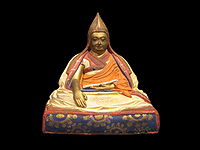
Ngawang Lobsang Gyatso, the Great Fifth Dalai Lama (1617–1682), was a political and religious leader in seventeenth-century Tibet
. Ngawang Lozang Gyatso was the ordination name he had received from Panchen Lobsang Chökyi Gyaltsen who was responsible for his ordination. He was the first Dalai Lama
to wield effective political power over central Tibet, and is frequently referred to as the "Great Fifth Dalai Lama".
to a family with traditional ties to the Sakya
and Nyingma
orders. His famous noble Zahor
family had held their seat since the 14th century at Taktsé Castle
, the former stronghold of the Tibetan kings. His father, Dudul Rabten, was arrested in 1618 for being involved in a plot against the royal government of the king of Tsang at almost the same time the Gelug
had secretly chosen his son as the reincarnation of Yonten Gyatso, the 4th Dalai Lama. According to the 14th Dalai Lama it was Sonam Choephel, the chief attendant of the Fourth Dalai Lama, who discovered the incarnation. Dudul Rabten escaped and tried to reach eastern Tibet but was rearrested and never saw his son again before he died in 1626 at Samdruptse, the king of Tsang
's castle in Shigatse
. Lobsang Gyatso's family were all ordered to live at the court at Samdruptse, but his mother, fearing the king, returned with her son to her family's home, Narkatse castle, in Yardrog
.
doctrines and some say he took Nyingma initiations, while he is also famous for being a great practitioner of Dzogchen
. In his secret Lukhang
temple on a lake behind the Potala palace in Lhasa
one wall of mural
s illustrates a commentary by Longchenpa
on a Dzogchen
tantra Rigpa Rangshar, interpreted according to the Ngawang Lobsang Gyatso's own experience of practice. The murals show characteristic visions of the secret practice of thödgal, and Trul khor
.
school of Tibetan Buddhism
, after defeating the rival Kagyu
school and a secular ruler, the prince of Tsang
based in Shigatse
.
Sonam Rapten, also called Sonam Choephel, the Regent during the youth of Lobsang Gyatso, requested the aid of Gushi Khan
, a powerful Mongol military leader.
Gushi Khan conquered Kham
in 1640 bringing the Sakya
s and the lords of Kham and Amdo
under their control. His victory over the prince of Tsang
in Shigatse
in 1642, completed the unification of the country, and displacing the rival dominant school of the Karmapa
s. He then recognized the authority of the Fifth Dalai Lama, making him the ruler of the whole of Tibet.
The Mongol army in Tibet and Tibetans loyal to the Gelugpa are said to have forced monks of some Kagyu monasteries to convert to the Gelug school in 1648. In 1674 he met with the 10th Karmapa, Chöying Dorje
(1604–1674) at the Potala, and the reconciliation was welcomed by all after the many conflicts and difficulties.
However, he banished the Jonang
to Amdo
from Central Tibet and some Bonpo monasteries were forced to convert to the Gelug school. This ban was politically motivated, although there were some philosophical disagreements.
Lobsang Gyatso proclaimed Lhasa as the capital of Tibet, and "appointed governors to the districts, chose ministers for his government, and promulgated a set of laws. The young Dalai Lama also transformed his regent into a prime minister, or, as the Tibetans called him, the Desi. Administrative authority remained with the Desi and military power with Gushri, who was entitled king of Tibet."
The Dalai Lama also established warm relations with the Shunzhi Emperor of China, the second Manchu
emperor of the Qing Dynasty
, during a state visit to Beijing
in 1652 after several earlier invitations. He set out accompanied by 3,000 men and stayed at the Yellow Palace which had been specially constructed by the Manchu emperor to house him. The emperor met the Dalai Lama in January 1653 when he was only 14 (15 by Western reckoning). The Dalai Lama stayed in Beijing for two months and was honoured with two grand imperial receptions. Some historians claim that the emperor treated the Dalai Lama as an equal while others dispute this claim. The Emperor subsequently granted him the honorific title Dalai Lama, Overseer of the Buddhist Faith on Earth Under the Great Benevolent Self-subsisting Buddha of the Western Paradise. From this meeting onwards, the Dalai Lamas were considered priests to the throne by successive Qing emperors.
Gushri Khan maintained friendly, respectful relations with Lobsang Gyatso but died in 1655. His followers showed little interest in the administration of the country although they did appoint a Regent for a while to advance their interests in Lhasa. Gushri Khan left ten sons to follow him. Eight of them, with their tribes, settled in the strategically important Koko Nur region in Amdo
and quarreled constantly over territory. The 5th Dalai Lama sent several governors in 1656 and 1659 to restore order. The Mongols were gradually Tibetanised and played an important role in extending the Gelug school's influence in Amdo.
The 5th Dalai Lama gradually assumed complete power, including that of appointing the regents.
of Tibet
, and the first to be accorded this title during his lifetime, was the teacher and close ally of the 5th Dalai Lama, who gave him the monastery of Tashilhunpo
as a living and declared him to be an incarnation of Amitabha
Buddha (Tibetan: Ö-pa-me) and since then every incarnation of the Panchen Lama has been the master of Tashilhunpo.
When Lobsang Chökyi Gyaltsen died in 1662, aged 93, the Fifth Dalai Lama immediately began the tradition of searching for his reincarnation. He composed a special prayer asking his master 'to return' and ordered the monks of the great monasteries to recite it. He also reserved the title of Panchen (short for Pandita chen po or 'Great Scholar'), which had previously been a courtesy title for all learned lamas, exclusively for him, and this title has continued to be given to his successors and, posthumously, to his predecessors starting with Khedrup Je.
in 1645 after one of his spiritual advisers, Konchog Chophel (d. 1646), pointed out that the site was ideal as a seat of government, situated as it is between Drepung and Sera
monasteries and the old city of Lhasa. The Dalai Lama and his government moved into the Potrang Karpo ('White Palace') in 1649. Construction lasted until 1694, some twelve years after his death. The Potrang Marpo ('Red Palace') was added between 1690 and 1694.
 The Fifth Dalai Lama was the first to institutionalize the State Oracle of Nechung
. He ordered a temple to be built in Lhasa, called Trode Khangsar
, which was designated as a "protector house" (btsan khan) for Dorje Shugden
. He also crafted the first statue of Dorje Shugden
which is currently at Gaden Phelgyeling Monastery in Kathmandu, Nepal.
He established a centralized, dual system of government
under the Gyalwa Rinpoche (i.e., the Dalai Lama), divided equally between laymen and monks (both Gelugpa and Nyingmapa); this form of government, with few changes, survived up to modern times. He also instituted the Lhasa Mönlam, the New Year Festival or "Great Prayer of Lhasa".
It was under his rule that the "rule of religion" was finally firmly established "even to the layman, to the nomad, or to the farmer in his fields". This was not only the supremacy of the Gelugpa school over Bön, or over the other Buddhist schools, but "the dedication of an entire nation to a religious principle".
Lobsang Gyatso was the first to declare Bön to be a fifth school of Buddhism in Tibet. This position was restated in 1987 by Tenzin Gyatso, the current, 14th Dalai Lama
, who also forbade discrimination against the Bönpo. However, Tibetans still differentiate between Bön and Buddhism
, calling members of the Nyingma
, Sakya
, Kagyu
and Gelug
schools "nangpa
" (meaning "insider"), but referring to practitioners of Bön as "bönpo".
.
, his Prime Minister and, according to persistent rumours, his son, whom he had appointed in 1679. This was done so that the Potala Palace could be finished and to prevent Tibet's neighbors taking advantage of an interregnum in the succession of the Dalai Lamas. Desi Sangay Gyatso also served as regent until the assumption of power by the Sixth Dalai Lama
.
Autobiography
Tibet
Tibet is a plateau region in Asia, north-east of the Himalayas. It is the traditional homeland of the Tibetan people as well as some other ethnic groups such as Monpas, Qiang, and Lhobas, and is now also inhabited by considerable numbers of Han and Hui people...
. Ngawang Lozang Gyatso was the ordination name he had received from Panchen Lobsang Chökyi Gyaltsen who was responsible for his ordination. He was the first Dalai Lama
Dalai Lama
The Dalai Lama is a high lama in the Gelug or "Yellow Hat" branch of Tibetan Buddhism. The name is a combination of the Mongolian word далай meaning "Ocean" and the Tibetan word bla-ma meaning "teacher"...
to wield effective political power over central Tibet, and is frequently referred to as the "Great Fifth Dalai Lama".
Birth, family and childhood
Lobsang Gyatso (birthname: Künga Nyingpo) was born in 1617 in TsangÜ-Tsang
Ü-Tsang , or Tsang-Ü, is one of the three traditional provinces of Tibet, the other two being Amdo and Kham. Geographically Ü-Tsang covered the central and western portions of the Tibetan cultural area, including the Tsang-po watershed, the western districts surrounding and extending past Mount...
to a family with traditional ties to the Sakya
Sakya
The Sakya school is one of four major schools of Tibetan Buddhism, the others being the Nyingma, Kagyu, and Gelug...
and Nyingma
Nyingma
The Nyingma tradition is the oldest of the four major schools of Tibetan Buddhism . "Nyingma" literally means "ancient," and is often referred to as Nga'gyur or the "old school" because it is founded on the first translations of Buddhist scriptures from Sanskrit into Tibetan, in the eighth century...
orders. His famous noble Zahor
Záhor
Záhor is a village and municipality in the Sobrance District in the Košice Region of east Slovakia.-Geography:The village lies at an altitude of 109 metres and covers an area of 7.722 km².It has a population of 710 people.-External links:...
family had held their seat since the 14th century at Taktsé Castle
Taktsé Castle
Taktsé Castle was a castle located in the Chingwa district of Chonggyä in central Tibet. According to legend, it was home to the kings of Tibet before Songtsen Gampo moved his capital to Lhasa. It later became the birthplace of the Great Fifth Dalai Lama , whose aristocratic family had made...
, the former stronghold of the Tibetan kings. His father, Dudul Rabten, was arrested in 1618 for being involved in a plot against the royal government of the king of Tsang at almost the same time the Gelug
Gelug
The Gelug or Gelug-pa , also known as the Yellow Hat sect, is a school of Buddhism founded by Je Tsongkhapa , a philosopher and Tibetan religious leader...
had secretly chosen his son as the reincarnation of Yonten Gyatso, the 4th Dalai Lama. According to the 14th Dalai Lama it was Sonam Choephel, the chief attendant of the Fourth Dalai Lama, who discovered the incarnation. Dudul Rabten escaped and tried to reach eastern Tibet but was rearrested and never saw his son again before he died in 1626 at Samdruptse, the king of Tsang
Ü-Tsang
Ü-Tsang , or Tsang-Ü, is one of the three traditional provinces of Tibet, the other two being Amdo and Kham. Geographically Ü-Tsang covered the central and western portions of the Tibetan cultural area, including the Tsang-po watershed, the western districts surrounding and extending past Mount...
's castle in Shigatse
Shigatse
Shigatse is a county-level city and the second largest city in Tibet Autonomous Region , People's Republic of China, with a population of 92000, about southwest of Lhasa and northwest of Gyantse...
. Lobsang Gyatso's family were all ordered to live at the court at Samdruptse, but his mother, fearing the king, returned with her son to her family's home, Narkatse castle, in Yardrog
Yamdrok Lake
Yamdrok Lake is one of the three largest sacred lakes in Tibet . It is over long. The lake is surrounded by many snow-capped mountains and is fed by numerous small streams. The lake does have an outlet stream at its far western end....
.
Studies
The Fifth Dalai Lama completed all his training as a Gelugpa and proved to be an exceptional scholar. He also studied Nyingmapa tantricTantra
Tantra , anglicised tantricism or tantrism or tantram, is the name scholars give to an inter-religious spiritual movement that arose in medieval India, expressed in scriptures ....
doctrines and some say he took Nyingma initiations, while he is also famous for being a great practitioner of Dzogchen
Dzogchen
According to Tibetan Buddhism and Bön, Dzogchen is the natural, primordial state or natural condition of the mind, and a body of teachings and meditation practices aimed at realizing that condition. Dzogchen, or "Great Perfection", is a central teaching of the Nyingma school also practiced by...
. In his secret Lukhang
Lukhang
Lukhang , formally Zongdag Lukhang is the name of a secret temple of His Holiness Lozang Gyatso, 5th Dalai Lama...
temple on a lake behind the Potala palace in Lhasa
Lhasa
Lhasa is the administrative capital of the Tibet Autonomous Region in the People's Republic of China and the second most populous city on the Tibetan Plateau, after Xining. At an altitude of , Lhasa is one of the highest cities in the world...
one wall of mural
Mural
A mural is any piece of artwork painted or applied directly on a wall, ceiling or other large permanent surface. A particularly distinguishing characteristic of mural painting is that the architectural elements of the given space are harmoniously incorporated into the picture.-History:Murals of...
s illustrates a commentary by Longchenpa
Longchenpa
Longchen Rabjampa, Drimé Özer "Longchenpa" was a major teacher in the Nyingma school of Tibetan Buddhism. Along with Sakya Pandita and Je Tsongkhapa, he is commonly recognized as one of the three main manifestations of Manjushri to have taught in Central Tibet...
on a Dzogchen
Dzogchen
According to Tibetan Buddhism and Bön, Dzogchen is the natural, primordial state or natural condition of the mind, and a body of teachings and meditation practices aimed at realizing that condition. Dzogchen, or "Great Perfection", is a central teaching of the Nyingma school also practiced by...
tantra Rigpa Rangshar, interpreted according to the Ngawang Lobsang Gyatso's own experience of practice. The murals show characteristic visions of the secret practice of thödgal, and Trul khor
Trul khor
Tsa lung Trul khor known for brevity as Trul khor is a Himalayan tantric discipline which includes breathwork , meditative contemplation and precise dynamic movements to centre the practitioner and to...
.
Political activities
The Fifth Dalai Lama is known for unifying Tibet under the control of the GelugGelug
The Gelug or Gelug-pa , also known as the Yellow Hat sect, is a school of Buddhism founded by Je Tsongkhapa , a philosopher and Tibetan religious leader...
school of Tibetan Buddhism
Tibetan Buddhism
Tibetan Buddhism is the body of Buddhist religious doctrine and institutions characteristic of Tibet and certain regions of the Himalayas, including northern Nepal, Bhutan, and India . It is the state religion of Bhutan...
, after defeating the rival Kagyu
Kagyu
The Kagyu, Kagyupa, or Kagyud school, also known as the "Oral Lineage" or Whispered Transmission school, is today regarded as one of six main schools of Himalayan or Tibetan Buddhism, the other five being the Nyingma, Sakya, Jonang, Bon and Gelug...
school and a secular ruler, the prince of Tsang
Ü-Tsang
Ü-Tsang , or Tsang-Ü, is one of the three traditional provinces of Tibet, the other two being Amdo and Kham. Geographically Ü-Tsang covered the central and western portions of the Tibetan cultural area, including the Tsang-po watershed, the western districts surrounding and extending past Mount...
based in Shigatse
Shigatse
Shigatse is a county-level city and the second largest city in Tibet Autonomous Region , People's Republic of China, with a population of 92000, about southwest of Lhasa and northwest of Gyantse...
.
Sonam Rapten, also called Sonam Choephel, the Regent during the youth of Lobsang Gyatso, requested the aid of Gushi Khan
Güshi Khan
Güshi Khan , a Khoshut prince and leader of the Khoshut Khanate, who had supplanted the Tumed descendants of Altan Khan. His military assistance to the Gelug school enabled the 5th Dalai Lama to establish political control over Tibet...
, a powerful Mongol military leader.
Gushi Khan conquered Kham
Kham
Kham , is a historical region covering a land area largely divided between present-day Tibetan Autonomous Region and Sichuan province, with smaller portions located within Qinghai, Gansu and Yunnan provinces of China. During the Republic of China's rule over mainland China , most of the region was...
in 1640 bringing the Sakya
Sakya
The Sakya school is one of four major schools of Tibetan Buddhism, the others being the Nyingma, Kagyu, and Gelug...
s and the lords of Kham and Amdo
Amdo
Amdo is one of the three traditional regions of Tibet, the other two being Ü-Tsang and Kham; it is also the birth place of the 14th Dalai Lama. Amdo encompasses a large area from the Machu River to the Drichu river . While culturally and ethnically a Tibetan area, Amdo has been administered by a...
under their control. His victory over the prince of Tsang
Ü-Tsang
Ü-Tsang , or Tsang-Ü, is one of the three traditional provinces of Tibet, the other two being Amdo and Kham. Geographically Ü-Tsang covered the central and western portions of the Tibetan cultural area, including the Tsang-po watershed, the western districts surrounding and extending past Mount...
in Shigatse
Shigatse
Shigatse is a county-level city and the second largest city in Tibet Autonomous Region , People's Republic of China, with a population of 92000, about southwest of Lhasa and northwest of Gyantse...
in 1642, completed the unification of the country, and displacing the rival dominant school of the Karmapa
Karmapa
The Karmapa is the head of the Karma Kagyu, the largest sub-school of the Kagyupa , itself one of the four major schools of Tibetan Buddhism....
s. He then recognized the authority of the Fifth Dalai Lama, making him the ruler of the whole of Tibet.
The Mongol army in Tibet and Tibetans loyal to the Gelugpa are said to have forced monks of some Kagyu monasteries to convert to the Gelug school in 1648. In 1674 he met with the 10th Karmapa, Chöying Dorje
Chöying Dorje
Chöying Dorje , also Choying Dorje, was the tenth Gyalwa Karmapa, head of the Kagyu School of Tibetan Buddhism.Chöying Dorje was born in Khaytri Tang in the kingdom of Golok in Amdo. At the age of eight, he was recognized by Shamar Mipan Chökyi Wangchuk, the sixth Shamarpa and received the complete...
(1604–1674) at the Potala, and the reconciliation was welcomed by all after the many conflicts and difficulties.
However, he banished the Jonang
Jonang
The Jonang is one of the schools of Tibetan Buddhism. Its origins in Tibet can be traced to early 12th century master Yumo Mikyo Dorje, but became much wider known with the help of Dolpopa Sherab Gyeltsen, a monk originally trained in the Sakya school...
to Amdo
Amdo
Amdo is one of the three traditional regions of Tibet, the other two being Ü-Tsang and Kham; it is also the birth place of the 14th Dalai Lama. Amdo encompasses a large area from the Machu River to the Drichu river . While culturally and ethnically a Tibetan area, Amdo has been administered by a...
from Central Tibet and some Bonpo monasteries were forced to convert to the Gelug school. This ban was politically motivated, although there were some philosophical disagreements.
Lobsang Gyatso proclaimed Lhasa as the capital of Tibet, and "appointed governors to the districts, chose ministers for his government, and promulgated a set of laws. The young Dalai Lama also transformed his regent into a prime minister, or, as the Tibetans called him, the Desi. Administrative authority remained with the Desi and military power with Gushri, who was entitled king of Tibet."
The Dalai Lama also established warm relations with the Shunzhi Emperor of China, the second Manchu
Manchu
The Manchu people or Man are an ethnic minority of China who originated in Manchuria . During their rise in the 17th century, with the help of the Ming dynasty rebels , they came to power in China and founded the Qing Dynasty, which ruled China until the Xinhai Revolution of 1911, which...
emperor of the Qing Dynasty
Qing Dynasty
The Qing Dynasty was the last dynasty of China, ruling from 1644 to 1912 with a brief, abortive restoration in 1917. It was preceded by the Ming Dynasty and followed by the Republic of China....
, during a state visit to Beijing
Beijing
Beijing , also known as Peking , is the capital of the People's Republic of China and one of the most populous cities in the world, with a population of 19,612,368 as of 2010. The city is the country's political, cultural, and educational center, and home to the headquarters for most of China's...
in 1652 after several earlier invitations. He set out accompanied by 3,000 men and stayed at the Yellow Palace which had been specially constructed by the Manchu emperor to house him. The emperor met the Dalai Lama in January 1653 when he was only 14 (15 by Western reckoning). The Dalai Lama stayed in Beijing for two months and was honoured with two grand imperial receptions. Some historians claim that the emperor treated the Dalai Lama as an equal while others dispute this claim. The Emperor subsequently granted him the honorific title Dalai Lama, Overseer of the Buddhist Faith on Earth Under the Great Benevolent Self-subsisting Buddha of the Western Paradise. From this meeting onwards, the Dalai Lamas were considered priests to the throne by successive Qing emperors.
Gushri Khan maintained friendly, respectful relations with Lobsang Gyatso but died in 1655. His followers showed little interest in the administration of the country although they did appoint a Regent for a while to advance their interests in Lhasa. Gushri Khan left ten sons to follow him. Eight of them, with their tribes, settled in the strategically important Koko Nur region in Amdo
Amdo
Amdo is one of the three traditional regions of Tibet, the other two being Ü-Tsang and Kham; it is also the birth place of the 14th Dalai Lama. Amdo encompasses a large area from the Machu River to the Drichu river . While culturally and ethnically a Tibetan area, Amdo has been administered by a...
and quarreled constantly over territory. The 5th Dalai Lama sent several governors in 1656 and 1659 to restore order. The Mongols were gradually Tibetanised and played an important role in extending the Gelug school's influence in Amdo.
The 5th Dalai Lama gradually assumed complete power, including that of appointing the regents.
Relations with the Fourth Panchen Lama
Lobsang Chökyi Gyaltsen, (1570–1662), the Fourth Panchen LamaPanchen Lama
The Panchen Lama , or Bainqên Erdê'ni , is the highest ranking Lama after the Dalai Lama in the Gelugpa lineage of Tibetan Buddhism...
of Tibet
Tibet
Tibet is a plateau region in Asia, north-east of the Himalayas. It is the traditional homeland of the Tibetan people as well as some other ethnic groups such as Monpas, Qiang, and Lhobas, and is now also inhabited by considerable numbers of Han and Hui people...
, and the first to be accorded this title during his lifetime, was the teacher and close ally of the 5th Dalai Lama, who gave him the monastery of Tashilhunpo
Tashilhunpo
Tashilhunpo Monastery , founded in 1447 by Gendun Drup, the First Dalai Lama, is a historic and culturally important monastery next to Shigatse, the second-largest city in Tibet....
as a living and declared him to be an incarnation of Amitabha
Amitabha
Amitābha is a celestial buddha described in the scriptures of the Mahāyāna school of Buddhism...
Buddha (Tibetan: Ö-pa-me) and since then every incarnation of the Panchen Lama has been the master of Tashilhunpo.
When Lobsang Chökyi Gyaltsen died in 1662, aged 93, the Fifth Dalai Lama immediately began the tradition of searching for his reincarnation. He composed a special prayer asking his master 'to return' and ordered the monks of the great monasteries to recite it. He also reserved the title of Panchen (short for Pandita chen po or 'Great Scholar'), which had previously been a courtesy title for all learned lamas, exclusively for him, and this title has continued to be given to his successors and, posthumously, to his predecessors starting with Khedrup Je.
His writings
Lobsang Gyatso was a prolific writer and respected scholar, who wrote in a free style which allowed him to frankly and sometimes, ironically, express his own deepest feelings and independent interpretations. He wrote that: "When I finished the Oral teachings of Manjushri [in 1658], I had to leave the ranks of the Gelug. Today [in 1674], having completed the Oral teachings of the Knowledge-holders, I will probably have to withdraw from the Nyingma ranks as well!" His works total 24 volumes including a detailed history of Tibet which he wrote in 1643 at the request of Gushri Khan. He has left an autobiography called Dukulai Gosang.Construction of the Potala Palace
The Fifth Dalai Lama started the construction of the Potala PalacePotala Palace
The Potala Palace is located in Lhasa, Tibet Autonomous Region, China. It was named after Mount Potala, the abode of Chenresig or Avalokitesvara...
in 1645 after one of his spiritual advisers, Konchog Chophel (d. 1646), pointed out that the site was ideal as a seat of government, situated as it is between Drepung and Sera
Sera
Sera may refer to:- Music :* Sera, a Symphonic rock/electronica singer/composer/producer* Sera, the well known bass player in Greece- Places :* Sera, Hiroshima, a town in Japan* Sera District, Hiroshima, a district located in Hiroshima, Japan...
monasteries and the old city of Lhasa. The Dalai Lama and his government moved into the Potrang Karpo ('White Palace') in 1649. Construction lasted until 1694, some twelve years after his death. The Potrang Marpo ('Red Palace') was added between 1690 and 1694.
Other activities
Nechung
Naiqung Monastery, Naiqung Jog , or Naiqung Goinba , is the seat of the State Oracle of Tibet.It is also referred to as Sungi Gyelpoi Tsenkar, the "Demon Fortress of the Oracle King."...
. He ordered a temple to be built in Lhasa, called Trode Khangsar
Trode Khangsar
Trode Khangsar is a temple located in Lhasa that is over 300 years old . The temple is dedicated to the protector Dorje Shugden and has been traditionally managed by the Gelug monastery Riwo Chöling, which is located in the Yarlung valley.-Protector:...
, which was designated as a "protector house" (btsan khan) for Dorje Shugden
Dorje Shugden
Dorje Shugden , "Vajra Possessing Strength", or Dolgyal Shugden , "Shugden, King of Dhol" is a deity in Tibetan Buddhism, especially its Gelug school, who is regarded as a Dharma Protector or "guardian angel." The practice of Dharma Protectors is central to most religious Tibetans and...
. He also crafted the first statue of Dorje Shugden
Dorje Shugden
Dorje Shugden , "Vajra Possessing Strength", or Dolgyal Shugden , "Shugden, King of Dhol" is a deity in Tibetan Buddhism, especially its Gelug school, who is regarded as a Dharma Protector or "guardian angel." The practice of Dharma Protectors is central to most religious Tibetans and...
which is currently at Gaden Phelgyeling Monastery in Kathmandu, Nepal.
He established a centralized, dual system of government
Dual system of government
The Dual System of Government or Cho-sid-nyi is the traditional diarchal political system of Tibetan peoples whereby the Desi coexists with the spiritual authority of the realm, usually unified under a third single ruler. The actual distribution of power between institutions varied over time and...
under the Gyalwa Rinpoche (i.e., the Dalai Lama), divided equally between laymen and monks (both Gelugpa and Nyingmapa); this form of government, with few changes, survived up to modern times. He also instituted the Lhasa Mönlam, the New Year Festival or "Great Prayer of Lhasa".
It was under his rule that the "rule of religion" was finally firmly established "even to the layman, to the nomad, or to the farmer in his fields". This was not only the supremacy of the Gelugpa school over Bön, or over the other Buddhist schools, but "the dedication of an entire nation to a religious principle".
Lobsang Gyatso was the first to declare Bön to be a fifth school of Buddhism in Tibet. This position was restated in 1987 by Tenzin Gyatso, the current, 14th Dalai Lama
Dalai Lama
The Dalai Lama is a high lama in the Gelug or "Yellow Hat" branch of Tibetan Buddhism. The name is a combination of the Mongolian word далай meaning "Ocean" and the Tibetan word bla-ma meaning "teacher"...
, who also forbade discrimination against the Bönpo. However, Tibetans still differentiate between Bön and Buddhism
Buddhism
Buddhism is a religion and philosophy encompassing a variety of traditions, beliefs and practices, largely based on teachings attributed to Siddhartha Gautama, commonly known as the Buddha . The Buddha lived and taught in the northeastern Indian subcontinent some time between the 6th and 4th...
, calling members of the Nyingma
Nyingma
The Nyingma tradition is the oldest of the four major schools of Tibetan Buddhism . "Nyingma" literally means "ancient," and is often referred to as Nga'gyur or the "old school" because it is founded on the first translations of Buddhist scriptures from Sanskrit into Tibetan, in the eighth century...
, Sakya
Sakya
The Sakya school is one of four major schools of Tibetan Buddhism, the others being the Nyingma, Kagyu, and Gelug...
, Kagyu
Kagyu
The Kagyu, Kagyupa, or Kagyud school, also known as the "Oral Lineage" or Whispered Transmission school, is today regarded as one of six main schools of Himalayan or Tibetan Buddhism, the other five being the Nyingma, Sakya, Jonang, Bon and Gelug...
and Gelug
Gelug
The Gelug or Gelug-pa , also known as the Yellow Hat sect, is a school of Buddhism founded by Je Tsongkhapa , a philosopher and Tibetan religious leader...
schools "nangpa
" (meaning "insider"), but referring to practitioners of Bön as "bönpo".
Revolt of the Three Feudatories
In 1673, the 5th Dalai Lama supported the Revolt of the Three FeudatoriesRevolt of the Three Feudatories
The Revolt of the Three Feudatories was a rebellion in the Qing Dynasty during the reign of the Kangxi Emperor. The revolt was led by the three lords of the fiefdoms in Yunnan, Guangdong and Fujian provinces against the Qing central government....
.
Death and succession
The death of the Fifth Dalai Lama in 1682 at the age of 65 was kept hidden until 1696, by Desi Sangye GyatsoDesi Sangye Gyatso
Desi Sangye Gyatso was the fifth regent of the 5th Dalai Lama who founded the School of Medicine and Astrology on Chags-po-ri Hill in 1694 and wrote the Blue Beryl treatise. The name is sometimes written Sangye Gyamtso.By some accounts, Sangye Gyatso is believed to be the son of the 5th Dalai...
, his Prime Minister and, according to persistent rumours, his son, whom he had appointed in 1679. This was done so that the Potala Palace could be finished and to prevent Tibet's neighbors taking advantage of an interregnum in the succession of the Dalai Lamas. Desi Sangay Gyatso also served as regent until the assumption of power by the Sixth Dalai Lama
Tsangyang Gyatso, 6th Dalai Lama
Tsangyang Gyatso was the sixth Dalai Lama. He was a Monpa by ethnicity and was born at Urgelling Monastery, 5 km from Tawang, Tibet and not far from the large Tawang Monastery in the northwestern part of present-day Arunachal Pradesh in India .He led a playboy lifestyle and disappeared, near...
.
- "In order to complete the Potala Palace, Desi Sangye Gyatso carried out the wishes of the Fifth Dalai Lama and kept his death a secret for fifteen years. People were told that the Great Fifth was continuing his long retreat. Meals were taken to his chamber and on important occasions the Dalai Lama's ceremonial gown was placed on the throne. However, when Mongol princes insisted on having an audience, an old monk called Depa Deyab of NamgyalNamgyalNamgyal, a Tibetan deity, has been a personal name in several countries; see :*Namgyal dynasty, rulers in Sikkim*Namgyal dynasty of Ladakh, rulers in Ladakh* Namgyal Institute of Tibetology...
monastery, who resembled the Dalai Lama, was hired to pose in his place. He wore a hat and an eye shade to conceal the fact that he lacked the Dalai Lama's piercing eyes. The Desi managed to maintain this charade till he heard that a boy in Mon exhibited remarkable abilities. He sent his trusted attendants to the area and, in 1688, the boy [the future 6th Dalai Lama] was brought to Nankartse, a place near Lhasa. There he was educated by teachers appointed by the Desi until 1697...."
Quotation from Dukulai Gosang
According to Samten Gyaltsen Karmay, the Fifth Dalai Lama writes in his autobiography, Dukulai Gosang:The official Tsawa Kachu of the Ganden Palace showed me statues and rosaries (that belonged to the Fourth Dalai Lama and other lamas), but I was unable to distinguish between them! When he left the room I heard him tell the people outside that I had successfully passed the tests. Later, when he became my tutor, he would often admonish me and say: "You must work hard, since you were unable to recognize the objects!"
Further reading
- Practice of Emptiness: The Perfection of Wisdom Chapter of the Fifth Dalai Lama's "Sacred Word of Manjushri". (1974) Translated by Jeffrey Hopkins with instruction from Geshe Rapden. Library of Tibetan Works and Archives. Dharamsala, H.P., India.
- Mullin, Glenn H. (2001). The Fourteen Dalai Lamas: A Sacred Legacy of Reincarnation, pp. 184–237. Clear Light Publishers. Santa Fe, New Mexico. ISBN 1-57416-092-3.
- Karmay, Samten Gyaltsen:
- 1988 (reprint 1998). Secret visions of the Fifth Dalai Lama. London: Serindia Publications, Some additional information
- 1998 'The Fifth Dalai Lama and his Reunification of Tibet'. The Arrow and the Spindle, Studies in History, Myths, Rituals and Beliefs in Tibet. Kathmandu: Mandala Book Point
Autobiography
- Two extracts from the autobiography of the Fifth Dalai Lama called Dukulai Gosang, Volume Kha, Lhasa Publication taken from the Homepage of The 14TH Dalai Lama
External links
- Karmay, Samten G. (2005). "The Great Fifth". Downloaded as a pdf file on 16 December 2007 from: http://www.iias.nl/nl/39/IIAS_NL39_1213.pdf
- The Fifth Dalai Lama and His Peer Tulku Dragpa Gyaltsen by Trinley Kalsang