
All Topics  
Haber process


   Email Print
   Bookmark   Link


Haber process


The Haber process, also called the Haber–Bosch process, is the nitrogen fixation
Nitrogen fixation

Nitrogen fixation is the process by which nitrogen is taken from its relatively inert molecular form in the Earth's atmosphere and converted into nitrogen compounds ....
 reaction of nitrogen
Nitrogen

Nitrogen is a chemical element that has the symbol N and atomic number 7 and atomic mass 14.00674?. Elemental nitrogen is a colorless, odorless, tasteless and mostly inert diatomic gas at standard conditions, constituting 78% by volume of Earth's atmosphere....
 and hydrogen
Hydrogen

Hydrogen is the chemical element with atomic number 1. It is represented by the chemical symbol H. At standard temperature and pressure, hydrogen is a colorless, odorless, nonmetallic, tasteless, highly combustion and explosive Diatomic molecule gas with the molecular formula H2....
, over an enriched iron catalyst
Catalysis

Catalysis is the process in which the reaction rate of a chemical reaction is either increased or decreased by means of a chemical substance known as a catalyst....
, to produce ammonia
Ammonia

Ammonia is a chemical compound with the chemical formula nitrogenhydrogen. It is normally encountered as a gas with a characteristic pungent odor....
. The Haber process is important because ammonia is difficult to produce on an industrial scale, and the fertilizer generated from the ammonia is responsible for sustaining one-third of the Earth's population. Despite the fact that 78.1% of the air
AIR

Air is the part of Earth's atmosphere that humans breath and as such Air .Air may also refer to:...
 we breathe is nitrogen
Nitrogen

Nitrogen is a chemical element that has the symbol N and atomic number 7 and atomic mass 14.00674?. Elemental nitrogen is a colorless, odorless, tasteless and mostly inert diatomic gas at standard conditions, constituting 78% by volume of Earth's atmosphere....
, the gas is relatively unreactive because nitrogen molecules are held together by strong triple bonds
Chemical bond

A chemical bond is the physical process responsible for the attractive interactions between atoms and molecules, and that which confers stability to diatomic and polyatomic chemical compounds....
.


Discussion
Ask a question about 'Haber process'
Start a new discussion about 'Haber process'
Answer questions from other users
Full Discussion Forum


Encyclopedia


The Haber process, also called the Haber–Bosch process, is the nitrogen fixation
Nitrogen fixation

Nitrogen fixation is the process by which nitrogen is taken from its relatively inert molecular form in the Earth's atmosphere and converted into nitrogen compounds ....
 reaction of nitrogen
Nitrogen

Nitrogen is a chemical element that has the symbol N and atomic number 7 and atomic mass 14.00674?. Elemental nitrogen is a colorless, odorless, tasteless and mostly inert diatomic gas at standard conditions, constituting 78% by volume of Earth's atmosphere....
 and hydrogen
Hydrogen

Hydrogen is the chemical element with atomic number 1. It is represented by the chemical symbol H. At standard temperature and pressure, hydrogen is a colorless, odorless, nonmetallic, tasteless, highly combustion and explosive Diatomic molecule gas with the molecular formula H2....
, over an enriched iron catalyst
Catalysis

Catalysis is the process in which the reaction rate of a chemical reaction is either increased or decreased by means of a chemical substance known as a catalyst....
, to produce ammonia
Ammonia

Ammonia is a chemical compound with the chemical formula nitrogenhydrogen. It is normally encountered as a gas with a characteristic pungent odor....
. The Haber process is important because ammonia is difficult to produce on an industrial scale, and the fertilizer generated from the ammonia is responsible for sustaining one-third of the Earth's population. Despite the fact that 78.1% of the air
AIR

Air is the part of Earth's atmosphere that humans breath and as such Air .Air may also refer to:...
 we breathe is nitrogen
Nitrogen

Nitrogen is a chemical element that has the symbol N and atomic number 7 and atomic mass 14.00674?. Elemental nitrogen is a colorless, odorless, tasteless and mostly inert diatomic gas at standard conditions, constituting 78% by volume of Earth's atmosphere....
, the gas is relatively unreactive because nitrogen molecules are held together by strong triple bonds
Chemical bond

A chemical bond is the physical process responsible for the attractive interactions between atoms and molecules, and that which confers stability to diatomic and polyatomic chemical compounds....
. It was not until the early 20th century that this method was developed to harness the atmospheric abundance of nitrogen
Nitrogen

Nitrogen is a chemical element that has the symbol N and atomic number 7 and atomic mass 14.00674?. Elemental nitrogen is a colorless, odorless, tasteless and mostly inert diatomic gas at standard conditions, constituting 78% by volume of Earth's atmosphere....
 to create ammonia
Ammonia

Ammonia is a chemical compound with the chemical formula nitrogenhydrogen. It is normally encountered as a gas with a characteristic pungent odor....
, which can then be oxidized
Redox

Redox describes all chemical reactions in which atoms have their oxidation number changed.This can be either a simple redox process such as the oxidation of carbon to yield carbon dioxide or the reduction of carbon by hydrogen to yield methane , or it can be a complex process such as the oxidation of sugar in the human body through a ser...
 to make the nitrate
Nitrate

In inorganic chemistry, a nitrate is a salt of nitric acid with an ion composed of one nitrogen and three oxygen atoms . In organic chemistry the esters of nitric acid and various alcohols are called nitrates....
s and nitrite
Nitrite

The nitrite ion is NO2-. The anion is bent, being isoelectronic with ozone. More generally, a nitrite compound is either a Salt or an ester of nitrous acid....
s essential for the production of nitrate
Nitrate

In inorganic chemistry, a nitrate is a salt of nitric acid with an ion composed of one nitrogen and three oxygen atoms . In organic chemistry the esters of nitric acid and various alcohols are called nitrates....
 fertilizer and munitions.

History

Fritz Haber
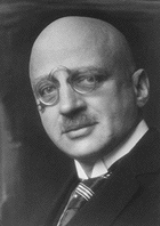
Early in the twentieth century several chemists tried and failed to produce ammonia from atmospheric nitrogen. The enormous technical problems associated with the process were first solved by German chemist
List of chemists

This is a list of famous chemists: ...
 Fritz Haber
Fritz Haber

Fritz Haber was a German chemistry, who received the Nobel Prize in Chemistry in 1918 for his development for Haber process, important for fertilizers and explosives....
 (with the invaluable help of Robert Le Rossignol, who developed and built the necessary high-pressure devices). They first demonstrated their success in the summer of 1909, producing ammonia from air drop by drop, at the rate of about a cup every two hours. The process was purchased by the German
Germany

Germany , officially the Federal Republic of Germany , is a country in Central Europe. It is bordered to the north by the North Sea, Denmark, and the Baltic Sea; to the east by Poland and the Czech Republic; to the south by Austria and Switzerland; and to the west by France, Luxembourg, Belgium, and the Netherlands....
 chemical company BASF
BASF

BASF SE is a German chemical company and the largest chemical company in the world. BASF originally stood for Badische Anilin- und Soda-Fabrik ....
, which assigned Carl Bosch
Carl Bosch

Carl Bosch was a German chemist and engineer and Nobel Prize in Chemistry. He was a pioneer in the field of high-pressure industrial chemistry and founder of IG Farben, at one point the world's largest chemical company....
 the difficult task of scaling up Haber's tabletop machine to industrial-level production. Haber and Bosch were later awarded Nobel prizes
Nobel Prize

The Nobel Prize , established in the 1895 will of Swedish chemist Alfred Nobel; it was first awarded in Nobel Prize in Physics, Nobel Prize in Chemistry, Nobel Prize in Physiology or Medicine, Nobel Prize in Literature, and Nobel Peace Prize in 1901....
, in 1918 and 1931 respectively, for their work in overcoming the chemical and engineering problems posed by the use of large-scale high-pressure technology. Ammonia was first manufactured using the Haber process on an industrial scale in 1913 in BASF's Oppau plant in Germany. During World War I
World War I

World War I, or the First World War , was a global military conflict which involved the Great powers, organized into two opposing military alliances: the Allies of World War I and the Central Powers....
, production was shifted from fertilizer to explosives, particularly through the conversion of ammonia into a synthetic form of Chile saltpeter
Sodium nitrate

Sodium nitrate is the chemical compound with the chemical formula NaNO3. This salts, also known as "Chile saltpeter" or "Peru saltpeter" , is a white solid which is very soluble in water....
, which could then be changed into other substances for the production of gunpowder and high explosives (the Allies had access to large amounts of Chile saltpeter from natural deposits in South America; Germany had to produce its own). It has been suggested that without this process, Germany would not have fought in the war, or would have had to surrender years earlier.

Prior to the use of natural gas as a hydrogen source, electricity was used to electrolyse water. The Vemork
Vemork

Vemork is the name of a hydroelectricity power plant outside Rjukan in Tinn, Norway. The plant was built by Norsk Hydro and opened in 1911, its main purpose being to produce hydrogen for the production of fertilizer....
 60 MW hydro electric plant in Norway was constructed purely to produce hydrogen via electrolysis of water as a precursor to ammonia production, and up until the second world war provided the majority of Europe's ammonia.

The Process


Nowadays, the bulk of the hydrogen
Hydrogen

Hydrogen is the chemical element with atomic number 1. It is represented by the chemical symbol H. At standard temperature and pressure, hydrogen is a colorless, odorless, nonmetallic, tasteless, highly combustion and explosive Diatomic molecule gas with the molecular formula H2....
 required is produced from methane
Methane

Methane is a chemical compound with the molecular formula . It is the simplest alkane, and the principal component of natural gas. Methane's bond angles are 109.5 degrees....
 (natural gas
Natural gas

Natural gas is a gas consisting primarily of methane. It is found associated with fossil fuels, in coal beds, as methane clathrates, and is created by methanogenic organisms in marshes, bogs, and landfills....
) using heterogeneous catalysis
Heterogeneous catalysis

Heterogeneous catalysis is a chemistry term which describes catalysis where the catalyst is in a different phase to the reactants. Heterogeneous catalysts provide a surface for the chemical reaction to take place on....
, because this requires far less external energy input compared to the electrolysis of water. However, the source of the hydrogen makes no difference to the Haber-Bosch process, which is only concerned with synthesizing ammonia from nitrogen and hydrogen.

Synthesis gas preparation


First, the methane is cleaned, mainly to remove sulphur impurities that would poison the catalysts.

The clean methane is then reacted with steam
Steam

In physical chemistry, and in engineering, steam refers to vaporized water. It is a pure, completely invisible gaseous phase . At standard temperature and pressure, pure steam occupies about 1,600 times the volume of an equal mass of liquid water....
 over a catalyst of nickel oxide
Nickel oxide

Nickel oxide may refer to:* Nickel oxide, NiO, green well characterised oxide* Nickel oxide, Ni2O3, black, not well characterised oxide...
. This is called steam reforming
Steam reforming

Steam reforming , hydrogen reforming or catalytic oxidation, is a method of producing hydrogen from hydrocarbons. On an industrial scale, it is the dominant method for producing hydrogen....
:
CH4 + H2O ? CO + 3H2


Secondary reforming then takes place with the addition of air to convert the methane that did not react during steam reforming.

2CH4 + O2 ? 2CO + 4H2
CH4 + 2O2 ? CO2 + 2H2O


Then the water gas shift reaction
Water gas shift reaction

The water-gas shift reaction is a chemical reaction in which carbon monoxide reacts with water to form carbon dioxide and hydrogen:The water-gas shift reaction is an important industrial reaction....
 yields more hydrogen from CO and steam.

CO + H2O ? CO2 + H2


The gas mixture is now passed into a methanator, which converts most of the remaining CO into methane for recycling:

CO + 3H2 ? CH4 + H2O


This last step is necessary as carbon monoxide poisons the catalyst. The overall reaction so far turns methane and steam into carbon dioxide, steam, and hydrogen.

Ammonia synthesis - Haber Process

The final stage, which is the actual Haber Process, is the synthesis of ammonia using a form of magnetite
Magnetite

Magnetite is a ferrimagnetism mineral with chemical formula Iron3Oxygen4, one of several iron oxides and a member of the spinel group....
, iron oxide, as the catalyst:

N2(g) + 3H2(g) ? 2NH3(g), ?Ho = -92.4 kJmol
Mole (unit)

The mole is a Units of measurement of amount of substance: it is an SI base unit, and one of the few units used to measure this physical quantity....
-1


This is done at 15–25 MPa
Pascal

Pascal or PASCAL may refer to:...
 (150–250 bar
Bar (unit)

The bar , decibar and the millibar are units of pressure. They are not SI units, nor are they cgs units, but they are accepted for use with the SI....
) and between 300 and 550 °C, passing the gases over four beds of catalyst, with cooling between each pass to maintain a reasonable equilibrium constant
Equilibrium constant

For a general chemical equilibriumthe equilibrium constant can be defined bywhere is the activity of the chemical species A etc . It is conventional to put the activities of the products in the numerator and those of the reactants in the denominator....
. On each pass only about 15% conversion occurs, but any unreacted gases are recycled, so that eventually an overall conversion of 98% can be achieved.

The steam reforming, shift conversion, carbon dioxide removal, and methanation steps each operate at absolute pressures of about 2.5–3.5 MPa (25–35 bar), and the ammonia synthesis loop operates at absolute pressures ranging from 6–18 MPa (60–180 bar), depending upon which proprietary design is used.

There are many engineering and construction companies that offer proprietary designs for ammonia synthesis plants. Haldor Topsoe
Haldor Topsoe

Haldor Topsoe is a Denmark catalyst company. The company was founded in 1940 by Dr. Haldor Topsoe. The company also develops process technology...
 of Denmark
Denmark

Denmark is a Scandinavian country in northern Europe and the senior member of the Kingdom of Denmark. It is the southernmost of the Nordic countries....
, Lurgi AG
Lurgi AG

LURGI GmbH is a Germany Engineering, Construction and Chemical Process Licensing company. The head office is provided in Frankfurt/Main. Lurgi GmbH is part of Air Liquide S....
 of Germany
Germany

Germany , officially the Federal Republic of Germany , is a country in Central Europe. It is bordered to the north by the North Sea, Denmark, and the Baltic Sea; to the east by Poland and the Czech Republic; to the south by Austria and Switzerland; and to the west by France, Luxembourg, Belgium, and the Netherlands....
, Uhde
ThyssenKrupp

ThyssenKrupp Aktiengesellschaft is a large Germany industry Conglomerate , with more than 200,000 employees. The corporation consists of 670 companies worldwide....
 of Germany
Germany

Germany , officially the Federal Republic of Germany , is a country in Central Europe. It is bordered to the north by the North Sea, Denmark, and the Baltic Sea; to the east by Poland and the Czech Republic; to the south by Austria and Switzerland; and to the west by France, Luxembourg, Belgium, and the Netherlands....
, Saipem/Snamprogetti
Saipem

Saipem is an Italian oil and gas industry contractor. It is a subsidiary of Italian energy company Eni, which owns approximately 43% of Saipem's shares....
 of Italy
Italy

Italy , officially the Italian Republic , is a country located on the Italian Peninsula in Southern Europe and on the two largest islands in the Mediterranean Sea, Sicily and Sardinia....
 and Kellogg, Brown and Root
Kellogg, Brown and Root

KBR, Inc. is an United States engineering and construction company, formerly a subsidiary of Halliburton, based in Houston. After Halliburton acquired Dresser Industries in 1998, Dresser's engineering subsidiary, The M....
 of the United States are among the most experienced companies in that field.

Reaction rate and equilibrium

There are two opposing considerations in this synthesis: the position of the equilibrium and the rate of reaction
Reaction rate

The reaction rate or rate of reaction for a reactant or product in a particular chemical reaction is intuitively defined as how fast a reaction takes place....
. At room temperature, the reaction is slow and the obvious solution is to raise the temperature. This may increase the rate of the reaction but, since the reaction is exothermic
Exothermic reaction

An exothermic reaction is a chemical reaction that releases energy in the form of heat. It is the opposite of an endothermic reaction. Expressed in a chemical equation:...
, it also has the effect, according to Le Chatelier's Principle
Le Châtelier's principle

In chemistry, Le Chatelier's Principle, also called the Le Chatelier-Braun principle, can be used to predict the effect of a change in conditions on a chemical equilibrium....
, of favouring the reverse reaction and thus reducing equilibrium constant
Equilibrium constant

For a general chemical equilibriumthe equilibrium constant can be defined bywhere is the activity of the chemical species A etc . It is conventional to put the activities of the products in the numerator and those of the reactants in the denominator....
, given by:


Variation in Keq for the Equilibrium
N2 (g) + 3H2 (g) ? 2NH3 (g)
as a Function of Temperature
Temperature (°C) Keq
300 4.34 x 10⁻³
400 1.64 x 10⁻⁴
450 4.51 x 10⁻⁵
500 1.45 x 10⁻⁵
550 5.38 x 10⁻⁶
600 2.25 x 10⁻⁶
As the temperature increases, the equilibrium
Equilibrium

For the opposite, see disequilibrium.Equilibrium is the condition of a system in which competing influences are balanced and it may refer to:...
 is shifted and hence, the constant drops dramatically according to the van't Hoff equation
Van't Hoff equation

The van 't Hoff equation in chemical thermodynamics relates the change in temperature to the change in the equilibrium constant given the standard enthalpy change for the process....
. Thus one might suppose that a low temperature is to be used and some other means to increase rate. However, the catalyst itself requires a temperature of at least 400 °C to be efficient.

Pressure
Pressure

Pressure is the force per unit area applied to an object in a direction surface normal to the surface. Gauge pressure is the pressure relative to the local atmospheric or ambient pressure....
 is the obvious choice to favour the forward reaction because there are 4 moles of reactant for every 2 moles of product (see entropy
Entropy

In many branches of science, entropy is a measure of the disorder of a system. The concept of entropy is particularly notable as it is applied across physics, information theory and mathematics....
), and the pressure used (around 200 atm) alters the equilibrium concentrations to give a profitable yield.

Economically, though, pressure is an expensive commodity. Pipes and reaction vessels need to be strengthened, valves more rigorous, and there are safety considerations of working at 200 atm. In addition, running pumps and compressors takes considerable energy. Thus the compromise used gives a single pass yield of around 15%.

Another way to increase the yield of the reaction would be to remove the product (i.e. ammonia gas) from the system. In practice, gaseous ammonia is not removed from the reactor itself, since the temperature is too high; but it is removed from the equilibrium mixture of gases leaving the reaction vessel. The hot gases are cooled enough, whilst maintaining a high pressure, for the ammonia to condense and be removed as liquid. Unreacted hydrogen and nitrogen gases are then returned to the reaction vessel to undergo further reaction.

Catalysts

The catalyst has no effect on the position of chemical equilibrium
Chemical equilibrium

In a chemical process, chemical equilibrium is the state in which the Activity or concentrations of the reactants and products have no net change over time....
; rather, it provides an alternative pathway with lower activation energy
Activation energy

In chemistry, activation energy is a term introduced in 1889 by the Swedish scientist Svante Arrhenius, that is defined as the energy that must be overcome in order for a chemical reaction to occur....
 and hence increases the reaction rate, while remaining chemically unchanged at the end of the reaction. The first Haber–Bosch reaction chambers used osmium
Osmium

Osmium is a chemical element that has the symbol Os and atomic number 76. Osmium is a hard, brittle, blue-gray or blue-black transition metal in the platinum family, and is the densest natural element....
 and uranium
Uranium

Uranium is a silvery-gray metallic chemical element in the actinide series of the periodic table that has the chemical symbol U and atomic number 92....
 as catalysts. However, under Bosch's direction in 1909, the BASF researcher Alwin Mittasch discovered a much less expensive iron
Iron

Iron is a chemical element with the symbol Fe and atomic number 26. Iron is a Group 8 element and period 4 element. Iron is lustrous and silvery in color....
-based catalyst that is still used today.

In industrial practice, the iron catalyst is prepared by exposing a mass of magnetite
Magnetite

Magnetite is a ferrimagnetism mineral with chemical formula Iron3Oxygen4, one of several iron oxides and a member of the spinel group....
, an iron oxide, to the hot hydrogen feedstock. This reduces some of the magnetite to metallic iron, removing oxygen
Oxygen

Oxygen no O2 produced; 2) O2 produced, but absorbed in oceans & seabed rock; 3) O2 starts to gas out of the oceans, but is absorbed by land surfaces and formation of ozone layer; 4-5) O2 sinks filled and the gas accumulates]]...
 in the process. However, the catalyst maintains most of its bulk volume during the reduction, and so the result is a highly porous material whose large surface area aids its effectiveness as a catalyst. Other minor components of the catalyst include calcium
Calcium

Calcium is the chemical element with the symbol Ca and atomic number 20. It has an atomic mass of 40.078 amu. Calcium is a soft grey alkaline earth metal, and is the fifth most abundant element by mass in the earth's Crust ....
 and aluminium oxide
Aluminium oxide

Aluminium oxide is an amphoteric oxide of aluminium with the chemical formula 23. It is also commonly referred to as alumina or aloxite in the mining, ceramic and materials science communities....
s, which support the porous iron catalyst and help it maintain its surface area over time, and potassium
Potassium

Potassium is a chemical element. It has the symbol K , atomic number 19, and atomic mass 39.0983. Potassium was first isolated from potash, hence the name....
, which increases the electron
Electron

The electron is a subatomic particle that carries a negative electric charge. It has elementary particle and is believed to be a point particle....
 density of the catalyst and so improves its activity.

The reaction mechanism
Reaction mechanism

In chemistry, a reaction mechanism is the step by step sequence of elementary reactions by which overall chemical change occurs .Although only the net chemical change is directly observation for most chemical reactions, experiments can often be designed that suggest the possible sequence of steps in a reaction mechanism....
, involving the heterogeneous catalyst, is believed to be as follows:

  1. N2(g) ? N2(adsorbed)
  2. N2(adsorbed) ? 2N(adsorbed)
  3. H2(g) ? H2(adsorbed)
  4. H2(adsorbed) ? 2H(adsorbed)
  5. N(adsorbed) + 3H(adsorbed)? NH3(adsorbed)
  6. NH3(adsorbed) ? NH3(g)


Reaction 5 occurs in three steps, forming NH, NH2, and then NH3. Experimental evidence points to reaction 2 as being the slow, rate-determining step
Rate-determining step

The rate-determining step is a chemistry term for the slowest reaction step in a chemical reaction. The rate-determining step is often compared to the neck of a funnel; the rate at which water flows through the funnel is determined by the width of the neck, not by the speed at which water is poured in....
.

A major contributor to the elucidation of this mechanism is Gerhard Ertl
Gerhard Ertl

Gerhard Ertl is a German physicist and a Professor emeritus at the Department of Physical Chemistry, Fritz Haber Institute of the MPG in Berlin, Germany....
.

Economic and environmental aspects

The Haber process now produces 100 million tons of nitrogen fertilizer per year, mostly in the form of anhydrous ammonia
Ammonia

Ammonia is a chemical compound with the chemical formula nitrogenhydrogen. It is normally encountered as a gas with a characteristic pungent odor....
, ammonium nitrate
Ammonium nitrate

The chemical compound ammonium nitrate, the nitrate of ammonia with the chemical formula NitrogenHydrogen4NitrogenOxygen3, is a white powder at room temperature and standard pressure....
, and urea
Urea

Urea is an organic compound with the chemical formula 2carbonoxygen.Urea is also known by the International Nonproprietary Name carbamide, as established by the World Health Organization....
. 3-5% of world natural gas production is consumed in the Haber process (~1-2% of the world's annual energy supply). That fertilizer is responsible for sustaining one-third of the Earth's population, as well as various deleterious environmental consequences. Generation of hydrogen using electrolysis of water, using renewable energy, is not currently competitive cost-wise with hydrogen from fossil fuels, such as natural gas, and is responsible for 4% of current hydrogen production. Notably, the rise of this industrial process led to the "Nitrate Crisis" in Chile
Chile

Chile, officially the Republic of Chile , is a country in South America occupying a long and narrow coastal strip wedged between the Andes mountains and the Pacific Ocean....
, when the industrials who owned the nitrate mines (most of them British) left the country — since the natural nitrate mines were no longer profitable — closing the mines and leaving a large unemployed Chilean population behind.

See also

  • Chemical kinetics
    Chemical kinetics

    Chemical kinetics, also known as reaction kinetics, is the study of reaction rate of chemical processes. Chemical kinetics includes investigations of how different experimental conditions can influence the speed of a chemical reaction and yield information about the reaction mechanism and transition states, as well as the construction of ma...
  • Reaction rate
    Reaction rate

    The reaction rate or rate of reaction for a reactant or product in a particular chemical reaction is intuitively defined as how fast a reaction takes place....
  • Rate equation
    Rate equation

    The rate law or rate equation for a chemical reaction is an equation which links the reaction rate with concentrations or pressures of reactants and constant parameters ....
  • Timeline of hydrogen technologies
    Timeline of hydrogen technologies

    Timeline of hydrogen technologies A timeline of the history of hydrogen technology....


External links

  • ”CIEC Catalysis”,