


Franz Anton Bustelli

Encyclopedia
Bavaria
Bavaria, formally the Free State of Bavaria is a state of Germany, located in the southeast of Germany. With an area of , it is the largest state by area, forming almost 20% of the total land area of Germany...
n Nymphenburg Porcelain Manufactory
Nymphenburg Porcelain Manufactory
The Nymphenburg Porcelain Manufactory , manufacturer of Nymphenburg porcelain, is situated in the Nymphenburg Palace in Munich, capital of Bavaria, and since the mid-eighteenth century has been manufacturing porcelain of high artistic value.- History :After his accession in 1745 Maximilian III...
from 1754 to his death in 1763. He is widely regarded as the finest modeller of porcelain
Porcelain
Porcelain is a ceramic material made by heating raw materials, generally including clay in the form of kaolin, in a kiln to temperatures between and...
in the Rococo
Rococo
Rococo , also referred to as "Late Baroque", is an 18th-century style which developed as Baroque artists gave up their symmetry and became increasingly ornate, florid, and playful...
style: "if the art of European porcelain finds its most perfect expression in the rococo style, so the style finds its most perfect expression in the work of Bustelli".
He was born in Locarno
Locarno
Locarno is the capital of the Locarno district, located on the northern tip of Lake Maggiore in the Swiss canton of Ticino, close to Ascona at the foot of the Alps. It has a population of about 15,000...
in Italian-speaking Switzerland
Switzerland
Switzerland name of one of the Swiss cantons. ; ; ; or ), in its full name the Swiss Confederation , is a federal republic consisting of 26 cantons, with Bern as the seat of the federal authorities. The country is situated in Western Europe,Or Central Europe depending on the definition....
, and died in Munich
Munich
Munich The city's motto is "" . Before 2006, it was "Weltstadt mit Herz" . Its native name, , is derived from the Old High German Munichen, meaning "by the monks' place". The city's name derives from the monks of the Benedictine order who founded the city; hence the monk depicted on the city's coat...
, Bavaria, just after his 40th birthday. Few details of his life are known, but he trained as a sculptor, probably mostly in wood, and perhaps in Italy. He spoke and wrote German fluently, and may have grown up in Bavaria.
Nymphenburg
Bustelli joined the Neudeck factory in Munich in 1754, the year after it was established by the local ruler, Maximilian III Joseph, Elector of Bavaria. The factory moved in 1761 to the grounds of the Elector's Nymphenburg PalaceNymphenburg Palace
The Nymphenburg Palace , i.e. "Nymph's Castle", is a Baroque palace in Munich, Bavaria, southern Germany. The palace was the main summer residence of the rulers of Bavaria.-History:...
near Munich, where it remains today, but its products are normally referred to as Nymphenburg for the earlier period as well. It was a relatively late entrant to the group of porcelain factories set up in Europe as the secrets of the techniques developed by Johann Friedrich Böttger
Johann Friedrich Böttger
Johann Friedrich Böttger was a Germanalchemist.He was generally acknowledged as the inventor of European porcelain although more recent sources ascribe this to Ehrenfried Walther von Tschirnhaus...
for the Meissen
Meissen porcelain
Meissen porcelain or Meissen china is the first European hard-paste porcelain that was developed from 1708 by Ehrenfried Walther von Tschirnhaus. After his death that October, Johann Friedrich Böttger, continued his work and brought porcelain to the market...
factory in Saxony
Saxony
The Free State of Saxony is a landlocked state of Germany, contingent with Brandenburg, Saxony Anhalt, Thuringia, Bavaria, the Czech Republic and Poland. It is the tenth-largest German state in area, with of Germany's sixteen states....
(established in 1710) gradually leaked out. Bustelli was rapidly promoted to Modellmeister, or head modeller, and created moulds for about 150 new models for Neudeck and Nymphenburg.
His first figures were small classical gods and putti, followed by a series of street vendors, as well as some larger religious figures, including a Crucifixion
Crucifixion
Crucifixion is an ancient method of painful execution in which the condemned person is tied or nailed to a large wooden cross and left to hang until dead...
, that follow directly from the style of South German woodcarving of the period. In a series of Chinese and Turkish figures, from about 1756 onwards, reflecting the Rococo taste for chinoiserie
Chinoiserie
Chinoiserie, a French term, signifying "Chinese-esque", and pronounced ) refers to a recurring theme in European artistic styles since the seventeenth century, which reflect Chinese artistic influences...
and Orientalism
Orientalism
Orientalism is a term used for the imitation or depiction of aspects of Eastern cultures in the West by writers, designers and artists, as well as having other meanings...
, he reached the height of his powers, seen in the mature figures of the following years. The most famous of his works are a set of eight pairs of male and female single figures whose glances interact, portraying characters in the Commedia dell'arte
Commedia dell'arte
Commedia dell'arte is a form of theatre characterized by masked "types" which began in Italy in the 16th century, and was responsible for the advent of the actress and improvised performances based on sketches or scenarios. The closest translation of the name is "comedy of craft"; it is shortened...
(1759-60).
These were followed by groups of paired lovers and other figures, such as hounds. He was involved in the design of a large dinner service for the Elector, though the elaborate individual paintings, by Joseph Zächenberger, were not completed until after his death.
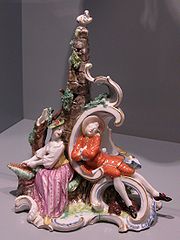
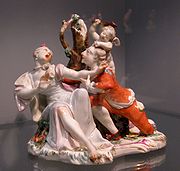
Bustelli produced models that were made into moulds, and after Nymphenburg introduced painted figures in 1756, he executed or designed the paint scheme for a finished model to be followed by the factory's painters. Models were produced in both polychrome and plain white examples, with the latter more numerous, and the colouring often varying considerably between examples (see picture above). With the older, and far more prolific, modeller Johann Joachim Kaendler
Johann Joachim Kaendler
Johann Joachim Kändler was the most important modelleur of the Meissen porcelain manufacture.Kändler was born in Fischbach near Dresden, Germany. After apprenticing at the sculptor Thomae in Dresden, he became assistant of Johann Jakob Kirchner at Meissen porcelain, and succeeded him as...
of Meissen, Bustelli is the outstanding figure of Rococo porcelain, and his best work has a unique grace, energy, drama and often wit. His figures are thoroughly designed in the round, meant to be appreciated from all angles. The bases are unusually thin, and often include scroll-work that integrates elegantly with the figures. Some subjects are drawn from engraving
Engraving
Engraving is the practice of incising a design on to a hard, usually flat surface, by cutting grooves into it. The result may be a decorated object in itself, as when silver, gold, steel, or glass are engraved, or may provide an intaglio printing plate, of copper or another metal, for printing...
s, and many seem to show the influence of the conventional theatrical gestures of the period.
He was not very highly paid, and his possessions at his death included furniture and personal effects, some of his own figures, 228 engravings, and 31 books on chemistry
Chemistry
Chemistry is the science of matter, especially its chemical reactions, but also its composition, structure and properties. Chemistry is concerned with atoms and their interactions with other atoms, and particularly with the properties of chemical bonds....
.
Today many Bustelli designs continue to be produced by Nymphenburg, though not from the original moulds, and using modern stamps. Original figures may fetch over $150,000. The best collections of original pieces are in Munich, in the Bavarian National Museum, where a whole room is devoted to his work, and the Bäuml collection in the Marstallmuseum in Nymphenburg Palace; the Bäuml family owned the factory between 1888 and 1975. Other museums all over the world have examples.
5196 Bustelli
5196 Bustelli
5196 Bustelli is a main-belt asteroid discovered on September 30, 1973, by Cornelis Johannes van Houten, Ingrid van Houten-Groeneveld and Tom Gehrels at Palomar Observatory. It is named after Franz Anton Bustelli , a modeller of Rococo porcelain.- External links :*...
(3102 T-2) is a main belt asteroid, discovered in 1973 and named after Bustelli; Böttger and Kaendler of Meissen have the two preceding numbers.
External links
- Large group at the Victoria and Albert MuseumVictoria and Albert MuseumThe Victoria and Albert Museum , set in the Brompton district of The Royal Borough of Kensington and Chelsea, London, England, is the world's largest museum of decorative arts and design, housing a permanent collection of over 4.5 million objects...
- Bustelli page at Nyphenburg Porcelain
- database of figures auctioned by Christie'sChristie'sChristie's is an art business and a fine arts auction house.- History :The official company literature states that founder James Christie conducted the first sale in London, England, on 5 December 1766, and the earliest auction catalogue the company retains is from December 1766...
; the largest group of images online.