
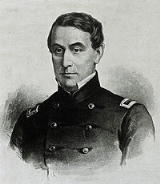
Robert Anderson was an
American militaryThe United States Armed Forces are the military forces of the United States. They consist of the Army, Navy, Marine Corps, Air Force, and Coast Guard.The United States has a strong tradition of civilian control of the military...
leader. He served as a
Union ArmyThe Union Army was the land force that fought for the Union during the American Civil War. It was also known as the Federal Army, the U.S. Army, the Northern Army and the National Army...
officerAn officer is a member of an armed force or uniformed service who holds a position of authority. Commissioned officers derive authority directly from a sovereign power and, as such, hold a commission charging them with the duties and responsibilities of a specific office or position...
in the
American Civil WarThe American Civil War was a civil war fought in the United States of America. In response to the election of Abraham Lincoln as President of the United States, 11 southern slave states declared their secession from the United States and formed the Confederate States of America ; the other 25...
, known for his command of
Fort SumterThe Battle of Fort Sumter was the bombardment and surrender of Fort Sumter, near Charleston, South Carolina, that started the American Civil War. Following declarations of secession by seven Southern states, South Carolina demanded that the U.S. Army abandon its facilities in Charleston Harbor. On...
at the start of the war. He is often referred to as
Major Robert Anderson, referring to his
rankMilitary rank is a system of hierarchical relationships in armed forces or civil institutions organized along military lines. Usually, uniforms denote the bearer's rank by particular insignia affixed to the uniforms...
at Fort Sumter. In 1871 he died in France at age 66.
Early life
Anderson was born in "Soldier's Retreat," near
Louisville, KentuckyLouisville is the largest city in the U.S. state of Kentucky, and the county seat of Jefferson County. Since 2003, the city's borders have been coterminous with those of the county because of a city-county merger. The city's population at the 2010 census was 741,096...
. He graduated from the
United States Military AcademyThe United States Military Academy at West Point is a four-year coeducational federal service academy located at West Point, New York. The academy sits on scenic high ground overlooking the Hudson River, north of New York City...
(West Point) in 1825 and received a commission as a
brevetIn many of the world's military establishments, brevet referred to a warrant authorizing a commissioned officer to hold a higher rank temporarily, but usually without receiving the pay of that higher rank except when actually serving in that role. An officer so promoted may be referred to as being...
second lieutenant in the 2nd Regiment of Artillery. He served in the
Black Hawk WarThe Black Hawk War was a brief conflict fought in 1832 between the United States and Native Americans headed by Black Hawk, a Sauk leader. The war erupted soon after Black Hawk and a group of Sauks, Meskwakis, and Kickapoos known as the "British Band" crossed the Mississippi River into the U.S....
of 1832 as a
colonelIn the United States Army, Air Force, and Marine Corps, colonel is a senior field grade military officer rank just above the rank of lieutenant colonel and just below the rank of brigadier general...
of
IllinoisIllinois is the fifth-most populous state of the United States of America, and is often noted for being a microcosm of the entire country. With Chicago in the northeast, small industrial cities and great agricultural productivity in central and northern Illinois, and natural resources like coal,...
volunteers, where he had the distinction of twice mustering
CaptainThe army rank of captain is a commissioned officer rank historically corresponding to command of a company of soldiers. The rank is also used by some air forces and marine forces. Today a captain is typically either the commander or second-in-command of a company or artillery battery...
Abraham LincolnAbraham Lincoln was the 16th President of the United States, serving from March 1861 until his assassination in April 1865. He successfully led his country through a great constitutional, military and moral crisis – the American Civil War – preserving the Union, while ending slavery, and...
in and out of army service. Returning to the Army as a first lieutenant in 1833, he served in the
Second Seminole WarThe Second Seminole War, also known as the Florida War, was a conflict from 1835 to 1842 in Florida between various groups of Native Americans collectively known as Seminoles and the United States, part of a series of conflicts called the Seminole Wars...
as an assistant
adjutant generalAn Adjutant General is a military chief administrative officer.-Imperial Russia:In Imperial Russia, the General-Adjutant was a Court officer, who was usually an army general. He served as a personal aide to the Tsar and hence was a member of the H. I. M. Retinue...
on the staff of
Winfield ScottWinfield Scott was a United States Army general, and unsuccessful presidential candidate of the Whig Party in 1852....
, and in the Mexican-American War, where he was severely wounded at
Molino del ReyThe Battle of Molino del Rey was one of the bloodiest engagements of the Mexican-American War. It was fought in September 1847 between Mexican forces under General Antonio Léon against an American force under General Winfield Scott at a hill called El Molino del Rey near Mexico City.-Background:On...
, and for which he received a
brevetIn many of the world's military establishments, brevet referred to a warrant authorizing a commissioned officer to hold a higher rank temporarily, but usually without receiving the pay of that higher rank except when actually serving in that role. An officer so promoted may be referred to as being...
promotion to
majorIn the United States Army, Air Force, and Marine Corps, major is a field grade military officer rank just above the rank of captain and just below the rank of lieutenant colonel...
. He eventually received a permanent promotion to major of the 1st Regiment of Artillery in the Regular Army on October 5, 1857. He is the author of
Instruction for Field Artillery, Horse and Foot in 1839.
Fort Sumter
When
South Carolina secededSouth Carolina is one of the 13 original colonies of the United States. European exploration began in 1540, but the explorers brought European diseases that decimated the local Indian population. It was founded in 1663...
In December 1860, Major Anderson, a pro-slavery, former slave-owner from Kentucky, remained loyal to the Union. He was the commanding officer of United States Army forces in Charleston, South Carolina—the last remaining important Union post in the Deep South. Acting without orders, he moved his small garrison from Fort Moultrie, which was indefensible, to the more modern, more defensible,
Fort SumterFort Sumter is a Third System masonry coastal fortification located in Charleston Harbor, South Carolina. The fort is best known as the site upon which the shots initiating the American Civil War were fired, at the Battle of Fort Sumter.- Construction :...
in the middle of
Charleston HarborThe Charleston Harbor is an inlet of the Atlantic Ocean at Charleston, South Carolina. The inlet is formed by the junction of Ashley and Cooper rivers at . Morris and Sullivan's Island, shelter the entrance...
. South Carolina leaders cried betrayal, while the North celebrated with enormous excitement at this show of defiance against secessionism. In February 1861 the
Confederate States of AmericaThe Confederate States of America was a government set up from 1861 to 1865 by 11 Southern slave states of the United States of America that had declared their secession from the U.S...
was formed and took charge. Jefferson Davis, the Confederate President, ordered the fort be captured. The artillery attack was commanded by Brig. Gen.
P. G. T. BeauregardPierre Gustave Toutant Beauregard was a Louisiana-born American military officer, politician, inventor, writer, civil servant, and the first prominent general of the Confederate States Army during the American Civil War. Today he is commonly referred to as P. G. T. Beauregard, but he rarely used...
, who had been Anderson's student at West Point. The attack began April 12, 1861, and continued until Anderson, badly outnumbered and outgunned, surrendered the fort on April 14. The battle began the American Civil War. No one was killed in the battle on either side, but one Union soldier was killed during a 100-gun salute.
The modern meaning of
the American flagThe national flag of the United States of America consists of thirteen equal horizontal stripes of red alternating with white, with a blue rectangle in the canton bearing fifty small, white, five-pointed stars arranged in nine offset horizontal rows of six stars alternating with rows...
, according to Adam Goodheart (2011), was forged in December 1860, when Anderson, acting without orders, moved the American garrison from Fort Moultrie to
Fort SumterFort Sumter is a Third System masonry coastal fortification located in Charleston Harbor, South Carolina. The fort is best known as the site upon which the shots initiating the American Civil War were fired, at the Battle of Fort Sumter.- Construction :...
, in Charleston Harbor, in defiance of the overwhelming power of the new
Confederate States of AmericaThe Confederate States of America was a government set up from 1861 to 1865 by 11 Southern slave states of the United States of America that had declared their secession from the U.S...
. Goodheart argues this was the opening move of the
Civil WarThe American Civil War was a civil war fought in the United States of America. In response to the election of Abraham Lincoln as President of the United States, 11 southern slave states declared their secession from the United States and formed the Confederate States of America ; the other 25...
, and the flag was used throughout the North to symbolize American nationalism and rejection of secessionism.
- Before that day, the flag had served mostly as a military ensign or a convenient marking of American territory, flown from forts, embassies, and ships, and displayed on special occasions like the Fourth of July. But in the weeks after Major Anderson's surprising stand, it became something different. Suddenly the Stars and Stripes flew -- as it does today, and especially as it did after September 11 -- from houses, from storefronts, from churches; above the village greens and college quads. For the first time American flags were mass-produced rather than individually stitched and even so, manufacturers could not keep up with demand. As the long winter of 1861 turned into spring, that old flag meant something new. The abstraction of the Union clause was transfigured into a physical thing: strips of cloth that millions of people would fight for, and many thousands die for.
Anderson's actions in defense of American nationalism made him an immediate national hero. He was promoted to
brigadier generalA brigadier general in the United States Army, Air Force, and Marine Corps, is a one-star general officer, with the pay grade of O-7. Brigadier general ranks above a colonel and below major general. Brigadier general is equivalent to the rank of rear admiral in the other uniformed...
, effective May 15. Anderson took the fort's
33-star flagThe Fort Sumter Flag is a historic United States flag with a distinctive, diamond-shaped pattern of 33 stars. The flag was lowered by Major Robert Anderson on April 14, 1861 when he surrendered Fort Sumter, in the harbor of Charleston, South Carolina, at the outset of the American Civil...
with him to
New York CityNew York is the most populous city in the United States and the center of the New York Metropolitan Area, one of the most populous metropolitan areas in the world. New York exerts a significant impact upon global commerce, finance, media, art, fashion, research, technology, education, and...
, where he participated in a
Union SquareUnion Square is a public square in the Manhattan borough of New York City, New York.It is an important and historic intersection, located where Broadway and the former Bowery Road – now Fourth Avenue – came together in the early 19th century; its name celebrates neither the...
patriotic rally that was the largest public gathering in North America up to that time.
Civil War roles
Anderson then went on a highly-successful
recruitingMilitary recruitment is the act of requesting people, usually male adults, to join a military voluntarily. Involuntary military recruitment is known as conscription. Many countries that have abolished conscription use military recruiters to persuade people to join, often at an early age. To...
tour of the
NorthNorthern United States, also sometimes the North, may refer to:* A particular grouping of states or regions of the United States of America. The United States Census Bureau divides some of the northernmost United States into the Midwest Region and the Northeast Region...
. His next assignment placed him in another sensitive political position, commander of the Department of Kentucky (subsequently renamed the Department of the Cumberland), in a
border stateIn the context of the American Civil War, the border states were slave states that did not declare their secession from the United States before April 1861...
that had officially declared neutrality between the warring parties. He served in that position from May 28, 1861, until failing health required his replacement, by Brig. Gen. William T. Sherman, on October 6, 1861.
General Anderson's last assignment of his military career was as commanding officer of
Fort AdamsFort Adams in Newport, Rhode Island, was established on July 4, 1799 as a First System coastal fortification. Its first commander was Captain John Henry who was later instrumental in starting the War of 1812.-History:...
in Newport, Rhode Island, in August 1863. By coincidence, Fort Adams had been General Beauregard's first assignment after his graduation from West Point. Anderson officially retired from the Army on October 27, 1863, and saw no further active service.
Later life
Days after
Robert E. Lee'sRobert Edward Lee was a career military officer who is best known for having commanded the Confederate Army of Northern Virginia in the American Civil War....
surrender at
AppomattoxThe Appomattox Courthouse is the current courthouse in Appomattox, Virginia built in 1892. It is located in the middle of the state about three miles northwest of the Appomattox Court House National Historical Park, once known as Clover Hill - home of the original Old Appomattox Court House...
and the effective conclusion of the war, Anderson returned to Charleston in the uniform of a brevet
major generalIn the United States Army, United States Marine Corps, and United States Air Force, major general is a two-star general-officer rank, with the pay grade of O-8. Major general ranks above brigadier general and below lieutenant general...
(ranking as of February 3, 1865) and, four years after lowering the 33-star flag in surrender, raised it in triumph over the recaptured but badly battered
Fort SumterFort Sumter is a Third System masonry coastal fortification located in Charleston Harbor, South Carolina. The fort is best known as the site upon which the shots initiating the American Civil War were fired, at the Battle of Fort Sumter.- Construction :...
during ceremonies there. (The same evening, April 14, 1865,
PresidentThe President of the United States of America is the head of state and head of government of the United States. The president leads the executive branch of the federal government and is the commander-in-chief of the United States Armed Forces....
Abraham Lincoln was
assassinatedThe assassination of United States President Abraham Lincoln took place on Good Friday, April 14, 1865, as the American Civil War was drawing to a close. The assassination occurred five days after the commanding General of the Army of Northern Virginia, Robert E. Lee, and his battered Army of...
).
A notable post-war achievement of Anderson took place in
Braintree, MassachusettsThe Town of Braintree is a suburban city in Norfolk County, Massachusetts, United States. Although officially known as a town, Braintree adopted a municipal charter, effective 2008, with a mayor-council form of government and is considered a city under Massachusetts law. The population was 35,744...
, in 1869, when he visited Braintree to discuss the future of the U.S. Army with the "father of the United States Military Academy," Major General
Sylvanus ThayerColonel and Brevet Brigadier General Sylvanus Thayer also known as "the Father of West Point" was an early superintendent of the United States Military Academy at West Point and an early advocate of engineering education in the United States.-Biography:Thayer was born in Braintree, Massachusetts,...
. An outcome of that visit was establishment of the Military Academy's Association of Graduates (AoG).
Anderson died in
NiceNice is the fifth most populous city in France, after Paris, Marseille, Lyon and Toulouse, with a population of 348,721 within its administrative limits on a land area of . The urban area of Nice extends beyond the administrative city limits with a population of more than 955,000 on an area of...
,
FranceThe French Republic , The French Republic , The French Republic , (commonly known as France , is a unitary semi-presidential republic in Western Europe with several overseas territories and islands located on other continents and in the Indian, Pacific, and Atlantic oceans. Metropolitan France...
, and is buried at
West Point CemeteryWest Point Cemetery is a historic cemetery on the grounds of the United States Military Academy in West Point, New York. It overlooks the Hudson River, and served as a burial ground for American Revolutionary War soldiers and early West Point inhabitants long before 1817 when it was officially...
.
Family
Anderson's mother Sarah Marshall was first cousin to
Chief JusticeThe Chief Justice in many countries is the name for the presiding member of a Supreme Court in Commonwealth or other countries with an Anglo-Saxon justice system based on English common law, such as the Supreme Court of Canada, the Constitutional Court of South Africa, the Court of Final Appeal of...
John MarshallJohn Marshall was the Chief Justice of the United States whose court opinions helped lay the basis for American constitutional law and made the Supreme Court of the United States a coequal branch of government along with the legislative and executive branches...
. Anderson's brother,
Charles AndersonCharles Anderson was first a Whig and later a Republican politician from Ohio. He served briefly as the 27th Governor of Ohio.-Biography:...
, served as Governor of Ohio from 1865 to 1866. Another brother,
William Marshall AndersonWilliam Marshall Anderson was an American scholar, explorer and politician, noted for his detailed travel journals in the Rocky Mountains and Imperial Mexico.-Background:...
, was a Western explorer and Ohio attorney. A zealous Catholic and Confederate sympathizer, he briefly moved to Mexico during the reign of Emperor Maximilian in hopes of establishing a Confederate colony there. W. Marshall Anderson's son,
Thomas M. AndersonThomas McArthur Anderson was a career officer in the United States Army who served as a general in the Spanish-American War and the Philippine-American War.-Early Life and Civil War:...
, was a brigadier general who fought in the
Spanish-American WarThe Spanish–American War was a conflict in 1898 between Spain and the United States, effectively the result of American intervention in the ongoing Cuban War of Independence...
and
Philippine-American WarThe Philippine–American War, also known as the Philippine War of Independence or the Philippine Insurrection , was an armed conflict between a group of Filipino revolutionaries and the United States which arose from the struggle of the First Philippine Republic to gain independence following...
.
Anderson was the great-uncle of Ambassador
Larz AndersonLarz Anderson III was a wealthy American businessman and diplomat who briefly served as U.S. Ambassador to Japan ....
, a Washington, D.C. socialite, who donated his house to serve as the headquarters of the
Society of the CincinnatiThe Society of the Cincinnati is a historical organization with branches in the United States and France founded in 1783 to preserve the ideals and fellowship of the American Revolutionary War officers and to pressure the government to honor pledges it had made to officers who fought for American...
. He was also the great-grandfather of actor
Montgomery CliftEdward Montgomery Clift was an American film and stage actor. The New York Times’ obituary noted his portrayal of "moody, sensitive young men"....
(only if Clift's mother's story about her adoption and family line is correct - see Montgomery Clift) and the first cousin twice removed of William Clark and
George Rogers ClarkGeorge Rogers Clark was a soldier from Virginia and the highest ranking American military officer on the northwestern frontier during the American Revolutionary War. He served as leader of the Kentucky militia throughout much of the war...
.
See also
- List of American Civil War generals
External links