


Folliculogenesis

Encyclopedia
Biology
Biology is a natural science concerned with the study of life and living organisms, including their structure, function, growth, origin, evolution, distribution, and taxonomy. Biology is a vast subject containing many subdivisions, topics, and disciplines...
, folliculogenesis is the maturation of the ovarian follicle
Ovarian follicle
Ovarian follicles are the basic units of female reproductive biology, each of which is composed of roughly spherical aggregations of cells found in the ovary. They contain a single oocyte . These structures are periodically initiated to grow and develop, culminating in ovulation of usually a single...
, a densely-packed shell of somatic cells that contains an immature oocyte
Oocyte
An oocyte, ovocyte, or rarely ocyte, is a female gametocyte or germ cell involved in reproduction. In other words, it is an immature ovum, or egg cell. An oocyte is produced in the ovary during female gametogenesis. The female germ cells produce a primordial germ cell which undergoes a mitotic...
. Folliculogenesis describes the progression of a number of small primordial follicles into large preovulatory follicles that enter the menstrual cycle
Menstrual cycle
The menstrual cycle is the scientific term for the physiological changes that can occur in fertile women for the purpose of sexual reproduction. This article focuses on the human menstrual cycle....
.
Contrary to male spermatogenesis
Spermatogenesis
Spermatogenesis is the process by which male primary germ cells undergo division, and produce a number of cells termed spermatogonia, from which the primary spermatocytes are derived. Each primary spermatocyte divides into two secondary spermatocytes, and each secondary spermatocyte into two...
, which can last indefinitely, folliculogenesis ends when the remaining follicles in the ovaries
Ovary
The ovary is an ovum-producing reproductive organ, often found in pairs as part of the vertebrate female reproductive system. Ovaries in anatomically female individuals are analogous to testes in anatomically male individuals, in that they are both gonads and endocrine glands.-Human anatomy:Ovaries...
are incapable of responding to the hormonal cues that previously recruited some follicles to mature. This depletion in follicle supply signals the beginning of the menopause
Menopause
Menopause is a term used to describe the permanent cessation of the primary functions of the human ovaries: the ripening and release of ova and the release of hormones that cause both the creation of the uterine lining and the subsequent shedding of the uterine lining...
.
Note: Although the process is similar in many animals, this article will deal exclusively with human
Human
Humans are the only living species in the Homo genus...
folliculogenesis.
Overview
The primary role of the follicle is oocyteOocyte
An oocyte, ovocyte, or rarely ocyte, is a female gametocyte or germ cell involved in reproduction. In other words, it is an immature ovum, or egg cell. An oocyte is produced in the ovary during female gametogenesis. The female germ cells produce a primordial germ cell which undergoes a mitotic...
support. From birth, the ovaries of the human female contain a number of immature, primordial follicles. These follicles each contain a similarly immature primary oocyte. After puberty
Puberty
Puberty is the process of physical changes by which a child's body matures into an adult body capable of reproduction, as initiated by hormonal signals from the brain to the gonads; the ovaries in a girl, the testes in a boy...
and commencing with the first menstruation
Menstruation
Menstruation is the shedding of the uterine lining . It occurs on a regular basis in sexually reproductive-age females of certain mammal species. This article focuses on human menstruation.-Overview:...
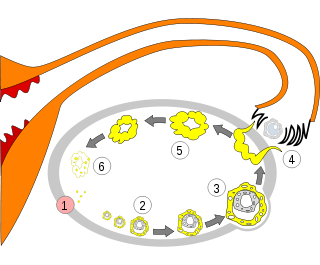
, a clutch of follicles begins folliculogenesis, entering a growth pattern that will end in death or in ovulation (the process where the oocyte leaves the follicle).
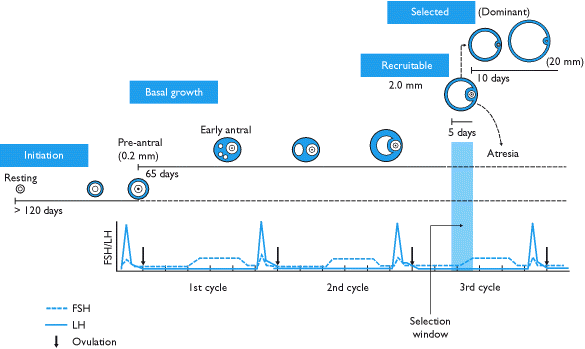
During post-pubescent follicular development, and over the course of roughly a year, primordial follicles that have begun development undergo a series of critical changes in character, both histologically and hormonally. Two-thirds of the way through this process, the follicles have transitioned to tertiary, or antral, follicles. At this stage in development, they become dependent on hormones emanating from the host body, causing a substantial increase in their growth rate.
With a little more than ten days until the end of the period of follicular development, most of the original group of follicles have died (a process known as atresia). The remaining cohort of follicles enter the menstrual cycle
Menstrual cycle
The menstrual cycle is the scientific term for the physiological changes that can occur in fertile women for the purpose of sexual reproduction. This article focuses on the human menstrual cycle....
, competing with each other until only one follicle is left. This remaining follicle, the late tertiary or pre-ovulatory follicle, ruptures and discharges the oocyte (that has since grown into a secondary oocyte), ending folliculogenesis.
Phases of development
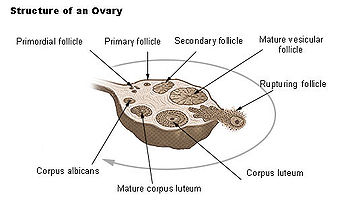
Folliculogenesis lasts for approximately 375 days. It coincides with thirteen menstrual cycles. The process begins continuously, meaning that at any time the ovary contains follicles in all stages of development, and ends when a mature oocyte departs from the preovulatory follicle in a process called ovulation.The growing follicle passes through the following distinct stages that are defined by certain structural characteristics (unfamiliar terms will be defined in their respective sections):
In a larger perspective, the whole folliculogenesis, from primordial to preovulatory follicle, belongs to the stage of ootidogenesis of oogenesis
Oogenesis
Oogenesis, ovogenesis or oögenesis is the creation of an ovum . It is the female form of gametogenesis. The male equivalent is spermatogenesis...
.
| Stage | Description | Size >- | Primordial |
Dormant Dormant Dormant means lacking activity. It can refer to:*Dormancy in an organism's life cycle*Dormant volcano, a volcano that is inactive but may become active in the future... , small, only one layer of flat granulosa cells |
>- | Mitotic cells, cuboidal granulosa cells | >- | Presence of theca cells Theca of follicle The theca folliculi comprise a layer of the ovarian follicles. They appear as the follicles become tertiary follicles.The theca are divided into two layers, the theca interna and the theca externa.... , multiple layers of granulosa cells |
>- | >- | Fully formed antrum Follicular antrum The follicular antrum is the portion of an ovarian follicle filled with liquor folliculi.-External links: "Graafian Follicle" - "Mammal, canine ovary "*... , no further cytodifferentiation, no novel progress |
>- | Building growth in estrogen concentration, all other follicles atretic or dead |
In addition, follicles that have formed an antrum
Follicular antrum
The follicular antrum is the portion of an ovarian follicle filled with liquor folliculi.-External links: "Graafian Follicle" - "Mammal, canine ovary "*...
are called antral follicles or Graafian follicles. Definitions differ in where this shift occurs in the staging given above, with some stating that it occurs when entering the secondary stage, and others stating that it occurs when entering the tertiary stage.
Up until the preovulatory stage, the follicle contains a primary oocyte that is arrested in prophase of meiosis I
Meiosis
Meiosis is a special type of cell division necessary for sexual reproduction. The cells produced by meiosis are gametes or spores. The animals' gametes are called sperm and egg cells....
. During the late preovulatory stage, the oocyte continues meiosis and becomes a secondary oocyte, arrested in metaphase II
Metaphase
Metaphase, from the ancient Greek μετά and φάσις , is a stage of mitosis in the eukaryotic cell cycle in which condensed & highly coiled chromosomes, carrying genetic information, align in the middle of the cell before being separated into each of the two daughter cells...
.
Primordial
Ovary
The ovary is an ovum-producing reproductive organ, often found in pairs as part of the vertebrate female reproductive system. Ovaries in anatomically female individuals are analogous to testes in anatomically male individuals, in that they are both gonads and endocrine glands.-Human anatomy:Ovaries...
contains its peak number of follicles (about 300,000 in the average case, but individual peak populations range from 35,000 to 2.5 million). These primordial follicles contain immature oocytes surrounded by flat, squamous granulosa cells (the support cells) that are segregated from the oocyte's environment by the basal lamina. They are quiescent, showing little to no biological activity
Biological activity
In pharmacology, biological activity or pharmacological activity describes the beneficial or adverse effects of a drug on living matter. When a drug is a complex chemical mixture, this activity is exerted by the substance's active ingredient or pharmacophore but can be modified by the other...
. Because primordial follicles can be dormant for up to 50 years in the human, the length of the ovarian cycle does not include this time.
The supply of follicles decreases slightly before birth, and to 180,000 by puberty for the average case (populations at puberty range from 25,000 to 1.5 million). By virtue of the "inefficient" nature of folliculogenesis (discussed later), only 400 of these follicles will ever reach the preovulatory stage.
At menopause
Menopause
Menopause is a term used to describe the permanent cessation of the primary functions of the human ovaries: the ripening and release of ova and the release of hormones that cause both the creation of the uterine lining and the subsequent shedding of the uterine lining...
, only 1,000 follicles remain. It seems likely that early menopause occurs for women with low populations at birth, and late menopause occurs for women with high populations at birth, but there is as yet no clinical evidence for this.
The process by which primordial cells wake up is known as initial recruitment. Research has shown that initial recruitment is mediated by the counterbalance of various stimulatory and inhibitory hormones and locally produced growth factors.
Primary
The granulosa cells of these primordial follicles change from a flat to a cuboidal structure, marking the beginning of the primary follicle. The oocyte genome is activated and genes become transcribedTranscription (genetics)
Transcription is the process of creating a complementary RNA copy of a sequence of DNA. Both RNA and DNA are nucleic acids, which use base pairs of nucleotides as a complementary language that can be converted back and forth from DNA to RNA by the action of the correct enzymes...
. Rudimentary paracrine signalling pathways that are vital for communication between the follicle and oocyte are formed. Both the oocyte and the follicle grow dramatically, increasing to almost 0.1 mm in diameter.
Primary follicles develop receptors to follicle stimulating hormone (FSH) at this time, but they are gonadotropin-independent up until the antral stage. Research has shown, however, that the presence of FSH accelerates follicle growth in vitro.
A glycoprotein polymer capsule called the zona pellucida
Zona pellucida
The zona pellucida is a glycoprotein membrane surrounding the plasma membrane of an oocyte. It is a vital constitutive part of the latter, external but of essential importance to it...
forms around the oocyte, separating it from the surrounding granulosa cells. The zona pellucida, which remains with the oocyte after ovulation, contains enzymes that catalyze with sperm
Spermatozoon
A spermatozoon is a motile sperm cell, or moving form of the haploid cell that is the male gamete. A spermatozoon joins an ovum to form a zygote...
to allow penetration.
Secondary
Stroma-like theca cells are recruited by oocyte-secreted signals. They surround the follicle's outermost layer, the basal laminaBasal lamina
The basal lamina is a layer of extracellular matrix secreted by the epithelial cells, on which the epithelium sits. It is often confused with the basement membrane, and sometimes used inconsistently in the literature, see below....
, and undergo cytodifferentiation to become the theca externa
Theca externa
The theca externa is the outer layers of the theca folliculi. They contain smooth muscle and abundant collagen. During ovulation, the surge in luteinizing hormone increases cAMP which increases progesterone and PGF2α production. The PGF2α induces the contraction of the smooth muscle cells of the...
and theca interna
Theca interna
Theca interna cells express receptors for luteinizing hormone to produce androstenedione, which via a few steps, gives the granulosa the precursor for estrogen manufacturing....
. An intricate network of capillary vessels forms between these two thecal layers and begins to circulate blood to and from the follicle.
The late-term secondary follicle is marked histologically by a fully grown oocyte surrounded by a zona pellucida, approximately nine layers of granulosa cells, a basal lamina, a theca interna, a capillary net, and a theca externa.
290 days have lapsed since recruitment.
Antrum formation
The formation of a fluid-filled cavity adjacent to the oocyte called the antrumFollicular antrum
The follicular antrum is the portion of an ovarian follicle filled with liquor folliculi.-External links: "Graafian Follicle" - "Mammal, canine ovary "*...
designates the follicle as an antral follicle
Antral follicle
An antral follicle is an ovarian follicle during a certain latter stage of folliculogenesis.Definitions differ in where the shift into an antral follicle occurs in the staging of folliculogenesis, with some stating that it occurs when entering the secondary stage, and others stating that it occurs...
, in contrast to so a called preantral follicle that still lacks an antrum. An antral follicle is also called a Graafian follicle.
Definitions differ in which stage this shift occurs, with some designating follicles in the secondary stage as antral, and others designating them as preantral.
Early tertiary
In the tertiary follicle, the basic structure of the mature follicle has formed and no novel cells are detectable. Granulosa and theca cells continue to undergo mitotis concomitant with an increase in antrum volume. Tertiary follicles can attain a tremendous size that is hampered only by the availability of FSH, which it is now dependent on.By command of an oocyte-secreted morphogenic gradient, the tertiary follicle's granulosa cells begin to differentiate themselves into four distinct subtypes: corona radiata that surrounds the zona pellucida, membrana that's interior to the basal lamina, periantral that's adjacent to the antrum, and cumulus oophorous that connects the membrana and corona radiata granulosa cells together. Each type of cell behaves differently in response to FSH.
Theca cells express receptors for luteinizing hormone (LH
LH
LH, Lh, or lh may stand for:*Laurel and Hardy*Leasehold *Left-handed or left hand*Letterhead, the heading at the top of a sheet of letter paper*lh, a digraph for many languages...
). LH induces the production of androgen
Androgen
Androgen, also called androgenic hormone or testoid, is the generic term for any natural or synthetic compound, usually a steroid hormone, that stimulates or controls the development and maintenance of male characteristics in vertebrates by binding to androgen receptors...
s by the theca cells, most notably androstendione, which are aromatized by granulosa cells to produce estrogens, primarily estradiol
Estradiol
Estradiol is a sex hormone. Estradiol is abbreviated E2 as it has 2 hydroxyl groups in its molecular structure. Estrone has 1 and estriol has 3 . Estradiol is about 10 times as potent as estrone and about 80 times as potent as estriol in its estrogenic effect...
. Consequently, estrogen levels begin to rise.
Late tertiary and preovulatory (the follicular phase of the menstrual cycle)
At this point, the majority of the group of follicles that started growth 360 days ago have already died. This process of follicle death is known as atresiaOvarian follicle atresia
Ovarian follicle atresia is the periodic process in which immature ovarian follicles degenerate and are subsequently re-absorbed during the follicular phase of the menstrual cycle. Typically around 20 follicles mature each month and only a single follicle is ovulated. The rest undergo atresia...
, and it is characterized by radical apoptosis
Apoptosis
Apoptosis is the process of programmed cell death that may occur in multicellular organisms. Biochemical events lead to characteristic cell changes and death. These changes include blebbing, cell shrinkage, nuclear fragmentation, chromatin condensation, and chromosomal DNA fragmentation...
of all constituent cells and the oocyte. Although it is not known what causes atresia, the presence of high concentrations of FSH has been shown to prevent it.
A rise in pituitary FSH caused by the disintegration of the corpus luteum at the conclusion of the twelfth menstrual cycle precipitates the selection of five to seven class 5 follicles to participate in the thirteenth. These follicles enter the end of the twelfth menstrual cycle and transition into the follicular phase
Follicular phase
The follicular phase is the phase of the estrous cycle, during which follicles in the ovary mature. It ends with ovulation. The main hormone controlling this stage is estradiol....
of the thirteenth cycle. The selected follicles, called antral follicles, compete with each other for growth-inducing FSH.
In response to the rise of FSH, the antral follicles begin to secrete oestrogen and inhibin, which have a negative feedback effect on FSH. Follicles that have fewer FSH-receptor
FSH-receptor
The follicle-stimulating hormone receptor or FSH-receptor is a transmembrane receptor that interacts with the follicle-stimulating hormone and represents a G protein-coupled receptor . Its activation is necessary for the hormonal functioning of FSH...
s will not be able to develop further; they will show retardation of their growth rate and become atretic. Eventually, only one follicle will be viable. This remaining follicle, called the dominant follicle, will grow quickly and dramatically—up to 20 mm in diameter—to become the preovulatory follicle.
Note: Many sources misrepresent the pace of follicle growth, some even suggesting that it takes only fourteen days for a primordial follicle to become preovulatory. In all cases, the follicular phase of the menstrual cycle means the time between selection of a tertiary follicle and its subsequent growth into a preovulatory follicle.
Ovulation and the corpus luteum
By the end of the follicular, or proliferative, phase of the thirteenth day of the menstrual cycle, the cumulus oophorusCumulus oophorus
The cumulus oophorus , also called discus proligerus, is a cluster of cells that surround the oocyte both in the ovarian follicle and after ovulation...
layer of the preovulatory follicle will develop an opening, or stigma, and excrete the oocyte with a complement of cumulus cells in a process called ovulation
Ovulation
Ovulation is the process in a female's menstrual cycle by which a mature ovarian follicle ruptures and discharges an ovum . Ovulation also occurs in the estrous cycle of other female mammals, which differs in many fundamental ways from the menstrual cycle...
. The oocyte is now called the ovum
Ovum
An ovum is a haploid female reproductive cell or gamete. Both animals and embryophytes have ova. The term ovule is used for the young ovum of an animal, as well as the plant structure that carries the female gametophyte and egg cell and develops into a seed after fertilization...
and is competent to undergo fertilization. The ovum will now travel down one of the fallopian tubes to eventually be discharged through menstruation, if not fertilized by a sperm
Sperm
The term sperm is derived from the Greek word sperma and refers to the male reproductive cells. In the types of sexual reproduction known as anisogamy and oogamy, there is a marked difference in the size of the gametes with the smaller one being termed the "male" or sperm cell...
cell, or implanted in the uterus
Uterus
The uterus or womb is a major female hormone-responsive reproductive sex organ of most mammals including humans. One end, the cervix, opens into the vagina, while the other is connected to one or both fallopian tubes, depending on the species...
, if previously fertilized. The fully developed oocyte (gamete
Gamete
A gamete is a cell that fuses with another cell during fertilization in organisms that reproduce sexually...
) is now at the behest of the menstrual cycle.
The ruptured follicle will undergo a dramatic transformation into the corpus luteum
Corpus luteum
The corpus luteum is a temporary endocrine structure in mammals, involved in production of relatively high levels of progesterone and moderate levels of estradiol and inhibin A...
, a steroidiogenic cluster of cells that maintains the endometrium
Endometrium
-Function:The endometrium is the innermost glandular layer and functions as a lining for the uterus, preventing adhesions between the opposed walls of the myometrium, thereby maintaining the patency of the uterine cavity. During the menstrual cycle or estrous cycle, the endometrium grows to a...
of the uterus by the secretion of large amounts of progesterone
Progesterone
Progesterone also known as P4 is a C-21 steroid hormone involved in the female menstrual cycle, pregnancy and embryogenesis of humans and other species...
and minor amounts of estrogen
Estrogen
Estrogens , oestrogens , or œstrogens, are a group of compounds named for their importance in the estrous cycle of humans and other animals. They are the primary female sex hormones. Natural estrogens are steroid hormones, while some synthetic ones are non-steroidal...
.
These two steps, while not part of folliculogenesis, are included for completeness. They are discussed in their entirety by their respective articles, and placed into perspective by the menstrual cycle
Menstrual cycle
The menstrual cycle is the scientific term for the physiological changes that can occur in fertile women for the purpose of sexual reproduction. This article focuses on the human menstrual cycle....
article. It is recommended that these three topics be reviewed.
Hormone function
As with most things related to the reproductive system, folliculogenesis is controlled by the endocrine systemEndocrine system
In physiology, the endocrine system is a system of glands, each of which secretes a type of hormone directly into the bloodstream to regulate the body. The endocrine system is in contrast to the exocrine system, which secretes its chemicals using ducts. It derives from the Greek words "endo"...
. Five hormones participate in an intricate process of positive and negative feedback to regulate folliculogenesis. They are:
- gonadotropin-releasing hormoneGonadotropin-releasing hormoneGonadotropin-releasing hormone , also known as Luteinizing-hormone-releasing hormone and luliberin, is a tropic peptide hormone responsible for the release of follicle-stimulating hormone and luteinizing hormone from the anterior pituitary. GnRH is synthesized and released from neurons within...
(GnRH) secreted by the hypothalamusHypothalamusThe Hypothalamus is a portion of the brain that contains a number of small nuclei with a variety of functions... - two gonadotropins:
- follicle-stimulating hormoneFollicle-stimulating hormoneFollicle-stimulating hormone is a hormone found in humans and other animals. It is synthesized and secreted by gonadotrophs of the anterior pituitary gland. FSH regulates the development, growth, pubertal maturation, and reproductive processes of the body. FSH and Luteinizing hormone act...
(FSH) - luteinizing hormoneLuteinizing hormoneLuteinizing hormone is a hormone produced by the anterior pituitary gland. In females, an acute rise of LH called the LH surge triggers ovulation and development of the corpus luteum. In males, where LH had also been called interstitial cell-stimulating hormone , it stimulates Leydig cell...
(LH)
- follicle-stimulating hormone
- estrogenEstrogenEstrogens , oestrogens , or œstrogens, are a group of compounds named for their importance in the estrous cycle of humans and other animals. They are the primary female sex hormones. Natural estrogens are steroid hormones, while some synthetic ones are non-steroidal...
- progesteroneProgesteroneProgesterone also known as P4 is a C-21 steroid hormone involved in the female menstrual cycle, pregnancy and embryogenesis of humans and other species...
GnRH stimulates the release of FSH and LH from the anterior pituitary gland that will later have a stimulatory effect on follicle growth (not immediately, however, because only antral follicles are dependent on FSH and LH). When theca cells form in the tertiary follicle the amount of estrogen increases sharply (theca-derived androgen is aromatized into estrogen by the granulosa cells).
At low concentration, estrogen inhibits gonadotropins, but high concentration of estrogen stimulates them. In addition, as more estrogen is secreted, more LH receptors are made by the theca cells, inciting theca cells to create more androgen that will become estrogen downstream. This positive feedback loop causes LH to spike sharply, and it is this spike that causes ovulation.
Following ovulation, LH stimulates the formation of the corpus luteum. Estrogen has since dropped to negative stimulatory levels after ovulation and therefore serves to maintain the concentration of FSH and LH. Inhibin, which is also secreted by the corpus luteum, contributes to FSH inhibition.
The endocrine system coincides with the menstrual cycle and goes through thirteen cycles (and thus thirteen LH spikes) during the course of normal folliculogenesis. However, coordinated enzyme signalling and the time-specific expression of hormonal receptors ensures that follicle growth does not become disregulated during these premature spikes.
Number of follicles
Recently, two publications have challenged the idea that a finite number of follicles are set around the time of birth. Renewal of ovarian follicles from germline stem cells (originating from bone marrow and peripheral blood) was reported in the postnatal mouse ovary. Studies attempting to replicate these results are underway, but a study of populations in 325 human ovaries found no supporting evidence for follicular replenishment.In 2010, researchers at the University of Edinburgh
University of Edinburgh
The University of Edinburgh, founded in 1583, is a public research university located in Edinburgh, the capital of Scotland, and a UNESCO World Heritage Site. The university is deeply embedded in the fabric of the city, with many of the buildings in the historic Old Town belonging to the university...
determined that by the time women are 30 years old, only 10% of their non-growing follicles (NGFs) remain. At birth, women have all their follicles for folliculogenesis, and they steadily decline until menopause
Menopause
Menopause is a term used to describe the permanent cessation of the primary functions of the human ovaries: the ripening and release of ova and the release of hormones that cause both the creation of the uterine lining and the subsequent shedding of the uterine lining...
.
See also
- ovarian follicleOvarian follicleOvarian follicles are the basic units of female reproductive biology, each of which is composed of roughly spherical aggregations of cells found in the ovary. They contain a single oocyte . These structures are periodically initiated to grow and develop, culminating in ovulation of usually a single...
- granulosa cells
- fertilization
- menstrual cycleMenstrual cycleThe menstrual cycle is the scientific term for the physiological changes that can occur in fertile women for the purpose of sexual reproduction. This article focuses on the human menstrual cycle....
- ovulationOvulationOvulation is the process in a female's menstrual cycle by which a mature ovarian follicle ruptures and discharges an ovum . Ovulation also occurs in the estrous cycle of other female mammals, which differs in many fundamental ways from the menstrual cycle...
- reproductive cycle
- spermatogenesisSpermatogenesisSpermatogenesis is the process by which male primary germ cells undergo division, and produce a number of cells termed spermatogonia, from which the primary spermatocytes are derived. Each primary spermatocyte divides into two secondary spermatocytes, and each secondary spermatocyte into two...
- Follicular atresiaFollicular atresiaFollicular atresia is the break-down of the ovarian follicles. It occurs continually throughout a woman's life, as she is born with approximately 400,000-600,000 follicles and will only ovulate around 400 in her lifetime....