


Flower child

Encyclopedia
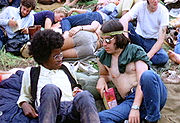
Hippie
The hippie subculture was originally a youth movement that arose in the United States during the mid-1960s and spread to other countries around the world. The etymology of the term 'hippie' is from hipster, and was initially used to describe beatniks who had moved into San Francisco's...
, especially the idealistic young people who gathered in San Francisco and environs during the 1967 Summer of Love
Summer of Love
The Summer of Love was a social phenomenon that occurred during the summer of 1967, when as many as 100,000 people converged on the Haight-Ashbury neighborhood of San Francisco, creating a cultural and political rebellion...
. It was the custom of "flower children" to wear and distribute flower
Flower
A flower, sometimes known as a bloom or blossom, is the reproductive structure found in flowering plants . The biological function of a flower is to effect reproduction, usually by providing a mechanism for the union of sperm with eggs...
s or floral-themed decorations to symbolize altruistic ideals of universal brotherhood, peace
Peace
Peace is a state of harmony characterized by the lack of violent conflict. Commonly understood as the absence of hostility, peace also suggests the existence of healthy or newly healed interpersonal or international relationships, prosperity in matters of social or economic welfare, the...
and love
Love
Love is an emotion of strong affection and personal attachment. In philosophical context, love is a virtue representing all of human kindness, compassion, and affection. Love is central to many religions, as in the Christian phrase, "God is love" or Agape in the Canonical gospels...
. The mass media picked up on the term and used it to refer in a broad sense to any hippie. Flower children were also associated with the flower power
Flower power
Flower power is a slogan used by the American counterculture movement during the late 1960s and early 1970s as a symbol of passive resistance and non-violence ideology. It is rooted in the opposition movement to the Vietnam War. The expression was coined by the American Beat poet Allen Ginsberg in...
political movement, which originated in ideas written by Allen Ginsberg
Allen Ginsberg
Irwin Allen Ginsberg was an American poet and one of the leading figures of the Beat Generation in the 1950s. He vigorously opposed militarism, materialism and sexual repression...
in 1965.
San Francisco
Scott McKenzie
Scott McKenzie is an American singer. He is best known for his 1967 hit single and generational anthem, "San Francisco ".-Life and career:...
's rendition of the song
Song
In music, a song is a composition for voice or voices, performed by singing.A song may be accompanied by musical instruments, or it may be unaccompanied, as in the case of a cappella songs...
"San Francisco (Be Sure to Wear Flowers in Your Hair)
San Francisco (Be Sure to Wear Flowers in Your Hair)
"San Francisco " is a song, written by John Phillips of The Mamas & the Papas, and sung by Scott McKenzie. It was written and released in 1967 to promote the Monterey Pop Festival....
" was released in May 1967. The song was written by John Phillips
John Phillips (musician)
John Edmund Andrew Phillips , was an American singer, guitarist, songwriter and promoter . Known as Papa John, Phillips was a member and leader of the singing group The Mamas & the Papas...
to promote the June 1967 Monterey Pop Festival
Monterey Pop Festival
The Monterey International Pop Music Festival was a three-day concert event held June 16 to June 18, 1967 at the Monterey County Fairgrounds in Monterey, California...
, and it urged visitors to San Francisco
San Francisco, California
San Francisco , officially the City and County of San Francisco, is the financial, cultural, and transportation center of the San Francisco Bay Area, a region of 7.15 million people which includes San Jose and Oakland...
to "wear some flowers in your hair", in keeping with the festival's billing as "three days of music, love, and flowers":
If you're going to San Francisco,
be sure to wear some flowers in your hair...
If you come to San Francisco,
Summertime will be a love-in there.
"San Francisco" became an instant hit (#4 in the United States, #1 in the U.K.) and quickly transcended its original purpose.
Summer of Love
After the January 14 Human Be-InHuman Be-In
The Human Be-In was a happening in San Francisco's Golden Gate Park, the afternoon and evening of January 14, 1967. It was a prelude to San Francisco's Summer of Love, which made the Haight-Ashbury district a symbol as the center of an American counterculture and introduced the word 'psychedelic'...
organized by artist Michael Bowen
Michael Bowen (artist)
Michael Bowen was an American fine artist known as one of the co-founders of the late 20th and 21st century Visionary art movements...
(among other things, announcements told participants to bring flowers), as many as 100,000 young people from all over the world flocked to San Francisco's Haight-Ashbury
Haight-Ashbury, San Francisco, California
Haight-Ashbury is a district of San Francisco, California, named for the intersection of Haight and Ashbury streets. It is also called The Haight and The Upper Haight.-Location:...
district, Berkeley
Berkeley, California
Berkeley is a city on the east shore of the San Francisco Bay in Northern California, United States. Its neighbors to the south are the cities of Oakland and Emeryville. To the north is the city of Albany and the unincorporated community of Kensington...
, and other Bay Area
San Francisco Bay Area
The San Francisco Bay Area, commonly known as the Bay Area, is a populated region that surrounds the San Francisco and San Pablo estuaries in Northern California. The region encompasses metropolitan areas of San Francisco, Oakland, and San Jose, along with smaller urban and rural areas...
cities during the Summer of Love.http://www.net.info.nl/cohen/ in search of different value systems and experiences. The Summer of Love
Summer of Love
The Summer of Love was a social phenomenon that occurred during the summer of 1967, when as many as 100,000 people converged on the Haight-Ashbury neighborhood of San Francisco, creating a cultural and political rebellion...
became a watershed event in the development of a worldwide 1960s counterculture when newly-recruited Flower Children returned home at the end of the summer, taking with them new styles, ideas, and behaviors and introducing them in all major U.S. and Western European cities.
Flowers and politics
The term achieved shades of political meaning when San Francisco Bay Area Flower Children gathered in Berkeley, CaliforniaBerkeley, California
Berkeley is a city on the east shore of the San Francisco Bay in Northern California, United States. Its neighbors to the south are the cities of Oakland and Emeryville. To the north is the city of Albany and the unincorporated community of Kensington...
in April 1969 to participate in the planting of flowers, shrubs, grass, and trees during the building of People's Park
People's Park (Berkeley)
People's Park in Berkeley, California, USA, is a park off Telegraph Avenue, bounded by Haste and Bowditch streets and Dwight Way, near the University of California, Berkeley. The park was created during the radical political activism of the late 1960s....
. After authorities destroyed People's Park and installed an 8 ft (2.4 m) tall chain-link wire fence around its perimeter, planting flowers became a symbol of peaceful resistance.
In the October 21, 1967 march on the Pentagon, protesters were quickly surrounded by Federal troops. Actor George Harris
Hibiscus (entertainer)
Hibiscus was one of the leaders of the psychedelic gay liberation theatre collective group known as the Cockettes in early 1970s San Francisco; in today's theatrical parlance he would be considered to be a "Creative Director".-Early life:Harris was born in Bronxville, New York in 1949 to George...
put flowers in the barrels of the soldiers' guns. Photographer Bernie Boston snapped a picture which has become a familiar image of the 1960s antiwar movement. Inspired by Harris' idealistic gesture, protesters at Kent State University
Kent State University
Kent State University is a public research university located in Kent, Ohio, United States. The university has eight campuses around the northeast Ohio region with the main campus in Kent being the largest...
three years later were still putting flowers in National Guardsmen's guns.
See also
- HippieHippieThe hippie subculture was originally a youth movement that arose in the United States during the mid-1960s and spread to other countries around the world. The etymology of the term 'hippie' is from hipster, and was initially used to describe beatniks who had moved into San Francisco's...
- Love beadsLove beadsLove beads are one of the traditional accessories of hippies. They consist of one or more long strings of beads, frequently handmade, worn about the neck by both genders...
- Summer of LoveSummer of LoveThe Summer of Love was a social phenomenon that occurred during the summer of 1967, when as many as 100,000 people converged on the Haight-Ashbury neighborhood of San Francisco, creating a cultural and political rebellion...
- Counterculture of the 1960sCounterculture of the 1960sThe counterculture of the 1960s refers to a cultural movement that mainly developed in the United States and spread throughout much of the western world between 1960 and 1973. The movement gained momentum during the U.S. government's extensive military intervention in Vietnam...
- Carnation RevolutionCarnation RevolutionThe Carnation Revolution , also referred to as the 25 de Abril , was a military coup started on 25 April 1974, in Lisbon, Portugal, coupled with an unanticipated and extensive campaign of civil resistance...