


Fire classes

Encyclopedia
| American | European | Australian/Asian | Fuel/Heat source |
|---|---|---|---|
| Class A | Class A | Class A | Ordinary combustibles |
| Class B | Class B | Class B | Flammable liquids |
| Class C | Class C | Flammable gases | |
| Class C | UNCLASSIFIED | Class E | Electrical equipment |
| Class D | Class D | Class D | Combustible metals |
| Class K | Class F | Class F | Cooking oil or fat |
In firefighting, fires are identified according to one or more fire classes. Each class designates the fuel involved in the fire, and thus the most appropriate extinguishing agent
Fire control
control of fire 'control of fire' is the practice of reducing the heat output of a fire, or reducing the area over which the fire exists, or suppressing or extinguishing the fire by depriving a fire of fuel, oxygen or heat ....
. The classifications allow selection of extinguishing agents along lines of effectiveness at putting the type of fire out, as well as avoiding unwanted side-effects. For example, non-conductive
Electrical conductor
In physics and electrical engineering, a conductor is a material which contains movable electric charges. In metallic conductors such as copper or aluminum, the movable charged particles are electrons...
extinguishing agents are rated for electrical fires, so to avoid electrocuting the firefighter
Firefighter
Firefighters are rescuers extensively trained primarily to put out hazardous fires that threaten civilian populations and property, to rescue people from car incidents, collapsed and burning buildings and other such situations...
.
Multiple classification systems exist, with different designations for the various classes of fire. The United States
United States
The United States of America is a federal constitutional republic comprising fifty states and a federal district...
uses the NFPA
National Fire Protection Association
The National Fire Protection Association is a United States trade association that creates and maintains private, copywrited, standards and codes for usage and adoption by local governments...
system. Europe
Europe
Europe is, by convention, one of the world's seven continents. Comprising the westernmost peninsula of Eurasia, Europe is generally 'divided' from Asia to its east by the watershed divides of the Ural and Caucasus Mountains, the Ural River, the Caspian and Black Seas, and the waterways connecting...
use the European Standard "Classification of fires" (EN 2:1992, incorporatiing amendment A1:2004). Australasia
Australasia
Australasia is a region of Oceania comprising Australia, New Zealand, the island of New Guinea, and neighbouring islands in the Pacific Ocean. The term was coined by Charles de Brosses in Histoire des navigations aux terres australes...
use another.
Ordinary combustibles
"Ordinary combustible" fires are the most common type of fire, and are designated Class A under both systems. These occur when a solid, organic material such as woodWood
Wood is a hard, fibrous tissue found in many trees. It has been used for hundreds of thousands of years for both fuel and as a construction material. It is an organic material, a natural composite of cellulose fibers embedded in a matrix of lignin which resists compression...
, cloth, rubber
Rubber
Natural rubber, also called India rubber or caoutchouc, is an elastomer that was originally derived from latex, a milky colloid produced by some plants. The plants would be ‘tapped’, that is, an incision made into the bark of the tree and the sticky, milk colored latex sap collected and refined...
, or some plastic
Plastic
A plastic material is any of a wide range of synthetic or semi-synthetic organic solids used in the manufacture of industrial products. Plastics are typically polymers of high molecular mass, and may contain other substances to improve performance and/or reduce production costs...
s become heated to their ignition point. At this point the material undergoes combustion
Combustion
Combustion or burning is the sequence of exothermic chemical reactions between a fuel and an oxidant accompanied by the production of heat and conversion of chemical species. The release of heat can result in the production of light in the form of either glowing or a flame...
and will continue burning as long as the four components of the fire tetrahedron (heat, fuel, oxygen, and the sustaining chemical reaction) are available.
This class of fire is commonly used in controlled circumstances, such as a campfire
Campfire
A campfire is a fire lit at a campsite, to serve the following functions: light, warmth, a beacon, a bug and/or apex predator deterrent, to cook, and for a psychological sense of security. In established campgrounds they are usually in a fire ring for safety. Campfires are a popular feature of...
, match
Match
A match is a tool for starting a fire under controlled conditions. A typical modern match is made of a small wooden stick or stiff paper. One end is coated with a material that can be ignited by frictional heat generated by striking the match against a suitable surface...
or wood-burning stove
Stove
A stove is an enclosed heated space. The term is commonly taken to mean an enclosed space in which fuel is burned to provide heating, either to heat the space in which the stove is situated or to heat the stove itself, and items placed on it...
. To use the campfire as an example, it has a fire tetrahedron—the heat is provided by another fire (such as a match or lighter), the fuel is the wood
Wood
Wood is a hard, fibrous tissue found in many trees. It has been used for hundreds of thousands of years for both fuel and as a construction material. It is an organic material, a natural composite of cellulose fibers embedded in a matrix of lignin which resists compression...
, the oxygen is naturally available in the open-air environment of a forest, and the chemical reaction links the three other facets. This fire is not dangerous, because the fire is contained to the wood alone and is usually isolated from other flammable materials, for example by bare ground and rocks. However, when a class-A fire burns in a less-restricted environment the fire can quickly grow out of control and become a wildfire
Wildfire
A wildfire is any uncontrolled fire in combustible vegetation that occurs in the countryside or a wilderness area. Other names such as brush fire, bushfire, forest fire, desert fire, grass fire, hill fire, squirrel fire, vegetation fire, veldfire, and wilkjjofire may be used to describe the same...
. This is the case when firefighting and fire control
Fire control
control of fire 'control of fire' is the practice of reducing the heat output of a fire, or reducing the area over which the fire exists, or suppressing or extinguishing the fire by depriving a fire of fuel, oxygen or heat ....
techniques are required.
This class of fire is fairly simple to fight and contain—by simply removing the heat, oxygen, or fuel, or by suppressing the underlying chemical reaction, the fire tetrahedron collapses and the fire dies out. The most common way to do this is by removing heat by spraying the burning material with water
Water
Water is a chemical substance with the chemical formula H2O. A water molecule contains one oxygen and two hydrogen atoms connected by covalent bonds. Water is a liquid at ambient conditions, but it often co-exists on Earth with its solid state, ice, and gaseous state . Water also exists in a...
; oxygen can be removed by smothering the fire with foam from a fire extinguisher
Fire extinguisher
A fire extinguisher or extinguisher, flame entinguisher is an active fire protection device used to extinguish or control small fires, often in emergency situations...
; forest fires are often fought by removing fuel by backburning; and an ammonium phosphate
Ammonium phosphate
Ammonium phosphate is the salt of ammonia and phosphoric acid. It has the formula 3PO4 and consists of ammonium cations and phosphate anion. It is obtained as a crystalline powder upon mixing concentrated solutions of ammonia and phosphoric acid, or on the addition of excess of ammonia to the...
dry chemical powder fire extinguisher (but not sodium bicarbonate
Sodium bicarbonate
Sodium bicarbonate or sodium hydrogen carbonate is the chemical compound with the formula Na HCO3. Sodium bicarbonate is a white solid that is crystalline but often appears as a fine powder. It has a slightly salty, alkaline taste resembling that of washing soda . The natural mineral form is...
or potassium bicarbonate
Potassium bicarbonate
Potassium bicarbonate , is a colorless, odorless, slightly basic, salty substance...
both of which are rated for B-class fires) breaks the fire's underlying chemical reaction.
As these fires are the most commonly encountered, most fire departments have equipment to handle them specifically. While this is acceptable for most ordinary conditions, most firefighters find themselves having to call for special equipment such as foam
Foam
-Definition:A foam is a substance that is formed by trapping gas in a liquid or solid in a divided form, i.e. by forming gas regions inside liquid regions, leading to different kinds of dispersed media...
in the case of other fires.
Flammable liquid and gas
These are fires whose fuel is flammable or combustible liquid or gas. The US system designates all such fires "Class B". In the European/Australian system, flammable liquids are designated "Class B", while burning gases are separately designated "Class C". These fires follow the same basic fire tetrahedron (heat, fuel, oxygen, chemical reaction) as ordinary combustible fires, except that the fuel in question is a flammable liquid such as gasoline, or gas such as natural gasNatural gas
Natural gas is a naturally occurring gas mixture consisting primarily of methane, typically with 0–20% higher hydrocarbons . It is found associated with other hydrocarbon fuel, in coal beds, as methane clathrates, and is an important fuel source and a major feedstock for fertilizers.Most natural...
. A solid stream of water should never be used to extinguish this type because it can cause the fuel to scatter, spreading the flames. The most effective way to extinguish a liquid or gas fueled fire is by inhibiting the chemical chain reaction of the fire, which is done by dry chemical and Halon
Halon
Halon can refer to:* Haloalkane, or halogenoalkane, a group of chemical compounds consisting of alkanes with linked halogens. In particular, bromine-containing haloalkanes.* Halomethane fire extinguishing systems...
extinguishing agents, although smothering with CO2 or, for liquids, foam is also effective. Halon has fallen out of favor in recent times because it is an ozone-depleting material; the Montreal Protocol declares that Halon
Halon
Halon can refer to:* Haloalkane, or halogenoalkane, a group of chemical compounds consisting of alkanes with linked halogens. In particular, bromine-containing haloalkanes.* Halomethane fire extinguishing systems...
should no longer be used. Chemicals such as FM-200 are now the recommended halogenated suppressant. Some newer clean agents designed to replace halon work by cooling the liquid below its flash point, but these have limited class B effect
Electrical
Electrical fires are fires involving potentially energized electricalElectricity
Electricity is a general term encompassing a variety of phenomena resulting from the presence and flow of electric charge. These include many easily recognizable phenomena, such as lightning, static electricity, and the flow of electrical current in an electrical wire...
equipment. The US system designates these "Class C"; the Australian system designates them "Class E". This sort of fire may be caused by, for example, short-circuiting machinery or overloaded electrical cables. These fires can be a severe hazard to firefighters using water or other conductive agents: Electricity may be conducted from the fire, through water, the firefighter's body, and then earth. Electrical shocks have caused many firefighter deaths.
Electrical fire may be fought in the same way as an ordinary combustible fire, but water, foam, and other conductive agents are not to be used. While the fire is, or could possibly be electrically energized, it can be fought with any extinguishing agent rated for electrical fire. Carbon dioxide
Carbon dioxide
Carbon dioxide is a naturally occurring chemical compound composed of two oxygen atoms covalently bonded to a single carbon atom...
CO2, FM-200 and dry chemical powder extinguishers such as PKP
Purple-K
Purple-K is a dry-chemical fire suppression agent used in some dry powder fire extinguishers. It is the most effective dry chemical in fighting class B fires, and can be used against some energized electrical equipment fires...
and even baking soda are especially suited to extinguishing this sort of fire. PKP should be a last resort solution to extinguishing the fire due to its corrosive tendencies. Once electricity is shut off to the equipment involved, it will generally become an ordinary combustible fire.
Metal
Certain metals are flammable or combustible. Fires involving such are designated "Class D" in both systems. Examples of such metals include sodiumSodium
Sodium is a chemical element with the symbol Na and atomic number 11. It is a soft, silvery-white, highly reactive metal and is a member of the alkali metals; its only stable isotope is 23Na. It is an abundant element that exists in numerous minerals, most commonly as sodium chloride...
, titanium
Titanium
Titanium is a chemical element with the symbol Ti and atomic number 22. It has a low density and is a strong, lustrous, corrosion-resistant transition metal with a silver color....
, magnesium
Magnesium
Magnesium is a chemical element with the symbol Mg, atomic number 12, and common oxidation number +2. It is an alkaline earth metal and the eighth most abundant element in the Earth's crust and ninth in the known universe as a whole...
, potassium
Potassium
Potassium is the chemical element with the symbol K and atomic number 19. Elemental potassium is a soft silvery-white alkali metal that oxidizes rapidly in air and is very reactive with water, generating sufficient heat to ignite the hydrogen emitted in the reaction.Potassium and sodium are...
, uranium
Uranium
Uranium is a silvery-white metallic chemical element in the actinide series of the periodic table, with atomic number 92. It is assigned the chemical symbol U. A uranium atom has 92 protons and 92 electrons, of which 6 are valence electrons...
, lithium
Lithium
Lithium is a soft, silver-white metal that belongs to the alkali metal group of chemical elements. It is represented by the symbol Li, and it has the atomic number 3. Under standard conditions it is the lightest metal and the least dense solid element. Like all alkali metals, lithium is highly...
, plutonium
Plutonium
Plutonium is a transuranic radioactive chemical element with the chemical symbol Pu and atomic number 94. It is an actinide metal of silvery-gray appearance that tarnishes when exposed to air, forming a dull coating when oxidized. The element normally exhibits six allotropes and four oxidation...
, and calcium
Calcium
Calcium is the chemical element with the symbol Ca and atomic number 20. It has an atomic mass of 40.078 amu. Calcium is a soft gray alkaline earth metal, and is the fifth-most-abundant element by mass in the Earth's crust...
. Magnesium and titanium fires are common. When one of these combustible metals ignites, it can easily and rapidly spread to surrounding ordinary combustible materials.
With the exception of the metals that burn in contact with air or water (for example, sodium), masses of combustible metals do not represent unusual fire risks because they have the ability to conduct heat away from hot spots so efficiently that the heat of combustion cannot be maintained—this means that it will require a lot of heat to ignite a mass of combustible metal. Generally, metal fire risks exist when sawdust, machine shavings and other metal 'fines' are present. Generally, these fires can be ignited by the same types of ignition sources that would start other common fires.
Water and other common firefighting materials can excite metal fires and make them worse. The NFPA recommends that metal fires be fought with "dry powder" extinguishing agents. Dry powder agents work by smothering and heat absorption. The most common of these agents are sodium chloride
Sodium chloride
Sodium chloride, also known as salt, common salt, table salt or halite, is an inorganic compound with the formula NaCl. Sodium chloride is the salt most responsible for the salinity of the ocean and of the extracellular fluid of many multicellular organisms...
granules and graphite
Graphite
The mineral graphite is one of the allotropes of carbon. It was named by Abraham Gottlob Werner in 1789 from the Ancient Greek γράφω , "to draw/write", for its use in pencils, where it is commonly called lead . Unlike diamond , graphite is an electrical conductor, a semimetal...
powder. In recent years powdered copper
Copper
Copper is a chemical element with the symbol Cu and atomic number 29. It is a ductile metal with very high thermal and electrical conductivity. Pure copper is soft and malleable; an exposed surface has a reddish-orange tarnish...
has also come into use.
Some extinguishers are labeled as containing dry chemical extinguishing agents. This may be confused with dry powder. The two are not the same. Using one of these extinguishers in error, in place of dry powder, can be ineffective or actually increase the intensity of a metal fire.
Metal fires represent a unique hazard because people are often not aware of the characteristics of these fires and are not properly prepared to fight them. Therefore, even a small metal fire can spread and become a larger fire in the surrounding ordinary combustible materials.
Cooking oils and fats (kitchen fires)
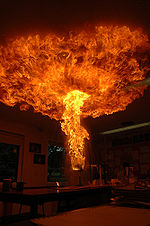
Cooking oil
Cooking oil is purified fat of plant origin, which is usually liquid at room temperature ....
s or fats are designated "Class K" under the American system, and "Class F" under the European/Australasian systems. Though such fires are technically a subclass of the flammable liquid/gas class, the special characteristics of these types of fires are considered important enough to recognize separately. Saponification
Saponification
Saponification is a process that produces soap, usually from fats and lye. In technical terms, saponification involves base hydrolysis of triglycerides, which are esters of fatty acids, to form the sodium salt of a carboxylate. In addition to soap, such traditional saponification processes...
can be used to extinguish such fires. Appropriate fire extinguishers may also have hoods over them that help extinguish the fire.
External links
- Classification of Portable Fire Extinguishers, Occupational Safety and Health AdministrationOccupational Safety and Health AdministrationThe United States Occupational Safety and Health Administration is an agency of the United States Department of Labor. It was created by Congress of the United States under the Occupational Safety and Health Act, signed by President Richard M. Nixon, on December 29, 1970...
- Evacuation Plans and Procedures eTool, Occupational Safety and Health AdministrationOccupational Safety and Health AdministrationThe United States Occupational Safety and Health Administration is an agency of the United States Department of Labor. It was created by Congress of the United States under the Occupational Safety and Health Act, signed by President Richard M. Nixon, on December 29, 1970...
- Information on Fire Extinguishers, The Fire Safety Advice Centre
- For Fire Extinguishers, Wollongong Extinguisher Service-Australia