

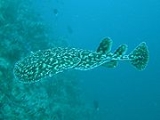
Electric ray

Encyclopedia
The electric rays are a group of rays, flattened cartilaginous fish with enlarged pectoral fins, comprising the order Torpediniformes. They are known for being capable of producing an electric discharge
, ranging from as little as 8 volt
s up to 220 volt
s depending on species, used to stun prey and for defense. There are 69 species in four families.
Perhaps the best known members are those of the genus
Torpedo
, also called crampfish and numbfish, after which the device called a torpedo
is named. The name comes from the Latin
torpere, to be stiffened or paralyzed, referring to the effect on someone who handles or steps on a living electric ray.
With their thick, flabby bodies and short tails, torpedo rays are poor swimmers. Their disk-shaped bodies allow them to remain suspended in the water or roam with minimal swimming
effort.
s (reduced in some narkids), and a stout, muscular tail with a well-developed caudal fin. The body is thick and flabby, with soft, loose skin devoid of dermal denticles and thorns. A pair of kidney
-shaped electric organs are found at the base of the pectoral fins. The snout is broad, large in the Narcinidae but reduced in all other families. The mouth, nostril
s, and five pairs of gill slit
s are located underneath the disc.
Electric rays are found from shallow coastal waters down to at least 1000 metres (3,280.8 ft) depth. They are sluggish and slow moving, propelling themselves along with their tails, rather than using their disc-shaped bodies, as other rays do. They feed on invertebrates and small fish. They lie in wait for prey below the sand or other substrate, using their electricity to stun and capture it.
and operations. In his dialogue Meno
, Plato
has the character Meno accuse Socrates
of "stunning" people with his puzzling questions, in a manner similar to the way the torpedo fish stuns with electricity. Scribonius Largus
, a Roman physician, recorded the use of torpedo fish
for treatment of headache
s and gout
in his Compositiones Medicae of 46 AD. The torpedo fish, or electric ray, appears continuously in premodern natural histories as a magical creature, and its ability to numb fishermen without seeming to touch them was a significant source of evidence for the belief in occult qualities in nature during the ages before the discovery of electricity as an explanatory mode.
-powered hair dryer into a bathtub.
Electric discharge
Electric discharge describes any flow of electric charge through a gas, liquid or solid. Electric discharges include:*Electric glow discharge*Electric arc*Electrostatic discharge*Electric discharge in gases*Leader *Partial discharge...
, ranging from as little as 8 volt
Volt
The volt is the SI derived unit for electric potential, electric potential difference, and electromotive force. The volt is named in honor of the Italian physicist Alessandro Volta , who invented the voltaic pile, possibly the first chemical battery.- Definition :A single volt is defined as the...
s up to 220 volt
Volt
The volt is the SI derived unit for electric potential, electric potential difference, and electromotive force. The volt is named in honor of the Italian physicist Alessandro Volta , who invented the voltaic pile, possibly the first chemical battery.- Definition :A single volt is defined as the...
s depending on species, used to stun prey and for defense. There are 69 species in four families.
Perhaps the best known members are those of the genus
Genus
In biology, a genus is a low-level taxonomic rank used in the biological classification of living and fossil organisms, which is an example of definition by genus and differentia...
Torpedo
Torpedo (genus)
Torpedo is a genus of rays, commonly known as electric rays, torpedo rays, or torpedoes. It is the sole genus of the family Torpedinidae. They are slow-moving bottom-dwellers capable of generating electricity as a defense and feeding mechanism...
, also called crampfish and numbfish, after which the device called a torpedo
Torpedo
The modern torpedo is a self-propelled missile weapon with an explosive warhead, launched above or below the water surface, propelled underwater towards a target, and designed to detonate either on contact with it or in proximity to it.The term torpedo was originally employed for...
is named. The name comes from the Latin
Latin
Latin is an Italic language originally spoken in Latium and Ancient Rome. It, along with most European languages, is a descendant of the ancient Proto-Indo-European language. Although it is considered a dead language, a number of scholars and members of the Christian clergy speak it fluently, and...
torpere, to be stiffened or paralyzed, referring to the effect on someone who handles or steps on a living electric ray.
With their thick, flabby bodies and short tails, torpedo rays are poor swimmers. Their disk-shaped bodies allow them to remain suspended in the water or roam with minimal swimming
Aquatic locomotion
Swimming is biologically propelled motion through a liquid medium. Swimming has evolved a number of times in a range of organisms ranging from arthropods to fish to molluscs.-Evolution of swimming:...
effort.
Description
Electric rays have a rounded pectoral disc with two moderately large rounded-angular (not pointed or hooked) dorsal finDorsal fin
A dorsal fin is a fin located on the backs of various unrelated marine and freshwater vertebrates, including most fishes, marine mammals , and the ichthyosaurs...
s (reduced in some narkids), and a stout, muscular tail with a well-developed caudal fin. The body is thick and flabby, with soft, loose skin devoid of dermal denticles and thorns. A pair of kidney
Kidney
The kidneys, organs with several functions, serve essential regulatory roles in most animals, including vertebrates and some invertebrates. They are essential in the urinary system and also serve homeostatic functions such as the regulation of electrolytes, maintenance of acid–base balance, and...
-shaped electric organs are found at the base of the pectoral fins. The snout is broad, large in the Narcinidae but reduced in all other families. The mouth, nostril
Nostril
A nostril is one of the two channels of the nose, from the point where they bifurcate to the external opening. In birds and mammals, they contain branched bones or cartilages called turbinates, whose function is to warm air on inhalation and remove moisture on exhalation...
s, and five pairs of gill slit
Gill slit
Gill slits are individual openings to gills, i.e., multiple gill arches, which lack a single outer cover. Such gills are characteristic of Cartilaginous fish such as sharks, rays, sawfish, and guitarfish. Most of these have five pairs, but a few species have 6 or 7 pairs...
s are located underneath the disc.
Electric rays are found from shallow coastal waters down to at least 1000 metres (3,280.8 ft) depth. They are sluggish and slow moving, propelling themselves along with their tails, rather than using their disc-shaped bodies, as other rays do. They feed on invertebrates and small fish. They lie in wait for prey below the sand or other substrate, using their electricity to stun and capture it.
Relationship to humans
The electrogenic properties of electric rays have been known since antiquity. The ancient Greeks used electric rays to numb the pain of childbirthChildbirth
Childbirth is the culmination of a human pregnancy or gestation period with the birth of one or more newborn infants from a woman's uterus...
and operations. In his dialogue Meno
Meno
Meno is a Socratic dialogue written by Plato. It attempts to determine the definition of virtue, or arete, meaning virtue in general, rather than particular virtues, such as justice or temperance. The first part of the work is written in the Socratic dialectical style and Meno is reduced to...
, Plato
Plato
Plato , was a Classical Greek philosopher, mathematician, student of Socrates, writer of philosophical dialogues, and founder of the Academy in Athens, the first institution of higher learning in the Western world. Along with his mentor, Socrates, and his student, Aristotle, Plato helped to lay the...
has the character Meno accuse Socrates
Socrates
Socrates was a classical Greek Athenian philosopher. Credited as one of the founders of Western philosophy, he is an enigmatic figure known chiefly through the accounts of later classical writers, especially the writings of his students Plato and Xenophon, and the plays of his contemporary ...
of "stunning" people with his puzzling questions, in a manner similar to the way the torpedo fish stuns with electricity. Scribonius Largus
Scribonius Largus
Scribonius Largus was the court physician to the Roman emperor Claudius.About 47 AD, at the request of Gaius Julius Callistus, the emperor's freedman, he drew up a list of 271 prescriptions , most of them his own, although he acknowledged his indebtedness to his tutors, to friends and to the...
, a Roman physician, recorded the use of torpedo fish
Common torpedo
The common torpedo, ocellate torpedo, or eyed electric ray is a species of electric ray in the family Torpedinidae, found in the Mediterranean Sea and the eastern Atlantic Ocean from the Bay of Biscay to Angola. It is a benthic fish typically encountered over soft substrates in fairly shallow,...
for treatment of headache
Headache
A headache or cephalalgia is pain anywhere in the region of the head or neck. It can be a symptom of a number of different conditions of the head and neck. The brain tissue itself is not sensitive to pain because it lacks pain receptors. Rather, the pain is caused by disturbance of the...
s and gout
Gout
Gout is a medical condition usually characterized by recurrent attacks of acute inflammatory arthritis—a red, tender, hot, swollen joint. The metatarsal-phalangeal joint at the base of the big toe is the most commonly affected . However, it may also present as tophi, kidney stones, or urate...
in his Compositiones Medicae of 46 AD. The torpedo fish, or electric ray, appears continuously in premodern natural histories as a magical creature, and its ability to numb fishermen without seeming to touch them was a significant source of evidence for the belief in occult qualities in nature during the ages before the discovery of electricity as an explanatory mode.
Bioelectricity
The electric ray is known to be the most electro-sensitive of all animals. Their eyes are situated on the top of their head, resulting in poor vision that must be compensated for with the use of other senses, including the detection of electricity. Many species of rays and skates outside the family of the electric ray have electric organs located in the tail; however, the electric ray possesses two large electric organs on each side of its head, where current passes from the lower to the upper surface of the body. The organs are governed by four central nerves from each side of the electric lobe, or specialized brain lobe, which is of a different color from the rest of the brain. The main nerves branch repeatedly, then attach to the lower side of each plate in the batteries, which are composed of hexagonal columns, in honeycomb formation: each column consists of 140 to half a million gelatinous plates. In marine fish, these batteries are connected as a parallel circuit where freshwater batteries are found in series, transmitting discharges of higher voltage, as fresh water cannot conduct electricity as well as salt water. It is with such a battery that an average electric ray may electrocute larger prey with a current of up to 30 amperes and a voltage of 50 to 200 volts, a similar effect to dropping a mainsMains electricity
Mains is the general-purpose alternating current electric power supply. In the US, electric power is referred to by several names including household power, household electricity, powerline, domestic power, wall power, line power, AC power, city power, street power, and grid power...
-powered hair dryer into a bathtub.
Systematics
There are over 60 species of electric rays, grouped into 12 genera and 3 families. The torpedinids feed on large prey, which are stunned using their electric organs and swallowed whole, while the narcinids specialize on small prey on or in the bottom substrate. Both groups use electricity for defense, but it is unclear whether the narcinids use electricity in feeding.- Family NarcinidaeNarcinidaeThe numbfishes are a group of electric rays in the family Narcinidae. They are bottom-dwelling cartilaginous fishes with large, rounded pectoral fin discs and long tails...
(numbfishes)- Subfamily Narcininae
- Genus BenthobatisBenthobatisBenthobatis is a genus of fish in the Narcinidae family.It contains the following species:* Benthobatis kreffti Rincón, Stehmann & Vooren, 2001 * Benthobatis marcida Bean & Weed, 1909...
- Genus DiplobatisDiplobatisDiplobatis is a genus of electric rays in the family Narcinidae.-Species:* Diplobatis colombiensis Fechhelm & McEachran, 1984 * Diplobatis guamachensis Martín Salazar, 1957...
- Genus DiscopygeDiscopygeThe genus Discopyge, the apron rays is a small genus of fish in the family Narcinidae. It currently contains two species:* Discopyge castelloi Menni, Rincón & M. L. Garcia, 2008* Discopyge tschudii Heckel, 1846...
- Genus NarcineNarcineNarcine is a genus of small electric rays in the family Narcinidae.-Description:Narcine species have a rounded pectoral fin disc and two dorsal fins, the first usually smaller than the second and placed behind the pelvic fin bases. The tail is longer than the disc and has a lateral fold...
- Genus Benthobatis
- Subfamily Narkinae (sleeper rays)
- Genus Crassinarke
- Genus ElectroluxElectrolux addisoniElectrolux addisoni is a species of electric ray and the only member of the genus Electrolux. It lives on reefs feeding on polychaete worms and small crustaceans, it has only been seen by divers to feed during the daytime. It is endemic to the coast of South Africa. It was first recorded in 1984...
- Genus HeteronarceHeteronarceThe genus Heteronarce is a genus of sleeper rays in the family Narkidae. This genus is found only in the western Indian Ocean along the coasts of Africa, the Arabian Peninsula and India...
- Genus NarkeNarke (genus)Narke is a genus of electric rays, classified in the family Narkidae.-Species:* Narke capensis * Narke dipterygia...
- Genus TemeraFinless sleeper rayThe finless sleeper ray is a little-known species of sleeper ray in the family Narkidae, and the sole member of its genus. It is found over the continental shelf off Southeast Asia, from the eastern Andaman Sea to Vietnam and Borneo. Typically growing no more than long, it may be the smallest...
- Genus Typhlonarke
- Subfamily Narcininae
- Family Torpedinidae (torpedo electric rays)
- Subfamily Hypninae (coffin rays)
- Genus Hypnos
- Subfamily Torpedininae
- Genus TorpedoTorpedo (genus)Torpedo is a genus of rays, commonly known as electric rays, torpedo rays, or torpedoes. It is the sole genus of the family Torpedinidae. They are slow-moving bottom-dwellers capable of generating electricity as a defense and feeding mechanism...
- Genus Torpedo
- Subfamily Hypninae (coffin rays)