

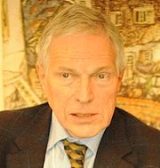
Edmund Phelps

Encyclopedia
Edmund Strother Phelps, Jr. (born July 26, 1933) is an American economist and the winner of the 2006 Bank of Sweden Prize in Economic Sciences in Memory of Alfred Nobel
. Early in his career he became renowned for his research at Yale
's Cowles Foundation in the first half of the 1960s on the sources of economic growth. His demonstration of the Golden rule savings rate
, a concept first devised by John von Neumann
and Maurice Allais
, started a wave of research on how much a nation ought to spend on present consumption rather than save and invest for future generations. His most seminal work inserted a microfoundation—one featuring imperfect information, incomplete knowledge and expectations about wages and prices—to support a macroeconomic theory of employment determination and price-wage dynamics. This led to his development of the natural rate of unemployment
—its existence and the mechanism governing its size.
Phelps has been McVickar Professor of Political Economy at Columbia University
since 1982. He is also the director of Columbia's Center on Capitalism and Society.
, and moved with his family to Hastings-on-Hudson, New York
when he was six years old, where he spent his school years. In 1951, he went to Amherst College
for his undergraduate education. At his father's advice, Phelps enrolled in his first economics
course in his second year at Amherst. James Nelson
gave the course, which was based on the famous textbook by Paul Samuelson
. Phelps was strongly impressed with the possibility of applying formal analysis to one of his old interests: business. He quickly became aware of an important unsolved problem with the existing theory, and the existing gap between microeconomics and macroeconomics.
After receiving his B.A.
at Amherst in 1955, Phelps went to Yale University
for graduate studies. While at Yale he studied under future Nobel prize winners James Tobin
and Thomas Schelling
, among others. Phelps was also strongly influenced by William Fellner and Henry Wallich
, whose courses emphasized the expectations of agents. Phelps received his Ph.D.
from Yale in 1959.
, while also teaching at Yale. While at the Cowles Foundation, his research focused mainly on neo-classical growth theory
, following the seminal work of Solow
. As part of this research, in 1961 Phelps published a famous paper on the Golden Rule savings rate
, one of his major contributions to economic science. He also wrote papers dealing with other areas of economic theory, such as monetary economics or Ricardian equivalence
and its relation to optimal growth.
His position at Cowles gave Phelps the chance to interact with Arthur Okun and other notables in the field. He was able to collaborate with other top economists working on growth theory, including David Cass
and fellow Nobelist Tjalling Koopmans
. During the academic year 1962-63 Phelps visited MIT
, where he was in contact with future Nobel prize winners Paul Samuelson
, Robert Solow
and Franco Modigliani
.
In 1966, Phelps left Yale and moved to University of Pennsylvania
, where he was offered a tenure
d position as professor of economics. While at Penn, Phelps' research focused mainly on the link between employment
, wage
setting and inflation
, leading to his influential 1968 paper "Money-Wage Dynamics and Labor Market Equilibrium". This research contributed important insights in the microeconomics of the Phillips curve
, including the role of expectations (in the form of adaptive expectations
) and imperfect information
in the setting of wages and prices. It also introduced the concept of the natural rate of unemployment and argued that labor market equilibrium is independent of the rate of inflation, thus there is no long run tradeoff between unemployment and inflation. This observation, if accurate, would have the crucial implication that the Keynesian policy
of demand management has only transitory effects and cannot be used to control the long run rate of unemployment in the economy. In January 1969, Phelps organized a conference at Penn in support of the research on the micro-foundations of inflation and employment determination. The conference papers were published the next year in a book which had a strong and lasting influence, becoming known as the "Phelps volume". During this period, along with the research on the Phillips curve, Phelps also collaborated with other economists on research regarding economic growth, the effects of monetary and fiscal policy and optimal population growth
.
In the following years, an element in Phelps's foundations came under heavy criticism with the introduction of Muth
's rational expectations
, which was popularized by future Nobel prize winner Robert Lucas, Jr.
. Phelps, with Calvo and John Taylor, started a program to rebuild Keynesian economics with rational expectations by employing sticky wages and prices
. They achieved this by explicitly incorporating in models the fact that wage contracts are set in advance for multiple periods, an idea originating from Phelps' 1968 paper. This research lead to a paper published with John Taylor in 1977, proving that staggered wage setting gives monetary policy a role in stabilizing economic fluctuations. The use of staggered wage and price setting, further developed by Calvo in a 1983 paper, became a cornerstone of New Keynesian economics
. During the '70s, Phelps and Calvo also collaborated on research regarding optimal contracts under asymmetric information.
Phelps spent the year 1969-1970 at the Center for Advanced Study in Behavioral Science at Stanford University
. Discussions with fellow Nobel prize winners Amartya Sen
and Kenneth Arrow
, and especially the influence of the philosophy
of John Rawls
, whom he met during the year at the Center, led Phelps to undertake some research outside macroeconomics. As a result, in 1972 he published seminal research in the new field he named statistical discrimination
. He also published research on economic justice, applying ideas from Rawls' book A Theory of Justice
.
In 1971, Phelps moved to the Economics Department at Columbia University
, which also included future Nobel prize winners William Vickrey
and James J. Heckman (future laureate Robert Mundell
joined three years later), as well as Phoebus Dhrymes, Guillermo Calvo
and John B. Taylor
. There he published research on the inflation tax
and the impact of fiscal policy
on optimal inflation. In 1972, Phelps published a new book which focused on the derivation of policy implications of his new theory. The book further popularized his "expectations-augmented Phillips curve", and also, among other things, introduced the concept of hysteresis with regard to unemployment (prolonged unemployment is partially irreversible as workers lose skill and become demoralized).
In the late '70s, Phelps and one of his former students, Roman Frydman
, conducted some research on the implications of assuming rational expectations, first independently and then in collaboration. Their results suggested that rational expectations are not the correct way to model agents' expectations. They organized a conference on this issue in 1981 and published the proceedings in a 1983 book. However, as rational expectations were becoming the standard in macroeconomics, the book was initially received with hostility, and was largely ignored. The financial crisis of 2007, and the attendant failure of rational expectations models to predict it, led to a renewed interest in this work.
In 1982 Phelps was appointed the McVickar Professor of Political Economy at Columbia. During the early '80s he wrote an introductory textbook synthesizing the current economics knowledge. The book, Political Economy, was published in 1985, but had limited classroom adoption.
(where he spent most of his 1985-86 sabbatical and Observatoire Français des Conjonctures Économiques (OFCE). He became interested in the puzzle of the persistent high unemployment in Europe despite no let-up in inflation and published on this subject with Jean-Paul Fitoussi (the director of OFCE). Fitoussi, Jean-Paul and Edmund S. Phelps (1988). The Slump in Europe: Open Economy Theory Reconstructed. Basil Blackwell. Further study of the subject led Phelps to believe that it is not a transitory phenomenon, but rather the effect of changes in equilibrium unemployment. During the next years, Phelps tried to build a theory to determine endogenously
the natural rate of unemployment. He published partial research results in a 1994 book, Structural Slumps: The Modern Equilibrium Theory of Employment, Interest and Assets. Phelps also collaborated closely with Luigi Paganetto at the University of Rome Tor Vergata
and, between 1988–98, as co-organizers of the Villa Mondragone
International Seminar.
In 1990 Phelps took part in a mission from the then-forming EBRD to Moscow, where he and Kenneth Arrow
designed a proposal for the reform of the USSR
. After the EBRD was established, he became a member of its Economic Advisory Board, where he stayed until 1993. From work at EBRD and collaboration with his former student Roman Frydman, Phelps developed a strong interest in the Eastern Europe
an transition economies
.
Over the late 1980s and early 1990s, Phelps created a new non-monetary theory of employment in which business asset values drive the natural rate. This theory, first fully set out in his book Structural Slumps (1994), explains Europe’s slump without disinflation in the 1980s: the elevation of the world real rate of interest, declining opportunities for continuing technological catch-up and the mushrooming social wealth granted by Europe’s emerging welfare state play the main causal roles. Two sequel papers in 2000 and 2001 on the theory of ‘structural booms’ explained America’s inflationless expansion in the late 1990s and explicitly implied its transience. These and other papers develop the thesis that the great economic swings experienced by the West in the past century not only originate in non-monetary shocks but also operate fundamentally through non-monetary mechanisms.
In the mid-1990s his research turned to what he called economic inclusion. He published in 1997 a book for the general public, Rewarding Work, about the causes and cures of the joblessness and low wages among disadvantaged workers.
of the Consiglio Nazionale delle Ricerche in 1997-2000.
In 2001 he and Roman Frydman founded the Center on Capitalism & Society at Columbia (now a unit of Arts and Sciences) to promote and conduct research on capitalism.
In 2008, writing in the wake of the recession in the United States, Phelps wrote with disregard of the Keynesian resurgence
:
said Phelps' work had "deepened our understanding of the relation between short-run and long-run effects of economic policy."
In the year 2000, Phelps was made a Distinguished Fellow of the American Economic Association
. In February 2008, he was named Chevalier of France's Legion of Honor. Four months later he was given the Global Economy Prize of Kiel Institute for the World Economy
.
Nobel Prize
Nobel Memorial Prize in Economic Sciences
The Nobel Memorial Prize in Economic Sciences, commonly referred to as the Nobel Prize in Economics, but officially the Sveriges Riksbank Prize in Economic Sciences in Memory of Alfred Nobel , is an award for outstanding contributions to the field of economics, generally regarded as one of the...
. Early in his career he became renowned for his research at Yale
Yale University
Yale University is a private, Ivy League university located in New Haven, Connecticut, United States. Founded in 1701 in the Colony of Connecticut, the university is the third-oldest institution of higher education in the United States...
's Cowles Foundation in the first half of the 1960s on the sources of economic growth. His demonstration of the Golden rule savings rate
Golden Rule savings rate
In economics, the Golden Rule savings rate is the rate of savings which maximizes steady state level or growth of consumption , as for example in the Solow growth model...
, a concept first devised by John von Neumann
John von Neumann
John von Neumann was a Hungarian-American mathematician and polymath who made major contributions to a vast number of fields, including set theory, functional analysis, quantum mechanics, ergodic theory, geometry, fluid dynamics, economics and game theory, computer science, numerical analysis,...
and Maurice Allais
Maurice Allais
Maurice Félix Charles Allais was a French economist, and was the 1988 winner of the Nobel Memorial Prize in Economics "for his pioneering contributions to the theory of markets and efficient utilization of resources."...
, started a wave of research on how much a nation ought to spend on present consumption rather than save and invest for future generations. His most seminal work inserted a microfoundation—one featuring imperfect information, incomplete knowledge and expectations about wages and prices—to support a macroeconomic theory of employment determination and price-wage dynamics. This led to his development of the natural rate of unemployment
Natural rate of unemployment
The natural rate of unemployment is a concept of economic activity developed in particular by Milton Friedman and Edmund Phelps in the 1960s, both recipients of the Nobel prize in economics...
—its existence and the mechanism governing its size.
Phelps has been McVickar Professor of Political Economy at Columbia University
Columbia University
Columbia University in the City of New York is a private, Ivy League university in Manhattan, New York City. Columbia is the oldest institution of higher learning in the state of New York, the fifth oldest in the United States, and one of the country's nine Colonial Colleges founded before the...
since 1982. He is also the director of Columbia's Center on Capitalism and Society.
Early life and education
Phelps was born in Evanston, IllinoisEvanston, Illinois
Evanston is a suburban municipality in Cook County, Illinois 12 miles north of downtown Chicago, bordering Chicago to the south, Skokie to the west, and Wilmette to the north, with an estimated population of 74,360 as of 2003. It is one of the North Shore communities that adjoin Lake Michigan...
, and moved with his family to Hastings-on-Hudson, New York
Hastings-on-Hudson, New York
Hastings-on-Hudson is a village in Westchester County, New York, United States. It is located in the southwest part of the town of Greenburgh. As of the 2010 census, it had a population of 7,849. It lies on U.S. Route 9, "Broadway" in Hastings...
when he was six years old, where he spent his school years. In 1951, he went to Amherst College
Amherst College
Amherst College is a private liberal arts college located in Amherst, Massachusetts, United States. Amherst is an exclusively undergraduate four-year institution and enrolled 1,744 students in the fall of 2009...
for his undergraduate education. At his father's advice, Phelps enrolled in his first economics
Economics
Economics is the social science that analyzes the production, distribution, and consumption of goods and services. The term economics comes from the Ancient Greek from + , hence "rules of the house"...
course in his second year at Amherst. James Nelson
James Nelson
James "Jimmy" Nelson was a Scottish international footballer who played for Cardiff City and Newcastle United in the 1920s and 1930s and was the right back in the Wembley Wizards Scotland side of 1928.-Early years:...
gave the course, which was based on the famous textbook by Paul Samuelson
Paul Samuelson
Paul Anthony Samuelson was an American economist, and the first American to win the Nobel Memorial Prize in Economic Sciences. The Swedish Royal Academies stated, when awarding the prize, that he "has done more than any other contemporary economist to raise the level of scientific analysis in...
. Phelps was strongly impressed with the possibility of applying formal analysis to one of his old interests: business. He quickly became aware of an important unsolved problem with the existing theory, and the existing gap between microeconomics and macroeconomics.
After receiving his B.A.
Bachelor of Arts
A Bachelor of Arts , from the Latin artium baccalaureus, is a bachelor's degree awarded for an undergraduate course or program in either the liberal arts, the sciences, or both...
at Amherst in 1955, Phelps went to Yale University
Yale University
Yale University is a private, Ivy League university located in New Haven, Connecticut, United States. Founded in 1701 in the Colony of Connecticut, the university is the third-oldest institution of higher education in the United States...
for graduate studies. While at Yale he studied under future Nobel prize winners James Tobin
James Tobin
James Tobin was an American economist who, in his lifetime, served on the Council of Economic Advisors and the Board of Governors of the Federal Reserve System, and taught at Harvard and Yale Universities. He developed the ideas of Keynesian economics, and advocated government intervention to...
and Thomas Schelling
Thomas Schelling
Thomas Crombie Schelling is an American economist and professor of foreign affairs, national security, nuclear strategy, and arms control at the School of Public Policy at University of Maryland, College Park. He is also co-faculty at the New England Complex Systems Institute...
, among others. Phelps was also strongly influenced by William Fellner and Henry Wallich
Henry Wallich
Henry Christopher Wallich was an American economist and central banker. He was a professor of economics at Yale University and a member of the Council of Economic Advisors during the Dwight D. Eisenhower administration. He was an economic collumnist for Newsweek magazine, from 1965...
, whose courses emphasized the expectations of agents. Phelps received his Ph.D.
Ph.D.
A Ph.D. is a Doctor of Philosophy, an academic degree.Ph.D. may also refer to:* Ph.D. , a 1980s British group*Piled Higher and Deeper, a web comic strip*PhD: Phantasy Degree, a Korean comic series* PhD Docbook renderer, an XML renderer...
from Yale in 1959.
Research in the 1960s and 1970s
After receiving his Ph.D., Phelps went to work as an economist for the RAND Corporation. However, feeling he could not pursue macroeconomics (his main research interest) at RAND (which focused on defense work), Phelps decided to return to the academic world. So, the next year, in 1960, he took a research position at the Cowles FoundationCowles Foundation
The Cowles Commission for Research in Economics is an economic research institute, founded in Colorado Springs in 1932 by Alfred Cowles, a businessman and economist. In 1939, the Cowles Commission moved to the University of Chicago under the directorship of Theodore O. Yntema. Jacob Marschak took...
, while also teaching at Yale. While at the Cowles Foundation, his research focused mainly on neo-classical growth theory
Exogenous growth model
The neoclassical growth model, also known as the Solow–Swan growth model or exogenous growth model, is a class of economic models of long-run economic growth set within the framework of neoclassical economics...
, following the seminal work of Solow
Robert Solow
Robert Merton Solow is an American economist particularly known for his work on the theory of economic growth that culminated in the exogenous growth model named after him...
. As part of this research, in 1961 Phelps published a famous paper on the Golden Rule savings rate
Golden Rule savings rate
In economics, the Golden Rule savings rate is the rate of savings which maximizes steady state level or growth of consumption , as for example in the Solow growth model...
, one of his major contributions to economic science. He also wrote papers dealing with other areas of economic theory, such as monetary economics or Ricardian equivalence
Ricardian equivalence
The Ricardian equivalence proposition is an economic theory holding that consumers internalize the government's budget constraint: as a result, the timing of any tax change does not affect their change in spending...
and its relation to optimal growth.
His position at Cowles gave Phelps the chance to interact with Arthur Okun and other notables in the field. He was able to collaborate with other top economists working on growth theory, including David Cass
David Cass
David Cass was a professor of economics at the University of Pennsylvania, mostly known for his contributions to general equilibrium theory. His most famous work was on the Ramsey growth model, which is also known as the Ramsey-Cass-Koopmans model.-Biography:David Cass was born in 1937 in...
and fellow Nobelist Tjalling Koopmans
Tjalling Koopmans
Tjalling Charles Koopmans was the joint winner, with Leonid Kantorovich, of the 1975 Nobel Memorial Prize in Economic Sciences....
. During the academic year 1962-63 Phelps visited MIT
Massachusetts Institute of Technology
The Massachusetts Institute of Technology is a private research university located in Cambridge, Massachusetts. MIT has five schools and one college, containing a total of 32 academic departments, with a strong emphasis on scientific and technological education and research.Founded in 1861 in...
, where he was in contact with future Nobel prize winners Paul Samuelson
Paul Samuelson
Paul Anthony Samuelson was an American economist, and the first American to win the Nobel Memorial Prize in Economic Sciences. The Swedish Royal Academies stated, when awarding the prize, that he "has done more than any other contemporary economist to raise the level of scientific analysis in...
, Robert Solow
Robert Solow
Robert Merton Solow is an American economist particularly known for his work on the theory of economic growth that culminated in the exogenous growth model named after him...
and Franco Modigliani
Franco Modigliani
Franco Modigliani was an Italian economist at the MIT Sloan School of Management and MIT Department of Economics, and winner of the Nobel Memorial Prize in Economics in 1985.-Life and career:...
.
In 1966, Phelps left Yale and moved to University of Pennsylvania
University of Pennsylvania
The University of Pennsylvania is a private, Ivy League university located in Philadelphia, Pennsylvania, United States. Penn is the fourth-oldest institution of higher education in the United States,Penn is the fourth-oldest using the founding dates claimed by each institution...
, where he was offered a tenure
Tenure
Tenure commonly refers to life tenure in a job and specifically to a senior academic's contractual right not to have his or her position terminated without just cause.-19th century:...
d position as professor of economics. While at Penn, Phelps' research focused mainly on the link between employment
Employment
Employment is a contract between two parties, one being the employer and the other being the employee. An employee may be defined as:- Employee :...
, wage
Wage
A wage is a compensation, usually financial, received by workers in exchange for their labor.Compensation in terms of wages is given to workers and compensation in terms of salary is given to employees...
setting and inflation
Inflation
In economics, inflation is a rise in the general level of prices of goods and services in an economy over a period of time.When the general price level rises, each unit of currency buys fewer goods and services. Consequently, inflation also reflects an erosion in the purchasing power of money – a...
, leading to his influential 1968 paper "Money-Wage Dynamics and Labor Market Equilibrium". This research contributed important insights in the microeconomics of the Phillips curve
Phillips curve
In economics, the Phillips curve is a historical inverse relationship between the rate of unemployment and the rate of inflation in an economy. Stated simply, the lower the unemployment in an economy, the higher the rate of inflation...
, including the role of expectations (in the form of adaptive expectations
Adaptive expectations
In economics, adaptive expectations means that people form their expectations about what will happen in the future based on what has happened in the past...
) and imperfect information
Perfect information
In game theory, perfect information describes the situation when a player has available the same information to determine all of the possible games as would be available at the end of the game....
in the setting of wages and prices. It also introduced the concept of the natural rate of unemployment and argued that labor market equilibrium is independent of the rate of inflation, thus there is no long run tradeoff between unemployment and inflation. This observation, if accurate, would have the crucial implication that the Keynesian policy
Keynesian economics
Keynesian economics is a school of macroeconomic thought based on the ideas of 20th-century English economist John Maynard Keynes.Keynesian economics argues that private sector decisions sometimes lead to inefficient macroeconomic outcomes and, therefore, advocates active policy responses by the...
of demand management has only transitory effects and cannot be used to control the long run rate of unemployment in the economy. In January 1969, Phelps organized a conference at Penn in support of the research on the micro-foundations of inflation and employment determination. The conference papers were published the next year in a book which had a strong and lasting influence, becoming known as the "Phelps volume". During this period, along with the research on the Phillips curve, Phelps also collaborated with other economists on research regarding economic growth, the effects of monetary and fiscal policy and optimal population growth
Population growth
Population growth is the change in a population over time, and can be quantified as the change in the number of individuals of any species in a population using "per unit time" for measurement....
.
In the following years, an element in Phelps's foundations came under heavy criticism with the introduction of Muth
John Muth
-Legacy:It has hard to point to one substantial area of economic research into dynamic problems which has not changed as a result of the publication of Muth's works at GSIA. Almost paradoxically, the only viable alternative to Muth's hypothesis is the research agenda put forward by Herb Simon and...
's rational expectations
Rational expectations
Rational expectations is a hypothesis in economics which states that agents' predictions of the future value of economically relevant variables are not systematically wrong in that all errors are random. An alternative formulation is that rational expectations are model-consistent expectations, in...
, which was popularized by future Nobel prize winner Robert Lucas, Jr.
Robert Lucas, Jr.
Robert Emerson Lucas, Jr. is an American economist at the University of Chicago. He received the Nobel Prize in Economics in 1995 and is consistently indexed among the top 10 economists in the Research Papers in Economics rankings. He is married to economist Nancy Stokey.He received his B.A. in...
. Phelps, with Calvo and John Taylor, started a program to rebuild Keynesian economics with rational expectations by employing sticky wages and prices
Sticky (economics)
Sticky, in the social sciences and particularly economics, describes a situation in which a variable is resistant to change. Sticky prices are an important part of macroeconomic theory since they may be used to explain why markets might not reach equilibrium right away. Nominal wages are often said...
. They achieved this by explicitly incorporating in models the fact that wage contracts are set in advance for multiple periods, an idea originating from Phelps' 1968 paper. This research lead to a paper published with John Taylor in 1977, proving that staggered wage setting gives monetary policy a role in stabilizing economic fluctuations. The use of staggered wage and price setting, further developed by Calvo in a 1983 paper, became a cornerstone of New Keynesian economics
New Keynesian economics
New Keynesian economics is a school of contemporary macroeconomics that strives to provide microeconomic foundations for Keynesian economics. It developed partly as a response to criticisms of Keynesian macroeconomics by adherents of New Classical macroeconomics.Two main assumptions define the New...
. During the '70s, Phelps and Calvo also collaborated on research regarding optimal contracts under asymmetric information.
Phelps spent the year 1969-1970 at the Center for Advanced Study in Behavioral Science at Stanford University
Stanford University
The Leland Stanford Junior University, commonly referred to as Stanford University or Stanford, is a private research university on an campus located near Palo Alto, California. It is situated in the northwestern Santa Clara Valley on the San Francisco Peninsula, approximately northwest of San...
. Discussions with fellow Nobel prize winners Amartya Sen
Amartya Sen
Amartya Sen, CH is an Indian economist who was awarded the 1998 Nobel Prize in Economic Sciences for his contributions to welfare economics and social choice theory, and for his interest in the problems of society's poorest members...
and Kenneth Arrow
Kenneth Arrow
Kenneth Joseph Arrow is an American economist and joint winner of the Nobel Memorial Prize in Economics with John Hicks in 1972. To date, he is the youngest person to have received this award, at 51....
, and especially the influence of the philosophy
Philosophy
Philosophy is the study of general and fundamental problems, such as those connected with existence, knowledge, values, reason, mind, and language. Philosophy is distinguished from other ways of addressing such problems by its critical, generally systematic approach and its reliance on rational...
of John Rawls
John Rawls
John Bordley Rawls was an American philosopher and a leading figure in moral and political philosophy. He held the James Bryant Conant University Professorship at Harvard University....
, whom he met during the year at the Center, led Phelps to undertake some research outside macroeconomics. As a result, in 1972 he published seminal research in the new field he named statistical discrimination
Statistical discrimination (economics)
Statistical discrimination is an economic theory of racial or gender inequality based on stereotypes. According to this theory, inequality may exist and persist between demographic groups even when economic agents are rational and non-prejudiced...
. He also published research on economic justice, applying ideas from Rawls' book A Theory of Justice
A Theory of Justice
A Theory of Justice is a book of political philosophy and ethics by John Rawls. It was originally published in 1971 and revised in both 1975 and 1999. In A Theory of Justice, Rawls attempts to solve the problem of distributive justice by utilising a variant of the familiar device of the social...
.
In 1971, Phelps moved to the Economics Department at Columbia University
Columbia University
Columbia University in the City of New York is a private, Ivy League university in Manhattan, New York City. Columbia is the oldest institution of higher learning in the state of New York, the fifth oldest in the United States, and one of the country's nine Colonial Colleges founded before the...
, which also included future Nobel prize winners William Vickrey
William Vickrey
William Spencer Vickrey was a Canadian professor of economics and Nobel Laureate. Vickrey was awarded the Nobel Memorial Prize in Economics with James Mirrlees for their research into the economic theory of incentives under asymmetric information...
and James J. Heckman (future laureate Robert Mundell
Robert Mundell
Robert Mundell, CC is a Nobel Prize-winning Canadian economist. Currently, Mundell is a professor of economics at Columbia University and the Chinese University of Hong Kong....
joined three years later), as well as Phoebus Dhrymes, Guillermo Calvo
Guillermo Calvo
Guillermo Antonio Calvo is an Argentine economist who is currently Director of Columbia University's mid-career Program in Economic Policy Management in their School of International and Public Affairs ....
and John B. Taylor
John B. Taylor
John Brian Taylor is the Mary and Robert Raymond Professor of Economics at Stanford University, and the George P. Shultz Senior Fellow in Economics at Stanford University's Hoover Institution....
. There he published research on the inflation tax
Inflation tax
Inflation tax is a term which refers to the financial loss of value suffered by holders of cash and fixed-rate bonds, as well those on fixed income , due to the effects of inflation...
and the impact of fiscal policy
Fiscal policy
In economics and political science, fiscal policy is the use of government expenditure and revenue collection to influence the economy....
on optimal inflation. In 1972, Phelps published a new book which focused on the derivation of policy implications of his new theory. The book further popularized his "expectations-augmented Phillips curve", and also, among other things, introduced the concept of hysteresis with regard to unemployment (prolonged unemployment is partially irreversible as workers lose skill and become demoralized).
In the late '70s, Phelps and one of his former students, Roman Frydman
Roman Frydman
Roman Frydman is an American economist at New York University and the author of more than ten books treating macroeconomic theory and privatization.Frydman's research, exemplified by his two recent books with Michael D...
, conducted some research on the implications of assuming rational expectations, first independently and then in collaboration. Their results suggested that rational expectations are not the correct way to model agents' expectations. They organized a conference on this issue in 1981 and published the proceedings in a 1983 book. However, as rational expectations were becoming the standard in macroeconomics, the book was initially received with hostility, and was largely ignored. The financial crisis of 2007, and the attendant failure of rational expectations models to predict it, led to a renewed interest in this work.
In 1982 Phelps was appointed the McVickar Professor of Political Economy at Columbia. During the early '80s he wrote an introductory textbook synthesizing the current economics knowledge. The book, Political Economy, was published in 1985, but had limited classroom adoption.
Research and work since mid-1980s
'In the 1980s Phelps increased collaboration with European universities and institutions, including Banca d'ItaliaBanca d'Italia
Banca d'Italia is the central bank of Italy and part of the European System of Central Banks. It is located in Palazzo Koch, Roma, via Nazionale...
(where he spent most of his 1985-86 sabbatical and Observatoire Français des Conjonctures Économiques (OFCE). He became interested in the puzzle of the persistent high unemployment in Europe despite no let-up in inflation and published on this subject with Jean-Paul Fitoussi (the director of OFCE). Fitoussi, Jean-Paul and Edmund S. Phelps (1988). The Slump in Europe: Open Economy Theory Reconstructed. Basil Blackwell. Further study of the subject led Phelps to believe that it is not a transitory phenomenon, but rather the effect of changes in equilibrium unemployment. During the next years, Phelps tried to build a theory to determine endogenously
Endogeneity (economics)
In an econometric model, a parameter or variable is said to be endogenous when there is a correlation between the parameter or variable and the error term. Endogeneity can arise as a result of measurement error, autoregression with autocorrelated errors, simultaneity, omitted variables, and sample...
the natural rate of unemployment. He published partial research results in a 1994 book, Structural Slumps: The Modern Equilibrium Theory of Employment, Interest and Assets. Phelps also collaborated closely with Luigi Paganetto at the University of Rome Tor Vergata
University of Rome Tor Vergata
The University of Rome Tor Vergata is a public university located in Rome, Italy. It is one of the largest research-based institutions in the country. The University is an international center for research and education and it is well known for scientific studies...
and, between 1988–98, as co-organizers of the Villa Mondragone
Villa Mondragone
Villa Mondragone is a patrician villa originally in the territory of the Italian commune of Frascati , now in the territory of Monte Porzio Catone...
International Seminar.
In 1990 Phelps took part in a mission from the then-forming EBRD to Moscow, where he and Kenneth Arrow
Kenneth Arrow
Kenneth Joseph Arrow is an American economist and joint winner of the Nobel Memorial Prize in Economics with John Hicks in 1972. To date, he is the youngest person to have received this award, at 51....
designed a proposal for the reform of the USSR
Soviet Union
The Soviet Union , officially the Union of Soviet Socialist Republics , was a constitutionally socialist state that existed in Eurasia between 1922 and 1991....
. After the EBRD was established, he became a member of its Economic Advisory Board, where he stayed until 1993. From work at EBRD and collaboration with his former student Roman Frydman, Phelps developed a strong interest in the Eastern Europe
Eastern Europe
Eastern Europe is the eastern part of Europe. The term has widely disparate geopolitical, geographical, cultural and socioeconomic readings, which makes it highly context-dependent and even volatile, and there are "almost as many definitions of Eastern Europe as there are scholars of the region"...
an transition economies
Transition economy
A transition economy or transitional economy is an economy which is changing from a centrally planned economy to a free market. Transition economies undergo economic liberalization, where market forces set prices rather than a central planning organization and trade barriers are removed,...
.
Over the late 1980s and early 1990s, Phelps created a new non-monetary theory of employment in which business asset values drive the natural rate. This theory, first fully set out in his book Structural Slumps (1994), explains Europe’s slump without disinflation in the 1980s: the elevation of the world real rate of interest, declining opportunities for continuing technological catch-up and the mushrooming social wealth granted by Europe’s emerging welfare state play the main causal roles. Two sequel papers in 2000 and 2001 on the theory of ‘structural booms’ explained America’s inflationless expansion in the late 1990s and explicitly implied its transience. These and other papers develop the thesis that the great economic swings experienced by the West in the past century not only originate in non-monetary shocks but also operate fundamentally through non-monetary mechanisms.
In the mid-1990s his research turned to what he called economic inclusion. He published in 1997 a book for the general public, Rewarding Work, about the causes and cures of the joblessness and low wages among disadvantaged workers.
Current focus
Phelps’s current work is about the benefits and sources of a country’s structural dynamism – the enterprise and creativity of entrepreneurs, the skill of financiers in selecting and supporting the best projects, and the knowledge managers draw upon in evaluating and making use of new methods and products. Every dynamic economy has its doldrums and even torpid economies may rise, perhaps with delay, to an extraordinary opportunity. Yet great dynamism, he argues, brings advantages in virtually every dimension of economic performance, not just in productivity. For Phelps, the challenges presented in a creative and evolving business sector provide most people with their main vehicle for the exploration, exercise and development of their talents. In the already advanced economies this is perhaps the best reason why policy must aim to build a business sector of high dynamism and broad inclusion. The research task is to identify the institutions that are pathways to dynamism and the institutions that are obstructions. Phelps’s own research on dynamism began at the European Bank for Reconstruction and Development in 1990 and 1992–93, where he worked on the theory of capitalism and issues of mass privatization in eastern Europe. Later in the decade he turned to studying a range of economic institutions in western Europe and the United States. He conducted research with a focus on the Italian economy as Senior Advisor to the ProjectIn 2001 he and Roman Frydman founded the Center on Capitalism & Society at Columbia (now a unit of Arts and Sciences) to promote and conduct research on capitalism.
In 2008, writing in the wake of the recession in the United States, Phelps wrote with disregard of the Keynesian resurgence
2008–2009 Keynesian resurgence
In 2008 and 2009, there was a resurgence of interest in Keynesian economics among policy makers in the world's industrialized economies. This has included discussions and implementation of economic policies in accordance with the recommendations made by John Maynard Keynes in response to the Great...
:
"What theory can we use to get us out of the impending slump quickly and reliably? To use the
'new classical' theoryNew classical macroeconomicsNew classical macroeconomics, sometimes simply called new classical economics, is a school of thought in macroeconomics that builds its analysis entirely on a neoclassical framework. Specifically, it emphasizes the importance of rigorous foundations based on microeconomics...
of fluctuations begun at Chicago in the 1970s – the theory in which the "risk management" models are embedded – is unthinkable, since it is precisely the theory
falsified by the asset price collapse. The thoughts of some have turned to John Maynard Keynes.
His insights into uncertainty and speculation were deep. Yet his employment theory was
problematic and the 'Keynesian' policy solutions are questionable at best....At the end of his life Keynes wrote of 'modernist stuff, gone wrong and turned sour and silly'. He told his friend Friedrich Hayek he intended to re-examine his theory in his next book. He would have moved on. The admiration we all have for Keynes's fabulous contributions should not sway us from moving on."
Honours and awards
In 2006, Phelps was awarded the The Sveriges Riksbank Prize in Economic Sciences in Memory of Alfred Nobel, referred to, colloquially, as the Nobel Prize in Economics for (in the words of the award committee) "his analysis of inter-temporal tradeoffs in macroeconomic policy". In announcing the prize, the Royal Swedish Academy of SciencesRoyal Swedish Academy of Sciences
The Royal Swedish Academy of Sciences or Kungliga Vetenskapsakademien is one of the Royal Academies of Sweden. The Academy is an independent, non-governmental scientific organization which acts to promote the sciences, primarily the natural sciences and mathematics.The Academy was founded on 2...
said Phelps' work had "deepened our understanding of the relation between short-run and long-run effects of economic policy."
In the year 2000, Phelps was made a Distinguished Fellow of the American Economic Association
American Economic Association
The American Economic Association, or AEA, is a learned society in the field of economics, headquartered in Nashville, Tennessee. It publishes one of the most prestigious academic journals in economics: the American Economic Review...
. In February 2008, he was named Chevalier of France's Legion of Honor. Four months later he was given the Global Economy Prize of Kiel Institute for the World Economy
Kiel Institute for the World Economy
The Kiel Institute for the World Economy is located in Kiel, Germany, and one of the leading economic research institutes in Germany. It is engaged in research and consulting with regard to global economic affairs, economic education and documentation...
.
Publications
External links
- Edmund Phelps official webpage at Columbia UniversityColumbia UniversityColumbia University in the City of New York is a private, Ivy League university in Manhattan, New York City. Columbia is the oldest institution of higher learning in the state of New York, the fifth oldest in the United States, and one of the country's nine Colonial Colleges founded before the...
- Edmund Phelps' syndicated op/ed column from project-syndicate.org
- Center on Capitalism and Society Edmund Phelps, director
- Who is Edmund Phelps from whoswhoineconomics.com
- Summary of Phelps' influence by George Mason University's Professor Tyler CowenTyler CowenTyler Cowen is an American economist, academic, and writer. He occupies the Holbert C. Harris Chair of economics as a professor at George Mason University and is co-author, with Alex Tabarrok, of the popular economics blog Marginal Revolution...
- Phelps and the Nobel Prize by Arnold Kling. EconLog and Econlib
- True and False Lessons Drawn from the Structural Slump, a November 21, 2011 speech by Phelps to the Council on Foreign RelationsCouncil on Foreign RelationsThe Council on Foreign Relations is an American nonprofit nonpartisan membership organization, publisher, and think tank specializing in U.S. foreign policy and international affairs...
Nobel Prize
- Macroeconomics for a Modern Economy, Phelps' Prize Lecture at nobelprize.org
- Professor Edmund S. Phelps Wins 2006 Nobel Prize in Economics, a Columbia University press release