
The neoclassical growth model, also known as the Solow–Swan growth model or exogenous growth model, is a class of economic models of long-run
economic growthIn economics, economic growth is defined as the increasing capacity of the economy to satisfy the wants of goods and services of the members of society. Economic growth is enabled by increases in productivity, which lowers the inputs for a given amount of output. Lowered costs increase demand...
set within the framework of
neoclassical economicsNeoclassical economics is a term variously used for approaches to economics focusing on the determination of prices, outputs, and income distributions in markets through supply and demand, often mediated through a hypothesized maximization of utility by income-constrained individuals and of profits...
. Neoclassical growth models attempt to explain long run economic growth by looking at
productivityProductivity is a measure of the efficiency of production. Productivity is a ratio of what is produced to what is required to produce it. Usually this ratio is in the form of an average, expressing the total output divided by the total input...
,
capital accumulationThe accumulation of capital refers to the gathering or amassing of objects of value; the increase in wealth through concentration; or the creation of wealth. Capital is money or a financial asset invested for the purpose of making more money...
,
population growthPopulation growth is the change in a population over time, and can be quantified as the change in the number of individuals of any species in a population using "per unit time" for measurement....
and technological progress.
Development of the model
The neo-classical model was an extension to the 1946 Harrod–Domar model that included a new term:
productivityProductivity is a measure of the efficiency of production. Productivity is a ratio of what is produced to what is required to produce it. Usually this ratio is in the form of an average, expressing the total output divided by the total input...
growth. Important contributions to the model came from the work done by
Robert SolowRobert Merton Solow is an American economist particularly known for his work on the theory of economic growth that culminated in the exogenous growth model named after him...
and
T.W. SwanTrevor Winchester Swan was an Australian economist. He is best known for his work on the neoclassical model of economic growth, published simultaneously with that of Robert Solow, for his work on integrating internal and external balance, represented by the Swan diagram and for pioneering work in...
who independently developed relatively simple growth models. Solow's model fitted available data on
USThe United States of America is a federal constitutional republic comprising fifty states and a federal district...
economic growth with some success. In 1987, Solow received the Nobel Prize in Economics for his work. Solow was also the first economist to develop a growth model which distinguished between vintages of capital. In Solow's model, new capital is more valuable than old (vintage) capital because—since capital is produced based on known technology, and technology improves with time—new capital will be more productive than old capital. Both
Paul RomerPaul Michael Romer is an American economist, entrepreneur, and activist. He is currently the Henry Kaufman Visiting Professor at New York University Stern School of Business and will be joining NYU as a full time professor beginning in 2011...
and
Robert Lucas, Jr.Robert Emerson Lucas, Jr. is an American economist at the University of Chicago. He received the Nobel Prize in Economics in 1995 and is consistently indexed among the top 10 economists in the Research Papers in Economics rankings. He is married to economist Nancy Stokey.He received his B.A. in...
subsequently developed alternatives to Solow's neo-classical growth model. Today, economists use Solow's sources-of-growth accounting to estimate the separate effects on economic growth of technological change, capital, and labor.
Extension to the Harrod–Domar model
Solow extended the Harrod–Domar model by:
- Adding labor as a factor of production;
- Requiring diminishing returns
In economics, diminishing returns is the decrease in the marginal output of a production process as the amount of a single factor of production is increased, while the amounts of all other factors of production stay constant.The law of diminishing returns In economics, diminishing returns (also...
to labor and capital separately, and constant returns to scale for both factors combined;
- Introducing a time-varying technology variable distinct from capital and labor.
The capital-output and capital-labor ratios are not fixed as they are in the Harrod–Domar model. These refinements allow increasing
capital intensityCapital intensity is the term in economics for the amount of fixed or real capital present in relation to other factors of production, especially labor...
to be distinguished from technological progress.
Short run implications
- Policy measures like tax
To tax is to impose a financial charge or other levy upon a taxpayer by a state or the functional equivalent of a state such that failure to pay is punishable by law. Taxes are also imposed by many subnational entities...
cuts or investment subsidiesA subsidy is an assistance paid to a business or economic sector. Most subsidies are made by the government to producers or distributors in an industry to prevent the decline of that industry or an increase in the prices of its products or simply to encourage it to hire more labor A subsidy (also...
can affect the steady state level of output but not the long-run growth rate.
- Growth is affected only in the short-run as the economy converges to the new steady state output level.
- The rate of growth as the economy converges to the steady state is determined by the rate of capital accumulation
The accumulation of capital refers to the gathering or amassing of objects of value; the increase in wealth through concentration; or the creation of wealth. Capital is money or a financial asset invested for the purpose of making more money...
.
- Capital accumulation is in turn determined by the savings rate (the proportion of output used to create more capital rather than being consumed
Consumption is a common concept in economics, and gives rise to derived concepts such as consumer debt. Generally, consumption is defined in part by comparison to production. But the precise definition can vary because different schools of economists define production quite differently...
) and the rate of capital depreciationDepreciation refers to two very different but related concepts:# the decrease in value of assets , and# the allocation of the cost of assets to periods in which the assets are used ....
.
Long run implications
In neoclassical growth models, the long-run rate of growth is
exogenousExogenous refers to an action or object coming from outside a system. It is the opposite of endogenous, something generated from within the system....
ly determined – in other words, it is determined outside of the model. A common prediction of these models is that an economy will always
convergeThe idea of convergence in economics is the hypothesis that poorer economies' per capita incomes will tend to grow at faster rates than richer economies. As a result, all economies should eventually converge in terms of per capita income...
towards a steady state rate of growth, which depends only on the rate of technological progress and the rate of labor force growth.
A country with a higher saving rate will experience faster growth, e.g.
SingaporeSingapore , officially the Republic of Singapore, is a Southeast Asian city-state off the southern tip of the Malay Peninsula, north of the equator. An island country made up of 63 islands, it is separated from Malaysia by the Straits of Johor to its north and from Indonesia's Riau Islands by the...
had a 40% saving rate in the period 1960 to 1996 and annual
GDPGross domestic product refers to the market value of all final goods and services produced within a country in a given period. GDP per capita is often considered an indicator of a country's standard of living....
growth of 5-6%, compared with
KenyaKenya , officially known as the Republic of Kenya, is a country in East Africa that lies on the equator, with the Indian Ocean to its south-east...
in the same time period which had a 15% saving rate and annual GDP growth of just 1%. This relationship was anticipated in the earlier models, and is retained in the Solow model; however, in the very long-run capital accumulation appears to be less significant than technological innovation in the Solow model.
Assumptions
The key assumption of the neoclassical growth model is that capital is subject to
diminishing returnsIn economics, diminishing returns is the decrease in the marginal output of a production process as the amount of a single factor of production is increased, while the amounts of all other factors of production stay constant.The law of diminishing returns In economics, diminishing returns (also...
in a closed economy.
→Given a fixed stock of labor, the impact on output of the last unit of capital accumulated will always be less than the one before.
→Assuming for simplicity no technological progress or labor force growth, diminishing returns implies that at some point the amount of new capital produced is only just enough to make up for the amount of existing capital lost due to depreciation.
At this point, because of the assumptions of no technological progress or labor force growth, the economy ceases to grow.
→Assuming non-zero rates of labor growth complicates matters somewhat, but the basic logic still applies – in the short-run the rate of growth slows as diminishing returns take effect and the economy converges to a constant "steady-state" rate of growth (that is, no economic growth per-capita).
→Including non-zero technological progress is very similar to the assumption of non-zero workforce growth, in terms of "effective labor": a new steady state is reached with constant output per worker-hour required for a unit of output. However, in this case, per-capita output is growing at the rate of technological progress in the "steady-state" (that is, the rate of
productivityProductivity is a measure of the efficiency of production. Productivity is a ratio of what is produced to what is required to produce it. Usually this ratio is in the form of an average, expressing the total output divided by the total input...
growth).
Variations in productivity's effects
Within the Solow growth model, the
Solow residualThe Solow residual is a number describing empirical productivity growth in an economy from year to year and decade to decade. Robert Solow defined rising productivity as rising output with constant capital and labor input...
or
total factor productivityIn economics, total-factor productivity is a variable which accounts for effects in total output not caused by inputs. If all inputs are accounted for, then total factor productivity can be taken as a measure of an economy’s long-term technological change or technological dynamism.If all inputs...
is an often used measure of technological progress. The model can be reformulated in slightly different ways using different productivity assumptions, or different measurement metrics:
- Average Labor Productivity (ALP) is economic output per labor hour.
- Multifactor productivity
Multifactor productivity measures the changes in output per unit of combined inputs. In the United States, Indices of MFP are produced for the private business, private nonfarm business, and manufacturing sectors of the economy...
(MFP) is output divided by a weighted average of capital and labor inputs. The weights used are usually based on the aggregate input shares either factor earns. This ratio is often quoted as: 33% return to capital and 66% return to labor (in Western nations), but Robert J. GordonRobert James "Bob" Gordon is an American economist. He is the Stanley G. Harris Professor of the Social Sciences at Northwestern University. He is known for his work on productivity, growth, the causes of unemployment, and airline economics.-Education:...
says the weight to labor is more commonly assumed to be 75%.
In a growing economy, capital is accumulated faster than people are born, so the denominator in the growth function under the MFP calculation is growing faster than in the ALP calculation. Hence, MFP growth is almost always lower than ALP growth. (Therefore, measuring in ALP terms increases the apparent
capital deepeningCapital deepening is a term used in economics to describe an economy where capital per worker is increasing. This is also referred to as increase in the capital intensity. Capital deepening is often measured by the capital stock per labour hour. Overall, the economy will expand, and productivity...
effect.) MFP is measured by the "
Solow residualThe Solow residual is a number describing empirical productivity growth in an economy from year to year and decade to decade. Robert Solow defined rising productivity as rising output with constant capital and labor input...
", not ALP.
Graphical representation of the model
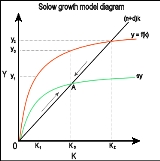
The model starts with a neoclassical production function Y/L = F(K/L), rearranged to y = f(k), which is the red curve on the graph. From the production function; output per worker is a function of capital per worker. The production function assumes diminishing returns to capital in this model, as denoted by the slope of the production function.
n = population growth rate
δ =
depreciationDepreciation refers to two very different but related concepts:# the decrease in value of assets , and# the allocation of the cost of assets to periods in which the assets are used ....
k = capital per worker
y = output/income per worker
L = labor force
s = saving rate
Capital per worker change is determined by three variables:
- Investment (saving) per worker
- Population growth, increasing population decreases the level of capital per worker.
- Depreciation – capital stock declines as it depreciates.
When sy > (n + δ)k, in other words, when the savings rate is greater than the population growth rate plus the depreciation rate, when the green line is above the black line on the graph, then capital (k) per worker is increasing, this is known as
capital deepeningCapital deepening is a term used in economics to describe an economy where capital per worker is increasing. This is also referred to as increase in the capital intensity. Capital deepening is often measured by the capital stock per labour hour. Overall, the economy will expand, and productivity...
. Where capital is increasing at a rate only enough to keep pace with population increase and depreciation it is known as capital widening.
The curves intersect at point A, the "steady state". At the steady state, output per worker is constant. However total output is growing at the rate of n, the rate of population growth.
The optimal savings rate is called the golden rule savings rate and is derived below. In a typical Cobb–Douglas production function the golden rule savings rate is alpha.
Left of point A, point k
1 for example, the saving per worker is greater than the amount needed to maintain a steady level of capital, so capital per worker increases. There is capital deepening from y
1 to y
0, and thus output per worker increases.
Right of point A where sy < (n + δ)k, point k
2 for example, capital per worker is falling, as investment is not enough to combat population growth and depreciation. Therefore output per worker falls from y
2 to y
0.
The model and changes in the saving rate
The graph is very similar to the above, however, it now has a second savings function s
1y, the blue curve. It demonstrates that an increase in the saving rate shifts the function up. Saving per worker is now greater than population growth plus depreciation, so capital accumulation increases, shifting the steady state from point A to B. As can be seen on the graph, output per worker correspondingly moves from y
0 to y
1. Initially the economy expands faster, but eventually goes back to the steady state rate of growth which equals n.
There is now permanently higher capital and productivity per worker, but economic growth is the same as before the savings increase.
The model and changes in population
This graph is again very similar to the first one, however, the population growth rate has now increased from n to n
1, this introduces a new capital widening line (n
1 + δ)
Mathematical framework
The Solow growth model can be described by the interaction of five basic macroeconomic equations:
- Macro-production function
- GDP equation
- Savings function
- Change in capital
- Change in workforce
Macro-production function
-

This is a Cobb–Douglas function where Y represents the total production in an economy. A represents
multifactor productivityMultifactor productivity measures the changes in output per unit of combined inputs. In the United States, Indices of MFP are produced for the private business, private nonfarm business, and manufacturing sectors of the economy...
(often generalized as technology), K is capital and L is labor.
An important relation in the macro-production function:
-

which is the macro-production function divided by L to give total production per capita y and the capital intensity k.
Savings function
-

This function depicts savings, I as a portion s of the total production Y.
Change in workforce
-

'n' is the rate of growth. e.g. n=0.02 would mean

or a 2% rise in
Empirical evidence
A key prediction of neoclassical growth models is that the income levels of poor countries will tend to
catch upThe idea of convergence in economics is the hypothesis that poorer economies' per capita incomes will tend to grow at faster rates than richer economies. As a result, all economies should eventually converge in terms of per capita income...
with or converge towards the income levels of rich countries as long as they have similar characteristics – for instance saving rates. Since the 1950s, the opposite empirical result has been observed on average. If the average growth rate of countries since, say, 1960 is plotted against initial GDP per capita (i.e. GDP per capita in 1960), one observes a positive relationship. In other words, the developed world appears to have grown at a faster rate than the developing world, the opposite of what is expected according to a prediction of convergence. However, a few formerly poor countries, notably
JapanJapan is an island nation in East Asia. Located in the Pacific Ocean, it lies to the east of the Sea of Japan, China, North Korea, South Korea and Russia, stretching from the Sea of Okhotsk in the north to the East China Sea and Taiwan in the south...
, do appear to have converged with rich countries, and in the case of Japan actually exceeded other countries' productivity, some theorize that this is what has caused Japan's poor growth recently – convergent growth rates are still expected, even after convergence has occurred; leading to over-optimistic investment, and actual
recessionIn economics, a recession is a business cycle contraction, a general slowdown in economic activity. During recessions, many macroeconomic indicators vary in a similar way...
.
The evidence is stronger for convergence within countries. For instance the per-capita income levels of the southern states of the United States have tended to converge to the levels in the Northern states. These observations have led to the adoption of the conditional convergence concept. Whether convergence occurs or not depends on the characteristics of the country or region in question, such as:
- Institutional arrangements
- Free market
A free market is a competitive market where prices are determined by supply and demand. However, the term is also commonly used for markets in which economic intervention and regulation by the state is limited to tax collection, and enforcement of private ownership and contracts...
s internally, and trade policyUnder a free trade policy, prices emerge from supply and demand, and are the sole determinant of resource allocation. 'Free' trade differs from other forms of trade policy where the allocation of goods and services among trading countries are determined by price strategies that may differ from...
with other countries.
- Education
Education in its broadest, general sense is the means through which the aims and habits of a group of people lives on from one generation to the next. Generally, it occurs through any experience that has a formative effect on the way one thinks, feels, or acts...
policy
Evidence for conditional convergence comes from multivariate, cross-country regressions.
If productivity were associated with high technology then the introduction of information technology should have led to a noticeable productivity acceleration over the past twenty years; but it has not: see: Solow computer paradox.
Econometric analysis on Singapore and the other "
East Asian TigersThe Four Asian Tigers or Asian Dragons is a term used in reference to the highly developed economies of Hong Kong, Singapore, South Korea and Taiwan. These nations and areas were notable for maintaining exceptionally high growth rates and rapid industrialization between the early 1960s and 1990s...
" has produced the surprising result that although output per worker has been rising, almost none of their rapid growth had been due to rising per-capita productivity (they have a low "
Solow residualThe Solow residual is a number describing empirical productivity growth in an economy from year to year and decade to decade. Robert Solow defined rising productivity as rising output with constant capital and labor input...
").
Criticisms
Empirical evidence offers mixed support for the model. Limitations of the model include its failure to take account of entrepreneurship (which may be a catalyst behind economic growth) and strength of institutions (which facilitate economic growth). In addition, it does not explain how or why technological progress occurs. This failing has led to the development of
endogenous growth theoryEndogenous growth theory holds that economic growth is primarily the result of endogenous and not external force. In Endogenous growth theory investment in human capital, innovation and knowledge are significant contributors to economic growth. The theory also focus on positive externalities and...
, which endogenizes technological progress and/or knowledge accumulation.
External links