

Echinacea

Encyclopedia
Echinacea is a genus of herbaceous
flowering plant
s in the daisy
family, Asteraceae
. The nine species it contains are commonly called purple coneflowers. They are endemic to eastern and central North America
, where they are found growing in moist to dry prairie
s and open wooded areas. They have large, showy heads of composite flower
s, blooming from early to late summer. The generic name is derived from the Greek
word ἐχῖνος (echino), meaning "sea urchin
," due to the spiny central disk. Some species are used in herbal medicines
and some are cultivated in gardens for their showy flowers. A few species are of conservation concern.
, drought
-tolerant perennial plant
s growing up to 140 cm in height. They grow from taproot
s, except E. purpurea, which grows from a short caudex
with fibrous roots. They have erect stems that in most species are unbranched. Both the basal and cauline leaves are arranged alternately. The leaves are normally hairy with a rough texture, having uniseriate trichome
s (1-4 rings of cells) but sometimes they lack hairs. The basal leaves and the lower stem leaves have petioles, and as the leaves progress up the stem the petioles often decrease in length. The leaf blades in different species may have one, three or five nerves. Some species have linear to lanceolate shaped leaves, and others have elliptic- to ovate-shaped leaves; often the leaves decrease in size as they progress up the stems. Leaf bases gradually increase in width away from the petioles or the bases are rounded to heart shaped. Most species have leaf margins that are entire, but sometimes they are dentate or serrate. The flowers are collected together into single rounded heads that terminate long peduncles. The inflorescence
s have crateriform to hemispheric shaped involucres which are 12–40 mm wide. The phyllaries, or bract
s below the flower head, are persistent and number 15–50. The phyllaries are produced in a 2–4 series. The receptacles are hemispheric to conic in shape. The paleae have orange to reddish purple ends, and are longer than the disc corollas. The paleae bases partially surrounding the cypselae, and are keeled with the apices abruptly constricted to awn-like tips. The ray florets number 8–21 and the corollas are dark purple to pale pink, white, or yellow. The tubes of the corolla are hairless or sparsely hairy, and the laminae are spreading, reflexed, or drooping in habit and linear to elliptic or obovate in shape. The abaxial faces of the laminae are glabrous or moderately hairy. The flower heads have typically 200-300 fertile, bisexual disc florets but some have more. The corollas are pinkish, greenish, reddish-purple or yellow and have tubes shorter than the throats. The pollen is normally yellow in most species, but usually white in E. pallida. The three or four-angled fruit
s, called cypselae, are tan or bicolored with a dark brown band distally. The pappi is persistent and variously crown-shaped with 0 to 4 or more prominent teeth. x = 11.
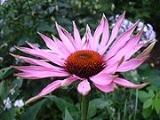
Like all Asteraceae, the flowering structure is a composite inflorescence
, with purple (rarely yellow or white) florets
arranged in a prominent, somewhat cone-shaped head
– "cone-shaped" because the petals of the outer ray florets tend to point downward (are reflexed) once the flower head opens, thus forming a cone. Plants are generally long lived, with distinctive flowers. The common name "cone flower" comes from the characteristic center “cone” at the center of the flower. The generic name Echinacea is rooted in the Greek word ἐχῖνος (echinos), meaning sea urchin
, it references the spiky appearance and feel of the flower heads. Echinacea plants also reseed in the fall. New flowers will grow where seeds have fallen from the prior year.
 The species of Echinacea are
Researchers at the Agricultural Research Service
are using DNA analysis to help determine the number of Echinacea species. The DNA analysis allows researchers to reveal clear distinctions among species based on chemical differences in root metabolites. The research concluded that of the 40 genetically diverse populations of Echinacea studied, there were nine distinct species. http://www.ars.usda.gov/is/pr/2010/100305.htm
Multiple scientific reviews and meta-analyses
have evaluated the published peer review
ed literature on the immunological effects of Echinacea. Reviews of the medicinal effects of Echinacea are often complicated by the inclusion of these different products. Evaluation of the literature within the field suffers generally from a lack of well-controlled trials, with many studies of low quality.
A 2007 study by the University of Connecticut
combined findings from 14 previously reported trials examining Echinacea and concluded that Echinacea can cut the chances of catching a cold
by more than half, and shorten the duration of a cold by an average of 1.4 days. However, Dr. Wallace Sampson, an editor of Scientific Review of Alternative Medicine
and a Stanford University
emeritus clinical professor of medicine, says that the referenced trials lack the similarities necessary to provide definitive results when combined into one report. "If you have studies that measure different things, there is no way to correct for that. These researchers tried, but you just can’t do it."
A 2003 controlled double-blind study from the University of Virginia School of Medicine
and documented in the New England Journal of Medicine
stated that echinacea extracts had "no clinically significant effects" on rates of infection or duration or intensity of symptoms. The effects held when the herb was taken immediately following infectious viral exposure and when taken as a prophylaxis starting a week prior to exposure. In a press release, Dr. Michael Murray, the Director of Education for Factors Group of Nutritional Companies, a manufacturer of Echinacea-related products, calls the study "faulty and inaccurate." According to Dr. Murray, none of the three extracts used on the 399 study participants contained all three of the components of Echinacea responsible for its immune-enhancing effects: polysaccharides, alkylamides and cichoric acid
. In addition, Dr. Murray said "the standard dosage for dried Echinacea angustifolia root is normally three grams per day or more and this study used less than one gram."
An earlier University of Maryland review based on 13 European studies concluded that echinacea, when taken at first sign of a cold, reduced cold symptoms or shortened their duration. The review also found that three of four published studies concluded that taking echinacea to prevent a cold was ineffective.
The European Medicines Agency
(EMEA) assessed the body of evidence and approved the use of expressed juice and dried expressed juice from fresh flowering aerial parts of Echinacea purpurea
for the short-term prevention and treatment of the common cold. According to their recommendations:
, stimulating the body's non-specific immune system
and warding off infection
s and also being utilized as a laxative. A study commonly used to support that belief is a 2007 meta-analysis
in The Lancet Infectious Diseases. The studies pooled in the meta-analysis used different types of echinacea, different parts of the plant, and various dosages. This review cannot inform recommendations on the efficacy of any particular type of echinacea, dosage, or treatment regimen. The safety of echinacea under long-term use is also unknown.
for its general medicinal qualities. Echinacea was one of the basic antimicrobial herbs of eclectic medicine
from the mid 19th century through the early 20th century, and its use was documented for snakebite, anthrax, and for relief of pain. In the 1930s echinacea became popular in both Europe and America as a herbal medicine. According to Wallace Sampson, MD, its modern day use as a treatment for the common cold began when a Swiss herbal supplement maker was "erroneously told" that echinacea was used for cold prevention by Native American tribes who lived in the area of South Dakota. Although Native American tribes didn't use echinacea to prevent the common cold, some Plains tribes did use echinacea to treat some of the symptoms that could be caused by the common cold: The Kiowa
used it for coughs and sore throats, the Cheyenne
for sore throats, the Pawnee for headaches, and many tribes including the Lakotah used it as an analgesic.
Native Americans learned of E. angustifolia
by observing elk
seeking out the plants and consuming them when sick or wounded, and identified those plants as elk root.
, which are common to many other plants. Both the phenol compounds cichoric acid
and caftaric acid
are present in E. purpurea, other phenols include echinacoside
, which is found in greater levels within E. angustifolia and E. pallida roots than in other species. When making herbal remedies, these phenols can serve as markers for the quantity of raw echinacea in the product. Other chemical constituents that may be important in echinacea health effects include alkylamides and polysaccharide
s.
The immunomodulator
y effects of echinacea preparations are likely caused by fat-soluble alkylamides (alkamides), which occur mostly in E. angustifolia and E. purpurea but not in E. pallida. Alkylamides bind to human CB2 and CB1 cannabinoid receptors and thus inhibit tumor necrosis factor α TNF-alpha. These Alkylamides have similar potency to that of THC at the CB2 receptor, with THC being around 1.5 times stronger (~40 nm vs ~60 nm affinities). However, potency is dramatically less than that of THC at the psychoactive CB1 receptor (~40 nm vs ~ >1500 nm affinities).
As with any herbal preparation, individual doses may vary significantly in active chemical composition. In addition to poor process control which may affect inter- and intra-batch homogeneity, species, plant part, extraction method, and contamination or adulteration with other products all lead to variability between products.
The several species of echinacea differ in their precise chemical constitution, and may provide variable dosages of any active ingredients.
.. Muscle and joint pain has been associated with Echinacea, but it may have been caused by cold or flu symptoms for which the Echinacea products were administered. There are isolated case reports of rare and idiosyncratic reactions
including thrombocytopenic purpura
, leucopenia, hepatitis
, renal failure
, and atrial fibrillation
, although it is not clear that these were due to Echinacea itself.
There are concerns that by stimulating immune function, Echinacea could potentially exacerbate autoimmune disease and/or decrease the effectiveness of immunosuppresive drugs, but this warning is based on theoretical considerations rather than human data. There have been no case reports of any drug interactions with Echinacea and "the currently available evidence suggests that echinacea is unlikely to pose serious health threats for patients combining it with conventional drugs."
As a matter of manufacturing safety, one investigation by an independent consumer testing laboratory found that five of eleven selected retail Echinacea products failed quality testing. Four of the failing products contained levels of phenols below the potency level stated on the labels. One failing product was contaminated with lead.
s in gardens. They tolerate a wide variety of conditions, maintain attractive foliage throughout the season, and multiply rapidly. Appropriate species are used in prairie
restorations.
Ecinacea extracts inhibited growth of three species of trypanosomatids: Leishmania donovani
, Leishmania major
, and Trypanosoma brucei
.
Herbaceous plant
A herbaceous plant is a plant that has leaves and stems that die down at the end of the growing season to the soil level. They have no persistent woody stem above ground...
flowering plant
Flowering plant
The flowering plants , also known as Angiospermae or Magnoliophyta, are the most diverse group of land plants. Angiosperms are seed-producing plants like the gymnosperms and can be distinguished from the gymnosperms by a series of synapomorphies...
s in the daisy
Bellis perennis
Bellis perennis is a common European species of Daisy, often considered the archetypal species of that name. Many related plants also share the name "Daisy", so to distinguish this species from other daisies it is sometimes qualified as Common Daisy, Lawn Daisy or occasionally English daisy. It is...
family, Asteraceae
Asteraceae
The Asteraceae or Compositae , is an exceedingly large and widespread family of vascular plants. The group has more than 22,750 currently accepted species, spread across 1620 genera and 12 subfamilies...
. The nine species it contains are commonly called purple coneflowers. They are endemic to eastern and central North America
North America
North America is a continent wholly within the Northern Hemisphere and almost wholly within the Western Hemisphere. It is also considered a northern subcontinent of the Americas...
, where they are found growing in moist to dry prairie
Prairie
Prairies are considered part of the temperate grasslands, savannas, and shrublands biome by ecologists, based on similar temperate climates, moderate rainfall, and grasses, herbs, and shrubs, rather than trees, as the dominant vegetation type...
s and open wooded areas. They have large, showy heads of composite flower
Flower
A flower, sometimes known as a bloom or blossom, is the reproductive structure found in flowering plants . The biological function of a flower is to effect reproduction, usually by providing a mechanism for the union of sperm with eggs...
s, blooming from early to late summer. The generic name is derived from the Greek
Greek language
Greek is an independent branch of the Indo-European family of languages. Native to the southern Balkans, it has the longest documented history of any Indo-European language, spanning 34 centuries of written records. Its writing system has been the Greek alphabet for the majority of its history;...
word ἐχῖνος (echino), meaning "sea urchin
Sea urchin
Sea urchins or urchins are small, spiny, globular animals which, with their close kin, such as sand dollars, constitute the class Echinoidea of the echinoderm phylum. They inhabit all oceans. Their shell, or "test", is round and spiny, typically from across. Common colors include black and dull...
," due to the spiny central disk. Some species are used in herbal medicines
Herbalism
Herbalism is a traditional medicinal or folk medicine practice based on the use of plants and plant extracts. Herbalism is also known as botanical medicine, medical herbalism, herbal medicine, herbology, herblore, and phytotherapy...
and some are cultivated in gardens for their showy flowers. A few species are of conservation concern.
Description
Echinacea species are herbaceousHerbaceous plant
A herbaceous plant is a plant that has leaves and stems that die down at the end of the growing season to the soil level. They have no persistent woody stem above ground...
, drought
Drought
A drought is an extended period of months or years when a region notes a deficiency in its water supply. Generally, this occurs when a region receives consistently below average precipitation. It can have a substantial impact on the ecosystem and agriculture of the affected region...
-tolerant perennial plant
Perennial plant
A perennial plant or simply perennial is a plant that lives for more than two years. The term is often used to differentiate a plant from shorter lived annuals and biennials. The term is sometimes misused by commercial gardeners or horticulturalists to describe only herbaceous perennials...
s growing up to 140 cm in height. They grow from taproot
Taproot
A taproot is an enlarged, somewhat straight to tapering plant root that grows vertically downward. It forms a center from which other roots sprout laterally.Plants with taproots are difficult to transplant...
s, except E. purpurea, which grows from a short caudex
Caudex
A caudex is a form of stem morphology appearing as a thickened, short, perennial stem that is either underground or near ground level . It may be swollen for the purpose of water storage, especially in xerophytes...
with fibrous roots. They have erect stems that in most species are unbranched. Both the basal and cauline leaves are arranged alternately. The leaves are normally hairy with a rough texture, having uniseriate trichome
Trichome
Trichomes are fine outgrowths or appendages on plants and certain protists. These are of diverse structure and function. Examples are hairs, glandular hairs, scales, and papillae.- Algal trichomes :...
s (1-4 rings of cells) but sometimes they lack hairs. The basal leaves and the lower stem leaves have petioles, and as the leaves progress up the stem the petioles often decrease in length. The leaf blades in different species may have one, three or five nerves. Some species have linear to lanceolate shaped leaves, and others have elliptic- to ovate-shaped leaves; often the leaves decrease in size as they progress up the stems. Leaf bases gradually increase in width away from the petioles or the bases are rounded to heart shaped. Most species have leaf margins that are entire, but sometimes they are dentate or serrate. The flowers are collected together into single rounded heads that terminate long peduncles. The inflorescence
Inflorescence
An inflorescence is a group or cluster of flowers arranged on a stem that is composed of a main branch or a complicated arrangement of branches. Strictly, it is the part of the shoot of seed plants where flowers are formed and which is accordingly modified...
s have crateriform to hemispheric shaped involucres which are 12–40 mm wide. The phyllaries, or bract
Bract
In botany, a bract is a modified or specialized leaf, especially one associated with a reproductive structure such as a flower, inflorescence axis, or cone scale. Bracts are often different from foliage leaves. They may be smaller, larger, or of a different color, shape, or texture...
s below the flower head, are persistent and number 15–50. The phyllaries are produced in a 2–4 series. The receptacles are hemispheric to conic in shape. The paleae have orange to reddish purple ends, and are longer than the disc corollas. The paleae bases partially surrounding the cypselae, and are keeled with the apices abruptly constricted to awn-like tips. The ray florets number 8–21 and the corollas are dark purple to pale pink, white, or yellow. The tubes of the corolla are hairless or sparsely hairy, and the laminae are spreading, reflexed, or drooping in habit and linear to elliptic or obovate in shape. The abaxial faces of the laminae are glabrous or moderately hairy. The flower heads have typically 200-300 fertile, bisexual disc florets but some have more. The corollas are pinkish, greenish, reddish-purple or yellow and have tubes shorter than the throats. The pollen is normally yellow in most species, but usually white in E. pallida. The three or four-angled fruit
Fruit
In broad terms, a fruit is a structure of a plant that contains its seeds.The term has different meanings dependent on context. In non-technical usage, such as food preparation, fruit normally means the fleshy seed-associated structures of certain plants that are sweet and edible in the raw state,...
s, called cypselae, are tan or bicolored with a dark brown band distally. The pappi is persistent and variously crown-shaped with 0 to 4 or more prominent teeth. x = 11.
Like all Asteraceae, the flowering structure is a composite inflorescence
Inflorescence
An inflorescence is a group or cluster of flowers arranged on a stem that is composed of a main branch or a complicated arrangement of branches. Strictly, it is the part of the shoot of seed plants where flowers are formed and which is accordingly modified...
, with purple (rarely yellow or white) florets
Flower
A flower, sometimes known as a bloom or blossom, is the reproductive structure found in flowering plants . The biological function of a flower is to effect reproduction, usually by providing a mechanism for the union of sperm with eggs...
arranged in a prominent, somewhat cone-shaped head
Head (botany)
The capitulum is considered the most derived form of inflorescence. Flower heads found outside Asteraceae show lesser degrees of specialization....
– "cone-shaped" because the petals of the outer ray florets tend to point downward (are reflexed) once the flower head opens, thus forming a cone. Plants are generally long lived, with distinctive flowers. The common name "cone flower" comes from the characteristic center “cone” at the center of the flower. The generic name Echinacea is rooted in the Greek word ἐχῖνος (echinos), meaning sea urchin
Sea urchin
Sea urchins or urchins are small, spiny, globular animals which, with their close kin, such as sand dollars, constitute the class Echinoidea of the echinoderm phylum. They inhabit all oceans. Their shell, or "test", is round and spiny, typically from across. Common colors include black and dull...
, it references the spiky appearance and feel of the flower heads. Echinacea plants also reseed in the fall. New flowers will grow where seeds have fallen from the prior year.
Species
- Echinacea angustifoliaEchinacea angustifoliaEchinacea angustifolia is a herbaceous plant species in Asteraceae. The plants grow tall with spindle-shaped taproots that are often branched. The stems and leaves are moderately to densely hairy.E. angustifolia blooms late spring to mid summer...
– Narrow-leaf Coneflower - Echinacea atrorubensEchinacea atrorubensEchinacea atrorubens - Topeka Purple Coneflower is a herbaceous perennial plant growing from 50 to 90 cm tall from elongate-turbinate roots that are sometimes branched. The stems and foliage are usually hairy with appressed to ascending hairs 1.2 mm long , rarely some plants are glabrous....
– Topeka Purple Coneflower - Echinacea laevigataEchinacea laevigataEchinacea laevigata, the smooth purple coneflower, is an Endangered Species Act federally listed endangered species of plant found in the piedmont of the southeastern United States...
– Smooth Coneflower, Smooth Purple Coneflower - Echinacea pallidaEchinacea pallidaEchinacea pallida , commonly called Pale Purple Cone-flower, is a species of herbaceous perennial plant in the family Asteraceae. It is sometimes grown in gardens and used for medicinal purposes. Its native range is the south central region of the United States.-Description:E. pallida is similar to E...
– Pale Purple Coneflower - Echinacea paradoxaEchinacea paradoxaEchinacea paradoxa is a perennial species of flowering plant in the genus Echinacea. Echinacea paradoxa is native to Missouri, Arkansas, Oklahoma, and Texas, and is listed as threatened in Arkansas....
– Yellow Coneflower, Bush's Purple Coneflower - Echinacea purpureaEchinacea purpureaEchinacea purpurea is a species of flowering plant in the genus Echinacea. Its cone-shaped flowering heads are usually, but not always purple. It is native to eastern North America and present to some extent in the wild in much of the eastern, southeastern and midwest United States...
– Purple Coneflower, Eastern Purple Coneflower - Echinacea sanguineaEchinacea sanguineaEchinacea sanguinea is a herbaceous perennial native to open sandy fields and open pine woods and prairies in Texas, Oklahoma, Louisiana, and Arkansas. It is the southernmost Echinacea species...
– Sanguine purple Coneflower - Echinacea simulataEchinacea simulataEchinacea simulata McGregor, Sida. Wavy-leaf purple coneflower or Pale purple coneflower is a species of herbaceous plant in family Asteraceae very much like Echinacea pallida except that it has yellow colored pollen grains. Plants growing 50 to 100 cm tall from taproot like roots fusiform in...
– Wavyleaf Purple Coneflower - Echinacea tennesseensisEchinacea tennesseensisEchinacea tennesseensis, also known as the Tennessee coneflower or Tennessee purple coneflower, is a flowering plant in the family Asteraceae, endemic to the cedar glades of the central portion of the U.S. state of Tennessee.-Description:...
– Tennessee Coneflower
Researchers at the Agricultural Research Service
Agricultural Research Service
The Agricultural Research Service is the principal in-house research agency of the United States Department of Agriculture . ARS is one of four agencies in USDA's Research, Education and Economics mission area...
are using DNA analysis to help determine the number of Echinacea species. The DNA analysis allows researchers to reveal clear distinctions among species based on chemical differences in root metabolites. The research concluded that of the 40 genetically diverse populations of Echinacea studied, there were nine distinct species. http://www.ars.usda.gov/is/pr/2010/100305.htm
Medicinal effects
Marketed and studied medicinal products contain different species (E. purpurea, E. angustifolia, E. pallida), different organs (roots and herbs) and different preparations (extracts and expressed juice). Their chemical compositions are very different.Multiple scientific reviews and meta-analyses
Meta-analysis
In statistics, a meta-analysis combines the results of several studies that address a set of related research hypotheses. In its simplest form, this is normally by identification of a common measure of effect size, for which a weighted average might be the output of a meta-analyses. Here the...
have evaluated the published peer review
Peer review
Peer review is a process of self-regulation by a profession or a process of evaluation involving qualified individuals within the relevant field. Peer review methods are employed to maintain standards, improve performance and provide credibility...
ed literature on the immunological effects of Echinacea. Reviews of the medicinal effects of Echinacea are often complicated by the inclusion of these different products. Evaluation of the literature within the field suffers generally from a lack of well-controlled trials, with many studies of low quality.
A 2007 study by the University of Connecticut
University of Connecticut
The admission rate to the University of Connecticut is about 50% and has been steadily decreasing, with about 28,000 prospective students applying for admission to the freshman class in recent years. Approximately 40,000 prospective students tour the main campus in Storrs annually...
combined findings from 14 previously reported trials examining Echinacea and concluded that Echinacea can cut the chances of catching a cold
Common cold
The common cold is a viral infectious disease of the upper respiratory system, caused primarily by rhinoviruses and coronaviruses. Common symptoms include a cough, sore throat, runny nose, and fever...
by more than half, and shorten the duration of a cold by an average of 1.4 days. However, Dr. Wallace Sampson, an editor of Scientific Review of Alternative Medicine
Scientific Review of Alternative Medicine
Scientific Review of Alternative Medicine and Aberrant Medical Practices is a scientific journal published by the Commission for Scientific Medicine and Mental Health...
and a Stanford University
Stanford University
The Leland Stanford Junior University, commonly referred to as Stanford University or Stanford, is a private research university on an campus located near Palo Alto, California. It is situated in the northwestern Santa Clara Valley on the San Francisco Peninsula, approximately northwest of San...
emeritus clinical professor of medicine, says that the referenced trials lack the similarities necessary to provide definitive results when combined into one report. "If you have studies that measure different things, there is no way to correct for that. These researchers tried, but you just can’t do it."
A 2003 controlled double-blind study from the University of Virginia School of Medicine
University of Virginia School of Medicine
The University of Virginia School of Medicine is a medical school located in Charlottesville, Virginia, United States. The tenth medical school to open in the United States, it has been part of the University of Virginia since the University's establishment in 1819 by Thomas Jefferson...
and documented in the New England Journal of Medicine
New England Journal of Medicine
The New England Journal of Medicine is an English-language peer-reviewed medical journal published by the Massachusetts Medical Society. It describes itself as the oldest continuously published medical journal in the world.-History:...
stated that echinacea extracts had "no clinically significant effects" on rates of infection or duration or intensity of symptoms. The effects held when the herb was taken immediately following infectious viral exposure and when taken as a prophylaxis starting a week prior to exposure. In a press release, Dr. Michael Murray, the Director of Education for Factors Group of Nutritional Companies, a manufacturer of Echinacea-related products, calls the study "faulty and inaccurate." According to Dr. Murray, none of the three extracts used on the 399 study participants contained all three of the components of Echinacea responsible for its immune-enhancing effects: polysaccharides, alkylamides and cichoric acid
Cichoric acid
Cichoric acid is a hydroxycinnamic acid, an organic compound of the phenylpropanoid class and occurs in a variety of plant species. It is a derivative of both caffeic acid and tartaric acid....
. In addition, Dr. Murray said "the standard dosage for dried Echinacea angustifolia root is normally three grams per day or more and this study used less than one gram."
An earlier University of Maryland review based on 13 European studies concluded that echinacea, when taken at first sign of a cold, reduced cold symptoms or shortened their duration. The review also found that three of four published studies concluded that taking echinacea to prevent a cold was ineffective.
The European Medicines Agency
European Medicines Agency
The European Medicines Agency is a European agency for the evaluation of medicinal products. From 1995 to 2004, the European Medicines Agency was known as European Agency for the Evaluation of Medicinal Products.Roughly parallel to the U.S...
(EMEA) assessed the body of evidence and approved the use of expressed juice and dried expressed juice from fresh flowering aerial parts of Echinacea purpurea
Echinacea purpurea
Echinacea purpurea is a species of flowering plant in the genus Echinacea. Its cone-shaped flowering heads are usually, but not always purple. It is native to eastern North America and present to some extent in the wild in much of the eastern, southeastern and midwest United States...
for the short-term prevention and treatment of the common cold. According to their recommendations:
It should not be used for more than 10 days. The use in children below 1 year of age is contraindicated, because of theoretically possible undesirable effect on immature immune system. The use in children between 1 and 12 years of age is not recommended, because efficacy has not been sufficiently documented although specific risks are not documented. In the absence of sufficient data, the use in pregnancy and lactation is not recommended.
Popular belief and traditional use
Echinacea is popularly believed to be an immunostimulatorImmunostimulator
Immunostimulants, also known as immunostimulators, are substances that stimulate the immune system by inducing activation or increasing activity of any of its components...
, stimulating the body's non-specific immune system
Immune system
An immune system is a system of biological structures and processes within an organism that protects against disease by identifying and killing pathogens and tumor cells. It detects a wide variety of agents, from viruses to parasitic worms, and needs to distinguish them from the organism's own...
and warding off infection
Infection
An infection is the colonization of a host organism by parasite species. Infecting parasites seek to use the host's resources to reproduce, often resulting in disease...
s and also being utilized as a laxative. A study commonly used to support that belief is a 2007 meta-analysis
Meta-analysis
In statistics, a meta-analysis combines the results of several studies that address a set of related research hypotheses. In its simplest form, this is normally by identification of a common measure of effect size, for which a weighted average might be the output of a meta-analyses. Here the...
in The Lancet Infectious Diseases. The studies pooled in the meta-analysis used different types of echinacea, different parts of the plant, and various dosages. This review cannot inform recommendations on the efficacy of any particular type of echinacea, dosage, or treatment regimen. The safety of echinacea under long-term use is also unknown.
History
Echinacea angustifolia was widely used by the North American Plains IndiansPlains Indians
The Plains Indians are the Indigenous peoples who live on the plains and rolling hills of the Great Plains of North America. Their colorful equestrian culture and resistance to White domination have made the Plains Indians an archetype in literature and art for American Indians everywhere.Plains...
for its general medicinal qualities. Echinacea was one of the basic antimicrobial herbs of eclectic medicine
Eclectic medicine
Eclectic medicine was a branch of American medicine which made use of botanical remedies along with other substances and physical therapy practices, popular in the latter half of the 19th and first half of the 20th centuries....
from the mid 19th century through the early 20th century, and its use was documented for snakebite, anthrax, and for relief of pain. In the 1930s echinacea became popular in both Europe and America as a herbal medicine. According to Wallace Sampson, MD, its modern day use as a treatment for the common cold began when a Swiss herbal supplement maker was "erroneously told" that echinacea was used for cold prevention by Native American tribes who lived in the area of South Dakota. Although Native American tribes didn't use echinacea to prevent the common cold, some Plains tribes did use echinacea to treat some of the symptoms that could be caused by the common cold: The Kiowa
Kiowa
The Kiowa are a nation of American Indians and indigenous people of the Great Plains. They migrated from the northern plains to the southern plains in the late 17th century. In 1867, the Kiowa moved to a reservation in southwestern Oklahoma...
used it for coughs and sore throats, the Cheyenne
Cheyenne
Cheyenne are a Native American people of the Great Plains, who are of the Algonquian language family. The Cheyenne Nation is composed of two united tribes, the Só'taeo'o and the Tsétsêhéstâhese .The Cheyenne are thought to have branched off other tribes of Algonquian stock inhabiting lands...
for sore throats, the Pawnee for headaches, and many tribes including the Lakotah used it as an analgesic.
Native Americans learned of E. angustifolia
Echinacea angustifolia
Echinacea angustifolia is a herbaceous plant species in Asteraceae. The plants grow tall with spindle-shaped taproots that are often branched. The stems and leaves are moderately to densely hairy.E. angustifolia blooms late spring to mid summer...
by observing elk
Elk
The Elk is the large deer, also called Cervus canadensis or wapiti, of North America and eastern Asia.Elk may also refer to:Other antlered mammals:...
seeking out the plants and consuming them when sick or wounded, and identified those plants as elk root.
Active substances
Like most crude drugs from plant or animal origin, the constituent base for echinacea is complex, consisting of a wide variety of chemicals of variable effect and potency. Some chemicals may be directly antimicrobial, while others may work at stimulating or modulating different parts of the immune system. All species have chemical compounds called phenolsNatural phenol
Natural phenols, bioavailable phenols, plant phenolics, low molecular weight phenols or phenoloids are a class of natural products. They are small molecules containing one or more phenolic group. These molecules are smaller in size than polyphenols, containing less than 12 phenolic groups...
, which are common to many other plants. Both the phenol compounds cichoric acid
Cichoric acid
Cichoric acid is a hydroxycinnamic acid, an organic compound of the phenylpropanoid class and occurs in a variety of plant species. It is a derivative of both caffeic acid and tartaric acid....
and caftaric acid
Caftaric acid
Caftaric acid is a non-flavanoid that impacts the color of white wine. Many believe this molecule is responsible for the yellowish-gold color seen in some whites wines. Aside from wine, it is abundantly present in raisins....
are present in E. purpurea, other phenols include echinacoside
Echinacoside
Echinacoside is a natural phenol. It is a caffeic acid glycoside from the phenylpropanoid class. It is constituted from a trisaccharide consisting of one glucose and two rhamnose moieties glycosidically linked to one caffeic acid and one dihydroxyphenylethanol residue at the centrally situated...
, which is found in greater levels within E. angustifolia and E. pallida roots than in other species. When making herbal remedies, these phenols can serve as markers for the quantity of raw echinacea in the product. Other chemical constituents that may be important in echinacea health effects include alkylamides and polysaccharide
Polysaccharide
Polysaccharides are long carbohydrate molecules, of repeated monomer units joined together by glycosidic bonds. They range in structure from linear to highly branched. Polysaccharides are often quite heterogeneous, containing slight modifications of the repeating unit. Depending on the structure,...
s.
The immunomodulator
Immunomodulator
An immunomodulator, also known as an immunotherapy is a substance which has an effect on the immune system.- Immunosuppressants :Inhibits immune response in organ transplantation and autoimmune diseases.- Immunostimulants :...
y effects of echinacea preparations are likely caused by fat-soluble alkylamides (alkamides), which occur mostly in E. angustifolia and E. purpurea but not in E. pallida. Alkylamides bind to human CB2 and CB1 cannabinoid receptors and thus inhibit tumor necrosis factor α TNF-alpha. These Alkylamides have similar potency to that of THC at the CB2 receptor, with THC being around 1.5 times stronger (~40 nm vs ~60 nm affinities). However, potency is dramatically less than that of THC at the psychoactive CB1 receptor (~40 nm vs ~ >1500 nm affinities).
As with any herbal preparation, individual doses may vary significantly in active chemical composition. In addition to poor process control which may affect inter- and intra-batch homogeneity, species, plant part, extraction method, and contamination or adulteration with other products all lead to variability between products.
Root or whole plant
As with any plant, the chemical makeup of echinacea is not consistent throughout the organism. In particular, the root has been promoted as containing a more efficacious mixture of active chemicals. A 2003 study in the Journal of the American Medical Association (Taylor et al. 2003) found that when echinacea products made from the entire plant were taken after the second cold symptom appeared they provided no measurable beneficial effect for children in treating the severity or duration of symptoms caused by the common cold virus. A 2005 study in the New England Journal of Medicine (Turner, 2005) focused on several root extracts, but still found no statistically significant effects on duration, intensity, or prevention of symptoms.Frequency of administration
Proponents of echinacea assert that it is not a "one-dose" treatment, and that in order to work effectively, a dose should be taken at the very first sign of a cold symptom. Subsequent doses are called for every two to four hours after the first dose, including during the overnight sleeping period, until the cold symptoms have disappeared.The several species of echinacea differ in their precise chemical constitution, and may provide variable dosages of any active ingredients.
Side effects and contraindications
When taken by mouth, Echinacea does not usually cause side effects. One of the most extensive and systematic studies to review the safety of Echinacea products concluded that overall, "adverse events are rare, mild and reversible," with the most common symptoms being "gastrointestinal and skin-related." Such side effects include nausea, abdominal pain, diarrhea, itch, and rash. Echinacea has also been linked to rare allergic reactions, including asthma, shortness of breath, and one case of anaphylaxisAnaphylaxis
Anaphylaxis is defined as "a serious allergic reaction that is rapid in onset and may cause death". It typically results in a number of symptoms including throat swelling, an itchy rash, and low blood pressure...
.. Muscle and joint pain has been associated with Echinacea, but it may have been caused by cold or flu symptoms for which the Echinacea products were administered. There are isolated case reports of rare and idiosyncratic reactions
Idiosyncratic drug reaction
Idiosyncratic drug reactions, also known as type B reactions, are drug reactions that occur rarely and unpredictably amongst the population. This is not to be mistaken with idiopathic, which implies that the cause is not known...
including thrombocytopenic purpura
Thrombocytopenic purpura
Thrombocytopenic purpura are purpura associated with a reduction in circulating blood platelets which can result from a variety of causes.- Types :...
, leucopenia, hepatitis
Hepatitis
Hepatitis is a medical condition defined by the inflammation of the liver and characterized by the presence of inflammatory cells in the tissue of the organ. The name is from the Greek hepar , the root being hepat- , meaning liver, and suffix -itis, meaning "inflammation"...
, renal failure
Renal failure
Renal failure or kidney failure describes a medical condition in which the kidneys fail to adequately filter toxins and waste products from the blood...
, and atrial fibrillation
Atrial fibrillation
Atrial fibrillation is the most common cardiac arrhythmia . It is a common cause of irregular heart beat, identified clinically by taking a pulse. Chaotic electrical activity in the two upper chambers of the heart result in the muscle fibrillating , instead of achieving coordinated contraction...
, although it is not clear that these were due to Echinacea itself.
There are concerns that by stimulating immune function, Echinacea could potentially exacerbate autoimmune disease and/or decrease the effectiveness of immunosuppresive drugs, but this warning is based on theoretical considerations rather than human data. There have been no case reports of any drug interactions with Echinacea and "the currently available evidence suggests that echinacea is unlikely to pose serious health threats for patients combining it with conventional drugs."
As a matter of manufacturing safety, one investigation by an independent consumer testing laboratory found that five of eleven selected retail Echinacea products failed quality testing. Four of the failing products contained levels of phenols below the potency level stated on the labels. One failing product was contaminated with lead.
Other uses
Some species of echinacea, notably E. purpurea, E. angustifolia, and E. pallida, are grown as ornamental plantOrnamental plant
Ornamental plants are plants that are grown for decorative purposes in gardens and landscape design projects, as house plants, for cut flowers and specimen display...
s in gardens. They tolerate a wide variety of conditions, maintain attractive foliage throughout the season, and multiply rapidly. Appropriate species are used in prairie
Prairie
Prairies are considered part of the temperate grasslands, savannas, and shrublands biome by ecologists, based on similar temperate climates, moderate rainfall, and grasses, herbs, and shrubs, rather than trees, as the dominant vegetation type...
restorations.
Ecinacea extracts inhibited growth of three species of trypanosomatids: Leishmania donovani
Leishmania donovani
Leishmania donovani is a species of Leishmania. It is an important cause of visceral leishmaniasis. The reference genome of L. donovani extracted in the south eastern Nepal was published in 2011...
, Leishmania major
Leishmania major
Leishmania major is a species of Leishmania.It is associated with zoonotic cutaneous leishmaniasis.The genome has been sequenced....
, and Trypanosoma brucei
Trypanosoma brucei
Trypanosoma brucei is a parasitic protist species that causes African trypanosomiasis in humans and nagana in animals in Africa. There are 3 sub-species of T. brucei: T. b. brucei, T. b. gambiense and T. b. rhodesiense.These obligate parasites have two hosts - an insect vector and mammalian host...
.
External links
- Echinacea – the wonder herb (reprinted from The Skeptic Winter 2007)
- American Botanical Council Web site Echinacea information from The American Botanical Council
- Website devoted to Echinacea