
All Topics  
Taproot

 
Taproot

   Email Print
   Bookmark   Link


Taproot


A plant
Plant

Plants are Life organisms belonging to the Kingdom Plantae. They include familiar organisms such as trees, herbs, bushes, grasses, vines, ferns, mosses, and green algae....
's taproot is a somewhat straight tapering root
Root

In vascular plants, the root is the organ of a plant body that typically lies below the surface of the soil. This is not always the case, however, since a root can also be aerial root or aerating ....
 that grows vertically downward. It forms a center from which other roots sprout laterally.

Plants with taproots are difficult to transplant
Transplanting

In agriculture and gardening, transplanting or replanting is the technique of moving a plant from one location to another. Most often this takes the form of starting a plant from seed in optimal conditions, such as in a greenhouse or protected nursery bed, then replanting it in another, usually outdoor, growing location....
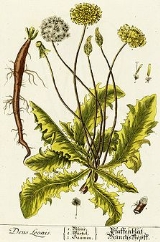
. The presence of a taproot is why dandelions are hard to uproot — the top is pulled, but the long taproot stays in the ground, and re-sprouts.

A taproot system contrasts to a fibrous root system
Fibrous root system

A fibrous root system is the opposite of a taproot. It is usually formed by thin, moderately branching roots growing from the Plant stem. A fibrous root system is universal in monocotyledonous plants and ferns, and is also common in dicotyledonous plants....
 with many branched roots.

Most tree
TREE

TREE was a Boston hardcore punk band formed in the summer of 1990. They were active in the Boston music scene until disbanding in 2002....
s begin life with a taproot, but after one to a few years the main root system changes to a wide-spreading fibrous root system with mainly horizontal growing surface roots and only a few vertical, deep anchoring roots.


Discussion
Ask a question about 'Taproot'
Start a new discussion about 'Taproot'
Answer questions from other users
Full Discussion Forum


Encyclopedia


Dandelion Blackwell 0136


A plant
Plant

Plants are Life organisms belonging to the Kingdom Plantae. They include familiar organisms such as trees, herbs, bushes, grasses, vines, ferns, mosses, and green algae....
's taproot is a somewhat straight tapering root
Root

In vascular plants, the root is the organ of a plant body that typically lies below the surface of the soil. This is not always the case, however, since a root can also be aerial root or aerating ....
 that grows vertically downward. It forms a center from which other roots sprout laterally.

Plants with taproots are difficult to transplant
Transplanting

In agriculture and gardening, transplanting or replanting is the technique of moving a plant from one location to another. Most often this takes the form of starting a plant from seed in optimal conditions, such as in a greenhouse or protected nursery bed, then replanting it in another, usually outdoor, growing location....
. The presence of a taproot is why dandelions are hard to uproot — the top is pulled, but the long taproot stays in the ground, and re-sprouts.

A taproot system contrasts to a fibrous root system
Fibrous root system

A fibrous root system is the opposite of a taproot. It is usually formed by thin, moderately branching roots growing from the Plant stem. A fibrous root system is universal in monocotyledonous plants and ferns, and is also common in dicotyledonous plants....
 with many branched roots.

Most tree
TREE

TREE was a Boston hardcore punk band formed in the summer of 1990. They were active in the Boston music scene until disbanding in 2002....
s begin life with a taproot, but after one to a few years the main root system changes to a wide-spreading fibrous root system with mainly horizontal growing surface roots and only a few vertical, deep anchoring roots. A typical mature tree 30–50 m tall has a root system that extends horizontally in all directions as far as the tree is tall or more, but well over 95% of the roots are in the top 50 cm depth of soil.

Many taproots are modified into storage organ
Storage organ

A storage organ is a part of a plant specifically modified for storage of energy or water. Storage organs often grow underground, where they are better protected from attack by herbivores....
s.

Some plants with taproots:

  • Burdock
    Burdock

    Burdock is any of a group of Biennial plant thistles in the genus Arctium, family Asteraceae. Native to the Old World, several species have been widely introduced worldwide....
  • Dandelion
  • Kudzu
    Kudzu

    , Pueraria lobata , is one of about 20 species in the genus Pueraria in the pea family Fabaceae, subfamily Faboideae. It is native to southern Japan and southeast China in eastern Asia....
  • Parsnip
    Parsnip

    The parsnip is a root vegetable related to the carrot. Parsnips resemble carrots, but are paler than most of them and have a stronger flavor. Like carrots, parsnips are native to Eurasia and have been eaten there since ancient times....
  • Patterson's Curse
    Patterson's Curse

    Echium plantagineum is a species of Echium, native to western and southern Europe , northern Africa, and southwestern Asia .It is an annual plant or biennial plant growing to 20-60 cm tall, with rough, hairy, lanceolate leaf up to 14 cm long....
  • Poppy mallow
    Poppy mallow

    Callirhoe, the poppy mallows, is a genus of nine species in the mallow family , native to the prairies and grasslands of North America....
  • Radish
    Radish

    The radish is an Eating root vegetable of the Brassicaceae family that was domesticated in Europe in pre-Roman Empire times. They are grown and consumed throughout the world....
  • Turnip
    Turnip

    The turnip is a root vegetable commonly grown in temperate climates worldwide for its white, bulbous taproot. Small, tender, varieties are grown for human consumption, while larger varieties are grown as fodder for livestock....
  • Carrot
    Carrot

    The carrot is a root vegetable, usually orange or white, or red-white blend in colour, with a crisp texture when fresh. The edible part of a carrot is a taproot....
  • Green alkanet
    Green alkanet

    Pentaglottis sempervirens is a bristly, perennial plant growing to approximately 60cm to 90cm , usually in damp or shaded places and often close to buildings....
  • Sturt's Desert Pea
    Sturt's desert pea

    Sturt's Desert Pea, Swainsona formosa, is an Australia plant in the genus Swainsona, named after English botanist Isaac Swainson, famous for its distinctive blood-red leaf-like flowers, each with a bulbous black centre, or "boss"....
  • Welwitschia
    Welwitschia

    Welwitschia is a monotypic genus of gymnosperm plant, composed solely of the very distinct Welwitschia mirabilis. It is the only genus of the family Welwitschiaceae, in the order Welwitschiales, in the division Gnetophyta....


Development


Taproots develop from the radicle
Radicle

In botany, the radicle is the first part of a seedling to emerge from the seed during the process of germination. The radicle is the embryonic root of the plant, and grows downward in the soil....
 of the seed, which forms the primary root. It produces branches called the secondary roots, and they in turn produce branches to form tertiary roots. These may further branch to form rootlets. Soil characteristics strongly influence the architecture of taproots. For example deep rich soils favour the development of vertical taproots in many oak species such as Quercus kelloggii, while clayey soils promote the growth of mulitple taproots.

Typical taproots

  • Conical root: this type root tuber is conical in shape, i.e. broad at the base and tapering gradually towards the apex: e.g. carrot
    Carrot

    The carrot is a root vegetable, usually orange or white, or red-white blend in colour, with a crisp texture when fresh. The edible part of a carrot is a taproot....
    .
  • Fusiform root: this root is swollen in the middle and tapers towards the base and the apex: e.g. radish
    Radish

    The radish is an Eating root vegetable of the Brassicaceae family that was domesticated in Europe in pre-Roman Empire times. They are grown and consumed throughout the world....
    .
  • Napiform root: the root has a top-like appearance. It is very broad at the base and tapers suddenly like a tail at the apex: e.g. turnip
    Turnip

    The turnip is a root vegetable commonly grown in temperate climates worldwide for its white, bulbous taproot. Small, tender, varieties are grown for human consumption, while larger varieties are grown as fodder for livestock....
    .


External links

  • Citation: "…The tap roots transfer rainwater
    Rain

    Rain is liquid precipitation . On Earth, it is the condensation of atmospheric water vapor into droplet heavy enough to fall, often making it to the surface....
     from the surface to reservoirs deep underground and redistribute water… increases photosynthesis
    Photosynthesis

    File:Seawifs global biosphere.jpgPhotosynthesis is a metabolic pathway that converts carbon dioxide into organic compounds, especially sugars, using the energy from sunlight....
     and the evaporation of water… by 40 percent in the dry season
    Dry season

    The dry season is a term commonly used when describing the weather in the tropics. The weather in the tropics is dominated by the tropical rain belt, which oscillation from the northern to the southern tropics over the course of the year....
    … During the wet season, these plants can store as much as 10 percent of the annual precipitation
    Precipitation (meteorology)

    File:MeanMonthlyP.gifIn meteorology, precipitation is any product of the condensation of Atmosphere water vapor that is deposited on the earth's surface....
     as deep as 13 meters (43 feet) underground, to be tapped during the dry months… tree roots acting like pipes to allow water to shift around much faster than it could otherwise percolate
    PeRColate

    PeRColate is an open source set of extensions to Max/MSP, developed by Dan Trueman at Princeton University and R. Luke DuBois at the Computer Music Center, Columbia University....
     through the soil
    Soil

    Soil is the naturally occurring, unconsolidated or loose covering on the Earth's surface. Soil is composed of particles of broken rock that have been altered by chemical and environmental processes including weathering and erosion....
    ."