

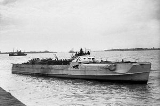
E-boat

Encyclopedia
E-boats (German:Schnellboot ("fast boat") or S-Boot) was the designation for Motor Torpedo Boat
s of the German Navy
during World War II
. It is commonly held that the E stood for Enemy.
The E-boat was a very fast vessel, able to cruise at 40 or 50 knots, and its wooden hull meant it could cross magnetic minefields unharmed. It was better suited to the open sea and had substantially longer range (approximately 700 nautical miles) than the American PT boat
and the British Motor Torpedo Boat
(MTB). As a result the Royal Navy
later developed better matched versions of MTBs using the Fairmile 'D'
hull design.
, Germany's military production was severely curtailed. Small patrol craft, however, were not subject to any strictures. E-boats can trace their lineage back to a private motor yacht
—a 22-ton-displacement, 34-knot craft called Oheka II
, which had been built in 1927 for a wealthy financier and patron of the arts, Otto Kahn, by the German shipbuilding
company Lürssen
.
This design was chosen because the theatre of operations of such boats was expected to be the North Sea
, English Channel
and the Western Approaches
. The requirement for good performance in rough seas dictated the use of a round-bottomed displacement hull rather than the flat-bottomed planing hull that was more usual for small, high-speed boats. Lürssen overcame many of the disadvantages of such a hull and, with the Oheka II, produced a craft that was fast, strong and seaworthy. This attracted the interest of the German Navy, which in 1929 ordered a similar boat but fitted with two torpedo tubes. This became the S-1, and was the basis for all subsequent E-boats.
After experimenting with the S-1 the Germans made several improvements to the design. Small rudders added on either side of the main rudder could be angled outboard to 30 degrees, creating at high speed what's known as the Lürssen Effect. This drew in an "air pocket slightly behind the three propellers, increasing their efficiency, reducing the stern wave and keeping the boat at a nearly horizontal attitude". This was an important innovation as the horizontal attitude lifted the stern somewhat, allowing even greater speed, and the reduced stern wave made E-boats harder to see, especially at night.
and the English Channel in order to intercept shipping heading for the English ports in the south and east. As such, they were up against Royal Navy
and Commonwealth (particularly Royal Canadian Navy
contingents leading up to D-Day
), Motor Gun Boat
s (MGBs), Motor Torpedo Boat
s (MTBs), Motor Launch
es, frigates
and destroyer
s. They were also transferred in small numbers to the Mediterranean, and the Black Sea by river and land transport. Some small E-boats were built as boats for carrying by auxiliary cruisers.
Crew members could earn an award particular to their work—Das Schnellbootkriegsabzeichen
—denoted by a badge depicting an E-boat passing through a wreath. The criteria were good conduct, distinction in action, and participating in at least twelve enemy actions. It was also awarded for particularly successful missions, displays of leadership or being killed in action. It could be awarded under special circumstances, such as when another decoration was not suitable.
Schnellboote of the 9th flotilla were the first naval units to respond to the invasion fleet of Operation Overlord
. They left Cherbourg harbour at 5am on 6 June 1944. On finding themselves confronted by the entire invasion fleet, they fired their torpedoes at maximum range and returned to Cherbourg.
During World War II E-boats sank 101 merchant ships totalling 214,728 tons. In addition, they sank 12 destroyers, 11 minesweepers, eight landing ships, six MTBs, a torpedo boat, a minelayer, one submarine and a number of small merchant craft. They also damaged two cruisers, five destroyers, three landing ships, a repair ship, a naval tug and numerous merchant vessels. Sea mines laid by the E-boats were responsible for the loss of 37 merchant ships totalling 148,535 tons, a destroyer, two minesweepers and four landing ships.
In recognition of their service, the members of Schnellboot crews were awarded the Knight's Cross
on 23 occasions, and the German Cross
in Gold on 112 occasions.
Between 1949 and 1956, Operation Jungle
, a joint operation was established between MI6, the CIA, and the Gehlen Organization to insert agents into the Baltic states
and Poland
by sea. Royal Navy Commander Anthony Courtney
was struck by the potential capabilities of former E-boat hulls, and John Harvey-Jones
of the Naval Intelligence Division
was put in charge of the project. He discovered that the Royal Navy still had two E-boats, P5230 and P5208, and had them sent to Portsmouth, where one of them, P5230 (ex-S130), was modified to reduce its weight and increase its power with the installation of two Napier Deltic
engines of 3000 hp apiece. In the interests of deniability
, a former German E-boat captain, Helmut Klose, and a German crew were recruited to man the E-boat. They operated under the cover of the British Control Commission's Fishery Protection Service, which was responsible for preventing Soviet navy vessels from interfering with German fishing boats and for destroying stray mines.
in Cornwall to undergo restoration work by Roving Commissions Ltd.
Built as hull No.1030 at the Schlichting boatyard in Travemünde
, S-130 was commissioned on 21 October 1943 and took an active part in the war, participating in the Exercise Tiger
attack and attacks on the D-day
invasion fleet.
According to Dutch military historian Maurice Laarman:
S-130 was returned to the newly formed Bundesmarine in March 1957, and operated under the number UW 10. Serving initially in the Unterwasserwaffenschule training sailors in underwater weaponry such as mines and torpedoes, she later became a test boat under the name EF 3.
Today this S-130 is on display in Wilhelmshaven, Germany. Photos by Laarman are here:http://www.prinzeugen.com/S130.htm
The second "S-130" is undergoing thorough restoration in Southdown in Cornwall, England. Multiple galleries of photos of the process are here:http://www.rovcom.co.uk/s130_ww2_schnellboot_lift.htm
S-26 class: Entered service in 1940. 40 m hull. Torpedo tubes covered by forward deck.
S-30 class
S-38 class
S-38b class: Improved S-38 class with armoured bridge. Various armament including 40mm Bofors or 20mm Flak aft, MG34 Zwillingsockel midships
S-100 class: From 1943. 1 x 20 mm in the bow, 2 × 20 mm gun amidships
and 37 mm gun aft
.
S-151 class
Type 700: late war design proposal with stern torpedo tubes and 30 mm gun turret forward. Eight boats built, but completed to S-100 design specification
Other AA armament carried on different models included two or more pintle-mounted MG-34s, 3.7 cm Flak 42 (S-100) and 8.6 cm RaG M42 (S-100) or, rarely, a quad 2 cm flak mount.
Motor Torpedo Boat
Motor Torpedo Boat was the name given to fast torpedo boats by the Royal Navy, and the Royal Canadian Navy.The capitalised term is generally used for the Royal Navy boats and abbreviated to "MTB"...
s of the German Navy
German Navy
The German Navy is the navy of Germany and is part of the unified Bundeswehr .The German Navy traces its roots back to the Imperial Fleet of the revolutionary era of 1848 – 52 and more directly to the Prussian Navy, which later evolved into the Northern German Federal Navy...
during World War II
World War II
World War II, or the Second World War , was a global conflict lasting from 1939 to 1945, involving most of the world's nations—including all of the great powers—eventually forming two opposing military alliances: the Allies and the Axis...
. It is commonly held that the E stood for Enemy.
The E-boat was a very fast vessel, able to cruise at 40 or 50 knots, and its wooden hull meant it could cross magnetic minefields unharmed. It was better suited to the open sea and had substantially longer range (approximately 700 nautical miles) than the American PT boat
PT boat
PT Boats were a variety of motor torpedo boat , a small, fast vessel used by the United States Navy in World War II to attack larger surface ships. The PT boat squadrons were nicknamed "the mosquito fleet". The Japanese called them "Devil Boats".The original pre–World War I torpedo boats were...
and the British Motor Torpedo Boat
Motor Torpedo Boat
Motor Torpedo Boat was the name given to fast torpedo boats by the Royal Navy, and the Royal Canadian Navy.The capitalised term is generally used for the Royal Navy boats and abbreviated to "MTB"...
(MTB). As a result the Royal Navy
Royal Navy
The Royal Navy is the naval warfare service branch of the British Armed Forces. Founded in the 16th century, it is the oldest service branch and is known as the Senior Service...
later developed better matched versions of MTBs using the Fairmile 'D'
Fairmile D motor torpedo boat
The Fairmile D motor torpedo boat was a type of British Motor Torpedo Boat designed by Bill Holt and conceived by Fairmile Marine for the Royal Navy....
hull design.
Development
As a result of the Treaty of VersaillesTreaty of Versailles
The Treaty of Versailles was one of the peace treaties at the end of World War I. It ended the state of war between Germany and the Allied Powers. It was signed on 28 June 1919, exactly five years after the assassination of Archduke Franz Ferdinand. The other Central Powers on the German side of...
, Germany's military production was severely curtailed. Small patrol craft, however, were not subject to any strictures. E-boats can trace their lineage back to a private motor yacht
Yacht
A yacht is a recreational boat or ship. The term originated from the Dutch Jacht meaning "hunt". It was originally defined as a light fast sailing vessel used by the Dutch navy to pursue pirates and other transgressors around and into the shallow waters of the Low Countries...
—a 22-ton-displacement, 34-knot craft called Oheka II
Oheka II
Oheka II was a private motor yacht built for German investment banker Otto Hermann Kahn by Lürssen in 1927. Capable of 34 knots top speed, she became the blueprint for the German Navy's Schnellboot....
, which had been built in 1927 for a wealthy financier and patron of the arts, Otto Kahn, by the German shipbuilding
Shipbuilding
Shipbuilding is the construction of ships and floating vessels. It normally takes place in a specialized facility known as a shipyard. Shipbuilders, also called shipwrights, follow a specialized occupation that traces its roots to before recorded history.Shipbuilding and ship repairs, both...
company Lürssen
Lürssen
Lürssen is a German shipbuilding company based in Bremen-Vegesack.Lürssen designs and constructs yachts, naval ships and special vessels...
.
This design was chosen because the theatre of operations of such boats was expected to be the North Sea
North Sea
In the southwest, beyond the Straits of Dover, the North Sea becomes the English Channel connecting to the Atlantic Ocean. In the east, it connects to the Baltic Sea via the Skagerrak and Kattegat, narrow straits that separate Denmark from Norway and Sweden respectively...
, English Channel
English Channel
The English Channel , often referred to simply as the Channel, is an arm of the Atlantic Ocean that separates southern England from northern France, and joins the North Sea to the Atlantic. It is about long and varies in width from at its widest to in the Strait of Dover...
and the Western Approaches
Western Approaches
The Western Approaches is a rectangular area of the Atlantic ocean lying on the western coast of Great Britain. The rectangle is higher than it is wide, the north and south boundaries defined by the north and south ends of the British Isles, the eastern boundary lying on the western coast, and the...
. The requirement for good performance in rough seas dictated the use of a round-bottomed displacement hull rather than the flat-bottomed planing hull that was more usual for small, high-speed boats. Lürssen overcame many of the disadvantages of such a hull and, with the Oheka II, produced a craft that was fast, strong and seaworthy. This attracted the interest of the German Navy, which in 1929 ordered a similar boat but fitted with two torpedo tubes. This became the S-1, and was the basis for all subsequent E-boats.
After experimenting with the S-1 the Germans made several improvements to the design. Small rudders added on either side of the main rudder could be angled outboard to 30 degrees, creating at high speed what's known as the Lürssen Effect. This drew in an "air pocket slightly behind the three propellers, increasing their efficiency, reducing the stern wave and keeping the boat at a nearly horizontal attitude". This was an important innovation as the horizontal attitude lifted the stern somewhat, allowing even greater speed, and the reduced stern wave made E-boats harder to see, especially at night.
Operations with the Kriegsmarine
E-boats were often used to patrol the Baltic SeaBaltic Sea
The Baltic Sea is a brackish mediterranean sea located in Northern Europe, from 53°N to 66°N latitude and from 20°E to 26°E longitude. It is bounded by the Scandinavian Peninsula, the mainland of Europe, and the Danish islands. It drains into the Kattegat by way of the Øresund, the Great Belt and...
and the English Channel in order to intercept shipping heading for the English ports in the south and east. As such, they were up against Royal Navy
Royal Navy
The Royal Navy is the naval warfare service branch of the British Armed Forces. Founded in the 16th century, it is the oldest service branch and is known as the Senior Service...
and Commonwealth (particularly Royal Canadian Navy
Royal Canadian Navy
The history of the Royal Canadian Navy goes back to 1910, when the naval force was created as the Naval Service of Canada and renamed a year later by King George V. The Royal Canadian Navy is one of the three environmental commands of the Canadian Forces...
contingents leading up to D-Day
D-Day
D-Day is a term often used in military parlance to denote the day on which a combat attack or operation is to be initiated. "D-Day" often represents a variable, designating the day upon which some significant event will occur or has occurred; see Military designation of days and hours for similar...
), Motor Gun Boat
Motor Gun Boat
Motor Gun Boat was a Royal Navy term for a small military vessel of the Second World War. They were physically similar to the Motor Torpedo Boats but equipped with a mix of guns instead of torpedoes. Their small size and high speed made them difficult targets for E-boats or torpedo bombers, but...
s (MGBs), Motor Torpedo Boat
Motor Torpedo Boat
Motor Torpedo Boat was the name given to fast torpedo boats by the Royal Navy, and the Royal Canadian Navy.The capitalised term is generally used for the Royal Navy boats and abbreviated to "MTB"...
s (MTBs), Motor Launch
Motor Launch
A Motor Launch is a small military vessel in British navy service. It was designed for harbour defence and submarine chasing or for armed high speed air-sea rescue....
es, frigates
Captain class frigate
The Captain class were 78 frigates of the Royal Navy, constructed in the United States, launched in 1942–1943 and delivered to the United Kingdom under the provisions of Lend-Lease. They served in World War II as convoy escorts, anti-submarine warfare vessels and coastal forces control frigates...
and destroyer
Destroyer
In naval terminology, a destroyer is a fast and maneuverable yet long-endurance warship intended to escort larger vessels in a fleet, convoy or battle group and defend them against smaller, powerful, short-range attackers. Destroyers, originally called torpedo-boat destroyers in 1892, evolved from...
s. They were also transferred in small numbers to the Mediterranean, and the Black Sea by river and land transport. Some small E-boats were built as boats for carrying by auxiliary cruisers.
Crew members could earn an award particular to their work—Das Schnellbootkriegsabzeichen
Fast Attack Craft War Badge
The E-Boat War Badge is a German military decoration awarded to Kriegsmarine members for service on fast attack craft or torpedo boats worn on the lower part of the left breast pocket of the naval service tunic, underneath the 1st class Iron Cross if awarded, or equivalent grade award...
—denoted by a badge depicting an E-boat passing through a wreath. The criteria were good conduct, distinction in action, and participating in at least twelve enemy actions. It was also awarded for particularly successful missions, displays of leadership or being killed in action. It could be awarded under special circumstances, such as when another decoration was not suitable.
Schnellboote of the 9th flotilla were the first naval units to respond to the invasion fleet of Operation Overlord
Operation Overlord
Operation Overlord was the code name for the Battle of Normandy, the operation that launched the invasion of German-occupied western Europe during World War II by Allied forces. The operation commenced on 6 June 1944 with the Normandy landings...
. They left Cherbourg harbour at 5am on 6 June 1944. On finding themselves confronted by the entire invasion fleet, they fired their torpedoes at maximum range and returned to Cherbourg.
During World War II E-boats sank 101 merchant ships totalling 214,728 tons. In addition, they sank 12 destroyers, 11 minesweepers, eight landing ships, six MTBs, a torpedo boat, a minelayer, one submarine and a number of small merchant craft. They also damaged two cruisers, five destroyers, three landing ships, a repair ship, a naval tug and numerous merchant vessels. Sea mines laid by the E-boats were responsible for the loss of 37 merchant ships totalling 148,535 tons, a destroyer, two minesweepers and four landing ships.
In recognition of their service, the members of Schnellboot crews were awarded the Knight's Cross
Knight's Cross
Knight's Cross refers to a distinguishing grade or level of various orders that denotes bravery and leadership on the battlefield....
on 23 occasions, and the German Cross
German Cross
The German Cross was instituted by Adolf Hitler on 17 November 1941 as an award ranking higher than the Iron Cross First Class but below the Knight's Cross of the Iron Cross respectively ranking higher than the War Merit Cross First Class with Swords but below the Knight's Cross of the War Merit...
in Gold on 112 occasions.
Italian version
The poor seaworthiness of the MAS boats led the Italian Navy to build its own version of E-boats. The prototype was designed on the pattern of six German-built E-boats captured from the Yugoslav Navy in 1941. Notably, two of them sank the largest warship (the British cruiser ) that was sunk by this kind of boat in World War II. Thirty six of these vessels were completed by 1943.Post-war service in the Royal Navy
At the end of the war about 34 E-boats were surrendered to the British. Three boats, S-130 (renamed P5230), S-208 (P5208) and S-212 (P5212) were retained for trials.Between 1949 and 1956, Operation Jungle
Operation Jungle
Operation Jungle was a program by the British Secret Intelligence Service early in the Cold War for the clandestine insertion of intelligence and resistance agents into the Baltic states...
, a joint operation was established between MI6, the CIA, and the Gehlen Organization to insert agents into the Baltic states
Baltic states
The term Baltic states refers to the Baltic territories which gained independence from the Russian Empire in the wake of World War I: primarily the contiguous trio of Estonia, Latvia, Lithuania ; Finland also fell within the scope of the term after initially gaining independence in the 1920s.The...
and Poland
Poland
Poland , officially the Republic of Poland , is a country in Central Europe bordered by Germany to the west; the Czech Republic and Slovakia to the south; Ukraine, Belarus and Lithuania to the east; and the Baltic Sea and Kaliningrad Oblast, a Russian exclave, to the north...
by sea. Royal Navy Commander Anthony Courtney
Anthony Courtney
Commander Anthony Tosswill Courtney, OBE, RN was a British Royal Navy officer and politician. While a Member of Parliament, he was a victim of a plot apparently instituted by the KGB to discredit him, which appeared to contribute to the loss of his seat...
was struck by the potential capabilities of former E-boat hulls, and John Harvey-Jones
John Harvey-Jones
Sir John Harvey-Jones MBE was an English businessman. He was the chairman of Imperial Chemical Industries from 1982 to 1987...
of the Naval Intelligence Division
Naval Intelligence Division
The Naval Intelligence Division was the intelligence arm of the British Admiralty before the establishment of a unified Defence Staff in 1965. It dealt with matters concerning British naval plans, with the collection of naval intelligence...
was put in charge of the project. He discovered that the Royal Navy still had two E-boats, P5230 and P5208, and had them sent to Portsmouth, where one of them, P5230 (ex-S130), was modified to reduce its weight and increase its power with the installation of two Napier Deltic
Napier Deltic
The Napier Deltic engine is a British opposed-piston valveless, two-stroke diesel engine used in marine and locomotive applications, designed and produced by Napier & Son...
engines of 3000 hp apiece. In the interests of deniability
Plausible deniability
Plausible deniability is, at root, credible ability to deny a fact or allegation, or to deny previous knowledge of a fact. The term most often refers to the denial of blame in chains of command, where upper rungs quarantine the blame to the lower rungs, and the lower rungs are often inaccessible,...
, a former German E-boat captain, Helmut Klose, and a German crew were recruited to man the E-boat. They operated under the cover of the British Control Commission's Fishery Protection Service, which was responsible for preventing Soviet navy vessels from interfering with German fishing boats and for destroying stray mines.
Service in the Spanish Navy
The Kriegsmarine supplied the Spanish Navy with six E-boats during the Spanish civil war, and six more during the Second World War. Another six were built in Spain with some assistance from Lürssen. The German-built boats were discarded in the 1960s, while some of the Spanish-built ones served until the early 1970s.Survivors
There is just one surviving E-boat identified as S-130, not two as previously stated. S-130 was purchased and towed from Wilhelmshaven, Germany to Southampton, England in 2003, under the auspices of the BMPT. In 2004 S-130 was towed to Mashfords yard in Plymouth, England to await funding for restoration. In 2008 S-130, having been purchased by Kevin Wheatcroft, was slipped and set up ashore at SouthdownSouthdown
Southdown may refer to:* Southdown , a breed of sheep* Southdown, Harpenden, a region in Harpenden, Hertfordshire, England* Southdown, New Zealand, a suburb of Auckland* Southdown Creative, an American film and video production company...
in Cornwall to undergo restoration work by Roving Commissions Ltd.
Built as hull No.1030 at the Schlichting boatyard in Travemünde
Travemünde
Travemünde is a borough of Lübeck, Germany, located at the mouth of the river Trave in Lübeck Bay. It began life as a fortress built by Henry the Lion, Duke of Saxony, in the 12th century to guard the mouth of the Trave, and the Danes subsequently strengthened it. It became a town in 1317 and in...
, S-130 was commissioned on 21 October 1943 and took an active part in the war, participating in the Exercise Tiger
Exercise Tiger
Exercise Tiger, or Operation Tiger, were the code names for a full-scale rehearsal in 1944 for the D-Day invasion of Normandy. During the exercise, an Allied convoy was attacked, resulting in the deaths of 946 American servicemen....
attack and attacks on the D-day
D-Day
D-Day is a term often used in military parlance to denote the day on which a combat attack or operation is to be initiated. "D-Day" often represents a variable, designating the day upon which some significant event will occur or has occurred; see Military designation of days and hours for similar...
invasion fleet.
According to Dutch military historian Maurice Laarman:
In 1945, S-130 was taken as a British war prize ( FPB 5030) and put to use in covert operations. Under the guise of the "British Baltic Fishery Protection Service", the British Secret Intelligence Service MI 6 ferried spies and agents into Eastern Europe. Beginning in May 1949, MI 6 used S-208, (Kommandant Hans-Helmut Klose) to insert agents into Lithuania, Latvia, Estonia, and Poland. The operations were very successful and continued under a more permanent organisation based in Hamburg. In 1952, S-130 joined the operation and the mission was enlarged to include signal intelligence (SIGINT) equipment. In 1954/55, S-130 and S-208 were replaced by a new generation of German S-boote.
S-130 was returned to the newly formed Bundesmarine in March 1957, and operated under the number UW 10. Serving initially in the Unterwasserwaffenschule training sailors in underwater weaponry such as mines and torpedoes, she later became a test boat under the name EF 3.
Today this S-130 is on display in Wilhelmshaven, Germany. Photos by Laarman are here:http://www.prinzeugen.com/S130.htm
The second "S-130" is undergoing thorough restoration in Southdown in Cornwall, England. Multiple galleries of photos of the process are here:http://www.rovcom.co.uk/s130_ww2_schnellboot_lift.htm
Variants
The Schnellboot design evolved over time. The first had a pair of torpedo tubes on the fore deck. Wartime types were:-S-26 class: Entered service in 1940. 40 m hull. Torpedo tubes covered by forward deck.
S-30 class
S-38 class
S-38b class: Improved S-38 class with armoured bridge. Various armament including 40mm Bofors or 20mm Flak aft, MG34 Zwillingsockel midships
S-100 class: From 1943. 1 x 20 mm in the bow, 2 × 20 mm gun amidships
Glossary of nautical terms
This is a glossary of nautical terms; some remain current, many date from the 17th-19th century. See also Wiktionary's nautical terms, :Category:Nautical terms, and Nautical metaphors in English.- A :...
and 37 mm gun aft
Aft
Aft, in naval terminology, is an adjective or adverb meaning, towards the stern of the ship, when the frame of reference is within the ship. Example: "Able Seaman Smith; lay aft!". Or; "What's happening aft?"...
.
S-151 class
Type 700: late war design proposal with stern torpedo tubes and 30 mm gun turret forward. Eight boats built, but completed to S-100 design specification
Specification
- Length: 34.9 m (114 feet 6 inches)
- Weight: up to 120 tTonneThe tonne, known as the metric ton in the US , often put pleonastically as "metric tonne" to avoid confusion with ton, is a metric system unit of mass equal to 1000 kilograms. The tonne is not an International System of Units unit, but is accepted for use with the SI...
- Speed: 43.8 kts
- Engines: Three 20-cylinder 2000 hp Daimler Benz MB501 dieselsDiesel engineA diesel engine is an internal combustion engine that uses the heat of compression to initiate ignition to burn the fuel, which is injected into the combustion chamber...
driving three shafts. - Armament:
- 2 × 53.3 cm (21 inches) torpedo tubes, with room for 2 more torpedoes (for reloading).
- 1 × 20 mm gun, (20 mm single on early boats, twin and special bow version on later classes)
- 1 × 40 mm gun (40 mm Bofors) on some S-38 class boats
Other AA armament carried on different models included two or more pintle-mounted MG-34s, 3.7 cm Flak 42 (S-100) and 8.6 cm RaG M42 (S-100) or, rarely, a quad 2 cm flak mount.
See also
- Steam Gun BoatSteam Gun BoatThe Steam Gun Boat was a Royal Navy term for a class of small naval vessels used during the Second World War. The class consisted of nine gun boats, powered by steam, and built from 1940 to 1942 for the Coastal Forces of the Royal Navy....
- Fairmile D motor torpedo boatFairmile D motor torpedo boatThe Fairmile D motor torpedo boat was a type of British Motor Torpedo Boat designed by Bill Holt and conceived by Fairmile Marine for the Royal Navy....
- R boatR boatThe R boats were a group of small minesweepers but used for several purposes during the Second World War.A total of 424 boats were built for the Kriegsmarine before and during World War II. The German Navy used them in every theatre including the Baltic, Mediterranean and the Black Sea...
- List of Knight's Cross recipients of the Schnellboot service