

Ductile iron

Encyclopedia
Ductile iron, also known as ductile cast iron, nodular cast iron, spheroidal graphite iron, spherulitic graphite cast iron and SG iron, is a type of cast iron
invented in 1943 by Keith Millis
. While most varieties of cast iron are brittle
, ductile iron is much more flexible
and elastic
, due to its nodular graphite inclusions.
On October 25, 1949, Keith Dwight Millis, Albert Paul Gagnebin and Norman Boden Pilling received US patent 2,485,760 on a Cast Ferrous Alloy for ductile iron production via magnesium treatment.
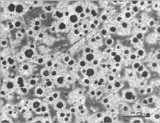
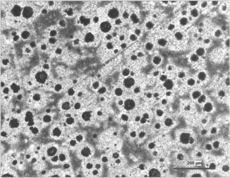 Ductile iron is not a single material but is part of a group of materials which can be produced to have a wide range of properties through control of the microstructure. The common defining characteristic of this group of materials is the morphological structure of the graphite
. In ductile irons, the graphite is in the form of spherical
nodules rather than flakes (as in grey iron), thus inhibiting the creation of cracks and providing the enhanced ductility that gives the alloy its name. The formation of nodules is achieved by addition of nodulizing elements, most commonly Magnesium
(note Magnesium boils at 1100C and Iron melts at 1500C) and, less often now, Cerium
(usually in the form of Misch metal), into the melt. Tellurium has also been used. Yttrium
, often a component of Misch metal, has also been studied as a possible nodulizer.
Besides the requirement that the graphite be manipulated into the spheroidal shape, the ferrite and pearlite ratios can be controlled through alloying, shakeout temperature control or post-casting heat treatment to vary the relative amounts pearlite and ferrite from 0% pearlite and 100% ferrite, to 100% pearlite and 0% ferrite. The control of the pearlite and ferrite ratio manipulates the tensile, yield and elongation characteristics of the ductile iron to produce numerous standard grades of material.
"Austempered
Ductile Iron" (ADI) was invented in the 1950s but was commercialized and achieved success only some years later. In ADI, the metallurgical structure is manipulated through a sophisticated heat treating process. The "aus" portion of the name refers to austenite
.
Other elements such as copper
or tin
may be added to increase tensile and yield strength while simultaneously reducing elongation. Improved corrosion resistance can be achieved by replacing 15% to 30% of the iron
in the alloy with varying amounts of nickel
, copper
, or chromium
.
, used for water and sewer lines. It competes with polymer
ic materials such as PVC
, HDPE, LDPE and polypropylene
, which are all much lighter than steel or ductile iron.
Ductile iron is specifically useful in many automotive components, where strength needs surpass that of aluminum but do not necessarily require steel. Other major industrial applications include off-highway diesel trucks, class 8 trucks, agricultural tractors, and oil well pumps.
Cast iron
Cast iron is derived from pig iron, and while it usually refers to gray iron, it also identifies a large group of ferrous alloys which solidify with a eutectic. The color of a fractured surface can be used to identify an alloy. White cast iron is named after its white surface when fractured, due...
invented in 1943 by Keith Millis
Keith Millis
Keith Dwight Millis was an American metallurgical engineer and inventor of ductile iron.Keith Millis grew up in Rensselaer, New York and earned his Bachelor of Science in Metallurgical Engineering as a 1938 graduate of Rensselaer Polytechnic Institute...
. While most varieties of cast iron are brittle
Brittle
A material is brittle if, when subjected to stress, it breaks without significant deformation . Brittle materials absorb relatively little energy prior to fracture, even those of high strength. Breaking is often accompanied by a snapping sound. Brittle materials include most ceramics and glasses ...
, ductile iron is much more flexible
Flexible
Flexible may refer to:* Flexible electrical cable, also known as a power cord* Flexible electronics* Flexible response* Flexible mold* Flextime* Flexible-fuel vehicle* Flexible rake receiver* Flexible spending account, a tax-advantaged savings account...
and elastic
Elasticity (physics)
In physics, elasticity is the physical property of a material that returns to its original shape after the stress that made it deform or distort is removed. The relative amount of deformation is called the strain....
, due to its nodular graphite inclusions.
On October 25, 1949, Keith Dwight Millis, Albert Paul Gagnebin and Norman Boden Pilling received US patent 2,485,760 on a Cast Ferrous Alloy for ductile iron production via magnesium treatment.
Metallurgy
Graphite
The mineral graphite is one of the allotropes of carbon. It was named by Abraham Gottlob Werner in 1789 from the Ancient Greek γράφω , "to draw/write", for its use in pencils, where it is commonly called lead . Unlike diamond , graphite is an electrical conductor, a semimetal...
. In ductile irons, the graphite is in the form of spherical
Sphere
A sphere is a perfectly round geometrical object in three-dimensional space, such as the shape of a round ball. Like a circle in two dimensions, a perfect sphere is completely symmetrical around its center, with all points on the surface lying the same distance r from the center point...
nodules rather than flakes (as in grey iron), thus inhibiting the creation of cracks and providing the enhanced ductility that gives the alloy its name. The formation of nodules is achieved by addition of nodulizing elements, most commonly Magnesium
Magnesium
Magnesium is a chemical element with the symbol Mg, atomic number 12, and common oxidation number +2. It is an alkaline earth metal and the eighth most abundant element in the Earth's crust and ninth in the known universe as a whole...
(note Magnesium boils at 1100C and Iron melts at 1500C) and, less often now, Cerium
Cerium
Cerium is a chemical element with the symbol Ce and atomic number 58. It is a soft, silvery, ductile metal which easily oxidizes in air. Cerium was named after the dwarf planet . Cerium is the most abundant of the rare earth elements, making up about 0.0046% of the Earth's crust by weight...
(usually in the form of Misch metal), into the melt. Tellurium has also been used. Yttrium
Yttrium
Yttrium is a chemical element with symbol Y and atomic number 39. It is a silvery-metallic transition metal chemically similar to the lanthanides and it has often been classified as a "rare earth element". Yttrium is almost always found combined with the lanthanides in rare earth minerals and is...
, often a component of Misch metal, has also been studied as a possible nodulizer.
Besides the requirement that the graphite be manipulated into the spheroidal shape, the ferrite and pearlite ratios can be controlled through alloying, shakeout temperature control or post-casting heat treatment to vary the relative amounts pearlite and ferrite from 0% pearlite and 100% ferrite, to 100% pearlite and 0% ferrite. The control of the pearlite and ferrite ratio manipulates the tensile, yield and elongation characteristics of the ductile iron to produce numerous standard grades of material.
"Austempered
Austempering
Austempering is an isothermal heat treatment that is applied to ferrous metals, most notably steel and ductile iron. In steel it produces a lower bainite microstructure whereas in cast irons it produces a structure of acicular ferrite and high carbon, stabilized austenite known as ausferrite. It is...
Ductile Iron" (ADI) was invented in the 1950s but was commercialized and achieved success only some years later. In ADI, the metallurgical structure is manipulated through a sophisticated heat treating process. The "aus" portion of the name refers to austenite
Austenite
Austenite, also known as gamma phase iron, is a metallic non-magnetic allotrope of iron or a solid solution of iron, with an alloying element. In plain-carbon steel, austenite exists above the critical eutectoid temperature of ; other alloys of steel have different eutectoid temperatures...
.
Composition
A typical chemical analysis of this material:- IronIronIron is a chemical element with the symbol Fe and atomic number 26. It is a metal in the first transition series. It is the most common element forming the planet Earth as a whole, forming much of Earth's outer and inner core. It is the fourth most common element in the Earth's crust...
- CarbonCarbonCarbon is the chemical element with symbol C and atomic number 6. As a member of group 14 on the periodic table, it is nonmetallic and tetravalent—making four electrons available to form covalent chemical bonds...
3.3 to 3.4% - SiliconSiliconSilicon is a chemical element with the symbol Si and atomic number 14. A tetravalent metalloid, it is less reactive than its chemical analog carbon, the nonmetal directly above it in the periodic table, but more reactive than germanium, the metalloid directly below it in the table...
2.2 to 2.8% - ManganeseManganeseManganese is a chemical element, designated by the symbol Mn. It has the atomic number 25. It is found as a free element in nature , and in many minerals...
0.1 to 0.5% - MagnesiumMagnesiumMagnesium is a chemical element with the symbol Mg, atomic number 12, and common oxidation number +2. It is an alkaline earth metal and the eighth most abundant element in the Earth's crust and ninth in the known universe as a whole...
0.03 to 0.05% - PhosphorusPhosphorusPhosphorus is the chemical element that has the symbol P and atomic number 15. A multivalent nonmetal of the nitrogen group, phosphorus as a mineral is almost always present in its maximally oxidized state, as inorganic phosphate rocks...
0.005 to 0.04% - SulfurSulfurSulfur or sulphur is the chemical element with atomic number 16. In the periodic table it is represented by the symbol S. It is an abundant, multivalent non-metal. Under normal conditions, sulfur atoms form cyclic octatomic molecules with chemical formula S8. Elemental sulfur is a bright yellow...
0.005 to 0.02%
Other elements such as copper
Copper
Copper is a chemical element with the symbol Cu and atomic number 29. It is a ductile metal with very high thermal and electrical conductivity. Pure copper is soft and malleable; an exposed surface has a reddish-orange tarnish...
or tin
Tin
Tin is a chemical element with the symbol Sn and atomic number 50. It is a main group metal in group 14 of the periodic table. Tin shows chemical similarity to both neighboring group 14 elements, germanium and lead and has two possible oxidation states, +2 and the slightly more stable +4...
may be added to increase tensile and yield strength while simultaneously reducing elongation. Improved corrosion resistance can be achieved by replacing 15% to 30% of the iron
Iron
Iron is a chemical element with the symbol Fe and atomic number 26. It is a metal in the first transition series. It is the most common element forming the planet Earth as a whole, forming much of Earth's outer and inner core. It is the fourth most common element in the Earth's crust...
in the alloy with varying amounts of nickel
Nickel
Nickel is a chemical element with the chemical symbol Ni and atomic number 28. It is a silvery-white lustrous metal with a slight golden tinge. Nickel belongs to the transition metals and is hard and ductile...
, copper
Copper
Copper is a chemical element with the symbol Cu and atomic number 29. It is a ductile metal with very high thermal and electrical conductivity. Pure copper is soft and malleable; an exposed surface has a reddish-orange tarnish...
, or chromium
Chromium
Chromium is a chemical element which has the symbol Cr and atomic number 24. It is the first element in Group 6. It is a steely-gray, lustrous, hard metal that takes a high polish and has a high melting point. It is also odorless, tasteless, and malleable...
.
Applications
Much of the annual production of ductile iron is in the form of ductile iron pipeDuctile iron pipe
Ductile iron pipe is a pipe commonly used for potable water distribution. The predominant wall material is ductile iron, a spheroidized graphite cast iron, although an internal cement mortar lining usually serves to inhibit corrosion from the fluid being distributed, and various types of external...
, used for water and sewer lines. It competes with polymer
Polymer
A polymer is a large molecule composed of repeating structural units. These subunits are typically connected by covalent chemical bonds...
ic materials such as PVC
PVC
Polyvinyl chloride is a plastic.PVC may also refer to:*Param Vir Chakra, India's highest military honor*Peripheral venous catheter, a small, flexible tube placed into a peripheral vein in order to administer medication or fluids...
, HDPE, LDPE and polypropylene
Polypropylene
Polypropylene , also known as polypropene, is a thermoplastic polymer used in a wide variety of applications including packaging, textiles , stationery, plastic parts and reusable containers of various types, laboratory equipment, loudspeakers, automotive components, and polymer banknotes...
, which are all much lighter than steel or ductile iron.
Ductile iron is specifically useful in many automotive components, where strength needs surpass that of aluminum but do not necessarily require steel. Other major industrial applications include off-highway diesel trucks, class 8 trucks, agricultural tractors, and oil well pumps.