

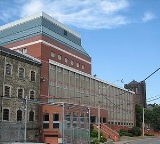
Don Jail

Encyclopedia
The Toronto Jail is a provincial jail for remand
ed offenders in the city of Toronto
, Ontario
, Canada. It is located in the Riverdale
neighbourhood on Gerrard Street East near its intersection with Broadview Avenue. It gets its nickname from the nearby Don River
. One reason for the popular use of the "Don" nickname is that this jail was the third or fourth to be known as the Toronto Jail. The Toronto Central Prison
was also colloquially known as the Toronto Jail, as were the King Street Gaols
. Ironically, The Don is the only jail to have been officially designated the Toronto Jail, yet has rarely been referred to as such outside official circles. The original Don Jail closed in 1977 and is now owned by the Bridgepoint Health Foundation which will incorporate it into a redeveloped hospital. The adjoining "new jail" will remain operational until a new facility, the Toronto South Detention Centre is completed on the site of the current Mimico Correctional Centre
.
William Thomas
in 1852, its distinctive façade in the Italianate style with a pedimented central pavilion and vermiculated columns flanking the main entrance portico is one of the architectural treasures of the city and one of very few pre-Confederation (1867) structures that remains intact in Toronto. For example, it is over thirty years older than Toronto's Romanesque Old City Hall
. Owing to its sturdy construction, its interior has gone largely unchanged in the last fifty years as renovations would be both difficult and expensive, even in an empty facility; as such, it is considered badly outdated as a prison facility.
The adjoining "New Jail" was built in 1958 and remained in operation after the "Old Jail" closed in 1977.
organizations, prisoner advocate groups and even corrections officers have decried its overcrowding and inadequate facilities. Guards at the jail have even walked out in protest of these conditions: on January 16, 2008 one such walk-out resulted in a complete jail lockdown. However, despite several attempts to close the facility, it remains open primarily to deal with the large number of remand
prisoners awaiting trial. It is often overburdened by a large number of arrested persons awaiting arraignment
. It does not hold any persons actually found guilty of an offence, except for brief periods while they await transfer from court to the institution where they will serve their sentences.
Courts have taken judicial notice
of the deplorable conditions in "The Don". In R. v. Smith [2003] O.J. No. 1782, Justice Richard Schneider set a precedent in this regard by crediting persons serving time in the facility awaiting trial with three days for every day spent in the facility, as opposed to the more common "2-for-1" practice. In R. v. Permesar [2003] O.J. No. 5420, the same judge noted that the prison failed to meet the Standard Minimum Rules for the Treatment of Prisoners
set by the United Nations
. These conditions were also brought to light by a controversial article appearing in the Toronto Star
after journalist
Linda Diebel was smuggled into the prison by Dave Levac
, a sympathetic Ontario MPP. Mr. Levac faced censure by the Integrity Commissioner
for bringing in the reporter, whom he led Jail officials to believe was a member of his staff, as part of his entourage.
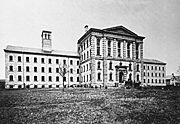 Before capital punishment
was abolished in Canada, the Don was the site of a number of hanging
s. Starting with the execution of John Boyd in January 1908, hangings at the Don took place in an indoor chamber, which was a converted washroom, at the northeast corner of the old building. Previously, condemned men had been hanged on an outdoor scaffold in the jail yard. The indoor facility was seen as an improvement because outdoor executions were quasi-public (at the hanging of Fred Lee Rice in 1905, crowds had lined surrounding rooftops to see something of the spectacle) and because the condemned didn’t have to walk as far.
The best-known Canadian hangmen, such as John Radclive, Arthur Ellis
and Camille Blanchard, hanged men at the Don. The Toronto-based hangman Samuel Edwards, who worked during the Great Depression
, carried out his first execution there in July, 1931.
Twenty-six men were hanged on the Don’s indoor gallows. The jail saw three double hangings: Roy Hotrum and William McFadden in August, 1921; Leonard Jackson and Steven Suchan in December, 1952; Ronald Turpin
and Arthur Lucas
on 11 December 1962. Turpin and Lucas had each been convicted in separate murders, and their executions were Canada's last before capital punishment was abolished.
In 2007, human remains were found on the jail's grounds during an archaeological assessment.
English network when the Boyd Gang
, a notorious group of bank robbers
, broke out of the facility for the second time. The news anchor was future Bonanza
star, Lorne Greene
.
For the movie Cocktail (1988), starring Tom Cruise
and Bryan Brown
, the rotunda
in the old section of the jail was redressed as an upscale New York
nightclub
.
The jail was also a filming location for the episode So Shall Ye Reap, from the TV series War Of The Worlds
in which it served as the hideout for the aliens.
The jail is featured in pivotal scenes in the novel Old City Hall, by Robert Rotenberg
.
The jail is extensively featured in the 2009 documentary Hangman's Graveyard
. The film details the recent archaeological investigation at the jail and tells the story of the executed inmates found in an abandoned cemetery beneath a parking lot behind the jail.
Scenes from Chicago
were filmed in the old Don Jail.
Before Bridgepoint Health begins the full renovation of the old section of the Don Jail it is to be offered as a venue rental location. Rentals will be available once the building is brought up to code for public gatherings.
Toronto artist and musician Andre Ethier
wrote the song "Don River Jail" about the building.
Detention of suspects
The detention of suspects is the process of keeping a person who has been arrested in a police-cell, remand prison or other detention centre before trial or sentencing. One criticism of pretrial detention is that eventual acquittal can be a somewhat hollow victory, in that there is no way to...
ed offenders in the city of Toronto
Toronto
Toronto is the provincial capital of Ontario and the largest city in Canada. It is located in Southern Ontario on the northwestern shore of Lake Ontario. A relatively modern city, Toronto's history dates back to the late-18th century, when its land was first purchased by the British monarchy from...
, Ontario
Ontario
Ontario is a province of Canada, located in east-central Canada. It is Canada's most populous province and second largest in total area. It is home to the nation's most populous city, Toronto, and the nation's capital, Ottawa....
, Canada. It is located in the Riverdale
Riverdale, Toronto
Riverdale is a large neighbourhood in Toronto, Ontario, Canada. It is bounded by the Don River Valley to the west, Danforth Avenue and Greektown to the north, Jones Avenue, the CN/GO tracks, and Leslieville to the east, and Lake Shore Boulevard to the south....
neighbourhood on Gerrard Street East near its intersection with Broadview Avenue. It gets its nickname from the nearby Don River
Don River (Toronto)
The Don River is one of two rivers bounding the original settled area of Toronto, Ontario along the shore of Lake Ontario, the other being the Humber River to the west. The Don is formed from two rivers, the East and West Branches, that meet about north of Lake Ontario while flowing southward into...
. One reason for the popular use of the "Don" nickname is that this jail was the third or fourth to be known as the Toronto Jail. The Toronto Central Prison
Toronto Central Prison
The Toronto Central Prison, also known as the Central Prison, Central Prison for Men, and more colloquially as The Toronto Jail , was a 336-bed facility located near the intersection of King Street and Strachan Avenue in Toronto, Ontario, Canada...
was also colloquially known as the Toronto Jail, as were the King Street Gaols
King Street Gaol (1827)
The second King Street Gaol was built in 1824 to replace the first King Street Gaol in Toronto, Ontario, then known as the town of York...
. Ironically, The Don is the only jail to have been officially designated the Toronto Jail, yet has rarely been referred to as such outside official circles. The original Don Jail closed in 1977 and is now owned by the Bridgepoint Health Foundation which will incorporate it into a redeveloped hospital. The adjoining "new jail" will remain operational until a new facility, the Toronto South Detention Centre is completed on the site of the current Mimico Correctional Centre
Mimico Correctional Centre
The Mimico Correctional Centre is a provincial medium-security correctional facility for adult male inmates serving a sentence of 2-years-less-a-day or less in Ontario, Canada. Its history can be traced back to 1887...
.
Architecture
The Toronto Gaol was built between 1862 and 1865 (predating Canadian Confederation by two years) with most of the current jail facilities being built in the 1950s, although a jail has stood on the site since 1858. Designed by architectArchitect
An architect is a person trained in the planning, design and oversight of the construction of buildings. To practice architecture means to offer or render services in connection with the design and construction of a building, or group of buildings and the space within the site surrounding the...
William Thomas
William Thomas (architect)
William Thomas was an Anglo-Canadian architect.Thomas was apprenticed under Charles Barry and A.W. Pugin as a carpenter-joiner. His younger brother was the sculptor John Thomas .Thomas began his own practice at Leamington Spa in 1831 but in 1837 went bankrupt...
in 1852, its distinctive façade in the Italianate style with a pedimented central pavilion and vermiculated columns flanking the main entrance portico is one of the architectural treasures of the city and one of very few pre-Confederation (1867) structures that remains intact in Toronto. For example, it is over thirty years older than Toronto's Romanesque Old City Hall
Old City Hall (Toronto)
Toronto's Old City Hall was home to its city council from 1899 to 1966 and remains one of the city's most prominent structures. The building is located at the corner of Queen and Bay Streets, across Bay Street from Nathan Phillips Square and the new City Hall in the centre of downtown Toronto...
. Owing to its sturdy construction, its interior has gone largely unchanged in the last fifty years as renovations would be both difficult and expensive, even in an empty facility; as such, it is considered badly outdated as a prison facility.
The adjoining "New Jail" was built in 1958 and remained in operation after the "Old Jail" closed in 1977.
Living conditions
Originally constructed to house 276 prisoners, its "rated capacity" is now 550, and its average prisoner load is about 620. In addition, as a "short-term" jail, it was not designed with adequate visitor facilities, exercise areas, telephones, lawyer meeting rooms, showers, or even laundry facilities. However, the average stay is 30–90 days, and many prisoners are kept there for months. Many attempts have been made to close it as politicians, international human rightsHuman rights
Human rights are "commonly understood as inalienable fundamental rights to which a person is inherently entitled simply because she or he is a human being." Human rights are thus conceived as universal and egalitarian . These rights may exist as natural rights or as legal rights, in both national...
organizations, prisoner advocate groups and even corrections officers have decried its overcrowding and inadequate facilities. Guards at the jail have even walked out in protest of these conditions: on January 16, 2008 one such walk-out resulted in a complete jail lockdown. However, despite several attempts to close the facility, it remains open primarily to deal with the large number of remand
Detention of suspects
The detention of suspects is the process of keeping a person who has been arrested in a police-cell, remand prison or other detention centre before trial or sentencing. One criticism of pretrial detention is that eventual acquittal can be a somewhat hollow victory, in that there is no way to...
prisoners awaiting trial. It is often overburdened by a large number of arrested persons awaiting arraignment
Arraignment
Arraignment is a formal reading of a criminal complaint in the presence of the defendant to inform the defendant of the charges against him or her. In response to arraignment, the accused is expected to enter a plea...
. It does not hold any persons actually found guilty of an offence, except for brief periods while they await transfer from court to the institution where they will serve their sentences.
Courts have taken judicial notice
Judicial notice
Judicial notice is a rule in the law of evidence that allows a fact to be introduced into evidence if the truth of that fact is so notorious or well known that it cannot be refuted. This is done upon the request of the party seeking to have the fact at issue determined by the court...
of the deplorable conditions in "The Don". In R. v. Smith [2003] O.J. No. 1782, Justice Richard Schneider set a precedent in this regard by crediting persons serving time in the facility awaiting trial with three days for every day spent in the facility, as opposed to the more common "2-for-1" practice. In R. v. Permesar [2003] O.J. No. 5420, the same judge noted that the prison failed to meet the Standard Minimum Rules for the Treatment of Prisoners
Standard Minimum Rules for the Treatment of Prisoners
The Standard Minimum Rules for the Treatment of Prisoners were adopted on 30 August 1955 by the United Nations Congress on the Prevention of Crime and the Treatment of Offenders, held at Geneva, and approved by the Economic and Social Council in resolutions of 31 July 1957 and 13 May 1977.Although...
set by the United Nations
United Nations
The United Nations is an international organization whose stated aims are facilitating cooperation in international law, international security, economic development, social progress, human rights, and achievement of world peace...
. These conditions were also brought to light by a controversial article appearing in the Toronto Star
Toronto Star
The Toronto Star is Canada's highest-circulation newspaper, based in Toronto, Ontario, Canada. Its print edition is distributed almost entirely within the province of Ontario...
after journalist
Journalist
A journalist collects and distributes news and other information. A journalist's work is referred to as journalism.A reporter is a type of journalist who researchs, writes, and reports on information to be presented in mass media, including print media , electronic media , and digital media A...
Linda Diebel was smuggled into the prison by Dave Levac
Dave Levac
David Joseph "Dave" Levac is a politician in Ontario, Canada. He is a member of the Legislative Assembly of Ontario, representing the riding of Brant for the Ontario Liberal Party...
, a sympathetic Ontario MPP. Mr. Levac faced censure by the Integrity Commissioner
Office of the Integrity Commissioner (Ontario)
The Office of the Integrity Commissioner for the Province of Ontario is responsible to prevent ethics violations before they occur for members of the Legislative Assembly of Ontario.-Integrity Commissioners:* Lynn Morrison...
for bringing in the reporter, whom he led Jail officials to believe was a member of his staff, as part of his entourage.
Capital punishment
Capital punishment
Capital punishment, the death penalty, or execution is the sentence of death upon a person by the state as a punishment for an offence. Crimes that can result in a death penalty are known as capital crimes or capital offences. The term capital originates from the Latin capitalis, literally...
was abolished in Canada, the Don was the site of a number of hanging
Hanging
Hanging is the lethal suspension of a person by a ligature. The Oxford English Dictionary states that hanging in this sense is "specifically to put to death by suspension by the neck", though it formerly also referred to crucifixion and death by impalement in which the body would remain...
s. Starting with the execution of John Boyd in January 1908, hangings at the Don took place in an indoor chamber, which was a converted washroom, at the northeast corner of the old building. Previously, condemned men had been hanged on an outdoor scaffold in the jail yard. The indoor facility was seen as an improvement because outdoor executions were quasi-public (at the hanging of Fred Lee Rice in 1905, crowds had lined surrounding rooftops to see something of the spectacle) and because the condemned didn’t have to walk as far.
The best-known Canadian hangmen, such as John Radclive, Arthur Ellis
Arthur Ellis
Arthur Ellis may refer to:*Arthur Ayres Ellis* Arthur Edward Ellis, English football referee* Arthur Ellis , English rugby union player* Arthur Ellis , Canadian politician* Arthur B...
and Camille Blanchard, hanged men at the Don. The Toronto-based hangman Samuel Edwards, who worked during the Great Depression
Great Depression
The Great Depression was a severe worldwide economic depression in the decade preceding World War II. The timing of the Great Depression varied across nations, but in most countries it started in about 1929 and lasted until the late 1930s or early 1940s...
, carried out his first execution there in July, 1931.
Twenty-six men were hanged on the Don’s indoor gallows. The jail saw three double hangings: Roy Hotrum and William McFadden in August, 1921; Leonard Jackson and Steven Suchan in December, 1952; Ronald Turpin
Ronald Turpin
On December 10, 1962 Ronald Turpin, 29, was one of the two last people to be executed in the Dominion of Canada. The other prisoner was Arthur Lucas who was executed alongside Turpin at the Toronto Jail. Turpin had been convicted of the murder of Metropolitan Toronto police officer Frederick Nash...
and Arthur Lucas
Arthur Lucas
Arthur Lucas, originally from the U.S. state of Georgia, was one of the two last people to be executed in Canada, on December 11, 1962. Lucas had been convicted of the murder of an undercover narcotics agent from Detroit...
on 11 December 1962. Turpin and Lucas had each been convicted in separate murders, and their executions were Canada's last before capital punishment was abolished.
In 2007, human remains were found on the jail's grounds during an archaeological assessment.
Movies, television and books
In 1952, the jail was the subject of the first ever television news report on the CBC TelevisionCBC Television
CBC Television is a Canadian television network owned by the Canadian Broadcasting Corporation, the national public broadcaster.Although the CBC is supported by public funding, the television network supplements this funding with commercial advertising revenue, in contrast to CBC Radio which are...
English network when the Boyd Gang
Boyd Gang
The Boyd Gang was a notorious criminal gang based in Toronto, Ontario, Canada, named for member Edwin Alonzo Boyd. The gang was a favourite of the media at the time because of its sensational actions, which included bank robberies, jail breaks, beautiful women, gun fights, manhunts, and daring...
, a notorious group of bank robbers
Bank robbery
Bank robbery is the crime of stealing from a bank during opening hours. According to the Federal Bureau of Investigation's Uniform Crime Reporting Program, robbery is "the taking or attempting to take anything of value from the care, custody, or control of a person or persons by force or threat of...
, broke out of the facility for the second time. The news anchor was future Bonanza
Bonanza
Bonanza is an American western television series that both ran on and was a production of NBC from September 12, 1959 to January 16, 1973. Lasting 14 seasons and 430 episodes, it ranks as the second longest running western series and still continues to air in syndication. It centers on the...
star, Lorne Greene
Lorne Greene
Lorne Greene , was the stage name of Lyon Himan Green, OC, a Canadian actor.His television roles include Ben Cartwright on the western Bonanza, and Commander Adama in the science fiction movie and subsequent TV Series Battlestar Galactica...
.
For the movie Cocktail (1988), starring Tom Cruise
Tom Cruise
Thomas Cruise Mapother IV , better known as Tom Cruise, is an American film actor and producer. He has been nominated for three Academy Awards and he has won three Golden Globe Awards....
and Bryan Brown
Bryan Brown
Bryan Neathway Brown, AM is an Australian actor.-Early life:Brown was born in Sydney, the son of John Brown and Molly Brown, a house cleaner who worked as a pianist in the early days of the Langshaw School of Ballet. He grew up in the south-western Sydney suburb of Bankstown and began working at...
, the rotunda
Rotunda (architecture)
A rotunda is any building with a circular ground plan, sometimes covered by a dome. It can also refer to a round room within a building . The Pantheon in Rome is a famous rotunda. A Band Rotunda is a circular bandstand, usually with a dome...
in the old section of the jail was redressed as an upscale New York
New York
New York is a state in the Northeastern region of the United States. It is the nation's third most populous state. New York is bordered by New Jersey and Pennsylvania to the south, and by Connecticut, Massachusetts and Vermont to the east...
nightclub
Nightclub
A nightclub is an entertainment venue which usually operates late into the night...
.
The jail was also a filming location for the episode So Shall Ye Reap, from the TV series War Of The Worlds
War of the Worlds (TV series)
War of the Worlds is a television program that ran for two seasons, from 1988 to 1990. The series is an extension of the original 1953 film The War of the Worlds, using the same War Machine, often incorporating aspects from the film, radio adaptation, and original novel into its mythology.Though...
in which it served as the hideout for the aliens.
The jail is featured in pivotal scenes in the novel Old City Hall, by Robert Rotenberg
Robert Rotenberg
Robert Rotenberg is a Canadian criminal lawyer and writer, based in Toronto. His extensive experience as a criminal defence lawyer informs his critically acclaimed first novel, Old City Hall. He currently practices as part of the association of Rotenberg Shidlowski Jesin...
.
The jail is extensively featured in the 2009 documentary Hangman's Graveyard
Hangman's Graveyard
Hangman's Graveyard is a Gemini nominated and award winning Canadian documentary which was originally broadcast in Canada on History Television on December 6, 2009. A work-in-progress screening of the film was presented at the Ontario Archaeological Society’s 36th annual symposium and as the...
. The film details the recent archaeological investigation at the jail and tells the story of the executed inmates found in an abandoned cemetery beneath a parking lot behind the jail.
Scenes from Chicago
Chicago (2002 film)
Chicago is a 2002 musical film adapted from the satirical stage musical of the same name, exploring the themes of celebrity, scandal, and corruption in Jazz-age Chicago....
were filmed in the old Don Jail.
Before Bridgepoint Health begins the full renovation of the old section of the Don Jail it is to be offered as a venue rental location. Rentals will be available once the building is brought up to code for public gatherings.
Toronto artist and musician Andre Ethier
Andre Ethier (musician)
Andre Ethier is a Canadian rock singer-songwriter and visual artist, who was formerly associated with the indie rock band The Deadly Snakes. He has also released three solo albums....
wrote the song "Don River Jail" about the building.
See also
- List of oldest buildings and structures in Toronto
- List of correctional facilities in Ontario
- Capital punishment in CanadaCapital punishment in CanadaCapital punishment in Canada dates back to 1749. Before Canada eliminated the death penalty for murder on July 14, 1976, 1,481 people were sentenced to death, with 710 executed. Of those executed, 697 were men and 13 were women. The only method used in Canada for capital punishment in nonmilitary...